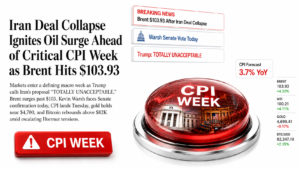

CPI Eve, USD/CAD at 1.3963 & Dow Jones Surges to 50,422 on Iran Ceasefire Optimism | Technical Analysis – US Session | 9 June 2026
CPI Eve, Dow Surges to 50,422 & Gold
Slides as Iran Ceasefire Holds
The US session opens on the eve of Wednesday’s May CPI print — the most consequential single data release before the June 16–17 FOMC meeting — with markets in a fragile equilibrium: equities attempting to stabilise after last week’s tech-led selloff, gold sliding on ceasefire relief, Bitcoin consolidating near $61,000, and the US 30-year yield pushing above 5% on persistent inflation expectations.
The backdrop is unambiguously complex. Iran and Israel agreed to halt attacks, removing the immediate tail risk that had driven Brent crude above $96 over the weekend. Gold, which had surged on safe-haven demand, is now pulling back toward $4,250 — caught between ceasefire-driven risk-on and the persistent reality that US CPI for May is expected to print at 4.2% YoY, the highest since April 2023. The Fed’s June meeting (16–17 Jun) is overwhelmingly expected to hold at 3.50–3.75%, but Wednesday’s CPI number will determine whether December’s implied hike probability — currently at ~40% — accelerates decisively.
Oscar Health (OSCR) is a session standout: shares surged over 10% after options activity exploded and the stock held above recent lows, with Wells Fargo’s June 4 upgrade from underweight to market perform adding institutional credibility to the recovery. Wheat is trading near 588c/bu — an important level that reflects the interplay between Middle East supply chain risk, strong US export commitments running at 9%+ above prior year, and a dollar that has strengthened materially since May. The US 30-year yield at 5.03% reflects the bond market’s demand for term premium in a world of persistent inflation and growing fiscal concerns.
US Session Headlines — 9 June 2026
Market-moving events as New York opens for Tuesday’s session
US Session Data — 9–10 June 2026
Key releases and event risks through this week’s critical Fed-relevant data window
| Time (ET) | Region | Event | Forecast | Previous | Impact |
|---|---|---|---|---|---|
| 10:00 AM | 🇺🇸US | JOLTS Job Openings (Apr) | 7.7M | 7.9M | MEDIUM |
| 10:30 AM | 🇺🇸US | Fed Governor Speech (Waller) | — | — | MEDIUM |
| Wed 08:30 AM | 🇺🇸US | CPI May (YoY / MoM) | 4.2% / +0.5% | 3.8% / +0.6% | CRITICAL |
| Wed 08:30 AM | 🇺🇸US | Core CPI May (YoY) | 2.9% | 2.6% | HIGH |
| Thu 08:30 AM | 🇺🇸US | Initial Jobless Claims | 225K | 219K | MEDIUM |
| Thu 08:30 AM | 🇪🇺Eurozone | ECB Rate Decision (Deposit Rate) | 2.25% (+25bp) | 2.00% | CRITICAL |
| Mon 16–17 Jun | 🇺🇸US | FOMC Rate Decision | 3.50–3.75% (Hold) | 3.50–3.75% | CRITICAL |
US Session Setups — 9 June 2026
Nine instruments; fundamental backdrop, technical levels, and directional bias for the US session and week ahead

Fundamental Backdrop
USD/CAD is at its highest level of 2026, printing 1.3963 as the Bank of Canada–Federal Reserve rate differential sits at 100 basis points in the dollar’s favour. The BoC has been cutting into slower Canadian growth while the Fed has held firm at 3.50–3.75%. Canadian economic headwinds are structural: the domestic economy faces softer labour market conditions, ongoing North American trade policy uncertainty, and a housing market adjustment. The loonie’s only credible support mechanism — oil prices — is now becoming a drag rather than a tailwind: the Iran–Israel ceasefire is easing Brent from its recent highs, reducing the energy sector premium that had been supporting CAD. USD/CAD’s YTD gain of +1.55% understates the dollar’s structural advantage in this rate environment.
Technical Outlook
1.3963 is within striking distance of the 2026 YTD high of 1.3948. A clean break and daily close above 1.3950 opens the door to 1.4000—1.4060, the psychological and technical resistance cluster from November 2025. The immediate support at 1.3900 aligns with the session’s opening range low. The ascending structure from the May low of 1.3493 is intact; pullbacks toward 1.3860—1.3880 should be treated as buying opportunities rather than reversal signals. Tomorrow’s US CPI print is the single largest catalyst: a beat above 4.2% reinforces USD strength and could drive USD/CAD toward 1.4050 intraday.
Session Catalysts
Watch for: (1) Wednesday’s US CPI at 08:30 ET — a beat accelerates USD/CAD toward 1.41; (2) Canadian housing and trade balance data — any miss deepens CAD’s structural underperformance; (3) Crude oil price action — a ceasefire-driven crude selloff below $90 would accelerate the loonie’s decline. The BoC’s next meeting on July 9 is priced to cut again, which would widen the differential to 125bp, providing additional structural support for USD/CAD longs.

Fundamental Backdrop
USD/CHF at 0.7975 continues to reflect the extreme monetary policy divergence between the Swiss National Bank (maintaining a near-zero or 0% rate) and the Federal Reserve (holding at 3.50–3.75%). The franc’s persistent strength is rooted in its safe-haven status: while the Iran–Israel ceasefire has reduced acute geopolitical tension, the structural uncertainty — an unresolved nuclear dispute, fragile Middle East stability — keeps CHF bid even as risk assets recover. The SNB’s interventionist posture historically limits CHF appreciation beyond 0.7700–0.7800 on a sustained basis. The one-month CHF appreciation of 2.46% against the dollar has caused Swiss export sector concern, adding to SNB pressure to jawbone or intervene. The 12-month gain of 3.12% reflects the persistent safe-haven premium.
Technical Outlook
0.7975 sits at the lower end of the June trading range (0.7880–0.8060). The pair reached 0.7800 as recently as early June during the height of US-Iran ceasefire optimism — that level represents a critical support zone and the SNB’s informal pain threshold. Resistance at 0.8060–0.8080 has capped multiple rally attempts this month. The setup favours a range-bound strategy: sell USD/CHF strength toward 0.8060, buy dips toward 0.7900. A clean break below 0.7880 (ceasefire deterioration or dollar weakness scenario) targets 0.7780.
Session Catalysts
Watch for: (1) Any ceasefire deterioration — CHF bid returns aggressively and USD/CHF tests 0.7880 rapidly; (2) US CPI Wednesday — a hot print strengthens the dollar and could push USD/CHF toward 0.8050–0.8080; (3) SNB rhetoric — any intervention language caps CHF appreciation below 0.7800. The pair’s direction this week is almost entirely determined by the risk-on/risk-off calibration from Iran–Israel and Wednesday’s CPI.

Fundamental Backdrop
Gold at $4,266 is in a corrective phase, trading near its lowest level since late March. The 8.76% one-month pullback reflects the dual headwind of rising real yields and reduced geopolitical risk. The December Fed rate hike probability rising to ~40% — up from 14% one month ago after the stronger-than-expected May NFP report (+172K, nearly double consensus) — has driven real yields (nominal yield minus inflation breakeven) materially higher, increasing the opportunity cost of holding the non-yielding metal. The Iran–Israel ceasefire has further reduced the acute safe-haven premium that drove gold from $3,800 in March to near $4,400 at peak panic. The structural YoY gain of 29.83% confirms gold’s longer-term bull market thesis is intact, but the near-term tactical trade is selling rallies toward $4,340–$4,380.
Technical Outlook
Gold’s rejection from the $4,370–$4,400 zone last week established the current corrective structure. Key support at $4,200 (March consolidation zone and 38.2% Fibonacci retracement from the October 2025 low) is the first major structural level. Below that, $4,050–$4,100 represents the prior breakout zone. On the upside, the first meaningful resistance sits at $4,350–$4,380 (last week’s peak demand zone and the declining 10-day EMA). The CPI-driven scenario matrix: a hot print (4.5%+) drives real yields higher and sends gold toward $4,200; a miss (3.8% or below) reduces Fed hike probability and triggers a sharp recovery toward $4,400.
Session Catalysts
Watch for: (1) Wednesday’s CPI — the single most important driver for gold this week; a print above 4.2% is gold-negative, below 3.8% is gold-positive; (2) Iran ceasefire durability — any breakdown in talks re-ignites safe-haven demand; (3) Fed Governor speeches today — any language suggesting December hike probability is rising accelerates gold’s pullback toward $4,200. Position sizing must account for the Wednesday binary: avoid oversized shorts into the CPI print.

Fundamental Backdrop
Wheat at 588c/bu is at a seasonally pressured juncture. Barchart data confirms the daily technical signal as Strong Sell, and the seasonal pattern for CBOT wheat typically produces lows in June–July during Northern Hemisphere harvest pressure before recovering into autumn. However, three countervailing structural supports are preventing a full breakdown: (1) US marketing year wheat shipments are running 9.13% above the prior year as of the June 4 weekly inspections; (2) Black Sea supply disruptions from the prolonged conflict backdrop continue to divert global import demand toward US suppliers; (3) The interplay between wheat and crude oil — with Brent near $96 — has kept transportation and fertiliser input cost inflation elevated, supporting floor prices. The technical structure below 598–600c is firmly bearish, but the geopolitical premium prevents a collapse toward 520–540c without a definitive Middle East resolution.
Technical Outlook
The 598–600c shelf is the critical resistance on a retest of the breakdown. The 2026 high of 617.75c (February 18) represents the maximum upside barrier. On the downside, 554c is the next major support (prior March consolidation low) with 530–535c the structural demand zone representing a full seasonal harvest discount. The current 588c level sits in the upper portion of the near-term range. A short on any rally toward 595–598c aligns with both the seasonal bias and the technical structure. Stop above 610c (reclaim of the 600c shelf).
Session Catalysts
Watch for: (1) Thursday’s USDA Supply & Demand report — any upward revision to US production or ending stocks is wheat-negative; (2) Black Sea weather or shipping disruption headlines — any supply shock can reverse 20–30c rapidly; (3) Crude oil trajectory — if the ceasefire drives Brent toward $88–$90, transportation cost deflation removes a structural wheat floor. The risk/reward on a 595–598c short, targeting 558c with a stop at 612c, is approximately 2:1 — within acceptable parameters.

Fundamental Backdrop
The Dow’s 0.67% advance to 50,422 is a technical relief rally after last week’s sharp selloff — Nasdaq fell 4% in a single session as semiconductor stocks lost over $1 trillion in market cap, and the Broadcom earnings-driven rotation compressed valuations across the tech complex. Today’s broad advance (S&P +0.63%, Nasdaq +0.69%, Russell 2000 +0.77%) confirms this is risk-appetite recovery rather than a fundamental re-rating. The VIX at 16.05 (+1.78%) signals the market is not fully relaxed — uncertainty about tomorrow’s CPI print is keeping option demand elevated. The Dow’s composition — overweight in energy, industrials, and financials versus the Nasdaq’s tech concentration — makes it relatively less exposed to the rate-sensitive tech selloff dynamic, which explains why the Dow’s YTD relative performance vs. Nasdaq has been more resilient.
Technical Outlook
50,422 is a meaningful recovery from last week’s lows. The Dow needs a daily close above 50,500–50,700 to confirm further upside momentum after this session’s strong advance. Key support at 49,800 (the June 5 selloff low when Nasdaq lost 4%) must hold on any post-CPI downside. The 51,500–51,700 zone represents the May high and a prior consolidation top — that is the first meaningful resistance on a CPI-friendly outcome. Avoid directional conviction into tomorrow’s binary: position sizing should be reduced proportionally to account for a potential ±600–800 point Dow range on the CPI release.
Session Catalysts
Watch for: (1) Wednesday CPI — a hot print (4.5%+) would likely send the Dow back toward 49,800–50,000; a miss below 3.8% could trigger a 500–600 point rally; (2) Energy and tech stock behaviour — both sectors continued to underperform into Tuesday’s midday session despite the headline Dow gain; (3) Strategy Inc. Bitcoin selling narrative — if it escalates, it creates broader crypto-equity contagion that could weigh on fintech and digital asset-adjacent Dow constituents.

Fundamental Backdrop
Oscar Health is experiencing a genuine fundamental re-rating, not just a technical squeeze. The catalysts stack convincingly: the Wells Fargo upgrade on June 4 raised the target from $11 to $20 and cited better-than-expected ACA enrollment and medical cost outcomes — two of the key investor concerns that had depressed the stock below $12 in late 2025. Q1 2026 earnings beat expectations materially. The company operates in a sector receiving structural tailwinds: ACA marketplace enrollment is growing, Oscar’s tech-driven claims management platform (+Oscar) is differentiating its cost structure from traditional insurers, and the broader health insurance sector benefits from the 3.50–3.75% rate environment (higher investment yield on float). Insider buy activity of $11.9M vs. $5.1M in sells over three months confirms alignment between management and shareholders.
Technical Outlook
$27.05 is a new 52-week high, breaking above the prior resistance at $25.58. In technical analysis, when a stock breaks out to a new 52-week high on elevated volume and explosive options activity, the breakout is typically treated as valid until reclaimed. The previous 52-week high ($25.58) becomes the first meaningful support on any pullback. $23.00 represents the pre-Wells Fargo upgrade consolidation zone and the institutional stop-loss cluster. On the upside, $30.00 corresponds to the June 12 call options with 731 contracts of open interest — a clear options market magnet. The 86.56% three-month IV implies a ±$4–5 weekly expected move, making the $25.50–$30.00 range plausible this week.
Session Catalysts
Watch for: (1) Any further analyst upgrades — with the stock now trading above most price targets, upgrades and target raises are the catalyst that sustains the momentum; (2) Healthcare policy headlines — ACA enrollment data or any changes to subsidy policy are direct OSCR drivers; (3) Macro sell-off risk — if CPI prints hot Wednesday and equities sell off broadly, OSCR’s high-beta 86.56% IV means it could pullback 8–10% alongside the market. Buy the dip toward $25.50 if the macro selloff creates entry rather than chasing the opening print.

Fundamental Backdrop
Bitcoin’s breach of $60,000 on Friday marked the first time since October 2024 the price had traded below that level, triggering stop-losses and margin calls across the leveraged crypto ecosystem. The catalyst was Strategy Inc. — formerly MicroStrategy — selling a portion of its holdings, which shattered the market narrative that the company would be an unconditional perpetual buyer. At 27% down YTD and ~50% below its all-time high, Bitcoin is in a structural bear market by conventional definitions. However, the Fear & Greed Index near 8 (Extreme Fear) historically represents a contrarian buy signal: extreme fear readings have preceded 30–50% recoveries in previous Bitcoin cycles. Two US spot Dogecoin ETFs are now live, and the broader crypto regulatory environment under SEC Chair Atkins is incrementally more constructive than 2024.
Technical Outlook
$60,000 is now the critical support, defined as the Friday panic low and the prior October 2024 support. A weekly close below $60,000 opens a test of $52,000–$55,000 (the 2024 breakout zone). On the upside, the $68,000 zone represents the broken 2026 consolidation support-turned-resistance (price spent weeks between $68,000–$68,000 before the breakdown). A full recovery to $68,000–$75,000 is the bull case and requires both macro conditions (CPI softening, Fed cut expectations returning) and a fundamental narrative shift (institutional re-accumulation, ETF inflows recovering).
Session Catalysts
Watch for: (1) Wednesday CPI — a soft print reduces rate hike probability and is materially positive for Bitcoin; a hot print increases opportunity cost of non-yielding assets and could send BTC back toward $60,000; (2) Strategy Inc. holding update — any statement on their buying programme re-engagement would be bullish; (3) ETF flow data — if US spot Bitcoin ETF inflows resume after Friday’s outflows, that provides short-term demand support. $54,500 dip-buy with stop $54,500 and target $68,000 offers a 3:1 risk/reward on a CPI-benign scenario.

Fundamental Backdrop
Dogecoin at $0.082 is 88% below its all-time high of $0.7376 (May 2021) and near the lower end of its 2026 trading range. The structural case for DOGE is weaker than for Bitcoin or even XRP. Its unlimited supply (unlike Bitcoin’s 21M cap), proof-of-work consensus mechanism, and lack of smart contract functionality mean DOGE’s value is almost entirely speculative and community/celebrity-driven. The two live spot ETFs (21Shares TDOG on Nasdaq, REX-Osprey DOJE) have not generated the institutional inflow tailwind that Bitcoin and Ethereum ETFs did. The competitive landscape has fundamentally changed since 2021: Solana-based meme coins (Bonk, Popcat and dozens of others) now absorb retail speculative demand that would previously have flowed to DOGE. Elon Musk’s intermittent X/Twitter references remain the primary catalyst risk.
Technical Outlook
The technical picture confirms the fundamental weakness. DOGE is in a sustained downtrend from the 2026 peak of approximately $0.42 (January 2026). The structure is lower highs and lower lows throughout the year. The $0.090 level is a psychological resistance; any rally toward $0.090–$0.100 should be treated as a selling opportunity rather than a breakout signal. Below current levels, $0.055 represents the 2026 market’s Polymarket-implied downside scenario with 60% probability. The $0.050 level is the structural long-term support that represents the pre-2025 meme-coin frenzy baseline.
Session Catalysts
Watch for: (1) Elon Musk X posts — still the number one DOGE catalyst, capable of ±20–30% in hours; (2) X Payments integration news — any confirmed DOGE payment integration within X would be structurally bullish; (3) Broad crypto recovery — if Bitcoin breaks above $70,000, altcoin rotation typically provides a 15–20% DOGE relief rally regardless of fundamentals. The short-side setup: sell $0.090 rally with stop $0.105 and target $0.055 for approximately 2.5:1 risk/reward.

Fundamental Backdrop
The US 30-year Treasury yield at 5.03% reflects three converging pressures: (1) Sticky inflation — April CPI at 3.8% and May expected at 4.2% means the Fed’s 2% target is nowhere in sight, and the market is demanding term premium to compensate for the inflation uncertainty embedded in a 30-year holding period; (2) Fiscal expansion concerns — the US deficit trajectory, combined with Treasury issuance running at record levels, means bond supply is structurally overwhelming near-term demand; (3) Geopolitical energy risk — even with the Iran ceasefire, Brent crude above $96 embeds ongoing energy cost pressure that delays the inflation normalisation necessary for yields to decline sustainably. The 10-year yield at 5.46% and the inverted 10Y–30Y spread of approximately ‑43 basis points shows the market is pricing higher near-term rates but beginning to discount eventual long-run normalisation — though that normalisation is being pushed further out.
Technical Outlook
The 30-year yield approaching and breaking above 5.00% is a significant psychological and technical level. The May FRED average of 4.97% confirms this is a multi-week trend, not a one-day spike. The prior April 10 high of 4.92% is now support. Above 5.00%, the next technical resistance (from a yield perspective) is 5.25% — the post-2025 highs that marked prior yield ceilings. A hot CPI print Wednesday could push 30Y toward 5.15–5.20% in a single session. Short bond duration (sell the 30Y bond futures, equivalently) is the trade aligned with this view, with the 4.80% yield level as the stop (implying the bond price stops at approximately 96 8/32).
Session Catalysts
Watch for: (1) Wednesday’s May CPI — a 4.2%+ print extends the 30Y yield rise toward 5.15–5.20%; a sub-3.8% print could drive a sharp yield correction to 4.85–4.90%; (2) Treasury auction results — any weak bid-to-cover ratio at upcoming auctions amplifies the supply-driven yield widening; (3) Fed Governor Waller’s speech today — any language acknowledging the inflation overshoot or hinting at year-end hike probability rising is yield-positive (bond-negative). The 30-year yield’s behaviour will also set the tone for mortgage rates, equity valuations, and the USD’s carry advantage versus lower-yielding G10 currencies through the summer.
Key Questions for the US Session
Detailed answers to the session’s most important analytical questions
US Session Summary — 9 June 2026
Tuesday’s US session is defined by the countdown to Wednesday’s May CPI print — the most consequential single data release before the June 16–17 FOMC meeting and potentially the catalyst that either validates or dismantles the current market positioning across all nine instruments covered in this brief. The Dow’s +0.67% relief rally, gold’s cautious softening to $4,266, and Bitcoin’s tentative recovery to $60,980 all represent positions taken against a wall of uncertainty that clears at 08:30 ET Wednesday morning. The Iran–Israel ceasefire has removed the most acute tail risk, but with Brent still near $96 and CPI expected to accelerate to 4.2%, the structural inflation problem has not been solved — only the geopolitical acceleration has paused.
The actionable framework for the remainder of the US session demands stratification by conviction and time horizon. Highest conviction: USD/CAD long toward 1.4020–1.4080 — the BoC–Fed divergence is structural, CAD lacks oil support in a war-premium crude environment, and technical momentum is clearly upward. Second highest: US 30Y yield targeting 5.25% — the fiscal, inflation, and supply dynamics supporting higher long-end yields are durable and CPI-independent. Oscar Health at $27.05 is the session’s most asymmetric single-stock opportunity on a pullback basis: buy $25.50 rather than chasing the gap, with conviction that the ACA cycle re-rating is early-stage.
In crypto, Bitcoin at $54,500 dip-buy is a CPI-contingent trade — do not initiate before Wednesday’s 08:30 ET data unless you are comfortable holding through the binary. Dogecoin at $0.082 remains structurally challenged, and the $0.090 level provides the cleanest short entry. Gold’s tactical bearishness resolves through $4,200 support before the medium-term accumulation opportunity presents itself. The single most important instruction for the US session: reduce position sizing across all instruments proportionally to account for the CPI binary at 08:30 ET Wednesday. The expected range expansion across gold, Bitcoin, Dow, and USD/CAD on the CPI print is materially larger than a standard session move — appropriate risk management demands you survive the number before adding directional conviction.
Access Live US Markets →