Market Overview: Major currency pairs are trading cautiously as investors are positioning ahead of key U.S. economic releases — including the advance Q4 GDP report and the Core PCE Price Index — while global PMI data is also generating selective FX moves. The US Dollar is remaining firm near a three-week high after the January FOMC minutes are signalling that policymakers see little urgency to cut rates. ECB leadership uncertainty is capping EUR/USD upside, stronger UK Retail Sales are providing GBP/USD a floor, BOJ rate hike expectations are keeping USD/JPY gains in check, and weaker Australian PMI data is pressuring AUD/USD despite its medium-term bullish structure.
| Symbol | Bid | Ask | Spread |
|---|
| EUR/USD | 1.17554 | 1.17563 | 0.00009 |
| GBP/USD | 1.34599 | 1.34600 | 0.00001 |
| USD/JPY | 154.921 | 154.929 | 0.00800 |
| AUD/USD | 0.70478 | 0.70487 | 0.00009 |
Forex
EUR/USD Euro / US Dollar
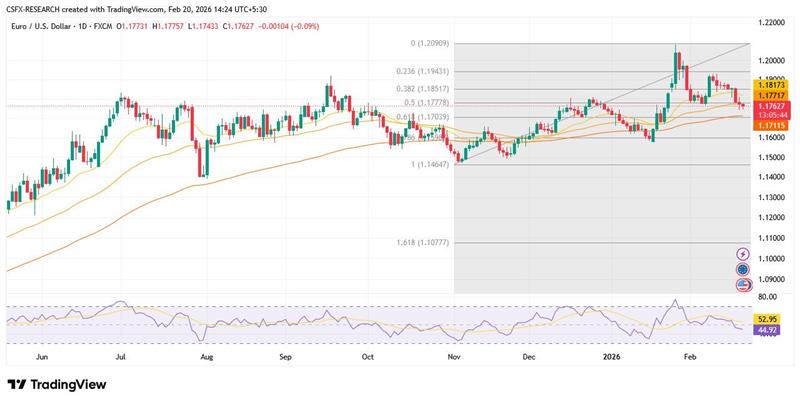
EUR/USD is trading sideways above 1.1750 as markets are remaining cautious ahead of U.S. PCE, GDP data, and Eurozone PMI figures.
🏦 ECB Leadership Uncertainty
📊 U.S. PCE & GDP Release
🇩🇪 German PMI Data
🇪🇺 Eurozone Disinflation
🇺🇦 Russia–Ukraine Ceasefire Talks
The EUR/USD pair is trading sideways around 1.1770 in early European dealings on Friday, with the Euro’s upside being capped by growing speculation over leadership changes at the European Central Bank. According to a Financial Times report, ECB President Christine Lagarde may be stepping down before completing her eight-year term. Analysts are noting that an early exit could give French President Emmanuel Macron and German Chancellor Friedrich Merz the opportunity to influence the choice of successor ahead of France’s April 2027 presidential election — a development that is injecting policy uncertainty into EUR pricing.
Meanwhile, the broader macro backdrop is also weighing on the pair. Russia–Ukraine ceasefire negotiations are progressing but are generating mixed signals — with European nations increasing defence spending commitments, which is adding fiscal pressure to EU budgets and complicating the ECB’s rate-cutting path. The Eurozone is also grappling with sticky core services inflation even as headline CPI is cooling, limiting the ECB’s room to cut as aggressively as markets are hoping. Preliminary Eurozone and German PMI data are due today, with a reading below expectations risking a further EUR selloff. On the USD side, the FOMC January minutes are reaffirming that the Fed is in no hurry to cut, keeping the Dollar supported.
Exponential Moving Averages
EMA 101.1817 ▼ Bearish
EMA 201.1817 ▼ Bearish
EMA 501.1773 ▼ Bearish
Simple Moving Averages
SMA 101.1844 ▼ Bearish
SMA 201.1856 ▼ Bearish
SMA 501.1771 ▼ Bearish
Momentum Oscillators
RSI (14)44.33 — Neutral Zone
Stochastic9.18 — Sell Zone
Overall Signal
SentimentBearish ▼
DirectionSELL
| Level | R2 | R1 | S1 | S2 |
|---|
| Price |
1.2150 |
1.2030 |
1.1640 |
1.1520 |
Entry (Limit Sell)1.1789
Take Profit1.1698
Stop Loss1.1846
Direction⬇ SELL
Bearish Full MA bearish crossover — ECB uncertainty & USD strength are compounding selling pressure.
Forex
GBP/USD Pound Sterling / US Dollar
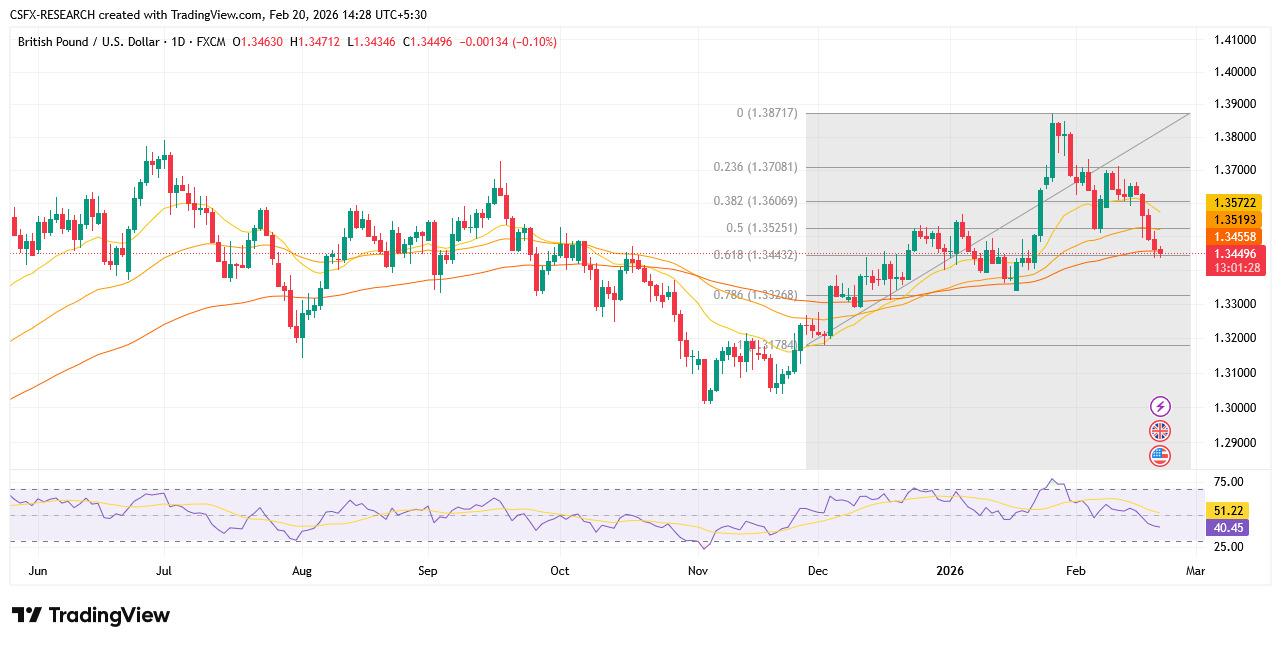
GBP/USD is rebounding from early declines, supported by stronger-than-expected UK Retail Sales data — though the broader bias is remaining to the downside.
🇬🇧 UK Retail Sales Beat
🏦 BOE Dovish Pivot Bets
📊 UK Flash PMI — Feb
🇺🇸 USD at 3-Week High
🤝 UK–EU Trade Relations
Pound Sterling is recovering early losses and is trading broadly flat near 1.3460 against the US Dollar during Friday’s European session. GBP/USD is drawing support from stronger UK Retail Sales data for January. The Office for National Statistics is reporting that Retail Sales rose an unexpected 1.8% month-on-month, accelerating from December’s 0.4% gain and well above forecasts of just 0.2%. On an annual basis, sales are jumping 4.5%, exceeding expectations of 2.8%.
However, the Bank of England is maintaining its cautious dovish pivot, with markets pricing in 75 basis points of cuts through 2026. Growing fears around the UK economic growth outlook — with the IMF recently trimming its UK 2026 GDP forecast — are limiting Sterling’s upside. Meanwhile, the evolving UK–EU trade reset, as the UK is seeking to renegotiate elements of the post-Brexit Trade and Cooperation Agreement, is adding a degree of political uncertainty. Investors are now watching February’s flash S&P Global PMI data due at 09:30 GMT, with the UK Composite PMI expected to ease to 53.4 from 53.7. The US Dollar Index is trading near 98.00 — close to its nearly four-week high — is capping any meaningful GBP recovery.
Exponential Moving Averages
EMA 101.3553 ▼ Bearish
EMA 201.3573 ▼ Bearish
EMA 501.3522 ▼ Bearish
Simple Moving Averages
SMA 101.3583 ▼ Bearish
SMA 201.3639 ▼ Bearish
SMA 501.3527 ▼ Bearish
Momentum Oscillators
RSI (14)40.34 — Neutral Zone
Stochastic4.45 — Sell Zone
Overall Signal
SentimentBearish ▼
DirectionSELL
| Level | R2 | R1 | S1 | S2 |
|---|
| Price |
1.3956 |
1.3832 |
1.3432 |
1.3308 |
Entry (Limit Sell)1.3509
Take Profit1.3396
Stop Loss1.3587
Direction⬇ SELL
Bearish All MAs are in negative crossover — retail sales beat is providing only temporary relief.
Forex
USD/JPY US Dollar / Japanese Yen
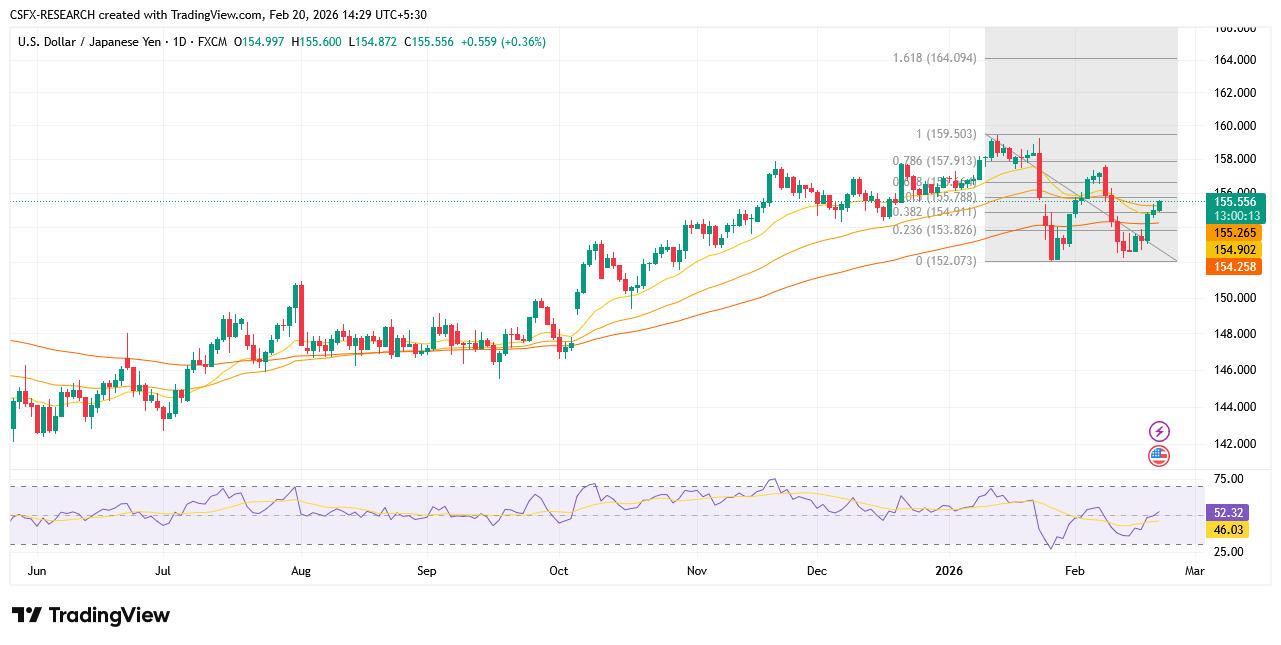
The Japanese Yen is staying under pressure against the US Dollar as Japan’s National CPI is showing signs of cooling — limiting BOJ rate hike urgency.
🏦 BOJ Rate Hike Expectations
📊 Japan CPI — Cooling Signals
🇺🇸 FOMC — No Rush to Cut
🛡 Japan Defense Spending Surge
🇯🇵 MOF FX Intervention Risk
The Japanese Yen is remaining on the defensive against the US Dollar during Friday’s European session, with USD/JPY holding near its weekly peak of 155.20 set on Thursday. The pair is staying supported as the Greenback is continuing to outperform, following signals from the FOMC January meeting minutes that policymakers see little urgency to cut interest rates with inflation still running above the Federal Reserve’s 2% target. The US Dollar Index is trading close to 98.00, hovering near a fresh three-week high.
On the Japanese side, the National Consumer Price Index is posting a moderate increase in January, but the pace of inflation is cooling at the margin — tempering expectations for near-term BOJ rate hikes. However, the Bank of Japan is holding a structurally hawkish bias, and markets are pricing at least one additional 25-basis-point hike in 2026. Japan’s government is also significantly expanding its defence budget — with defence spending approaching 2% of GDP — which is increasing JGB issuance and marginally pressuring Japanese bonds, providing a complex backdrop for Yen positioning. The Ministry of Finance (MOF) is remaining on verbal intervention watch, with officials having previously acted to curb Yen weakness when USD/JPY approached 160.00.
Exponential Moving Averages
EMA 10154.571 ▲ Bullish
EMA 20154.912 ▲ Bullish
EMA 50155.292 ▲ Bullish
Simple Moving Averages
SMA 10154.099 ▲ Bullish
SMA 20154.545 ▲ Bullish
SMA 50155.979 ▼ Bearish
Momentum Oscillators
RSI (14)52.24 — Buy Zone
Stochastic52.23 — Neutral
Overall Signal
SentimentBullish ▲
DirectionBUY
| Level | R2 | R1 | S1 | S2 |
|---|
| Price |
159.98 |
158.25 |
152.62 |
150.89 |
Entry (Limit Buy)154.68
Take Profit156.58
Stop Loss153.78
Direction⬆ BUY
Bullish Mostly bullish MA alignment — watch MOF verbal intervention risk near 157–158.
Forex
AUD/USD Australian Dollar / US Dollar
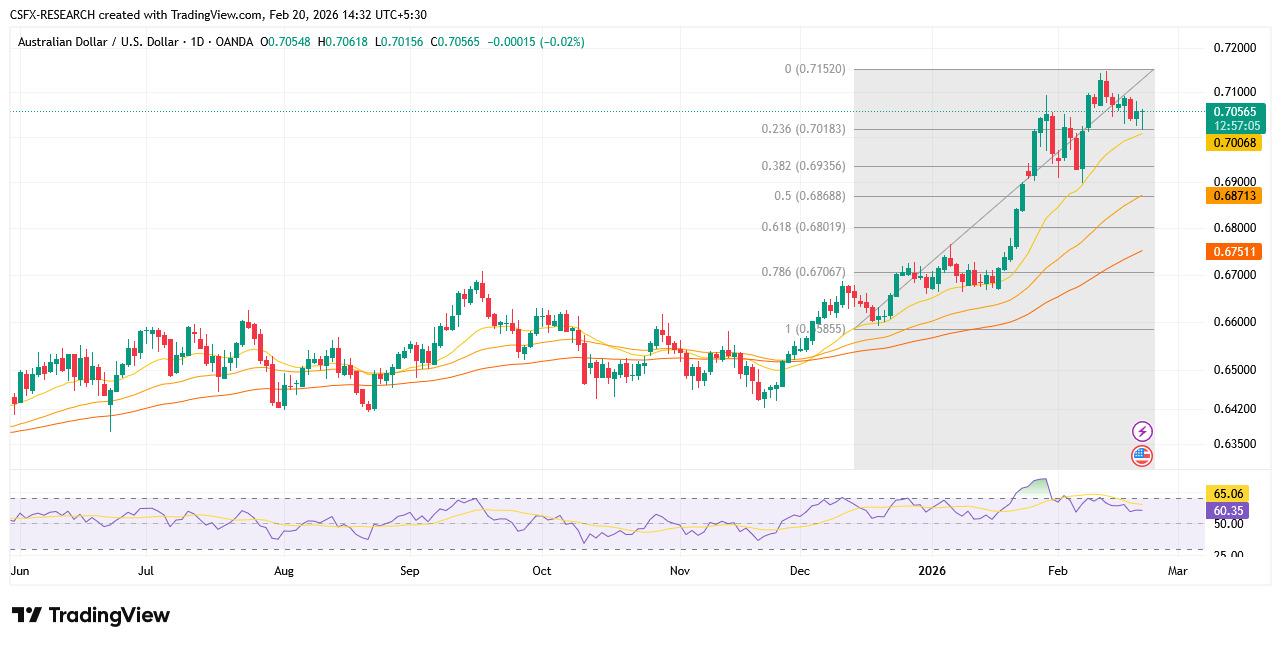
The Australian Dollar is staying under pressure after softer-than-expected S&P Global PMI data is dampening business activity sentiment.
🇦🇺 Australia PMI — 52.0 in Feb
🇨🇳 China Demand Outlook
🏦 RBA Rate Cut Speculation
⛏ Iron Ore & Commodity Exports
🇺🇸 U.S. Jobless Claims Beat
The Australian Dollar is remaining under pressure against the US Dollar during Friday’s European session, with AUD/USD hovering around 0.7040 after surrendering the previous session’s gains. The Aussie is weakening after preliminary February PMI figures from S&P Global are pointing to a broad cooling in business activity. Australia’s Composite PMI is falling to 52.0 in February from 55.7 in January — marking seventeen straight months of expansion but at a more subdued pace. The Services PMI is easing to 52.2 from 56.3, and the Manufacturing PMI is slipping to 51.5 from 52.3.
AUD/USD is also facing structural headwinds from China’s uneven economic recovery. China is Australia’s largest trading partner, and softer Chinese manufacturing PMI data is raising concerns about demand for Australian iron ore, coal, and LNG exports. The Reserve Bank of Australia is facing growing calls to cut rates as domestic growth is softening, though persistent wage inflation is complicating the calculus. A weaker-than-expected U.S. PCE reading today could provide the Aussie temporary relief by softening the Dollar. Conversely, USD strength on the back of firm GDP data could push AUD/USD back below the 0.7000 psychological support level.
Exponential Moving Averages
EMA 100.7053 ▲ Bullish
EMA 200.7005 ▲ Bullish
EMA 500.6871 ▲ Bullish
Simple Moving Averages
SMA 100.7076 ▼ Bearish
SMA 200.7031 ▲ Bullish
SMA 500.6830 ▲ Bullish
Momentum Oscillators
RSI (14)60.51 — Neutral Zone
Stochastic61.91 — Neutral
Overall Signal
SentimentBullish ▲
DirectionBUY (Dip)
| Level | R2 | R1 | S1 | S2 |
|---|
| Price |
0.7173 |
0.7071 |
0.6742 |
0.6640 |
Entry (Limit Buy)0.7025
Take Profit0.7122
Stop Loss0.6986
Direction⬆ BUY
Bullish Medium-term EMAs intact — near-term softness is offering potential buy-the-dip opportunity at 0.7025.
📊 Elsewhere in Forex Markets
🗓 Key Economic Events — Today
| Currency | Event | Forecast | Previous | Time (GMT) |
|---|
| USD | Core PCE Price Index MoM (Dec) | 0.3% | 0.2% | 19:00 |
| USD | GDP (QoQ) Q4 — Advance | 2.8% | 4.4% | 19:00 |
| USD | New Home Sales (Dec) | 732K | 737K | 20:30 |
| GBP | Flash Composite PMI (Feb) | 53.4 | 53.7 | 09:30 |
| EUR | Flash Composite PMI — Eurozone (Feb) | — | — | 10:00 |
Trade Major FX Pairs with Capital Street FX
EUR/USD, GBP/USD, USD/JPY, AUD/USD — all with ultra-tight spreads from 0.0 pips and leverage up to 1:10,000.
Open Live Account
Try Free Demo
Frequently Asked Questions — Forex Market
Why is EUR/USD struggling to hold above 1.18 in 2026?
EUR/USD is facing headwinds from two sides. On the Euro side, speculation that ECB President Christine Lagarde may step down early is creating policy uncertainty, and Eurozone growth is underperforming. The ECB is expected to cut rates further but the pace is uncertain. On the Dollar side, the Federal Reserve is maintaining a higher-for-longer bias after the January FOMC minutes signalled little urgency to ease, with the Dollar Index hovering near multi-week highs. The combination of ECB rate-cut expectations and Fed patience is creating a negative spread dynamic for EUR/USD.
What is causing the British Pound (GBP/USD) to weaken despite strong Retail Sales?
While UK Retail Sales are surprising to the upside — rising 1.8% MoM vs a 0.2% forecast — the Pound is being undermined by the broader USD strength narrative and Bank of England dovish pivot expectations. The BOE is expected to cut rates by up to 75 basis points through 2026 as UK growth is slowing. Additionally, the UK Composite PMI is expected to ease in February, and ongoing UK–EU trade renegotiation uncertainty is weighing on sentiment. The retail sales data is providing only short-term GBP support against the structural USD tailwind.
Is the Bank of Japan going to raise rates again in 2026 — and what does that mean for USD/JPY?
The BOJ is maintaining a gradual tightening bias and markets are pricing at least one additional 25 basis point hike in 2026. However, the pace of Japanese inflation is cooling at the margin, which is reducing near-term urgency. If the BOJ signals a hike, USD/JPY could pull back sharply from current levels near 155. Conversely, if U.S. data today confirms Fed rate resilience, USD/JPY could push toward 157–158 — where the Ministry of Finance has previously warned about intervention risk. Traders are watching both the BOJ’s rhetoric and U.S. economic releases very closely.
Why is AUD/USD bullish medium-term but under pressure short-term?
AUD/USD is experiencing a divergence between its medium-term and short-term outlooks. Medium-term, the Australian Dollar is supported by a commodities supercycle (supported by green energy transition demand for metals), a structurally hawkish RBA relative to many peers, and Australia’s improving current account position. Short-term, softer February PMI data, China growth concerns, strong U.S. economic data, and a firmer Dollar are applying downward pressure. The Limit Buy suggestion at 0.7025 is targeting this near-term dip within the broader bullish medium-term channel.
How does the U.S. Core PCE data impact forex markets?
The Core PCE Price Index is the Federal Reserve’s preferred measure of inflation. A reading above the 0.3% forecast would reinforce the “higher for longer” narrative, strengthening the US Dollar broadly — pushing EUR/USD and GBP/USD lower while lifting USD/JPY. A softer reading (below 0.2%) could reignite Fed rate-cut expectations, weakening the Dollar and potentially triggering a EUR/USD and AUD/USD bounce. Given the market’s current positioning close to key Dollar support levels, today’s PCE release carries outsized event risk for FX markets.
What is Capital Street FX’s leverage for forex trading and which account is best?
Capital Street FX is offering leverage of up to 1:10,000 across all account types. For forex trading, the Zero account (minimum $5,000) is offering 0.0 pip spreads with no commissions — ideal for active and high-frequency traders. The Classic account ($200 minimum) offers 0.8 pip spreads and EA builder access. The Professional account ($1,000 minimum) is offering custom spreads, API trading access, and swap-free options. All accounts include negative balance protection and access to 2,000+ instruments.
Risk Disclaimer: This daily FX analysis is produced by Capital Street FX for informational purposes only and does not constitute investment advice or a solicitation to trade. Forex and CFD trading involves significant risk of loss and may not be suitable for all investors. Leverage can amplify both profits and losses. Past performance is not a reliable indicator of future results. All trade suggestions are illustrative only and should not be acted upon without independent analysis and appropriate risk management. Capital Street FX accepts no liability for any trading losses arising from the use of this report.