Executive Summary: Global equity markets are entering the week of 21 February 2026 with heightened sensitivity to interest rate expectations, bond yield movements, and corporate earnings guidance. The macro backdrop has shifted materially following the Supreme Court’s February 20 ruling striking down IEEPA-based tariffs — triggering a relief rally that saw the S&P 500 gain 0.6%, the Nasdaq climb 0.8%, and the Dow add 0.3%. However, the week is not without its tensions: Q4 2025 GDP came in at a disappointing 1.4%, core PCE inflation is holding at a sticky 3%, and President Trump has immediately countered the ruling by announcing a new 10% global tariff via executive order. Investor sentiment remains finely balanced between Fed rate cut optimism and persistent inflation caution, with this week’s PPI (Friday), Consumer Confidence (Tuesday), and Trump speaking (Wednesday) carrying outsized event risk for all major indices.
Index Snapshot — 21 Feb 2026 S&P 500
6,881
▲ +0.6% SCOTUS Relief Rally
Nasdaq 100
~24,850
▲ +0.8% — 5-Week Losing Streak Ends
Dow Jones
49,662
▲ +0.3% — Near 50K Resistance
S&P 500 EPS Forecast
$305
2026 earnings estimate — up from $275 in 2025
Fed Rate Cuts Priced
3 × 25bp
Jun / Sep / Dec 2026 easing cycle
Core PCE — Sticky Inflation
3.0%
Keeping Fed on data-dependent path
🌍 Macro & Geopolitical Context 📊 Macro Intelligence
Key Forces Shaping Global Equity Markets This Week
Understanding the structural drivers behind index direction — SCOTUS ruling, Fed path, AI earnings cycle, tariff policy uncertainty
🏛️ SCOTUS IEEPA Ruling — 20 Feb 2026: The US Supreme Court ruled that IEEPA-based reciprocal tariffs are unconstitutional, with models estimating $175 billion in tariff refunds. The effective tariff rate is falling from a peak of 7.7% to approximately 4.5%. The decision sparked a relief rally — Amazon surged 2% on reduced import cost expectations, Alphabet gained nearly 4%, and trade-sensitive industrials outperformed. However, President Trump immediately announced a new 10% global tariff via executive order, meaning the policy environment remains volatile and binary-risk-intensive for equities.
🤖 AI Earnings & Capex Watch: The Nasdaq’s performance continues to pivot around AI infrastructure spending narratives. Meta announced it will use millions of Nvidia chips in its data centre buildout, sending Nvidia shares up 1.6%. Amazon’s stock has recovered after shedding roughly 18% between Feb 2–14 following its $200 billion capex guidance — nearly 60% above Wall Street expectations. The market is now wrestling with a key 2026 question: when does AI capex translate into AI earnings? Companies that can demonstrate AI monetisation are expected to lead the next leg of the bull market.
The Federal Reserve remains the single most important macro variable for US equities. Markets are pricing three 25bp rate cuts in 2026 — June, September, and December — but the data dependency of the Fed’s path is creating elevated sensitivity to each inflation print. Q4 2025 GDP grew only 1.4%, well below expectations, while core PCE is holding at 3% — a combination that is keeping the Fed in a difficult position between supporting growth and controlling inflation. Fed Chair Powell’s term expires in May 2026, and President Trump’s stated intention to appoint a new chair is adding institutional uncertainty to an already complex macro backdrop.
Global macro signals are sending mixed messages to equity markets. US equity valuations remain historically stretched — the Shiller CAPE ratio sits near 39 against a long-run average of approximately 17 — meaning the market requires near-perfect execution from both the economy and corporate earnings to justify current price levels. Wall Street consensus remains constructive: Morgan Stanley is targeting 7,800 for the S&P 500 by year-end 2026 (approximately 14% upside), while Deutsche Bank and Oppenheimer are forecasting 8,000 and 8,100 respectively. But with Q4 GDP disappointing and a new 10% global tariff executive order issued, the margin for error is thin.
🏛️ SCOTUS IEEPA Ruling — Tariff Refund $175B 📉 Q4 GDP: 1.4% — Below Expectations 🔥 Core PCE: 3% — Sticky Inflation 🏦 Fed: 3× 25bp Cuts Priced 2026 🤖 AI Capex Boom — Nvidia, Meta, MSFT 📋 New 10% Global Tariff EO — Trump 📊 S&P 500 EPS $305 Forecast 2026 ⚠️ Shiller CAPE ~39 — Elevated Valuations
🎯 Wall Street S&P 500 Year-End 2026 Targets
Morgan Stanley
7,800
+14% upside
RBC Capital
7,750
+13% upside
Deutsche Bank
8,000
+16% upside
Oppenheimer
8,100
+18% upside
Index Deep Dives 📈 US Large Cap
S&P 500 Weekly Outlook SPX / US500
Valuation sensitivity to rates persists as the index navigates the dual forces of AI earnings optimism and sticky inflation headwinds
💵 3× Fed Rate Cuts Priced — Valuation Support 📊 EPS $305 Forecast — 11% Growth 🏛️ SCOTUS Relief Rally — Tariff Refund 🔥 Core PCE 3% — Rate Risk Elevated ⚠️ CAPE Ratio ~39 — Thin Margin for Error 🤖 Mag 7 AI Earnings Cycle
⚠️ Valuation Risk: The S&P 500’s forward earnings yield is trading near parity with the 10-year US Treasury — an equity risk premium of approximately 0.02%, among the lowest on record. This near-zero spread means equity investors are not being adequately compensated for the volatility they are accepting. Any earnings disappointment, inflation surprise, or Fed hawkish pivot could trigger a meaningful de-rating from current levels.
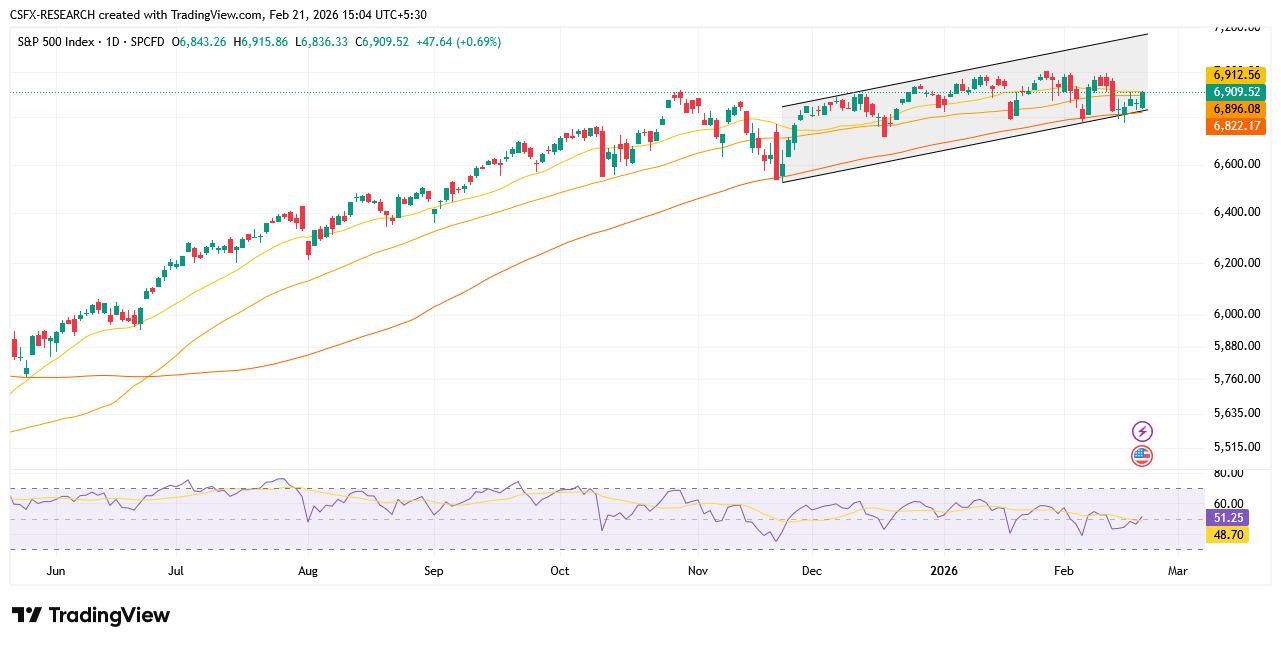
The S&P 500 is remaining supported by resilient earnings expectations and strong large-cap participation, with the index settling at 6,881 following Wednesday’s session — gaining 0.56% as technology names including Nvidia (+1.6%) and Amazon (+2%) drove upside. The SCOTUS ruling on February 20 providing a further 0.6% intraday pop, though the immediate White House counter-move of a new 10% global tariff executive order is quickly moderating the relief. The index is trading within its near-term technical range, with the critical 7,000 psychological resistance level acting as the near-term ceiling for the bull case.
Earnings are continuing to do the heavy lifting for the S&P 500’s structural case. S&P 500 EPS is forecast to reach $305/share in 2026 — up approximately 11% from $275 in 2025 — with eight of eleven sectors expected to post higher earnings growth rates than last year. However, Amazon’s selloff of approximately 18% over February 2–14 is serving as a cautionary tale: the market is now scrutinising AI capex commitments more aggressively, and companies that cannot demonstrate a clear path from AI spending to AI revenue are facing severe valuation punishment. This dynamic is making Q1 2026 earnings season — which begins in April — a potentially high-stakes inflection point.
The near-term macro watch list for the S&P 500 is concentrated around two variables: the pace of Fed rate cuts and the trajectory of core inflation. With core PCE holding at 3% and the Fed on a data-dependent path, Friday’s PPI print carries outsized significance — a reading above expectations could temporarily restrain rate cut pricing and pressure the index toward the 6,741 lower support zone, while a softer print could provide the clear macro green light for a continuation toward 7,000.
| Level Type | R2 | R1 | S1 | S2 |
|---|
| Price (SPX) | 7,000 | 6,919 | 6,833 | 6,741 |
Cautiously Bullish Earnings strength and rate cut pricing are supporting the bull case, but thin risk premium and sticky inflation are limiting conviction. A break above 6,919 targets the 7,000 psychological level. Watch Friday’s PPI as the week’s binary catalyst.
💻 US Growth / Tech
Nasdaq 100 Weekly Outlook NDX / NAS100
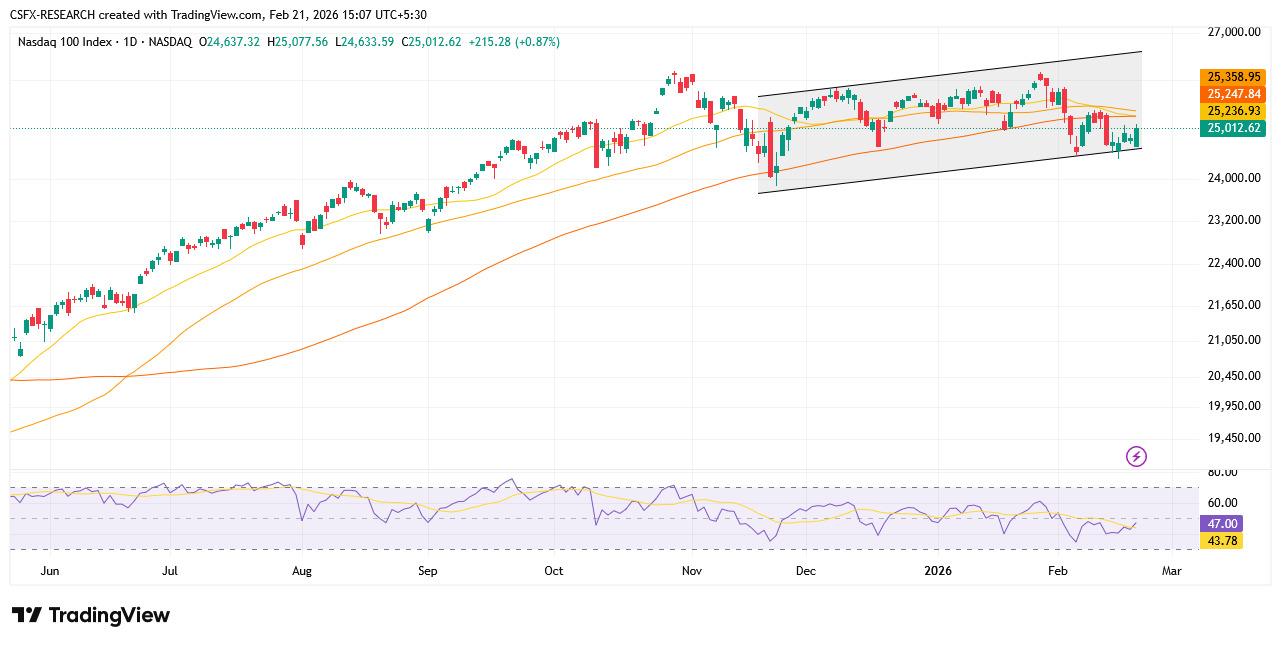
Growth stocks are most sensitive to yield moves — the Nasdaq snapped a five-week losing streak on the SCOTUS ruling as AI capex narratives collide with earnings scrutiny
🤖 AI Capex Boom — Nvidia / Meta / MSFT 📉 5-Week Losing Streak Snapped 📊 Yield-Sensitive — Duration Risk High 🏛️ SCOTUS Relief — Amazon +2% ⚠️ Amazon -12.9% YTD — Capex Scrutiny 🔋 Magnificent Seven Rotation Risk
🔎 Magnificent Seven Watch: The Nasdaq’s performance remains disproportionately driven by the Magnificent Seven mega-caps. Nvidia is continuing its march higher on AI chip demand. Microsoft is delivering steady AI monetisation through Azure. Meta’s announcement of millions of Nvidia chips for data centres is reinforcing the AI capex cycle. Amazon, however, has recovered only partially from its 18% selloff — the market’s reaction to its $200B capex guidance is a key signal that AI spending ambition without near-term AI revenue visibility is no longer being rewarded automatically.
The Nasdaq 100 is remaining the most interest-rate-sensitive of the major US indices — its heavy weighting toward growth and technology stocks means that every basis point of change in US Treasury yields translates directly into valuation adjustments across its largest constituents. Recent price action is showing continued demand on pullbacks, with the index successfully holding above the 24,628 support level, but upside momentum has been meaningfully moderated by the five-week losing streak that the SCOTUS ruling only partially arrested.
The earnings optimism narrative for the Nasdaq is continuing to build for 2026, but with important nuance. Dan Ives at Wedbush Securities is maintaining an extremely bullish posture on AI beneficiaries — particularly Nvidia, Microsoft, Apple, Tesla, and Palantir. Goldman Sachs chief strategist Peter Oppenheimer has noted that despite high valuations, investor optimism driven by AI and easing narratives has the potential to drive further multiple expansion in an “optimism phase” of bull markets. However, with the Nasdaq now entering a period of elevated valuation scrutiny following Amazon’s punishing selloff, the index is increasingly bifurcating between AI monetisers (rewarded) and AI spenders (penalised).
The key near-term catalyst for the Nasdaq this week is Thursday’s Initial Jobless Claims and Friday’s US PPI. A PPI surprise to the upside would likely push real yields higher, applying the most pressure to growth stocks given their longer-duration profile. The 10-year Treasury yield trajectory is the single most important external variable for Nasdaq traders this week, with a sustained break below 4.2% required to provide a clear fundamental green light for the next upside leg.
| Level Type | R2 | R1 | S1 | S2 |
|---|
| Price (NDX) | 26,115 | 25,331 | 24,628 | 23,876 |
Conditionally Bullish Five-week losing streak snapped but conviction is conditional on yield direction. A break above 25,331 opens the path toward 26,115. Monitor the 10-year Treasury yield as the primary real-time indicator. Friday PPI is the week’s decisive catalyst.
🏭 US Value / Industrials
Dow Jones Weekly Outlook DJIA / US30
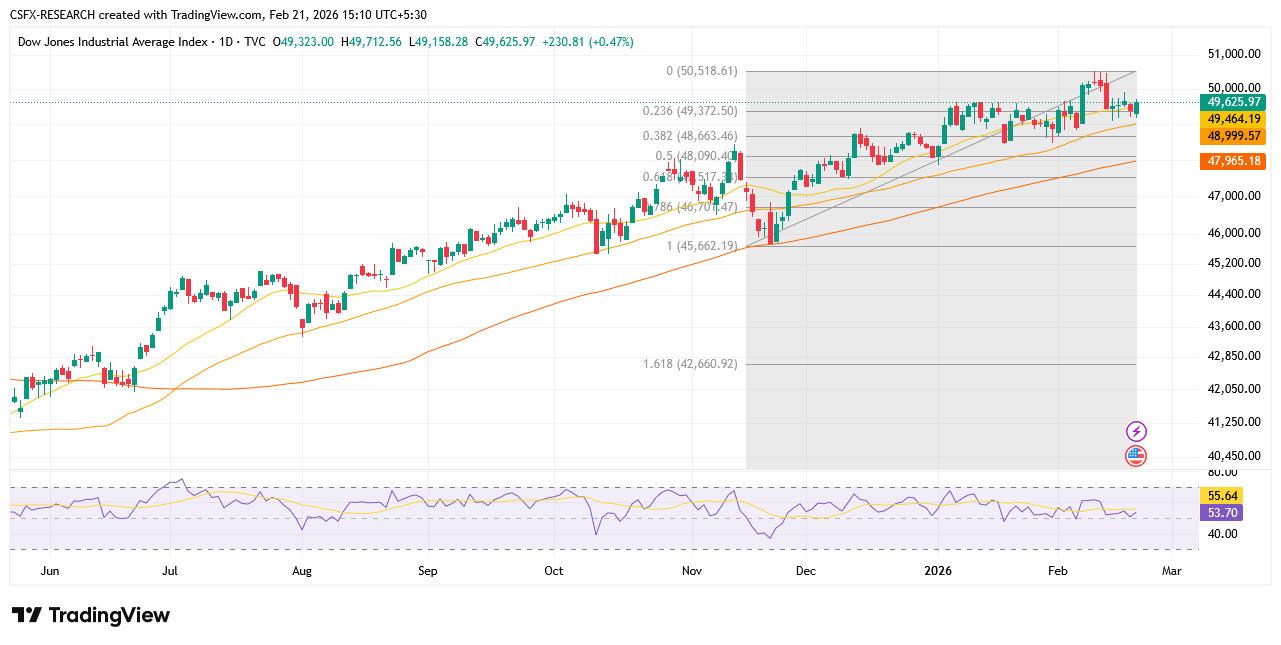
Defensive rotation is providing relative stability near the 50,000 psychological threshold — the Dow’s value tilt offers relative insulation from yield volatility
🏭 Industrial Sector — Tariff Ruling Beneficiary ⚖️ Defensive Tilt — Lower Duration Risk 📊 Near 50,000 Psychological Resistance 💊 Healthcare / Financials — Value Rotation 🌍 Global Growth — Demand Sensitivity 📉 Q4 GDP 1.4% — Growth Uncertainty
The Dow Jones Industrial Average is demonstrating relative stability compared to its growth-heavy counterparts, settling at 49,662 following Wednesday’s session — a modest gain of 129 points (0.26%). The index is approaching the psychologically significant 50,000 level, a threshold that has attracted significant media and trader attention. The Dow’s relative resilience reflects its stronger weighting toward industrials, healthcare, and financial services — sectors that benefit from economic normalisation but are less dependent on AI multiple expansion for their valuations.
The SCOTUS tariff ruling is providing the Dow’s industrial components with a particularly meaningful tailwind. Industrial companies and manufacturers across the DJIA are direct beneficiaries of lower import costs and reduced supply chain friction. However, President Trump’s rapid counter-response — announcing a new 10% global tariff via executive order within hours of the court ruling — is creating a binary policy environment that makes sustained positioning difficult. The Dow is responding to the net of these two forces: the structural relief of the court ruling slightly outweighs the incremental uncertainty of the new executive order, but the margin is narrow.
The soft-landing narrative is the central pillar for the Dow’s constructive medium-term outlook. If Q4’s 1.4% GDP growth proves to be a transitory weakness driven by the government shutdown rather than structural economic deterioration, and if the Fed successfully delivers its first rate cut by June, the Dow’s value orientation should benefit from an improving earnings backdrop across its more cyclically-sensitive constituents. This week’s Consumer Confidence reading (Tuesday) is a critical data point — it will signal whether the American consumer remains resilient despite the uncertainty around tariffs and Fed policy.
| Level Type | R2 | R1 | S1 | S2 |
|---|
| Price (DJIA) | 50,620 | 49,867 | 49,124 | 48,448 |
Relatively Stable The Dow’s defensive and industrial tilt is offering relative protection. A break above 49,867 targets 50,620 — the first sustained close above 50K would be a significant psychological milestone. Consumer Confidence Tuesday is the near-term catalyst; PPI Friday is the week’s decisive macro signal.
📊 Overall Equity Market View — Week of 21 February 2026
Global equity markets are remaining in a finely balanced macro environment this week, with the outcome of the SCOTUS tariff ruling, the persistence of sticky inflation, and the unfolding trajectory of AI earnings all pulling simultaneously in different directions. The relief rally triggered by the court ruling is constructive — but the immediate executive order counter-response from the White House ensures that tariff policy uncertainty remains an active binary risk for all indices. Traders should not mistake a one-day SCOTUS rally for a structural resolution of trade policy uncertainty.
The S&P 500 is best positioned for a gradual grind toward 7,000 if PPI comes in soft on Friday — confirming the disinflationary trend and validating the three-cut Fed path. The Nasdaq 100 is the most binary of the three indices: a PPI surprise to the upside would apply disproportionate pressure to growth stocks given their duration sensitivity, while a cool print could trigger a meaningful recovery rally given the crowded short positioning that built during the five-week losing streak. The Dow continues to function as the relative safe harbour, with its industrial components benefiting from the SCOTUS ruling and its value orientation insulating it from the worst of yield volatility.
Across all three indices, the week’s primary binary event is Friday’s US PPI. Secondary catalysts include Tuesday’s Consumer Confidence reading as a demand signal, and President Trump’s Wednesday speech — which carries acute headline risk following the tariff executive order. The AI capex-to-earnings narrative will continue to evolve in the background, with any Nvidia-related headline carrying outsized potential to move the Nasdaq in particular.
🗓 Key Economic Events This Week — Index Impact
| Currency | Event | Day | Index Impact |
|---|
| NZD | Retail Sales (QoQ) — Q4 | Monday | Risk sentiment indicator — minor |
| USD | CB Consumer Confidence (Feb) | Tuesday | High — Demand outlook → All US indices |
| AUD | CPI (QoQ & YoY) — January | Wednesday | Medium — Global inflation read → Risk tone |
| USD | President Trump Speaks | Wednesday | High — Tariff EO headlines → All indices binary risk |
| EUR | German GDP (QoQ) — Q4 | Wednesday | Medium — Global growth → Risk appetite |
| EUR | Eurozone CPI (YoY) — January | Wednesday | Medium — ECB policy → EUR/USD → Global risk |
| USD | Initial Jobless Claims | Thursday | Medium — Labour market health → Fed expectations |
| CHF | Swiss GDP (QoQ) — Q4 | Friday | Low — Global growth peripheral signal |
| EUR | German CPI (MoM) — February | Friday | Medium — European inflation → ECB easing pace |
| USD | PPI (MoM) — January | Friday | HIGH — KEY: Inflation → Real yields → All indices |
📊 Broader Market & Sector Snapshot
S&P 500
▲ 6,881 — SCOTUS Relief
Nasdaq 100
▲ ~24,850 — Streak Snapped
Dow Jones
▲ 49,662 — Near 50K
VIX (Fear Index)
↔ ~17.8 — Caution Elevated
10Y Treasury Yield
↔ Data-Dependent Path
US Dollar (DXY)
▼ 96.57 — Post-Ruling Weak
Nvidia (NVDA)
▲ AI Capex Narrative Leader
Amazon (AMZN)
▼ -12.9% YTD — Recovering
DAX (Germany)
↔ GDP Data Dependent
Trade S&P 500, Nasdaq 100 & Dow Jones with Capital Street FX
US30, US500, NAS100 — ultra-tight spreads from 0.0 pips and leverage up to 1:10,000 across 2,000+ instruments including global equity indices.
Open Live Account Try Free Demo
Frequently Asked Questions — Global Indices Weekly Outlook
What is driving the S&P 500 outlook in February 2026?
The S&P 500 is being shaped by three dominant forces. First, the Federal Reserve is pricing three 25bp rate cuts for 2026, supporting equity valuations by lowering the discount rate on future earnings. Second, the SCOTUS ruling on February 20 invalidating IEEPA tariffs triggered a 0.6% relief rally, reducing inflation fears and improving global trade sentiment. Third, AI-driven earnings optimism is sustaining the Magnificent Seven mega-caps, though Q4 GDP coming in at only 1.4% and core PCE holding at 3% are creating uncertainty about the pace of recovery. S&P 500 EPS is forecast to reach $305/share in 2026, up 11% from 2025.
What are the year-end 2026 targets for the S&P 500?
Wall Street consensus is broadly bullish: Morgan Stanley targets 7,800 (~14% upside), RBC Capital Markets 7,750, Deutsche Bank 8,000, and Oppenheimer 8,100. The median street target is approximately 7,500. Key assumptions are continued AI earnings growth, further Fed rate cuts, and the One Big Beautiful Act delivering $129 billion in corporate tax relief. Key risks include sticky core PCE at 3%, Q4 GDP disappointing at 1.4%, and a Shiller CAPE ratio near 39 — historically elevated territory that leaves little margin for earnings disappointment.
Why is the Nasdaq 100 the most rate-sensitive major index?
The Nasdaq 100’s heavy weighting toward growth and technology stocks means its constituent companies are valued largely on discounted future earnings and cash flows. When interest rates rise, the discount rate used to value these future cash flows increases — mechanically lowering present values and compressing multiples. This “duration” effect is most pronounced for high-growth, low-current-earnings companies. The Nasdaq snapped a five-week losing streak following the SCOTUS ruling which improved rate cut expectations. Friday’s PPI is the week’s key catalyst for Nasdaq direction.
How does the SCOTUS IEEPA tariff ruling affect equity markets?
The Supreme Court’s February 20 ruling striking down IEEPA-based reciprocal tariffs is significant on multiple levels. It reduces the effective US tariff rate from approximately 7.7% to 4.5%, potentially refunding $175 billion in revenues. This is directly positive for import-dependent companies — Amazon, Home Depot, and industrials all rallied. It also reduces inflation expectations, supporting the Fed’s rate-cutting path. However, President Trump immediately announced a new 10% global tariff via executive order, ensuring policy uncertainty remains elevated. The net effect is a partial relief, not a full resolution.
What is the Dow Jones outlook and why is it showing relative stability?
The Dow Jones is displaying relative stability at approximately 49,662, approaching the psychologically significant 50,000 level. Its resilience reflects its stronger weighting toward industrials, healthcare, and financial services — sectors less dependent on AI multiple expansion and less sensitive to yield movements than growth stocks. Industrial companies within the Dow are direct beneficiaries of the SCOTUS tariff ruling. Sustained upside above 50,000 requires a broader macro improvement, particularly a softer inflation trend and evidence that Q4’s 1.4% GDP growth was transitory rather than structural.
What are the key risk events for equity traders this week?
Key risk events this week: CB Consumer Confidence Tuesday (demand signal); President Trump speaking Wednesday (tariff policy headline risk — acute given the new 10% global tariff EO); German GDP Wednesday (global growth barometer); Eurozone CPI Wednesday (ECB easing pace signal); Initial Jobless Claims Thursday (labour market health); and US PPI Friday — the week’s most critical event, directly affecting real yield expectations, rate cut pricing, and therefore the valuation of all three major US indices. Any Nvidia or Magnificent Seven AI capex headlines carry secondary but significant market-moving potential.
Risk Disclaimer: This global indices weekly outlook is produced by Capital Street FX for informational purposes only and does not constitute investment advice or a solicitation to trade. Equity index, forex, and CFD trading involves significant risk of loss and may not be suitable for all investors. Leverage can amplify both profits and losses. Past performance is not a reliable indicator of future results. All analysis, price levels, and commentary are illustrative only and should not be acted upon without independent research and appropriate risk management. The fundamental and macro analysis contained herein draws on publicly available information and is subject to rapid change. Capital Street FX accepts no liability for any trading losses arising from the use of this report. Data correct as of 21 February 2026.