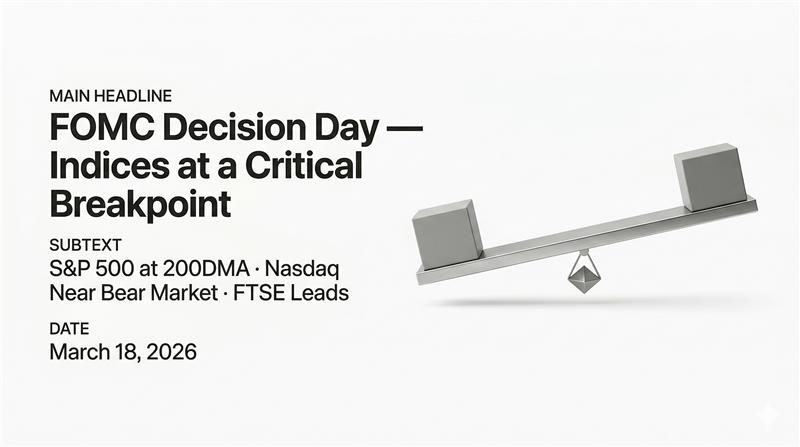
Index Market Analysis – March 18, 2026 | FOMC Decision Day | Nasdaq 100 · S&P 500 · FTSE 100
Index Market Analysis
FOMC Decision Day
Nasdaq 100 · S&P 500 · FTSE 100 — Deep-dive technical analysis, economic calendar, candlestick patterns, and trade setups for the next 24 hours.
The Day the Dot Plot Speaks
Wednesday, March 18, 2026 arrives as one of the most consequential macro days of the year so far, combining the FOMC’s quarterly Summary of Economic Projections (SEP) with a geopolitical backdrop that has fundamentally altered the inflation calculus for global central banks. U.S.–Israeli strikes on Iran in late February triggered a cascade that sent Brent crude above $100 a barrel for the first time since August 2022, reigniting stagflation fears across developed markets.
The S&P 500 has now recorded three consecutive weeks of losses through March 13, its longest losing streak since late 2023. The Nasdaq 100 sits approximately 14% below its February all-time high of 25,500, flirting with bear market territory. The FTSE 100, insulated by its heavy weighting in energy and commodity names (BP and Shell each up ~3%), has been the relative outperformer among G7 indices — though it too pulled back from record territory as the oil shock raised inflationary concerns for the BoE.
The Bank of Japan meets today and tomorrow, while the Bank of England delivers its own decision on March 19. Markets are simultaneously digesting surging oil, a softening U.S. labour market (February NFP: −92,000), and Jerome Powell’s approaching May exit as Fed Chair — making this possibly the most market-sensitive FOMC in two years.
| Index / Asset | Country | Last Close | 1D Change | WTD | MTD | YTD | Trend Bias |
|---|---|---|---|---|---|---|---|
| S&P 500 (SPX) | 🇺🇸 USA | 6,741 | +0.60% | +1.64% | −4.2% | −4.8% | Bearish |
| Nasdaq 100 (NDX) | 🇺🇸 USA | 21,900 | +0.65% | +1.9% | −6.1% | −14.1% | Bearish |
| Dow Jones (DJIA) | 🇺🇸 USA | 47,163 | +0.46% | +1.3% | −3.9% | −5.6% | Bearish |
| FTSE 100 | 🇬🇧 UK | 10,403 | +0.83% | +1.1% | −1.5% | +3.2% | Mixed |
| DAX 40 | 🇩🇪 Germany | 23,730 | +0.71% | +1.2% | −2.1% | +8.4% | Mixed |
| Nikkei 225 | 🇯🇵 Japan | ~53,800 | −0.4% | −1.1% | −3.2% | −2.8% | Bearish |
| VIX (Fear Index) | 🇺🇸 USA | 22.37 | −4.85% | Elevated — Structural volatility regime | Elevated | ||
| Brent Crude | 🌍 Global | $103.10 | +3.0% | First time above $100 since Aug 2022 | Risk-On Macro | ||
| US 10Y Yield | 🇺🇸 USA | 4.206% | −1bp | Falling ahead of FOMC — pricing in caution | Watch | ||
Data as of Tuesday March 17, 2026 NYSE close / London close. Nasdaq 100 price is a morning pre-open estimate for March 18. All prices in USD unless noted.
Events That Will Move Markets in the Next 24 Hours
The following table covers only HIGH impact events for the jurisdictions that matter most to index traders — USA, UK, Japan, Australia, Eurozone, and China — over the 24-hour window from Wednesday morning to Thursday morning (GMT).
| Date / Time (GMT) | Country | Event | Previous | Forecast | Impact | Index Risk |
|---|---|---|---|---|---|---|
| Mar 18 · 19:00 | 🇺🇸 USA | FOMC Rate Decision | 3.50–3.75% | 3.50–3.75% (Hold) | HIGH | SPX · NDX · All |
| Mar 18 · 19:00 | 🇺🇸 USA | SEP / Dot Plot Update | 1 cut (Dec ’25) | 0–1 cut — BINARY | HIGH ⚡ | All · USD · Gold |
| Mar 18 · 19:30 | 🇺🇸 USA | Powell Press Conference | — | Hawkish hold expected | HIGH | SPX · NDX · DXY |
| Mar 18 · ~01:00 | 🇯🇵 Japan | BoJ Rate Decision (Day 1 of 2) | 0.75% | Hold 0.75% | MEDIUM | Nikkei · JPY |
| Mar 18 All Day | 🇨🇳 China | Loan Prime Rate (LPR) — 1Y & 5Y | 3.10% / 3.60% | Hold expected | MEDIUM | Hang Seng · DAX |
| Mar 18 · 09:30 | 🇬🇧 UK | UK CPI (February) | 3.4% (Dec) | ~3.1%–3.3% | HIGH | FTSE 100 · GBP |
| Mar 18 · 12:30 | 🇪🇺 Eurozone | ECB Speakers (Lagarde, Lane) | — | Oil shock / inflation commentary | MEDIUM | DAX · CAC |
| Mar 19 · 07:00 | 🇬🇧 UK | BoE Rate Decision + Minutes | 3.75% | Hold 3.75% (28% cut odds) | HIGH | FTSE 100 · GBP |
| Mar 19 · ~03:00 | 🇯🇵 Japan | BoJ Rate Decision + Ueda Presser | 0.75% | Hold 0.75% | HIGH | Nikkei · USD/JPY |
| Mar 19 · 00:30 | 🇦🇺 Australia | AU Employment Change & Unemployment Rate | +44K / 4.1% | +25K / 4.2% | MEDIUM | ASX 200 · AUD |
| Mar 19 · 09:30 | 🇬🇧 UK | UK Retail Sales (February) | −0.6% MoM | +0.2% MoM | MEDIUM | FTSE 100 · GBP |
| Mar 19 · 02:00 | 🇨🇳 China | China Industrial Production / Retail Sales | +5.9% YoY | +5.7% YoY | MEDIUM | Commodities · DAX |
Central Bank Rate Summary
| Central Bank | Current Rate | Meeting Date | Expected Action |
|---|---|---|---|
| 🇺🇸 Fed (FOMC) | 3.50–3.75% | Mar 18 TODAY | Hold |
| 🇬🇧 BoE | 3.75% | Mar 19 Tomorrow | Hold (28% cut) |
| 🇯🇵 BoJ | 0.75% | Mar 18–19 | Hold |
| 🇪🇺 ECB | 2.40% | Apr 22 (next) | No Meeting |
| 🇦🇺 RBA | 4.10% | Mar 17 (done) | Cut −25bp |
| 🇨🇳 PBoC | 3.10% (LPR) | Mar 18 | Hold |
RBA cut to 4.10% on March 17 in response to global uncertainty and cooling domestic inflation.
Macro Scoreboard: Key Data
| Indicator | Reading | Trend | Impact |
|---|---|---|---|
| US Core PCE (Jan) | 3.06% YoY | ↑ Hot | Hawkish |
| US CPI (Feb) | +0.3% MoM | Above target | Hawkish |
| US NFP (Feb) | −92,000 | Very weak | Dovish signal |
| US Unemployment | 4.4% | Rising | Mixed |
| UK CPI (Dec ’25) | 3.4% YoY | Above target | BoE Hold |
| Brent Oil | $103/bbl | ↑ Surge | Stagflation |
| Japan CPI Core-Core | 2.9% YoY | Sticky | BoJ Hold |
| China Feb Output | Beat forecasts | ↑ Positive | Mildly+ |
S&P 500 (SPX) — Technical Analysis & Trade Setup
The 200-Day MA Battleground
Technical Indicators Dashboard
Trend Analysis
The S&P 500’s trend structure is bearish on the short-to-medium term timeframe. After peaking near 7,002 in January 2026, the index has traced a classic sequence of lower highs and lower lows, completing three consecutive losing weeks through March 13 and establishing its worst 2026 performance streak. As of the March 17 close at 6,741, the index remains below its 50-day, 100-day, and 200-day moving averages — a configuration that technical analysts describe as a fully broken MA stack.
The index’s breadth has deteriorated sharply: fewer than 32% of S&P 500 constituents trade above their own 50-day moving average, down from 65% at the start of the month. On the positive side, the two-day relief rally on March 16–17 (cumulative +0.85%) has created a short-term bounce structure off the 6,600 area — but this remains a counter-trend move until proven otherwise. The 20-day MA is now crossing below the 50-day MA (a “Death Cross” on the shorter-term MAs), a structural warning flag.
Candlestick Patterns (Daily Timeframe)
Do not initiate S&P 500 positions until after 19:30 GMT today. The following setups activate AFTER the dot plot outcome is known:
R:R ratio approximately 1:2.3 for both setups. Risk per trade max 1% of account. FOMC events historically generate 1–3% moves on SPX in the 24 hours following the decision.
Nasdaq 100 (NDX) — Technical Analysis & Trade Setup
Bear Market Territory: Anatomy of a Tech Correction
Technical Indicators Dashboard
Trend Analysis
The Nasdaq 100’s structural trend tells a clear story: the short-to-medium term trend is decisively bearish, while the long-term bull market that began in early 2023 remains technically intact on monthly timeframes. The index’s trajectory from February’s 25,500 all-time high has been a sustained, orderly decline — not a crash — characterised by a series of lower highs, with each counter-trend rally meeting resistance at progressively lower levels.
The most ominous technical development is the MA stack configuration: the 20-day MA crossed below the 50-day MA (a “Death Cross” on the short-term MAs) and both are now pointing downward well below the 200-day MA. Price itself trades roughly 2,200 points below its 200-day moving average at ~24,106 — an extraordinary gap that signals how aggressively institutional money has rotated out of tech-heavy US equities. The ADX at ~18 suggests the downtrend’s momentum is relatively mild, consistent with a grinding bear rather than a panic-driven crash.
The partial recovery on March 16–17 is encouraging in isolation but lacks the volume and breadth confirmation needed to declare a trend reversal. RSI rebounding from oversold territory (was near 35 two weeks ago) to a neutral 47–51 is a necessary condition for a sustainable recovery, but not sufficient on its own.
Candlestick Patterns (Daily Timeframe)
Primary setup: Short the mid-channel resistance zone after FOMC confirmation. Secondary setup: Long on dovish dot plot break above 22,500.
Bearish R:R ~1:2.5 | Bullish breakout R:R ~1:2.0 | Bear market threshold at 21,000 is the macro line-in-the-sand for the NDX this week.
FTSE 100 — Technical Analysis & Trade Setup
G7’s Relative Outperformer — But Can It Hold?
Technical Indicators Dashboard
Trend Analysis
The FTSE 100 presents the most nuanced technical picture of the three indices under review today. On longer timeframes (weekly and monthly), the trend is decisively bullish — all weekly and monthly moving averages remain below price, pointing upward, with strong buy signals from those timeframes. The FTSE hit all-time highs above 11,000 in February, driven by record energy sector contributions and foreign-investor inflows attracted by sterling weakness.
However, on the daily timeframe, the picture has deteriorated since mid-February. The RSI has pulled back from near-overbought levels (~68) to a more cautious 43.27 — not yet in oversold territory but no longer momentum-driven. The MACD is in negative territory at −5.75, confirming short-term selling pressure. Price has retreated from the 11,000 highs to 10,403, sitting roughly 1.4% above the critical 50-day and 5-day MA cluster (10,295–10,303) that forms the next key support zone.
The critical structural question for the FTSE this week is whether the 10,180–10,250 Fibonacci 0.5 retracement zone holds as support on any pullback. Below that level, the technical picture becomes more bearish. Above 10,552 (200-day MA), the longer-term bull case would be reasserting itself strongly.
Candlestick Patterns (Daily Timeframe)
| Sector | Key Names | Driver | Directional Bias |
|---|---|---|---|
| Energy | BP, Shell | Brent Crude $103 (+3%) | Bullish |
| Mining / Commodities | Rio Tinto, Anglo American, Glencore | China Feb data beat; gold +2% | Bullish |
| Financials / Banks | HSBC, Barclays, Lloyds | BoE hold; elevated rates | Neutral |
| Consumer Staples | Unilever, Reckitt, Diageo | Defensive flows from US selloff | Mild Bullish |
| Pharma / Healthcare | AstraZeneca, GSK | Dollar weakness; defensive demand | Neutral |
| Retail / Consumer Disc. | JD Sports, Next | BoE hold; oil hitting wages | Mildly Bearish |
The FTSE 100 long at the Fibonacci 0.5 / 50-DMA confluence (10,250–10,300) represents the best risk/reward long in G7 indices right now. Entry is strictly conditional: wait for price to touch the support zone and close a bullish reversal candle (hammer, pin bar, or engulfing). Await BoE decision (March 19) before scaling to full size.
Do NOT enter blindly at 10,250. Wait for price to arrive at this zone AND print a confirmed reversal candle on the daily chart. A BoE rate cut (28% probability) would temporarily weaken GBP and could actually give a short-term FTSE boost, as the index’s foreign earnings are worth more in weaker sterling terms.
The Five Forces Shaping Index Markets Right Now
| # | Force | Description | Index Impact | Probability |
|---|---|---|---|---|
| 1 | FOMC Dot Plot (Today) | Will median dot show 0, 1, or 2 cuts in 2026? Markets expect “zero to one” cuts — any hawkish surprise sends SPX below 6,600 | SPX, NDX: ±3% | Happening Now |
| 2 | Iran Oil Shock | Brent above $100 for first time since 2022. Strait of Hormuz partially disrupted. Every $10 rise in oil adds ~0.5% to US CPI | FTSE bullish, NDX/SPX bearish | Active |
| 3 | US Labour Weakness | February NFP: −92,000 — worst reading in years. Unemployment at 4.4% — rising. Creates “stagflation trap” for Fed | Binary: dovish signal vs. recession fear | Developing |
| 4 | Powell Succession | Powell exits May 2026. Kevin Warsh (Trump nominee) is hawkish. Uncertainty about policy direction under new chair adding volatility premium | SPX: structural discount | Medium |
| 5 | AI/Tech Valuation Reset | Trade Desk −7%, software stocks under pressure. AI disruption concerns weigh on Nasdaq. Tech sector P/E compression ongoing | NDX: structural headwind | Ongoing |
Scenario Analysis for the Next 24 Hours
| Scenario | Probability | SPX Target | NDX Target | FTSE Impact |
|---|---|---|---|---|
| Hawkish dot plot (0 cuts, Powell aggressive) | 40% | 6,580–6,620 | 21,000–21,200 | 10,200–10,300 |
| Neutral hold (1 cut, Powell non-committal) | 35% | 6,760–6,830 | 22,000–22,300 | 10,450–10,550 |
| Dovish surprise (Powell signals flexibility) | 20% | 6,900–7,000 | 22,500–23,000 | 10,600–10,750 |
| Extreme hawkish (hints at hike) | 5% | <6,500 | <21,000 | 10,000–10,150 |
Risk-Adjusted Position Sizing Guide
| Account Risk Tolerance | Pre-FOMC Size | Post-FOMC Size |
|---|---|---|
| Conservative (<1% per trade) | 0% — Flat | 50% normal |
| Moderate (1–2% per trade) | 0–25% normal | 75% normal |
| Aggressive (2–3% per trade) | 25% normal | 100% normal |
| Professional / Hedged | Hedged Straddle | Full size |
Trader FAQ — March 18, 2026
Without question, it is the FOMC rate decision at 19:00 GMT and the simultaneous release of the Summary of Economic Projections (dot plot). The rate hold itself is almost fully priced (92%+ probability per CME FedWatch). What will actually move markets is whether the median dot shifts to project zero cuts in 2026 (hawkish — bearish for stocks) versus retaining one cut (broadly neutral — possible relief rally). Jerome Powell’s press conference at 19:30 GMT will then set the tone for the entire week. Think of the dot plot as the real rate decision today.
The Nasdaq 100 is approaching but has not yet formally entered bear market territory as of this report. It has fallen approximately 14.1% from its February 2026 all-time high of 25,500, sitting near 21,900. The conventional definition of a bear market requires a 20% peak-to-trough decline. That threshold sits at approximately 21,000 points — the critical technical level to watch this week. If the FOMC triggers a hawkish selloff that breaks NDX below 21,000, a formal bear market would be confirmed and would likely accelerate further institutional selling.
Three structural factors are driving FTSE 100 outperformance. First, its heavy energy weighting — BP and Shell collectively represent a large portion of the index and have each surged ~3% as Brent crude reclaimed $100/barrel due to the Iran war. Second, sterling weakness means that the FTSE’s many international companies (which earn profits in USD, EUR, and other currencies) see those earnings worth more when translated back to GBP. Third, the FTSE has significantly less tech and AI-exposed stock concentration than the S&P 500 or Nasdaq, so the valuation re-rating pressure affecting Magnificent Seven names has had limited impact on London.
In short: no. Experienced traders understand that buying before a binary event — particularly one as market-moving as a dot plot release — is speculation on the unknowable, not trading with edge. The asymmetric risk profile is especially unfavourable today: a hawkish outcome (40% probability per our analysis) could send the SPX 2–3% lower very quickly, wiping out any pre-rally gains. The correct approach is to reduce existing positions to 25–50% of normal size ahead of 19:00 GMT, wait for the dot plot and Powell’s press conference to clarify the market’s direction, and then enter the resulting move on the first pullback after 20:00 GMT.
Here is a quick reference: S&P 500 — key support at 6,600–6,650 / key resistance at 6,800 (200-DMA) and 6,850. Nasdaq 100 — critical support at 21,000 (bear market line) / resistance at 22,300–22,500 (descending channel top) and 24,000 (200-DMA, distant). FTSE 100 — key support at 10,250–10,300 (50-DMA / Fibonacci 0.5 confluence) / resistance at 10,552 (200-DMA) and 10,750.
The BoE decision carries about a 28% market-implied probability of a 25bp cut to 3.50%, with a 72% probability of a hold at 3.75%. For the FTSE, the counterintuitive dynamic is important to understand: a rate cut would likely weaken GBP, which — because the majority of FTSE 100 revenues are earned overseas — would mechanically boost the index’s GBP-denominated value. Conversely, a hawkish hold might strengthen GBP and marginally pressure the FTSE. Either way, the impact of the BoE on the FTSE is generally less dramatic than an FOMC decision on US indices. The more important BoE factor is the MPC’s forward guidance on 2026 cuts and how it frames the inflation risk from the Iran oil shock.
The VIX at 22.37 (down 4.85% on March 17) is in the “elevated but moderating” zone. A reading above 20 signals a structurally elevated volatility regime — meaning options are expensive, whipsaw moves are more common, and mean-reversion strategies outperform trending ones. The decline from a recent high above 27 (March 13) to 22.37 is encouraging but not yet a green light for normal position sizing. For context: VIX below 18 signals a calm, trending market; 18–25 signals heightened uncertainty; above 25 signals fear regime. Today’s FOMC decision could easily push VIX back above 25 if the dot plot disappoints. Until VIX falls sustainably below 20, reduce position sizing by 30–40% versus your normal allocation.
Navigating the Most Complex Trading Day of 2026 So Far
March 18, 2026 will be remembered as a pivotal inflection point regardless of what the FOMC delivers. Three consecutive weeks of losses on US indices, a Nasdaq 100 on the doorstep of bear market territory, oil entrenched above $100, a softening labour market, and one of the most market-sensitive dot plot releases in two years — this is the environment experienced traders have been waiting to navigate with precision.
The S&P 500 sits at a technical crossroads, trading below its key moving average cluster with the 200-day MA acting as the first ceiling to any meaningful recovery. The resolution of today’s FOMC binary event will define the next directional move: a hawkish dot plot risks a break below 6,600 while a dovish outcome could propel a recovery toward 6,850–7,000.
The Nasdaq 100 demands the most disciplined approach. The 21,000 bear market threshold is not just a number — it is a psychological and institutional line-in-the-sand that, if breached, would trigger systematic selling from rules-based funds. Short the rallies into resistance (22,300–22,500), but be ready to cover quickly and flip long if the dot plot surprises to the dovish side.
The FTSE 100 remains the standout long candidate in the G7 index universe for structural reasons that are unlikely to reverse quickly: energy exposure, sterling dynamics, and lower AI concentration. The conditional long setup at 10,250–10,300 — awaiting a confirmed rejection candle — offers the best risk/reward framework available in major indices right now, assuming BoE doesn’t deliver an aggressively hawkish surprise on March 19.
The single most important discipline today: play the reaction, not the prediction. Let the dot plot and Powell’s words define the direction. Then enter the resulting move on the first pullback, with defined risk, proper sizing, and clear invalidation levels. The market rewards patience and precision over prediction on days like today.