
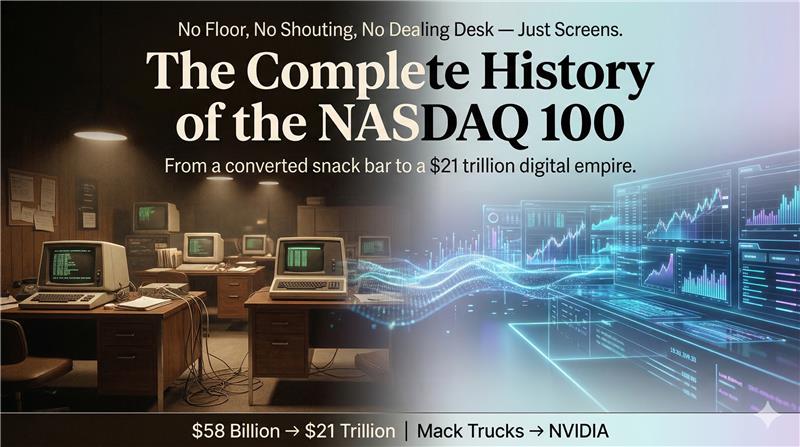
The Exchange That Built the Future: How NASDAQ Turned Code Into Culture— and Gave the World Apple, Google, Amazon & the Age of Unicorns
The Original Tech Company:
How NASDAQ Built the Digital World
— and Handed Apple, Microsoft
& Google Their Stage

Before the iPhone. Before the search box. Before the algorithm that ran the cloud. There was a room of humming machines in a converted snack bar in Connecticut — and one idea so radical that Wall Street laughed at it for years. NASDAQ was not just the world’s first electronic stock market. It was the world’s first tech company. Everything that came after it was built on the infrastructure it proved could work: that screens beat floors, that code beats shouting, and that the future of finance was a machine. This is that story — from 1971 to the $21 trillion index of 2026.
They called it a quotation system. The men on Wall Street called it worse things than that. What it actually was — what nobody quite had the language to say in 1971 — was a declaration of war on every assumption the financial world had made about how markets were supposed to work.
The room in Trumbull, Connecticut didn’t look like a revolution. It looked like a utility closet that had been issued government contracts. Bunker-Ramo mainframes hummed in rows. Cathode-ray tubes threw cold blue light across engineers in sideburns and plaid trousers. Tape drives spooled data that, a few miles away on Wall Street, would have required a hundred phone calls and a pile of pink paper to duplicate. Here, it was instantaneous. It was automatic. It was, for the first time in the history of organised markets, a machine.
The New York Stock Exchange had marble floors and wooden posts and specialists in coloured jackets who controlled every trade in every stock assigned to them. They stood at physical posts, in a physical room, in a building at 11 Wall Street that was designed to look like power. And for two hundred years, it had been power — the kind that required proximity, connections, and a seat at the right table. The kind that charged you a percentage for letting you in the door.
What opened on February 8, 1971 charged nobody for proximity. There was no proximity to charge for. There was only the screen, the quote, and the phone call you made after you’d already seen what everyone in the country was offering, simultaneously, in real time. For the first time since the Dutch invented the stock exchange in 1602, the intermediary had a competitor. His name was software.
NASDAQ was not built to house tech companies. It was built as one — the world’s first. Every screen-based market, every electronic trading system, every algorithmic strategy that came after it was built on the proof of concept that a room of computers in Connecticut provided on February 8, 1971. The companies it would eventually make famous — Apple, Microsoft, Google, Amazon — merely followed the trail that NASDAQ itself had blazed, a full decade before any of them existed in their modern form.
■ PART I · BEFORE NASDAQPink Sheets, Telephone Operators, and the System Designed to Fleece You
To understand what NASDAQ was, you first had to live inside what it replaced — and what it replaced was a market that worked the way markets always work when there is no transparency: it worked in favour of the man with the information. Every single time.
The over-the-counter market of the 1960s ran on pink sheets — actual paper, actually pink, printed daily by the National Quotation Bureau and distributed by hand to broker-dealers across the country. By the time the sheets arrived at a dealer’s desk in Chicago, the prices on them were already stale. By afternoon, they were archaeology. A retail investor wanting to buy or sell a stock not listed on the New York or American exchanges was at the complete mercy of whoever answered the phone.
Different dealers quoted different prices for the same stock. The spread between what you could buy at and what you could sell at was wide, inconsistent, and entirely opaque. You had no way of knowing whether the dealer on the phone was giving you the market or giving you his margin. The answer, almost invariably, was both — and you were paying for the privilege of not knowing the difference.
The SEC’s landmark 1963 Special Study of the Securities Markets documented the mess in the language of regulators, which is to say carefully. It found the OTC market fragmented, delayed, and riddled with spreads that systematically disadvantaged small investors. Its conclusion, stripped of bureaucratic phrasing, was: this needs to be a computer. The NASD — the National Association of Securities Dealers, which regulated the OTC broker-dealers — took the recommendation. In 1968, it hired a company most people have since forgotten, whose contribution to the modern financial world is almost incomprehensibly underappreciated: the Bunker-Ramo Corporation of Trumbull, Connecticut.
Bunker-Ramo was not a Wall Street firm. It was an electronics company, grown from the aerospace and defence contracts of the Cold War, that happened to have built stock quotation display systems for brokerage firms. The contract it received from the NASD was reportedly worth around $25 million over five years. The brief was straightforward: build a centralised computer network that would allow market makers to update their bid and ask quotes electronically, in real time, and make those quotes visible to all other participants through terminal screens — simultaneously, everywhere, at once.
Three years. A purpose-built data centre in a facility that had, by at least one account, previously served as a company canteen. And on February 8, 1971, the National Association of Securities Dealers Automated Quotations — NASDAQ — opened for business.
■ PART II · THE MACHINE THAT CHANGED EVERYTHINGA Snack Bar in Connecticut, and the Most Radical Idea in Finance Since 1602
On its first day, NASDAQ did not execute a single trade. This is important to understand, because it is one of the great underappreciated distinctions in market history. NASDAQ was, in its original form, a quotation system. The screens showed you the price. The phone still got you the deal. What it had done — what it had done that no market in human history had managed before — was make the quote universal. For the first time, a broker in Seattle could see, on his screen, what a market maker in Boston was offering on the same security, at the same moment, without making a phone call. The price was no longer a secret. It was a number on a screen. And that changed everything.
On Day One, the system broadcast quotes for over 2,500 securities to approximately 500 market makers across the United States. By year-end 1971, NASDAQ had processed nearly two billion shares. Intel Corporation — which would become, half a century later, one of the defining names in the history of semiconductor technology — went public on NASDAQ on October 13, 1971, raising $6.8 million at $23.50 per share. The exchange that had been built to replace a pile of pink paper was already hosting the future.
What the NYSE had that NASDAQ would never build was a trading floor. What NASDAQ had that the NYSE could never replicate was something subtler and, in the long run, far more powerful: competitive market making. On the NYSE, a single specialist firm controlled all trading in each assigned stock. In moments of stress, that specialist could — and did — withdraw from the market entirely, disappearing the liquidity at precisely the moment it was most desperately needed. NASDAQ, by design, required multiple competing market makers in every security. When one stepped back, others remained. The redundancy was mechanical, not discretionary. The market could not be closed by a human decision to close it.
What NASDAQ’s Headquarters Actually Looks Like — And Why That’s the Point
When you see the NASDAQ opening bell on CNBC — the confetti, the flashing blue lights, the towering screen behind the executives clutching their laminated IPO plaques — you are looking at 4 Times Square, Midtown Manhattan: the NASDAQ MarketSite, a cylindrical eight-storey tower wrapped in 14,000 square feet of LED display, lit from 7am to 1am, 365 days a year. It cost $37 million to build. It opened on January 1, 2000, timed to coincide with the millennium and, as it happened, the absolute peak of the era that had made NASDAQ a household name.
There is no trading floor inside it. Not one square foot. What is inside is a broadcast studio — 28,500 square feet of television production infrastructure, two state-of-the-art digital studios at street level, a wall of 96 monitors twenty feet tall, four electronically controlled cameras, reporters’ booths on the mezzanine, and capacity for five simultaneous live broadcasts. CNBC has had a permanent studio presence since 2007. Bloomberg, Fox Business, CNN International, Reuters TV, Yahoo Finance — they all broadcast from it. None of them are broadcasting from a market. They are broadcasting from a media facility built by an exchange that had no physical market to show anyone.
This is not incidental. It is the most honest architectural metaphor in American finance. NASDAQ needed Times Square precisely because it had no floor. The NYSE could point journalists at the actual trading room, the actual open-outcry pits, the actual human noise. NASDAQ had to build a simulacrum — not of trading, but of the idea of trading. The exchange that abolished the physical to prove a point about the future built itself the most visible physical landmark in American finance to compensate. The building is a monument to its own absence. And somehow, that is fitting.
■ PART III · THE INDEX IS BORNJanuary 31, 1985: 100 Companies, $58 Billion, and a Truck Maker Named Mack
By the early 1980s, NASDAQ had fought its way to legitimacy the hard way: volume. In 1981, it handled 37 percent of all US equity trading. In 1984, the Small Order Execution System — SOES — had finally allowed trades to be completed electronically, without a telephone call, for the first time in the exchange’s thirteen-year history. The machines weren’t just quoting anymore. They were trading. And the exchange that ran them needed a benchmark — not just the sprawling Nasdaq Composite, which tracked every one of its 2,500-plus listed companies, but a curated, investable index of the hundred largest non-financial names: the kind of thing you could write an options contract against, or eventually, an ETF.
On January 31, 1985, the Nasdaq-100 Index launched at a base value of 250. Total combined market capitalisation of its components: $58 billion. Roughly the market cap of a single mid-size company today — barely a rounding error in the era of NVIDIA. The decision to create a parallel financial-sector index — and keep the banks, the insurance firms, the mortgage companies entirely out of the NDX — was made as a matter of structural tidiness. It would prove, twenty-three years later, to be the most important decision in the history of index design.
The original hundred companies were not what you would expect if you arrived at 1985 with only the 2026 NASDAQ 100 as your reference. Alongside Apple Computer and Intel sat Mack Trucks. Adolph Coors Brewing. Chi Chi’s Restaurants — a Tex-Mex chain with a yellow sombrero logo that would eventually file for bankruptcy in 2003. HBO. Liz Claiborne. McCormick Spices. PACCAR, the commercial truck manufacturer. In 1985, the NASDAQ 100 was not a technology index. It was a large-cap non-financial index that happened to list on an exchange that happened to attract technology companies. The technology identity was a tendency. The destiny came later.
Of the original 100 components in 1985, precisely four have remained members continuously ever since: Apple (then Apple Computer), Intel, PACCAR, and Costco (which joined via its 1993 merger with Price Club). More than 500 other companies have cycled through the index in the intervening four decades. The NDX is a living system, not a monument. It replaces losers with winners on an annual basis. The index of 2026 contains none of the failed dot-com companies of 2000. It contains none of the pandemic-era momentum darlings who peaked in 2021. It always — structurally, mechanically — holds the present leaders. That perpetual self-renewal is the most underappreciated structural advantage in the index universe.
In 1998, a critical evolution took place that almost no one outside a small circle of index architects understood the significance of at the time: NASDAQ shifted the NDX from pure market-capitalisation weighting to a modified cap-weighting methodology — one that capped the influence any single company could exert on the index. The explicit purpose was to enable an exchange-traded fund. The result, launched in March 1999 on the American Stock Exchange under the ticker QQQ, attracted $658 million in its first week and ended 1999 as the most actively traded security in the United States. The index that had been created as a media tool — a headline number for television — now had $658 million in it. And rising, at a rate nobody had quite prepared for.
■ PART IV · THE FIRST CATASTROPHEThe Dot-Com Bubble: What Happens When the Story Gets Ahead of the Math
Between January 1995 and March 2000, the NASDAQ 100 rose from 576 points to approximately 4,800. That was a 733 percent gain in five years. The internet was real. The productivity implications of networked computers were real. The companies riding that story were, for the most part, not. Their forward price-to-earnings ratios reached 60 times at the peak — three times what serious value investors considered rational, and more than twice the highest P/E ever recorded in the history of the S&P 500. But nobody was there to discuss P/E ratios. They were busy buying.
Pets.com spent $1.2 million on a single Super Bowl ad in January 2000 for a business that sold pet food at below cost, had been listed for less than a year, and would be liquidated by November. Webvan raised approximately $396 million in venture capital and a further $375 million in its IPO for an online grocery delivery business that lost money on every order — and collapsed in July 2001 having burned through over $800 million and never once turned a profit. Priceline — whose first-day market capitalisation reached $9.8 billion, the largest first-day valuation of any internet company to that date — bought airline tickets at market price in order to fulfil its customers’ below-market bids, losing money on every transaction by design and calling it a business model. These were not aberrations. They were the median.
The Federal Reserve began raising interest rates in early 1999. It raised them six times. On March 20, 2000, Barron’s ran a cover story titled “Burning Up” — a clinical, data-driven examination of the cash burn rates of major internet companies, with a conclusion that was essentially a countdown clock. The NASDAQ Composite had peaked at 5,048.62 on March 10. It would not see that level again for fifteen years.
The NASDAQ 100 fell 83 percent from its peak to its trough in October 2002. Not 83 percent of the speculative froth. Not 83 percent of the overvaluation. Eighty-three cents of every dollar invested at the peak, gone. Amazon fell from $100 to $7. Intel reached $73 at its high and has not come close since. Cisco — briefly the world’s most valuable company at the peak — still trades below its March 2000 price, a quarter of a century later. More than five trillion dollars in market capitalisation was destroyed. More than 50 percent of public dot-com companies ceased to exist. Silicon Valley shed 200,000 jobs. And the recovery — the full recovery, back to the March 2000 high — took exactly fifteen years, arriving on April 23, 2015.
■ PART V · THE LONG CRAWL BACKGoogle Arrives, the Banks Explode, and the Index Discovers Its Best Feature
The recovery from the dot-com crash did not look like a recovery for a long time. It looked like a slow-motion tour of the wreckage. The companies that led the index upward from 2003 were largely not the companies that had driven it to its peak. They were different companies, with different business models, and a different relationship to the concept of revenue. Google — founded by two Stanford graduate students in a garage in Menlo Park, IPO’d on August 19, 2004, at $85 per share — was the prototype of what the new era looked like. It generated money with the mechanical regularity of a toll booth. You searched. It showed you an ad. Somebody paid for the ad. The money arrived. No vision statement required.
Apple had spent the dot-com years reinventing itself in a different direction entirely. The iPod appeared in 2001. iTunes followed. The iPhone launched in June 2007 and immediately rewrote the terms of what a consumer technology company could be: not a tool you used at your desk, but an object you carried in your pocket and touched, without thinking, more than a hundred times a day. Brand loyalty at that depth of penetration was not a marketing achievement. It was an economic moat — as durable, in its way, as a government monopoly, and considerably more profitable. By the time the NDX was grinding back toward 2,000 points, Apple was worth multiples of the Apple that had been in the original 1985 index.
Then came September 15, 2008, and the thing that every stress test had always left out of its worst-case scenarios: the simultaneous collapse of the entire US financial system. Lehman Brothers filed for the largest bankruptcy in American history. The NASDAQ 100 fell roughly 50 percent from its pre-crisis highs to the trough in March 2009. It was catastrophic.
From September 2008 to the trough in March 2009, the NASDAQ 100 fell approximately 50 percent — terrible, but broadly in line with every other major index. The divergence came after. By year-end 2009, the NDX was up 78 percent from its March low. The S&P 500, the Dow Jones, and every other major index that had swallowed full exposure to the financial sector managed an average recovery of roughly 65 percent over the same period. The gap — 13 percentage points — was precise in its origin: the NDX held zero banks, zero insurance companies, zero mortgage servicers. It had none of the companies whose destruction was most permanent, and it recovered from the QE tailwind faster than any index burdened by the wreckage of the financial sector. The no-financials rule, once a structural tidying exercise, had just been proven — by the largest financial crisis in 80 years — to be the single most consequential design decision in the history of indexing.
The Federal Reserve’s response to the GFC — zero interest rates, quantitative easing, and a commitment to hold the policy rate at the floor for years — created the precise conditions under which a long-duration growth index thrives. When the discount rate approaches zero, the present value of distant future cash flows approaches the present value of near-term earnings. The mathematical moat around growth stocks expands. Companies whose value existed in their futures — which is what every company in the NASDAQ 100 had always been — became worth more, by formula, at every iteration of rate cuts. The NDX was not just the beneficiary of the Fed’s post-GFC policy. It was, structurally, the index that the post-GFC policy was built for, whether anyone knew it or not.
In August 2018, Apple became the first American company — the first company in human history — to reach a one-trillion-dollar market capitalisation. The number required a pause. One trillion dollars. A thousand billion. A million million. Microsoft followed. Google, by then renamed Alphabet, followed. Amazon followed. The NASDAQ 100 was no longer a niche instrument for technology investors. It was the most-watched equity benchmark on earth.
■ PART VI · THE SUPERCYCLECOVID, Zero Rates, a Chatbot, and the $21 Trillion Machine
The pandemic hit the NASDAQ 100 the way a car hits a wall at 60 miles per hour: suddenly, totally, and with a completeness that made the preceding period seem, in retrospect, almost comically peaceful. Between February 19 and March 23, 2020 — thirty-three trading days — the index fell 32 percent. The fastest 30-percent-plus decline in its history. Offices emptied in hours. Supply chains froze. Airports went silent. For a few genuinely terrifying weeks in late March, the working assumption in financial markets was that the global economy might simply stop.
And then the Federal Reserve did something it had never done on a Sunday before. On March 15, 2020, before Asian markets opened on Monday morning, it cut interest rates to zero and committed to holding them there for a minimum of three years. The US government authorised over six trillion dollars in fiscal stimulus. And remote work — which had been a convenience, a perk, a thing you negotiated as part of a senior job offer — became overnight the operating condition of the global economy. Every company that sold cloud computing, video conferencing, e-commerce, digital entertainment, or online anything woke up on Monday, March 16, to discover that its total addressable market had just been expanded by mandate. A decade of organic adoption had been compressed into ninety days.
By August 19, 2020 — exactly five months after the bottom — the NASDAQ 100 had fully recovered its February highs and was making new all-time records. It had accomplished in five months what the dot-com crash had taken fifteen years to achieve. The difference, stripped to its essential nature, was this: the companies inside the index in 2020 were the companies whose revenues were actually accelerating as the world locked down. Amazon’s revenue surged. Microsoft’s Azure cloud grew at record rates. Zoom went from near-obscurity to ubiquity in ninety days. The dot-com companies of 2000 had been valued on the promise of future revenues. The NASDAQ 100 companies of 2020 had the revenues already. Recovery, for a company with genuine earnings power, is a question of when. For a company with no earnings power, it may never come.
In 2000, the typical NDX component had a forward P/E of 60 times or higher, no profits, and often no revenue model beyond “the internet changes everything.” In 2020, the companies driving the recovery — Apple, Amazon, Microsoft, Alphabet, Facebook — had collectively generated hundreds of billions in real profits in the preceding twelve months. Holding genuine earnings through a crisis means waiting for the world to return to normal. Holding promises through a crisis means discovering, often slowly and expensively, that the world never intended to make them real.
By November 2021, the NDX had reached 16,573. Then the Federal Reserve began hiking rates at the fastest pace in forty years — from 0.25 percent to 5.25 percent in fourteen months. The index fell 33 percent through 2022, bottoming in October. The “tech bubble” narrative returned to the financial press with the confidence of a pattern it had learned to recognise. It was wrong again, though not without reason to be suspicious.
On November 30, 2022, OpenAI released a chatbot called ChatGPT to the public. It reached 100 million users in two months. This was the fastest consumer application adoption in recorded history — faster than the smartphone, faster than social media, faster than the internet itself had spread in the mid-1990s. The artificial intelligence era, which had been developing in university research labs and corporate skunkworks projects for a decade, arrived in public all at once. And with it came the most violent re-rating of a single sector in the NASDAQ 100’s history: chip manufacturers, cloud platforms, enterprise software firms, AI model developers — every company positioned to benefit from the GPU buildout that would be required to run this technology at scale. The NDX rose 53.8 percent in 2023. Its second-best year ever. NVIDIA — whose graphics processing units had become the essential hardware of AI model training — rose 240 percent. In 2024, the NDX rose a further 24.9 percent. NVIDIA rose 171 percent, briefly making it the most valuable company in human history.
The Magnificent Seven: When Seven Balance Sheets Become One Benchmark
The AI supercycle produced a concentration problem that no risk manager’s framework had been built to handle, because nothing like it had existed before. By the peak in October 2025, seven companies — Apple, Microsoft, NVIDIA, Alphabet, Amazon, Meta, and Tesla — had accumulated a combined index weight that made every conventional understanding of “diversified technology exposure” operationally meaningless. A long position in QQQ, which most retail investors understand as owning a hundred technology companies, had become in practical terms a concentrated bet on seven quarterly earnings reports. When NVIDIA fell 3 percent, the index felt it. When Microsoft guided below consensus, the entire index priced in the disappointment before lunch.
This was not a design failure. It was the mathematical output of a market-capitalisation-weighted index in a market where seven companies were generating exponentially more earnings growth than the other ninety-three. The Magnificent Seven collectively reported 26.6 percent earnings growth in their most recent major cycle, against roughly 12 percent for the broader S&P 500 ex-seven. When the growth divergence is that stark, the cap-weighted index concentrates in the winners. It can’t not. That’s what it’s built to do.
🤖 NVIDIA — The GPU Monarch
Data centre revenue from $14.5B (FY2022) to $96B+ (FY2025). Briefly the world’s most valuable company. Now under pressure as hyperscalers interrogate AI infrastructure returns. H100 and Blackwell chips remain the choke-points of the global AI buildout.
☁️ Microsoft — The Enterprise Default
A $10B partnership with OpenAI and Azure cloud growth made Microsoft the enterprise AI platform of record. Its 2026 capex guidance — part of the $650B+ hyperscaler total — is now the centrepiece of the AI ROI interrogation. Every analyst has a model. Nobody has an answer.
📱 Apple — The Tariff Target
Manufacturing in China, India, and Vietnam makes Apple uniquely exposed to the Trump-era tariff regime. Criticised for its perceived gap in AI ambition versus peers. But no massive capex commitments means it may be the one to hold if the infrastructure story sours.
🔍 Alphabet — The Survivor
Overcame the existential threat that ChatGPT posed to its search advertising revenue. Gemini AI integration drove a 65.8% return in 2025 — best among the Seven. Antitrust proceedings remain the structural ceiling that no multiple expansion can clear.
📦 Amazon — The Robot Banker
AWS leads global cloud infrastructure. Committed to approximately $100B in capex for AI buildout in 2025. Forty new-generation robotics fulfilment facilities projected to deliver $4B in annual cost savings by 2027, per Morgan Stanley.
📡 Meta — The Open-Source Bet
Llama open-source AI models plus the most valuable advertising data flywheel in existence. Down 6.6% in March 2026 amid concerns that AI monetisation hasn’t arrived on schedule. But $37B+ in digital advertising revenue provides a floor that few technology companies can match.
■ PART VII · THE PRESENT MOMENTMarch 2026: Correction, Rotation, and the Bill Coming Due for the AI Era
The NASDAQ 100 of March 2026 is an index in the middle of an argument — not with the market, exactly, but with itself. It sits approximately 7 percent below its February 2026 all-time high of 26,182, trading around 24,268. The AI supercycle that delivered back-to-back annual returns of 53.8 percent and 24.9 percent has entered what a quant might call its interrogation phase and what everyone else would call a reckoning. The market that cheered when Microsoft announced another fifty billion in data centre construction now wants to know when that data centre generates the revenue to justify the check.
The numbers are stark. The combined capital expenditure of the four largest hyperscalers — Microsoft, Amazon, Alphabet, and Meta — is projected to exceed $600 billion in 2026. That is a sixty percent year-on-year increase. It is also a number larger than the entire GDP of several G20 nations, committed to building infrastructure whose commercial returns remain, at the time of writing, only partially visible. The market that spent two years celebrating these commitments as proof of moat-building has spent the first quarter of 2026 asking a different question: what is the payback period, exactly, and who modelled it?
For two years, from late 2022 through 2024, the NASDAQ 100 rewarded companies in near-direct proportion to the size of their AI capital expenditure commitments. The implicit logic: whoever builds the most infrastructure controls the most of the AI era. That logic is now being pressure-tested. The question has shifted from “are you investing in AI?” to “show us the revenue.” Azure’s growth rate, AWS’s AI-specific contracts, Meta’s advertising lift from AI personalisation, Google’s AI search monetisation — these are the numbers that will determine whether the current drawdown is a temporary pause or the opening act of a more structural reset.
Simultaneously, the capital rotation that large institutional investors had been describing theoretically for years has begun to happen actually. The Russell 2000 index of small-cap stocks — which had been serially underperforming the NASDAQ 100 throughout the AI era — surged over 7 percent year-to-date by mid-March 2026, even as the NDX traded flat to negative. The Federal Reserve’s rate-cutting cycle, which has brought the funds rate from its peak of 5.25 percent down to approximately 3.50–3.75 percent by early 2026, disproportionately benefits smaller companies with higher proportions of floating-rate debt — precisely the companies that had been crushed by the 2022 hiking cycle and left for dead. They are not dead.
A geopolitical overlay has added urgency to the correction that no model had adequately priced. The Middle East conflict that escalated in February 2026 sent Brent crude above $113 per barrel. This matters to the NASDAQ 100 in a way that would not have been true five years ago: AI data centres are among the largest consumers of electricity in the American economy, and the economics of AI hyperscaling are directly sensitive to energy costs. A sustained period of elevated oil prices does not merely hurt airlines and logistics companies. It cuts into the unit economics of every GPU cluster that Microsoft, Amazon, Alphabet, and Meta have been building. The correction, in other words, is not one thing. It is at least four things happening simultaneously, all in the same direction.
■ PART VIII · THE MECHANICSSix Forces That Have Always Driven the World’s Most Consequential Tech Index
The NASDAQ 100 does not respond to all the same variables as the S&P 500 or the Dow Jones. It has its own physics — its own set of forces that, historically, have determined its direction more reliably than any other set of inputs. These are the six that matter most.
🏦 The Federal Reserve
The single most powerful external driver, bar none. The NDX is a collection of long-duration growth assets. Rate hikes compress valuations mechanically, because they raise the discount rate applied to future cash flows. Rate cuts expand them, for the same reason. The 2022 hiking cycle produced a 33% drawdown. The current cutting cycle has been the structural support the index needed.
🤖 AI Capital Expenditure
Since November 2022, the defining driver. The willingness of hyperscalers and enterprises to commit billions to AI infrastructure has been the revenue engine for NVIDIA, Microsoft, Amazon, and Alphabet. The 2026 narrative shift — from spending commitments to demonstrated returns — is the principal source of the current correction.
📊 Magnificent Seven Earnings
Seven companies representing an outsized weight in the index means that their combined quarterly earnings are, in practical terms, the NASDAQ 100’s earnings report. Any single name’s miss moves the index meaningfully. This concentration has no precedent in 40 years of NDX history.
⚖️ Regulatory Environment
Antitrust proceedings, EU Digital Markets Act compliance costs, AI governance legislation, data privacy frameworks — these are structural headwinds with no equivalent in the S&P 500. They constrain the operational freedom of the NDX’s largest components in ways that are persistently real even when they are impossible to model precisely.
💱 US Dollar Strength
Nearly half of NDX revenues originate outside the United States. A strong dollar erodes those international revenues when translated back to USD. Dollar weakness flatters NDX earnings. USD/Asian currency moves are meaningful quarterly variables for Apple, Microsoft, and Alphabet specifically.
⚡ Energy & Infrastructure Costs
The newest force, barely visible before 2024. AI data centres require enormous and growing quantities of electricity. Energy price spikes — from geopolitical events, supply constraints, or electrification demand surges — directly affect the unit economics of AI hyperscaling. This is a structural change to the NDX’s sensitivity profile that is not going away.
■ COMPLETE TIMELINEEvery Defining Moment: NASDAQ & the NDX, 1963–2026
The SEC’s Special Study of the Securities Markets documents the OTC pink sheets as chronically broken and systematically unfair to retail investors. It recommends a computerised, real-time replacement. The recommendation takes eight years to become reality — but it becomes one.
The National Association of Securities Dealers retains the Bunker-Ramo Corporation of Trumbull, Connecticut to design and build the NASD Automated Quotation system. Budget: $25 million over five years. The first purpose-built data centre for financial markets is constructed — tape drives, monochrome screens, sideburns, and plaid trousers.
NASDAQ goes live. 2,500 OTC securities. 500 market makers. Bunker-Ramo terminals. No trading floor. Not ever. For the first time in market history, a broker in Chicago can see what a market maker in New York is quoting — simultaneously, in real time, from a screen.
Intel Corporation goes public on NASDAQ on October 13, 1971, raising $6.8 million at $23.50 per share. Apple follows in December 1980 — the largest IPO since Ford, creating 300 instant millionaires. Microsoft joins in 1986. The stage is being set.
Thirteen years after launch, the Small Order Execution System allows trades to be completed electronically without a telephone call. Until this moment, NASDAQ has been a price-display system. The phone still got you the deal. Now the machine gets you the deal.
The Nasdaq-100 Index launches at 250 points. Combined market cap: $58 billion. Components include Apple, Intel, Mack Trucks, Adolph Coors, Chi Chi’s Restaurants, and McCormick Spices. Created as a media benchmark for television coverage. Four of those 100 companies remain members today.
October 19: the Dow falls 22.6% in a single day. NASDAQ’s market makers stop answering their phones. Retail investors are stranded. The crash damages NASDAQ’s reliability reputation and forces mandatory adoption of SOES — turning a crisis into the catalyst for a genuine execution market.
NASDAQ’s annual share volume surpasses that of the New York Stock Exchange for the first time in history. The screen has beaten the floor. The same year, the first NDX options launch at the Chicago Board Options Exchange. The derivatives ecosystem begins.
The Nasdaq-100 Index Tracking Stock lists under ticker QQQ. $658 million in the first week. By year-end 1999, it is the most actively traded security in the United States. The media benchmark is now a two-way market — and one of the fastest-growing pools of capital in American finance.
NASDAQ MarketSite opens at 4 Times Square. 14,000 sq ft LED tower — the world’s largest at the time. Two broadcast studios, 96 monitors, four electronic cameras. No trading takes place. Not one share. The exchange that abolished the physical builds itself the most visible physical landmark in American finance to compensate.
The bubble peaks. Forward P/E: approximately 60 times. Pets.com has been listed for nine months and will be liquidated in November. The NDX peaks near 4,800. It will not return to this level for fifteen years.
The dot-com demolition completes. NDX at 1,114 — 83% below its peak. $5 trillion+ destroyed. More than half of public dot-com companies gone. Silicon Valley has shed 200,000 jobs. Recovery will require fifteen years and entirely different companies to accomplish it.
Google goes public at $85 per share. Unlike most dot-com companies, it is already profitable. Its search advertising model generates money with mechanical regularity. It is the opening act of the profitable-tech era — proof that internet companies could make money rather than merely spend it.
NDX falls ~50% from pre-GFC highs to March 2009 trough. Painful. But by year-end 2009, NDX is up 78% from its low versus ~65% for the S&P 500. Zero financial company exposure means no permanent losses from Lehman, Bear Stearns, or Citigroup. The no-financials rule is proven in fire.
The NASDAQ 100 reclaims its March 2000 high — 15 years and 44 days after the dot-com peak. The companies doing it are almost entirely different from the ones that drove it there. Amazon, Google, and Facebook were not in the bubble. The Apple of 2015 is worth 40 times the Apple of 2000.
Apple becomes the first company in human history to reach a $1 trillion market capitalisation. The number requires a mental adjustment. Microsoft, Alphabet, Amazon, and eventually Meta follow. The era of the trillion-dollar company has arrived. The NASDAQ 100 is the primary address of all of them.
February 19 to March 23: the fastest 30%-plus decline in NDX history. Then the Fed cuts to zero on a Sunday, commits to holding for three years, and the index recovers to all-time highs in exactly five months — the fastest major recovery in the index’s 35-year history at that point.
OpenAI releases ChatGPT. It reaches 100 million users in two months — the fastest consumer application adoption in history. Every semiconductor company, cloud platform, and enterprise software firm positioned near AI infrastructure gets repriced upward. The supercycle begins.
NVIDIA rises ~240% as GPU demand surges beyond all projections. NDX gains 53.8% — its second-best annual return ever. The AI capex cycle begins in earnest: Microsoft, Amazon, Alphabet, and Meta collectively commit hundreds of billions to AI infrastructure. The question nobody is asking yet: what’s the ROI?
The NASDAQ 100 reaches its all-time high of 26,182 in February 2026. Total return since the 1985 launch: approximately 20,000 percent. Combined market cap: $21 trillion. Cumulative AI hyperscaler capex for 2023–2025 has exceeded $800 billion. The question that now defines the index: when does that translate into proportionate revenue?
AI capex fatigue, Middle East oil shock, Trump tariff uncertainty, energy cost pressure on data centres, and capital rotation to small-caps weigh on the NDX. The index trades at ~24,268 — approximately 7% below its February 2026 ATH. The S&P 500 breaks below its 200-day moving average. The bull case requires AI monetisation proof in Q1 2026 earnings.
■ PART IX · THE OUTLOOKCapital Street FX NASDAQ 100 Forecast: 2026 to 2030
The NASDAQ 100’s forty-year record contains one lesson that is deeply uncomfortable in its simplicity: the correct long-term call has always been bullish. The index has survived the destruction of 83 percent of its value. It has survived a global financial crisis that wiped out its most structurally exposed peers. It has survived a pandemic that shut the global economy for months. In each case, those who held through the trough generated returns that made those who sold at the bottom look, in retrospect, like they had misread the fundamental nature of the instrument they were selling. In each case, the index’s self-renewing structure — continuously replacing declining companies with ascending ones — ensured that recovery was not just possible but structurally pre-programmed.
None of that makes the current moment easy to navigate. The AI ROI debate is a different kind of risk from the 2022 rate-hike correction or the 2020 pandemic crash. Both of those were macroeconomic in origin — external shocks to which the NDX’s underlying business models were not directly vulnerable. The 2026 correction is a business model question. If the $600 billion-plus annual capex cycle does not deliver commensurate revenue and earnings growth over the next 18 to 24 months, the repricing of mega-cap technology could be more persistent than the typical rate-cycle correction. Forecasting responsibly requires holding that possibility alongside the structural bull case — simultaneously, honestly, without flinching at either.
The Verdict: The Machine Keeps Running
Somewhere in Trumbull, Connecticut, in February 1971, a group of engineers in plaid trousers watched cathode-ray tubes boot up and display, for the first time, a real-time market price on a screen. The brokers who had spent their careers working the pink sheet system and the telephone networks laughed, or dismissed it, or failed to understand what they were looking at. What they were looking at was the future. Specifically: their own replacement.
Fifty-five years and several trillion dollars later, the machine they built runs the world’s most valuable companies. Apple designed the phone in your pocket. Microsoft runs the cloud that most of the world’s businesses run on. Google organised the world’s information. Amazon reshaped retail and cloud computing simultaneously. NVIDIA built the hardware that is training the artificial intelligence that may, eventually, be the most consequential technology in human history. None of them would exist in anything like their current form without the exchange infrastructure that NASDAQ proved was viable, in a converted snack bar in Connecticut, on February 8, 1971.
The NASDAQ 100 currently sits 24 percent below its all-time high. The AI ROI debate is unresolved. Energy prices are elevated. Tariff uncertainty is real. The great rotation into small-caps has begun. All of that is true. It is also true that this index has survived a catastrophic 83 percent drawdown, a global financial crisis, a pandemic, and four Federal Reserve tightening cycles. In each case, the verdict has been the same: the machine keeps running. The self-renewing structure replaces the failed with the ascending. The future, once again, is a number on a screen.