GTC 2026 · Post-Keynote Analysis
Nvidia (NVDA) Trade Idea
March 18, 2026
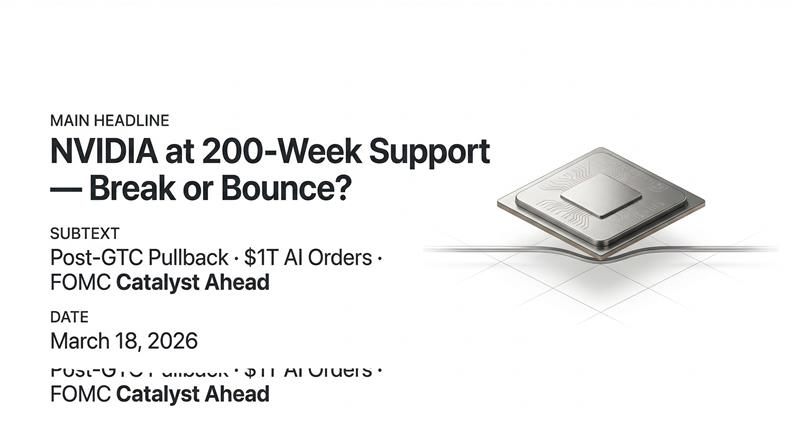
Post-GTC 2026 | $1 Trillion AI Forecast | China H200 Restart | 24-Hour Setup
NVDA / NASDAQ
$183.20
▲ +0.21% (30d)
52-Week Range
$86–$212
ATH: $212.19
Market Cap
$4.48T
World’s largest company
Consensus Target
$263–$274
38/43 analysts: Strong Buy
FY2026 Revenue
$215.94B
+65.47% YoY
01 · Executive Summary
The Setup in One Paragraph
Nvidia enters today’s session as the world’s most valuable company at a fascinating technical inflection point — $183.20, down approximately 13.7% from its October 2025 ATH of $212.19, sitting on its 1-week 200-MA for the second time in two weeks. The GTC 2026 developer conference (March 16–19, San Jose) just delivered Jensen Huang’s most bullish keynote yet: confirmed orders of $1 trillion in Blackwell and Vera Rubin chips through 2027 (up from $500B), restart of China H200 manufacturing after a year-long hiatus, and the introduction of Vera CPU, Groq 3 LPU, NemoClaw AI agent platform, and robotaxi partnerships with Hyundai, Nissan, BYD, and Geely. Despite all this, NVDA fell 0.70% on Tuesday March 17 — a classic “buy the rumour, sell the news” reaction suggesting the $1T figure had been partially priced in. Today’s trade setup is defined by two intersecting forces: the post-GTC correction digestion and the FOMC macro catalyst at 14:00 ET.
⚡ Primary Insight — GTC “Buy Rumour, Sell News” + FOMC Risk
Jensen Huang’s $1T forecast failed to spark the expected rally because institutional estimates were already incorporating ~$1T in backlog. The stock’s reaction is not a fundamental rejection — it’s a positioning reset. The 200-week MA double test at the $182–$184 zone is the key technical level. A hold here with the broader Nasdaq rallying post-FOMC (dovish scenario) sets up a high-quality long toward $190–$195. A break below $181 on a hawkish FOMC shock opens a retest of $175–$177.
02 · Live Technical Chart
NVDA — TradingView Chart with Indicators
📌 Chart shows: 50-DMA · 200-DMA (1W MA200 double-test zone at ~$182–184) · RSI(14) · MACD · Bollinger Bands · Volume. GTC catalyst: March 16–17. FOMC catalyst: March 18 (14:00 ET). Key levels: $177 support · $183–184 pivotal zone · $190 near-term target · $195 resistance · $207 ATH retest zone.
03 · Technical Analysis — 24H Focus
Technical Summary
RSI (14, Daily)
~47
Neutral — recovering from oversold
MACD (Daily)
Oscillators: SELL
TradingView consensus
Moving Averages
Neutral
Short MA: Buy · Long MA: Sell
200-Week MA
Double Test
Critical support zone
Beta (1Y)
1.86
High FOMC sensitivity
Implied Vol (IV)
4.76%
GTC week elevated
| Indicator / Level | Value | Signal | 24H Implication |
|---|
| 1W 200-MA (Double Test) | ~$182–184 | Key Support | Second test in 10 months. Hold = bullish reversal setup. Break = deeper correction to $175. |
| Bollinger Mid-Band | ~$182–185 | Neutral | Price compressing at mid-band pre-FOMC. Breakout expected tonight. |
| 3-Month Expected Range | $171.22–$194.95 | Range | Horizontal trend. Stock near the middle of this 90% probability range. |
| Short-term MA Signal | Buy (pivot bottom Feb 27) | Buy Signal | +3.46% from Feb 27 pivot bottom. Volume confirming. |
| Long-term MA Signal | General Sell | Warning | Long-term MA still in sell mode — confirms correction context. |
| Oscillators (TradingView) | Sell Consensus | Sell | Stochastic, CCI, Williams %R all in sell territory short-term. |
| Volume (March 16) | 216M shares ($39.5B) | Elevated | 59M more shares than average — GTC-driven institutional activity. |
| Analyst Consensus | 38/43 analysts Strong Buy | Strong Buy | $263–$274 avg target = 43-49% upside. Institutional conviction intact. |
Key Price Levels — Next 24 Hours
🔴 Primary Support
$181.00 – $182.50
1W 200-MA double test zone. Break = $175–$177 open.
🟢 Near-Term Target
$188.00 – $190.00
GTC gap-fill + R1 resistance zone.
🔴 Downside (FOMC Bear)
$175.00 – $177.00
Major structure. FOMC hawkish shock + China risk = downside target.
🟢 Bull Target 2
$194.00 – $195.00
Top of 3-month horizontal range. Pre-ATH resistance zone.
Daily Pivot
$183.20
R1: $187.80 · R2: $192.40 · S1: $178.60 · S2: $173.40
All-Time High
$212.19
Oct 2025. Current price is ~13.7% below ATH. Analyst PT: $263–$274.
Candlestick Pattern (Daily)
1W 200-MA Double Test (Weekly): NVDA hit the weekly 200-MA on March 2 (held as support) and is testing it again this week — the first double test in 10 months. This is a textbook descending channel support test pattern. A strong weekly close above $184 would confirm the double-bottom structure on the weekly chart.
GTC Candle (March 16): Touched $188 intraday before closing at $183 — a shooting star / doji hybrid pattern suggesting distribution at the GTC catalyst high. This candle warns that $185–$188 is now near-term resistance requiring volume confirmation to break.
Pattern Breakdown — Why $1T Fell Flat
Analysts at Spear Invest and D.A. Davidson noted publicly that the $1 trillion backlog figure was not a significant positive surprise — institutional estimates already incorporated this level. What did move the needle were the secondary announcements: the Vera Rubin Space Module, Groq 3 LPU partnerships, and critically, the China H200 restart with the 25% revenue-sharing framework.
The market’s muted reaction is actually a healthy technical signal: it means the stock isn’t in a speculative “announcement bubble.” The next significant upward catalyst will be either a FOMC dovish surprise today or the Q1 FY2027 earnings on May 27, 2026.
04 · Fundamental News Drivers
What’s Moving NVDA Today
Huang took the stage at SAP Center in San Jose before 30,000 attendees and disclosed that purchase orders for Blackwell and Vera Rubin chips will reach $1 trillion through 2027 — double the $500 billion projection from October 2025. Critically, this figure applies only to those two platforms. Adding Vera CPU, Groq 3, and new storage racks pushes the total beyond $1 trillion. The company’s Q1 FY2027 guidance stands at $78 billion in revenue (excluding China data center compute). FY2026 total revenue was $215.94 billion (+65.47% YoY). Free cash flow: $96.58 billion.
This is potentially the single most underappreciated catalyst from GTC week. Nvidia has received licenses to export the H200 chip (based on the Hopper architecture) to China under a new framework: US government receives 25% of China H200 revenues. This restarts a market that previously generated hundreds of millions in quarterly revenue before the 2025 shutdown. China also banned state-funded data centers from using foreign AI chips in late 2025 — meaning H200 sales will be directed at the private sector. The company also settled Mellanox-related antitrust concerns. Watch for H200 volume disclosures in the May 27 earnings.
The next-generation Vera Rubin architecture delivers a 3.5x training improvement and 5x inference speedup versus Blackwell. Huang also unveiled the Vera Rubin Space Module for orbital data centers — a genuinely new market with no existing revenue. The shift to agentic AI requires dramatically higher inference workloads, and Vera Rubin is purpose-built for this. Additionally, the standalone Vera CPU delivers 2x efficiency and 50% speed vs. rack CPUs. A Vera rack supports 22,500+ concurrent CPU environments — enabling AI factories at a scale previously impossible.
NVDA carries a beta of 1.86, meaning it moves approximately 1.86x the market’s daily swing. With the FOMC decision at 14:00 ET, any hawkish surprise that sends the Nasdaq down 1.5% would imply a potential NVDA move of ~2.8%. This amplified sensitivity makes position sizing critical today. A dovish surprise would send Nasdaq higher, giving NVDA the catalyst it needs to break above the GTC shooting star resistance at $188. A hawkish outcome would likely trigger a test of the critical $181 1W 200-MA support — if that level breaks, $175 becomes the next major zone.
Nvidia and Uber announced plans to deploy autonomous vehicles across 28 cities globally by 2028. Additionally, Huang announced partnerships with Hyundai, Nissan, BYD, and Geely to manufacture 18 million robotaxis annually powered by Nvidia’s self-driving platforms. This represents a new category of recurring compute revenue — autonomous vehicle inference is a continuous, always-on workload that doesn’t follow the lumpy capex cycle of data centers. The robotaxi addressable market is a long-term revenue stream that has not been fully reflected in current analyst price targets of $263–$274.
05 · Event Calendar — Next 24 Hours
Key Events Impacting NVDA
◈
All Day · March 18, 2026
🎤 GTC 2026 Day 3 — Ongoing Sessions & Product Demos
GTC runs through March 19. Day 3 features enterprise AI sessions, robotics demos, and potential new partnership announcements. Any surprise product reveal or major enterprise customer disclosure would be immediately bullish. Monitor Nvidia’s official Twitter/X and CNBC live coverage for real-time updates.
★
14:00 ET · 19:30 IST · 19:00 UTC
🇺🇸 FOMC Rate Decision — The Primary Market Catalyst
Dovish: Nasdaq rallies → NVDA expected move +3–5% (beta 1.86x) toward $188–$192. Hawkish: Nasdaq sells off → NVDA expected move -3–5% toward $175–$177. Reduce position by 30–40% before 13:45 ET. Re-enter post first 15-min candle confirmation.
★
14:30 ET · 20:00 IST
🇺🇸 Powell Press Conference — Tone Determines NVDA’s Next 24H
If Powell acknowledges AI infrastructure buildout as a positive productivity shock (past statements have hinted at this), it’s directly bullish for NVDA narrative. Any negative commentary on tech sector concentration or AI bubble language would be a short-term headwind.
◈
After Market Close
📊 Analyst Price Target Updates Expected Post-GTC
Several major banks typically update NVDA price targets within 24–48 hours of GTC keynotes. Any upward revision above the current $274 consensus high would be incrementally bullish. Watch for notes from Goldman Sachs, Morgan Stanley, Tigress Financial, and UBS.
!
May 27, 2026
📅 Q1 FY2027 Earnings — Forward Catalyst to Position For
Next earnings are 10 weeks away. Q1 FY2027 revenue guide is $78 billion (ex-China). The China H200 restart could add $1–3 billion in upside surprise. This is the next significant binary event — traders entering long now should consider whether they want to hold through earnings or exit before the event.
06 · Analyst Consensus
What the Street Thinks
Tigress Financial
Strong Buy
$360
Most aggressive target on the street
Consensus (38 analysts)
Strong Buy
$263.29
+43.7% upside from $183.20
UBS
Buy
$245
Conservative but constructive
MarketBeat Consensus
Strong Buy
$274.21
Blended 12-month forecast
AI Forecast Models
Neutral (30d)
$171–$192
Range-bound near-term
Bear Case
Hold/Sell
$100
5/43 analysts. AI peak thesis.
The 95% bullish vs 5% bearish sentiment ratio on Robinhood reflects the retail skew. Institutional consensus (38 of 43 Street analysts at Strong Buy with targets of $263–$274) represents a more measured but still overwhelmingly positive view. The key insight is that even the most conservative institutional target ($100) is from analysts who believe AI spending will peak and reverse — a thesis that GTC 2026’s $1T backlog disclosure directly challenges.
07 · Trade Setup
24-Hour NVDA Trade Ideas
Entry Zone
$182.00–$184.00
At the 1W 200-MA double test. Size in pre-FOMC with 50% position.
Stop Loss
$179.00
Below the 1W 200-MA. Daily close below = invalidation.
Take Profit 1
$188.00
GTC intraday high + R1 resistance. Take 50%.
Take Profit 2
$194.50
Top of 3M horizontal range. Full target if FOMC dovish.
⚠ R/R: ~1:1.5 to TP1 · ~1:4 to TP2. Execution plan: Enter 50% of position at market open ($182–$184 zone). Hold the other 50% to add ONLY if the post-FOMC 15-min candle closes above $185 on volume. This two-tranche approach manages the FOMC binary risk. If FOMC is hawkish and price breaks below $181, the stop at $179 closes the position before the deeper $175 scenario develops.
Entry Zone
$186.00–$187.50
On 15-min close above $185.50 post-FOMC
Stop Loss
$183.50
Below the breakout candle low
Take Profit 1
$190.00
Psychological + resistance
Take Profit 2
$195.00
3-month range top. Trailing stop after TP1.
⚠ R/R: ~1:1.5 to TP1 · ~1:3.5 to TP2. Condition: ONLY valid if (1) FOMC dot plot ≥2 cuts for 2026, AND (2) Nasdaq 100 clears its own resistance with volume, AND (3) NVDA 15-min volume is at least 1.5x average on the breakout candle. All three conditions must be present. This is a high-probability setup on a dovish day — skip it entirely on a hawkish FOMC.
Entry Zone
$180.00–$181.00
On confirmed daily close below $181.50
Stop Loss
$184.50
Above the 1W 200-MA resistance
Take Profit 1
$177.00
Structural support below 200-MA
Take Profit 2
$174.00
S2 pivot / deeper support zone
⚠ R/R: ~1:0.9 to TP1 · ~1:2.0 to TP2. Condition: Hawkish FOMC (zero cuts signaled) + Nasdaq 100 breaks below its own support + NVDA closes daily below $181.50. This is a lower-probability but valid setup given NVDA’s 1.86 beta. Do not short solely on the GTC “sell the news” reaction — the 1W 200-MA hold represents strong structural support. Only short on a confirmed macro catalyst (FOMC hawkish shock).
08 · Scenario Analysis
NVDA Bull vs Bear — Next 24 Hours
🟢 Bull Scenario — Probability: ~45%
Trigger: FOMC dovish (2+ cuts), Nasdaq rallies. 200-week MA holds on double test. GTC-week buying resumes.
Price path: $183 → $188 (TP1, GTC high recovery) → $194–$195 (range top) within 24–48 hours. Beta 1.86 amplifies any Nasdaq rally significantly.
Catalysts stacking: China H200 revenues beginning to flow + Vera Rubin shipments H2 2026 + Groq 3 LPU in production = revenue acceleration into Q2 FY2027 earnings.
12M target if thesis plays: $263–$274 (Street consensus). $360 (Tigress). Post-halving analog: similar technical structure to the May–June 2024 consolidation before the ATH push.
🔴 Bear Scenario — Probability: ~55%
Trigger: FOMC hawkish shock. Nasdaq 100 breaks support. NVDA’s 200-week MA fails on third test.
Price path: $183 → $177 → $174. A break below $177 opens the path to the Dec 2025 low at ~$130 over several weeks (not a 24H scenario).
Near-term risk factors: China export restrictions could tighten again; H200 revenue-sharing framework could face Congressional scrutiny; Q1 guide of $78B (ex-China) could disappoint if hyperscaler capex slows.
24H stop: If NVDA closes below $181 today, reduce all long exposure and reassess. The 200-week MA double-test failure would be the first confirmed break in over 10 months.
09 · Small Things That Matter
The Details Active Traders Watch
Pre-Market Behavior Today
NVDA closed at $183.22 on March 16, after-hours at $182.78 (−0.24%). Pre-market levels this morning matter enormously: any gap above $185 on GTC news flow is a bullish signal. Any gap below $181 is a yellow flag. The first 30 minutes of regular trading (09:30–10:00 ET) often re-test the overnight direction before establishing the day’s actual trend.
The “Trillion Is Already Priced” Problem
Multiple analysts confirmed post-keynote that the $1T backlog figure “wasn’t a big surprise” because consensus estimates already implied this level. This is a crucial insight: for NVDA to make a meaningful new high, it needs a new catalyst — not confirmation of expected numbers. The China H200 restart and the Vera Rubin Space Module are legitimately new revenue streams that weren’t fully in estimates. These are the details to watch for incremental price target upgrades.
CPU vs GPU Dynamics — The New Story
The biggest conceptual shift from GTC 2026 is that Nvidia’s CPUs are becoming the bottleneck in agentic AI workflows. Dion Harris (Nvidia AI infrastructure head) confirmed CPUs are now a major constraint on AI factory capacity. Nvidia’s Vera CPU — typically sold alongside GPUs in rack-scale systems — creates a new category of demand that AMD and Intel cannot easily address. CPU wafers are constrained industry-wide (“wafers don’t grow on trees”). This gives NVDA pricing power in a category previously dominated by Intel/AMD.
Options Market Signals
With quarterly options expiry approaching and GTC-week elevated implied volatility (IV at 4.76%), the options market is pricing a significant move. Call volume has exceeded put volume for the week, with heavy accumulation of $185–$190 calls expiring this Friday. This suggests options traders are positioned for a continued recovery. However, a break below $180 would trigger rapid put hedging by market makers, amplifying downside moves — a key reason the $181 stop level is so important.
Hyperscaler Dependency Risk
Nvidia’s top customers (Microsoft, Google, Amazon, Oracle) are responsible for a concentrated share of its data center revenue. The $650 billion in 2026 Big Tech capex is the foundation of Nvidia’s $78B Q1 guide. If any hyperscaler signals capex restraint (typically in quarterly earnings calls), NVDA would react violently to the downside. Huang explicitly acknowledged this risk at GTC: “We are bringing customers to [cloud providers]” — meaning Nvidia is actively working to diversify its customer base beyond the Magnificent 7.
The Kevin Warsh Wildcard for AI/Tech
Jerome Powell’s term expires May 23, 2026, and Kevin Warsh (formally nominated March 4) is the frontrunner to replace him. While Warsh is generally hawkish on monetary policy, he is reportedly more open to financial innovation and tech sector deregulation. For NVDA specifically, a Warsh Fed that reduces regulatory burden on AI infrastructure financing could be incrementally positive for data center investment broadly, supporting Nvidia’s hyperscaler customer spending.
10 · Frequently Asked Questions
NVDA Trader FAQ — GTC 2026 Edition
Why did NVDA fall despite Jensen Huang’s $1 trillion order forecast?
The $1 trillion backlog figure was already incorporated into institutional estimates — it wasn’t a genuine upside surprise. Both Spear Invest’s Ivana Delevska and D.A. Davidson’s Gil Luria confirmed publicly that “the trillion dollars is not much above what estimates were.” The stock’s muted reaction is actually technically healthy — it means the move wasn’t driven by speculative expectations that could snap back. For NVDA to make a sustained new high, it needs a catalyst that genuinely exceeds expectations. The China H200 restart with the 25% revenue-sharing framework and the Vera CPU as a new market category are the two developments from GTC that may not yet be fully priced in.
What is the 1-Week 200-MA and why is its double test so significant?
The 200-period moving average on the weekly chart represents the average closing price over the past 200 weeks — approximately four years of price history. For a company of NVDA’s size, this is one of the most widely watched technical levels among institutional traders. When price approaches this level after a significant correction, it often acts as strong support because a large number of long-term investors who track this level will step in to buy. The fact that NVDA hit this level in early March 2026 (held), and is testing it again now, creates a “double bottom” structure on the weekly chart. A confirmed weekly close above the 200-MA (above $184 by Friday’s close) would be a very strong technical signal — the first of its kind in 10 months.
Is the China H200 restart a meaningful revenue catalyst?
Yes, and it may be more significant than the market immediately priced in. Before restrictions were tightened, China was a multi-billion dollar quarterly revenue contributor for Nvidia’s data center segment. The new framework — US government receives 25% of China H200 revenues, Nvidia receives the other 75% with export licenses — represents a workable commercial path. The H200’s $30,000–$40,000 per-unit price point applied across the private Chinese AI data center market (which cannot use foreign chips in state-funded facilities but faces no such restriction in the commercial sector) could represent $2–5 billion in incremental quarterly revenue at scale. This figure will first appear in Q1 FY2027 earnings on May 27.
How does NVDA’s beta of 1.86 affect my position sizing today?
Beta of 1.86 means for every 1% the S&P 500 or Nasdaq moves, NVDA historically moves approximately 1.86% in the same direction. On FOMC days, the Nasdaq can move 1.5–3% in response to the statement and press conference. That implies a potential NVDA move of 2.8–5.6% — roughly $5–$10 per share from the current $183 level. The practical implication: if you normally trade 100 shares of a low-beta stock, you should trade significantly fewer NVDA shares on FOMC day to maintain the same dollar risk exposure. A common approach is to size NVDA positions at 1/1.86 = 54% of your normal position size during high-volatility macro events.
With NVDA down ~14% from its ATH at $183, is this a buying opportunity?
The fundamental case for buying is compelling: 38 of 43 covering analysts rate NVDA as Strong Buy with consensus 12-month targets of $263–$274, implying 43–49% upside. The company generates $96.58 billion in annual free cash flow and guided $78 billion for a single quarter. The post-halving AI cycle parallel (AI infrastructure buildout shows no signs of slowing) supports the long thesis. The technical case is more nuanced: the 1W 200-MA double test is a classic inflection point — it can be a buying opportunity if it holds, or the beginning of a deeper correction if it breaks. Patient investors with a 6–12 month view who can tolerate a potential 10–15% further drawdown have a historically high-probability entry zone here. Active traders should wait for FOMC clarity before making a directional commitment.
11 · Conclusion
24-Hour Outlook & Final Thoughts
The Bottom Line on NVDA — March 18, 2026
Nvidia enters today at the intersection of the most exciting fundamental story in corporate history and a technically precarious setup. The company has delivered a $1 trillion order backlog, restarted China revenues, unveiled its most powerful chips to date, and entered the robotaxi market — all in one week. Despite this, the stock is sitting on a critical 200-week moving average for the second time this month, held back by the same FOMC uncertainty that is dominating every other major financial asset.
The intelligent approach for today is a two-tranche strategy: initiate 50% of your target position at the current 200-week MA support zone ($182–$184) with a $179 hard stop, and add the second 50% only after the FOMC catalyst confirms a dovish direction with a 15-minute candle close above $185. This structure gives you partial exposure to the technical support trade while managing the FOMC binary risk.
For investors with longer horizons, the $183 entry with a 12-month target of $263–$274 (Street consensus) represents a risk/reward ratio of approximately 1:4.7 to consensus price targets — one of the more attractive setups in large-cap technology given the fundamental earnings trajectory. The Q1 FY2027 earnings on May 27 will be the next major catalyst to position for. Between now and then, manage the FOMC day with discipline, and let the GTC announcements be absorbed by the market at its own pace.
24H Bias
CAUTIOUS LONG
200-week MA support. FOMC-dependent.
Key Level (Support)
$181.50
1W 200-MA. Daily close below = exit all longs.
Key Level (Target)
$188–$194
GTC recovery zone + range top on FOMC dovish.