OPERATION SHIELD OF JUDAH — Market Crisis Report | Capital Street FX
THE WORLD IS
AT WAR:
WHAT IT
MEANS FOR
YOUR TRADES
The United States and Israel have launched a “massive and ongoing” coordinated military campaign against Iran — hitting Tehran, Isfahan, Qom, Tabriz, and cities across the country. Iran has retaliated with 35+ ballistic missiles at Israel. The Strait of Hormuz — through which 20% of the world’s oil supply flows every day — is now a live war zone. Markets open Monday into an entirely different world.
~02:00 UTC
Tabriz · Kermanshah · Karaj
Fired at Israel
Regime Change Hinted
surging toward $86+
Hormuz is closed
War + inflation bid
Geopolitical exit
Israel state of emergency
OPERATION SHIELD OF JUDAH: WHAT JUST HAPPENED
At approximately 02:00 UTC on Saturday, February 28, 2026, the United States and Israel launched a joint military campaign against Iran — codenamed Operation Shield of Judah. This is not a surgical strike. This is not a limited operation. U.S. officials have confirmed it as “not a small strike” — with dozens of American attack planes operating from multiple aircraft carriers and regional bases simultaneously, alongside Israeli strike packages targeting military infrastructure across the breadth of Iran.
Explosions have been confirmed across Tehran, Isfahan, Qom, Tabriz, Kermanshah, Karaj, and Lorestan province. Iranian state media confirmed strikes on military and defence sites as well as civilian infrastructure. The area around Supreme Leader Ali Khamenei’s residence in central Tehran was reportedly struck by seven missiles. Khamenei himself is not in Tehran and has been moved to a secure location.
⚡ Trump on Truth Social: “The United States military is undertaking a massive and ongoing operation to prevent this very wicked, radical dictatorship from threatening America and our core national security interests… We are going to destroy their missiles and raze their missile industry to the ground. We may have casualties — that often happens in war.”
Israel’s Defense Minister Israel Katz labelled the strikes a “preemptive attack” intended to “remove threats to the State of Israel.” Prime Minister Netanyahu stated Israel and the US had “embarked on an operation to remove the existential threat,” praising Trump for his “historic leadership.” Following the strikes, Israel declared a full national state of emergency, closed its airspace, and ordered all citizens to remain in protected spaces. Lufthansa Group has suspended all Tel Aviv Ben Gurion Airport flights through March 7.
Iran’s response was immediate and substantial. 35+ ballistic missiles have so far been launched from Iran toward Israel, with the IDF reporting interceptions by air defence systems, while fragments and impacts have been registered across northern Israel. Iran’s Supreme National Security Council vowed a “crushing response”, and Iran’s Foreign Ministry confirmed the armed forces are conducting retaliatory strikes against U.S. military facilities across the region. The Iraq Civil Aviation Authority has halted all air traffic over Iraq.
HOW WE GOT HERE: 47 DAYS OF ESCALATION
| Date | Event | Market Reaction |
|---|---|---|
| Dec 28, 2025 | Iran protests erupt — currency collapse, Grand Bazaar shopkeepers revolt | Oil +2%, Gold bid |
| Jan 8, 2026 | Iran cuts all internet access; crackdown kills thousands | Regional tensions spike |
| Jan 13, 2026 | Trump: Iranians “ready for war” warning; Iran declares readiness; US amasses forces | Oil +4% intraday |
| Jan 28, 2026 | Trump: “A massive Armada is heading to Iran” — two carrier groups mobilised | Oil +3%, Gold above $5,000 |
| Feb 3, 2026 | IRGC attempts to seize U.S. tanker in Strait of Hormuz; F-35 shoots down Iranian drone | Hormuz risk premium added |
| Feb 5, 2026 | Iran seizes two foreign oil tankers near Farsi Island; Hormuz drill closes strait | Shipping insurers spike |
| Feb 6, 2026 | Indirect talks in Muscat, Oman — described as “good start” but deep mistrust remains | Brief relief rally |
| Feb 13, 2026 | Trump at Fort Bragg: “Regime change would be the best thing that could happen” | Markets reprice war probability |
| Feb 17, 2026 | Khamenei at Geneva talks: Iran “capable of sinking” US warships; Hormuz closed for drill | Oil +4% largest 1-day move since Oct 2025 |
| Feb 24, 2026 | 12 F-22s deployed to Ovda Airbase in Israel — first U.S. offensive weapons on Israeli soil | Risk assets sell off |
| Feb 27, 2026 | USS Gerald R. Ford deployed off Israel coast; US Fleet HQ Bahrain evacuated | Final war premium pricing |
| Feb 28, 2026 | Operation Shield of Judah launched — US and Israel strike Iran | Oil +5%+, Gold ATH, Bitcoin −3% |
THE STRAIT OF HORMUZ: THE MOST DANGEROUS CHOKEPOINT ON EARTH
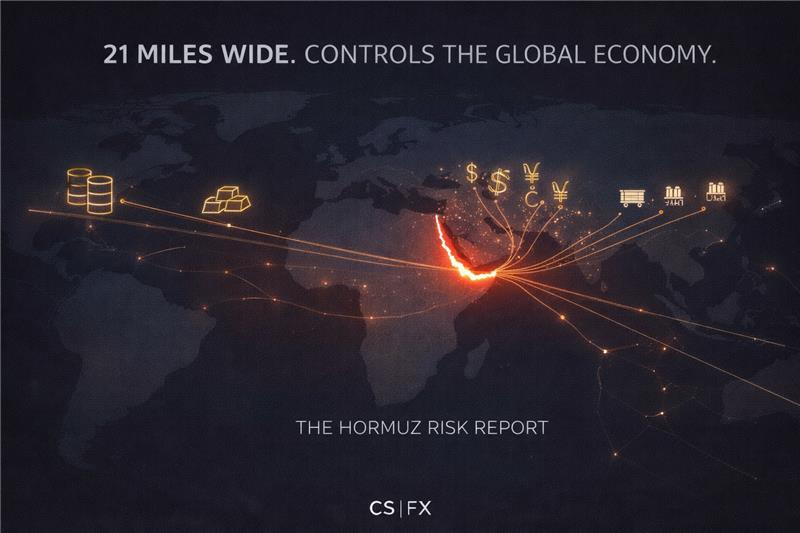
No single geographic feature is more important to your portfolio right now than the Strait of Hormuz — the 21-mile wide waterway between Iran and Oman through which roughly 20% of all the world’s oil and liquefied natural gas passes every day. The strait handles approximately $500 billion worth of energy per year. Crucially, the designated shipping lanes fall entirely within the territorial waters of Iran and Oman.
Transits Daily
Through Hormuz
If Strait Is Closed
Analysts at Capital Economics warned days before the strikes that “strikes on Iran would risk causing oil prices to jump and threaten to boost inflation in much of the world, reducing the pace or number of interest rate cuts by major central banks.” Ole Hansen, head of commodity strategy at Saxo Bank, stated the market was pricing in “the world’s most important oil artery once again sitting within striking distance of a conflict.”
The moment Iran moves to formally close or mine the strait — something it has threatened repeatedly and rehearsed during the February 5th drill — the global oil market enters genuinely uncharted territory. Alternative routes exist but carry 14–21 additional days transit time for Asian refiners, with West African and Arctic supplies unable to rapidly scale to fill the gap. The Saudi East-West pipeline and the UAE Habshan-Fujairah pipeline carry combined capacity of roughly 4.5 million barrels per day — roughly a third of normal Hormuz throughput.
📊 The JP Morgan Bear Case: If Brent is suppressed below $65 for an extended period the cohesion of OPEC+ faces a “major test.” But in a Hormuz closure scenario, JP Morgan’s own strategists estimate Brent could spike above $100 per barrel within days — adding 2–3 percentage points to global inflation and functionally eliminating any prospect of Federal Reserve rate cuts in 2026.
EVERY MARKET YOU TRADE — HOW THE WAR CHANGES THE CALCULUS
🛢 OIL (WTI / BRENT) — THE BINARY TRADE OF THE DECADE
Oil is the most directly and dramatically affected asset class. Before the strikes, WTI sat at $65.21 and Brent at $70.75. Within hours of confirmation, decentralised exchange Hyperliquid showed oil perpetuals surging more than 5%, with one WTI contract trading above $86.00. When regulated CME futures open Sunday evening, traders should expect a significant gap up — potentially the largest since 2022.
The scenario matrix is binary and extreme. Bull case: strikes are precise, Iran chooses not to close Hormuz for fear of losing the war, and oil stabilises in the $75–$85 range. Bear/extreme case: Iran mines or blockades Hormuz — or strikes Saudi Aramco infrastructure — triggering a rapid spike toward $100–$120 per barrel, a global inflation shock, and forced central bank tightening worldwide.
🥇 GOLD (XAU/USD) — THE ONLY SAFE HAVEN THAT HAS ALREADY SPOKEN
Gold above $5,100 — already at an all-time high — is the market’s clearest pre-emptive signal. The metal’s bid accelerated as soon as US-Iran tension became undeniable, with the precious metal rising 2% in a single session to reclaim $5,000 earlier this week. With confirmed war, gold has further structural upside. The next technical target is $5,300. Safe-haven demand is now confluent with inflation fears — as oil-driven CPI acceleration compounds an already overheated Core PCE at 3.0%. Gold is the one asset that benefits from both outcomes: war escalation (safe-haven bid) and negotiated ceasefire (inflationary oil-price normalisation still keeps real rates suppressed).
📈 EQUITIES (S&P 500 / NASDAQ) — GEOPOLITICAL PLAYBOOK MEETS ELEVATED RISK
Historical precedent from prior Middle East conflicts shows equity markets typically sell off sharply on the initial shock, then recover as the rate of escalation stabilises. The S&P 500, which already closed down 1.05% on Friday at 6,878.88 as the pre-war risk-off trade set in, faces a meaningful downside gap Monday morning. Futures markets are closed but early DEX and crypto signals point to 1.5–2.5% potential downside at the open.
Critical distinction: this conflict arrives at an unusually fragile moment for U.S. equities — the Nasdaq is already down 3.2% in February and the IGV Software ETF down 23% YTD. There is no buffer of investor confidence to absorb this shock. If the conflict extends beyond two weeks, the historical analogy shifts from the quick 2019 Soleimani-strike rebound to the structural 2002–2003 Iraq War multi-month drawdown.
₿ BITCOIN / CRYPTO — THE WEEKEND LIQUIDITY TRAP
Bitcoin fell below $64,000 within hours of the strikes — a decline of approximately 3% — as traders used crypto’s 24/7 liquidity as one of the only available exits while equity markets were closed for the weekend. This is the same pattern observed during every prior geopolitical shock: Bitcoin drops first, then recovers once equity markets open and investors can rebalance into traditional safe havens. Short-term traders should expect continued BTC volatility through the Monday open; the medium-term outlook depends entirely on whether the conflict broadens.
💱 FX MARKETS — THE DOLLAR’S COMPLEX WAR LOGIC
The war creates a complex dollar dynamic. The USD is classically a safe-haven beneficiary — a Middle East war triggers flight to USD-denominated assets. However, the tariff-inflation-war trident now facing the Fed means Powell is trapped in a no-cut-no-hike paralysis that caps dollar upside. EUR/USD at 1.17554 may find temporary support as European energy vulnerability (EU imports significant Gulf oil) actually paradoxically reinforces Euro haven flows. USD/JPY near 154.92 is the cleanest safe-haven play — yen typically surges in war environments, meaning this pair could drop sharply toward 150.00 if the conflict escalates. CAD and NOK are oil-linked currencies that should see immediate buying pressure as Brent surges.
| Asset | Pre-Strike Level | Immediate Reaction | Week-1 Scenario Bull | Week-1 Scenario Bear | Signal |
|---|---|---|---|---|---|
| Brent Crude | $70.75 | +5% → $72–74 | $80–85 (no Hormuz closure) | $100+ (Hormuz mined) | LONG BIAS |
| WTI Crude | $65.21 | +5% → $68–70 | $75–80 | $95+ | LONG BIAS |
| Gold (XAU/USD) | $5,100 ATH | Surging, new ATH | $5,200–5,300 | $5,400+ (extreme) | STRONG LONG |
| S&P 500 | 6,878 | −1.5% to −2.5% gap | Stabilise 6,700–6,900 | 5,800–6,200 (prolonged war) | REDUCE / HEDGE |
| Nasdaq Composite | 22,668 | −2% to −3% gap | Recovery 22,000–23,000 | 18,000–20,000 | REDUCE |
| USD/JPY | 154.92 | Yen strengthens | 152–154 | 148–150 (full safe-haven) | SHORT BIAS |
| USD/CAD | 1.36922 | CAD strengthens | 1.33–1.35 | 1.28–1.30 | SHORT USD/CAD |
| Bitcoin | ~$66,000 | −3% → sub $64K | Recovery post open | $55–60K extended war | VOLATILE / AWAIT |
WAR + TARIFFS + PCE 3.0%: THE STAGFLATION-WAR TRIPLE BIND
The war does not arrive in isolation. It lands on top of the most structurally challenging macro environment since 2022 — one defined by three compounding headwinds that are now all pulling in the same inflationary direction simultaneously.
Factor 1 — War inflation: A sustained $20–$30 per barrel increase in oil prices adds approximately 0.4–0.6 percentage points to U.S. CPI within 6–8 weeks, through fuel, transportation, and manufacturing cost pass-through. With Core PCE already at 3.0%, this could push headline CPI back toward 4.5–5% by Q2 2026.
Factor 2 — Tariff inflation: Trump’s 15% Section 122 emergency tariff surcharge, already driving core goods PCE to its highest since 2011, compounds with oil-driven energy inflation to create a dual-front inflation shock that the Federal Reserve has no clean policy response to.
Factor 3 — Labour market deterioration: January 2026 layoffs were already at their highest for that month since the GFC. Block Inc. cut 4,000+ jobs. If war uncertainty causes corporate hiring freezes — standard behavior during sustained geopolitical risk — the Fed faces the ultimate policy nightmare: rising inflation AND rising unemployment simultaneously. The Fed cannot cut. The Fed cannot hike. The Fed is frozen.
🔴 The Stagflation Trap is now fully operational. War-driven oil inflation, tariff-driven goods inflation, and deteriorating employment are converging in March 2026. The historical precedent most analogous to this configuration is 1973 — the Arab oil embargo — which produced a decade of stagflation and destroyed two bull markets. This is the scenario every experienced portfolio manager is now stress-testing.
8 CRITICAL WAR CAUTIONS
FOR TRADING THIS WEEK
Non-negotiable risk protocols every professional trader must apply immediately
STRATEGIC OUTLOOK: 4 SCENARIOS FOR THE WEEK
How each plausible war trajectory maps to specific market outcomes
Iran Closes / Mines the Strait of Hormuz
The black-swan-that-isn’t-a-black-swan. If Iran weaponises the Strait, Brent surges past $100 within 48 hours. Global CPI adds 2–3% within 60 days. The Federal Reserve is frozen — it cannot raise rates into a war recession, nor cut into a 5%+ inflation print. S&P 500 targets 5,800–6,200. USD/JPY collapses to 148. Gold spikes toward $5,500. This is the scenario every oil and energy trader is now pricing as a live probability — not a tail risk.
Short War — Iran Strikes Back But Avoids Hormuz
Iran retaliates against US bases and Israel with missiles — causing market volatility — but stops short of closing Hormuz, calculating the economic cost is too high. This is the Allianz Global Investors historical analogue: sharp equity sell-off on day one, partial recovery within two weeks once the maximum escalation threshold is visible. Brent stabilises $80–88. Equities recover to 6,700–6,900 by end of March. Gold consolidates $5,100–5,250. The most probable scenario — and the one for which the playbook is clearest.
Rapid Regime Change / Iranian Military Collapses
Trump explicitly called on Iranians to “take over your government.” Some Iranian citizens were reportedly celebrating the strikes. If a rapid collapse of IRGC command structures occurs — or if a significant popular uprising emerges in Tehran — the conflict could end faster than expected. This outcome is initially bullish for equities (risk-on), bearish for gold and oil. However, political transition in Iran would remain deeply uncertain and is NOT a reliable base case. Markets would price in uncertainty, not clarity.
War + Weak NFP = The Great Fed Pivot Trade
If Non-Farm Payrolls on March 6 comes in below +120K — plausible given January’s historically weak layoff data — AND the war creates recession risk through energy shock, the Fed may be forced to pivot despite inflation at 3.0%+. This outcome would see an explosive rally in long-duration Treasuries (TLT), a significant drop in the USD, surging EUR/USD and AUD/USD, and a violent equity short-squeeze. Smart money is already positioning for this tail scenario with small TLT longs as insurance.