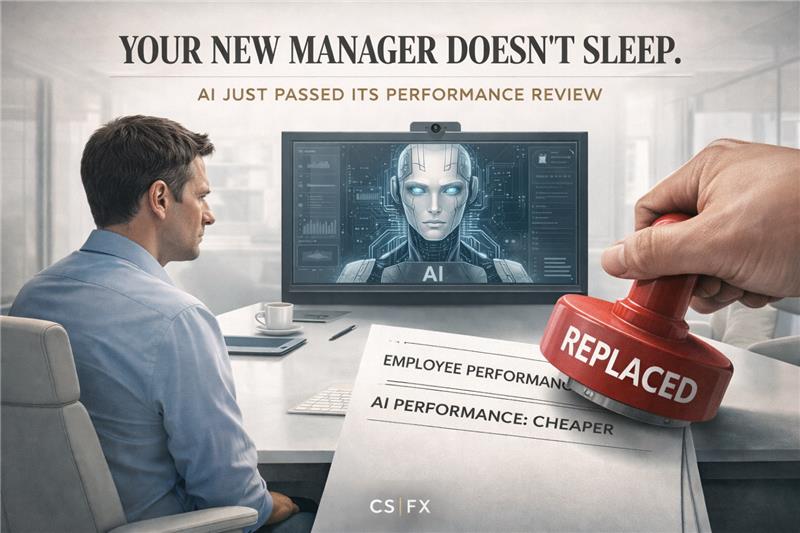
The AI Job Apocalypse Has a Start Date — And Jack Dorsey Just Announced It
The AI Job Apocalypse Has a Start Date —
And Jack Dorsey Just Announced It
Block just fired nearly half its workforce — 4,000 people — and its stock surged 24%. Then Dorsey looked every CEO on earth in the eye and said: “You’re next.” This is no longer a theory, a warning, or a think-piece. The AI restructuring of the global workforce has moved from PowerPoint slides to pink slips. Here’s what it means for every market, every sector, and every portfolio you own.
On the evening of Thursday, February 26th, 2026, Jack Dorsey — founder of Twitter, founder of Block, and a man with a demonstrable talent for sending shockwaves through industries he enters — published a letter to shareholders. In it, he announced he was cutting 4,000 jobs, nearly half of Block’s entire global workforce. He said the company was not in trouble. He said gross profit was up 24%. He said AI had made the cuts possible, necessary, and actually overdue. And then, in the sentence that made every CEO, CFO, and board member in the world quietly put down their evening drink, he added this: “Within the next year, I believe the majority of companies will reach the same conclusion and make similar structural changes.”
Block’s stock surged 24% within hours. The market didn’t just approve — it gave a standing ovation. And in that single data point lies perhaps the most important economic signal of 2026: the market is not afraid of AI destroying jobs. It is actively rewarding it.
Welcome to the era where firing half your workforce is considered a growth strategy. Buckle up — this one is going to affect everything.
Block’s gross profit per employee before these cuts: roughly $500,000. After the cuts, Dorsey is targeting $2,000,000 gross profit per person — a 4x efficiency leap. In the language of Wall Street, this is called “operational excellence.” In the language of the 4,000 people who just lost their jobs, it is called something rather different.
01 — THE EVENT What Dorsey Actually Said — And Why It’s Bigger Than Block
To understand why this story matters beyond one fintech company in Oakland, you need to read the letter carefully. Dorsey didn’t say “we’re cutting jobs because business is hard.” He said the opposite. Block’s Q4 2025 gross profit came in at $2.87 billion — up 24% year on year. Cash App revenue surged 33%. The company is, by every conventional metric, doing well.
The cuts happened not despite success but because of a new kind of calculation. What can we do with half the people, and AI doing the rest? That question is now being run through spreadsheets at every major corporation on earth, and the math is starting to come back looking rather uncomfortable for the approximately 3.4 billion people who currently hold salaried employment.
“Intelligence tools have changed what it means to build and run a company. A significantly smaller team, using the tools we’re building, can do more and do it better. And intelligence tool capabilities are compounding faster every week.” — Jack Dorsey, Shareholder Letter, February 26, 2026
What makes this qualitatively different from previous rounds of tech layoffs is the explicit, forward-looking nature of the claim. Dorsey is not managing a cyclical downturn. He is not correcting for pandemic overhiring alone. He is describing a permanent structural shift in how companies operate — and issuing what amounts to a public warning to every other corporate leader that standing still on this decision is the riskier choice.
“I don’t think we’re early to this realization. Within the next year, I believe the majority of companies will reach the same conclusion.” — Jack Dorsey, Analyst Call, February 26, 2026
What Dorsey is really saying to every other CEO is: “I’ve done the maths. The maths are terrifying. You should do the maths too. And when you do, I’d like it noted for the record that I warned you.” It is the corporate equivalent of shouting “fire!” in a crowded building — except in this version, the building is also appreciating in value as it burns.
02 — THE SCALE This Is Not One Company. This Is a Tidal Wave.
Block is not an outlier. It is the most dramatic recent example of a trend that has been building with accelerating force through 2025 and into 2026. The data tells a story that is difficult to look away from.
AI was responsible for almost 55,000 layoffs in the United States in 2025, with overall job cuts topping 1.17 million — the highest level since the pandemic year of 2020. And 2026 is already running hotter. So far in 2026, there have been 132 layoffs at tech companies affecting 51,330 people — a pace of 870 people per day. At that rate, 2026 will exceed 2025’s total before summer.
The roll call of companies that have cited AI as a factor in workforce reductions reads like a Fortune 500 attendance list: Amazon (30,000 cuts across 2025–26), Microsoft (15,000), Salesforce (5,000), Accenture (11,000), Citigroup, Dell, Intel, TCS (12,000), and UPS — with at least eight companies announcing AI-related layoffs affecting more than 10,000 employees each.
And it’s no longer just tech. Law firm Baker McKenzie is laying off between 600 and 1,000 employees — up to 10% of its global workforce — as part of a shift toward AI, with cuts primarily affecting support staff in research, marketing, and secretarial functions. When law firms start citing AI as a restructuring rationale, you are no longer in a tech-sector story. You are in an economy-wide story.
| Company | AI-Linked Cuts (2025–26) | Stock Reaction | Key Quote |
|---|---|---|---|
| Block (XYZ) | 4,000 (40% of workforce) | +24% | “Majority of companies will follow within a year” |
| Amazon | ~30,000 (2025–26) | Stock near highs | “AI enables leaner structures and faster innovation” |
| Salesforce | ~5,000 | +18% YTD | “AI handles 50% of our workload. I need less heads.” |
| Microsoft | ~15,000 | Outperforming | “Reshaping how work is structured around AI” |
| Klarna | ~50% via attrition | IPO-ready | “We stopped hiring. Attrition did the rest.” |
| Baker McKenzie | 600–1,000 (legal support) | Private | “Improving efficiency through AI across all functions” |
03 — THE MARKET LOGIC Why the Stock Goes Up When the Headcount Goes Down
Here is the central paradox that makes this story so financially significant: every time a major company announces mass layoffs attributed to AI, its stock price rises. Block +24%. Salesforce +18% over the restructuring period. Amazon at all-time highs. The market is not grieving these announcements. It is celebrating them with the enthusiasm of a shareholder who has just discovered their operating margins are about to become considerably more pleasant.
The logic is brutally simple. Labour is a company’s largest cost. If AI can do 40–50% of that labour at a fraction of the price, the resulting profit margin expansion is enormous. A company that generates $10 billion in gross profit with 10,000 employees is worth a certain multiple. A company that generates $12 billion in gross profit with 6,000 employees — and declining cost per output unit — is worth a dramatically higher multiple. The market is doing this maths in real time.
The uncomfortable flip side, which the stock market is currently choosing not to price, is what happens to consumer spending when enough people lose their jobs simultaneously. Workers are also consumers. And consumers are the foundation of corporate revenue. At some threshold — not yet reached, but theoretically approachable — the efficiency gains from AI layoffs begin to cannibalise the consumer demand that was generating the revenue in the first place. As CNBC’s Steve Sedgwick put it, “the news from a medium-sized tech payments company might have longer-term tremors and be a warning of societal upheaval far greater than other stories of the week.”
◆ A 4x efficiency improvement in gross profit per employee is the stated goal. The bar above is not a typo.
04 — THE HISTORY We Have Always Been Here Before. It Has Never Been Quite Like This.
Every generation of technology has come with its own version of “this time the machines will take the jobs.” The Luddites smashed textile looms in 1811. Economists worried about mechanisation destroying agricultural employment in the 1920s. The 1950s brought the first wave of office automation anxiety. The 1990s and 2000s saw manufacturing jobs migrate to automation and offshoring on a massive scale.
In each case, the pessimists were half-right. Jobs were destroyed. Entire categories of work disappeared. And new jobs emerged — different ones, often better ones, eventually. The canonical economist’s answer to AI displacement is the same one that has survived every previous technological revolution: “Trust the market. New jobs will emerge. The productivity gains will lift all boats.”
The reason 2026 feels different — and why it is generating genuinely novel anxiety among economists who have defended every previous wave — is speed and scope. Previous automation took decades to propagate across industries. The textile revolution ran for 50 years. Manufacturing automation moved over 30 years. This wave is compressing the displacement cycle into months. Microsoft AI chief Mustafa Suleyman warned that white-collar workers have a year to 18 months before they face widespread job displacement. Former presidential candidate Andrew Yang and JPMorgan Chase CEO Jamie Dimon have concurred.
| Technology Wave | Jobs Disrupted | Displacement Timeline | New Jobs Created | S&P 500 Reaction |
|---|---|---|---|---|
| Industrial Revolution (1800s) | Agricultural, craft labour | ~50 years | Factory, infrastructure | Long-term boom |
| Electrification (1900–1930) | Manual industrial | ~30 years | Services, engineering | Roaring 20s (then crash) |
| PC / Automation (1980–2000) | Clerical, data entry | ~20 years | Software, knowledge work | Tech bull market |
| Offshoring (2000–2015) | Manufacturing, call centres | ~15 years | Uneven distribution | Volatile, sector-dependent |
| AI Wave (2024–?) | White-collar, knowledge work | 18–36 months | Unknown | Short-term bullish · Risk: demand shock |
What makes the current wave structurally distinctive is the type of jobs being disrupted. Previous automation largely replaced physical, repetitive labour. This wave is targeting cognitive, white-collar work — the very category that previous disruptions created as a refuge. When the jobs created to replace the last round of automation are themselves being automated, you have entered genuinely uncharted territory.
For decades, the advice to every displaced worker has been “retrain, go to university, get into knowledge work.” In 2026, entry-level hiring at big tech companies has dropped by more than 50% over the last three years, and among 400 graduating students at one Indian technology institute, fewer than 25% have secured job offers. The ladder that everyone was told to climb has had several rungs quietly removed. Nobody left a note.
05 — MARKET IMPACT What Every Asset Class Is Now Calculating
This is not simply a story about employment. It is a story about the repricing of every major asset class as the market simultaneously celebrates AI efficiency gains and begins — slowly, reluctantly — to contemplate the demand-side consequences of mass labour displacement. Both things are happening. They are pointing in opposite directions. Markets are currently choosing to weight the first and ignore the second. That may not last indefinitely.
◆ Data compiled from Bloomberg, CNBC and Reuters. 5-day post-announcement window. Not all moves solely attributable to layoff news.
06 — THE REAL RISK The Number Nobody Is Pricing — Yet
Here is the scenario that the current bull market in AI efficiency stocks is implicitly dismissing: what happens when the displacement becomes non-trivial as a share of consumer spending power?
The US economy is approximately 70% consumer spending. Consumer spending requires consumers with income. If AI-driven restructuring simultaneously: reduces labour income at scale; concentrates productivity gains in capital holders (shareholders); and displaces workers faster than new job categories emerge — then the efficiency gains being celebrated on Wall Street today begin to undermine the revenue base that made those gains valuable in the first place.
This is not a fringe concern. A Citrini Research report that went viral modelled a scenario in 2028 where unemployment tops 10% and the S&P 500 tanks as consumer demand collapses faster than AI productivity gains compensate. Most mainstream economists consider that extreme. But the distance between “extreme” and “possible” has been shortening considerably in 2026.
| Scenario | AI Adoption Rate | Unemployment Impact | S&P 500 (3yr View) | Probability |
|---|---|---|---|---|
| Productivity Paradise | Gradual, managed | New jobs absorb displaced | +25–35% | 25% |
| Efficiency Boom (Base) | Rapid at white-collar level | +1–2% structural rise | +10–20% | 40% |
| Displacement Lag | Very fast, uneven | +3–5%, concentrated | Flat to -10% | 25% |
| Demand Shock | Sudden across all sectors | +7–10% | -20 to -35% | 10% |
07 — THE BOTTOM LINE What the Intelligent Investor, Trader, and Human Does Right Now
Jack Dorsey’s letter on February 26th, 2026 will likely be remembered as a defining document in the history of AI’s economic impact — not because Block is the biggest company, but because it was the first time a founder of genuine credibility, running a business in genuinely good health, publicly stated that the restructuring was not a crisis response but a competitive necessity. And that everyone else should expect to follow.
For traders and investors, the near-term playbook from this story is relatively clear: long AI infrastructure, long lean-operating-model tech, cautiously short traditional staffing and labour-intensive services, and beginning — just beginning — to build positions in the sectors that will benefit from the political and fiscal response that mass displacement will eventually trigger: retraining infrastructure, social safety net expansion, and the productivity-tool companies that enable the new leaner workforce to operate.
For the broader economy, the honest answer is that nobody knows the precise destination of this transition. What history does tell us is that technology transitions of this scale are neither purely creative nor purely destructive — they are both, simultaneously, at different speeds, for different people. The Industrial Revolution created enormous wealth and enormous suffering. The digitisation of the 1990s lifted billions and left others structurally behind. This wave will likely do the same, only faster.
The question that Jack Dorsey’s letter has placed on every boardroom table is no longer whether AI will restructure the global workforce. It is whether boards have the courage — or the competitive pressure — to act now rather than wait for the moment when acting feels unavoidable.
Based on the last 48 hours of market data, Wall Street has already made its bet.
Jack Dorsey ended his letter to employees with an acknowledgement that the layoff process might “feel awkward.” He wrote: “I’d rather it feel awkward and human than efficient and cold.” This is a genuinely thoughtful sentiment. It is also a sentence written by someone who just told 4,000 people they’re out of a job by email and X post. The gap between the aspiration and the mechanism is, shall we say, rich with irony — and is probably something the 4,000 people in question are currently reflecting on at some length.
◆ DATA SOURCES: Bloomberg · Reuters · CNBC · CNN Business · Fortune · VentureBeat · Challenger Gray & Christmas · RationalFX · TrueUp Layoffs Tracker · InformationWeek · Congressional Report on AI Jobs Impact (2025) · Programs.com AI Layoffs Database · SF Standard · Spokesman-Review · Oxford Economics