The Inflation Monster Is Back — And It Brought Tariffs
The Inflation Monster Is Back —
And It Brought Tariffs to the Party
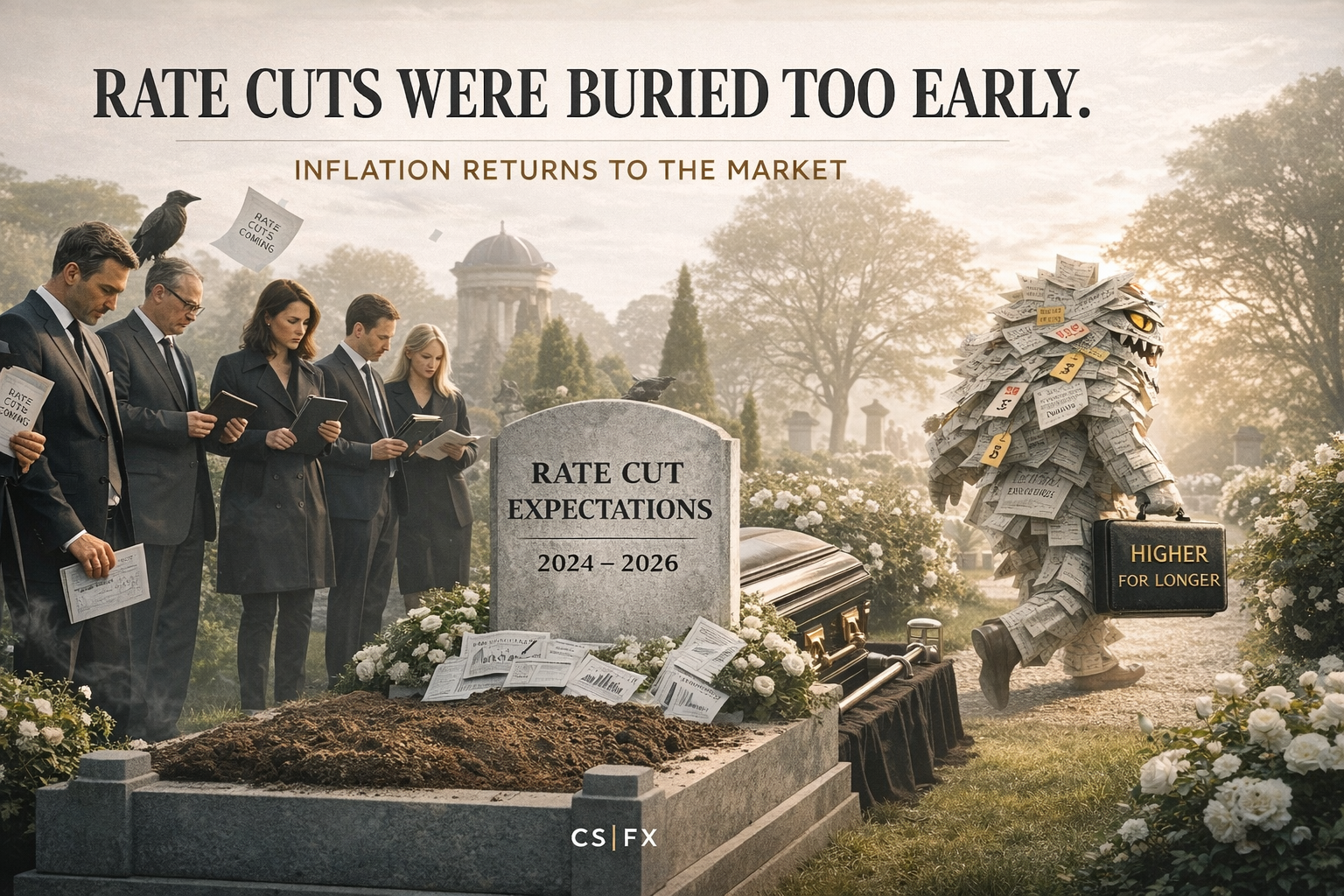
Core PCE just hit 3.0%. Jerome Powell is on his way out. Kevin Warsh is waiting in the wings. And someone just strapped a 15% global tariff belt to the whole thing. Welcome to the most complicated inflation story since the 1970s — and why it could reprice every single asset you own.
Picture the scene: You’ve spent two full years convincing yourself that inflation was dead. You held your rate-sensitive stocks, you bought bonds, you told your dinner party friends that the Fed had “engineered the most elegant soft landing in modern history.” You felt smart. You felt vindicated. And then, on February 20th, 2026, the Bureau of Economic Analysis quietly released a number that rearranged the furniture in your entire financial worldview.
Core PCE — the Federal Reserve’s preferred inflation gauge, the thing that’s supposed to be less volatile, calmer, the sensible adult in the room — came in at 3.0% year-over-year. A full percentage point above target. The “Supercore” metric (services excluding energy and housing, the Fed’s favourite internal obsession) surged 0.6% in a single month — its sharpest jump in nearly a year, driven by a 6.5% spike in airline fares and accelerating medical costs.
If you’re wondering why markets are having what can only be described as a collective existential crisis this February, you now have your answer.
The Fed’s 2% inflation target is now so far away, it’s starting to look less like a goal and more like a pleasant memory — the kind you tell your grandchildren about. “Back in my day, a cup of coffee only cost 3% more than last year.”
01 — THE DATA What “3.0% Core PCE” Actually Means for Your Portfolio
Numbers need context. So let’s zoom out. The Fed’s stated target is 2% annual inflation. They’ve been “close to” this target for roughly 18 months, teetering between 2.6% and 2.9%. Markets had priced in two to three rate cuts in 2026. Traders were as happy as pigs in a low-rate environment. Then this report arrived and reminded everyone that complacency is the market’s most expensive luxury.
What makes this particularly awkward for the Fed is the source of inflation. Goods prices have largely behaved. It’s services — the stubbornly human, hard-to-automate part of the economy — that keeps running hot. When a nurse gets a 6% pay raise and an airline mechanic demands the same, those costs get passed on in your plane ticket. And no amount of quantitative tightening will convince the nurse to accept a pay cut.
“The disinflation process is slower than previously expected.” — FOMC Statement, January 2026
Translation: We thought we’d killed it. We hadn’t. It was playing dead.
02 — THE HISTORY We’ve Been Here Before. It Did Not End Well.
The last time the United States found itself in a genuinely analogous situation, the year was 1972. Nixon had just pressured the Federal Reserve chairman Arthur Burns into keeping rates low ahead of an election. Wage and price controls had artificially suppressed inflation readings. And then in 1973, the Arab oil embargo arrived and detonated the entire carefully constructed fiction. What followed was a decade of stagflation, two recessions, and the eventual volcanic Paul Volcker rate-shock of 1980–82 that pushed mortgage rates to 18% and unemployment to 10.8%.
Is 2026 the same? Not quite — but the rhyme is uncomfortable. The mechanism is different: instead of oil embargoes, we have a 15% global tariff policy adding cost across every import category. Instead of Nixon pressuring Burns, we have a White House nudging for lower rates while PCE sits a full point above target. Instead of Arthur Burns, we are about to have Kevin Warsh — a man whose hawkish resume suddenly makes him the most interesting appointment in global finance.
| Episode | Peak Core Inflation | Fed Funds Rate Peak | S&P 500 Peak-to-Trough | Duration |
|---|---|---|---|---|
| 1970s Stagflation | 12.3% | 20.0% | -48% | ~8 years |
| 1980 Volcker Shock | 11.1% | 21.5% | -27% | ~2 years |
| 2022 Post-Pandemic Surge | 5.6% | 5.5% | -25% | ~18 months |
| 2026 — Current Episode | 3.0% (rising?) | 3.50–3.75% | TBD | Ongoing |
The good news: we are nowhere near the extremes of the 1970s or even 2022. The bad news: the market had priced in the assumption that we were past all of this. Equities in 2025 were not priced for a 3% inflation floor with rate cuts off the table. They were priced for a world where the Fed was your friend. That world is currently under review.
◆ Past drawdowns used as historical reference only. Not a forecast.
03 — THE FED DRAMA The World’s Most Powerful Job Is About to Change Hands
Jerome Powell, who once confidently declared that inflation was “transitory” (before eating those words in the most public fashion since New Coke), departs in May 2026. His replacement: Kevin Warsh, former Fed governor, Wall Street veteran, and a man whose documented history of inflation hawkishness is either precisely what this moment demands or a recipe for a policy overtightening of historic proportions. The market can’t quite decide which.
What makes this genuinely unprecedented is the political texture. The administration has been publicly vocal about wanting lower rates — and yet the inflation data is screaming the opposite. This creates a three-body problem for the new Fed chair: fight inflation (hawkish), please the White House (dovish), or thread an impossibly narrow needle. Bond markets have already started wagering on option one — 10-year Treasury yields dipped below 4% this week as investors piled into safe havens, with US bonds logging their best monthly performance in a year.
The peculiar paradox here is that the same White House applying tariffs (inflationary) is also pushing for rate cuts (accommodative). These two policies are, to put it gently, pulling in opposite directions on a macroeconomic rope with everyone’s retirement account in the middle.
Implementing inflationary tariffs while demanding rate cuts is a bit like setting your house on fire and then complaining to the fire department that the water is too cold. Technically both things are true. That doesn’t mean they solve each other.
04 — MARKET IMPACT Every Asset Class Has an Opinion on This. Here’s What They’re Saying.
Higher-for-longer inflation is not a neutral event for asset markets. It is, in fact, a complete reorganisation of the investment landscape. The 2020–2021 zero-rate era taught investors that cash was trash and duration was king. The post-2022 era reversed that. And 2026 is now asking investors to figure out which world they live in — for the third time in five years.
The critical insight from Figure 3 is the convergence happening in 2026. The Fed cut rates three times in late 2025. Core PCE, instead of following obediently downward, is now rising to meet the rate level. If this trend continues, the “real” interest rate (Fed Funds minus inflation) narrows toward zero — which historically has been the precondition for the Fed being forced back on the hawkish path. Warsh’s inbox in May is going to look like a crime scene.
05 — THE TARIFF WILDCARD Someone Added Gasoline to the Fire. On Purpose.
Here is where the story takes a genuinely novel turn that has no clean historical parallel. Every previous inflation episode — 1970s, 1980, 2022 — was primarily supply or demand driven. What we have in 2026 is inflation being amplified by deliberate trade policy: a 15% global tariff imposed across broad import categories.
Tariffs are, at their economic core, a tax on consumption paid by domestic buyers. When you put a 15% tariff on imported goods, you don’t hurt the foreign manufacturer as much as the marketing suggests. You raise prices for the American consumer. And when you do that while inflation is already sitting stubbornly at 3%, you have created what economists call a “supply-side inflation shock” layered on top of a “demand-side persistence problem.” The technical term for the resulting mood on trading floors is “not great.”
◆ Estimates based on BEA decomposition and Fed research. Tariff contribution is modelled.
The macroeconomic consensus — led by voices at Macquarie Asset Management and echoed by the BlackRock Investment Institute — is that the full economic impact of 2025’s tariff regime is only beginning to “exert itself most forcefully” in early 2026. In other words, the price increases that show up in today’s PCE reading are the early innings. The full effect is still loading.
06 — WHAT HAPPENS NEXT Five Scenarios the Market Is Betting On
In situations of this complexity, the intellectually honest answer is that nobody knows exactly how this resolves. But markets don’t have the luxury of intellectual honesty — they have to price something. Here are the five primary scenarios being traded on in dealing rooms from Dubai to New York:
| Scenario | PCE Path | Fed Response | S&P 500 Impact | Probability (Consensus) |
|---|---|---|---|---|
| Soft Miracle | Falls to 2.2% by Q4 | 1–2 cuts in H2 | +8–12% | 20% |
| Plateau (Base) | Stays 2.8–3.2% | Holds at 3.5–3.75% | Flat to -5% | 40% |
| Re-acceleration | Rises to 3.5%+ | Rate hike possible | -10 to -20% | 25% |
| Stagflation | High + GDP slows | Trapped — can’t act | -20 to -35% | 10% |
| Tariff Reversal | Falls sharply | Cuts aggressively | +15–20% | 5% |
The base case — a 40% probability plateau — is exactly the kind of outcome that is demoralising for equity bulls without being catastrophic enough to drive genuine defensive repositioning. It’s the financial equivalent of a grey, drizzling Tuesday that refuses to become either a sunny day or an interesting storm. Markets hate ambiguity almost as much as they hate actual bad news.
“Washington is showing everyone, markets included, that it will act unilaterally when it sees advantage, and that the post-1945 constraints on great-power behavior no longer hold.” — Adam Irwin, Heligan Group, February 2026
07 — THE BOTTOM LINE What the Intelligent Investor Does Right Now
The 2026 inflation story is not a story about a single number. It is a story about a system under multiple simultaneous stresses — sticky services inflation, tariff-driven cost pass-throughs, a Fed leadership transition with political overtones, and a global order that is, to put it delicately, less cooperative than it was a decade ago.
The playbook that emerges from the historical record and current asset pricing is, in broad strokes, this: prioritise companies with genuine pricing power and fortress balance sheets; be selective about duration in bond portfolios; take seriously the case for international diversification that analysts have been making since late 2025; treat gold’s persistence above $5,000 as a market statement rather than noise; and for the love of everything, stop telling yourself that rate cuts are “just around the corner.”
As for Kevin Warsh — the man inheriting this particular mess in May — the market has only one request: please, whatever you do, don’t call it transitory.
The Federal Reserve’s greatest challenge in 2026 isn’t the data. It’s the fact that the two most powerful forces pulling on monetary policy — inflation screaming “tighten!” and political will whispering “ease!” — have now collided in the inbox of a brand-new Fed chair on his first week. Kevin Warsh didn’t just take the world’s most powerful job. He took the world’s most complicated job, on the world’s worst Monday morning. One hopes he takes his coffee black.
◆ DATA SOURCES: Bureau of Economic Analysis (BEA) · Federal Reserve · Bloomberg Markets · Reuters · BlackRock Investment Institute · S&P Global Market Intelligence · Macquarie Asset Management · Heligan Group · IC Markets Global · Trading Economics · FRED (St. Louis Fed) · The Rio Times Global Economy Briefing