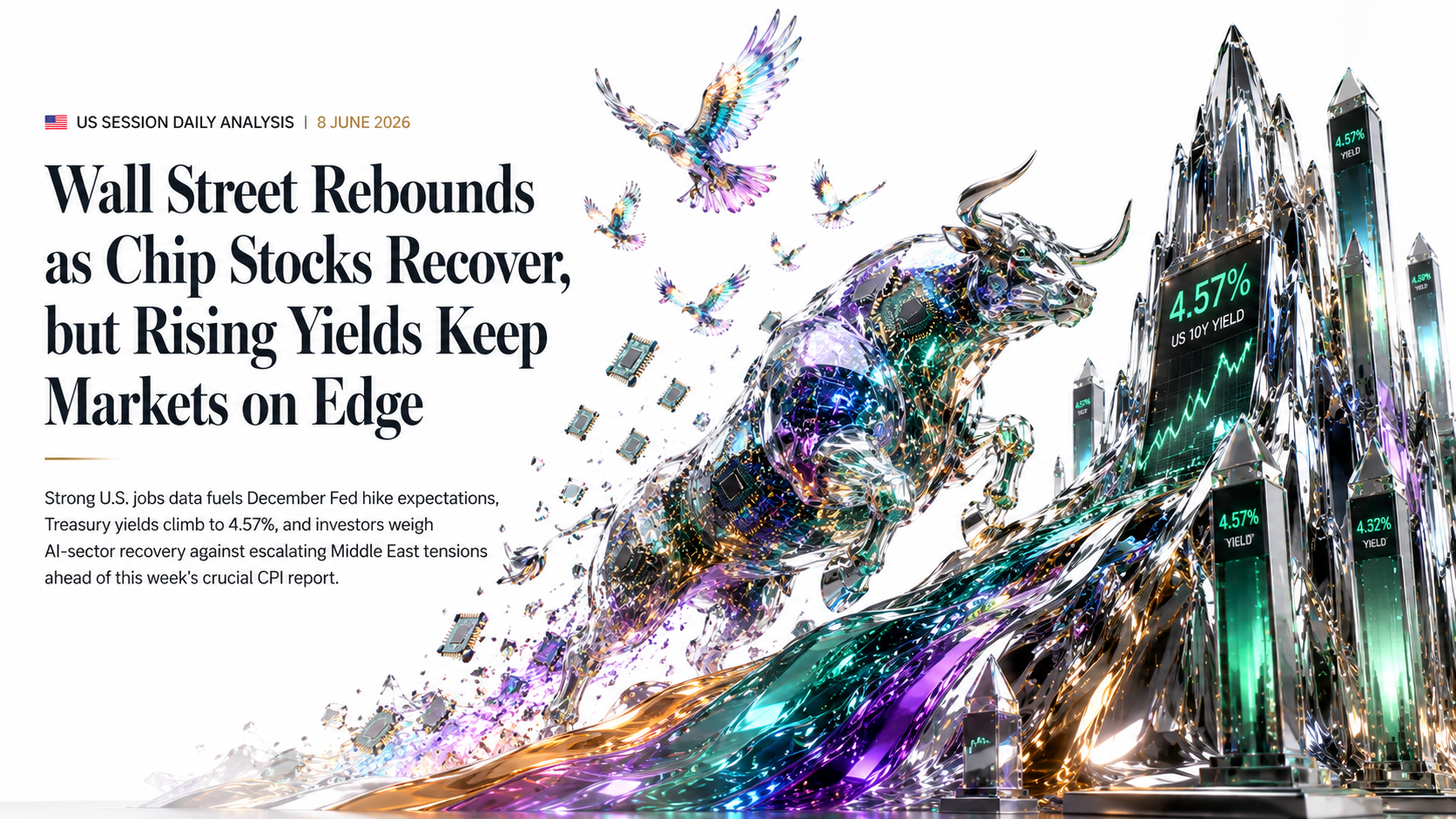
Wall St Rebounds, Yields Spike to 4.57% & Gold Steadies Off 11-Week Low | Technical Analysis – US Session | 8 June 2026
Wall St Rebounds as Chips
Claw Back; Yields Spike to 4.57%
Wall Street opens the new week attempting to stabilise after one of the most violent stretches of 2026: Friday’s session saw the Nasdaq plunge 4.18% — its worst day since the April 2025 tariff turmoil — as a Broadcom-led semiconductor rout wiped roughly a trillion dollars from equity markets, while a far-stronger-than-expected May jobs report sent Treasury yields surging and flipped the Fed conversation from cuts toward a possible December hike. Monday’s tape is a tentative bounce: chip names are clawing back losses, the S&P 500 is up roughly 0.71% near 7,436, and Marvell’s surprise S&P 500 inclusion is providing a sentiment spark — but the 10-year yield grinding to a two-week high of 4.57% and a fresh escalation between Israel and Iran over the weekend keep the rebound on a knife’s edge.
The May employment report is the dominant macro driver of the entire week. Nonfarm payrolls rose 172,000 versus a consensus near 85,000, with March and April figures revised higher, the unemployment rate steady at 4.3%, and average hourly earnings up 0.3%. Economists flagged the upcoming FIFA World Cup — which kicks off in the US on June 11 — as one likely source of the outsized hiring surprise. The print reinforced the view that the labour market remains resilient at a moment when inflation is still running above the Fed’s target, pushing market-implied odds of a December rate hike to roughly 70% from around 50% prior. The new Fed Chair, Kevin Warsh, is still widely expected to hold rates at the June 16–17 FOMC, but the hawkish tilt is now firmly priced.
The catalyst for the equity damage traces to Broadcom’s post-earnings guidance, which failed to lift its AI chip outlook and triggered a cascade across the semiconductor complex on Thursday and Friday. Marvell and Micron plunged roughly 16% and 13% respectively, with Intel and AMD shedding around 11%. SanDisk — one of the year’s most explosive AI-memory winners — fell 11.4% on Friday after touching an all-time high of $1,804 only days earlier. Monday’s chip recovery is being led by buy-the-dip flows and Citi’s decision to raise its year-end S&P 500 target to 8,100, citing continued AI-driven earnings strength.
The third thread is geopolitics and yields working in tandem. Israel and Iran exchanged missile strikes over the weekend, with the IDF confirming airstrikes on Iranian petrochemical facilities, threatening a fragile ceasefire and lifting crude back toward the mid-$90s. Higher oil compounds the inflation narrative that is already lifting the long end of the curve. The result is a textbook risk dynamic: a firmer dollar against rate-sensitive crosses, gold steadying near $4,332 just off an 11-week low, the Swiss franc bid as a safe haven, and a crypto complex trying to carve out a bottom after Bitcoin’s worst week since February. For US-session traders, the interplay of the 10-year yield, oil, and the chip rebound is the dominant theme into the cash open.
US Session Headlines — 8 June 2026
Market-moving events as the New York cash session opens
US Session Trade Set-Ups — 8 June 2026
Entry levels, stops, and targets for the current session

Fundamental Backdrop
USD/CAD is the cleanest expression of two offsetting macro forces. On the USD side: Friday’s NFP beat and the 10-year yield at 4.57% have firmed the dollar broadly and revived December Fed-hike pricing near 70%. On the CAD side: the weekend Israel–Iran escalation has pushed WTI back toward the mid-$90s, and Canada’s commodity-linked currency typically firms when crude rallies — a direct headwind to USD/CAD upside. The pair has consequently coiled into a very tight range. The net result is a market waiting for a directional catalyst: a sustained oil breakout would pressure the pair toward 1.38, while a fresh yield surge or risk-off equity reversal would lift it toward 1.40.
Technical Outlook
USD/CAD is hugging 1.3941 inside a narrow 1.3934–1.3954 daily band after climbing steadily from the late-May low near 1.3784. The pair sits just under the psychologically important 1.40 handle, with the daily signal reading Neutral. Support rests at 1.3900 (the rising 20-day area) and then 1.3850; resistance is layered at 1.3955 (today’s high) and the round 1.4000 figure. A buy-on-dip toward 1.3905 offers a favourable risk/reward into the 1.40 magnet, provided oil does not break sharply higher.
Session Catalysts
Watch for: (1) WTI crude direction on Middle East headlines — the single biggest CAD driver intraday; (2) US Treasury yield momentum, with the 10Y at 4.57% the dollar’s anchor; (3) broad risk sentiment from the chip-led equity rebound. Canada’s macro calendar is light today, so the pair will trade off the USD and oil legs.

Fundamental Backdrop
USD/CHF embodies the tension between a yield-driven dollar bid and the Swiss franc’s role as the market’s premier safe haven. The hot US jobs report and 4.57% 10-year yield argue for dollar strength, but the weekend Israel–Iran escalation and lingering equity fragility keep persistent demand under the franc, which historically appreciates during geopolitical and risk-off episodes. With the SNB maintaining a cautious stance and Swiss inflation contained, the franc tends to absorb global stress flows. Net, the safe-haven bid has the upper hand on rally attempts, even as Monday’s equity rebound provides a temporary risk-on counterweight that could lift the pair intraday.
Technical Outlook
USD/CHF trades near 0.7960, hovering just below the 0.80 round level that has repeatedly capped advances over the past month. The pair sits toward the lower half of its 0.7857–0.8050 monthly range. A rally into 0.8000–0.8020 offers a sell-on-strength setup so long as Middle East risk remains live; a break and hold above 0.8060 would invalidate the bearish lean and open 0.8120. On the downside, 0.7900 is initial support, with 0.7857 (the month’s low) the key target on a sustained safe-haven flush.
Session Catalysts
Key triggers: (1) any escalation/de-escalation in the Israel–Iran conflict — the dominant franc driver; (2) the path of US equities and the VIX, with risk-off favouring CHF; (3) US Treasury yield momentum, which works against the bearish thesis if the 10Y pushes toward 4.65%. Treat the franc as a real-time risk barometer this session.

Fundamental Backdrop
Gold is under a confluence of near-term bearish forces. The blockbuster May jobs report, the 10-year yield’s climb to 4.57%, and the firmer dollar have all raised the opportunity cost of holding non-yielding bullion, driving XAU/USD to an 11-week low last week, with price now steadying near $4,332. The hawkish repricing toward a possible December Fed hike is the proximate trigger. Yet the structural floor remains formidable: central-bank accumulation continues (China added to reserves for a 19th consecutive month), and the geopolitical risk premium from the Israel–Iran escalation keeps a bid under any deep flush. Institutions broadly retain constructive 2026 year-end targets in the $5,200–$6,300 range, framing the current move as a correction within a longer bull structure.
Technical Outlook
Gold has been carving a declining channel for roughly two months, with the decline accelerating after Friday’s payrolls. Price sits below the 100-day moving average and the middle Bollinger band (~$4,545), keeping the near-term bias bearish; the RSI near 40 is weak but not yet oversold, leaving room for further downside before exhaustion. Initial resistance is $4,354 (today’s high) and the $4,545 mid-band; support is the lower Bollinger band near $4,370 — already breached — with $4,270 and then $4,185 the next downside markers. A bounce toward $4,355 is a sell-on-strength opportunity into the prevailing trend.
Session Catalysts
Watch for: (1) Treasury yield and dollar momentum — the primary intraday gold drivers; (2) Israel–Iran headlines that could spark a safe-haven snap-back; (3) Thursday’s May CPI as the week’s pivotal inflation read. A softer CPI would ease yield pressure and could trigger a sharp short-covering rally toward $4,545.

Fundamental Backdrop
Natural gas is caught between a bearish supply picture and a brightening demand outlook. On the bearish side: US Lower-48 production has averaged 108.8 bcfd this month, inventories sit roughly 5% above the five-year seasonal norm, and LNG export flows have softened to around 16.4 bcfd from 17.1 bcfd in May on seasonal maintenance at Golden Pass and Freeport. On the bullish side: weather forecasts point to above-normal US temperatures through June 20, which should lift gas-fired power burn for air conditioning — and front-month futures rallied to a four-month high above $3.30 last week before pulling back. The structure is constructive into the summer cooling season even though today’s tape is soft, with prices up 8.98% over the past month but still 12.76% lower year-on-year.
Technical Outlook
Natural gas eased to $3.13 today, slipping back from the recent four-month high near $3.30. Momentum is short-term neutral after the pullback, with the daily buy/sell signal reading Neutral. Resistance is $3.30 (last week’s high) and then $3.50; support sits at $3.05 and the deeper $2.90 zone. A retracement toward $3.05–$3.08 offers a higher-quality long entry into the seasonal cooling-demand thesis, with a hard stop below $2.92. The NYMEX contract settles June 26, defining the near-term horizon.
Session Catalysts
Primary catalysts: (1) updated US temperature forecasts — any intensification of the June heat signature would accelerate a move toward $3.50; (2) Thursday’s EIA storage report, where a smaller-than-expected build would confirm the surplus narrowing; (3) LNG feedgas flows as maintenance schedules evolve at Gulf Coast terminals.

Fundamental Backdrop
The S&P 500 is rebounding after a violent week in which Broadcom’s underwhelming AI-chip guidance sparked a semiconductor rout that erased roughly $1T from markets, and Friday’s NFP beat sent yields spiking. The index lost 2.64% Friday to 7,383.74 but is up ~0.71% Monday near 7,436 as chip names recover and Marvell’s S&P 500 inclusion (effective June 22) lifts sentiment. The bull case rests on the AI earnings “giga-cycle” — Citi just raised its year-end target to 8,100, projecting $350 EPS in 2026 and $400 in 2027. The counterweight is the rate backdrop: with the 10-year at 4.57% and December hike odds near 70%, multiple expansion is constrained and future gains lean increasingly on earnings rather than valuation.
Technical Outlook
The index closed Friday at 7,383.74 after touching its first-ever 7,600+ close on June 1 (record 7,609.78). The 7,600 zone is now the key overhead resistance and bull target, while support layers at the round 7,300 figure and then 7,180 (the area near Friday’s washout low). Monday’s bounce off 7,380 is a constructive higher-low attempt; a buy-on-dip toward 7,360 offers favourable risk/reward into a retest of the record, with the bullish thesis invalidated on a daily close below 7,200. Momentum is recovering but remains fragile given the yield overhang.
Session Catalysts
Key triggers: (1) the 10-year yield — any push toward 4.65% would cap the rebound and pressure long-duration tech; (2) chip-sector follow-through, with Marvell, Nvidia, and Micron the tape’s pulse; (3) Thursday’s May CPI as the decisive inflation read into the June 16–17 FOMC. A cooler CPI is the cleanest bullish catalyst for a record retest.

Fundamental Backdrop
SanDisk is one of the five largest global NAND-flash suppliers and a marquee winner of the AI-memory boom. Its most recent quarter (Q3 FY26) was a blowout: revenue rose roughly 250% YoY to $5.95B with non-GAAP gross margin expanding to about 78.4% as NAND/SSD pricing surged on AI-driven demand. The Street has chased the story — Susquehanna raised its target to $3,250 and Mizuho reiterated a Buy. The 11.4% Friday drop to $1,559.32 was sector-driven contagion from Broadcom’s guidance miss rather than SanDisk-specific deterioration; the company operates in standard NAND/SSD demand, not the custom-ASIC products at the centre of Broadcom’s softness. The bull risk is valuation (Morningstar flags a premium) and the inherent cyclicality and limited pricing power of commodity-like NAND.
Technical Outlook
SNDK pulled back hard from its June 1 all-time high of $1,804 to close Friday at $1,559.32 (after-hours $1,529.50), and is now bouncing to around $1,615.97. With a beta near 3.23 and ~16% historical volatility, this is a high-amplitude name where position sizing matters more than entry precision. Initial support sits at $1,500 (round level), then $1,450 (the prior breakout shelf); a clean reclaim of $1,650 would signal the flush is being fully absorbed, with the $1,804 ATH and the $1,861 52-week high the upside targets. With price already recovering toward $1,616, the patient play is to wait for a pullback into the $1,450–$1,500 zone to scale in — rather than chasing the bounce — with a hard stop below $1,250.
Session Catalysts
Catalysts: (1) broad semiconductor sentiment and the Nvidia/Micron tape, which dictate SNDK’s beta-driven moves; (2) any incremental analyst commentary (Susquehanna/Mizuho price-target reiterations) following the selloff; (3) NAND spot-pricing and memory-cycle data points. Next earnings is not until Aug 13, so near-term direction is sector-flow driven.

Fundamental Backdrop
Bitcoin is attempting to carve out a bottom after its worst week since February, driven by a record streak of spot-ETF outflows and a rotation of speculative capital toward AI infrastructure equities. It reclaimed the $60,000 handle over the weekend and has pushed through $63,000 — currently around $63,778, up ~4.2% — even as the Israel–Iran escalation injected fresh macro risk; analysts increasingly flag the rising probability of a durable low. The countervailing pressure is the macro backdrop: a 4.57% 10-year yield and December Fed-hike odds near 70% raise the discount rate on risk assets generally. The constructive case hinges on ETF flows turning from outflow to inflow and BTC holding above the $58,000–$60,000 base.
Technical Outlook
BTC has recovered off its 2026 lows near $58,000 and reclaimed $63,000, a tentative higher-low structure now testing the first overhead barrier. Immediate resistance is the $63,000 shelf it is poking through, then the $66,000 supply zone; support sits at $60,000 (the reclaimed handle) and $58,000 (the recent base). A long entry on a pullback toward $60,000 with a stop below $56,500 offers favourable asymmetry into a $68,000 target if the recovery sustains. The decisive tell is whether the move holds above $63,000 through the US cash session and into the European close before fresh risk is added — chasing strength here without an ETF-flow turn is premature.
Session Catalysts
Watch for: (1) daily spot-ETF flow data — a turn to net inflows is the cleanest bottom signal; (2) US equity risk appetite, with the chip-led rebound supportive of crypto beta; (3) Treasury yield direction; (4) any Middle East escalation, which has counterintuitively coincided with crypto resilience this weekend.

Fundamental Backdrop
Dogecoin has bounced about 5% in the last 24 hours to roughly $0.085 alongside Bitcoin’s stabilisation, but the structure remains weak: DOGE is down ~14% over the week and ~56% year-on-year, having recently printed a 52-week low at $0.0778. As a high-beta meme asset, it amplifies Bitcoin’s moves in both directions, so its near-term fate is largely tethered to whether BTC’s bottoming attempt holds. The constructive longer-term wrinkle is regulatory: a March 2026 joint SEC/CFTC framework classified DOGE as a digital commodity, and infrastructure progress (e.g., DOGE gaining access to the Paxos network used by PayPal and Venmo) lends marginal utility credibility. Still, abundant, uncapped supply (10,000 new coins mined per minute) is a perpetual structural headwind.
Technical Outlook
DOGE has been stuck in a multi-week range, with the 14-day RSI near 46.7 — neutral, neither overbought nor oversold. Today’s intraday high near $0.0847 shows buyers attempting to push higher off the $0.078 52-week-low support. The defining technical hurdle is $0.10: a sustained reclaim would shift the structure from corrective to constructive and open $0.12. Until then, the bias is range-bound. A long near the $0.078 floor with a stop below $0.070 offers defined risk into a $0.10 target; the trade is fundamentally a leveraged expression of a Bitcoin recovery.
Session Catalysts
Catalysts: (1) Bitcoin direction — the dominant driver of DOGE beta; (2) broad crypto risk appetite tied to the US equity rebound; (3) any meme-coin rotation flows, which have historically produced sharp single-session spikes; (4) DOGE-specific adoption headlines. Avoid chasing strength below $0.10 without a clear BTC breakout.

Fundamental Backdrop
The 10-year Treasury yield has climbed to roughly 4.57%, a two-week high, in a near-textbook hawkish repricing. May payrolls of +172K (versus ~85K expected) with upward revisions, steady 4.3% unemployment, and 0.3% wage growth signalled a resilient labour market just as inflation continues to run above the Fed’s target. Markets responded by lifting December rate-hike odds to about 70% from 50%. Compounding the move, the weekend Israel–Iran escalation pushed oil higher, embedding an additional inflation premium across the curve. The new Fed Chair, Kevin Warsh, is still expected to hold at the June 16–17 FOMC, but the bias has decisively shifted toward tighter-for-longer, keeping upward pressure on yields (and downward pressure on bond prices).
Technical Outlook
The 10-year yield broke higher out of its recent consolidation and is testing the upper end of its multi-week range at 4.57%. With the 2-year at 4.17% and the 30-year at 5.01%, the curve is upward-sloping and steepening at the long end on inflation-premium concerns. Near-term yield resistance sits at 4.65% and then the psychologically important 4.75%; a yield floor (support for bonds) lies at 4.45%, with a break below 4.40% needed to neutralise the bearish-bond bias. The path of least resistance is higher yields unless Thursday’s CPI surprises sharply to the downside.
Session Catalysts
Key triggers: (1) Thursday’s May CPI — the single most important release for the curve; a hot print accelerates the move toward 4.70%+, a cool print triggers a relief rally in bonds; (2) Treasury auction demand this week; (3) oil prices via the inflation channel; (4) Fed-speak ahead of the pre-FOMC blackout. Equities, gold, and the dollar will all take cues from how far this yield move extends.
US Session Key Events — Week of 8 June 2026
High-impact data and central bank events during the US trading window (times ET)
| Time (ET) | Region | Event | Forecast | Prior | Impact |
|---|---|---|---|---|---|
| Mon, All Day | 🇺🇸US | Chip-Sector Rebound & Risk Sentiment Watch | — | Nasdaq -4.18% Fri | HIGH — EQUITY DIRECTION |
| Mon, All Day | 🌍Mideast | Israel–Iran Conflict / Oil Supply-Risk Watch | — | IDF strikes on petrochem | HIGH — OIL, CHF, GOLD |
| Mon 11:00 | 🇺🇸US | NY Fed 1-Yr Inflation Expectations (May) | 3.2% | 3.3% | MEDIUM |
| Tue | 🇺🇸US | NFIB Small Business Optimism (May) | 99.5 | 100.7 | LOW |
| Wed | 🇺🇸US | 10-Year Treasury Note Auction | — | Bid-to-cover watch | MEDIUM — YIELDS |
| Thu 08:30 | 🇺🇸US | CPI (May, MoM / YoY) & Core CPI | +0.3% / cooling | Above target | CRITICAL — FED, YIELDS, GOLD |
| Thu 10:30 | 🇺🇸US | EIA Natural Gas Storage | Surplus narrowing | ~5% above norm | MEDIUM — NAT GAS |
| Fri 08:30 | 🇺🇸US | PPI (May) & Univ. of Michigan Sentiment (Prelim) | Steady | — | HIGH — INFLATION |
| Thu, 11 Jun | 🌎Global | FIFA World Cup Kicks Off in US (Demand/Hiring Tailwind) | — | Cited in May NFP | MEDIUM — CONSUMER |
| 16–17 Jun | 🇺🇸US | FOMC Meeting (Chair Warsh) — Hold Expected | Hold at 5.25% | Dec hike odds ~70% | CRITICAL — ALL ASSETS |
Frequently Asked Questions — US Session
Analytical answers to the session’s most pressing market questions
US Session Summary — 8 June 2026
Monday’s US session opens as a fragile stabilisation attempt after a week that exposed how quickly the AI-momentum regime can reverse. Friday’s Nasdaq -4.18% — the worst session since April 2025 — was the collision of a Broadcom-led semiconductor guidance scare and a far-stronger-than-expected May jobs report that sent Treasury yields surging and flipped the Fed conversation from cuts toward a possible December hike. Today’s bounce, led by oversold chip names and amplified by Marvell’s S&P 500 inclusion and Citi’s raised 8,100 target, is real but conditional: it is happening with the 10-year yield grinding to a two-week high of 4.57%, which is the very pressure that caused the damage.
The actionable playbook for the US session requires respecting the yield overhang while leaning into selective strength. In equities, the S&P 500 rebound toward 7,610 is buyable on dips to 7,360, but the trade lives and dies by the 10-year — a push toward 4.65% caps the recovery. SanDisk’s 11% flush is a high-beta accumulation opportunity for patient, conservatively-sized longs given the intact $3,250 Street target, but only scaled in across $1,450–$1,550. In FX, USD/CAD is a range trade caught between firm yields and oil-supported CAD, while USD/CHF favours selling rallies toward 0.80 on the safe-haven franc bid. In commodities, gold steadying just off its 11-week low remains a sell-on-strength setup tactically while staying a longer-term accumulation story on deep flushes; natural gas offers a constructive buy-on-dip into the summer cooling-demand thesis despite a soft tape today.
In crypto, Bitcoin’s push through $63,000 (around $63,778) after its worst week since February is the session’s most-watched bottoming attempt — but the decisive confirmation is ETF flows turning positive, not price alone. Dogecoin’s 5% bounce is a leveraged expression of that same BTC recovery and should be sized as the higher-risk satellite, not the core position. The biggest near-term event risks dominating the entire week: Thursday’s May CPI (the swing factor for yields, gold, equities, and the dollar), the path of the Israel–Iran conflict and oil, chip-sector follow-through, and the June 16–17 FOMC under new Chair Warsh. Keep position sizes disciplined into a yield-sensitive, geopolitically charged tape; let CPI define direction; and treat the chip rebound as the pulse of risk appetite.
Access Live US Markets →