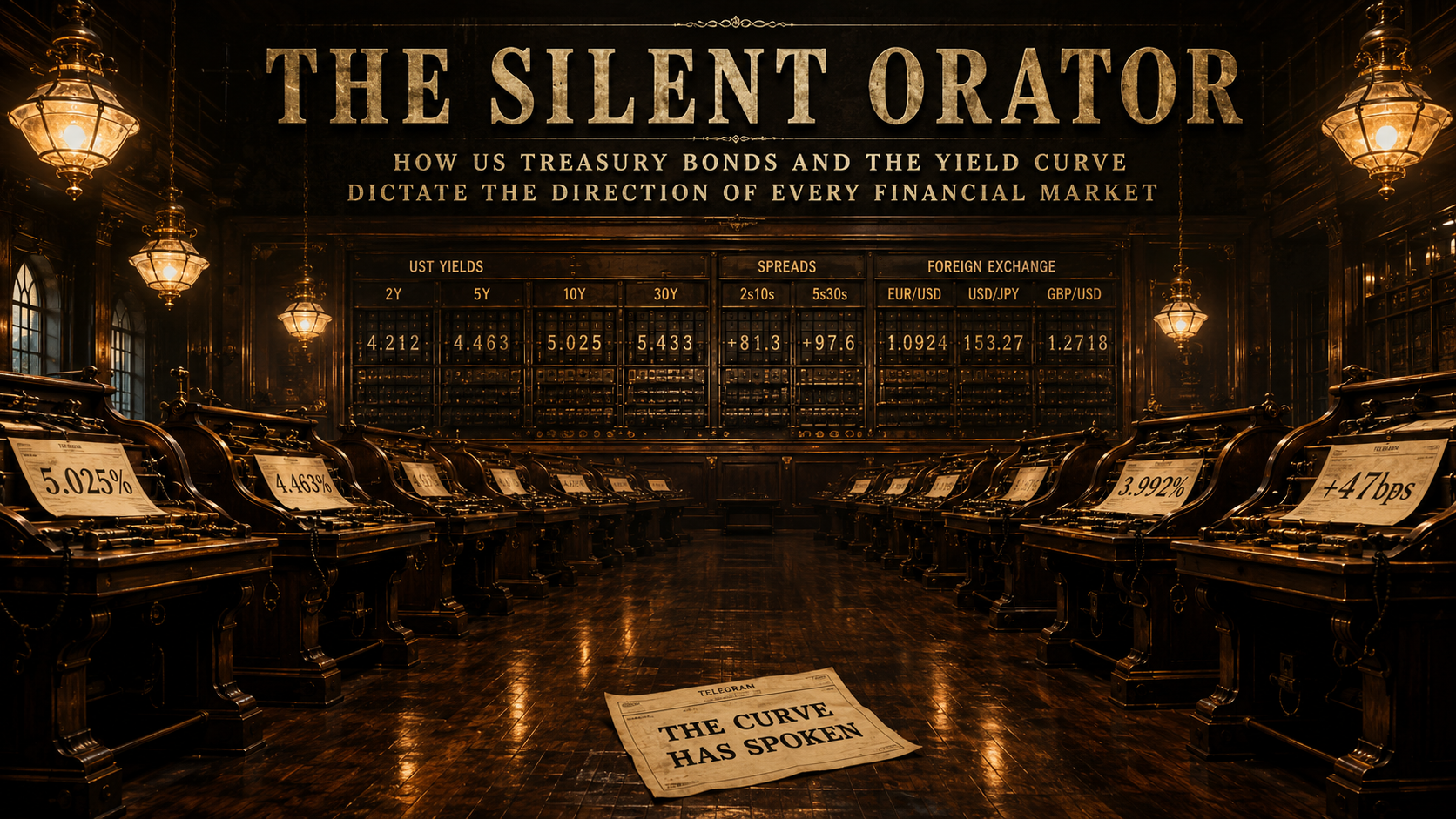
The Silent Orator: How US Treasury Bonds and the Yield Curve Dictate the Direction of Every Financial Market — and What They Are Saying Right Now | Capital Street FX
Orator
| Instrument | Level | Context | What the Yield Is Communicating |
|---|---|---|---|
| US 10Y Treasury | 4.463% | Near multi-year high — fiscal and inflation concerns | Global reference rate — every other financial asset priced from here |
| US 30Y Treasury | 5.025% | First close above 5% since 2007 · CNBC/Tradeweb June 1 | Fiscal credibility gauge — where bond vigilantes price sovereign discipline |
| US 2Y Treasury | 3.992% | Pricing near-term cuts — spread widens to +47bps | Near-term Fed expectations — diverging from long end signals re-steepening |
| 2Y/10Y Spread | +47bps | Re-steepening from −108bps — widest since inversion ended | Pattern that appeared before recessions in 1990, 2001, 2008 — not the all-clear |
| 10Y TIPS Real Yield | ~2.08% | 30Y TIPS: 2.70% · Highest sustained level since 2008 | True cost of money — dominant driver of gold, EM FX, and risk asset valuations |
| DXY Dollar Index | 98.97 | Two-week low — fiscal discount outweighs rate premium | Fiscal and geopolitical discount outweighing rate advantage — unusual divergence |
| USD/JPY | 159.26 | JGB 10Y ~2.70% — near 30-year high · BoJ normalisation ongoing | Carry differential narrowing — $1.1T repatriation risk building |
| EUR/USD | 1.1654 | Near 1-year high · Yahoo Finance June 1 | ECB stable — dollar soft on fiscal concerns — rate spread compressing |
| XAU/USD Gold | $4,542 | Steadied above $4,500 · ATH $5,595 · Investing.com June 1 | Real yield at 2.1% = headwind — fiscal credibility risk = structural floor |
| PCE Inflation | 3.8% YoY | Core 3.3% — softer than expected April — 5th year above target | Iran war energy component keeping inflation elevated — Warsh mandate context |
| Kevin Warsh / Fed Chair | Sworn in 22 May | Lowest Senate votes in Fed history | Neutral rate view: 3.5–4% — structurally higher than any current dot plot |
| Japan Treasury Holdings | ~$1.1T | Declining as JGB yields near 30-year high | Largest single repatriation risk — $220bn+ in play if 20% exits |
Without Words
On the afternoon of Thursday, 29 May 2026, nobody made a speech. Nobody needed to. The US Treasury sold $25 billion in 30-year bonds and the auction cleared at 5.025% — a number that appeared on trading terminals in Tokyo, London, and New York within milliseconds of the hammer falling. No finance minister issued a statement. No central banker stepped to a podium. A single number crossed the wire, and the largest financial market on earth began, without discussion or ceremony, to rearrange itself around it.
That number — 5.025% — was the highest yield on a 30-year US Treasury bond since 2007. The year that ended with Bear Stearns collapsing. The year before Lehman fell. The market that sent that yield was not panicking. It was speaking — in the precise, clipped language it has used for 236 years — about what it sees coming.
This is a market that does not hold press conferences. It does not publish forecasts or give interviews. It does not explain itself or issue clarifications when it has been misunderstood. It communicates entirely through movement: through a number on a screen, through the shape of a curve drawn between short and long maturities, through the relationship between what it costs to borrow money today and what the market believes that money will be worth tomorrow. When it has something important to say, it says it by moving. Right now, it is moving.
The curve that connects two-year and ten-year Treasury yields spent 803 consecutive days inverted — the longest inversion in the recorded history of the modern bond market. Every time this has happened in the post-war era, a recession has followed. Every single time, without exception. The inversion is now over. The curve has re-steepened to +47 basis points — and here is what every trader needs to understand about that: in 1989, 2000, and 2007, this moment — the re-steepening after a prolonged inversion — was read by the consensus as the all-clear. In each of those three cases, the re-steepening was not the danger passing. It was the danger arriving.
There is a new man in the Fed Chair’s office. Kevin Warsh was sworn in on 22 May 2026 — the first Fed Chair since Paul Volcker to inherit a situation where the bond market is not calmly accepting the institution’s authority but actively testing it. He believes the neutral rate is closer to 4% than the 2.5% on every existing dot plot. If he is right, everything built on the assumption that money is expensive right now is built on a miscalibrated foundation. The 30-year yield’s refusal to fall below 5% suggests the market has already decided which view it believes.
and Who Is Obligated to Listen
The yield does not send one signal. Think of it as a radio tower broadcasting on three frequencies simultaneously — and the tragedy of every major financial crisis in this article is that the institutions that suffered most were tuned to only one of them, while the other two were screaming warnings that nobody in the room was receiving.
Channel One: The Level
The 10-year yield is the price the world charges America to borrow money for a decade. Compressed into that single number is everything the market collectively believes about inflation, growth, Fed policy, fiscal sustainability, and geopolitical risk — all at once. When the real yield is positive and high, capital is expensive and leverage is punished. When the real yield is negative, capital is artificially free and risk accumulates in hidden corners of the system until the constraint is removed.
Here is the argument that makes today’s configuration genuinely dangerous: the Fed’s own dot plots assume a neutral rate of 2.5%. Kevin Warsh believes it is closer to 4%. If Warsh is right, the current Fed funds rate of 4.25–4.50% is barely restrictive at all. It only feels tight because every model, every risk system, and every portfolio was calibrated on the assumption that 2.5% was correct. That is not a small calibration error. That is the difference between thinking you are running a fever and thinking you are fine.
Channel Two: The Shape
If the level tells you the price of money, the shape of the curve tells you what the market believes is coming next. An inverted curve — where you earn more lending to the government for two years than for ten — is the market saying something simple and historically reliable: conditions will deteriorate, rates will need to fall, and the economy will slow or something will break. The 2Y/10Y spread has inverted before every US recession since 1955. Every single one. No exceptions in 70 years of data.
The trap is in the re-steepening. When the curve re-steepens after a prolonged inversion, it looks like resolution. In 1989, 2000, and 2007, traders and institutions celebrated the re-steepening as exactly this — the danger passing. Each time it was not the danger passing. It was the danger finally arriving — the short end pricing emergency rate cuts in response to early credit deterioration, while the long end held on fiscal and inflation concerns. Both ends were right. About different things. At the same time.
Channel Three: The Real Yield
Strip out inflation expectations and what remains is the real yield — the true cost of money, the number that governs gold, emerging market currencies, and every risk asset on earth with a precision that nominal yields cannot match. When the real yield is rising, gold faces structural headwinds — every basis point of real yield is a basis point of opportunity cost against holding metal. The current 10-year real yield of approximately 2.1% is the highest sustained level since 2008. That single number is doing more work in the gold market, in EM FX, and in equity valuations than any central banker speech delivered this year.
The current configuration shows an unusual divergence: a high nominal yield but a weakening dollar — suggesting that fiscal concerns are overriding the normal rate-differential logic. When the US dollar weakens despite high rates, the market is pricing something beyond monetary policy: it is pricing institutional credibility risk. This divergence has appeared only three times in the modern dollar era, each time preceding a significant global financial realignment.
“A national debt, if it is not excessive, will be to us a national blessing.” — Alexander Hamilton, 1781
In September 1789, Alexander Hamilton walked into the Treasury Secretary’s office and found a government $75 million in debt, with no central bank, no functioning tax system, and no established credit with any lender on earth. His solution was architectural: assume all state debts, consolidate them into a single class of federal bonds, and establish a creditor class with capital at stake in the republic’s solvency. Within two years, US government bonds were trading at par on the Amsterdam exchange — then the financial capital of the world. Hamilton had established something no founding document could create by fiat: a sovereign credit rating.
Andrew Jackson’s destruction of the Second Bank of the United States in 1832 removed the institutional architecture that managed the relationship between federal credit and money supply. The Panic of 1837 that followed produced six years of depression and seven state defaults. The lesson — that a bond market’s message is only as useful as the institutional infrastructure built to receive it — would not be fully absorbed for another seventy-six years.
and the Panic That Built the Fed
When Abraham Lincoln’s Treasury Secretary Salmon Chase faced the financing of the Civil War in 1861, the scale was without precedent — ultimately $5.2 billion, more than the entire history of US federal spending combined. Jay Cooke sold $362 million in 5-20 bonds between 1862 and 1865 through 2,500 sub-agents across Union states. At the peak of the Civil War bond campaigns, approximately 21 million Americans held government securities. The retail bond investor had been born.
“When a government funds itself by printing money, the yield prices the implicit devaluation instead.”
Capital Street FX ResearchThe Panic of 1907 closed this era. A failed copper corner triggered bank runs across New York. The US Treasury had no mechanism to inject emergency liquidity. J.P. Morgan — then 70 — convened New York’s major bank presidents in his personal library on a Saturday evening and refused to let them leave until they pledged $25 million in collective support for failing trust companies. The spectacle of a private banker deciding which banks lived and died was a political crisis as much as a financial one. The Federal Reserve Act was passed six years later, in 1913.
The Suppressed Message
In April 1942, the Federal Reserve formally agreed to cap Treasury bill rates at 0.375% and 10-year bond yields at 2.5%, committing to buy whatever volume was necessary to maintain those ceilings. Financial repression in its most explicit institutional form. The government had decided it could not afford to finance the war at market rates, and so it directed the central bank to ensure that the yield communicated something other than what the market would naturally say.
The pent-up inflationary pressure was suppressed until the caps were lifted. When the formal Treasury-Fed Accord was signed in March 1951, the reckoning began its slow release. It would take another two decades, and a series of compounding political decisions, before the full consequences arrived.
and the Message Building Beneath
In July 1944, 730 delegates from 44 allied nations gathered at Bretton Woods, New Hampshire and created the post-war monetary order: the US dollar pegged to gold at $35 per troy ounce; all other currencies pegged to the dollar. French Finance Minister Valéry Giscard d’Estaing called it the “exorbitant privilege” — the ability to finance deficits by issuing the currency the rest of the world was obligated to hold.
The Belgian-American economist Robert Triffin identified the structural contradiction in 1960: for the world to have enough dollars for international trade, the US had to run persistent current account deficits — but those persistent deficits would eventually cause foreign governments to accumulate more dollar claims than the US held gold to back them. By 1971, foreign dollar claims exceeded $45 billion against US gold reserves of $12 billion. On the evening of Sunday 15 August 1971, Nixon appeared on television to announce the suspension of dollar-gold convertibility. The yield, freed from its cage for the first time in three decades, had a great deal of suppressed information to communicate.
and Was Ignored
For ten years, from 1971 to 1981, the US bond market said the same thing every single day and was ignored. The 10-year yield climbed from 6% to 15.8% in a straight and unmistakable line. Nine consecutive years of negative real returns for anyone who held bonds. Three presidents — Nixon, Ford, Carter — each received the message and each found reasons to defer the response.
Paul Volcker was appointed Fed Chair in August 1979. He arrived with a conviction that bordered on the unfashionable: that the yield had been telling the truth for a decade, that inflation was real and structural rather than temporary, and that the only honest response was to cause the pain the system had been avoiding since 1971. By 1981, the prime lending rate had hit 21.5%. Volcker was burned in effigy. Farmers drove tractors to blockade the Fed building. Death threats became routine enough that the Fed installed metal detectors for the first time in its history. He did not flinch.
“The 40-year bond bull market that followed Volcker’s intervention was not a gift. It was the reward for the one official in a decade who actually listened to what the yield had been saying since 1971 — and had the institutional resolve to act on it.”
Capital Street FX ResearchInflation broke. From 14.8% in 1980, the CPI fell to 3.2% by 1983. The 10-year yield peaked at 15.8% in September 1981 and began the longest sustained decline in the history of the modern bond market — falling, with interruptions, for 39 consecutive years until it reached 0.51% in August 2020.
The Most Expensive Misreading of a
Unanimous Rate Consensus
By the end of 1993, the US bond market had achieved something remarkable: complete unanimity. Every significant participant — every primary dealer, every major fund, every leveraged account — had arrived at the same conclusion: the Federal Reserve was not going to raise interest rates. The mood was so settled that the phrase “soft landing” had already entered circulation. Duration risk was accumulated as though it were free. Orange County, California, was running a $74 billion investment portfolio built on the certainty that short rates would stay low. The certainty was absolute. And then it wasn’t.
On 4 February 1994, the Federal Reserve raised interest rates by 25 basis points — a surprise move, the first hike in five years. Over the following 12 months, the 10-year yield rose from 5.2% to 8.0% — 280 basis points in twelve months. Orange County declared bankruptcy with $1.7 billion in losses. Kidder Peabody was dissolved. Mexico’s peso moved from 3.4 to 7.2 against the dollar — a 112% move in weeks.
The current rate consensus — zero cuts for the entirety of 2026, with growing probability of a hike — is the most uniformly positioned rate market since 1993. The specific risk is not a surprise hike. It is that economic conditions deteriorate faster than Warsh’s hawkish framework accommodates, forcing a policy pivot that the market is entirely unprepared for.
How Asia Silenced the Yield’s
Warning About the Housing Bubble
Between June 2004 and June 2006, the Federal Reserve raised the Federal Funds rate 17 consecutive times — from 1% to 5.25%. The 10-year yield rose only from approximately 4.0% to 5.2% over the same period. Long-term borrowing costs barely moved. Greenspan called it a “conundrum” in February 2005.
“The yield was not malfunctioning. It was accurately reflecting the actual balance of supply and demand in the Treasury market. What had changed was the identity of the marginal buyer — and the marginal buyer had a political agenda that overwhelmed the Fed’s monetary policy transmission.”
Capital Street FX ResearchChina had joined the WTO in 2001 and was accumulating dollar reserves at $150–250 billion per year. Asian central banks were buying so much of the long end of the Treasury curve that they structurally overwhelmed the Fed’s tightening. The housing bubble inflated not despite the rate hikes but through them, because the transmission mechanism had been blocked by a structural foreign bid that the Fed did not fully comprehend until the damage was done.
The 2007 re-steepening was the yield’s final warning. The 2Y/10Y curve had inverted in July 2006. By spring 2007 it was re-steepening — the short end pricing rate cuts as early housing market stress appeared, while the long end held on inflation and fiscal concerns. The market read this as normalisation. Bear Stearns’ two hedge funds collapsed in June 2007. Lehman Brothers filed for bankruptcy on 15 September 2008.
America’s Crisis Strengthens America’s Bonds
September 2008 produced the most counter-intuitive message in the yield’s 218-year history. Lehman Brothers collapsed. The crisis was American in origin, American in mechanism, and American in its immediate devastation. In a world where financial assets were priced rationally, this should have produced capital flight from US assets. The opposite occurred. The 10-year yield fell from 3.8% to 2.5% in two months. The dollar surged 20%.
The yield was communicating a precise truth: dollar-denominated debt existed on virtually every institutional balance sheet in the world. When assets collapsed and margin calls arrived simultaneously, every institution had to raise dollars — not as a vote of confidence in America, but as pure arithmetic. America was simultaneously the source of the crisis and the destination of the flight from it.
On 22 May 2013, Ben Bernanke mentioned — in a single conditional sentence — that the Fed might at some future point consider tapering its bond purchases. He used the word “taper” once. Over the following three months, the 10-year yield rose 140 basis points. The Indian rupee fell 20%. The Brazilian real lost 15%. The Indonesian rupiah, Turkish lira, and South African rand collapsed simultaneously. Morgan Stanley coined the term “Fragile Five.” Not from a rate hike. Not from actual tapering. From one conditional word in one paragraph of one congressional testimony.
and the Reckoning That Followed
On 4 August 2020, the US 10-year Treasury yield closed at 0.51% — the lowest level in 234 years of American sovereign debt history. The combined fiscal and monetary response to COVID was without peacetime precedent. The US government spent approximately $5 trillion in pandemic relief. The Federal Reserve’s balance sheet expanded from $4 trillion to $9 trillion. The money supply — M2 — grew at 27% year-on-year in February 2021. What followed was inevitable: inflation. PCE reached 7.0% in June 2022. The Fed raised rates 525 basis points in 17 months.
The September 2022 UK gilt crisis demonstrated that the yield’s institutional power had not been diminished by years of suppression. UK Chancellor Kwasi Kwarteng announced £45 billion in unfunded tax cuts. Within 72 hours, the 30-year gilt yield had risen 150 basis points. GBP/USD fell to 1.0382 — its lowest level ever recorded. The Bank of England estimated that without intervention, a systemic failure of the UK pension system was days away. Liz Truss resigned as Prime Minister on 20 October 2022 — 45 days after taking office, the shortest tenure in British history. A budget had been destroyed by the bond market in 72 hours. The bond vigilantes were not extinct.
Now Saying Something Different
The US 2Y/10Y yield curve inverted on 5 July 2022. It remained inverted for 803 consecutive calendar days — 179 days longer than the previous record. For 803 days, the most reliable leading indicator in modern macroeconomics was communicating that economic conditions would deteriorate sufficiently to require rate cuts within the normal 6–24 month window. No recession appeared in the GDP data. The consensus declared victory: the soft landing had been achieved, the yield curve had been wrong for the first time in its modern history.
The consensus was reading the message correctly but misidentifying the context. The reason no recession appeared was that the US government was running fiscal deficits of $1.7–2.0 trillion annually throughout the inverted period — injecting demand that offset, quarter by quarter, the tightening signal the yield curve was sending. The curve was not wrong. It was being counteracted.
the Fed Lets the Yield Speak
Kevin Warsh was sworn in as the 11th Chair of the Federal Reserve on 22 May 2026 with the lowest Senate vote total in Federal Reserve Chair history. He becomes the first Fed Chair since Volcker to inherit a situation in which the bond market is actively testing, rather than passively accepting, the fiscal credibility of the institution he serves.
Three convictions recur consistently through Warsh’s public record. First, that the neutral rate is structurally higher — closer to 3.5–4.0% — than the Federal Reserve’s 2.5% estimate. If this view is correct, current policy at 4.25–4.50% is barely restrictive, and every model built on a 2.5% neutral assumption is operating with a mis-calibrated anchor.
Second, that quantitative easing suppressed volatility artificially and misallocated capital. A Warsh-led Fed will not quickly re-engage QE even under conditions of market stress, absent a genuine financial stability emergency. The “Greenspan Put” that has defined institutional behaviour since 1987 is, under Warsh’s framework, a policy error rather than a feature of well-managed monetary policy.
Third, that forward guidance has systematically damaged credibility. His preference is for data-dependence stated in terms of principles rather than specific outcomes. For the yield, this represents a structural regime change: a Fed Chair who will allow the bond market to discover the appropriate yield level rather than managing toward a target. The yield will communicate more freely, and more loudly when circumstances warrant, under Warsh than under any recent predecessor.
Trump’s public declaration at Warsh’s swearing-in ceremony that interest rates would fall “very quickly” was a political preference, not a monetary policy statement. Warsh said nothing at the ceremony that endorsed this timeline. His first Treasury auction as chair cleared the 30-year at 5.025%.
With PCE at 3.8% and the 30-year back above 5%, there is no room in the long end for perceived Fed capitulation to manifest as anything other than a further yield rise, a weaker dollar, and an acceleration of the fiscal credibility concern already visible in the curve.
and Who Is About to Stop
Of the foreign holders, the most consequential is Japan. Japanese institutional investors have been the largest buyers of long-duration foreign bonds for two decades, and US Treasuries have been their dominant allocation. The rationale was straightforward: JGB yields were zero or negative, making the currency-hedged return on US Treasuries materially higher than domestic alternatives. The Bank of Japan’s progressive normalisation — 10-year JGB yields now at 2.71%, a 30-year high — is closing this differential with mathematical certainty.
| Holder Category | Approx. Holdings | Motivation | Key Risk |
|---|---|---|---|
| Fed (SOMA) | ~$4.5T | Policy implementation — QT reducing from $9T peak | QT pace affects market supply — reversal if crisis |
| Japan | ~$1.1T | Yield premium over JGB — closing fast as BoJ hikes | Largest repatriation risk — $220B+ on 20% unwind |
| China | ~$760B | Reserve management — reduced from $1.3T peak | Geopolitical weaponisation risk — already reducing |
| UK | ~$720B | Financial centre reserve management and hedging | Lower than Japan/China — diversified motivation |
| US Households/Funds | ~$10T+ | Savings, pension, money market — rate-sensitive | Rotation out of bonds into money market above 5% yield |
| US Banks | ~$2T+ | Regulatory liquidity buffers — SVB-type risk | Mark-to-market losses if held to maturity vs sold |
| All Other Foreign | ~$5T+ | Reserve diversification, savings glut | Dollar reserve share declining — structural long-term |
Japan holds approximately $1.1 trillion in US Treasuries. An unwind of 20% — $220 billion in net Treasury selling — would be the largest single bond-market shock since the 2008 crisis. It would not happen in a single day. It would happen over months, in a structural realignment that would need to be absorbed by the remaining set of buyers at current yields or higher. The mechanism is the same as every major yield dislocation in this article: a mandatory buyer whose motivations have changed, and a market that will need to find a new clearing price when they step away.
Each With Specific Trade Setups
Three internally consistent macro scenarios for the next 12–36 months, each mapped to the yield’s current configuration and each generating specific trade implications. Select a scenario to see the full setup.
Warsh’s credibility holds. Core PCE breaks below 3.0% by Q2 2027 as the lagged effects of 525bps in tightening work through the system. The re-steepening is early-cycle rather than crisis-driven. The 10-year yield drifts lower as rate cuts begin in late 2026 or early 2027. The 30-year holds near 5% on fiscal concerns but stops rising. Asset prices recover selectively — bonds perform, equities in rate-sensitive sectors re-rate higher, gold consolidates before rising as real yields eventually fall.
The 803-day inversion was the warning. The re-steepening is the arrival. Credit deterioration in CRE and leveraged loans begins by Q3–Q4 2026. The short end collapses as the Fed cuts emergency-speed. The long end is anchored by fiscal concerns and Japan selling. The yield curve goes from +47bps to +150–200bps not because conditions are good but because the short end has priced an emergency. This is the 1989, 2000, 2007 pattern. The most probable of the three scenarios. Assets that perform: long-duration Treasuries (short end), gold, defensive equities, JPY. Assets that suffer: credit, cyclical equities, EM currencies.
The US debt trajectory — $36.2T at +$1T per 100 days — becomes the dominant market concern. A failed Treasury auction, a credit rating action, or a significant Japan repatriation event crystallises fiscal risk. The 30-year breaks above 5.5% and the dollar falls simultaneously — the UK 2022 Truss moment, at 40 times the scale. The Fed is trapped: cannot cut without accelerating dollar weakness, cannot hike without making the debt service cost worse. Gold surges as the monetary anchor fails. EM currencies with current account surpluses outperform. This is the lowest probability but the highest consequence scenario.
Trade Setups — Mapped to Each Scenario
and How to Listen
The US Treasury market has been speaking for 236 years. It spoke through Hamilton’s first bond issue and through Volcker’s 15.8% yield and through the taper tantrum that moved five currencies simultaneously on the word “taper.” It spoke through 803 days of inversion and it spoke again on May 29, 2026, when a 30-year bond cleared at 5.025% without ceremony or announcement.
The market’s current message, read across all three channels simultaneously, is this: fiscal credibility is being tested, the carry trade’s structural logic is deteriorating, the re-steepening that looks like normalisation has historically preceded deterioration, and the man now running monetary policy believes the economy has been less restricted than everyone assumed.
Whether this resolves as the 1981 Volcker peak — the beginning of 39 years of productive falling rates — or as the 2007 re-steepening trap — the quiet arrival of what was always coming — depends on facts that are not yet in evidence. The bond market has issued its assessment. The role of the trader is to listen across all three channels, track the evidence, and position for the scenario that the data, week by week, confirms.
Trade the bond market’s message with Capital Street FX
Access FX, commodities, indices, and 200+ instruments with up to 1:10,000 leverage and professional execution infrastructure.
Open Account