
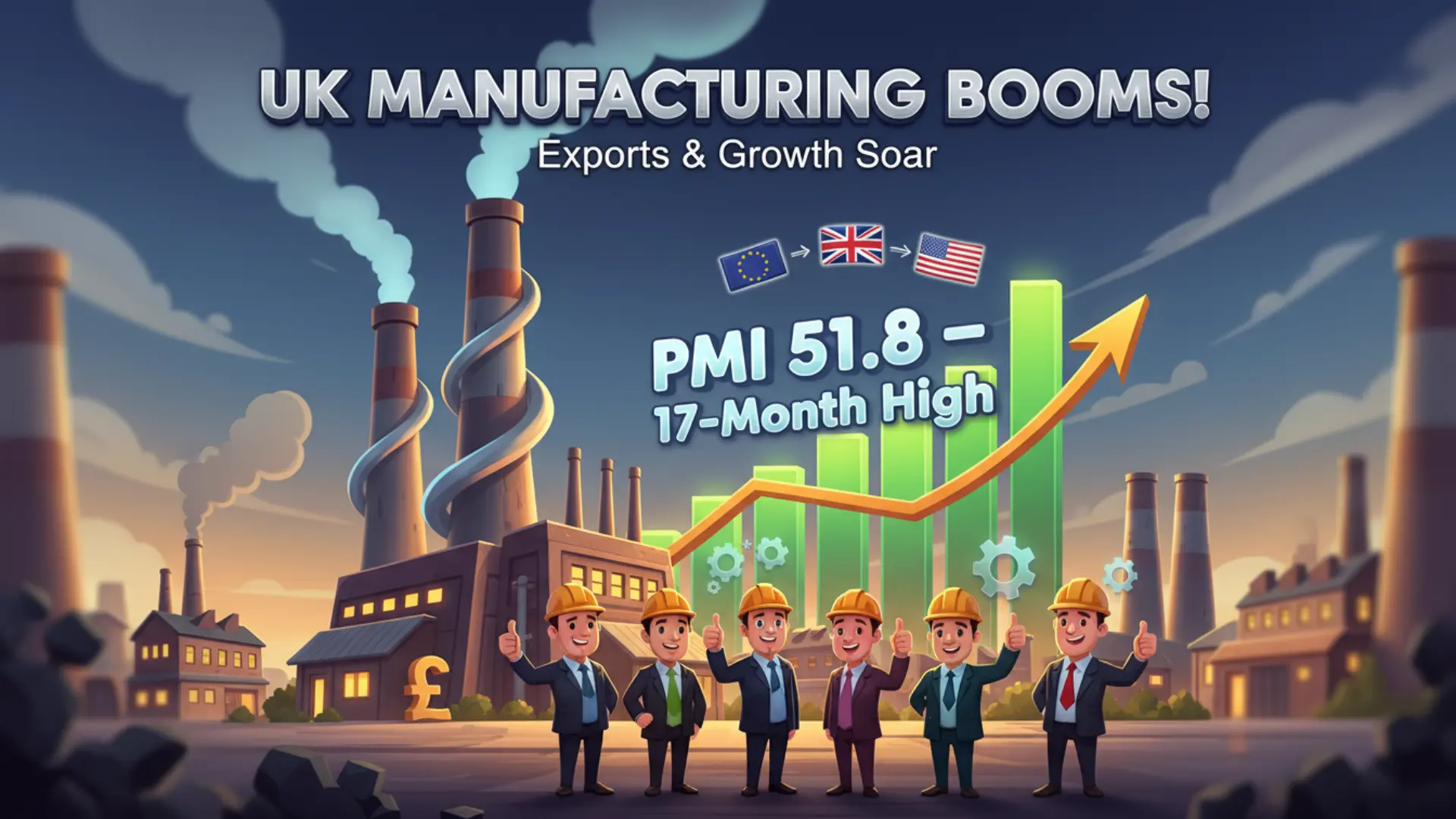
UK Manufacturing PMI Hits 17-Month High, Confidence Rises.
UK Manufacturing PMI Hits 17-Month High as Orders and Confidence Strengthen
Market Overview: UK Factories Start 2026 on Firmer Footing
UK manufacturing showed renewed momentum at the start of 2026, with activity expanding at its fastest pace in nearly a year and a half. The S&P Global UK Manufacturing PMI rose to 51.8 in January, up from 50.6 in December, marking a 17-month high and remaining firmly above the 50 threshold that separates expansion from contraction. The final reading also slightly exceeded the earlier flash estimate, reinforcing the view that conditions improved more than initially expected.
The sustained move into expansionary territory for a third consecutive month suggests that the sector is beginning the year on a more stable footing, supported by stronger demand and improving sentiment across key segments of the economy.
Output and Demand: Growth Broadens, Led by Large Firms
Manufacturing output increased for a fourth straight month in January, matching the pace recorded in October 2025 and delivering the strongest expansion since September 2024. Growth, however, remained uneven across the sector. Large manufacturers were the primary drivers of higher production, while small and medium-sized firms reported a third consecutive monthly decline in output, highlighting lingering challenges for parts of the supply chain.
New orders provided a notable boost, rising at the fastest pace in almost four years. Demand strengthened across consumer, intermediate, and investment goods, pointing to a broad-based recovery in domestic conditions. Export demand also returned to growth for the first time in four years, with manufacturers reporting increased sales to Europe, the United States, China, and several emerging markets. The improvement in overseas orders marks a significant shift after a prolonged period of weakness in global trade.
Business Confidence Improves as Outlook Brightens
Business optimism continued to recover in January, climbing to its highest level since before the 2024 Autumn Budget. Around 58% of manufacturers now expect output to rise over the next 12 months, reflecting a more constructive outlook for the year ahead.
Manufacturers cited expectations of a gradual market recovery, easing geopolitical risks, new product launches, planned capital investment, and stronger export prospects as key drivers of improved confidence. The pickup in sentiment suggests that firms are increasingly willing to look beyond near-term cost pressures and focus on medium-term growth opportunities.
Employment and Costs: Stabilisation Signals, But Pressures Persist
Employment conditions showed tentative signs of stabilisation, even as the sector continued to shed jobs. Headcount declined for a fifteenth consecutive month, but the pace of job losses slowed to the weakest rate over this period. Investment goods producers added staff, indicating confidence in future demand, while intermediate and consumer goods manufacturers continued to reduce employment.
Cost pressures edged higher in January. Both input costs and output prices accelerated modestly, with firms pointing to rising raw material prices and increased supplier charges. Energy, food products, freight, metals, packaging, and plastics were among the key contributors to higher costs. While price pressures remain contained compared with previous peaks, the uptick may complicate efforts to protect margins if demand growth slows.
What Businesses and Markets Are Watching Next
- Whether gains in new orders can be sustained through the first quarter
- Signs that smaller manufacturers begin to share in the recovery
- The impact of rising input costs on pricing power and profitability
- Developments in export demand amid shifting global economic conditions
- Broader UK economic data that could influence investment and hiring decisions
Outlook: Cautious Optimism for UK Manufacturing
Looking ahead, the January PMI data point to a cautiously improving outlook for UK manufacturing. Stronger demand, recovering exports, and rising confidence suggest the sector is gaining traction after a prolonged period of weakness. However, the uneven performance across firm sizes, ongoing job losses, and renewed cost pressures indicate that the recovery remains fragile.
For policymakers and investors alike, the coming months will be critical in determining whether the recent improvement marks the start of a more durable upswing or a temporary rebound driven by pent-up demand.
Summary
UK manufacturing began 2026 with increased momentum, as the PMI climbed to a 17-month high and signaled a third consecutive month of expansion. Stronger new orders, improving exports, and rising business confidence supported the recovery, even as smaller firms and employment continued to face challenges. With cost pressures edging higher and growth still uneven, the outlook has improved but remains cautious.
FAQs
What does the UK Manufacturing PMI measure?
The PMI tracks business conditions in the manufacturing sector, including output, new orders, employment, and prices, offering a timely snapshot of economic momentum.
Why is a PMI reading above 50 important?
A reading above 50 indicates expansion in manufacturing activity, while a reading below 50 signals contraction.
What drove the rise in the PMI in January?
The increase was driven by stronger new orders, improved export demand, higher output, and rising business confidence.
Are all UK manufacturers benefiting from the recovery?
No. Large manufacturers are leading the expansion, while small and medium-sized firms continue to report declines in production.
How could rising input costs affect manufacturers?
Higher costs may squeeze profit margins if firms are unable to pass them on to customers through higher prices.
Disclaimer:
This article is for informational purposes only and does not constitute financial, investment, or economic advice. Market conditions and economic data can change rapidly. Readers should conduct their own analysis or consult a qualified professional before making business or investment decisions.