
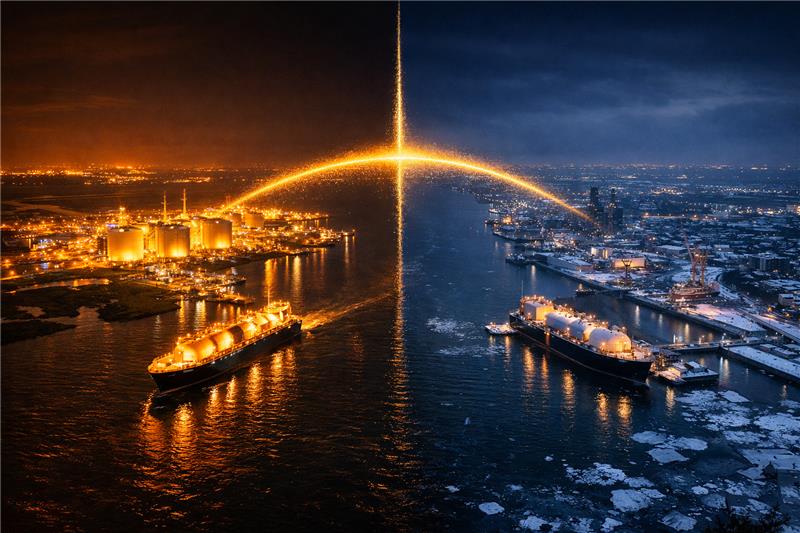
Natural Gas: The Complete Trader’s Guide 2026 — History, Cycles, Geopolitics, Technical Analysis & 2030 Outlook | Capital Street FX
The Widowmaker, the War, and the
Biggest LNG Supply Shock in History:
Natural Gas From 1990 to 2030
From $1.21 to $30.72 in 14 Months — The History of Nine Cycles · How Qatar Became the World’s Energy Pivot · The Shale Revolution That Changed Global Politics · CNG and the Road Transport Revolution · Long-Term Cyclical Technical Analysis · The Dual Chokepoint War · 2026–2030 Medium-Term Outlook

Mar 27, 2026
Jan 23, 2026
Nov 8 & 11, 2024
Forecast (Mar)
Nov 2025
Damaged · Ras Laffan
IEA · By 2030
2026 Target
Somewhere beneath the Persian Gulf, three thousand metres through Permian limestone, lies a geological structure so vast it has reshaped the politics of three continents and the energy accounts of a hundred nations. It is a gas field. Half of it belongs to Qatar — a nation smaller than Connecticut whose population would not fill a medium American city. The other half belongs to Iran — a civilisation four thousand years old with the second-largest gas reserves on earth. Both nations have built their entire modern identities on this shared reservoir. And in the first quarter of 2026, one of them is fighting a war that threatens to deny the world access to the other’s half. That conflict is why a commodity that traded at an all-time low of $1.21 per million British thermal units in November 2024 set a new all-time high of $30.72 fourteen months later — and why the story of natural gas, more than any other tradeable asset, is inseparable from the story of power, geography, and ambition on a planetary scale.
Natural gas does not occupy a single market. It occupies every market simultaneously. It heats homes across four continents, generates 42% of American electricity, feeds the fertiliser supply chain that underpins global food production, fires the furnaces of steel mills and glass factories, supplies the chemical feedstocks from which plastics, pharmaceuticals, and synthetic fibres are made, and powers an expanding fleet of buses, taxis, trucks, and passenger cars through the compressed natural gas infrastructure that is transforming road transport across Asia, the Middle East, and Latin America. When natural gas prices move, the entire industrial economy reprices — not immediately, not in headlines, but with mathematical certainty through every supply chain that uses heat, electricity, or chemical inputs. Understanding natural gas is understanding the circulatory system of the modern world.
This guide tells the complete story. It covers how the market was born, how it developed through nine distinct cycles since 1990, how Qatar turned a geological inconvenience into the world’s most strategically consequential LNG network, how the American shale revolution permanently altered global energy geopolitics, how natural gas became a fuel not just for power stations and heating systems but for the vehicles on the world’s roads, what the long-term cyclical structure of natural gas price action looks like on a monthly and multi-year basis, what the 3–5 year medium-term outlook holds as the largest LNG supply wave in history collides with the Ras Laffan damage and a threatened second maritime chokepoint, and how CFD traders can position themselves intelligently across all of these dynamics.
The Unwanted Fuel: How Gas Became the World’s Third-Largest Futures Market
For the first century of the oil age, natural gas was burned at the wellhead as waste. Drillers across Pennsylvania, Texas, and the Gulf Coast who struck oil alongside methane simply flared the gas — permanent orange flames visible for miles, consuming billions of cubic feet of the world’s most abundant energy source because no one had built the infrastructure to capture it. Gas needs pipes. Oil needs barrels. Barrels are easy. Pipes are not.
The 1891 completion of a 120-mile cast-iron pipeline from Indiana to Chicago proved the concept. By the 1930s, welded steel pipelines carried Gulf Coast gas to northeastern cities. The Natural Gas Act of 1938 established federal oversight and created the regulatory architecture that would dominate the industry for five decades — and would accidentally produce the first major supply crisis of the modern era. By holding wellhead prices below their market value through the Federal Power Commission, Washington suppressed investment precisely when supply was needed most. The 1973 OPEC oil embargo drove demand toward gas as a substitute; the price ceilings prevented producers from responding. Schools closed in winter, factories were rationed, and the most gas-rich nation on earth suffered chronic shortages — not because gas wasn’t underground, but because its own government had made finding it economically irrational.
The Natural Gas Policy Act of 1978 began phased deregulation, completed by FERC Order 636 in 1992. The immediate consequence: producers flooded the market and prices collapsed from approximately $9/MMBtu to $1.50/MMBtu — the first great gas crash, from 1983 to 1986. On January 4, 1990, natural gas futures began trading on the New York Mercantile Exchange, delivered to Henry Hub — a pipeline interchange in Erath, Louisiana, connecting ten major pipeline systems, the physical heartbeat of American gas distribution. One contract: 10,000 MMBtu. One price: discovered by the market, without interference, for the first time. Henry Hub natural gas futures are today the third-largest physical commodity contract in the world by volume, per CME Group. Traders accessing natural gas through a CFD track this benchmark — an instrument that moves the price of food, heats half of America, and sits at the centre of the most consequential geopolitical confrontation of the current decade.
Natural Gas CFD — Instrument Reference for Traders
Nine Acts of the Same Play: The Complete Cycle History 1990–2026
Every major natural gas cycle since 1990 has followed the same dramatic structure: an energy system running near capacity is struck by a single shock — a storm, a war, a technology revolution, a regulatory failure — that overwhelms the market’s buffer. The price responds near-vertically. Then supply recovers or demand falls, and the reversal is at least as fast as the move. The cast changes. The architecture does not. Nine cycles in thirty-six years have all told the same story.
Every major spike shares three structural conditions: (1) a supply constraint that cannot be resolved within days; (2) demand that is inelastic in the short term — households cannot reduce heating in a blizzard; (3) a storage buffer insufficient to bridge the gap. When all three align, the price response is near-vertical. The collapse always follows the same script: supply recovers, weather breaks, every long exits simultaneously. The collapse is always faster than the spike. Trading the exit requires speed, pre-defined risk, and the discipline not to try to catch the peak.
How a Desert Peninsula Became the Pivot of Global Energy
In 1971, a Shell drilling crew working 80 kilometres northeast of Doha completed a well in an offshore structure called the North West Dome. What they found would become the largest natural gas field ever discovered — a reservoir containing more than 900 trillion cubic feet of recoverable gas, sitting in Permian Khuff limestone at three thousand metres’ depth. Qatar’s leadership, dependent at the time on pearl fishing, oil revenues, and British protection, was initially unimpressed. In the early 1970s, Qatar was flaring approximately 80% of the gas it produced as a byproduct of oil extraction. The North Field was classified, essentially, as a problem without a solution. In the words of former Qatari Energy Minister Abdullah bin Hamad al-Attiyah, recalling those years: advisors told Qatar not to go into the LNG business. The country went anyway.
The North Field doesn’t stop at the Qatari maritime border. It continues north into Iranian territorial waters as the South Pars field — the same geological structure, the same reservoir pressure, the same gas. Beneath the Persian Gulf, Qatar and Iran share a single enormous pool. By the 1980s, Qatar had concluded the obvious: if they didn’t develop their half, Iran would drain the shared pressure, and Qatar’s gas would migrate toward the Iranian side. The physics were unforgiving. Qatargas was established in 1984 as a joint venture with ExxonMobil, ConocoPhillips, and Total. In 1989, the decision was taken to build Ras Laffan Industrial City from scratch on the Qatari coast — a purpose-built industrial complex to house LNG liquefaction trains, petrochemical plants, and export port infrastructure. In 1996, the first LNG cargo departed for Japan. By 2006, just ten years later, Qatar had overtaken Malaysia to become the world’s largest LNG exporter. A nation that had been flaring most of its gas in 1970 had become, within a generation, the single most important LNG supplier on earth.
I remember all the people who advised me and my country not to go into the LNG business. Today we will be the biggest in the world. Nobody predicted this. But we proved to the world that we are not only exporting LNG — we will be first, the biggest in the world.
Abdullah bin Hamad al-Attiyah, Former Qatari Energy Minister — reflecting on the North Field development decisionThe strategic implications of Qatar’s rise are the background story of every natural gas crisis since 2010. Ras Laffan — the city that didn’t exist in 1985 — came to account for roughly 20% of all global LNG supply. Europe’s shift away from Russian gas after 2022 was only possible because Qatar was there. Asia’s industrial expansion runs, in substantial part, on Qatari LNG. And Iran — sitting on the other half of the same field, with the world’s second-largest gas reserves — has largely been unable to monetise its South Pars portion due to sanctions, technical mismanagement, and political isolation. Qatar produced approximately 18.5 Bcf/day from its portion of the shared field before the 2026 conflict began. Iran produced approximately 2 Bcf/day from its portion. The same field. A ninefold productivity gap. The result of one generation of contrasting choices about sanctions, technology, and governance.
In March 2026, Iranian retaliatory strikes on Ras Laffan damaged approximately 17% of its LNG export capacity. Two trains with combined capacity of approximately 12.5 million tonnes per annum are heavily damaged and off-line, reducing Qatar’s total operational LNG production from 77 MTPA to an estimated 64.6 MTPA. The North Field East expansion project — which was to add 32 MTPA by end-2026 — has been placed in indefinite suspension. Qatar has declared force majeure and halted all LNG production from the damaged trains. Iran has effectively damaged infrastructure processing gas from a reservoir it co-owns — an act of geopolitical self-sabotage that reveals how completely the military logic of the conflict has overtaken its economic rationality. The global LNG market is structurally short supply for the remainder of this decade as a direct consequence of a single afternoon’s strikes on a city in the Qatari desert.
The IEA’s Global LNG Capacity Tracker (updated March 17, 2026) confirms: “In March 2026, QatarEnergy declared force majeure and halted all LNG production following military attacks on the Ras Laffan facility amid the ongoing conflict in the Middle East. The company also indicated that the start-up of the North Field East expansion project would most likely be delayed from its earlier end-2026 target.” The IEA notes the extent of the delay “remained uncertain as of mid-March and will depend on the duration of the conflict.” This is not an analyst estimate — it is a confirmed operational fact from the world’s energy data authority.
The Molecule That Powers Everything — Including the Road Beneath Your Wheels
Natural gas does not have one job. It has hundreds. Understanding its breadth of application is not background reading — it is the analytical foundation for understanding why every major price move in this commodity transmits through the global economy with a speed and reach that no other energy source can match. A sustained gas price spike is simultaneously an electricity shock, a food cost crisis, an industrial input inflation, a pharmaceutical and chemical cost surge, and — increasingly — a transport fuel crisis that affects road freight, municipal buses, and passenger vehicles across dozens of countries.
The Five Pillars of Global Gas Consumption
Power Generation — The Marginal Fuel for Civilisation’s Lights
Natural gas supplies approximately 42% of US electricity generation and is the world’s primary marginal power source — the fuel that ramps up or down to balance intermittent wind and solar. The IEA found that industry and electricity together drove 75% of global gas demand growth in 2024. Data centre construction — with AI workloads and cloud computing consuming roughly 3–4% of US power today and potentially 12% by 2030 — is creating structurally higher baseload demand that operates independently of weather or heating seasons. Every 1°F of above-normal summer temperature adds approximately 3–5 Bcf/day of additional power sector demand across the US alone.
Fertiliser — The Direct Link Between Gas Prices and Food on Your Table
Natural gas is the primary feedstock for nitrogen fertiliser — ammonia, urea, and UAN — which is the foundation of global agricultural productivity. When gas prices spike, nitrogen fertiliser production costs rise proportionally within 4–8 weeks. The 2021–2022 European gas crisis forced multiple ammonia plants to curtail or halt production, driving global nitrogen fertiliser prices to record levels and contributing to food price inflation across 60+ nations. In 2026, Yara International maintains 25% production curtailments across its European fleet because elevated gas costs make full output uneconomic. Fertiliser accounts for 36% of a corn farmer’s operating costs — the food cascade is already beginning.
Residential Heating — The Demand That Cannot Be Deferred
Natural gas heats approximately 47% of American homes and is the dominant winter heating fuel across Europe, Russia, Central Asia, and the urban centres of South and East Asia. This creates the commodity’s defining demand characteristic: near-zero price elasticity during cold weather events. A family in Minnesota cannot meaningfully reduce gas consumption when it’s –40°F outside. They pay whatever the spot market demands. This inelasticity is why Winter Storm Fern drove prices to $30.72 within days — and why every major cold snap in any gas-heated major economy is a potential market event.
Industrial Process Heat — Steel, Glass, Cement, Ceramics
Natural gas provides approximately one-third of total energy used by US industry. Steel mills, glass furnaces, cement kilns, ceramic production facilities, and food processing plants depend on gas for sustained high temperatures that their production processes require. Most cannot switch fuels quickly — converting a glass furnace from gas to any alternative takes years and costs tens of millions. When gas prices spike, these industries absorb costs until production becomes uneconomic, then curtail. European steel mills began cutting output within weeks of the 2022 gas crisis peaking. Industrial sectors across Europe and Asia are already under margin pressure in Q1 2026 from elevated global gas prices.
Petrochemicals, Plastics and Pharmaceuticals
Natural gas is the chemical feedstock for methanol, ammonia, ethylene (primary plastic precursor), and hydrogen. The bulk chemicals sector is the largest single industrial consumer of gas in the US at 29% of total industrial usage. A sustained gas price shock raises production costs across the entire petrochemical chain — from packaging and containers to pharmaceutical intermediates — with a lag of 4–12 weeks before consumer-facing prices reflect the upstream cost. Every plastic bottle, every synthetic fabric, every blister pack of medication carries within its price a component that traces back to the cost of methane at Henry Hub.
The Sixth Pillar: CNG and the Transport Revolution
The story of natural gas as a road transport fuel is one of the most important and least-reported energy transitions of the past two decades — and it is happening fastest in precisely the countries where gas price volatility matters most to political stability. Compressed Natural Gas (CNG) — methane compressed to less than 1% of its volume at standard conditions and stored in high-pressure cylinders — has become the primary alternative fuel for buses, taxis, auto-rickshaws, heavy freight trucks, and passenger cars across Asia, the Middle East, Latin America, and parts of Europe. The global CNG market was valued at approximately $174 billion in 2024 and is projected to grow at an 11.7–11.9% compound annual growth rate through 2034, reaching approximately $448 billion by 2032, per multiple market research sources.
The driver is straightforward economics. CNG costs approximately 25–40% less per equivalent kilometre than petrol or diesel in most major markets, produces 25% less CO2 than gasoline per kilometre travelled, generates 80% less carbon monoxide, and results in significantly lower particulate emissions — making it attractive both to cost-conscious fleet operators and to governments facing urban air quality crises. Asia Pacific dominates the market, accounting for approximately 48% of global CNG revenue in 2024. India and China are the growth engines: India is aggressively expanding its city gas distribution network, with targets for more than 35 million additional household connections and over 7,000 new CNG filling stations by 2029. China has invested heavily in CNG bus fleets and freight vehicles as part of its urban air quality programme. Iran — in an irony that colours the 2026 crisis — is itself one of the world’s largest CNG markets, having opened 12 new CNG stations across six provinces in February 2025, with a total network of approximately 2,600 stations supporting around 4.4 million natural gas vehicles.
The global CNG market (2024–2034): valued at $174 billion in 2024; projected to reach $448 billion by 2032 at an 11.7% CAGR. Asia Pacific holds 48% of global revenue share. Light duty vehicles account for 63% of CNG market by application; heavy trucks the fastest-growing segment at 13% CAGR, driven by logistics fleet operators seeking diesel cost reduction and compliance with emission norms. India, China, and Iran are the three largest individual CNG vehicle markets. In 2025, TotalEnergies signed a 10-year agreement with India’s Gujarat State Petroleum Corporation to supply LNG from its global portfolio specifically for industrial customers and CNG vehicles — a deal that underscores how LNG supply chains and CNG transport demand are becoming structurally interconnected.
The implications for natural gas price dynamics are significant. As CNG adoption expands — particularly in the transport-heavy, rapidly urbanising economies of South and Southeast Asia — it creates a structural demand increment that is less weather-dependent than heating demand and less economically cyclical than industrial power consumption. A city bus converted from diesel to CNG runs on CNG regardless of whether it’s summer or winter, recession or boom. The millions of auto-rickshaws in Mumbai, the CNG taxi fleets in Beijing, the waste collection trucks in European cities — they consume natural gas continuously, irrespective of the heating season. This structural transport demand is the quiet, growing bedrock beneath the volatile surface of spot price movements. Every percentage point of road transport that converts from petrol or diesel to CNG is an additional permanent demand increment for natural gas that the market’s traditional seasonal models do not fully capture.
The political dimension of CNG is equally important for traders to understand. In countries where domestic gas is priced well below international market rates — India, Pakistan, Bangladesh, Iran — governments heavily subsidise CNG as a public good, keeping it affordable for the urban poor who depend on CNG-powered auto-rickshaws and buses for daily mobility. When international gas prices spike, these governments face an acute political dilemma: absorb the cost through fiscal subsidy (which risks sovereign credit deterioration) or pass it through to consumers (which risks public unrest). The 2022 European gas crisis forced exactly this choice on governments from Pakistan to Egypt. In the current Hormuz crisis, countries that rely on LNG imports for their CNG supply — primarily in South Asia and Southeast Asia — face this dilemma again, with global LNG prices at crisis levels.
CNG transport demand matters to gas traders for three specific reasons. First, it provides a structural demand floor that supports longer-term price levels independently of weather. Second, it means that a gas price spike does not merely affect heating and power costs — it creates political pressure in transport-dependent emerging economies that can trigger subsidy decisions, import policy changes, and LNG tender activity. Third, as CNG fleets grow, the price sensitivity of the transport sector to gas supply disruptions increases — a sustained Hormuz closure would raise CNG fuel costs across Asia within weeks of the LNG cargo disruption, adding political urgency to the conflict’s resolution that goes beyond energy security into urban mobility and public order.
Reading the Market on the Monthly and Multi-Year Timeframe: The Cyclical Structure of Natural Gas
Natural gas is not a trend-following market. It is, at its structural core, a mean-reverting market — one that is governed by known seasonal demand cycles, observable storage dynamics, and the time-delayed response of drilling activity and production to price signals. These forces do not create a market that trends consistently in one direction; they create a market that oscillates — sometimes violently — around a fundamental value range anchored to the cost of production, the level of storage relative to seasonal norms, and the structural supply-demand balance at any given point in the macro cycle. Understanding this cyclical structure on the monthly and multi-year timeframe is the analytical foundation for any CFD trading approach that aspires to be durable — valid not for a week, but for a cycle.
The Annual Seasonal Cycle — Four Phases
The most reliable structural cycle in natural gas is the annual seasonal demand pattern. Research across the 2009–2025 period (the modern shale era) identifies four distinct seasonal phases, each with well-defined historical directional bias, average magnitude, and characteristic trading conditions. These phases are not deterministic — they are probabilistic tendencies that are strongly expressed in most years and occasionally inverted by major structural events (the 2022 Ukraine crisis, the 2026 Fern spike). Their value lies not in their certainty but in their asymmetry: when the seasonal phase is aligned with a fundamental catalyst, the probability of a sustained directional move is meaningfully higher than when they conflict.
Phase 1 · November–February: The Heating Season Premium
Historical analysis of the 2009–2025 period shows natural gas trading an average premium of approximately +20–22% versus the calendar-year average during January alone, reflecting peak heating demand, weather risk, and the proximity of storage withdrawal season. The pattern is consistently the most bullish of the four phases — but also the most volatile in both directions. The most violent moves in gas market history (Uri 2021, Fern 2026, Polar Vortex 2014) occur during this window. The directional bias is bullish, but the risk of being positioned incorrectly during a rapid price reversal is at its maximum.
The optimal entry approach in Phase 1 is not to buy the phase blindly but to monitor the October 31 EIA storage level relative to the five-year average. Storage entering winter 5% or more below average creates the structural vulnerability that translates weather risk into price risk. Storage 5% or more above average provides a buffer that historically dampens even significant cold events.
Phase 2 · February–March: The Winter Selloff
As the heating season approaches its meteorological end, natural gas historically enters its most reliably bearish short-to-medium term window. Prices that have risen on winter risk premium begin to price in improving storage trajectory, recovering production, and the approaching injection season. The 2026 Fern collapse — the March contract falling 26% in a single session on February 2 — is the most extreme expression of this phase in recorded history, but the directional pattern is consistent across the data: buying the end of winter is historically one of the poorest entry points in natural gas, regardless of what the price did in January.
Analytically, the key trigger that confirms Phase 2 is underway is the first week in which weather forecast models shift from cold to neutral or warm for the 8–14 day outlook. The market does not wait for the warmth to arrive — it prices the forecast. CFD traders who are short into this window need aggressive trailing stops, because the early-week forecast releases (Monday and Thursday weather model updates) are the key catalysts, not the EIA storage report.
Phase 3 · Mid-March to Early June: The Spring Rally
Between approximately March 15 and June 10, historical data from the shale era shows an average return of approximately +14% in front-month natural gas futures — the most consistent directional opportunity in the annual cycle. The mechanism is a sentiment shift: winter has passed, storage drawdowns have ended, and summer cooling demand begins to attract attention. Even in years with bloated storage levels, the market historically finds buyers in this window because there is nearly seven months before the next heating season — sufficient time for the market to believe supply can be managed. The best-performing Phase 3 in the data was 2022, when prices soared approximately 92% during this window on Russia-Ukraine supply concerns.
For CFD traders, the Spring Rally phase is statistically the best alignment of seasonal bias with risk/reward. The entry is typically the March/April shoulder season trough — when prices have compressed to their post-winter lows and the market has fully priced out the winter risk premium. The stop is a new seasonal low; the target is the summer cooling season peak in July–August.
Phase 4 · June to October: Summer and Pre-Winter Positioning
The June–August window shows the weakest and most variable directional bias in the annual cycle — historical average returns of approximately –2% across the shale era, with high dispersion. Cooling demand from air-conditioning provides a partial offset to the absence of heating demand, but summer heat waves are geographically and temporally unpredictable in ways that winter demand is not. September and early October then emerge as the historically most reliable pre-winter positioning opportunity, as the market begins pricing the next heating season’s risk premium approximately 6–8 weeks before the storage withdrawal season begins. CME research identifies September as historically one of the most bullish months for natural gas futures on a seasonal basis — a pattern used by systematic traders as an entry trigger for the October–November heating season buildup.
The Multi-Year Cycle — Structural Supply-Demand Rhythm
Above the annual seasonal cycle sits a slower, more powerful rhythm: the multi-year structural cycle driven by the time lag between price signals and supply response. In natural gas markets, this cycle runs approximately 4–7 years from trough to peak in the modern shale era, governed by a mechanics that has been consistent across every major cycle since 2009. The sequence is as follows: sustained low prices suppress drilling activity and reduce rig counts → production growth slows or falls → storage builds are insufficient to offset demand growth or weather events → prices spike → higher prices incentivise accelerated drilling → new supply arrives 12–24 months after the price signal → prices collapse again → the cycle restarts.
Plotting the annual average prices against this framework reveals the cycle clearly. The 2009–2012 trough period (shale supply overwhelming demand) gave way to the 2014 Polar Vortex spike and subsequent 2015–2016 El Niño trough. The 2021–2022 period saw the first major geopolitical disruption to the shale-era cycle, pushing annual averages ($3.84 in 2021; $6.45 in 2022) well above what supply-demand fundamentals alone would have suggested, before the cycle reverted to its structural trough in 2023–2024. The 2024 annual average of $2.21/MMBtu — the lowest inflation-adjusted annual average ever — was consistent with the trough phase of a multi-year cycle. The January 2026 spike, while dramatically amplified by the LNG export sensitivity effect, is consistent with the cycle’s turn: the market needed only a single triggering weather event to move from trough conditions to spike conditions, because the structural vulnerability (inadequate storage buffer, maximum LNG export demand) had been building for 18 months.
The ~250 Trading Day Dominant Cycle
Cycle analysis of daily natural gas futures price data identifies a dominant shorter-term cycle of approximately 250 trading days (approximately one calendar year) as the primary oscillating pattern within the multi-year structural cycle. This annual price cycle is observable across 15 years of data and reflects the fundamental mechanism of the market: storage injections and withdrawals driven by seasonal demand create a repeating approximately-annual oscillation in physical supply-demand balance. At current levels ($3.04/MMBtu), the price is in the trough phase of this annual cycle — post-winter drawdown, pre-summer cooling demand. Cyclical analysis would suggest the next directional impulse phase (when the cycle begins moving toward its next seasonal peak) should begin in the March–June Phase 3 window, consistent with the historical spring rally pattern.
The important caveat for 2026 specifically: the annual cycle is operating within a multi-year structural cycle that was partially reset by the Fern spike and is now subject to the geopolitical overlay of the Hormuz crisis. The annual cycle provides the base probability distribution; the geopolitical overlay provides the potential for the next peak to be significantly above what the cycle’s fundamental mechanics would normally predict.
Resistance: $3.032 (38.2% Fib) · $3.074 (50% Fib) · $3.116 (61.8% Fib) · $3.50–$3.60 (post-Fern base) · $4.00 (EIA forecast anchor) · $4.60 (Goldman target). Support: $2.898 (recent swing low, active) · $2.64 (next major technical support cited by analysts) · $2.00 (bear case target) · $1.21 (all-time inflation-adjusted low). Cyclical context: Price is at the Phase 2/Phase 3 transition point — historically the beginning of the spring rally window. A close above $3.12 with improving weather forecasts would confirm Phase 3 is underway. A close below $2.898 would signal a bear case extension toward $2.64.
Operation Epic Fury and the War That Changed Global Energy
At approximately 2 a.m. on February 28, 2026, US and Israeli aircraft struck military facilities, nuclear sites, and command infrastructure across Iran in Operation Epic Fury. Within hours, the IRGC transmitted warnings via VHF radio to vessels approaching the Strait of Hormuz. By March 2, a senior official confirmed the closure. Tanker traffic fell from 138 ships per day to as few as two in a single 24-hour period. The Hormuz-transiting daily flow of approximately 20 million barrels of oil and a significant share of global LNG had effectively ceased. Iranian retaliatory strikes on Qatar’s Ras Laffan removed 17% of global LNG export capacity. Brent crude surpassed $100/barrel on March 8 for the first time in four years. Goldman Sachs called it “the largest-ever supply shock” in its modelling history.
For natural gas specifically, the EIA’s March 2026 STEO states domestic US prices are “relatively unaffected” by the Hormuz disruption because US LNG facilities are already running near maximum capacity — there is no additional export volume to be pulled from domestic markets. The primary US domestic transmission mechanism is indirect: higher oil prices from the Hormuz crisis incentivise more Permian drilling, bringing more associated gas to market as a byproduct — a modestly bearish force for Henry Hub. The larger direct impact falls on global LNG benchmarks, which have moved to crisis levels, and through the cascade on every industry that depends on them globally.
The Bab el-Mandeb — The Second Front
On approximately March 14, 2026, an unnamed senior IRGC official warned Al Jazeera that Iran “still has many cards to play” and another strait could face “a situation similar to the Strait of Hormuz.” On March 26, The National (UAE) reported Iran explicitly signalling the Bab el-Mandeb — the 30-kilometre-wide gateway between Yemen and the Horn of Africa through which 6–8 million barrels of oil per day and 8% of global LNG trade transit. The two straits are sequential chokepoints on the same energy artery. Hormuz controls the exit from the Gulf; Bab el-Mandeb controls the approach to Europe. Closed simultaneously, the route breaks end to end.
Macquarie analysts are placing a 40% probability on oil reaching $200/barrel by June 2026 if both straits are simultaneously disrupted — a scenario with no post-WWII precedent. Iran’s Houthi allies in Yemen have already demonstrated drone, missile, sea-mine, and fast-boat capabilities sufficient to render Bab el-Mandeb commercially impassable without physical control of the strait — doing exactly this during 2023–2024, before pulling back as a deliberate strategic reserve for the current conflict. As of March 27, 2026, that reserve has not yet been deployed.
| Phase | Trigger | NATGAS CFD Directional Impact | Mechanism | Timeline |
|---|---|---|---|---|
| Current | Hormuz restricted; Ras Laffan 17% damaged | $3.04 — minimal direct domestic impact | US LNG at capacity; no additional export pull | Now |
| Phase 1 | Houthis resume Red Sea attacks; BaM threatened | $3.50–$4.50 (Long) | LNG freight uncertainty; risk premium builds | Weeks 1–4 |
| Phase 2 | Effective Bab el-Mandeb closure; Cape rerouting | $5.00–$7.00 (Long) | Emergency US LNG authorisations; global premium | Weeks 4–12 |
| Phase 3 | Both straits closed; $200 oil scenario | $8.00–$15.00+ (Long) | Energy security panic; force majeure declarations | Months 2–6 |
| Phase 4 | Conflict resolution; ceasefire | $3.00–$4.50 (Short) | Geopolitical premium unwinds rapidly; Qatar repairs begin | Weeks post-ceasefire |
Bab al-Mandeb and Hormuz are sequential choke points on the same artery. If Hormuz is hit, oil struggles to leave the Gulf. If Bab al-Mandeb is blocked, it struggles to reach Europe. If both are hit, the route breaks end to end — that is far more dangerous than either one alone.
Regional Security Analyst — quoted by The National (UAE), March 26, 2026When Gas Prices Move, Every Market Follows
The 2021–2022 European gas crisis is the most complete recent case study of what a sustained gas price shock does to the wider world. Russian supply curtailments drove European gas benchmarks from €26/MWh to €338/MWh between January 2021 and August 2022. But it did not stay an energy story. Within six weeks, European ammonia producers began curtailing output. Within twelve weeks, global fertiliser prices surged. Within six months, global food CPI was approaching multi-decade highs. Within fourteen months, the ECB had raised rates from –0.5% to 2.0% — and kept going. A price move in a commodity that most people couldn’t point to on a chart contributed to the worst cost-of-living crisis in a generation across forty nations. That cascade is already beginning again in 2026.
Stage 1: Power Prices Rise — Immediate
Gas is the marginal electricity fuel globally. A sustained Henry Hub move above $6/MMBtu raises wholesale power prices approximately 15–25% in gas-dependent grids within 2–4 weeks. In 2026, European power prices have already risen sharply as global LNG benchmarks respond to the Hormuz crisis. Aluminium smelters, chlorine producers, and energy-intensive manufacturers are first affected.
Stage 2: Nitrogen Fertiliser Rises — 4 to 8 Weeks
Gas is the primary feedstock for ammonia. In Q1 2026, Yara International is already maintaining 25% European production curtailments due to elevated gas costs. US Midwest fertiliser retailers have temporarily stopped quoting prices — a signal historically associated with acute supply stress and a 6–8 week leading indicator of agricultural commodity price pressure. Fertiliser accounts for 36% of a corn farmer’s costs.
Stage 3: Agricultural Commodity Prices Rise — 8 to 16 Weeks
Higher fertiliser costs reduce application rates and shift planting intentions. Crop yields fall with a one-season lag. Soft commodities (corn, wheat, soybeans) historically respond to a sustained gas price spike within 8–16 weeks. The agricultural commodity trader who monitors gas prices and fertiliser availability holds a 2–4 month preview of what the grains markets will do next.
Stage 4: Food Inflation — 3 to 6 Months
Food constitutes approximately 14% of US CPI and 20–25% of emerging market baskets. The 2022 fertiliser crisis contributed to food CPI hitting 50-year highs across multiple major economies. The 2026 fertiliser market tightening — already showing early-stage stress signals — suggests the cascade is in motion, with the worst food inflation impact likely arriving Q3–Q4 2026.
Stage 5: Central Bank Response and Market Repricing — 3 to 9 Months
Goldman Sachs has already raised its December 2026 US core PCE inflation forecast to 2.5% from 2.4% and cut Euro area GDP growth to 0.7% from 1.0%, citing the energy shock. Central banks tightening into a slowing economy raises bond yields, compresses equity valuations, and increases emerging market sovereign stress. The 2022 ECB rate cycle — from –0.5% to 4.0% in fourteen months — was triggered, in part, by a gas price move. The 2026 cascade is at its early stages.
Stage 6: Industrial Output Contraction — 6 to 18 Months
Industries without fuel-switching capacity — glass, cement, ceramics, specialty chemicals — face sustained margin compression and curtailments. Steel and aluminium producers curtail in Europe first, then Asia. Manufacturing PMIs fall in energy-intensive economies. Industrial metals weaken on demand destruction forecasts. Equity markets in manufacturing-heavy economies — Germany, South Korea, Japan — underperform. The gas trade’s shadow is very long indeed.
European gas: €26/MWh → €338/MWh (Jan 2021 to Aug 2022). Sequential effects: (1) European power +200–400%; (2) European ammonia curtailments reach 40% of capacity; (3) Global urea prices: $280 → $900/tonne; (4) FAO food price index: 50-year high, March 2022; (5) Euro area CPI peaks at 10.6%, October 2022; (6) ECB: –0.5% → 4.0% in 14 months. The gas trader who recognised the cascade at Stage 1 or 2 had 8–12 months of directional opportunity across energy, agricultural, fixed income, and equity markets simultaneously.
The Coming LNG Wave vs. the Qatar Gap: How the Next Five Years Will Play Out
The 3–5 year outlook for natural gas markets is shaped by the collision of two immense structural forces moving in opposite directions. The first is the largest wave of LNG export capacity additions in the history of the industry, concentrated in the United States and (pre-conflict) Qatar, expected to add approximately 300–345 billion cubic metres per year of new liquefaction capacity by 2030 — a 40%+ increase in global nameplate capacity in five years. The second is the permanent impairment of Qatar’s expansion plans, the force majeure on Ras Laffan production, and the structural supply gap created by strikes that will take three to five years to repair. These two forces do not simply cancel each other out — they create distinct market phases within the 2026–2030 period, each with its own dominant dynamic and its own trading implication.
Phase by Phase: 2026 to 2030
Geopolitical Premium + Domestic Oversupply
US Henry Hub trades domestically supplied — record production of 118 Bcf/day with storage at the five-year average entering injection season. The shoulder season (April–May) is structurally bearish for domestic prices. Simultaneously, global LNG benchmarks trade at crisis premiums as Hormuz restricts transit and Ras Laffan is partially offline. The gap between US Henry Hub and global LNG benchmarks is at a historic extreme. EIA forecasts a $3.80/MMBtu annual average; Goldman Sachs forecasts $4.60/MMBtu, with the winter 2026–2027 EIA storage level (November 1) as the critical variable determining whether the year’s second half is bullish or bearish. A cold winter 2026–2027 against an insufficiently rebuilt storage base creates the next major spike risk.
New US Capacity + Ongoing Qatar Gap
The IEA projects approximately 57 MTPA of new LNG liquefaction capacity coming online in 2026 — the highest single-year capacity addition ever — followed by 44 MTPA in 2027. New US LNG projects (Plaquemines LNG, Corpus Christi Stage 3, Golden Pass) will begin ramp-up. However, the Qatar expansion projects remain suspended, and Ras Laffan repairs are at an early stage. The net effect: significant new US LNG supply competes with a structurally reduced Qatari base to supply growing Asian and European demand. Global LNG prices likely ease from 2026 crisis levels but remain elevated relative to the pre-2026 equilibrium. EIA projects $3.90/MMBtu for Henry Hub 2027; Goldman projects $3.80/MMBtu. World Bank projects Henry Hub will “stabilise in 2027 on higher LNG exports.”
Potential Oversupply Period Begins
The IEA projects annual liquefaction capacity additions peaking at approximately 95 bcm/yr in 2028 — the fastest year of the entire wave. If demand growth does not absorb all incremental supply, the IEA notes global LNG markets could face approximately 65 bcm of surplus supply relative to the base case. The IEEFA estimates that by end-2028, global nameplate liquefaction capacity could reach 666.5 MTPA — exceeding IEA’s own long-term demand scenario for 2050 under its stated policies framework. This would be structurally bearish for global LNG prices — and, via the export pull mechanism, modestly bearish for Henry Hub. However, the Oxford Institute for Energy Studies (OIES) challenges the oversupply assumption, noting utilisation rates approaching 92–99% at 2030 are inconsistent with $6/MMBtu gas — real demand response to lower prices would be stronger than base cases project.
Post-Wave Tightening; Qatar Recovery Uncertain
After the peak capacity addition wave of 2026–2028, the pace of new projects slows. The IEA warns that “a prolonged period of lower LNG prices could reduce the incentive for project developers to invest in the sector — leading to a potential tightening of global gas markets post-2030, especially if demand growth follows a higher trajectory.” Qatar’s Ras Laffan repair, expected to complete between 2029 and 2031, begins restoring damaged capacity. The North Field East expansion — originally planned to add 32 MTPA by end-2026 — remains in suspension, with its restart date dependent on the duration and outcome of the conflict. The Oxford Institute estimates market balance in 2030 at approximately $6/MMBtu on a global equivalent basis; if demand surprises to the upside (particularly in Asia, where LNG adoption for CNG vehicles, power, and industry all have upside), tightening could begin before 2030.
The coming LNG wave is set to offer some respite for global gas markets, which have been tight and volatile for several years. As new supply comes to market, notably from the United States and Qatar, it should apply downward pressure on prices — offering welcome relief for gas importers worldwide. But elevated geopolitical tensions and economic uncertainty mean there is no room for complacency.
Keisuke Sadamori, Director of Energy Markets and Security, International Energy Agency — IEA Gas 2025 report launchThe 2026–2027 period is structurally bullish for long natural gas CFD positions on any geopolitical escalation or cold weather catalyst — geopolitical premium is live, Qatar supply is permanently reduced, and US production cannot fill the gap. The 2027–2028 period introduces the LNG supply wave as a moderating force — medium-term shorts on geopolitical de-escalation or warm weather become increasingly attractive as new capacity arrives. The 2029–2030 window reintroduces potential tightening risk as the pace of additions slows and demand grows: the post-wave setup, if demand follows the IEA’s high case, could resemble the 2019–2021 prelude to the current crisis — a tightening that sets up the next major bullish cycle. The multi-year trader’s positioning: long with geopolitical catalysts 2026–2027; gradually shifting toward range-bound or tactical short 2028 peak; watching for the next structural long setup from 2029.
Three Scenarios Across Five Years
| Institution | 2026 Forecast | 2027 Forecast | Key Assumption |
|---|---|---|---|
| EIA (STEO March 2026) | $3.80/MMBtu annual avg | $3.90/MMBtu | Mild Feb; record production — March 10, 2026 |
| EIA (February STEO) | $4.30/MMBtu annual avg | $4.38/MMBtu | Post-Fern storage deficit — Feb 10, 2026 |
| Goldman Sachs | $4.60/MMBtu | $3.80/MMBtu | Higher prices incentivise US production growth |
| World Bank | +11% from 2025 avg | Stabilise | Higher LNG exports support prices — Dec 2025 |
| OIES (Base 2030) | — | — | ~$6/MMBtu global equivalent at 92% utilisation |
| CSFX Base Case | $3.50–$4.50 | $3.80–$4.00 | Normal winter; production growth offsets Qatar gap |
| CSFX Bull Case | $6.50–$8.00 peak | $4.50–$5.00 | Cold winter + BaM closure + Qatar damage compounds |
| CSFX Bear Case | $1.80–$2.50 avg | $2.00–$3.00 | Super El Niño + recession + record production persists |
🟢 Bull Case
Probability: 25%Trigger: Bab el-Mandeb closure; cold winter 2026–2027; LNG export pull at maximum; storage enters winter 5%+ below average. Qatar capacity gap compounds LNG supply wave shortfall.
- Both straits restricted 3+ months
- Heating degree days 10%+ above 30-yr normal
- Data centre power demand adds 5+ Bcf/day summer burn
- Qatar North Field East delayed to 2031+
- 2030 target: $6.00–$8.00 as LNG supply tightens
🔵 Base Case
Probability: 50%Trigger: Hormuz de-escalates within Goldman’s 6-week central scenario; Qatar repair proceeds; US production at records; LNG wave arrives as projected; winter 2026–2027 near-normal.
- EIA: $3.80/MMBtu full-year 2026 average
- Goldman: $4.60/MMBtu convergence point
- LNG supply wave moderates global prices 2027–2028
- 2030: $3.50–$5.00 range as OIES tightening risk builds
🔴 Bear Case
Probability: 25%Trigger: Super El Niño produces warmest winter in 30 years; record production at 118+ Bcf/day; US recession reduces industrial demand 4+ Bcf/day; LNG wave produces genuine oversupply.
- NOAA confirms Super El Niño by October 2026
- GDP below 1%; industrial gas demand falls
- Storage approaches 4.0+ Tcf by November 1
- LNG wave oversupply 2027–2028: new all-time lows possible
Going Long and Short: Four CFD Trade Setups
Before You Trade: The Essential Framework
Natural gas is among the most volatile instruments accessible to retail traders. The February 2, 2026 post-Fern collapse saw the March futures contract fall 26% in a single trading session — at 3% margin, that move represents an 867% loss relative to margin posted. Between 74% and 89% of retail CFD accounts lose money when trading natural gas, per multiple regulated broker disclosures. The commodity rewards informed, disciplined positioning and destroys accounts managed with equity-market assumptions about volatility and timeframes.
Three rules apply to every natural gas CFD position regardless of directional view: one — never risk more than 1–2% of total account equity on a single position; two — define the stop before entry, not after; three — treat every Thursday 10:30 EST EIA storage report as a binary event. A deviation of 30+ Bcf from consensus can move the market 5–10% within seconds of the release. Either reduce position size to half or less before the release, or ensure the stop is wide enough to survive the binary move and still remain directionally valid. These are not suggestions. They are survival rules.
Contango, Backwardation and the Curve
The natural gas CFD tracks the front-month NYMEX Henry Hub futures price. During the injection season (April–October), the forward curve is typically in contango — later delivery months trade above the front month. Long CFD positions in contango carry a daily financing headwind as the reference price rolls to a higher-priced next contract. During supply shocks, the curve snaps into backwardation — the most extreme in history on January 28, 2026, when the February contract settled at $7.46 while March settled at $3.73, a spread the EIA described as “the widest front-month differential since at least 2014.” In severe backwardation, long CFD positions benefit from positive carry — both directional move and roll yield work simultaneously. Understanding which regime the curve is in determines whether the market’s structure is working for or against your position.
Setup 1 · Spring Rally — Shoulder Season Long
Natural Gas CFD · Phase 3 Seasonal EntrySetup 2 · El Niño Warm Winter Short
Natural Gas CFD · Conditional on NOAA El Niño ConfirmationSetup 3 · Dual Chokepoint Geopolitical Long
Natural Gas CFD · Event-Driven; Confirmed Houthi Escalation TriggerSetup 4 · Winter 2026–27 Seasonal Re-Entry
Natural Gas CFD · Medium-Term Seasonal PositionConclusion: The Molecule That Moves the World
The story of natural gas is, at its core, the story of human ingenuity meeting geological reality on a planetary scale. A fuel that was burned as waste for a century became — through deregulation, pipeline infrastructure, and then the most significant energy technology revolution since the internal combustion engine — the commodity that heats half of America, powers a third of the world’s electricity generation, feeds the fertiliser supply chain that underpins global food production, fires the steel mills and glass furnaces of industrial civilisation, sits beneath the growing CNG fleets that are reshaping road transport across Asia, and now finds itself at the centre of the most significant geopolitical confrontation of the current decade. That story did not begin in 2026. But 2026 is the year in which its contradictions have become impossible to ignore.
The American shale revolution — the technological achievement that turned a nation of energy importers into the world’s largest LNG exporter — has also made the domestic natural gas market more sensitive to supply shocks than at any prior point in its history. When 18.5 billion cubic feet per day flows to LNG export terminals rather than domestic storage, there is less cushion for the next Winter Storm Fern. The infrastructure that froze in January 2026 was not adequately winterised after Uri in 2021, and evidence of adequate weatherisation now is thin. The next cold event will arrive with the same vulnerabilities — and a global LNG export demand that continues to grow.
Beneath the Persian Gulf, the North Field and South Pars reservoir sits undisturbed by the conflicts raging above it. Qatar built an empire on its half. Iran, sitting on an equal share of the same field with the world’s second-largest gas reserves, has largely failed to monetise its portion due to sanctions and mismanagement — and has now gone to war in a manner that has damaged Qatar’s infrastructure and threatened the shipping routes through which both nations’ energy reaches the world. In the medium term, 2027–2028, the largest LNG supply wave in history will begin arriving — new US capacity, delayed but not cancelled Qatari expansion, Mozambique LNG, Canada’s LNG Canada. The world will have more gas capacity than at any prior moment. Whether it has enough will depend on where demand has grown, whether the Qatar repairs proceed on schedule, whether the Bab el-Mandeb remains open, and whether a climate anomaly sends the Northern Hemisphere into another January like the one we just survived.
For CFD traders, this market rewards those who have internalised its structure: the annual seasonal cycle, the multi-year supply-demand rhythm, the geopolitical overlay, and the discipline to position with defined risk at each phase. It punishes those who approach it with the leverage assumptions appropriate to a currency pair. This is not a market you trade on instinct. It is a market you study — and then, when the cycle and the catalyst and the risk/reward align, act with conviction.
The history of natural gas is the history of a market that has never once stayed where the consensus expected it — because the forces that move it are not preferences or projections, but physical realities: the depth of winter, the integrity of a wellhead, the width of a strait, and the relentless ingenuity of drillers who learned to produce more gas than the world could consume, right up until the moment it could not produce enough.