Capital Street FX | Index Market Analysis — Dow Jones, S&P 500, FTSE 100 | 31 March 2026
Tuesday, 31 March 2026
Published: 12:30 GMT
Correction Territory —
Fibonacci Floors on Trial
Global equity indices trade near multi-month lows as the US-Iran war, now entering its fifth week, has driven WTI crude above $102/barrel and structurally broken the 2025–2026 bull market trend across all three indices. The Dow and S&P 500 are in correction territory — down 10.5% and 9.4% from their January peaks respectively — with all key moving averages pointing lower and RSI readings deep in oversold territory. The FTSE 100 is mounting a tentative recovery from its 9,412 Fibonacci low, aided by its energy sector weighting and a weaker pound, but remains pinned below its declining 50-day SMA. Tuesday’s session opens with a risk-on bias after reports that President Trump is willing to end US military operations in Iran, though oil remains elevated and the Federal Reserve faces a paralysing policy dilemma between persistent inflation and near-stagnant payrolls.
Live Price Snapshot
Fundamental Analysis
The US-Israel war on Iran, which began 28 February 2026, represents the most consequential supply-side energy shock in the modern era. The International Energy Agency has characterised the disruption as the largest in the history of the global oil market. Iran’s effective closure of the Strait of Hormuz, through which 20% of the world’s oil transits daily, has removed an estimated 20 million barrels per day from available shipping capacity. Oil production in Gulf states has been cut by at least 10 million barrels per day — roughly 10% of global output. WTI crude closed above $100/barrel on 30 March for the first time since 2022, settling at $102.88, while Brent earlier in the session breached $116 before paring those gains.
QatarEnergy declared Force Majeure on its LNG contracts. Saudi Arabia’s largest refinery and Qatar’s export facilities have been targeted by drone strikes. The result is cascading across fertiliser, helium, jet fuel, and plastics supply chains. Qatar alone produces 30% of global helium supply — a critical input for semiconductor manufacturing — adding a second-order shock to the already-pressured technology sector.
On 31 March, reports emerged that President Trump has signalled willingness to end US military operations even if the Strait of Hormuz remains largely closed, which has generated a sharp risk-on response: US equity futures are up nearly 1%, and the VIX has retreated toward 28 from its intraday peak above 30. However, Iran’s foreign ministry has stated there are no direct negotiations underway, keeping the situation volatile. Traders holding short equity positions into this session are navigating headline risk in both directions. The structural oil premium is not going away even under de-escalation scenarios — with tanker restarts, refinery resumptions and LNG reliquefication estimated to take weeks at minimum.
The Federal Reserve held its federal funds rate at 3.50%–3.75% at its March 18 meeting — the second consecutive hold after three successive quarter-point cuts to end 2025. The policy dilemma is severe: core PCE remains near 3.0%, adjusted job creation has effectively flatlined, and the Iran war is now injecting a supply-side inflationary impulse that the Fed’s rate toolkit cannot address. As Wedbush analysts summarised: the Fed cannot cut into an inflation problem, cannot hike into a stagnant labour market, and cannot ignore a supply-side oil shock.
Chair Jerome Powell, speaking at Harvard University on 30 March, acknowledged that long-run inflation expectations remain anchored despite elevated near-term energy prices, and signalled that the Fed is not rushing to act. His key phrase — that monetary policy works with long and variable lags — was broadly interpreted as a hold-in-place signal for the May meeting. Markets have erased earlier wagers on a rate hike, and futures now price roughly one 25bp cut in H2 2026, contingent on oil stabilisation.
The leadership transition adds another dimension. Powell’s term expires 15 May 2026. President Trump has nominated Kevin Warsh as successor — a choice widely viewed as more accommodative. However, Warsh’s confirmation faces headwinds: Republican Senator Thom Tillis has pledged to block any Fed nomination until a Department of Justice investigation into Powell is resolved. Markets are beginning to price the uncertainty of a confirmation delay, which could leave the Fed without a confirmed chair during a period of maximum macro stress.
The Bank of England entered 2026 on a cautious easing path, having cut Bank Rate modestly in late 2025. The Iran war has ended that trajectory. UK CPI stood at 3.0% in February — the last reading before the conflict began — with core inflation at 3.2%. Petrol prices have since risen 14p/litre (+10%) and diesel by 29p/litre (+20%). Forecasters project UK CPI could breach 5.0% — the highest forecast in Europe — as energy cost pass-through works its way through household bills in Q2 and Q3 2026.
The Bank of England’s March 18 MPC minutes stated CPI is likely to reach 3.0%–3.5% in Q2 and Q3 alone — a significant upside revision from pre-war projections. Rate cuts previously anticipated for 2026 are now “unlikely to materialise,” per the House of Commons Library economic briefing. The possibility of rate hikes has been raised explicitly. The FTSE 100’s energy-heavy composition has historically acted as a partial inflation hedge — BP and Shell benefit directly from higher crude prices — but the index has still sold off sharply as financial stocks, airlines, and consumer discretionary components collapse under the weight of the energy shock.
The gap between the 10-year gilt yield and the FTSE 100 dividend yield has widened to more than 1.5 percentage points, mechanically reducing the relative attractiveness of UK equities on a yield basis. The BoE faces a policy path structurally tighter than the Fed’s, with less room to look through inflation given UK consumer exposure to energy prices and a smaller domestic energy production base. This rate differential — BoE holding or potentially hiking versus Fed frozen in place — is structurally supportive of GBP but negative for UK equity multiples.
The technology sector has been the hardest-hit component of all three indices. Micron Technology has collapsed 30% in eight sessions following what should have been a catalyst-positive earnings report — a breakthrough by Google in memory architecture was interpreted by traders as a threat to Micron’s demand outlook. Nvidia is now in bear market territory, down more than 21% from its all-time high on 29 October 2025. The Nasdaq Composite fell 0.73% on 30 March to 20,794, and is down 13.4% from its peak — the worst performer of the three major US indices.
Qatar’s Force Majeure on LNG contracts has added a structural headwind for semiconductor production specifically: helium, of which Qatar supplies 30% globally, is essential in chip manufacturing. Supply disruptions are therefore compounding the demand uncertainty already weighing on the sector. Pre-market on 31 March, Nvidia, Meta, and Microsoft are trading higher by approximately 1.5%, reflecting the broader risk-on tone from Iran de-escalation reports. Eli Lilly gained over 1% after announcing the acquisition of Centessa for $7.8 billion.
The FTSE 100’s composition provides partial insulation from the tech-sector collapse: the index has no major technology weighting comparable to the S&P 500’s top-heavy Magnificent Seven exposure. Instead, BP and Shell’s direct gains from $100+ oil provided a floor through the worst of the equity selling earlier in March. The current FTSE 100 recovery above 10,168 reflects this energy offset — but the index’s banking, airline, and retail components remain under sustained pressure as cost-of-living inflation accelerates.
Professional positioning is sharply defensive. The CBOE Volatility Index topped 30 during the 30 March session — a threshold that historically marks stressed institutional repositioning. Treasury yields fell as equities sold off, with the 10-year UST dropping 3.1 basis points to 4.311%, reflecting safe-haven demand even as bonds face their own inflation headwinds. The 10-year yield hit 4.46% on 27 March — its highest since July 2025 — before retreating on Powell’s relatively dovish Harvard remarks.
The S&P 500 is down 9.4% from its January closing high, with the Dow at 10.5% correction depth. Both indices are structurally below their 50-day and 200-day moving averages — conditions associated historically with sustained bear phases rather than routine pullbacks. RSI readings of 27.47 (S&P 500) and 28.93 (Dow Jones) represent deeply oversold conditions on a daily chart. While oversold readings can trigger short-covering bounces — and Tuesday’s pre-market gain is exactly that — they do not constitute trend reversal signals in the absence of a catalyst that resolves the oil and inflation overhang.
Rotation has been evident at the sector level: financials, utilities, and real estate gained on 30 March even as tech fell more than 1%. Staples have appreciated 7.3% in the past five sessions — their best five-day run since April 2020. This defensive rotation, combined with the FTSE 100’s energy composition, suggests institutional money is seeking inflation hedges within equities rather than exiting the asset class entirely. The upcoming March Non-Farm Payrolls on Good Friday — a stock market holiday — adds asymmetric event risk to the end of this week.
Today’s Key Economic Events — 31 March 2026
| Time (GMT) | Event | Currency | Impact | Index Implication |
|---|---|---|---|---|
| 09:00 | Eurozone CPI Flash Estimate (March) | EUR | High | Elevated print reinforces the case for ECB holding, reducing European risk appetite and weighing on FTSE 100 via weaker cross-border equity flows from the continent. |
| 09:30 | UK GDP (Monthly, January) | GBP | High | A weak reading would pressure the FTSE 100 by confirming UK recessionary risk, while a beat could support index recovery attempts above the 10,245 daily high. |
| 14:00 | CB Consumer Confidence (March) | USD | High | March survey captures full consumer reaction to the Iran war; a sharp decline would confirm deteriorating demand conditions, increasing selling pressure on the Dow and S&P 500. |
| 14:00 | JOLTS Job Openings (February) | USD | High | A softer openings print alongside elevated inflation would deepen the Fed’s stagflation dilemma, negative for US equity sentiment and supportive of defensive rotation. |
| 14:45 | Chicago PMI (March) | USD | Medium | A sub-50 contraction reading would add to US manufacturing deterioration narrative, weighing on the Dow Jones given its industrial-sector composition. |
| All Day | Iran De-escalation Headlines (Ongoing) | USD / Global | High | Any confirmed ceasefire or Hormuz reopening announcement would trigger sharp relief rallies across all three indices; a breakdown in talks would reverse Tuesday’s pre-market gains. |
Trade the 6,319–6,343 S&P 500 Floor
with Execution Precision
Technical Analysis

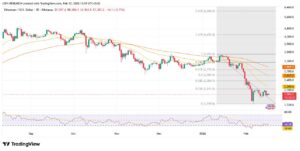
The Dow Jones has broken below all key Fibonacci retracement levels from the swing low at 45,041.43 (Fib 0.000) to the 50,529.25 swing high (Fib 1.000), with the daily close at 45,216.14 placing price directly at the 0.000 support zone. The three moving averages visible on the chart — 5-day SMA at 45,505, 50-day SMA at 46,077, and the 200-day SMA at 47,494 — are all pointing sharply lower and stacked in a classic bearish waterfall configuration. The 200-day SMA, which the Dow breached decisively in early-to-mid March 2026, has now become a zone of heavy overhead supply. Price is a full 2,278 points below the 200-day average — the largest distance below the 200-day since the 2022 drawdown.
The 0.236 Fibonacci level at 46,336.56 aligned precisely with the breakdown point in mid-March, and failed to hold as support on a test in late March. The 0.382 level at 47,137.78 and 0.500 at 47,785.34 acted as resistance levels during the February-to-March distribution phase before the accelerated sell-off. RSI(14) has compressed to 28.93 — technically oversold — while the MACD reads -183.04, the most negative divergence reading of the current sell-off cycle. The oscillator panel shows both RSI and its signal line deeply compressed, consistent with an index in a sustained trending decline rather than a mean-reverting pullback.
| Indicator | Value | Signal |
|---|---|---|
| Overall Daily Signal | — | Strong Sell |
| MA Alignment | 0 Buy / 12 Sell | Sell |
| RSI (14) | 28.93 | Oversold / Sell |
| MACD | −183.040 | Sell |
| 5-Day SMA | 45,505.77 | Sell |
| 50-Day SMA | 46,077.73 | Sell |
| 200-Day SMA | 47,494.94 | Sell |
| Fibonacci Pivot | 45,488.60 | Neutral |
| Fibonacci Level | Price | Zone Type |
|---|---|---|
| 1.000 (Swing High) | 50,529.25 | Major Resistance |
| 0.786 | 49,388.xx | Resistance |
| 0.618 | 48,532.91 | Resistance |
| 0.500 | 47,785.34 | Resistance |
| 0.382 | 47,137.78 | Resistance |
| 0.236 | 46,336.56 | Resistance |
| ◀ Current Price | 45,216.14 | At 0.000 Floor |
| 0.000 (Swing Low) | 45,041.43 | Key Support |
The Dow is testing its critical Fibonacci 0.000 base at 45,041 with all moving averages in bearish configuration and MACD at cycle extremes. A daily close below 45,041 opens a measured-move target toward 43,500–44,000. The primary invalidation level is a confirmed close back above the 200-day SMA at 47,494. The nearest catalyst is Consumer Confidence and JOLTS data at 14:00 GMT today, followed by the March NFP report on Good Friday.

The S&P 500 has completed a full Fibonacci retracement from the 6,319.99 swing low to the 7,007.01 all-time high, and is currently trading directly on the 0.000 support base at 6,319.99 — the index’s last meaningful structural floor before the next extension lower. Monday’s intraday low of 6,316.91 briefly punctured this level, closing at 6,343.72 in a candlestick structure that carries a partial bullish rejection tail, though the close above 6,319.99 is tenuous. The Fibonacci 0.236 retracement at 6,482.13 and the 0.382 at 6,582.44 now represent significant overhead resistance zones where sellers should be positioned to engage any rally. The 50-day SMA at 6,538.21 and the 200-day SMA at 6,737.18 form a stacked overhead supply band extending from 6,538 to 6,737.
RSI(14) at 27.47 is in deeply oversold territory — the most extreme reading since the COVID lows of early 2020 on a comparable drawdown basis — and the MACD at -49.97 is near cycle extreme. Crucially, the RSI signal line (yellow) has not yet crossed back above the RSI line, meaning there is no momentum-based reversal confirmation. The moving averages on the chart are all trending lower, with the narrow price action in recent sessions suggesting a consolidation at support rather than a reversal. The 0.786 Fibonacci level at 6,859.99 — previously a critical support in December 2025 — now represents a distant recovery target, over 500 points above current price.
| Indicator | Value | Signal |
|---|---|---|
| Overall Daily Signal | — | Strong Sell |
| MA Alignment | 0 Buy / 12 Sell | Sell |
| RSI (14) | 27.47 | Deeply Oversold |
| MACD | −49.970 | Sell |
| 5-Day SMA | 6,378.16 | Buy |
| 50-Day SMA | 6,538.21 | Sell |
| 200-Day SMA | 6,737.18 | Sell |
| Fibonacci Pivot | 6,390.68 | Watch |
| Fibonacci Level | Price | Zone Type |
|---|---|---|
| 1.000 (ATH) | 7,007.01 | Major Resistance |
| 0.786 | 6,859.99 | Strong Resistance |
| 0.618 | 6,744.57 | Resistance |
| 0.500 | 6,663.50 | Resistance |
| 0.382 | 6,582.44 | Resistance |
| 0.236 | 6,482.13 | Resistance |
| ◀ Current Price | 6,343.72 | Below 0.000 Floor |
| 0.000 (Swing Base) | 6,319.99 | Critical Support |
The S&P 500 sits directly on its Fibonacci 0.000 base at 6,319.99, with a daily close below this level opening measured-move targets toward 6,100 and, in an extended scenario, 5,870. All 12 moving average signals on Investing.com are Sell. The invalidation level is a daily close above the 50-day SMA at 6,538.21. The nearest catalyst cluster is Consumer Confidence and JOLTS at 14:00 GMT today.

The FTSE 100 chart structure is inverted relative to the US indices — the Fibonacci retracement is measured from the 9,412.73 swing low (Fib 1.000, the all-time low of the current sequence) to the 10,924.68 swing high (Fib 0.000). The index declined from the 10,924.68 peak through the 0.500 level at 10,168.70 and briefly tested the 0.618 at 9,990.29 before recovering. Tuesday’s price of 10,215.12 places the FTSE just above the 0.500 Fibonacci level — a structurally meaningful position that represents the midpoint of the full downswing. The 50-day SMA visible on the chart at approximately 10,349.30 and the declining 200-day SMA above provide overhead resistance. The three moving averages are in bearish order with the index price below all of them, though the gap between price and the 50-day SMA has narrowed significantly from the March lows near 9,800.
RSI(14) at 49.28 is in neutral territory — a significant recovery from the deeply oversold readings registered at the March 19–20 lows. This RSI recovery, combined with the price bounce from the 0.618 Fibonacci level, introduces a nuanced structure: the FTSE is technically recovering within a broader bearish trend. The 0.382 Fibonacci level at 10,347.11 and the 50-day SMA at 10,349.30 form an almost exact confluence resistance zone. The MACD at -5.75 remains negative, confirming that the recovery is a correction within the downtrend rather than a full trend reversal. The trendline from the December 2025 peak bears down on price between 10,300 and 10,400, and a sustained break above this band would be required to challenge the bearish narrative.
| Indicator | Value | Signal |
|---|---|---|
| Overall Daily Signal | — | Strong Sell |
| MA Alignment | 4 Buy / 8 Sell | Sell |
| RSI (14) | 43.27 | Neutral / Recovering |
| MACD | −5.750 | Sell |
| 5-Day SMA | 10,295.61 | Sell |
| 50-Day SMA | 10,303.13 | Sell |
| 200-Day SMA | 10,552.62 | Sell |
| Fibonacci Pivot | 10,266.25 | Neutral |
| Fibonacci Level | Price | Zone Type |
|---|---|---|
| 0.000 (Swing High) | 10,924.68 | Major Resistance |
| 0.236 | 10,567.86 | Resistance |
| 0.382 | 10,347.11 | Key Resistance |
| ◀ Current Price | 10,215.12 | Above 0.500 |
| 0.500 | 10,168.70 | Support |
| 0.618 | 9,990.29 | Strong Support |
| 0.786 | 9,730.28 | Deep Support |
| 1.000 (Swing Low) | 9,412.73 | Cycle Extreme |
The FTSE 100 is recovering from its 9,412.73 cycle low, with RSI normalising at 49.28, but remains structurally below all key moving averages and faces dense Fibonacci-and-SMA resistance at 10,303–10,380. The key invalidation level is a confirmed daily close above the 50-day SMA at 10,303. A rejection from this resistance band and re-test of the 0.500 Fib at 10,168 is the base-case scenario. The nearest catalyst is UK GDP at 09:30 GMT and Eurozone CPI at 09:00 GMT.
Session Conclusion
All three indices covered in today’s report carry Strong Sell daily signals from Investing.com, with RSI readings for the Dow (28.93) and S&P 500 (27.47) at deeply oversold levels not seen since the 2020 COVID drawdown. The FTSE 100’s RSI at 43.27 and its partial recovery from 9,412 represent a relative divergence — the index’s energy-sector composition has provided a partial buffer against the full force of the oil shock that is destroying US tech-heavy indices. The structural picture, however, remains bearish across all three: every key moving average is declining, MACD is negative across the board, and the macro backdrop — an active war, paralysed central banks, and stagflationary pressures — provides no fundamental catalyst for a sustained reversal.
The defining tension for the remainder of this week is the Iran headline risk. Tuesday’s pre-market risk-on surge demonstrates that markets are acutely positioned for any de-escalation signal. The S&P 500 and Dow futures gained nearly 1% on a single Trump social media post suggesting willingness to negotiate. This headline sensitivity is double-edged: it creates acute short-squeeze risk for bearish positions intraday, but the structural breakdown across all three indices — with the S&P 500 trading below its Fibonacci 0.000 base and the Dow approaching its — is unlikely to reverse without a durable resolution to the Hormuz closure. The March NFP report, released on Good Friday when markets are closed in the UK and US, adds tail risk to the Thursday close.
The economic calendar today — Consumer Confidence, JOLTS, and Chicago PMI between 14:00 and 14:45 GMT — provides a concentrated window of macro data that will either confirm or challenge the stagflation narrative. A Consumer Confidence miss would validate the University of Michigan’s 6% sentiment decline for March and accelerate selling. A JOLTS beat would be constructively interpreted but cannot offset the inflation overhang on its own. The session bias is cautiously short on any intraday rally toward the defined resistance zones.