
Forex Dollar Under Pressure on Powell Exit and Tariff Uncertainty April 6 2026
Forex Market on Edge: Policy Divergence, Intervention Risk & a Weakening Dollar Define Q2 Trade
Daily Forex Market Report covering EUR/USD · GBP/USD · USD/JPY · AUD/USD — Fundamentals, News & Trade Setups for April 6, 2026
Registration Error
Redirecting to login in 3...
Live Trade Setups — April 6, 2026
What You Need to Know Before You Trade Today
The forex market is navigating a pivotal week defined by two structural USD headwinds: the looming end of Jerome Powell’s tenure as Fed Chair in May and escalating uncertainty over the US tariff regime following Supreme Court scrutiny of White House trade policy. The dollar is under sustained pressure across the board, yet individual pairs are behaving differently as local central bank stories — BoJ tightening, ECB on hold, BoE uncertainty — assert independent influence. Risk sentiment remains cautious with the DXY hovering near multi-month lows and traders reluctant to build large directional bets ahead of this week’s Fed speakers and incoming inflation data.
- ▼ EUR/USD — Bearish: Pair has retreated sharply from its February high near 1.20, now pinned below the 0.382 Fibonacci retracement at 1.16658 with the ECB on hold and eurozone growth fragile.
- ▼ GBP/USD — Bearish: Sterling has given back the bulk of its Q1 gains and sits at the critical 0.786 Fib at 1.32112 — a break here opens the path to 1.30335.
- ⚠ USD/JPY — Caution: Price is approaching the 160 psychological level — historically the trigger for BoJ/MoF intervention — while BoJ rate hike expectations build for Q2.
- ▲ AUD/USD — Cautiously Bullish: Rebounding from the 0.618 Fib at 0.68630 with RBA on hold and China growth stabilising; a sustained recovery above 0.69259 would confirm momentum.
Registration Error
Redirecting to login in 3...
Price Snapshot — April 6, 2026
The Macro Picture Driving Today’s Forex Market
The Powell Exit Premium
The single biggest structural story weighing on the dollar in the current forex market cycle is the approaching end of Jerome Powell’s tenure as Federal Reserve Chair in May 2026. Markets have long respected Powell’s credibility in managing the Fed’s policy pivot from its aggressive 2022–2023 hiking cycle back toward accommodation. His replacement — widely expected to be someone politically closer to the Trump administration — introduces institutional uncertainty into the Fed’s reaction function. That uncertainty is a meaningful forex market risk premium on the dollar, particularly for EUR/USD, where the ECB is on hold and rate differential dynamics are already tilting in the euro’s favour. Even if the incoming chair proves equally credible, the transition itself is a headwind that forex participants are pricing into the DXY trend.
Tariff Uncertainty — The IEEPA Wildcard
The Supreme Court’s ongoing review of whether the White House legally invoked IEEPA powers to implement sweeping reciprocal tariffs is a latent volatility trigger for the entire forex market. If the court rules against the administration, existing import tariff payments would need to be reimbursed to US companies, creating a fresh wave of policy uncertainty that analysts at major banks view as definitively dollar negative. The market is not fully pricing this scenario — which means if the ruling lands against the administration, the USD could sell off sharply. GBP/USD and EUR/USD stand to benefit most in such a scenario, given their current proximity to technical levels that would accelerate momentum on a fundamental catalyst.
Central Bank Divergence
The forex market remains structurally driven by central bank policy divergence. The Federal Reserve held its funds rate at 3.75–4.00% at the March FOMC meeting, confirming an end to active quantitative tightening and beginning a programme of Treasury bill buybacks. The ECB is on hold at 2.00%, with eurozone inflation edging higher — March flash CPI showed a 1.2% month-on-month rise, the largest since 2022 — which reduces the probability of any near-term ECB cut. The BoJ remains the outlier on the hawkish side: having hiked in December 2025, markets now expect at least one further hike in Q2 2026, most likely in April or May. This convergence of Fed cuts and BoJ hikes is the most powerful fundamental driver for USD/JPY direction in the forex market today.
Risk Sentiment and the DXY
The DXY is navigating a structurally weakening trend. After peaking above 110 in January 2025 as Trump trade positioning dominated the forex market, the index fell sharply — losing approximately 9.4% in calendar year 2025 alone. The current level reflects a market that is consistently fading USD strength on any bounce. Risk sentiment remains cautious but not panicked: VIX is elevated relative to its Q4 2025 lows but has not reached crisis levels. This environment is particularly supportive of safe-haven JPY and selectively positive for AUD/USD when China demand signals stabilise, as they have in early 2026.
Cross-Market Correlations
The inverse relationship between the DXY and AUD/USD remains tight, with the Australian dollar benefiting from any USD softness amplified by China’s recovery signals. January and February 2026 trade data from Beijing was stronger than seasonal patterns implied, with manufacturing PMI rebounding to 50.4 in March. This provides a floor for AUD/USD in the current forex market. For EUR/USD, the pair’s tight negative correlation to the DXY means that any significant dollar selling episode — triggered by weak US data or the IEEPA ruling — will benefit the euro disproportionately. German fiscal expansion plans worth EUR 1 trillion for infrastructure and defence spending provide a medium-term fundamental tailwind for the euro that is not yet fully reflected in EUR/USD pricing.
Forward Catalyst — BoJ Decision Window
The most important single event for the forex market in the next 48–72 hours is Bank of Japan communication. Markets are assigning elevated probability to a further BoJ rate hike in the April–May window. Any explicit hawkish signal from Governor Ueda — particularly regarding the pace of additional normalisation — would compress the US–Japan yield differential sharply and could trigger a meaningful USD/JPY reversal from current levels near the historically sensitive 160.00 zone. Traders in the forex market should treat any BoJ headline during Tuesday’s Asian session with maximum attention, as the carry-trade unwind risk in USD/JPY is non-trivial at these prices.
Fundamental View
EUR/USD’s fundamental picture in the current forex market is shaped by the tension between a structurally weakening dollar and an equally fragile euro. The ECB held its deposit rate at 2.00% at the last meeting and is not expected to move in either direction before mid-year. While that rate-hold supports the euro relative to a Fed that is easing, the eurozone’s growth trajectory remains underwhelming — particularly in Germany, where industrial output has struggled with the EV transition and supply chain disruption.
The broader macro backdrop has created a ceiling for EUR/USD in the current forex market cycle. The pair’s dramatic rally from sub-1.08 levels in late 2024 to a brief test above 1.20 in early 2026 was driven overwhelmingly by dollar weakness rather than euro strength. Now, with much of the rate differential repricing already done and European growth still soft, the forex market is reassessing whether the euro can sustain gains. March CPI data showing a 1.2% monthly rise — the largest since 2022 — introduces a hawkish risk for the ECB, but simultaneously hurts growth prospects, creating a stagflationary tension that caps euro upside.
The US tariff threat remains a specific fundamental negative for EUR/USD. The Trump administration’s proposed 10–20% tariffs on EU goods would hit Germany’s export-heavy economy disproportionately. Until that risk is resolved — either through a trade deal or the IEEPA court ruling — the forex market is unlikely to position aggressively long on EUR/USD despite the medium-term bullish fundamental backdrop.
Technical Structure
On the daily chart, EUR/USD is trading in a clear descending channel from its February 2026 high near 1.20844. Price has broken below the 0.382 Fibonacci retracement at 1.16658 and the 0.236 level at 1.15658, confirming a deeper corrective phase. The pair is now testing the zone between 0.236 Fib (1.15658) and the 0 Fib level (1.14057), with bearish momentum intact on the daily timeframe. The descending trendline from the February peak continues to suppress any recovery attempts.
On the 4H chart, each attempted recovery is being sold. Price action shows a consistent pattern of lower highs and lower lows — the hallmark of a downtrend in the forex market. The 1.15500 area now acts as immediate resistance (former support). A close above 1.15800 would be needed to neutralise the near-term bearish bias. Below current price, 1.14500 and 1.14057 (the Fib base) are the key targets.
Key Fibonacci Levels: Resistance at 1.15658 (0.236), 1.16658 (0.382). Support at 1.14500 (structure), 1.14057 (Fib base / 0 level). The current technical structure in the forex market favours continued bearish pressure unless a significant fundamental catalyst reverses DXY direction.

Candlestick Patterns & Chart Formations
EUR/USD has formed a descending channel structure on the daily chart that has been intact since the February peak. Within this channel, each rally to the upper boundary has been sold, and the most recent candles show small-bodied indecision near the 0.236 Fibonacci level — a tentative doji formation that suggests short-term consolidation rather than reversal in the current forex market environment.
The descending channel’s lower bound currently sits near 1.14200, which aligns closely with the Fibonacci 0 level at 1.14057. This confluence makes 1.14–1.14057 the critical decision zone for the forex market in the coming sessions. A daily close below 1.14057 would represent a full Fibonacci retracement and open a measured move toward 1.13200.
| Level Type | Price | Basis | Significance |
|---|---|---|---|
| Strong Resistance | 1.17450 | Fib 0.5 | Mid-range recovery barrier |
| Resistance Zone | 1.16658 | Fib 0.382 | Breakdown level — now resistance |
| Immediate Resistance | 1.15658 | Fib 0.236 | Near-term supply zone |
| Current Price | 1.15221 | Live Market | In consolidation zone |
| Immediate Support | 1.14800 | Structure | Recent swing low area |
| Key Support | 1.14057 | Fib 0 / Base | Full Fibonacci retracement level |
| Major Support | 1.13000 | Psychological | Multi-month structural floor |
EUR/USD has broken below critical Fibonacci support levels and is trading in a confirmed descending channel. Sell on a pull-back toward the 0.236 Fib (1.15658) zone, with the target at the Fib base (1.14057) — a 2.4:1 risk/reward. Partial profits recommended at 1.14500. A close above 1.15950 invalidates the setup.
Fundamental View
GBP/USD has undergone a significant reversal from its February 2026 high near 1.3864, losing roughly 650 pips as the forex market reassessed the Bank of England’s policy trajectory and UK growth prospects. The BoE remains in a holding pattern — inflation in the UK is sticky, growth is soft, and the government’s fiscal position provides limited room for stimulus. This creates a stagflationary backdrop for sterling that, while not catastrophic, is structurally limiting for GBP/USD upside in the forex market.
The Q2 2026 forex market consensus positions GBP as “stronger than EUR in relative terms, but lacking the macro edge for a strong directional trend.” Sterling’s advantage over the euro lies in slightly more resilient UK economic data and the BoE’s marginally less dovish posture compared to the ECB. However, the GBP/USD pair is highly correlated to EUR/USD in the current forex market environment — meaning that the dominant driver remains DXY direction rather than cable-specific fundamentals.
The risk for GBP/USD in the forex market is that the 0.786 Fibonacci retracement at 1.32112 fails to hold. This level represents a critical line in the sand — a weekly close below it would shift the technical picture materially negative and open a path toward the 1.30335 structural support (the Fib base). From a fundamental perspective, the primary scenario for a break lower would be a combination of weak UK data and renewed dollar strength on any Fed repricing.
Technical Structure
GBP/USD’s daily chart tells a clear story of a pair that topped out in early February 2026 near the Fibonacci 0 level (1.38642) and has been in a sustained downtrend since. Price has retraced through the 0.236, 0.382, 0.5, and 0.618 Fibonacci levels sequentially and is now resting on the 0.786 retracement at 1.32112. Each Fibonacci level has acted as a temporary speed bump before being broken, suggesting the bears remain in control of this forex market pair.
The ascending trendline from the November 2025 lows — visible on the daily chart — has been decisively broken, confirming a structural shift in the forex market trend for this pair. The pair is now trading below all key moving averages on the daily timeframe. The current consolidation near 1.32112 (0.786 Fib) could produce a brief bounce toward 1.33508 (0.618 Fib), but any recovery without a fundamental catalyst is likely to be sold.
Key Fib levels: Resistance at 1.33508 (0.618), 1.34488 (0.5). Support at 1.32112 (0.786), 1.30335 (Fib base). The broader forex market structure is bearish until GBP/USD reclaims 1.34488 on a closing basis.

Candlestick Patterns & Chart Formations
GBP/USD has formed a pattern of successive Fibonacci support breaks — a textbook bearish continuation structure in the forex market. The pair is currently consolidating at the 0.786 Fibonacci retracement (1.32112), which is the last major technical support before the full retracement base at 1.30335. The tight range near this level suggests the forex market is awaiting a catalyst to determine the next directional move.
The pair’s break below the ascending trendline (connecting November 2025 and February 2026 lows) earlier in the quarter was a significant bearish signal. For this forex market pair, confirmation of a break below 1.32112 on a daily close basis would be the trigger for the next leg lower toward 1.30335. A recovery above 1.33508 is needed to shift the short-term bias back to neutral.
| Level Type | Price | Basis | Significance |
|---|---|---|---|
| Strong Resistance | 1.35469 | Fib 0.382 | Medium-term structural barrier |
| Resistance Zone | 1.34488 | Fib 0.5 | 50% retracement — key recovery level |
| Immediate Resistance | 1.33508 | Fib 0.618 | Former support / current resistance |
| Current Price | 1.32123 | Live Market | At 0.786 Fib — decision zone |
| Key Support | 1.32112 | Fib 0.786 | Critical support — last Fib before base |
| Major Support | 1.30335 | Fib 1.0 / Base | Full retracement target |
| Psychological | 1.30000 | Round Number | Major psychological level |
GBP/USD is sitting on the 0.786 Fibonacci support at 1.32112. Sell on a recovery toward 1.32300 with target at the Fib base (1.30335). R/R 2.5:1. A break above 1.33100 invalidates the setup — this level is former support acting as resistance. Partial close at 1.31500 recommended to lock in profit ahead of the round number level.
Fundamental View
USD/JPY is the most fundamentally interesting pair in the current forex market. At 159.549, price is approaching the historically critical 160.00 level — a threshold that has twice prompted Finance Ministry intervention in recent years. The mechanics are simple: above 160.00, imported inflation in Japan rises sharply (Japan imports 90%+ of its energy), the BoJ’s normalisation mission becomes politically urgent, and the Finance Ministry faces domestic political pressure to act. Historically, verbal intervention precedes actual FX buying of yen — and at current levels, traders in the forex market should price intervention risk heavily into any decision to go long USD/JPY.
The fundamental backdrop for yen appreciation is building. The Bank of Japan has already executed two 25bp rate hikes since 2007, bringing the policy rate to 0.75%. Markets expect at least one further hike in Q2 2026, with April and May both live meetings. Simultaneously, the Fed is easing — the funds rate is at 3.75–4.00% and expected to move lower. This narrowing yield differential is the structural case for a lower USD/JPY in the forex market over the next 6–12 months. Japan’s current account surplus — the largest on record driven by investment income — is a latent repatriation flow that could accelerate yen buying if domestic investors begin hedging more aggressively as US yields fall.
The wild card in the forex market for this pair is geopolitical: Trump administration commentary on preferring a weaker dollar — and implicit pressure on the BoJ — adds complexity. However, with the Finance Ministry having already flagged 160.00 as an area of concern in public communications, the asymmetric risk at current levels strongly favours selling USD/JPY rather than chasing higher in the forex market.
Technical Structure
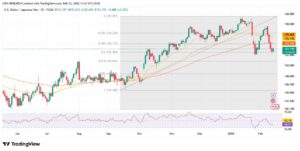
USD/JPY has rallied approximately 760 pips from its February 2026 lows near 152.02 to the current level of 159.54. On the daily chart, this move has been supported by a rising trendline connecting the January and February lows, which continues to provide dynamic support. However, the pair is now entering a zone of significant technical resistance in the forex market — the Fibonacci 0.236 retracement at 158.530 has already been breached to the upside, and the next major resistance zone is the Fibonacci 0 level at 160.539, which aligns almost exactly with the psychologically critical 160.00 handle.
The daily RSI is approaching overbought territory on this recent rally, and the 4H chart shows a series of diminishing upside wicks near the 159.80 level — a classic sign of buying exhaustion in the forex market. The pair has made multiple attempts to sustain above 159.80 without success, suggesting distribution is occurring at current levels. A daily close above 160.539 would be required to sustain bullish momentum — but the intervention risk makes this scenario extremely high-risk for any forex market long position.
Key Fib levels: Resistance at 158.530 (0.236 from below — now acting as minor support), 160.539 (0 / top of range). Support at 157.2875 (0.382), 154.843 (0.5), 155.279 (0.618).

Candlestick Patterns & Chart Formations
On the daily chart, USD/JPY is forming a rising channel with the upper bound near 160.00 acting as the critical test zone. Recent candles have shown a pattern of upper wicks at the 159.80–160.00 zone — indicating that buyers are being absorbed at these levels in the forex market. This is consistent with institutional distribution ahead of a potential reversal.
The bearish RSI divergence — where price makes higher highs but the RSI makes lower highs — is a reliable signal of momentum exhaustion in the forex market. Combined with the fundamental intervention risk at 160.00, the probability of a meaningful reversal is elevated. A daily close below 158.530 would be the first technical confirmation of a trend shift in this pair.
| Level Type | Price | Basis | Significance |
|---|---|---|---|
| Intervention Zone | 160.000 | Psychological / Historical | MoF intervention threshold — extreme risk |
| Strong Resistance | 160.539 | Fib 0 / Range Top | Full retracement target top |
| Immediate Resistance | 159.828 | 24H High | Intraday ceiling |
| Current Price | 159.549 | Live Market | In danger zone near 160.00 |
| Immediate Support | 158.530 | Fib 0.236 | First support below current price |
| Key Support | 157.288 | Fib 0.382 | Medium-term pullback target |
| Major Support | 155.279 | Fib 0.618 | Deep retracement level |
USD/JPY approaching the historically sensitive 160.00 intervention threshold with RSI divergence and wick rejections — highest conviction setup in today’s forex market. R/R 3.4:1. The BoJ’s Q2 hike expectations and the Finance Ministry’s intervention history make this a fundamentally and technically sound sell. Target at 0.382 Fib (157.288). Tight stop above 160.550 — well beyond the Fib 0 level to account for any spike on a failed intervention attempt.
Fundamental View
AUD/USD has staged a meaningful recovery from the lows of late March 2026, rebounding from near the 0.618 Fibonacci retracement at 0.68630. The fundamental case for the Australian dollar in the current forex market is built on three pillars: a stable RBA policy stance (on hold with no immediate cut expected), improving Chinese economic data, and the structural DXY downtrend. China’s March manufacturing PMI rebounded to 50.4, and early 2026 export data beat seasonal expectations — both positive for Australian commodity demand and a fundamental support for AUD/USD in the forex market.
The RBA’s hold position is nuanced. While inflation has eased from its 2024 peaks, it has not fallen far enough to justify rate cuts in the near term. This gives the Australian dollar a fundamental buffer against the broadly weaker USD environment in the forex market — the rate differential is not actively moving against AUD as it might be if the RBA were cutting alongside the Fed. Australia’s commodity exposure — particularly iron ore, coal and agricultural exports — provides a further terms-of-trade support when global growth expectations are stable or improving.
The primary risk for AUD/USD in the forex market remains a deterioration in risk sentiment. As a classic risk-on/risk-off currency, the Australian dollar is vulnerable to any significant equity market selloff or renewed safe-haven USD demand. The current recovery depends on risk appetite remaining stable — an escalation in US tariff rhetoric or a surprise in US inflation data could quickly reverse AUD/USD’s current bounce from the 0.618 Fib in the forex market.
Technical Structure
AUD/USD’s daily chart shows a pair recovering from a sharp pullback that began after the pair peaked near the Fibonacci 0.236 level (0.70666) in late February 2026. The selloff brought price down through the 0.382 (0.69888), 0.5 (0.69259) and briefly below the 0.618 (0.68630) Fibonacci retracements. The recovery from the 0.618 level is the key technical development in the current forex market — if sustained, it suggests this level is acting as major support and the broader forex market uptrend from the November 2025 base remains intact.
The ascending trendline from January 2026 lows — visible on the daily chart — has been defended and price is now attempting to reclaim the 0.5 Fib (0.69259). A confirmed daily close above 0.69259 would be a significant bullish signal for this forex market pair. The next resistance levels are 0.69888 (0.382 Fib) and 0.70666 (0.236 Fib). The structure remains constructive for bulls above the 0.618 Fib (0.68630).
Key Fib levels: Support at 0.68630 (0.618), 0.67735 (0.786). Resistance at 0.69259 (0.5), 0.69888 (0.382), 0.70666 (0.236). The broader forex market structure is bullish while the pair holds above 0.68630.

Candlestick Patterns & Chart Formations
AUD/USD has formed a potential reversal structure at the 0.618 Fibonacci retracement (0.68630). The most recent daily candles show a bullish recovery from this level, with price making higher lows — a tentative sign that sellers are losing momentum in the forex market at this key technical zone. The ascending trendline from January 2026 lows adds confluence to the support case.
For this recovery to be confirmed in the forex market, AUD/USD needs a daily close above 0.69259 (the 0.5 Fib). Without this confirmation, the current bounce could simply be a relief rally within a broader corrective structure. Forex market traders should wait for the 0.69259 break before adding to long positions, using the 0.68630 level as the key invalidation point.
| Level Type | Price | Basis | Significance |
|---|---|---|---|
| Strong Resistance | 0.71923 | Fib 0 / Range Top | Full recovery target |
| Resistance Zone | 0.70666 | Fib 0.236 | Near-term ceiling on recovery |
| Immediate Resistance | 0.69888 | Fib 0.382 | First major hurdle above current price |
| Breakout Level | 0.69259 | Fib 0.5 | Confirmation level for bullish bias |
| Current Price | 0.69080 | Live Market | In recovery mode above 0.618 Fib |
| Key Support | 0.68630 | Fib 0.618 | Critical support — bounce origin |
| Major Support | 0.67735 | Fib 0.786 | Deep retracement — invalidation level |
AUD/USD is recovering from the 0.618 Fibonacci support (0.68630) with the ascending trendline holding. Buy at current levels targeting the 0.236 Fib (0.70666) over the coming sessions. R/R 2.2:1. Partial close at 0.69888 (0.382 Fib) recommended. Invalidated by a daily close below 0.68200 — below the 0.618 Fib with clear momentum. RBA stability and China PMI recovery provide the fundamental backing for this forex market setup.
How to Capitalise on Today’s Forex Market with Capital Street FX
Four major pairs in motion — policy divergence, intervention risk and Fib bounces create high-probability setups across the forex market today.
High & Medium Impact Events — April 6, 2026
| GMT Time | Currency | Event | Forecast | Previous | Actual | Impact |
|---|---|---|---|---|---|---|
| 01:30 | AUD | RBA Meeting Minutes | — | — | Pending | MEDIUM |
| 06:00 | GBP | Halifax House Prices (MoM) | +0.3% | +0.4% | Pending | MEDIUM |
| 08:30 | EUR | Eurozone Sentix Investor Confidence | 2.5 | 1.4 | Pending | MEDIUM |
| 12:30 | USD | ISM Services PMI | 51.5 | 53.5 | Pending | HIGH |
| 14:00 | USD | Fed Governor Williams Speech | — | — | Pending | HIGH |
| All Day | JPY | BoJ Policy Communication Watch | — | 0.75% | Monitoring | HIGH |
| Tues | USD | US CPI (MoM) | +0.2% | +0.2% | Tomorrow | HIGH |
Traders’ Questions — April 6, 2026
Session Bias Summary & Outlook — April 6, 2026
Today’s forex market action confirms a dominant theme: the US dollar is structurally under pressure, but individual pairs are expressing this differently based on their local central bank dynamics. EUR/USD and GBP/USD are both in confirmed downtrends despite a bearish DXY — reflecting the reality that the eurozone and UK economies carry their own vulnerabilities that cap major rebounds. USD/JPY is approaching a historically critical threshold where the forex market must price both the intervention risk from Japanese authorities and the BoJ’s tightening trajectory. AUD/USD is the standout recovery story, supported by China demand and RBA stability.
The structural macro theme for the week in the forex market is policy divergence amplified by political uncertainty. With Powell’s Fed tenure ending in May, the Supreme Court ruling on tariffs pending, and the BoJ in an active hiking cycle, the forex market is navigating a period where central bank credibility and political interference in monetary policy are simultaneously in focus. This is a low-conviction environment for large directional bets — but high-conviction for range trades near key technical levels like 160.00 in USD/JPY and 1.32112 in GBP/USD.
Today’s remaining key catalysts: ISM Services PMI at 12:30 GMT (potential major forex market mover), Fed Governor Williams at 14:00 GMT (rate path implications), and BoJ communication (any session — monitor continuously). Tomorrow brings US CPI — which could decisively shift forex market positioning for the remainder of the week.
Over the next 3–5 days, the forex market bias for EUR/USD and GBP/USD remains bearish absent a major USD catalyst reversing the DXY. USD/JPY is expected to remain capped near 160.00 with downside risk increasing if BoJ delivers hawkish signals. AUD/USD has the most bullish near-term potential if risk sentiment holds and China data continues to support commodity currencies in the forex market.