
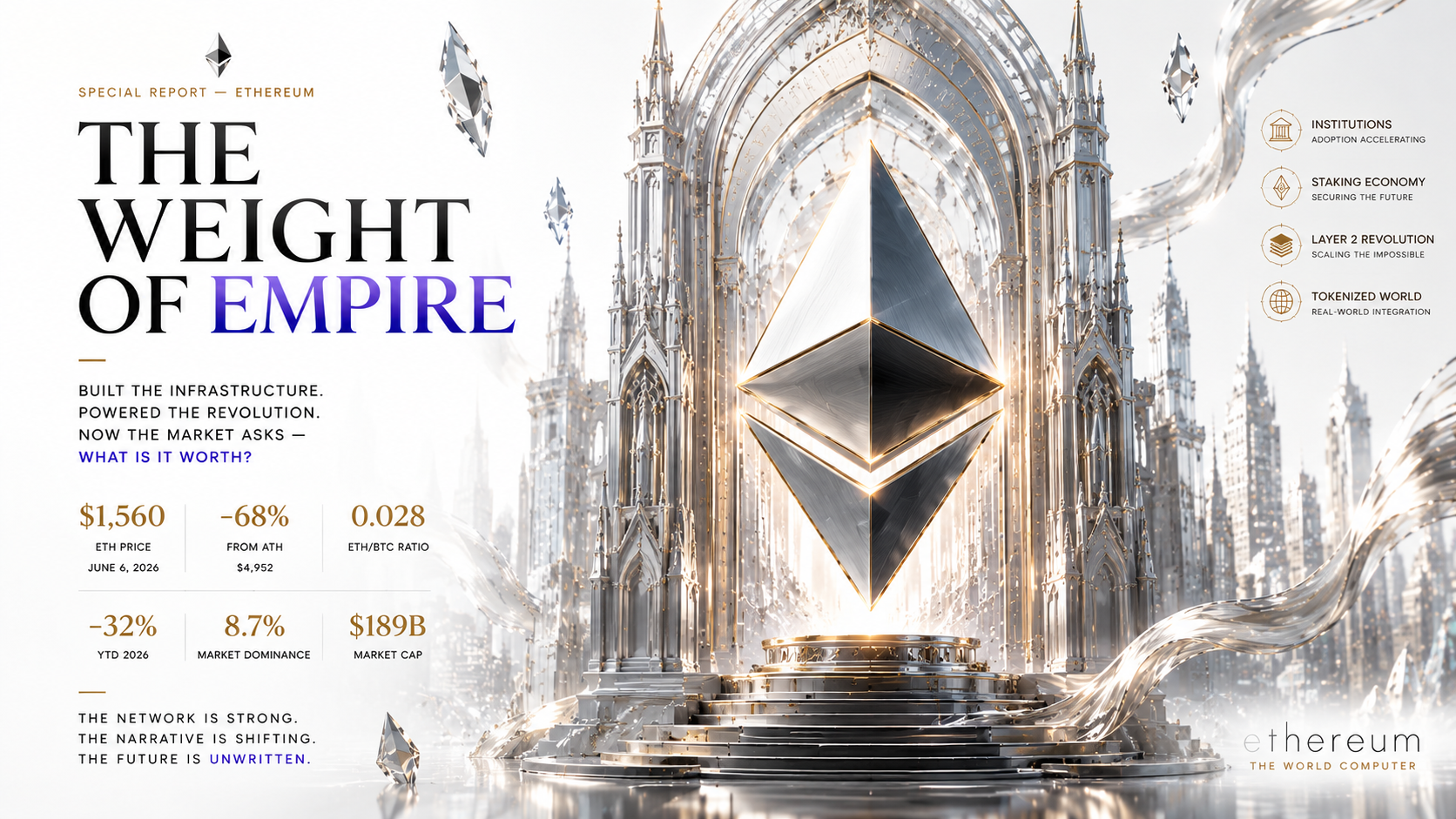
Ethereum: The Weight of Empire | Capital Street FX Research
The Weight
of Empire
Born as a prophecy. Built as a cathedral.
Now priced as a question.
Ethereum is the most important blockchain in the world. It is also, right now, one of the most misunderstood assets in global finance — and therein lies the opportunity.
This is not a price prediction article. It is a forensic examination of why the world’s second-largest cryptocurrency — the infrastructure on which BlackRock, JPMorgan, and Franklin Templeton are now building the next generation of global finance — is trading 68% below its all-time high while the network itself posts record after record. It is an investigation into a paradox: a technology succeeding brilliantly, its token repriced as if it were failing.
Across ten chapters, the Capital Street FX Research Desk maps the complete picture — from Vitalik Buterin’s nineteen-year-old whitepaper to the imminent Glamsterdam upgrade targeting 10,000 transactions per second; from the L2 scaling trade-off that suppressed fee revenue to the staking ETF revolution now distributing real yield to institutional shareholders; from the competitive threats posed by Bitcoin, Solana, XRP, and BNB to the $180 billion stablecoin moat and $8 billion tokenized Treasury market that only Ethereum commands.
What makes this report different from the noise: every claim is anchored in current on-chain data, every prediction carries an explicit probability, and every scenario is converted into an actionable trade structure — long, short, and relative value — with precise entry zones, stops, and targets for CFD traders operating across all time horizons from intraday to twelve months.
The conclusion is not comfort. It is clarity. Ethereum is not broken — it is between narratives. And between narratives, for those with the patience and the framework to act, is where the most asymmetric opportunities in financial history have always been found. This report is that framework.
The Prophet
and His Blueprint
November 2013 — The whitepaper that changed everything
In November 2013, a nineteen-year-old named Vitalik Buterin circulated a document among a small community of cryptographers. Twelve pages. Dense with mathematics. But inside those twelve pages lived an idea so ambitious it would, within a decade, become the foundation upon which BlackRock, JPMorgan, and Franklin Templeton would build new instruments of global finance — and simultaneously exhaust itself trying to be everything to everyone at once.
Buterin had found Bitcoin through his father, a computer scientist who saw early what most did not. He had co-founded Bitcoin Magazine at eighteen, lived the protocol deeply — and then concluded, with the clarity that sometimes visits very young minds before the world teaches them caution, that Bitcoin was thinking too small. Bitcoin was a calculator. He wanted to build a computer.
The whitepaper proposed what he called a “next-generation smart contract and decentralized application platform.” Not a currency. A platform. The distinction was everything. Where Bitcoin could store value and move it, Ethereum could execute arbitrary logic — code that would run exactly as written, simultaneously on thousands of machines, without any central authority able to stop or alter it. He called it the World Computer. And the world, eventually, believed him.
What that history tells you, if you read it slowly, is that Ethereum has always been a project in tension with itself. A decentralized platform governed by a foundation. A neutral protocol whose genesis block was pre-mined for insiders. A system where “code is law” — until it isn’t, as the DAO hack demonstrated. These tensions are not bugs. They are the character of the thing — and understanding that character is essential to understanding its current predicament.
The Numbers
That Sting
Anatomy of a sustained underperformance across cycles
Let us speak plainly about what has happened, because the numbers are the foundation upon which every argument — technical, philosophical, or narratival — must rest. Since Ethereum’s all-time high of $4,952 in August 2025, through the brutal correction that followed Bitcoin’s own October 2025 peak of $126,000, ETH has been the worst performing major asset in the top five by market cap. This is not a temporary market aberration. It is the crystallization of four years of structural underperformance relative to Bitcoin, and it is the story this report exists to explain.
The core paradox of Ethereum in 2026 is this: the network is being used more than ever — record stablecoin supply, record transaction counts, record smart contract deployments — while the token is in one of its deepest relative drawdowns in history. Someone who held ETH instead of BTC since the 2021 cycle peak has lost approximately 65% of their purchasing power measured in Bitcoin. That is the blunt arithmetic of four years of narrative erosion.
The Rivals at
the Gates
Bitcoin, Solana, XRP, and BNB — the full comparative picture
To truly understand Ethereum’s position, you need to see it not in isolation but in the company it keeps and the threats it faces. The top five cryptocurrencies by market cap have each told a different story through the 2024–2026 cycle — and comparing those stories reveals why the market has repriced Ethereum the way it has.
| Asset | Price · June 2026 | Cycle ATH | From ATH | YTD 2026 | Dominant Narrative |
|---|---|---|---|---|---|
| BitcoinBTC · #1 | ~$61,000 | $126,000 | −52% | −25% | Digital gold · ETF moat · corporate treasury |
| EthereumETH · #2 | ~$1,560 | $4,952 | −68% | −32% | Settlement layer · DeFi · institutional tokenization |
| BNBBNB · #3/4 | ~$635 | $1,375 | −54% | ~−20% | Exchange utility · auto-burn · BNB Chain ecosystem |
| XRPXRP · #3/4 | ~$1.38 | ~$3.50 | −61% | −37% | Cross-border payments · banking settlement · CLARITY Act |
| SolanaSOL · #5 | ~$82 | $294 | −72% | −35% | Performance L1 · retail/meme venue · Alpenglow upgrade |
The table shows something counterintuitive: Ethereum is not the worst performer in the top five. Solana has fallen further. XRP’s year-to-date decline is steeper than Ethereum’s. Even BNB, bolstered by Binance’s exchange flywheel and quarterly auto-burns, sits more than 50% below its 2025 all-time high. The true indictment of Ethereum is not that it has fallen more than its peers in absolute terms — it is that it has fallen more than Bitcoin, despite having been sold to the market as a productive asset with yield, network revenue, and superior smart contract utility that should command a premium over pure store-of-value Bitcoin.
Bitcoin: The Widening Moat
Bitcoin’s relative resilience through the 2025–2026 correction — down “only” 42% from its $126,000 peak versus Ethereum’s 68% — reflects the institutional infrastructure that has been built around it. The spot Bitcoin ETF ecosystem launched in early 2024 created a trillion-dollar institutional on-ramp with no equivalent in any other crypto asset. ETF inflows in 2025 reached $26.98 billion for Bitcoin. Corporate treasury adoption — companies holding BTC as a balance sheet reserve in the manner of a hard asset — has expanded dramatically since MicroStrategy’s model was validated and imitated. When macro conditions tighten, institutional capital does not rotate to Ethereum: it consolidates into Bitcoin. The ETH/BTC ratio is the purest expression of this dynamic, and four years of declining ratio tell you everything about where the institutional preference lies.
Solana: The Speed Challenger
Solana’s story in this cycle was one of spectacular rise and spectacular fall. It peaked at $294 in January 2025 on the back of meme coin fever — Solana had become the venue of choice for the chaotic, high-volume retail gambling activity that generated enormous on-chain revenue through late 2024. At its peak, Solana was generating more daily fee revenue than Ethereum. Institutional capital noticed: Solana investment products attracted $3.56 billion in new inflows in 2025, a tenfold increase. But when the meme coin boom unwound, Solana’s revenue collapsed and its price fell 72% from the peak to roughly $82 today. The Alpenglow upgrade — targeting 150-millisecond finality versus Solana’s current 12.8-second average — is in validator testing and could revive the narrative if mainnet activation stays on schedule for Q3 2026. For Ethereum, Solana remains a genuine competitive threat for developer mindshare and retail activity, but its moat is thin: built on a single activity type that proved ephemeral.
XRP: The Institutional Payment Bet
XRP’s 2024–2025 cycle was extraordinary. The resolution of the Ripple vs. SEC lawsuit — the long-standing regulatory shadow that had suppressed XRP’s institutional adoption for years — triggered a 600% rally from 2024 lows to a peak of approximately $3.50. Yet even this dramatic run could not push XRP to a new all-time high above its 2017 peak of $3.84. Today it trades at $1.38, down 61% from its peak but with a fundamentally cleaner story than before. The CLARITY Act is moving toward a full Senate vote, providing regulatory certainty for digital assets. XRP Ledger crossed $3 billion in tokenized real-world assets in late April 2026, with JPMorgan, Mastercard, and Ondo Finance completing the first cross-border tokenized Treasury settlement. XRP is winning the institutional payments narrative with banks, which is a different fight than Ethereum’s — but the capital it attracts comes partly at the expense of the ETH allocation in diversified crypto portfolios.
BNB: The Exchange Flywheel
BNB is perhaps the most underappreciated story in the top five. It peaked at approximately $1,375 in October 2025 — new all-time highs achieved through a combination of crypto-wide bull market and BNB-specific tailwinds: quarterly auto-burns reducing supply, Binance ecosystem growth in DeFi and AI sectors, and the Maxwell Upgrade improving BNB Chain scalability. Today it trades around $635, battling XRP for the fourth position by market cap in a range of $85–$86 billion. Unlike Ethereum, BNB’s value capture mechanism is explicit and undisputed: Binance uses a portion of exchange profits to buy and burn BNB quarterly. The supply deflation story is clean. The narrative is simple. And in a market that discounts complexity, BNB’s clarity has been a relative advantage.
Four years of ETH/BTC ratio decline have told the same story in different languages: the market values Bitcoin’s clarity more than Ethereum’s capability. This is not a technical verdict. It is a narrative verdict — and narrative verdicts can be reversed.
The Scaling
Paradox
How solving the problem created a new one — and what Glamsterdam changes
To understand what is happening to Ethereum’s token economics in 2026, you must understand what Ethereum did to its own revenue model in March 2024, and why it did it, and what it expects to get back in return. The story begins with a genuine problem: by 2021, using Ethereum had become punishingly expensive.
Sending a transaction could cost $50. Swapping tokens on Uniswap might require $200 in gas fees. The network was being used furiously by millions of people — and the costs of that usage were becoming a barrier to more usage. The solution was Layer 2: a constellation of separate chains that execute transactions cheaply, bundle them, and settle periodically on Ethereum’s mainnet.
In March 2024, the Dencun upgrade introduced EIP-4844 (“Proto-Danksharding”), creating “blob” data structures that allowed L2 networks to post their transaction batches far more cheaply. L2 data costs fell 50–90% overnight. The scaling problem was, in a meaningful technical sense, solved. And then Ethereum’s fee revenue fell 60–80% in the quarters following the upgrade — because the fees that drove the burn mechanism had been deliberately reduced.
The Glamsterdam devnet launched by end of May 2026, with the Ethereum Foundation confirming stability in ePBS (enshrined Proposer-Builder Separation) after tests using multiple client setups. The Q3 mainnet activation timeline has slipped slightly from the initial H1 2026 target, but the architecture is confirmed. Following Glamsterdam, the Heze-Bogota fork will focus on privacy and censorship resistance — Verkle trees and quantum-resistant cryptography. The roadmap beyond that includes full Danksharding, targeting 128 blobs per slot, which would make Ethereum’s data availability layer orders of magnitude more capable than anything existing today.
If Glamsterdam delivers — and the devnet evidence suggests it will — it directly attacks the three narratives that have driven capital away from ETH: that Ethereum is too slow, too expensive, and economically broken because scaling sacrificed revenue. A 78% fee reduction sounds like more revenue damage, but when paired with a 3.3x gas limit increase, the math reverses: more transactions at lower unit cost, generating more total fees. If L1 activity partially migrates back from L2s — which becomes economically attractive once L1 fees approach L2 fees — the burn mechanism reactivates.
The Philosopher
as King
Decentralized in theory. Something else in practice.
One of Ethereum’s founding paradoxes is this: it is a decentralized protocol governed by a foundation that is, in practice, governed by one man. When the Ethereum community erupted in early 2025 over the leadership of executive director Aya Miyaguchi — critics calling for her removal, pushing for researcher Danny Ryan’s promotion — Vitalik Buterin’s response was unambiguous: “The person deciding the new EF leadership team is me.” One sentence. No ambiguity. From the founder of a decentralized project.
Buterin’s intellectual authority over Ethereum’s roadmap is near-total. His preferences shape upgrade priorities. His public statements move markets. His philosophy — patient, academically rigorous, occasionally painfully slow to resolve internal debates — sets the tempo for a project that sometimes needs to move faster than philosophy allows. The Foundation underwent a governance overhaul through 2025: new co-executive directors, a CROPS mandate (Censorship resistance, Open source, Privacy, Security), increased Vitalik engagement. But departures continued: Danny Ryan after seven years, Josh Stark in April 2026 after helping lead The Merge, Dencun, Pectra, and Fusaka. Senior talent leaving at an unusual rate through a period of restructuring.
Critics — and there are articulate ones — argue that the L2 value capture problem is a direct consequence of governance: the decision to prioritize scaling impact over L1 fee capture was made by researchers whose incentives are not aligned with ETH token holders. Researchers optimize for global adoption. ETH holders optimize for price. These interests align sometimes. Not always. When they diverge, researchers win — because researchers control the upgrade roadmap.
But the counter-argument is equally compelling: Vitalik’s philosophical patience delivered The Merge — a feat of engineering that no other major blockchain has attempted and succeeded in. The critics want faster, more commercially-driven decision-making. What they might get is the short-term token price improvements of a Binance or a Solana Labs — and the long-term resilience risks that come with centralized roadmap control optimizing for market narrative over technical soundness. The governance criticism is real. Its alternative is unclear.
The Suits
Arrive
Staking ETFs, BlackRock, RWA tokenization, and the slow marriage with TradFi
Against all of this — the underperformance, the fee collapse, the governance complexity, the competitive pressure — stands one counter-narrative so powerful it keeps alive a serious long-term bull case for ETH. The institutions have arrived. Not rhetorically. Demonstrably, with billions of dollars, regulatory filings, product launches, and balance sheet commitments.
In January 2026, Grayscale’s Ethereum Staking ETF (ETHE) became the first U.S. crypto ETP to distribute actual staking rewards to shareholders — $0.083 per share, reflecting rewards earned between October and December 2025. This was not a technical curiosity. It was a watershed moment: for the first time, institutional investors holding an ETF received yield derived from Ethereum’s proof-of-stake consensus — the network paying them, in ETH, for holding ETH. With 71% of ETHE’s assets now staked, this is the beginning of a fixed-income-style demand profile for ETH that did not exist before.
BlackRock’s BUIDL tokenized fund runs on Ethereum. JPMorgan’s JLTXX tokenized money market fund settles there. Franklin Templeton’s tokenized products choose Ethereum. The institutions are not choosing Ethereum because they are crypto-native enthusiasts — they are choosing it because it is where the security, the liquidity, and the established smart contract infrastructure exist. These decisions are made by risk committees, not by speculation. They are durable in a way that retail allocation is not.
The supply structure is equally significant. With 30% of all ETH staked — roughly 36 million ETH — and exchange reserves at ten-year lows, the asset that the market is underweighting has had its liquid supply compressed dramatically by its own success as a proof-of-stake network. When institutional demand through staking ETFs and direct institutional custody begins to materially expand, it encounters a supply profile radically different from any previous Ethereum cycle.
The Price of
Complexity
Why narrative matters more than fundamentals in the short run — and less in the long run
Markets are not pricing machines for fundamentals. They are pricing machines for stories. And Ethereum’s story, as of June 2026, is genuinely hard to tell in a sentence. Bitcoin has a sentence. Solana has a sentence. XRP has a sentence. Each may be incomplete, but they are legible. Ethereum requires a paragraph — and paragraphs don’t fit on slides.
The institutional portfolio manager who needs to justify an allocation to their investment committee cannot say “Ethereum is the settlement layer for the L2 ecosystem where blob fees are scaling toward saturation while staking ETFs distribute yield and RWA tokenization grows in its ecosystem” and expect the room to follow. They can say “Bitcoin is digital gold with a fixed supply and a trillion-dollar ETF ecosystem” and sit down.
This narrative discount is real, and it is quantifiable in the ETH/BTC ratio. But narrative discounts are also the precondition for the most powerful re-ratings in financial markets. When a complex asset develops a simple story — when the “settlement layer of global finance” narrative crystallizes around demonstrable evidence — the re-rating can be rapid and violent. The question is whether the evidence arrives fast enough for the narrative to catch.
The fundamental evidence is accumulating: $8 billion in tokenized US Treasuries on Ethereum (doubled in six months). $180 billion in stablecoins (all-time high, 60% market share). $45.5 billion in DeFi TVL (53% of global DeFi). 31,869 active developers (nearly twice Solana’s count). What is missing is the simple story that ties these facts to ETH token value appreciation. The Glamsterdam upgrade, the staking ETF yield distribution, and the RWA tokenization wave are the three mechanisms most likely to produce that story — if they converge.
Ethereum built the cathedral. The congregation arrived. The question is whether the cathedral charges enough in rent — and whether the congregation understands what the admission buys them.
Predictions from
the Research Desk
What we expect to happen — grounded in on-chain data, technical roadmap, and market structure analysis
These are the Capital Street FX Research Desk’s forward predictions for Ethereum, grounded in the data presented in this report. We assign confidence ratings based on the strength of the underlying evidence and the number of independent signals pointing in the same direction. These are analytical predictions, not investment recommendations.
The Trading
Playbook
Scenarios, probabilities, and actionable trade structures for ETH/USD CFDs
Understanding Ethereum’s story is necessary but not sufficient for trading it. What matters for the trader is the conversion of narrative into levels, probabilities, and risk-managed setups. Below we present our scenario analysis and specific trade structures for ETH/USD across four time horizons. All trades assume CFD execution with appropriate risk management.
Capital Street FX offers 24/7 crypto CFD trading on ETH/USD and all major pairs — with leverage up to 1:1000 and above — across MT4, MT5, and cTrader. All scenarios below are executable as long or short CFD positions.
Probability Summary — 12-Month Price Range
Glamsterdam disappoints, L2 DA migration begins, ETF inflows weak. ETH fails to re-establish deflationary supply.
Glamsterdam activates, supply turns deflationary, staking ETF inflows grow modestly, RWA continues expanding.
ETF AUM doubles, supply durably deflationary, RWA tokenization accelerates, narrative simplifies around “yield-bearing settlement layer.”
Actionable Trade Structures — ETH/USD CFD
tradeable — right now.
The Reckoning
Rendered Plainly
What this is, what it isn’t, and what it requires
Let us answer the questions honestly, without the hedging language that financial analysis retreats into when the truth is uncomfortable.
Is Ethereum broken? In token price terms, it has experienced one of the sharpest relative drawdowns in its history. In network terms, it is thriving by almost every metric that matters: record stablecoin supply, record on-chain transactions, dominant developer ecosystem, deepening institutional infrastructure. The distress is in sentiment, in the value capture mechanism, and in the market’s unwillingness to pay a premium for complexity. That distinction matters enormously — the network is not broken, only the story told about it is currently losing in the market of narratives.
Is the L2 strategy a mistake? Not technically. Ethereum cannot scale to global demand on a monolithic base layer — the physics of decentralization prevent it. But the economic consequences of the L2 strategy for ETH token holders have been real and negative in the medium term. Whether the blob fee market eventually repairs the value capture mechanism is the open bet at the center of the next two to three years.
Is Ethereum being outcompeted? At the margin, yes. Solana captured developer attention and retail activity. XRP carved out institutional payment settlement. BNB’s exchange utility model created durable demand. But Ethereum retains — by a significant margin — the dominant position in everything that matters to institutions: DeFi TVL, stablecoin settlement, RWA tokenization, developer depth. The competitive gap has narrowed. It has not closed.
Is this a buying opportunity? At current prices, with the Glamsterdam catalyst imminent, supply at ten-year lows, and institutional infrastructure deepening, the risk/reward profile for long-term exposure to ETH is among the most asymmetric it has been since the 2022 bottom. The downside from $1,560 — with staking yield of ~4% APR providing a partial floor — is bounded. The upside in the bull scenario is three to five times current prices over twelve months and eight to twenty times over five years. That is not a normal asset’s profile. It is the profile of a long-duration asymmetric bet — and it requires conviction, patience, and willingness to be wrong for extended periods.
The cathedral that Vitalik Buterin imagined at nineteen years old, in twelve pages of mathematics circulated to a handful of cryptographers in November 2013, has been largely built. The infrastructure is dominant. The institutional partnerships are signed and funded. The staking mechanism is live and distributing yield. The developer ecosystem is the deepest in the history of programmable blockchains.
What is missing is the simple story. The clean, one-sentence narrative that allows a portfolio manager to justify the allocation on a single slide. “Ultrasound money” was a story. “World computer” was a story. “The yield-bearing settlement layer of global finance” is trying to become one — but it needs the evidence of Glamsterdam’s throughput, the data of the blob fee market, the balance sheets of sovereign wealth funds holding staking ETFs, before the market will accept it as the dominant frame.
Those proofs are arriving. Not all at once. Not on the timeline the impatient demand. But the direction of travel — on-chain, institutionally, technically — is unambiguous. The question is not whether Ethereum is important. It clearly, demonstrably is. The question is whether importance translates to value accrual within a timeframe that matters to your portfolio.
For traders, the Glamsterdam upgrade is the near-term binary event — the moment where the narrative either receives a powerful catalyst or continues to drift. For investors, the staking ETF yield distribution and RWA tokenization wave are the structural tailwinds that compound slowly and then, suddenly, quickly. History suggests that patience around inflection points in Ethereum’s cycle is rewarded. History also suggests that the inflection point rarely announces itself.
Ethereum is complicated right now. Complicated, in markets, sometimes means underpriced.
Before they become consensus.