BoJ Hits 1% & the Iran War Ends as Asia Rides a Record Nikkei into Warsh’s First FOMC | Technical Analysis – Asian Session | 17 June 2026
BoJ Hits 1% & the Iran War Ends as Asia
Rides a Record Nikkei into Warsh’s First FOMC
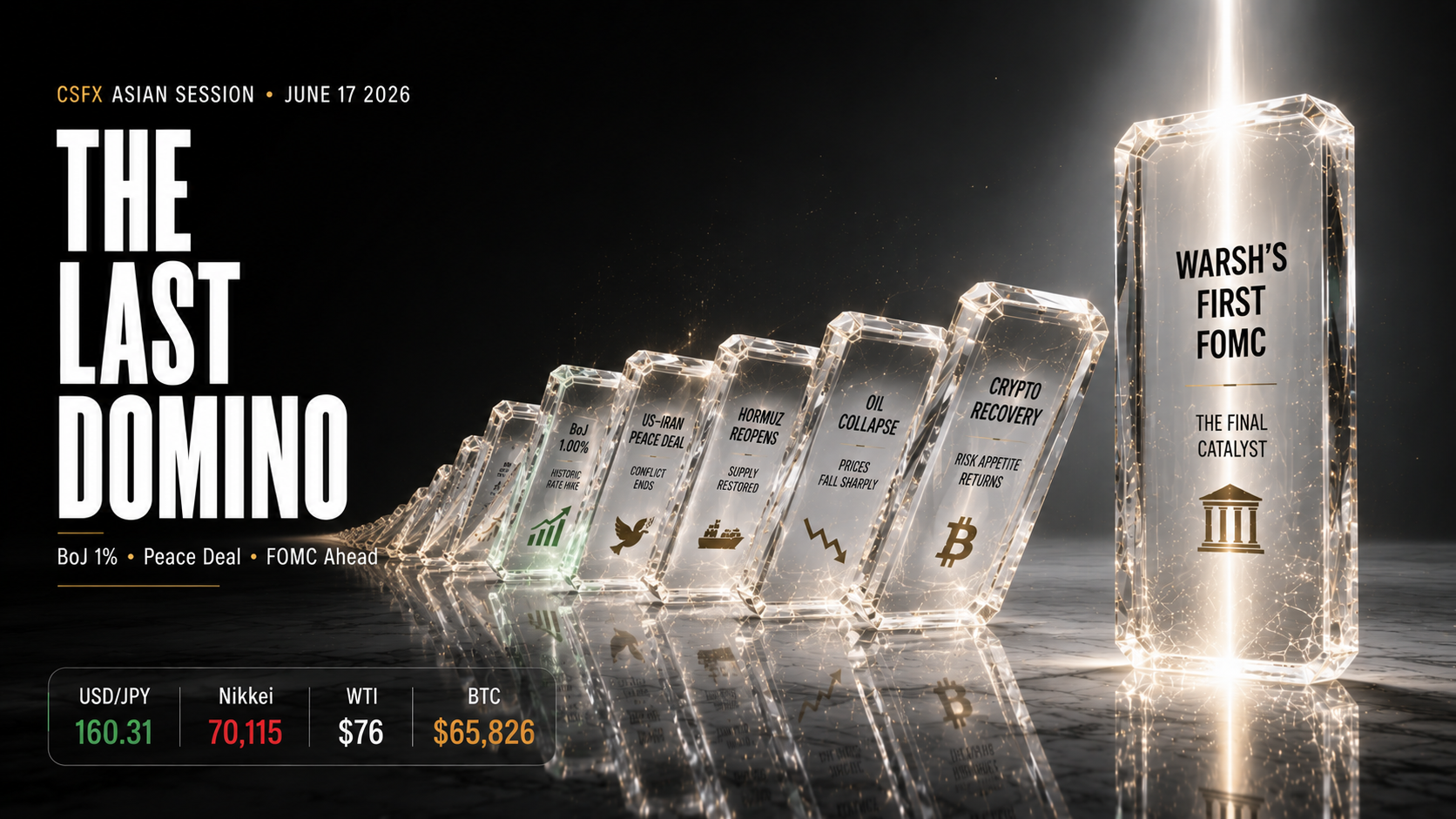
Asia trades a full-blown relief reset. The two catalysts that hung over the region all month have now both broken in the market’s favour: the Bank of Japan delivered its near-certain hike to 1.00% on 16 June — the first time Japanese rates have reached that level since 1995 — and a US–Iran peace deal has ended the war, reopened the Strait of Hormuz and sent crude crashing to a three-month low. The feared carry-unwind never came; instead Japanese equities ripped to fresh records and risk assets surged. The single remaining binary is the next one on the tape: Kevin Warsh’s first FOMC decision later today.
The reaction across the region is constructive and still extending. Japan’s Nikkei 225 has pushed above 70,000 for the first time to a fresh record near 70,115, building on the ~69,404 record close of 16 June, powered by an AI-driven semiconductor bid and heavy foreign inflows even as South Korea’s KOSPI consolidates after two strong sessions. The currency tell is the surprise: USD/JPY sits near 160.31, holding the line markets treat as an intervention trigger even after the hike, because the Fed at 3.50–3.75% still dwarfs a BoJ at 1.00% and today’s FOMC could lean hawkish. With the yen broadly soft, AUD/JPY holds firm near 113.21, close to the top of its range, as a hawkish RBA hold and the risk-on tone outweigh the BoJ move. In commodities, the Hormuz reopening is doing the heavy lifting: aluminium has slid toward a multi-week low near $3,409/t on resuming Gulf supply, while corn near $4.13 has broken to its lowest since October 2025 as the oil collapse strips out the biofuel bid on top of a bumper US crop.
The crypto tape is riding the same risk-on wave. Bitcoin has reclaimed ~$65,826, up more than 11% off its early-June sub-$60,000 low as the peace framework and easing oil revived appetite — though spot-ETF flows are only just turning and the move is geopolitical rather than crypto-specific, leaving it hostage to Warsh tonight. Chainlink near $8.34 has firmed off last week’s low on a FIFA World Cup oracle deal and record whale accumulation, while Dogecoin near $0.086 still sits a hair above its 52-week low, the cleanest read on how far the meme-coin complex has lagged the bounce. The binary that defines the next 24 hours: whether Warsh validates the dovish hopes the Iran de-escalation has stirred, or removes the easing bias and reminds the tape the Fed is not done with inflation. Open a live account to trade the Asian session.
Asian Session Headlines — 17 June 2026
Live market-moving events as the BoJ’s 1% hike, a US–Iran peace deal and Warsh’s FOMC debut converge on the Tokyo, Sydney and Hong Kong open
Asian Session Data — 16–22 June 2026
Key releases and event risks around the just-delivered BoJ/RBA decisions, today’s Warsh FOMC, the BoE and the 19 June Iran peace signing (times in GMT)
| Time (GMT) | Region | Event | Forecast | Previous | Impact |
|---|---|---|---|---|---|
| Tue 16 Jun ~03:00 | 🇯🇵Japan | BoJ Policy Rate + Ueda Presser — delivered | 1.00% (+25bp) | 1.00% (actual, 7–1) | CRITICAL |
| Tue 16 Jun 04:30 | 🇦🇺Australia | RBA Cash Rate Decision — delivered | 4.35% (Hold) | 4.35% (actual) | HIGH |
| Wed 17 Jun 12:30 | 🇺🇸US | Retail Sales (May) / Import Prices | — | — | MEDIUM |
| Wed 17 Jun 18:00 | 🇺🇸US | FOMC Rate Decision + Dot Plot (Warsh debut) | 3.50–3.75% (Hold) | 3.50–3.75% | CRITICAL |
| Wed 17 Jun 18:30 | 🇺🇸US | Warsh Press Conference | — | — | HIGH |
| Thu 18 Jun 11:00 | 🇬🇧UK | BoE Bank Rate Decision | 3.75% (Hold) | 3.75% | HIGH |
| Thu 18 Jun 23:50 | 🇯🇵Japan | Trade Balance / Exports (May) | — | — | MEDIUM |
| Fri 19 Jun — | 🇨🇭Geneva | US–Iran Peace Deal Signing Ceremony | — | — | CRITICAL |
Asian Session Setups — 17 June 2026
Seven instruments; fundamental backdrop, technical levels, and directional bias for the Asian session and the run into today’s FOMC and the 19 June peace signing

Fundamental Backdrop
AUD/JPY near 113.21 is holding close to the top of its range, and the message is that the BoJ hike did little to firm the yen on a broad basis — the same dynamic that kept USD/JPY pinned at 160. The bullish drivers dominate: the RBA held at 4.35% on 16 June with a hawkish lean — markets price a peak near 4.70% by end-2026 and no cuts until 2028 — giving the Aussie a real carry advantage even after Japan’s move, while the US–Iran peace deal, the record Nikkei and a broad risk-on reset all favour high-beta carry crosses. The counterweight is positioning, not fundamentals: at 113.21 the pair is approaching the 52-week high near 114.7, where the upside narrows and Japanese intervention risk on any sharp yen-weakening move rises. The net is a carry cross with the trend and the macro at its back but limited room before resistance — a buy-the-dip rather than a chase, explicitly hostage to today’s FOMC and the durability of the Iran truce.
Technical Outlook
The cross is trading in the upper third of its 109–114.8 band, with bullish technicals intact above its rising moving averages. First support on a pullback is 112.50 (the dip-entry zone), then 111.5 and the 110.9 area that frames the stop; a daily close below 110.9 would signal the risk-on bid is faltering and open 110.0 and the 109 base. On the upside, the 114.0–114.7 zone is the immediate hurdle and the 52-week high — a decisive break there opens fresh cycle highs, but a failure to clear it sets up the range fade. With momentum firm but the pair near resistance, buying dips toward 112.5 is cleaner than chasing into 114; the bullish case invalidates on a daily close below 110.9.
Session Catalysts
Watch for: (1) today’s FOMC and Warsh’s tone — a dovish lean lifts global risk and the cross, a hawkish hold pressures high-beta FX; (2) Japanese MOF/BoJ intervention risk as the pair nears the 114.7 high on any sharp yen-weakening move; (3) the Iran signing on 19 June — a clean signing reinforces risk-on, a wobble revives the haven yen bid; (4) China demand and commodity tone as the Aussie’s broader tell. Keep the stop disciplined into the Fed binary.

Fundamental Backdrop
USD/JPY near 160.31 is the session’s biggest surprise: the BoJ hiked to 1.00% and the pair barely budged, holding right on the level markets treat as an intervention trigger. The reason is the rate gap — even after Japan’s move the Fed sits at 3.50–3.75%, more than 250bp above the BoJ, and a firm dollar plus today’s near-certain Fed hold keep short-yen carry alive. But the asymmetry now leans toward yen strength. The gap is set to keep narrowing from the Japanese side as the BoJ signals further normalisation, the 160 line invites verbal or actual intervention, and the Iran-driven oil collapse removes a key prop under the dollar’s inflation premium. A dovish Warsh would compress the gap further; only a clearly hawkish Fed re-arms the bulls.
Technical Outlook
The pair is consolidating just under the 160.7–161.0 area that has capped the year, with the round 160.0 figure — the intervention psychological line — as the immediate pivot. A daily close back below 159.0 opens 157.0 (the target) and then the 155.5 zone. On the upside, a break above 162.5 (the stop) would signal that the Fed gap and carry are overpowering the BoJ-and-intervention story, opening fresh multi-decade highs. The setup favours fading strength into 160.8–162 rather than chasing, using the FOMC and intervention risk as the structural catalysts.
Session Catalysts
Watch for: (1) today’s FOMC — a dropped easing bias and higher dots lift the dollar and the pair; a dovish nod to the Iran de-escalation accelerates yen strength; (2) any MOF/BoJ verbal warning or intervention near 160–162 — a sharp, headline-driven yen spike; (3) BoJ guidance on the hiking pace; (4) the oil/risk tape. Size for two-sided headline risk around the Fed; this is a sell-rallies trade, not a chase-the-break short.

Fundamental Backdrop
LME aluminium near $3,409/t has slid from the May four-year high above $3,650 as the US–Iran peace deal unwinds the war premium. The Persian Gulf accounts for roughly 9% of global primary output, and the reopening of the Strait of Hormuz plus the prospect of resumed exports has flipped the near-term narrative from scarcity to normalising supply — oil’s parallel collapse adds a cost-push tailwind to the downside. Yet the bearish case is not clean: EGA’s flagship smelter is still ramping back from force majeure and may not reach full capacity for months, Bahrain’s ALBA remains below normal, and tighter Guinea bauxite restrictions cap raw-material availability. The metal is still up roughly 19% year-to-date. The result is a market giving back its geopolitical premium while a structural-tightness floor sits underneath — a fade-the-rally near-term, buy-the-deep-dip-eventually profile.
Technical Outlook
Aluminium has broken below the $3,500 shelf toward a multi-week low near $3,410. First resistance on a bounce is $3,490 (the short-rally entry), then $3,580 and the $3,680 area that frames the stop and the prior high. On the downside, $3,375 is the immediate support — the recent low — below which $3,300 and then $3,200 (the target) and the $3,100–3,150 structural zone come into view if supply normalises faster than smelters can disappoint. With momentum bearish on the peace dividend, selling rallies into $3,490 is the disciplined expression; the bearish case invalidates on a daily close back above $3,680.
Session Catalysts
Watch for: (1) the pace and credibility of the Hormuz reopening and Gulf export resumption — faster flows are directly bearish; (2) EGA/ALBA ramp updates — any setback re-tightens the market; (3) LME inventory and premium prints; (4) today’s FOMC — a hawkish Fed lifts discount rates and weighs on the whole metals complex, a dovish lean cushions it; (5) China activity data as the demand tell. This is a near-term fade with a defined stop into the supply-return event.

Fundamental Backdrop
CBOT corn near $4.13/bu (412′4) has broken to its lowest since October 2025, and the drivers are stacking on the same side. The US crop is roughly 94% emerged, ahead of the five-year average, with about 68% rated good-to-excellent and the forecast pointing to widespread rainfall across the growing region — a setup for a large harvest and ample supply. The US–Iran peace deal and the resulting oil collapse have removed the thin biofuel/ethanol bid that had been a marginal support, since agricultural goods often track crude via biofuel demand. Layered on top: the USDA has raised Argentine and Brazilian output forecasts and lifted global ending stocks above expectations, while a hoped-for wave of Chinese purchases of US corn has failed to materialise. With a surplus crop, a vanishing energy bid and weak export demand, the path of least resistance is lower.
Technical Outlook
Corn has sliced through the $4.20 support that framed the spring range and now trades at multi-month lows with technicals reading “strong sell.” First resistance on a bounce is $4.20 (the short entry), then $4.30 and the $4.42 area that frames the stop. On the downside, the round $4.00 figure is the immediate magnet, below which $3.85 (the target) and the 52-week low near $3.91 come into view; a clean break of $3.90 would open the mid-$3.80s and lower. With momentum stretched but the fundamental backdrop firmly bearish, selling rallies into $4.20 is cleaner than pressing new lows; the bearish case invalidates on a daily close back above $4.42.
Session Catalysts
Watch for: (1) US weather and the next Crop Progress print — continued favourable conditions are bearish; (2) any sizeable Chinese purchase announcement — the main upside risk that could trigger a short-cover bounce; (3) the oil tape — a deeper crude slide pressures the biofuel-linked complex further; (4) USDA balance-sheet revisions. This is a sell-rallies surplus trade with a disciplined stop above $4.42.


Fundamental Backdrop
The Nikkei 225 has pushed above 70,000 for the first time to a fresh record near 70,115, extending the ~69,404 record close of 16 June, and the message is that the market read the BoJ hike to 1.00% as confirmation Japan is exiting deflation rather than as a liquidity threat. The deep-seated drivers remain intact: an AI-driven semiconductor boom lifting Fujikura, Advantest and the chip complex, roughly ¥16tn of cumulative foreign inflows since April 2025, improving corporate earnings, and the broad risk-on impulse from the US–Iran peace deal and falling oil — a clear positive for energy-importing Japan. Goldman and Citi frame the move as structural, with Citi flagging scope toward 72,000 by year-end. The counterweight is simply that the index is at all-time highs and stretched, with today’s FOMC and a still-firm intervention-risk yen capable of triggering a profit-taking pullback.
Technical Outlook
The index continues to print higher highs and higher lows, trading comfortably above its rising 50-, 100- and 200-day moving averages, and has now converted the round 70,000 figure from overhead resistance into a pivot. First support on a pullback is the 69,400 area — the prior record close and the preferred long-entry shelf — then the former record near 68,818 and the 68,000 zone that frames the stop. On the upside, with 70,000 reclaimed the path opens toward the 72,000 target, with 71,000 the first interim hurdle. With the trend constructive but momentum overbought at records, buying dips toward 69,400 is cleaner than chasing the breakout; the bullish structure invalidates only on a daily close back below 68,000.
Session Catalysts
Watch for: (1) today’s FOMC and Warsh’s tone — a dovish lean and a softer dollar extend the rally, a hawkish hold pressures the high-multiple chip names; (2) USD/JPY — further yen strength is a headwind for exporters, renewed weakness a tailwind; (3) the 19 June Iran signing — a clean signing reinforces the risk bid; (4) semiconductor and AI headlines as the index’s leadership tell. Respect the record-high stretch and keep sizing measured into the Fed binary.

Fundamental Backdrop
Dogecoin near $0.086 is the clearest read on how far the meme-coin complex has lagged the broader risk-on bounce: while Bitcoin has rallied more than 11% off its early-June lows on the Iran peace deal, DOGE sits barely above its 52-week low near $0.078, down roughly 49% over the year with sentiment at extreme fear. There are thin fundamental positives — a MoonPay partnership set to enable DOGE payments at around 6,000 merchants from Q3, a steady stream of new holders, the launch of DOGE ETF products, and a March 2026 SEC/CFTC framework that classified it as a digital commodity — but DOGE has no cash flows and trades almost entirely on liquidity and beta. That makes it a high-risk, small-size oversold-bounce candidate rather than a conviction trade: it needs Bitcoin to hold its gains and a benign-to-dovish FOMC to lift the whole complex.
Technical Outlook
DOGE is basing just above the 52-week low, deeply oversold but without a confirmed reversal. First support is the $0.082 entry zone and then the $0.078 low; a decisive break below $0.072 (the stop) would signal the down-trend is resuming toward fresh lows. On the upside, the $0.092–0.095 area — the recent week’s high and a psychological round number — is the first hurdle, above which $0.105 (the target) and the $0.11 zone come into view on any broad-market follow-through. With the four-hour structure tentatively stabilising but the daily and weekly trends still weak, this is strictly a small-size, defined-risk bounce; invalidation is a close below $0.072.
Session Catalysts
Watch for: (1) Bitcoin holding above $60,000–65,000 — the precondition for any DOGE bounce; (2) today’s FOMC — a dovish Warsh lifts the high-beta tail, a hawkish hold sinks it first; (3) spot-ETF and broad crypto flows turning with the risk-on mood; (4) the 19 June Iran signing as a risk-sentiment input. Size this as a speculative satellite position, not a core holding.

Fundamental Backdrop
Chainlink near $8.34 has firmed off last week’s $7.90 low, and unlike DOGE it carries a genuine directional thesis. The catalysts are concrete: ADI Predictstreet, FIFA’s official World Cup 2026 prediction-market partner, has adopted Chainlink as its exclusive oracle infrastructure, placing LINK at the centre of a high-visibility use case; on-chain data shows wallets holding at least 100,000 LINK at a fresh all-time high near 805, a clear accumulation signal; and the broader CCIP cross-chain, real-world-asset (RWA) and CRE runtime push continue to expand LINK’s enterprise footprint. As the industry-standard oracle, LINK is leveraged to the stablecoin, tokenisation and institutional-adoption trends. The caveats are honest: daily and weekly trends are still technically heavy after a long bleed, and the token remains a high-beta asset that needs Bitcoin to hold and the Fed not to drain liquidity. That makes it a credible dip-accumulation rather than a breakout chase.
Technical Outlook
LINK is recovering within a broader down-trend, now trading near $8.34 just below the $8.54 resistance that has capped recent rallies. First support is $8.00, then the $7.90 entry zone and the $7.50 and $7.20 areas that frame the stop; a close below $7.20 would signal the recovery has failed and reopen the lows. On the upside, a clean break of $8.54 opens $9.00 and the $9.50 target, with the $10.00–10.70 zone the larger objective if the risk bid broadens. With whales accumulating and the FIFA catalyst fresh but the longer-term moving averages still falling, scaling into $7.90–8.00 weakness is the disciplined expression; invalidation is a daily close below $7.20.
Session Catalysts
Watch for: (1) Bitcoin holding its post-peace-deal gains — the precondition for an alt bid; (2) today’s FOMC — a dovish lean lifts the RWA/oracle complex, a hawkish hold caps it; (3) further CCIP migrations, RWA integrations and any FIFA/enterprise headlines; (4) the whale-wallet count as the accumulation tell. This is a small-to-medium dip-accumulation with a defined stop into the Fed.
Asian Session FAQ — 17 June 2026
The questions traders are asking as the BoJ hike lands, the Iran war ends and Warsh’s first FOMC looms
Asian Session Summary — 17 June 2026
Wednesday’s Asian session trades a market that has just cleared two of its three biggest overhangs in its favour. The Bank of Japan delivered its near-certain hike to 1.00% on 16 June — the first time Japanese rates have reached that level since 1995 — but framed it cautiously enough, against a still-wide Fed gap, that the dreaded carry-unwind never arrived. At the same time a US–Iran peace deal ended the war, reopened the Strait of Hormuz and sent crude crashing to a three-month low, with the formal signing set for 19 June. The result was a risk-on reset: the Nikkei 225 pushed above 70,000 for the first time to a fresh record near 70,115, USD/JPY held the 160 intervention line, and crypto rallied. This morning the focus turns to the one binary still outstanding — Kevin Warsh’s first FOMC, later today.
The actionable framework stratifies by Fed-sensitivity and conviction. Cleanest supply-driven expressions: short corn into rallies — a near-complete, well-rated US crop, raised South American output and a vanishing oil/biofuel bid point lower; and fade aluminium rallies near-term — the Hormuz reopening unwinds the war premium, though a structural-tightness floor (slow EGA/ALBA ramps, Guinea bauxite limits) sits underneath. Highest regional conviction in equities: buy Nikkei dips toward 69,400 — the BoJ hike confirmed the deflation exit, 70,000 is reclaimed and the AI bid and foreign inflows remain intact, with 72,000 the objective — but respect the record-high stretch and the FOMC.
In FX and crypto the ideas pivot on the Fed and the yen. Sell USD/JPY rallies toward 160.8–162 — the rate gap is narrowing and 160 invites intervention, with 162.5 the invalidation — while AUD/JPY is a buy-the-dip near 112.5 on RBA carry and risk-on, capped by the 114.7 range high. In the high-beta complex, the two crypto ideas diverge by design: Chainlink near $8.34 is a dip-accumulation on a FIFA oracle deal and record whale buying, while Dogecoin near $0.086 is a small-size, speculative oversold bounce — both pivoting on Bitcoin holding its post-deal gains. The single most important instruction for the session: treat today’s Warsh FOMC as the key binary, keep sizing measured across all dollar-, yen- and liquidity-linked instruments, lean on the least Fed-sensitive supply-driven ideas for conviction, and survive the press conference before adding directional risk.
Access Live Asian Markets →