SCOTUS Shields Fed’s Cook · Comcast +20% on NBCUniversal Spin-Off · S&P 500 +0.76% · Nasdaq 100 +1% · WTI ~$70.20 · Gold ~$4,040 · Bitcoin ~$60,217 | Technical Analysis US Session | 29 June 2026
Stocks Rally as US-Iran Stand Down, SCOTUS Shields the Fed —
Comcast Surges 20%+ on NBCUniversal Spin-Off Shock
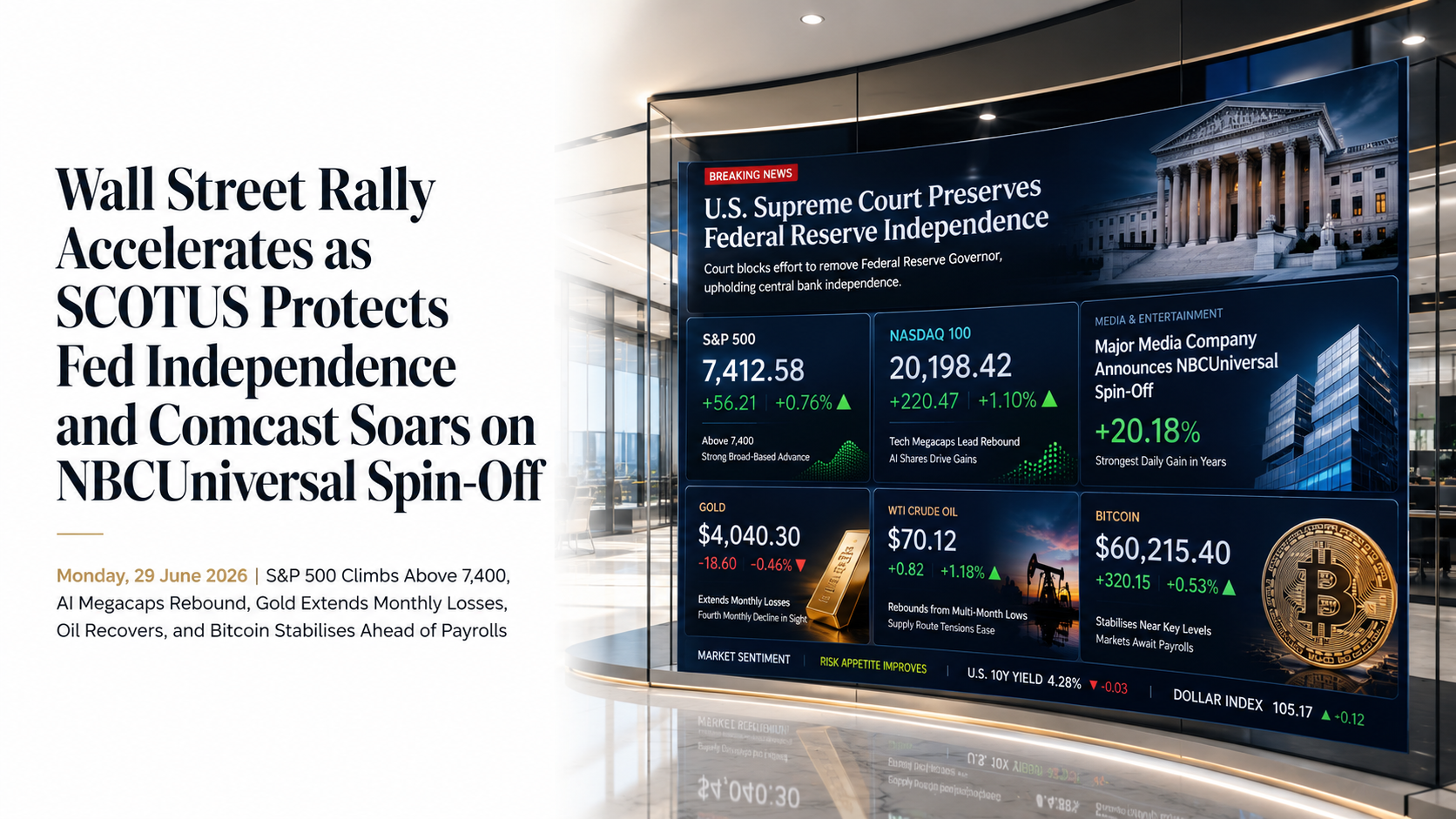
Wall Street opened the holiday-shortened week with its strongest session in over a week: the S&P 500 broke above 7,400 and the Nasdaq 100 added more than 1% as US-Iran peace talks edged forward, the Supreme Court blocked Trump’s removal of Fed Governor Lisa Cook in a pivotal 5-4 ruling, and Comcast ignited a major media re-rating by announcing a tax-free spin-off of NBCUniversal and Sky.
The Monday session is running on three distinct engines. First, geopolitical relief: the US and Iran agreed to “stand down for now” after the weekend’s exchange of fire near the Strait of Hormuz, with President Trump confirming Tehran has sought fresh talks in Doha on June 30. Second, a domestic macro shock: the Supreme Court ruled 5-4 that Trump cannot fire Fed Governor Lisa Cook for now, preserving central-bank independence heading into a week packed with labour-market data. Chief Justice Roberts joined the three liberal justices in the majority; the four remaining conservative justices dissented. Third, a corporate headline: Comcast surged more than 20% after announcing plans to spin off NBCUniversal and Sky into a separate publicly traded company via a tax-free transaction, the biggest US media restructuring in years.
Equities are clearly the day’s winner: the Nasdaq 100 is up roughly 1.1% with Nvidia, Microsoft, Amazon, Meta and Alphabet each adding around 2%, reversing last week’s chip-led five-session losing streak. The Dow Jones is up 251 points, pushing toward its record above 52,000 on Alphabet’s first day as a Dow component after replacing Verizon. Gold, however, is sliding toward $4,040–$4,046, still on course for a fourth consecutive monthly loss as markets price in three Fed rate hikes this year with ~60% probability attached to September. Bitcoin has stabilised near $60,200 but remains well below its June highs. Thursday’s early-released nonfarm payrolls report is the week’s defining catalyst.
US Session Market-Moving Headlines — 29 June 2026
The stories driving New York trading right now
Three Shocks in One Session: Iran Stands Down, SCOTUS Shields the Fed, and Comcast Blows Up Media
Monday’s US session is unusually crowded with market-moving catalysts for a day with no major scheduled data. By mid-morning, three distinct shocks had reshaped the tape. The geopolitical piece — the US-Iran stand-down — was largely priced ahead of the open after weekend news flow, explaining why the equity bounce, though real, has not been larger. The SCOTUS ruling on Lisa Cook is less about today’s price action and more about the medium-term macro narrative: a 5-4 decision blocking Trump’s removal of a Fed governor reinforces the market’s assumption that the Fed will remain a credible, independent inflation-fighter, which is ultimately why three hike-pricings for 2026 remain embedded in the curve.
The Comcast headline is the genuine surprise. A +20% move on a $130-billion market-cap stock is a significant event in itself, but its secondary effect is a media-sector re-rating that is lifting names across the entertainment and cable landscape. Combined, these three forces have produced a session where equities and risk assets are rallying even as the dollar refuses to confirm the “all clear” — because the dominant driver of FX remains the Fed’s hawkish rate path, which none of today’s three catalysts alters materially.
The reconciliation is that two separate forces are pulling in different directions. The equity rally is a relief trade on the marginal news of the day: a truce holding, talks resuming, supply chains in the Strait of Hormuz reopening. The dollar’s resilience reflects something stickier and slower-moving: a hawkish Fed that, after last week’s projections and a hot Core PCE print, has investors pricing three rate hikes this year with rising odds of a September move. Geopolitical risk premium is fast-moving and reversible; a 250–275bp-style policy advantage embedded in Fed pricing is not. That is precisely why gold — which should benefit from any lingering Middle East risk — is instead on track for a fourth straight monthly loss, and why Treasury yields are easing only modestly even as oil retreats. The session’s real swing factor is not the Doha talks; it is whether Thursday’s jobs report and this week’s ISM data crack the Fed’s hawkish resolve. Until then, the path of least resistance is risk-on equities sitting awkwardly alongside a dollar that has not yet been given a reason to fold.
US Session Economic Calendar — Week of 29 June 2026
Key releases and events shaping price action into Thursday’s jobs report and Friday’s holiday closure
| Day / Time | Event | Status / Expected | Impact | Market Read |
|---|---|---|---|---|
| 🇺🇸Mon (today) | US–Iran De-Escalation — Hostilities Paused, Doha Talks Eyed | Truce holding into Tuesday’s reported talks | 🔴 CRITICAL | Risk-on for equities; modest relief for oil; dollar largely unmoved — treat as fragile, not resolved |
| 🇺🇸Mon (today) | Nasdaq 100 / Dow Rebalancing — Alphabet Replaces Verizon | Effective before today’s open | 🟢 MED | Index-flow driven; modest technical support for Alphabet, outflow pressure on Verizon |
| 🇺🇸Tue, 30 Jun | June Consumer Confidence; May JOLTS Job Openings | Consensus tracking near recent soft trend | 🟢 MED | A soft labour-demand read would reinforce the case for a Fed pause; hot data revives hike bets |
| 🇺🇸Wed, 1 Jul | ADP Employment Change; June ISM Manufacturing PMI | Preview for Thursday’s payrolls | 🔴 HIGH | First real read on the labour market ahead of NFP; weak ADP would pressure the dollar and yields |
| 🇺🇸Thu, 2 Jul | June Nonfarm Payrolls, Unemployment Rate, Average Hourly Earnings — THE WEEK’S PIVOTAL RELEASE | Released early ahead of the holiday | 🔴 CRITICAL | The single most important catalyst this week for Fed pricing, the dollar, gold, yields and Nasdaq 100 |
| 🇺🇸Fri, 3 Jul | US Markets Closed — Independence Day Observed | No cash trading | ⚪ LOW | Thin holiday liquidity into the close on Thursday; expect position-squaring ahead of the long weekend |
| 🇺🇸Fed speakers | FOMC Commentary on Hike Path Following Hawkish Projections | Tone read against ~60% September-hike pricing | 🟢 MED | Any dovish pushback would pressure the dollar and Treasury yields; hawkish confirmation extends the dollar’s bid |
| 🇱🇩Ongoing | Doha Talks — US–Iran Negotiations on Final Hormuz Settlement | Reportedly scheduled this week | 🔴 HIGH | A durable deal would extend the oil/gold relief trade; a breakdown reverses Monday’s risk rally quickly |
US Session Trade Ideas — 29 June 2026
Nine structured setups — USD/CAD, USD/CHF, Gold, Crude Oil, Nasdaq 100, Infleqtion Inc., US 20-Year Yield, Bitcoin, XRP — with live prices, levels, and full fundamental and technical analysis

Fundamental Backdrop
USD/CAD is holding near 1.4211, just below its recent topping zone near 14-month highs at 1.4248, with the pullback driven largely by oil’s modest rebound off a four-month low rather than any reassessment of the Fed–BoC policy gap. As a classic commodity currency, the Canadian dollar remains sensitive to crude prices; the same WTI rebound that is lifting CAD today is fragile, conditional on the Iran truce holding into the Doha talks. The Bank of Canada continues to manage policy with an eye on a softer domestic growth backdrop, while the Fed’s hawkish projections and the prospect of further hikes this year keep the broader policy differential favouring the dollar. The pair’s medium-term structure remains a story of a stronger USD against a commodity-linked currency exposed to an oil market that has further to fall if the truce sticks.
Technical Outlook
The daily chart shows USD/CAD inside a well-defined ascending channel, with this pullback reading as a routine retracement after the pair hit fresh 14-month highs rather than a trend reversal — TradingView’s broader technical reads remain constructive. Resistance sits at 1.4220 (today’s high-water mark) and the 1.4248 cycle high; a clean break above opens 1.4280–1.4300. Support comes in at 1.4150 (today’s low), 1.4120 (preferred buy-dip, the rising trendline) and 1.3980 (stop, below which the channel structure would be in question). The cleanest expression is to buy the pullback toward 1.4120 rather than chase the highs, with the trendline providing a natural risk reference.
Session Catalysts
Watch for: (1) the durability of the Iran truce and any reversal in oil prices — a fresh leg lower in WTI is the cleanest bullish catalyst for this pair; (2) Thursday’s US jobs report, the week’s dominant USD catalyst; (3) Canadian economic data and any BoC commentary; (4) broad dollar-index direction relative to its 13-month high; (5) Wednesday’s ISM Manufacturing PMI as a read on US growth momentum.

Fundamental Backdrop
USD/CHF has eased modestly to around 0.8085 from Wednesday’s one-year high near 0.8126, but the structural drivers remain intact: the Swiss National Bank held its policy rate at 0% for a fourth consecutive meeting, reiterating that the stance “remains consistent with price stability and economic growth” while revising its inflation outlook higher and explicitly flagging willingness to intervene in FX markets “if necessary.” Against a Fed that has signalled further hikes this year after hawkish projections and a hot Core PCE print, the rate gap continues to favour the dollar. The franc remains roughly 4.8% weaker than before the Middle East conflict began, and today’s modest pullback reflects easing geopolitical risk premium rather than any change in the underlying policy divergence, leaving the broader uptrend intact.
Technical Outlook
The pair remains near its weakest levels for the franc since November 2025, with the pullback from 0.8126 reading as a shallow, orderly retracement rather than a reversal. Resistance sits at 0.8100 (today’s high), then the 0.8126 cycle high and the psychological 0.8150 area. Support comes in at 0.8055 (today’s low), 0.8040 (preferred buy-dip) and 0.7950 (stop, a level that would suggest the franc-strength narrative is reasserting). The key risk to the bullish case is SNB verbal or actual intervention, which after the bank’s explicit warning is a live, non-trivial tail risk for any sustained push toward 0.82–0.83.
Session Catalysts
Watch for: (1) any SNB verbal or actual FX intervention — the binary tail risk flagged explicitly by the bank; (2) Thursday’s US jobs report and its impact on Fed hike pricing; (3) the durability of the Iran truce, since haven demand for the franc fades as geopolitical risk eases; (4) broad dollar-index direction near its 13-month high; (5) Swiss growth data, with both the IMF and the Swiss government having trimmed 2026 growth forecasts.

Fundamental Backdrop
Gold is trading near $4,040–$4,049 an ounce, down around 1% on the day and on pace for its fourth consecutive monthly decline, with a drop of more than 10% in June alone. The metal’s typical role as a geopolitical and inflation hedge is being overridden by the Fed’s hawkish trajectory: markets are pricing three rate hikes this year, with roughly 60% odds of a September move, and a non-yielding asset like gold loses relative appeal as real rates stay elevated. The Iran de-escalation is a double-edged sword for gold — easing the geopolitical premium that had supported prices while doing nothing to soften the rate outlook that is the bigger drag. Friday’s in-line Core PCE print offered a brief reprieve, but the structural backdrop — a dollar near 13-month highs and a Fed unwilling to blink — remains the dominant force.
Technical Outlook
The chart reflects a market in a well-established downtrend for the month, with gold trading near the low end of its $4,020–$4,065 intraday band. Resistance sits at $4,065 (today’s high), then $4,090 (preferred sell-rally level) and $4,150 (stop, above which a more meaningful reversal of the monthly downtrend would be in play). Support comes in at $4,020 (today’s low), then $3,950 (target) and $3,820, a level cited by some forecasters as the next major support zone. The setup favours fading rallies into resistance, conditioned on the dollar holding firm and Fed pricing staying hawkish into Thursday’s jobs report.
Session Catalysts
Watch for: (1) Thursday’s nonfarm payrolls — a weak print would be the cleanest bullish catalyst for gold via reduced hike odds; (2) the durability of the Iran truce and any Doha-talks headlines; (3) the dollar index relative to its 13-month high; (4) Wednesday’s ISM Manufacturing PMI; (5) physical demand signals, with central-bank gold buying intentions reported to remain historically elevated even as paper-market prices slide.

Fundamental Backdrop
WTI is rebounding modestly to around $69.75 after Friday’s nearly 4% slide to the lowest level since February 27, as the US and Iran’s agreement to halt hostilities supports a bounce off oversold levels. The bigger structural story remains supply-side relief: shipping through the Strait of Hormuz has accelerated, Persian Gulf exports are estimated at roughly 75% of pre-war levels, Saudi Arabia has resumed loading at Ras Tanura, and Iraq is seeking a higher OPEC quota to recoup lost wartime sales. Goldman Sachs has cut its year-end Brent forecast to $80 and sees WTI near $75 by year-end, with Gulf exports normalising to pre-war levels by the end of July. The weekend’s renewed clashes are a reminder the de-escalation remains fragile, but the dominant force into the Doha talks is supply normalisation, not supply risk.
Technical Outlook
The chart shows crude attempting to stabilise after a sharp four-month-low print, with today’s $68.90–$70.40 range reflecting two-way positioning: bulls buying the dip on truce-relief headlines, bears reluctant to abandon the broader downtrend. Resistance sits at $70.40 (today’s high), then $72.50 (preferred sell-rally level, near recent supply) and $75.50 (stop, above which the supply-relief narrative would need reassessment). Support comes in at $68.90 (today’s low and near the four-month low), then $66.00 (target) as the next downside extension if the Doha talks progress toward a durable settlement. The cleanest expression is fading bounces into resistance while the structural oversupply story remains intact.
Session Catalysts
Watch for: (1) headlines from the reported Doha talks — a durable settlement accelerates the bearish case, a breakdown reverses it sharply; (2) further shipping-data confirmation of Hormuz throughput; (3) OPEC quota decisions, particularly any response to Iraq’s request; (4) US EIA inventory data later in the week; (5) the broader dollar trend, since dollar strength is a structural headwind for dollar-priced commodities.

Fundamental Backdrop
The Nasdaq 100 is rebounding from Friday’s close at 29,118.24 (-1.09%), a two-week low, as the US-Iran truce headline lifts broad risk appetite and investors rotate back into both hyperscaler and chip-producer AI names — Nvidia, Microsoft, Amazon and Meta are all firmer in early trade. The index’s June has been defined by a tug-of-war between genuinely strong AI-demand signals (Micron’s blowout quarter, roughly $22 billion in committed customer orders) and anxiety over the rising cost of building AI infrastructure, which compresses margin assumptions baked into elevated valuations. SpaceX’s confirmed addition to the index on July 7, following its record-setting June 12 IPO, and Alphabet’s effective-today replacement of Verizon in the Dow add idiosyncratic flow dynamics on top of the macro relief trade.
Technical Outlook
The index opened today near 29,040 and has pushed toward 29,440, comfortably inside its 52-week range of 22,388.09 to 30,762.20 but still well below the cycle high. Resistance sits at 29,440 (today’s high), then the psychological 30,000 level and the 30,762 cycle high. Support comes in at 29,040 (today’s open), 29,000 (preferred buy-dip, just below the round-number pivot) and 28,400 (stop, a level that would mark a failed relief rally). The setup favours buying dips into the rally while the truce headline holds, with Thursday’s jobs report the most likely trigger for a re-test of either boundary.
Session Catalysts
Watch for: (1) Thursday’s nonfarm payrolls — the week’s dominant catalyst for risk appetite and Fed pricing; (2) any reversal in the Iran truce or breakdown in the Doha talks; (3) continued AI-capex commentary from megacap earnings and management calls; (4) Wednesday’s ISM Manufacturing PMI as a growth signal; (5) index-flow effects from the Alphabet/Verizon Dow swap and the pending SpaceX Nasdaq 100 inclusion on July 7.

Fundamental Backdrop
Infleqtion (formerly ColdQuanta), a Louisville, Colorado-based neutral-atom quantum computing, sensing and timing company, is in the spotlight after Wedbush initiated coverage with an Outperform rating, calling it “a hidden quantum gem.” The fundamental backdrop is a classic high-cash, high-burn growth story: the company posted roughly $9.5 million in quarterly revenue against a net loss near $30 million, but sits on approximately $443.5 million in cash and short-term investments with minimal long-term debt, including a $100 million US Department of Commerce quantum grant plus a letter of intent for another $100 million. Management says the funding extends the company’s runway by nearly four years, and full-year 2026 revenue guidance was raised to at least $40 million on expanding customer activity, including contracts tied to the US Navy and NASA.
Technical Outlook
INFQ has been a textbook momentum name this month, running from a close near $10.63 to highs above $20.75 in roughly two weeks before fading back into the low-teens and bouncing again — closing Friday at $13.89, up 8.64% on the day, after intraday action that flipped between roughly $13.20–$13.40 support and $13.90–$14.10 resistance. With a price-to-sales ratio above 270 and a price-to-book over 4, the stock trades almost entirely on narrative and momentum rather than current fundamentals. Resistance sits at $14.10 (the recent intraday ceiling, preferred breakout trigger), then $16.30 and the $19–$20 area where the June high was set. Support comes in near $13.20–$13.40, then $12.50 (stop) and the low-teens base. Given the valuation and volatility profile, this is a momentum/range trade rather than a fundamentals-driven position.
Session Catalysts
Watch for: (1) follow-through analyst coverage after the Wedbush initiation; (2) further quantum-sector headlines (IBM’s $10 billion quantum investment, Quantinuum’s recent Nasdaq debut, and peers IonQ, Rigetti and D-Wave) which tend to move the whole group together; (3) any insider transaction disclosures, given recent director share sales flagged by analysts; (4) broader risk appetite, since small-cap speculative names like INFQ amplify Nasdaq-wide swings; (5) updates on the federal quantum-funding program and any additional grant tranches.

Fundamental Backdrop
The 20-year Treasury yield sits near 4.84%, easing modestly from last week’s 4.87% print as oil’s decline to a four-month low reduces near-term inflation pass-through risk, even as the broader curve remains elevated after the Fed’s hawkish projections and a hot Core PCE print pushed the 10-year above 4.39% and the 30-year near 4.86%. The long end remains caught between two forces: a Fed signalling three possible hikes this year, which argues for higher yields, and a softening growth and inflation impulse from cheaper energy, which argues for lower ones. Thursday’s early-released jobs report is the week’s most consequential input — a soft payrolls and wage print would let the long end extend its modest pullback, while a hot print would revive the move toward 5% seen earlier in the rate-hike repricing cycle.
Technical Outlook
The 20-year yield has been range-bound in the high-4% area for several weeks, oscillating with oil prices and Fed-pricing headlines. Resistance (higher yields) sits at 4.87% (the recent multi-session high) and 4.95% (the level to fade into, near the cycle highs touched during the most hawkish phase of repricing); a break above re-opens the path toward 5.05% (stop). Support (lower yields) comes in at 4.78%, then the 4.65% target zone that would represent a meaningful unwind of June’s hawkish repricing. The setup favours fading any push back toward 4.95% while oil stays soft and the Iran truce holds, with Thursday’s jobs data the key swing risk in either direction.
Session Catalysts
Watch for: (1) Thursday’s nonfarm payrolls and average hourly earnings — the dominant catalyst for the whole long end; (2) any further Fed commentary pushing back on or confirming hike pricing; (3) oil’s trajectory, since a renewed leg lower reinforces the disinflation narrative supporting lower yields; (4) Wednesday’s ISM Manufacturing PMI; (5) the upcoming Treasury refunding calendar and any auction-demand signals into the holiday-shortened week.

Fundamental Backdrop
Bitcoin is trading near $59,950, having fallen from above $69,000 at the start of June on a combination of sustained Bitcoin-ETF outflows, the Fed’s higher-for-longer rate trajectory, broad dollar strength near 13-month highs, and a rotation of speculative investor attention into AI equities rather than crypto. Strategy (formerly MicroStrategy) disclosed a significant overhaul of its Bitcoin-financing model, including authorisation to sell up to $1.25 billion of Bitcoin and the establishment of two $1 billion buyback programmes for its common and preferred shares — a sign that even the largest corporate Bitcoin holder is adapting to pressure on the leveraged-accumulation playbook that fuelled years of buying. The Iran truce is, on balance, a modest negative for Bitcoin’s narrow haven-demand case, while doing nothing to address the dollar-strength headwind that is the dominant driver.
Technical Outlook
Bitcoin remains in a bearish structure on both the daily and four-hour charts, with the 50-day moving average sloping down and sitting above the current price, acting as resistance. The 200-day moving average has also been declining since late June, confirming a weakening longer-term trend even though the weekly chart still shows the 200-day average in a broader uptrend dating back over a year. Resistance sits at $60,400 (today’s high), then $63,000 (preferred sell-rally level, near the prior support-turned-resistance zone) and $66,000 (stop). Support comes in at $59,500 (today’s low) and $55,000 (target), an extension of the multi-month downtrend if ETF outflows persist. The Extreme Fear reading on the Fear & Greed Index (18) raises the odds of a sharp short-covering bounce, so position sizing matters more than direction conviction here.
Session Catalysts
Watch for: (1) daily Bitcoin-ETF flow data — a return to net inflows would be the cleanest bullish reversal signal; (2) the dollar index relative to its 13-month high; (3) Thursday’s jobs report and its impact on risk appetite broadly; (4) any further disclosures on Strategy’s financing overhaul and its market impact; (5) broader crypto-market liquidations, which have repeatedly amplified moves in both directions this year.

Fundamental Backdrop
XRP is trading near $1.02, holding just above the psychologically critical $1.00 level after weeks of pressure from the same macro forces weighing on Bitcoin: dollar strength near 13-month highs, a hawkish Fed trajectory, and a broad rotation of speculative capital into AI equities rather than digital assets. The token’s structural backdrop remains constructive on a multi-month view — the SEC litigation was resolved in 2025 and spot XRP ETFs were approved in November, with issuers including Bitwise, Grayscale, 21Shares, Canary Capital and Franklin Templeton — but that adoption story is being overwhelmed by the same dollar-strength headwind dragging down the rest of the high-beta crypto complex. As with Bitcoin, the Iran truce is a modest net negative for crypto’s narrow haven-demand appeal while leaving the dominant dollar-strength driver unresolved.
Technical Outlook
XRP remains below its key 50-day and 200-day moving averages, with the $1.00 level continuing to act as the pivotal psychological and technical battleground it has been for several sessions. Resistance sits at $1.06 (today’s high), then $1.10 (preferred sell-rally level) and the $1.13–$1.14 moving-average cluster, a reclaim of which would meaningfully improve the technical picture. Support comes in at $0.99 (today’s low, just below the pivot) and $0.91 (target), a level some analysts have flagged via Bollinger-band downside projections should $1.00 give way decisively. The setup favours fading rallies into $1.10 while sizing for the possibility of an oversold-driven snap-back given how persistently the pair has defended the $1.00 line.
Session Catalysts
Watch for: (1) Bitcoin’s direction and broad crypto risk appetite, since XRP continues to amplify BTC moves; (2) the dollar index and Thursday’s jobs report; (3) spot XRP ETF flow data — sustained inflows could help defend the $1.00 support; (4) any Ripple/XRPL adoption or partnership headlines; (5) the $1.00 level itself — a sustained loss opens the path to $0.91, while a firm reclaim of $1.10–$1.14 would flip the near-term technical bias.
Key Questions for the US Session
Detailed answers to Monday’s most important analytical questions
US Session Summary — Monday, 29 June 2026
Monday’s US session is defined by a relief rally in equities running alongside a dollar that refuses to confirm the “all clear.” The Nasdaq 100 is bouncing roughly 1.3% off Friday’s two-week-low close as the US and Iran agree to halt hostilities near the Strait of Hormuz and AI megacaps rotate back into favour, with SpaceX’s pending Nasdaq 100 inclusion and Alphabet’s Dow entry adding idiosyncratic tailwinds. Yet the dollar index remains within reach of its 13-month high, USD/CAD and USD/CHF are easing only at the margin, gold is on track for a fourth straight monthly loss, and Bitcoin and XRP remain pinned near multi-month lows — all consistent with a market that is pricing geopolitical relief as fast-moving and reversible, while treating the Fed’s hawkish policy trajectory as the stickier, dominant force into Thursday’s early-released jobs report.
The actionable framework across today’s nine instruments is clear. Highest-conviction macro: Nasdaq 100 buy dips toward 29,000, stop 28,400, target 30,200 — the cleanest expression of today’s risk-on relief trade, governed entirely by whether Thursday’s jobs data confirms or undercuts the Fed’s hawkish path.
For the individual instruments: USD/CAD buy dips toward 1.4120, stop 1.3980, target 1.4280 — ascending channel intact despite the oil-driven pullback. USD/CHF buy dips toward 0.8040, stop 0.7950, target 0.8150 — rate-gap story intact, but mind SNB intervention risk. Gold sell rallies toward $4,090, stop $4,150, target $3,950 — hawkish Fed bets dominate, fourth monthly loss on deck. WTI crude sell rallies toward $72.50, stop $75.50, target $66.00 — supply-relief story outweighs the weekend risk premium. Infleqtion (INFQ) trade the $13.20–$14.10 range, buy a breakout above $14.10, stop $12.50, target $16.50 — momentum name, not a fundamentals trade. US 20-year yield fade a rally toward 4.95%, stop 5.05%, target 4.65% — oil retreat argues for lower long-end yields into payrolls. Bitcoin sell rallies toward $63,000, stop $66,000, target $55,000 — ETF outflows and dollar strength dominate, Extreme Fear reading raises bounce risk. XRP sell rallies toward $1.10, stop $1.20, target $0.91 — holding the $1.00 pivot for now. The decisive variable into the holiday-shortened close remains Thursday’s jobs report and the Doha talks: size positions accordingly.
Access Live US Markets →