US Strikes Iran After Hormuz Tanker Attacks as Oil Surges, Kospi’s Chip Rout Deepens, Hang Seng Extends Gains, and RBNZ Decision Looms | Technical Analysis – Asian Session Technical Analysis | 8 July 2026
US Strikes Iran After Hormuz Tanker Attacks as Oil Surges Above $72, Kospi’s Chip Rout Deepens, Hang Seng Extends Its Gains, and the RBNZ Decision Looms
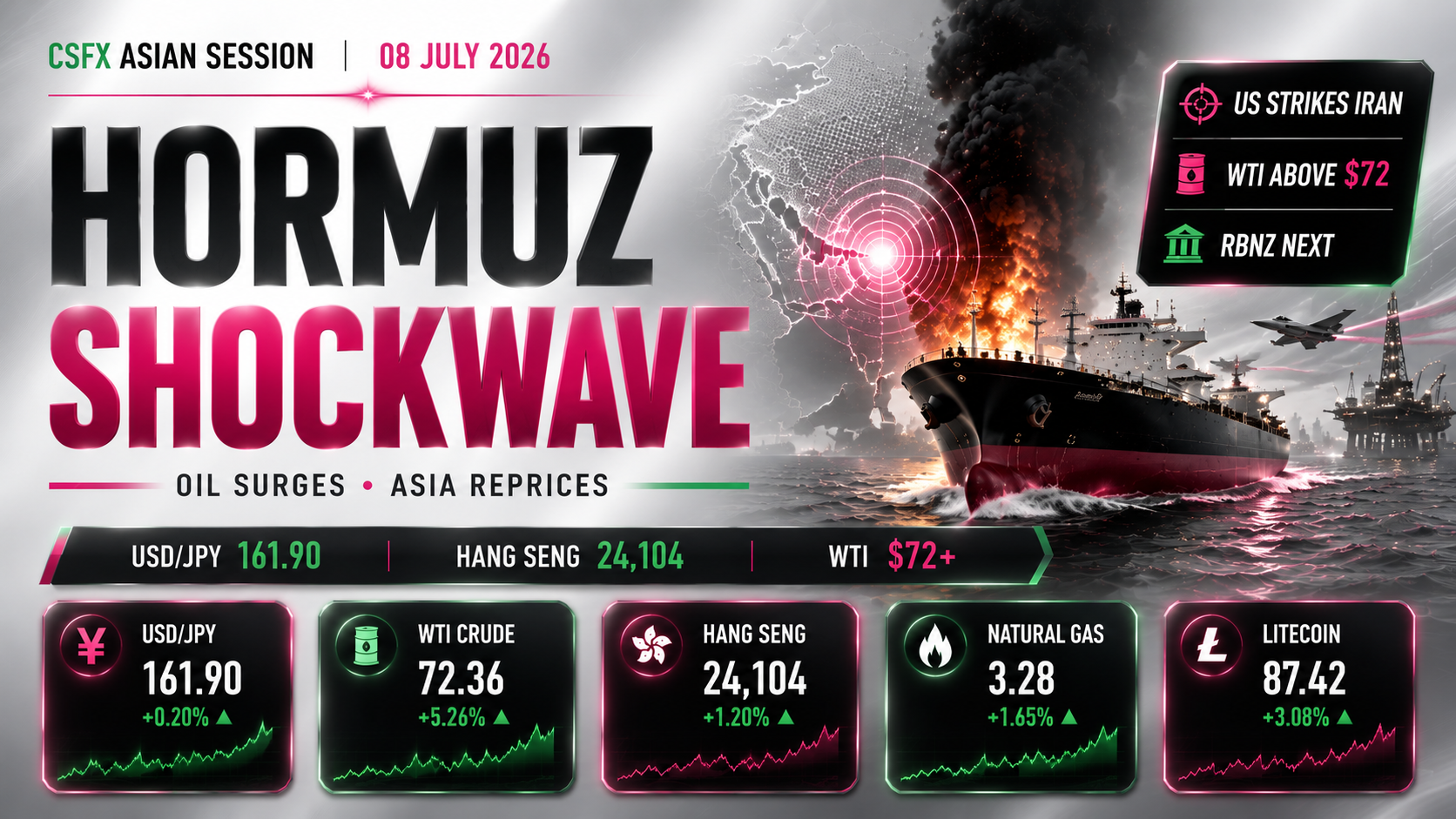
Asian markets open to a fresh Strait of Hormuz shock as the US strikes Iran in retaliation for tanker attacks and oil surges past $72, the Kospi’s chip-stock rout deepens even as Samsung posts a record profit, the Hang Seng extends its rally on tech strength and a buoyant IPO market, the yen holds near 40-year lows with intervention risk building, the Aussie dollar softens as the RBA flags an oil-driven inflation risk, Aluminium and Natural Gas both catch a fresh geopolitical bid, Litecoin and Solana extend their recoveries, and the RBNZ’s rate decision looms as the session’s next scheduled catalyst.
The overnight escalation in the Strait of Hormuz is the dominant story of the Asian session. Iran’s Revolutionary Guard Corps fired on three commercial vessels transiting the strait on Tuesday: the Qatari-owned LNG carrier Al Rekayyat, which suffered an engine-room fire and was at risk of exploding; the Saudi-flagged supertanker Wedyan; and a third vessel that reported structural damage. In response, US Central Command said it launched a “series of powerful strikes” early Wednesday, hitting more than 80 Iranian targets with precision munitions, including air-defence systems, radar sites, anti-ship missile batteries and small boats used by the Revolutionary Guard. The US Treasury separately revoked the sanctions waiver that had allowed Iran to sell crude and petrochemicals on the open market, a significant additional escalation on top of the military response. Saudi Arabia and Qatar have both formally condemned the attacks on their vessels, and shipping-security analysts warn that maritime traffic through the strait is likely to thin sharply again as owners reassess risk, with some rerouting toward the Red Sea despite ongoing Houthi threats there.
The chip-stock rout that first rattled Wall Street on Tuesday is extending deeper into the Asian session, with South Korea’s Kospi under renewed pressure even after Samsung Electronics reported a record quarterly profit, as investors instead focus on stretched AI-hardware valuations and the prospect of a broader unwind following Monday’s semiconductor-led selloff. Japan’s Nikkei 225 is also softer, tracking the regional tech weakness. Hong Kong’s Hang Seng is bucking the trend, however, surging roughly 2% to notch a fourth consecutive session of gains, supported by a rally in Tencent, SMIC, Lenovo, Kuaishou and Xiaomi, alongside continued strength in the city’s IPO market after autonomous-driving firm Momenta Global priced its Hong Kong listing above expectations. Beijing and Hong Kong authorities have also announced new measures to expand cross-border currency, bond and gold trading, aiming to reinforce the city’s role as the leading offshore yuan hub, while investors look ahead to China’s June CPI and PPI data due Thursday.
In FX, USD/JPY has eased modestly to near 161.90, pulling back slightly but still within striking distance of its 40-year high, as the wide roughly 250-basis-point gap between the Federal Reserve’s 3.50%–3.75% policy range and the Bank of Japan’s 1% rate continues to sustain carry-trade demand for the dollar. Finance Minister Satsuki Katayama has again reiterated that Tokyo stands ready to intervene at any time, and markets remain alert for a repeat of the sharp, unsignalled moves seen in recent weeks, even as many traders remain skeptical that intervention alone would provide lasting relief. AUD/USD, meanwhile, is little changed near 0.6941, hovering close to a three-month low, after RBA Assistant Governor (Economic) Sarah Hunter said the central bank would act as needed to return inflation to target and warned that further tightening may be required if the Hormuz-driven oil shock lifts household inflation expectations. Elsewhere in the region, the Reserve Bank of New Zealand’s Monetary Policy Committee is widely expected to hike its Official Cash Rate by 25 basis points to 2.50% later in the session, a decision that has flipped from a coin-toss to a clear majority view among economists over the past week even as the sharp fall in oil prices earlier this year had briefly clouded the tightening outlook.
In commodities, Aluminium on the London Metal Exchange has extended its snap-back to $3,153.93 a tonne, rebounding sharply from Tuesday’s four-month low near $3,090, as the renewed Strait of Hormuz escalation revives concerns over supply from the Gulf region, which accounts for close to a tenth of global aluminium output, even as rising Chinese and Indonesian smelter production continues to argue for a more measured advance. Natural Gas is holding firm near $3.27 per MMBtu, supported not only by strong LNG export flows and a still-warm US weather outlook but also by the direct strike on the Qatari LNG carrier in the strait, which has put global gas-shipping risk back in sharp focus for the first time since the tanker attacks earlier this year. In crypto, Litecoin has given back part of its recovery from last week’s swing low near $39.17, slipping to around $42.65 as it retreats from key Fibonacci resistance, while Solana has pulled back to $77.24, retreating from the $80 resistance band toward its 50-day EMA even as network activity metrics, including active addresses and transactions per second, remain near yearly highs. Both remain within their broader recovery structures despite the pullback, even as the Hormuz escalation keeps the broader risk-off tone in place. Wednesday’s FOMC minutes and Thursday’s Chinese inflation data loom as the next major catalysts for the balance of the week.
Asian Session Headlines
The stories driving price action across FX, equities, energy, metals, rates and crypto this session
Asian Session Economic Calendar — 8 July 2026
Key releases and events shaping price action across today’s Asian session (times local unless noted)
| Time | Event | Actual / Detail | Impact | Market Read |
|---|---|---|---|---|
| 🇮🇷Overnight | US Strikes on Iran After Hormuz Tanker Attacks | CENTCOM hits 80+ targets: air defences, radar sites, anti-ship missiles, small boats | 🔴 CRITICAL | Drives the entire session’s risk tone; WTI up more than 5% above $72 |
| 🇺🇸Ongoing | US Treasury Revokes Iran Oil-Sale Sanctions Waiver | Removes Iran’s ability to openly sell crude and petrochemicals on the open market | 🔴 CRITICAL | Compounds the Hormuz shipping-risk premium already lifting crude |
| 🇰🇷Ongoing | Kospi Chip-Stock Rout Deepens | South Korean shares extend Tuesday’s selloff despite Samsung’s record profit | 🔴 CRITICAL | Weighs on regional tech sentiment; Nikkei also softer in sympathy |
| 🈐🇳Ongoing | Hang Seng Extends Fourth Straight Session of Gains | Tencent, SMIC, Lenovo, Kuaishou and Xiaomi lead a tech-driven advance to ~24,104.06 | 🟢 MED | A rare pocket of regional resilience against the Hormuz-driven risk-off tone |
| 🇳🇰Later Today | RBNZ Official Cash Rate Decision | Consensus looks for a 25bp hike to 2.50%, a call that firmed sharply this week | 🔴 CRITICAL | A hike would extend NZD’s recent resilience; a hold would surprise markets |
| 🇨🇳Ongoing | PBOC Sets USD/CNY Reference Rate | Daily fix watched closely for signs of yuan-stability intent amid Hormuz volatility | 🟢 MED | A stronger-than-expected fix would help cap broader Asian FX weakness |
| 🇦🇺Ongoing | RBA’s Hunter Warns on Oil-Shock Inflation Risk | Assistant Governor says the board will act as needed to keep inflation on target | 🟢 MED | Keeps a hawkish floor under AUD even as risk-off flows weigh on the pair |
| 🇨🇳Ongoing | Momenta Global Debuts on Hong Kong Exchange | Autonomous-driving firm’s HK$5.89 billion IPO prices slightly above offer | ⚪ LOW | Reinforces the Hang Seng’s robust IPO-market narrative |
| 🇨🇳9 Jul (Upcoming) | China June CPI and PPI | Next major read on Chinese demand and factory-gate deflation pressures | 🟢 MED | Key input for the yuan and broader China-proxy trades into Thursday |
| 🇺🇸8 Jul, 2:00 PM ET | FOMC Meeting Minutes (Carryover From US Session) | Fuller record of the Fed’s June hold and its hawkish dot-plot signals | 🔴 CRITICAL | The week’s decisive catalyst for the Dollar, yields and risk assets into the US afternoon |
Asian Session Trade Ideas — 8 July 2026
Seven structured setups — USD/JPY, AUD/USD, Aluminium, Natural Gas, Hang Seng, Litecoin, Solana — with updated prices, levels, and full fundamental and technical analysis
USD/JPY

Fundamental Backdrop
USD/JPY has eased modestly to near 161.90, pulling back from its four-decade high but still within close reach, as the roughly 250-basis-point gap between the Federal Reserve’s 3.50%–3.75% policy range and the Bank of Japan’s 1% rate continues to sustain carry-trade demand for the dollar, even after the BOJ’s June hike to the highest level since 1995. Finance Minister Satsuki Katayama has again reiterated that Japanese authorities stand ready to intervene at any time and that Tokyo and Washington remain in close contact on currency policy, and reports have suggested Japan may stop signalling intervention plans in advance to better catch speculative short-yen positioning off guard. Even so, the pair has repeatedly shrugged off verbal warnings in recent sessions, and the overnight Hormuz escalation adds a layer of complexity: a sustained oil-driven inflation shock could eventually force the BOJ to tighten faster, but in the near term the flight-to-liquidity dynamics of a geopolitical shock have tended to support the dollar broadly.
Technical Outlook
USD/JPY remains in a well-defined uptrend but is consolidating just below its recent multi-decade high, having rebounded from a low near 160.29 earlier this month before pulling back from the 162.30 area. Resistance: 162.50 (a key round-number pivot watched closely for intervention risk) and 162.70 (this trade’s target, near the recent multi-decade high). Support: 161.00 (this trade’s buy-dip level, aligning with recent consolidation) and 160.30 (this trade’s stop, below last week’s swing low). A confirmed close above 162.70 without a visible MOF intervention would open a path toward the psychologically significant 164.50 area, while a sharp reversal back below 160.30 would raise the odds that verbal warnings have finally been followed by actual yen-buying intervention.
Session Catalysts
Watch for: (1) any actual, as opposed to verbal, intervention from Japan’s Ministry of Finance; (2) further headlines from the Strait of Hormuz escalation and their impact on broader risk appetite; (3) Wednesday’s FOMC minutes for confirmation of the Fed’s hawkish dot-plot signals; (4) any follow-through in Japanese wage and household-spending data; (5) US Treasury and G7 commentary on yen weakness.
AUD/USD

Fundamental Backdrop
AUD/USD is little changed near 0.6941, hovering close to a three-month low, as the overnight Strait of Hormuz escalation drives a broadly risk-off tone across Asian trade and weighs on the growth-sensitive, commodity-linked Aussie dollar. RBA Assistant Governor (Economic) Sarah Hunter said Wednesday that the board will act as needed to return inflation to target, explicitly warning that further tightening may be required if the oil shock lifts household inflation expectations — a hawkish signal that offers some underlying support even as the immediate market reaction favours the safe-haven dollar. The comments echo the RBA’s June minutes, which highlighted persistent concerns over excess demand and capacity constraints. Australia’s June composite PMI was recently revised up to 50.4, underscoring a broadly resilient domestic economy, but the currency remains hostage to the swings in global risk appetite driven by the Middle East conflict.
Technical Outlook
AUD/USD remains in a shallow downtrend below the psychologically important 0.7000 level, having pulled back from a recent two-week high near 0.6960. Resistance: 0.6960 (a near-term pivot) and 0.6980 (this trade’s sell-rally level, near the top of the recent range). Support: 0.6900 (a key near-term floor) and 0.6850 (this trade’s target, below the current three-month low). A confirmed close below 0.6850 would expose the next major support near 0.6800, while a break back above 0.6980 would suggest the RBA’s hawkish rhetoric is beginning to outweigh the Hormuz-driven risk-off flows.
Session Catalysts
Watch for: (1) further escalation or de-escalation headlines from the Strait of Hormuz; (2) any additional RBA commentary on the oil-shock inflation outlook; (3) China’s June CPI and PPI data on Thursday, given the Aussie’s sensitivity to Chinese demand; (4) the RBNZ’s rate decision later in the session, given the currencies’ close correlation; (5) Wednesday’s FOMC minutes and their impact on the broader US Dollar.
Aluminium

Fundamental Backdrop
LME Aluminium has extended its snap-back to $3,153.93 a tonne, rebounding sharply from Tuesday’s four-month low near $3,090, as the overnight Strait of Hormuz escalation revives concerns over supply disruption from the Gulf region, which accounts for close to a tenth of global aluminium output. The metal had spent the past two weeks unwinding much of its earlier war-risk premium after a US-Iran framework deal briefly reopened the strait, with rising Chinese and Indonesian smelter production and a firmer dollar both weighing on prices even as European physical premiums stayed elevated following force-majeure declarations at Gulf smelters damaged earlier this year. The renewed strikes and the revoked Iranian oil-sale waiver both argue for a fresh, if likely more contained, risk premium building back into the metal.
Technical Outlook
Aluminium has bounced firmly off Tuesday’s four-month low, reclaiming the $3,150 level and pushing into the upper half of its recent multi-week range. Resistance: $3,180 (a near-term pivot) and $3,250 (this trade’s target, near the top of the range last tested in late June). Support: $3,080 (this trade’s buy-dip level) and $3,020 (this trade’s stop, below the base of today’s bounce). A confirmed close above $3,250 would open a path back toward the early-June four-year high near $3,750, while a break back below $3,020 would suggest the China/Indonesia supply-glut narrative is reasserting itself over the Hormuz risk premium.
Session Catalysts
Watch for: (1) any further escalation or de-escalation around the Strait of Hormuz and its impact on Gulf smelter operations; (2) Chinese production and export data; (3) Indonesian smelter output trends; (4) LME warehouse inventory levels; (5) broader US Dollar direction into Wednesday’s FOMC minutes.
Natural Gas

Fundamental Backdrop
US Natural Gas is holding firm just below a one-week high near $3.27 per MMBtu, supported by falling Lower 48 production, which slipped to around 109.4 billion cubic feet per day so far in July from 110.0 bcfd in June, alongside rising average flows to major LNG export terminals, which have increased to roughly 18.1 bcfd so far this month. The overnight strike on the Qatari-owned LNG carrier Al Rekayyat in the Strait of Hormuz has added a fresh, more global dimension to the gas story, reviving concerns over the security of Gulf LNG shipping routes for the first time since earlier tanker incidents this year, even though the bulk of US gas supply and export capacity is insulated from the strait directly. Weather forecasts have shifted somewhat cooler across the eastern US through mid-July, a factor that could cap the upside if cooling demand fades faster than expected.
Technical Outlook
Natural Gas has rebounded from a recent low near $3.20, breaking back above its short-term moving averages on the daily chart. Resistance: $3.40 (a near-term pivot) and $3.55 (this trade’s target, near the top of the recent multi-week range). Support: $3.15 (this trade’s buy-dip level) and $3.00 (this trade’s stop, below the base of the recent consolidation). A confirmed close above $3.55 would open a path back toward the $3.80–$4.00 area last tested during the spring heat-driven rally, while a break back below $3.00 would suggest ample storage levels, currently around 6% above the five-year average, are reasserting themselves over the Hormuz-driven risk premium.
Session Catalysts
Watch for: (1) any further shipping incidents involving LNG carriers near the Strait of Hormuz; (2) updated US weather forecasts for the back half of July; (3) weekly EIA storage injection data; (4) LNG export-terminal flow rates; (5) Lower 48 production trends into the peak summer cooling season.
Hang Seng

Fundamental Backdrop
The Hang Seng Index is extending its rally to a fourth consecutive session, surging roughly 2% to around 24,104.06, as gains in Tencent (+2.4%), SMIC (+2.9%), Lenovo (+4.4%), Kuaishou (+1.2%) and Xiaomi (+2.9%) offset the overnight Hormuz-driven risk-off tone that is weighing on other regional benchmarks, including the Kospi. Hong Kong’s IPO market continues to reinforce sentiment, with autonomous-driving firm Momenta Global’s HK$5.89 billion listing pricing slightly above its offer, underscoring strong investor demand for technology listings even amid broader geopolitical uncertainty. Beijing and Hong Kong authorities have also unveiled new measures to expand cross-border currency, bond and gold trading, aiming to strengthen the city’s role as the leading offshore yuan hub, while markets look ahead to China’s June CPI and PPI data on Thursday for further confirmation of the domestic demand backdrop.
Technical Outlook
The Hang Seng remains within a well-defined near-term uptrend, having reversed Tuesday’s dip back to around 23,497 and broken decisively above the top of its recent range. Resistance: 24,200 (a near-term pivot, at a fresh multi-week high) and 24,700 (this trade’s target, on the path toward the 25,000 area). Support: 23,850 (this trade’s buy-dip level) and 23,450 (this trade’s stop, just below Tuesday’s low near 23,497). A confirmed close above 24,700 would open a path back toward the 25,000 area last tested in late spring, while a break back below 23,450 would suggest the Hormuz-driven risk-off tone is beginning to outweigh the domestic tech and IPO-market tailwinds.
Session Catalysts
Watch for: (1) any further escalation or de-escalation around the Strait of Hormuz and its impact on regional risk appetite; (2) China’s June CPI and PPI data on Thursday; (3) continued IPO pipeline activity in Hong Kong; (4) follow-through in mainland technology names; (5) the PBOC’s daily USD/CNY reference-rate fix.
Litecoin

Fundamental Backdrop
Litecoin has pulled back to $42.65, giving back part of its bounce off last week’s swing low near $39.17 after failing to clear key Fibonacci resistance, as some of the recent buying momentum fades following weeks of broader weakness. The move comes as the overnight Strait of Hormuz escalation has introduced a more cautious tone across broader risk assets, suggesting Litecoin’s pullback is being driven more by asset-specific technical positioning — including a sharp decline in derivatives open interest from above $1.2 billion during the prior rally to roughly $325 million, alongside continued exchange outflows — than by the macro backdrop. The Litecoin Foundation continues to promote the token’s utility as a fast, low-cost payments rail, a narrative that has helped it hold up better than some peers during the recent broader crypto-market correction.
Technical Outlook
Litecoin has slipped back below its 20-day EMA near $43.99, having failed to clear the 0.382 Fibonacci retracement level near $45.99, and now sits well below the 50-day EMA near $46.35. Resistance: $43.99 (the 20-day EMA, a key near-term barrier) and $45.50 (this trade’s target, on the approach to the 0.382 Fibonacci level at $45.99). Support: $41.00 (this trade’s buy-dip level, just above the $42.39 Fibonacci support) and $39.50 (this trade’s stop, below last week’s swing low near $39.17). A confirmed close back above $45.99 would open a path toward the 50-day EMA near $46.35 and eventually the 0.618 Fibonacci level near $49.89, while a break below $39.50 would expose fresh lows beyond the prior swing low.
Session Catalysts
Watch for: (1) broader crypto-market risk appetite in the wake of the Hormuz escalation; (2) Bitcoin’s price direction, given LTC’s typical correlation to the broader market; (3) any fresh Litecoin ETF or institutional-adoption headlines; (4) derivatives open-interest trends; (5) continued exchange-outflow data as a signal of accumulation.
Solana

Fundamental Backdrop
Solana has pulled back to $77.24, retreating from resistance just below the $80–$82 band that has capped the token since early June, even as on-chain fundamentals continue to strengthen: active addresses are nearing a yearly high approaching 7 million, and average transactions per second are trending toward a new all-time high near 1,100, driven in part by meme-coin launchpad and airdrop activity. The network’s forthcoming Alpenglow consensus upgrade, which aims to cut transaction finality from roughly 12 seconds to around 150 milliseconds, remains a potential medium-term catalyst if it nears mainnet deployment later this year. The token’s resilience in the face of the overnight Hormuz-driven risk-off tone suggests improving network fundamentals are helping offset broader macro caution for now.
Technical Outlook
Solana remains boxed in a range between roughly $63 and $82 since early June, with price now sitting just above its 50-day EMA near $75 after retreating from the top of the range, while the 100-day EMA near $81.60 and the 200-day EMA near $97 both sit above current price, reflecting a still-cautious longer-term trend structure. Resistance: $80.00 (the base of the recent range top) and $90.00 (this trade’s target, on the path toward the 200-day EMA). Support: $75.50 (this trade’s buy-dip level, just above the 50-day EMA) and $72.00 (this trade’s stop, below the 20-day EMA near $72). A confirmed daily close back above $80 would strengthen the recovery case and open a path toward $97 and eventually the $125–$130 zone flagged by some technical analysts, while a loss of $72.00 would expose the $63–$65 demand zone.
Session Catalysts
Watch for: (1) broader crypto-market risk appetite following the Hormuz escalation; (2) any updates on the Alpenglow consensus-upgrade timeline; (3) continued Solana ETF inflow or outflow data; (4) network activity metrics, including active addresses and transactions per second; (5) Bitcoin’s broader price direction given SOL’s high-beta relationship to it.
Asian Session FAQ — 8 July 2026
Answers to the questions traders are asking this session
Asian Session Summary — Wednesday, 8 July 2026
Wednesday’s Asian session opens under a fresh geopolitical shock as the US launches retaliatory strikes on Iran after the Revolutionary Guard fired on three commercial vessels in the Strait of Hormuz on Tuesday, including a Qatari-owned LNG carrier that suffered an engine-room fire; US Central Command says it hit more than 80 Iranian targets with precision munitions, while the US Treasury has separately revoked the sanctions waiver that had allowed Iran to sell crude on the open market. WTI crude has surged more than 5% to trade above $72 a barrel on the news. The shock is rippling unevenly across the region: South Korea’s Kospi is extending Tuesday’s chip-stock rout even after Samsung Electronics posted a record quarterly profit, while Hong Kong’s Hang Seng is bucking the trend to notch a fourth consecutive session of gains, surging to around 24,104.06, supported by a rally in Tencent, SMIC, Lenovo, Kuaishou and Xiaomi alongside a buoyant IPO market led by autonomous-driving firm Momenta Global. In FX, USD/JPY has eased to near 161.90, still within reach of a four-decade high, as the wide Fed-BOJ rate gap sustains carry demand even as Finance Minister Satsuki Katayama again warns that Tokyo stands ready to intervene, while AUD/USD is little changed near 0.6941 after RBA Assistant Governor Sarah Hunter flagged the risk of further tightening if the oil shock lifts inflation expectations. New Zealand’s central bank is widely expected to hike its Official Cash Rate to 2.50% later in the session. In commodities, Aluminium has extended its snap-back to $3,153.93 a tonne on renewed Gulf-supply risk, while Natural Gas is holding firm near $3.27 per MMBtu as the direct strike on a Qatari LNG carrier revives concerns over global gas-shipping security alongside already-strong US export demand. In crypto, Litecoin has given back part of its bounce off last week’s swing low to trade near $42.65, while Solana has pulled back to $77.24 even as network-activity metrics remain near yearly highs. Highest-conviction macro: buy Natural Gas on dips toward $3.15, stop $3.00, target $3.55 — the direct strike on a Gulf LNG carrier is a genuine, if likely temporary, catalyst layered on top of already-firm export demand, even though a cooler US weather shift and ample storage levels both carry real two-way risk into the trade.
For the individual instruments: USD/JPY buy dips toward 161.00, stop 160.30, target 162.70 — the wide Fed-BOJ rate gap remains a genuine tailwind for the pair, though verbal and potential actual intervention from Japan’s Ministry of Finance is a real and rising risk the closer the pair trades to 162.50. AUD/USD sell rallies toward 0.6980, buy dips toward 0.6850, stop 0.7020 — the Hormuz-driven risk-off tone is a genuine near-term headwind, though the RBA’s hawkish rhetoric on oil-shock inflation risk is a real offsetting factor that could limit further downside. Aluminium buy dips toward $3,080, stop $3,020, target $3,250 — the renewed Gulf-supply risk premium is a genuine catalyst, though rising Chinese and Indonesian output remains a real offsetting headwind. Natural Gas buy dips toward $3.15, stop $3.00, target $3.55 — the Qatari LNG tanker strike and strong export flows are genuine tailwinds, though a cooler US weather shift and elevated storage levels are real two-way risks. Hang Seng buy dips toward 23,850, stop 23,450, target 24,700 — the tech rally and robust IPO pipeline are genuine tailwinds, though the broader Hormuz-driven risk-off tone is a real headwind that could yet catch up with the index. Litecoin buy dips toward $41.00, stop $39.50, target $45.50 — the pullback from resistance argues for patience, and while the token remains within a broader corrective trend that calls for disciplined entries, the prior decline in open interest and continued exchange outflows are still genuine signs of healthier positioning. Solana buy dips toward $75.50, stop $72.00, target $90.00 — strengthening network fundamentals are a genuine tailwind, though the price remains well below its 200-day moving average, a real sign that the longer-term trend has not yet turned decisively bullish. The decisive variables for the remainder of the session are the RBNZ’s rate decision, any further escalation or de-escalation around the Strait of Hormuz, and Wednesday’s FOMC minutes, all of which carry the potential to reshape the broader risk, currency and commodity narrative heading into the European and US sessions. Size positions accordingly, and note that the Hormuz situation in particular remains fluid and carries genuine event risk that could reshape sentiment intraday.
Access Live Asian Markets →