
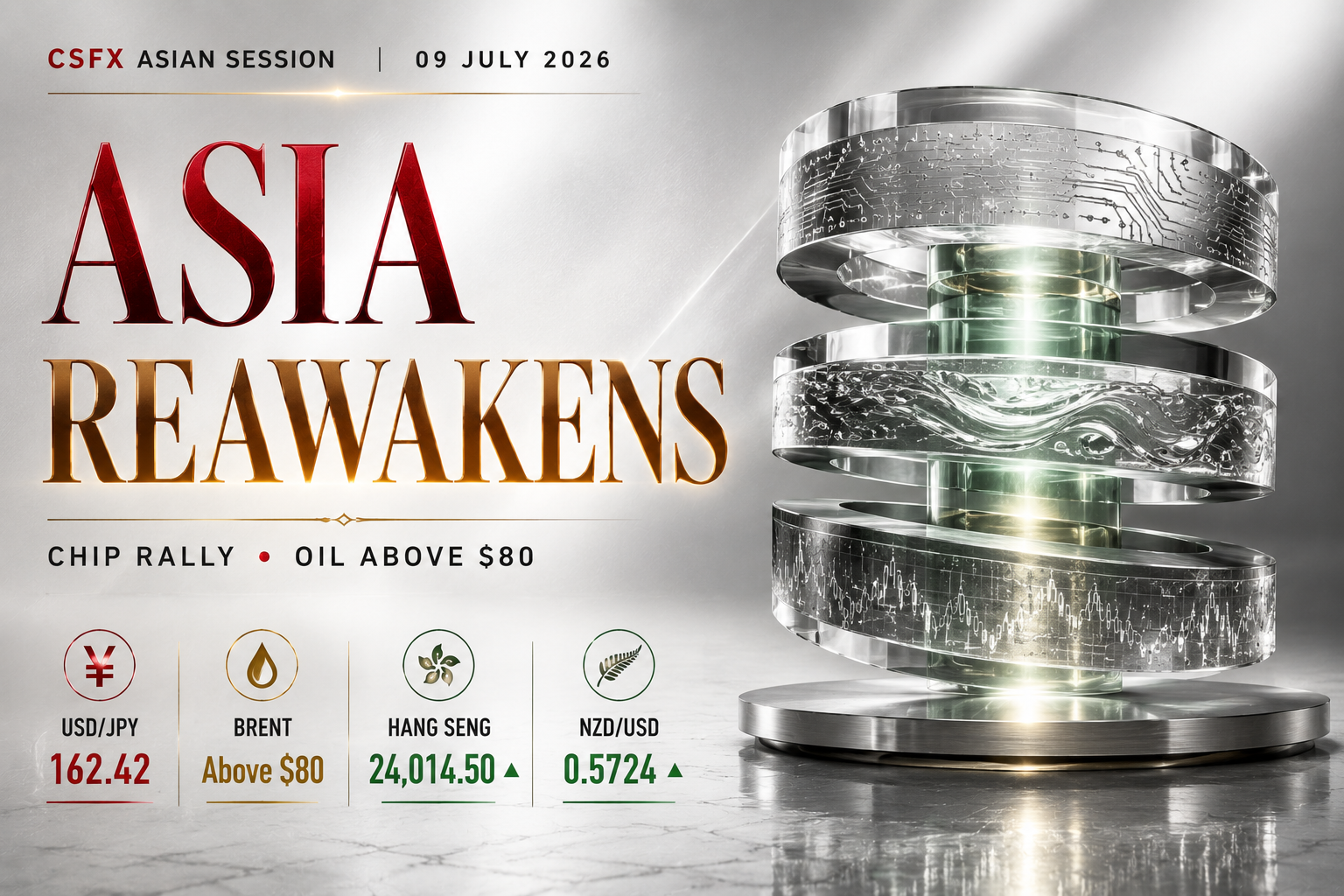
Asian Shares Rally on Chip Rebound as Oil Extends Gains for a Third Session, Bond Yields Surge on Iran Escalation; RBNZ Delivers Hawkish Hike, China Inflation Data Awaited | Asian Session – Technical Analysis | 9 July 2026
Asian Shares Rally on Chip Rebound as Oil Extends Its Advance for a Third Straight Session and Brent Clears $80, Bond Yields Surge on Renewed Iran Strikes; RBNZ Delivers Hawkish Hike, China Inflation Data Awaited
Asian equities climb as chipmakers rebound — Nikkei +2.3%, KOSPI +3.8%, Hang Seng +2.8% — even as oil extends its advance for a third session and Brent clears $80 on renewed US strikes against Iran; the global bond rout deepens, with 10-year JGB yields at their highest since 1996 near 2.88% and US 10-year yields near 4.59%; the RBNZ delivers its first hike in three years, lifting NZD/USD back above 0.5724, while USD/JPY eases slightly to 162.42, just under 40-year highs; Copper holds range-bound near $6.13 on US tariff-hearing uncertainty; Wheat sits at a one-month high near $6.13 ahead of Friday’s WASDE; and Dogecoin and BNB stay pressured near multi-week lows as crypto’s broader risk-off mood persists, with China’s June CPI and PPI data due later in the session.
Asia-Pacific markets are firmer through Thursday’s session as semiconductor names finally catch a bid after days of heavy selling. Japan’s Nikkei 225 has climbed 2.3% to snap a three-day losing streak, South Korea’s KOSPI has surged 3.8% on a 3.6% rise in Samsung Electronics and a 7.5% jump in SK Hynix, and Hong Kong’s Hang Seng has added more than 2.8% to trade near 24,014.50, with the broader MSCI Asia-Pacific ex-Japan index up 0.8%. The relief rally follows overnight reports that China may allow its leading AI firms to purchase a limited number of Nvidia’s H200 chips, which sent Nvidia up 3.6% and helped Wall Street’s Nasdaq eke out a small gain even as the Dow and S&P 500 retreated. “At this stage, the market still appears skewed towards the view that the (Iran) conflict ultimately de-escalates, and negotiations resume around the Memorandum of Understanding,” said Chris Weston, head of research at Pepperstone, though he cautioned that “the situation remains highly fluid, and conviction around timing is exceptionally difficult.”
That caution is well founded: oil prices have extended their advance for a third consecutive session after President Trump declared the US-Iran ceasefire memorandum of understanding “over” and the US military launched fresh strikes on Iran for a second straight day in an effort to help reopen the Strait of Hormuz. Brent crude has risen to around $78.65-$78.93 a barrel, up roughly 9% this week and briefly crossing above $80 for the first time since June 22, while WTI trades near $74.40. Trump later said he did not expect a return to full-scale war, which has helped cap the advance and soothe some of the earlier panic, but the renewed supply-risk premium has already done its work on inflation expectations: Fed funds futures now imply about 38 basis points of policy tightening this year, back to where pricing sat a week ago, after Wednesday’s FOMC Minutes showed a handful of participants already saw a case for raising rates in June before the committee ultimately agreed to hold.
The clearest casualty of that repricing is the bond market, where the global rout has deepened through Asian hours. The yield on 10-year Japanese government bonds has risen 1.5 basis points to 2.880%, the highest level since September 1996, while Australia’s 10-year yield has climbed 4 basis points to 4.924%, its highest since early June. The benchmark 10-year US Treasury yield has added another 2 basis points to 4.586% in Asian trade after a 4bp overnight rise, up some 10 basis points on the week. Currency markets, by contrast, have reacted more modestly to the yield surge: USD/JPY has actually eased around 0.2% to 162.42, failing to hold onto its own yield support and remaining just under the 40-year peak of 162.84 set earlier this week, with speculators still wary of Japanese intervention after repeated warnings from Finance Minister Satsuki Katayama that authorities stand ready to act “at any time.” Overnight, the Reserve Bank of New Zealand delivered its first Official Cash Rate hike in three years, lifting the OCR by 25 basis points to 2.50% and signalling further tightening is “likely,” even as four of the six-member Monetary Policy Committee characterised inflation risks as “broadly balanced” — a dovish-leaning hike that nonetheless pushed NZD/USD back above the 0.5700 handle to trade near 0.5724, its firmest level in roughly a week, as it reclaims ground lost to an overnight dip tied to the Iran-driven risk-off move.
In commodities, Copper is holding range-bound near $6.13 a pound after BHP Group received environmental approval for an expansion at its Chilean copper operations, part of the world’s largest miner’s strategy to nearly double its global copper output by the mid-2030s; the metal remains capped below its 20-day and 50-day moving averages, however, as the US begins three days of tariff hearings covering 60 countries over forced-labour practices, a development that introduces fresh uncertainty into global copper trade flows. Wheat, meanwhile, sits at a fresh one-month high near $6.13 a bushel after the USDA’s June 1 stocks report came in below expectations at 920 million bushels and the annual acreage report showed all-wheat plantings at a record-low 42.740 million acres, with the Hard Red Winter crop forecast at its smallest since 1957/58 after significant Great Plains drought; Friday’s July WASDE report will publish the first 2026/27 wheat-by-class projections and is the session’s key look-ahead catalyst for the grain complex. China’s June CPI and PPI figures are due later in the session and will be watched for confirmation that deflationary pressure in the world’s second-largest economy continues to ease.
In crypto, the broader risk-off mood that gripped markets after Wednesday’s escalation has yet to fully clear. Bitcoin remains capped below its $64,000 resistance, trading near $62,000-$62,500 after falling roughly 3% on Wednesday amid $300 million in liquidations, weighed down further by a $7.7 billion contraction in the stablecoin market in June — its steepest monthly drop since the 2022 TerraUSD collapse — that signals reduced dry powder available to buy dips. Dogecoin, the weakest of the large-cap majors, is pinned near its 52-week low around $0.071 after sliding almost 5% on Wednesday, though the token’s House of Doge entity completed its Nasdaq listing as HODO on July 1 and continues integrating with Paxos for broader payments adoption. BNB trades near $569.35, still pressured by new EU Markets in Crypto-Assets (MiCA) stablecoin rules that took effect July 1 and have forced Binance to restrict or suspend services in several EU member states — the exchange withdrew its Greek MiCA license application and now plans to apply in France — even as the underlying BNB Chain notched a milestone this week, with cumulative tokenized-stock trading volume surpassing $5.2 billion, overtaking Solana in that segment.
Asian Session Headlines
The stories driving price action across equities, FX, metals, grains, rates and crypto this session
Asian Session Economic Calendar — 9 July 2026
Key releases and events shaping price action across today’s Asian session (times GMT unless noted)
| Time | Event | Actual / Detail | Impact | Market Read |
|---|---|---|---|---|
| 🇺🇸Ongoing | US Strikes Iran for a Second Straight Day to Reopen Strait of Hormuz | Follows Trump’s declaration that the ceasefire MoU “is over”; Trump says he doesn’t expect full-scale war | 🔴 CRITICAL | Extends the oil-driven inflation impulse; keeps Brent above $78 and the bond rout intact |
| 🇳🇿Overnight | RBNZ Official Cash Rate Decision | +25bps to 2.50%, first hike in three years; further tightening flagged as “likely” | 🔴 CRITICAL | NZD/USD reclaims 0.5700; Kiwi among the stronger G10 performers on the session |
| 🇯🇹Overnight | 10-Year JGB Yield Hits Highest Since September 1996 | Up 1.5bps to 2.880%, extending the region-wide bond-yield surge | 🔴 CRITICAL | Reinforces yen carry-trade unwind risk even as USD/JPY itself stays soft |
| 🇨🇳Today | China June CPI and PPI | Watched for confirmation that deflationary pressure continues to ease | 🔴 CRITICAL | Key swing factor for the Hang Seng, CSI 300 and industrial-metals complex into the close |
| 🇺🇸Ongoing | US Tariff Hearings on 60 Countries Begin (Forced-Labour Review) | Three-day hearing process introducing fresh uncertainty to global trade flows | 🟢 MEDIUM | Caps Copper’s rebound attempts and keeps the metal range-bound near $6.13 |
| 🇳🇰Overnight | Kuwait and Bahrain Air Defense Alerts Continue | Missile-warning sirens activated for a third time amid Iran-Kuwait exchanges of fire | 🟢 MEDIUM | Sustains the Gulf shipping-risk premium underpinning Brent’s move above $80 |
| 🇺🇸Fri 10 Jul | USDA July WASDE Report (Look-Ahead) | First release of 2026/27 wheat-by-class projections; all-wheat plantings at a record-low 42.740M acres | 🟢 MEDIUM | The next scheduled catalyst for Wheat, which trades at a one-month high near $6.13 |
| 🇳🇺Today | NATO Summit Concludes in Ankara | Alliance finalising a declaration on collective defence following a two-day summit | ⚪ LOW | Secondary headline risk for European defence names and NATO-linked FX crosses |
Asian Session Trade Ideas — 9 July 2026
Seven structured setups — USD/JPY, NZD/USD, Copper, Wheat, Hang Seng, Dogecoin, BNB — with updated prices, levels, and full fundamental and technical analysis
USD/JPY

Fundamental Backdrop
USD/JPY is trading just under the 40-year peak of 162.84 reached earlier this week, but the pair’s failure to fully capture Thursday’s fresh leg higher in Treasury yields — the 10-year is near 4.586%, up another 2 basis points in Asian hours — suggests the move is running into two-sided pressure. On one side, the fundamental case for further Dollar strength remains intact: Japan’s fiscal-expansion concerns and a Bank of Japan seen as lagging on policy normalization continue to weigh on the yen, even after May wage data showed nominal wages up 3.2% while household spending fell 0.4%, a mixed signal that gives the BOJ little urgency to hike. On the other side, Finance Minister Satsuki Katayama has repeatedly warned that Japanese authorities are prepared to intervene “at any time,” and the currency’s failure to track yields higher on Thursday may reflect market caution around that risk following last week’s reports that Tokyo could stop pre-signalling any intervention to catch speculators off guard.
Technical Outlook
USD/JPY maintains a constructive intraday structure, holding just below Monday’s high near 162.42 after a short squeeze rally that followed a hammer candle at the 160.50-160.75 support zone. Four-hour RSI(14) is easing toward neutral from prior overbought readings while MACD stays slightly positive, hinting that upside momentum, while cooling, remains intact. Resistance: 162.41 (June 6 high, this week’s intraday cap) and 162.85 (this trade’s target, the 40-year peak). Support: 161.70 (this trade’s buy-dip level, Tuesday’s low) and 161.20 (this trade’s stop, beneath the 161.50-161.95 zone that has flipped from resistance to support). A confirmed close above 162.85 opens a path toward 163.50 and then the round 164.00 handle, while a break below 160.50 would neutralise the near-term bullish bias and raise the odds of a deeper yen recovery.
Session Catalysts
Watch for: (1) any fresh comments from Finance Minister Katayama or the Ministry of Finance on intervention readiness; (2) the pace of the US 10-year yield’s climb, given the pair’s muted correlation with yields on Thursday; (3) further headlines on the Iran conflict and their impact on broad Dollar demand; (4) China’s June CPI/PPI release and its read-through for regional risk appetite; (5) any signs of official Japanese dollar-selling around the 162.84-163.00 zone, historically a level of elevated intervention risk.
NZD/USD

Fundamental Backdrop
NZD/USD has caught a strong positive bid following the Reserve Bank of New Zealand’s first Official Cash Rate hike in three years, lifting the OCR by 25 basis points to 2.50% and reclaiming the 0.5700 mark in Asian trade. The hike itself was largely priced, but Governor Anna Breman’s guidance that further increases appear “likely” added a genuinely hawkish edge, even as four of six committee members characterised the balance of inflation risks as “broadly balanced” rather than skewed higher — a nuance some analysts read as a “dovish hike.” Most major New Zealand banks see the OCR reaching around 3.00% by year-end via two further quarter-point moves in September and December, with markets pricing roughly a 60% chance of a September follow-up. Subdued broader US Dollar demand is lending additional support ahead of any further Fed repricing, though the RBNZ’s own projections were not updated at this meeting, leaving the statement and vote to do the heavy lifting on forward guidance.
Technical Outlook
NZD/USD is testing the 0.5715 confluence zone, comprising the 100-day Exponential Moving Average on the 4-hour chart and a secondary resistance cluster, after reclaiming the 0.5700 handle from Tuesday’s pullback to 0.5693. The 4H MACD (12,26,9) reads a neutral 0.001, while the RSI at 43.75 and Williams %R at 43.1 both suggest a market that has room to extend higher without being overbought. Resistance: 0.5715 (this session’s confluence hurdle) and 0.5760 (this trade’s target, the next material supply zone). Support: 0.5680 (this trade’s buy-dip level, the former RBNZ-week consolidation floor) and 0.5640 (this trade’s stop, ahead of the deeper 0.5621-0.5600 zone flagged by more bearish technical reads). A sustained break above 0.5715 would open a path toward 0.5760 and then the 0.59 area some banks target for year-end, while a slide back below 0.5640 would call the RBNZ-driven bullish setup into question.
Session Catalysts
Watch for: (1) any follow-through commentary from RBNZ officials clarifying the “broadly balanced” risk assessment; (2) broader US Dollar direction into the New York open, given the pair’s sensitivity to global risk sentiment; (3) China’s June CPI/PPI release, an indirect but relevant swing factor for the risk-sensitive Kiwi; (4) continued volatility in oil prices, given New Zealand’s status as a net energy importer; (5) New Zealand’s Q2 CPI, due July 20, which will be the next hard data point testing the RBNZ’s hawkish guidance.
Copper

Fundamental Backdrop
Copper is holding range-bound near $6.13 a pound, caught between a structurally tight long-term supply picture and near-term trade-policy uncertainty. On the bullish side, BHP Group has received environmental approval for an expansion project at its Chilean copper operations, supporting the world’s largest miner’s strategy to nearly double global copper output by the mid-2030s amid a market that Saxo and others describe as facing a mine-supply “weak link,” with grid investment, AI data centres, EV infrastructure and defence capex all point to demand that may prove less price-sensitive than traditional end-uses. On the bearish side, the US has begun a three-day hearing process on a plan to impose tariffs on 60 countries over forced-labour practices, a development that introduces fresh uncertainty into global copper trade flows and has already been cited for a roughly 1.3% pullback in the metal this week. The oil-driven Dollar strength stemming from the Iran escalation is a secondary headwind, typically pressuring dollar-denominated industrial metals.
Technical Outlook
Copper futures remain capped below the 20-period moving average at $6.1416 and the 50-period moving average at $6.1361 on the four-hour chart, with both levels acting as resistance on rebound attempts; the Ichimoku Kijun level at $6.1401 forms the first barrier for any recovery move. The daily timeframe still shows long-term support well above the 200-day moving average at $5.904, underscoring that the broader uptrend from 2026’s lows remains structurally intact despite the near-term consolidation. Resistance: $6.16 (the MA-20/MA-50/Kijun confluence) and $6.30 (this trade’s target, the next material supply zone above the recent range). Support: $6.05 (this trade’s buy-dip level, a round-number pivot within the current range) and $5.95 (this trade’s stop, just below the $5.9562 support flagged as the line in the sand for deeper downside). A decisive move through $6.1401 resistance would open a path back toward the year’s highs, while a break of $5.9562 would expose a deeper correction toward the 200-day average.
Session Catalysts
Watch for: (1) further headlines from the ongoing US tariff hearings on 60 countries, the session’s dominant swing factor; (2) China’s June CPI/PPI release and its read-through for industrial demand; (3) any Section 232 tariff-related commentary from Commerce Secretary Howard Lutnick’s office; (4) broader Dollar direction, given the oil-driven haven bid; (5) Chilean supply updates, including further detail on BHP’s Chilean expansion timeline.
Wheat

Fundamental Backdrop
Wheat has climbed to its highest level since June 2026, trading near $6.13 a bushel, underpinned by a genuinely tightening US supply picture. The USDA’s June 1 wheat-stocks report came in at 920 million bushels, missing expectations, while the annual acreage report showed US all-wheat plantings at a record-low 42.740 million acres — the lowest in USDA records dating to 1919 — with winter wheat plantings shrinking to a six-year low of 31.52 million acres. The ERS projects the 2026/27 Hard Red Winter crop, typically the largest US wheat class, at its smallest since 1957/58 after significant Great Plains drought damaged yields and drove higher abandonment. Export demand has stayed firm, with a private sale of 100,000 metric tons of hard red spring wheat to Nigeria, a Saudi tender for 24.1 million bushels specifically routed to avoid the Strait of Hormuz, and a Jordanian tender for milling wheat, all supporting the bid even as the broader harvest progresses at a solid pace.
Technical Outlook
Wheat has broken decisively above its recent range, climbing from a sub-$5.90 base to test the $6.13-$6.14 area, its best levels of the past month. The advance has been steady rather than parabolic, consistent with genuine supply-driven repricing rather than speculative excess, and the metal has held each pullback toward its rising short-term moving averages. Resistance: $6.20 (near-term supply from the pre-drought consolidation) and $6.35 (this trade’s target, the next material level above the current one-month high). Support: $6.00 (this trade’s buy-dip level, the round-number pivot and recent breakout shelf) and $5.90 (this trade’s stop, beneath the base of the current advance). A confirmed close above $6.20 would open a path toward the $6.50 area, while a slide back below $5.90 would call the current breakout into question ahead of Friday’s report.
Session Catalysts
Watch for: (1) Friday’s July WASDE report, the single most important catalyst for the grain complex, which will publish the first 2026/27 wheat-by-class projections; (2) weekly US export sales data, given the recent surge in overseas demand; (3) Black Sea and Russian supply headlines, a persistent swing factor for global wheat pricing; (4) any escalation in Strait of Hormuz shipping risk, given tenders already being routed to avoid the chokepoint; (5) continued US harvest-progress updates through the Plains and Midwest.
Hang Seng

Fundamental Backdrop
The Hang Seng has surged more than 2.8% to trade near 24,014.50, tracking a region-wide semiconductor relief rally after reports that China plans to allow its top AI firms to purchase a limited number of Nvidia’s H200 chips, a headline that also lifted Nvidia 3.6% overnight and helped South Korea’s KOSPI jump 3.8% on gains in Samsung Electronics and SK Hynix. That risk-on impulse is unfolding alongside two genuine headwinds, however: the oil-driven inflation scare from the renewed Iran escalation is deepening the regional bond rout, with 10-year JGB yields at their highest since 1996 and Australia’s 10-year at a one-month high, while Hong Kong’s property sector has shown recent weakness, with the sub-index down more than 3% earlier in the week. China’s June CPI and PPI figures, due later in the session, are a swing factor that could either extend or cap Thursday’s rally depending on whether they confirm continued easing of deflationary pressure in the mainland economy.
Technical Outlook
The Hang Seng has broken down from an approximate horizontal trend channel over the medium-to-long term, a pattern that continues to signal a technically negative bias even as Thursday’s rally represents a genuine near-term positive reaction. The index reacted back after a false break of a head-and-shoulders formation, and a significant penetration below 23,765 would renew negative signals, while a break of the opposite side of the formation would be a strong positive signal. The index is now testing resistance at the 24,400 level; a failure there could give a negative reaction, but an upward breakthrough of 24,400 would represent a genuinely positive signal for the medium-term trend. Resistance: 24,400 (the key technical pivot cited above) and 24,600 (this trade’s target, just above that pivot). Support: 23,700 (this trade’s buy-dip level, just above the 23,765 pattern-defining level) and 23,400 (this trade’s stop, below the pattern-negation threshold).
Session Catalysts
Watch for: (1) China’s June CPI and PPI release, the session’s most important swing factor for mainland and Hong Kong-listed shares; (2) continued momentum in the chip-sector relief rally and any follow-through Nvidia/AI-chip headlines; (3) further Hong Kong IPO activity, given the market’s robust recent listing pipeline; (4) property-sector headlines, given the segment’s recent underperformance; (5) any fresh escalation in the Iran conflict that could reverse the regional risk-on tone.
Dogecoin

Fundamental Backdrop
Dogecoin is pinned near its 52-week low around $0.071, having fallen almost 5% on Wednesday as the broader crypto market absorbed the Iran-driven risk-off shock alongside a genuinely concerning liquidity signal: the stablecoin market contracted 2.4%, or $7.7 billion, in June, its steepest monthly decline since the 2022 TerraUSD collapse, indicating that fresh capital is leaving the crypto ecosystem rather than merely rotating within it. Bitcoin’s own failure to reclaim the $64,000 resistance zone has left little support for the high-beta, no-yield memecoin, which typically expresses broad risk-off de-risking most violently among the large-cap majors. There are pockets of structural support: the House of Doge entity completed its Nasdaq listing under the ticker HODO on July 1 following its merger with Brag House Holdings, and the project continues integrating with Paxos to expand real-world payment utility, but neither catalyst has been enough to offset the macro-driven selling pressure this week.
Technical Outlook
Dogecoin maintains a bearish near-term bias, trading within its 52-week range of $0.072939-$0.483816 and hugging the lower boundary of that range after rejecting resistance near $0.0793 earlier this week. The daily RSI sits near 41, in neutral-to-bearish territory that leaves room for further downside without technically being oversold. Resistance: $0.0770 (this trade’s sell-rally level, the recent pullback high) and $0.0810 (this trade’s stop, ahead of the more significant $0.0850 supply zone). Support: $0.0729 (the 52-week low and immediate psychological floor) and $0.0660 (this trade’s target, a level consistent with a continuation of the current downtrend). A confirmed close below $0.0700 would expose a test of the 52-week low and likely accelerate momentum toward this trade’s target, while a reclaim of $0.0810 would invalidate the bearish setup.
Session Catalysts
Watch for: (1) Bitcoin’s ability to reclaim the $64,000 resistance zone, the primary read-through for altcoin risk appetite; (2) further stablecoin-market flow data, given June’s record contraction; (3) any follow-through on the HODO Nasdaq listing or Paxos integration that could provide an idiosyncratic catalyst; (4) broader macro headlines out of the Iran conflict, given crypto’s demonstrated correlation with risk assets rather than havens in this cycle; (5) US spot Bitcoin ETF flow data, which snapped a 10-day losing streak this week but remains fragile.
BNB

Fundamental Backdrop
BNB is trading near $569.35, pressured by a combination of broad crypto risk-off flows and a genuine regulatory overhang: the European Union’s Markets in Crypto-Assets (MiCA) stablecoin rules took effect July 1, and Binance has since notified users across multiple EU countries that it would restrict or suspend certain services because it lacked the required authorization in time, withdrawing its Greek MiCA license application and now planning to seek approval in France instead. That headline has added caution to sentiment even as the underlying BNB Chain ecosystem posted genuine structural progress this week: BNB Chain released its Agent Studio tool in partnership with AWS on July 1, letting developers deploy on-chain AI agents in roughly 15 minutes, and cumulative tokenized-stock trading volume on the chain has surpassed $5.2 billion, overtaking Solana in that segment, with Binance’s Bstocks platform reaching $1 billion in assets under management. The tension between near-term regulatory friction and longer-term ecosystem growth leaves the token vulnerable to further downside until the EU service picture clarifies.
Technical Outlook
BNB has traded in a range of roughly $549-$568 in recent weeks and remains capped below its 200-day moving average near $590, a level that continues to act as the key bull/bear line for the medium-term trend; a hold above $590 would target the $600-$625 area, while continued failure to reclaim it risks a drop toward the $506-$518 support zone flagged by several technical services. The 14-day RSI near 36 signals the market is approaching but not yet in oversold territory, leaving room for further downside without a clear reversal signal. Resistance: $585 (this trade’s sell-rally level, just below the 200-day moving average) and $605 (this trade’s stop, above the 200-day average itself). Support: $560 (a recent range floor) and $530 (this trade’s target, within the broader $506-$562 target band flagged by momentum-based forecasts).
Session Catalysts
Watch for: (1) further clarity on Binance’s EU MiCA compliance path and any additional country-level service restrictions; (2) broader crypto risk sentiment, given BNB’s high correlation to Bitcoin and the majors; (3) continued BNB Chain ecosystem headlines, including Agent Studio adoption and tokenized real-world-asset volume growth; (4) quarterly BNB token-burn data, a structural deflationary factor for the supply side; (5) any regulatory follow-through in France, where Binance now plans to seek its EU operating license.
Asian Session FAQ — 9 July 2026
Answers to the questions traders are asking about today’s session
Asian Session Summary — Thursday, 9 July 2026 (Updated Mid-Session, 3:30 PM HKT)
Thursday’s Asian session is unfolding as a tug-of-war between a genuine sector-specific equity relief rally and a deepening macro-driven bond and oil shock. Asia-Pacific shares are broadly firmer as semiconductors finally catch a bid after days of heavy selling: Japan’s Nikkei 225 has climbed 2.3% to snap a three-day losing streak, South Korea’s KOSPI has surged 3.8% on a 3.6% rise in Samsung Electronics and a 7.5% jump in SK Hynix, and Hong Kong’s Hang Seng has added more than 2.8% to trade near 24,014.50, all lifted by overnight reports that China may allow its top AI firms to buy a limited number of Nvidia’s H200 chips. That risk-on impulse is unfolding alongside a genuinely concerning macro backdrop: oil has extended its advance for a third straight session after President Trump declared the US-Iran ceasefire memorandum of understanding “over” and the US military struck Iran for a second consecutive day to help reopen the Strait of Hormuz, with Brent crude clearing $80 a barrel for the first time since June 22 even as Trump said he does not expect a return to full-scale war. That renewed oil-driven inflation impulse has deepened the global bond rout: the 10-year Japanese government bond yield has risen to 2.880%, its highest level since September 1996, Australia’s 10-year yield has climbed to 4.924%, and the 10-year US Treasury yield has added another 2 basis points to 4.586% in Asian trade, with Fed funds futures now implying about 38 basis points of policy tightening this year following Wednesday’s hawkish-leaning FOMC Minutes. Currency markets have responded more modestly than the yield surge might suggest: USD/JPY has actually eased around 0.2% to 162.42, just under the 40-year peak of 162.84, as intervention-wary speculators and a matching rise in JGB yields blunt the pair’s usual yield sensitivity. Overnight, the Reserve Bank of New Zealand delivered its first Official Cash Rate hike in three years, lifting the OCR to 2.50% and flagging further tightening as “likely” even as four of six committee members saw inflation risks as “broadly balanced,” pushing NZD/USD back above 0.5700 to trade near 0.5724. In commodities, Copper is holding range-bound near $6.13 a pound as the US begins three days of tariff hearings on 60 countries, while Wheat sits at a fresh one-month high near $6.13 a bushel on tight US stocks and record-low acreage, with Friday’s pivotal WASDE report the next major catalyst for the grain complex. In crypto, the risk-off mood from Wednesday’s escalation persists: Bitcoin remains capped below $64,000 near $62,000-$62,500 after a record June stablecoin-market contraction, Dogecoin is pinned near its 52-week low around $0.071, and BNB trades near $569.35, still weighed down by new EU MiCA-driven service restrictions on Binance. China’s June CPI and PPI figures, due later in the session, are the next major swing factor for regional risk appetite. Highest-conviction macro: sell USD/JPY rallies toward 162.85, stop 163.30, target 161.20 — the pair’s persistent failure to track its own widening yield support, combined with acute intervention risk this close to the 40-year peak, forms a genuine, mutually reinforcing case for near-term Dollar-Yen weakness, even though a sudden yield breakout or a fresh bout of broad Dollar strength on further Iran escalation both carry real squeeze risk into the trade.
For the individual instruments: USD/JPY buy dips toward 161.70, stop 161.20, target 162.85 — the underlying yield-differential and BOJ-lag case for Dollar strength remains genuine, though intervention risk near the 40-year peak and this week’s matching rise in JGB yields are real headwinds to a sustained breakout. NZD/USD buy dips toward 0.5680, stop 0.5640, target 0.5760 — the RBNZ’s hawkish hike and guidance for further tightening are genuine tailwinds, though the “broadly balanced” risk language from four of six committee members is a real source of two-way risk if the market concludes this was closer to a one-off move. Copper buy dips toward $6.05, stop $5.95, target $6.30 — the structurally tight long-term supply picture and BHP’s Chilean expansion are genuine longer-term tailwinds, though the ongoing US tariff hearings on 60 countries are a real near-term headwind capping the metal’s rebound attempts. Wheat buy dips toward $6.00, stop $5.90, target $6.35 — record-low acreage and the smallest Hard Red Winter crop since 1957/58 are genuine structural tailwinds, though Friday’s WASDE report carries real two-way surprise risk on both the supply and export-demand sides. Hang Seng buy dips toward 23,700, stop 23,400, target 24,600 — the chip-sector relief rally and Thursday’s momentum are genuine near-term tailwinds, though the index’s broken medium-term trend channel and the deepening regional bond rout are real headwinds to a sustained breakout above 24,400. Dogecoin sell rallies toward $0.0770, stop $0.0810, target $0.0660 — the token’s proximity to its 52-week low and the record June stablecoin contraction are genuine bearish signals, though a Bitcoin reclaim of $64,000 or fresh HODO/Paxos-linked catalysts are real forces that could flip the setup. BNB sell rallies toward $585, stop $605, target $530 — the new EU MiCA-driven service restrictions and the token’s failure to reclaim its 200-day moving average are genuine near-term headwinds, though the BNB Chain’s tokenized-stock volume milestone and Agent Studio launch are real structural tailwinds that could support a faster-than-expected recovery. The decisive variables for the remainder of the session are China’s June CPI and PPI data, the trajectory of the Iran conflict and any further US strikes, and whether the chip-sector relief rally can broaden out or fades as the bond-yield pressure intensifies into the European and US handover. Size positions accordingly, and note that the Iran situation in particular remains fluid and carries genuine event risk that could reshape sentiment intraday.
Access Live Asian Markets →