
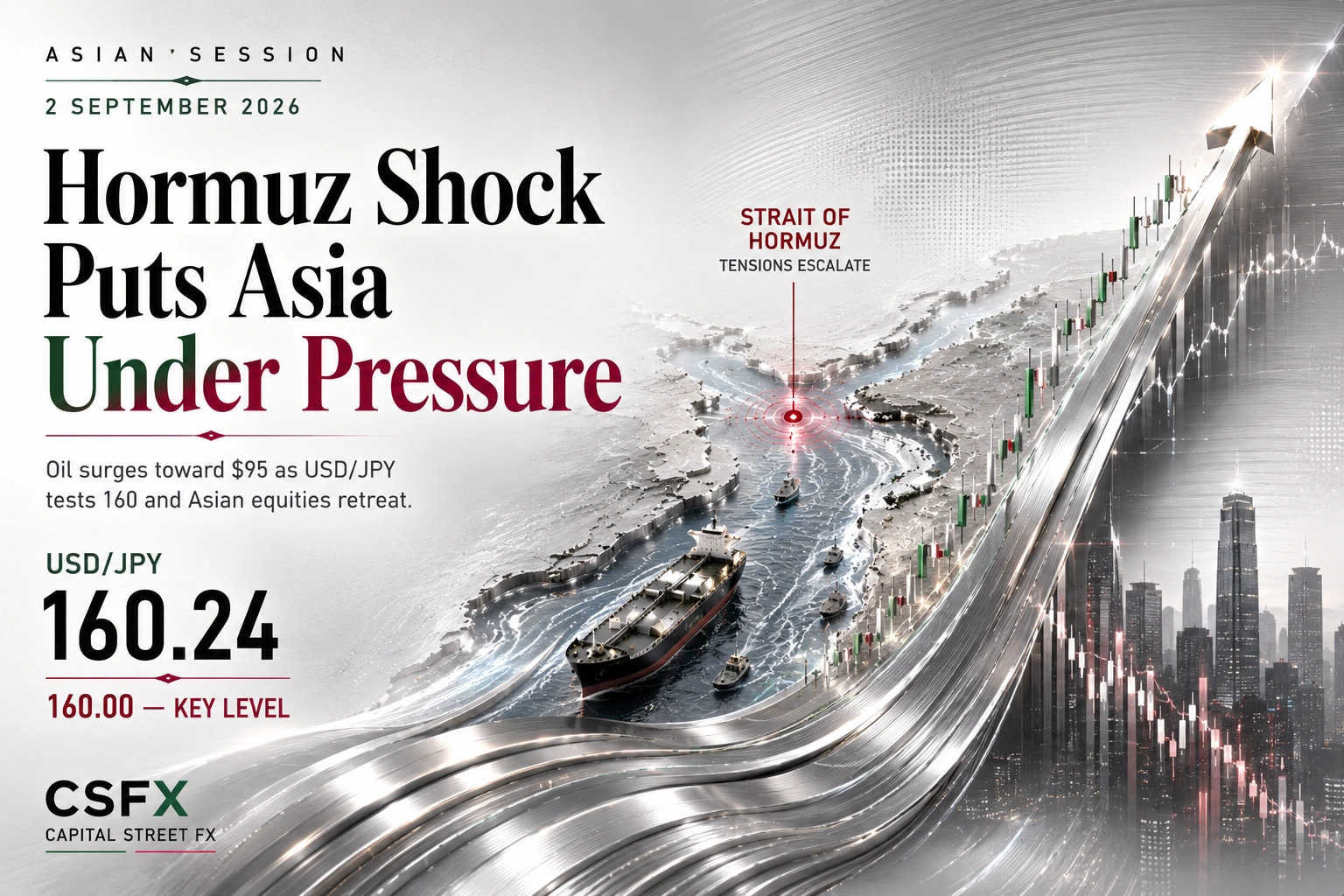
Iran Strikes Push Brent Toward $95 as USD/JPY Tests 160 | Technical Analysis | Asian Session | 2 Sep 2026
Fresh Iran Strikes Push Brent Toward $95 as Hang Seng Slides and the RBNZ Hikes to 2.75%
USD/JPY · AUD/USD · Copper · Corn · Hang Seng · Cardano (ADA) · Solana (SOL) — live Asian market outlook today, updated through the trading session
Asian Market News — Live Now, 2 September 2026
Top-moving headlines shaping the Asian market outlook today, updated through the session
Iran Strikes US Base in Jordan as Trump Claims “Total Control” of Hormuz, Rejects Talks
Iran launched a fresh missile barrage overnight against a US base in Jordan, prompting a “potential threat” alert for citizens in Bahrain, as the conflict entered a more intense phase following the weekend’s US strikes on Larak Island. President Trump publicly rejected renewed talks with Tehran and claimed the US now has “total control” of the Strait of Hormuz, while the G20 separately demanded free and safe transit through the waterway, a call China objected to.
GeopoliticsBrent Surges Toward $95 and WTI Toward $91 on Renewed Supply Fears
Brent crude jumped roughly 4.6–5.3% to settle near $94.65–95.32 a barrel, its highest level since the conflict began, while WTI advanced toward $90.80–91, its biggest one-day gain in five weeks. European gas futures also jumped 5.9% to €73.95, a 22-month high, as markets price a prolonged disruption to Middle East energy flows and reassess the odds of further Fed tightening.
CommoditiesHang Seng Falls to 25,105 and Nikkei Briefly Cracks 65,000 as Asian Equities Sell Off
Hong Kong’s Hang Seng Index declined for a third consecutive session, down about 0.8% (210 points) to near 25,105 after touching 25,089 intraday, its lowest since July, with Tencent, China Construction Bank and Hong Kong Exchanges among the laggards while Xiaomi bucked the trend. Japan’s Nikkei 225 opened down over 1,000 points and briefly slipped below 65,000 before stabilising, with chip names Tokyo Electron and Advantest leading losses as rising oil and Japanese bond yields compound the risk-off tone.For broader market analysis, traders are monitoring the impact on Asian equities.
EquitiesRBNZ Hikes OCR to 2.75% Despite Inflation Already at 4.1%
The Reserve Bank of New Zealand raised its Official Cash Rate by 25 basis points to 2.75% by consensus, arguing that gradual tightening now reduces the risk of a larger, faster increase later even with annual inflation running at 4.1%, above the top of its 1–3% target band, on higher Middle East-linked fuel prices. Four of seven committee members flagged upside risks to the inflation outlook, keeping further hikes on the table for October and December.
Monetary PolicyChina’s Caixin PMI Hits Two-Year High as Australia Awaits Q2 GDP
The Caixin/RatingDog China General Manufacturing PMI rose to 51.5 in August from 50.9 in July, beating the 51.0 consensus and marking the ninth straight month of expansion, the longest such upturn in five years, on the back of the fastest export-order growth in six months. Australia’s own Q2 GDP print is due later in the session, with consensus split between 0.2% (NAB) and 0.4% q/q (CBA, ANZ), and net exports are expected to have swung to a modest positive contribution.
Macro DataUSD/JPY Tests 160, Copper Nears Records, Crypto Broadly Softer
USD/JPY is trading near 160.20–160.27, testing the psychologically important 160.00 level as wide US-Japan rate differentials and oil-driven inflation pressure outweigh intervention risk. Copper is trading near $6.73/lb, close to its 52-week high, on a Chile supply shock, while corn sits near 541.90 cents/bushel on a Hormuz-linked “war premium.” Crypto markets are broadly softer, with Bitcoin near $77,400, Solana down roughly 3.5–3.7% to about $99.80, and Cardano off a more modest 1–2% near $0.1965.
FX, Commodities & CryptoLive · Updated through the Asian morning session, Wednesday 2 September 2026
Asian Economic Calendar This Week — 2 September 2026
Key releases and events shaping price action through the rest of the session and week
| Time | Event | Forecast / Detail | Impact | Market Read |
|---|---|---|---|---|
| 🇳🇰02:00 NZT Today (Released) | RBNZ Official Cash Rate Decision | Hiked 25bp to 2.75% from 2.50%, as expected, by consensus | 🔴 CRITICAL | NZD reaction muted since fully priced; guidance keeps October/December hikes live |
| 🇨🇳09:45 CST Today (Released) | China Caixin/RatingDog Manufacturing PMI (Aug) | 51.5 actual vs 51.0 expected, 50.9 prior | 🔴 CRITICAL | Ninth straight expansion month, longest upturn in five years; mild AUD/CNH support |
| 🇦🇺Later Today (Due) | Australia Q2 GDP (q/q) | Consensus 0.2–0.4%; NAB 0.2%, JPM 0.3%, CBA/ANZ 0.4% | 🔴 CRITICAL | Composition matters more than the headline: trade turning positive, inventories a drag |
| 🇩🇪Recap | Eurozone August Flash CPI | Climbed above 3% on higher energy prices | 🟡 MEDIUM | Adds to the global inflation-repricing backdrop alongside the Fed and RBNZ moves |
| 🇺🇸10:00 ET Today (US Session) | ISM Services PMI (August) | Follows Tuesday’s softer ISM Manufacturing at 54.6 | 🔴 CRITICAL | Next read on whether the US slowdown is broadening beyond the factory sector |
| 🇺🇸09:45 ET Today (US Session) | Bank of Canada Rate Decision | Expected hold at 2.25%, a seventh straight unchanged decision | 🟡 MEDIUM | Guidance tone matters more than the hold itself for USD/CAD |
| 🇺🇸08:30 ET Friday, 4 September | August Non-Farm Payrolls | The decisive input for the 15–16 September FOMC decision | 🔴 CRITICAL | The week’s binary event for the Dollar, gold, equities and the curve |
Asian Session Trade Ideas — USD/JPY, AUD/USD, Copper and More
Technical setups and fundamental context across the session’s seven key instruments
USD/JPY
Why This Setup
The pair is grinding back toward the 160.00 handle it retraced from a month ago, with wide US-Japan rate differentials and oil-driven inflation pressure on the yen the dominant tailwind even as the Bank of Japan flags a possible September hike; a sustained break above 160 opens the path toward the year’s highs near 164. The two-way risk is real: a weak yen breaching 160 raises the odds of verbal or actual intervention from Japan’s Ministry of Finance, and any dovish repricing of the Fed on a soft Friday payrolls print would also cap the trade.

AUD/USD
Why This Setup
Broad-based US dollar strength tied to the Iran-driven risk-off tone and elevated Fed hike odds is outweighing an otherwise constructive China Caixin PMI print, leaving AUD/USD on the back foot below its 0.7165 daily pivot. The genuine two-way risk sits in today’s Q2 GDP release: a print at or above the 0.4% high end of consensus, alongside the Caixin PMI’s ninth straight month of expansion, the longest upturn in five years, could quickly revive the AUD-as-China-proxy bid and squeeze this short.

Copper
Why This Setup
A structural supply shock out of Chile, where storm-hit output has slumped to an estimated 2011 low, is a genuine tailwind pushing copper back toward its 52-week high even as broader risk sentiment sours on the Iran conflict. The two-way risk is that a sharper equity and industrial-demand risk-off, combined with the broadly stronger dollar this session, could still drag copper lower in sympathy with the rest of the metals complex if the Middle East headlines intensify further.

Corn
Why This Setup
Tightening US crop conditions and a distinct geopolitical “war premium,” tied to higher fertiliser and shipping costs from the Hormuz standoff, are the genuine tailwinds keeping corn pinned near its 52-week high. The two-way risk is that any credible Hormuz de-escalation headline, or a run of favourable harvest weather in the coming weeks, could deflate that premium quickly and pull prices back toward the middle of the recent range.

Hang Seng Index
Why This Setup
A rate-sensitive, tech-heavy index is a natural casualty of a US 10-year yield near 4.80% and a broadly stronger dollar, and the fresh Iran escalation has reignited exactly that pressure, with Tencent and Hong Kong Exchanges leading Wednesday’s declines. The genuine two-way risk is China’s Caixin PMI beat, the longest expansion streak in five years, which could spark a sharp short-covering bounce if it is followed by fresh Beijing stimulus headlines or a calming of the Hormuz situation.

Cardano (ADA)
Why This Setup
Broad crypto de-risking, as Treasury yields near 4.80% and the dollar firms on the Iran-driven risk-off tone, is the dominant headwind, with ADA drifting lower alongside Bitcoin and the wider altcoin complex this session. The two-way risk is that continued whale accumulation reported this week and Cardano’s pending governance vote on Constitutional Committee seats could act as idiosyncratic catalysts for a bounce if broader risk sentiment stabilises.

Solana (SOL)
Why This Setup
SOL is leading the crypto complex lower this session as rate-driven, high-beta de-risking accelerates into Friday’s payrolls, pulling the token off its recent monthly highs even after posting its first green monthly candle in over a year in August. The two-way risk is that continued institutional interest, including a reported plan from Charles Schwab to incorporate SOL, and an already-oversold short-term setup could spark a sharp relief bounce if broader risk appetite stabilises.

Frequently Asked Questions — Asian Session, 2 September 2026
Quick answers to the questions traders are asking this session
Why is the Hang Seng falling for a third straight session?
Why did the RBNZ hike rates when inflation is already at 4.1%?
What does China’s Caixin PMI beat mean for the Australian dollar?
Why is USD/JPY testing the 160.00 level again?
Why are copper and corn both trading near 52-week highs?
Why is crypto broadly weaker today, and why is Solana underperforming?
What should traders watch for the rest of the Asian session and week?
Asian Session Summary — Wednesday, 2 September 2026 (Live Update)
Wednesday’s Asian session is being defined by the same transmission chain that closed out the US session on Tuesday, only louder: Iran’s overnight missile strike on a US base in Jordan and a “potential threat” alert in Bahrain have pushed Brent crude up roughly 4.6–5.3% to near $94.65–95.32, the highest since the conflict began, with WTI approaching $91. That renewed war-risk premium is feeding straight into an already-hawkish rates backdrop, with the US 10-year Treasury yield pinned near 4.798%, its highest since January 2025, keeping the dollar broadly bid and equities on the defensive across the region.
The Hang Seng has fallen for a third straight session, down about 0.8% to roughly 25,105 after testing 25,089 intraday, while Japan’s Nikkei 225 opened down over 1,000 points and briefly cracked below 65,000 before stabilising, with chip names among the hardest hit. Mainland Chinese benchmarks are softer too, even though China’s private-sector Caixin PMI beat forecasts at 51.5, a two-year high marking the longest expansion streak in five years. The Reserve Bank of New Zealand hiked its Official Cash Rate 25 basis points to 2.75% despite inflation already running at 4.1%, and Australia’s Q2 GDP print is still to come later in the session. Elsewhere, USD/JPY is testing the psychologically important 160.00 level, copper and corn are both trading near 52-week highs on supply and geopolitical premiums respectively, and crypto markets are broadly softer, led lower by Solana.
Highest-conviction session idea: stay with the risk-off, rates-and-oil trade — buy USD/JPY and copper dips, sell Hang Seng and high-beta crypto rallies — while treating Australia’s Q2 GDP and Friday’s US payrolls as the two events most likely to either confirm or unwind the current structure.
For the individual instruments: USD/JPY buy dips toward 159.40, stop 158.60, target 161.50 — wide US-Japan rate differentials and oil-driven inflation pressure on the yen are a genuine tailwind, though intervention risk from Japanese authorities near 160 is a real source of two-way risk. AUD/USD sell rallies toward 0.7175, stop 0.7220, target 0.7040 — broad US dollar strength on the risk-off tone is a genuine headwind, though a strong China Caixin PMI and today’s Q2 GDP release are a real source of two-way risk. Copper buy dips toward $6.62, stop $6.50, target $6.88 — a Chile supply shock is a genuine tailwind, though a broader risk-off shock from the Iran escalation is a real source of two-way risk. Corn buy dips toward 528.00, stop 515.00, target 555.00 — tight US supply and a Hormuz-linked war premium are a genuine tailwind, though any de-escalation headline is a real source of two-way risk. Hang Seng sell rallies toward 25,350, stop 25,560, target 24,700 — a 4.80% 10-year yield and stronger dollar are a genuine headwind, though the Caixin PMI beat and potential China stimulus headlines are a real source of two-way risk. Cardano sell rallies toward $0.2080, stop $0.2160, target $0.1850 — broad crypto de-risking is a genuine headwind, though reported whale accumulation and a pending governance vote are a real source of two-way risk. Solana sell rallies toward $106.00, stop $110.00, target $92.00 — rate-driven high-beta de-risking is a genuine headwind, though continued institutional interest and an oversold setup are a real source of two-way risk. The decisive variables for the rest of the session are whether Brent holds above $94 into the European open and whether the Hormuz headlines quieten or intensify further. Size positions accordingly, and note that fast-moving Middle East headlines carry genuine event risk that could exaggerate moves in either direction.