Shenzhen Summit Today: A $30bn Tariff Deal and AI Chip Curbs in Play Before Trump Meets Xi and Putin | Market Outlook | 18 Nov 2026
Shenzhen Summit in Focus | Trump, Xi and Putin at APEC | Wednesday 18 November 2026
Shenzhen Summit Today: A $30bn Tariff Deal and AI Chip Curbs in Play Before Trump Meets Xi and Putin
Summit tone gauge, next 48 hours Balanced, low expectations Officials expect talks, not signed agreements
- Average US tariff on China
- About 36.5%
- China on US goods: about 31%
- Trade truce expiry
- 10 Jan 2027
- Extended from 10 November
- Offshore yuan
- 6.6655
- Fixing strongest since February 2023
- Tariff cuts awaiting a start date
- $30bn each
- Agreed in principle in September
Shenzhen Summit Overview
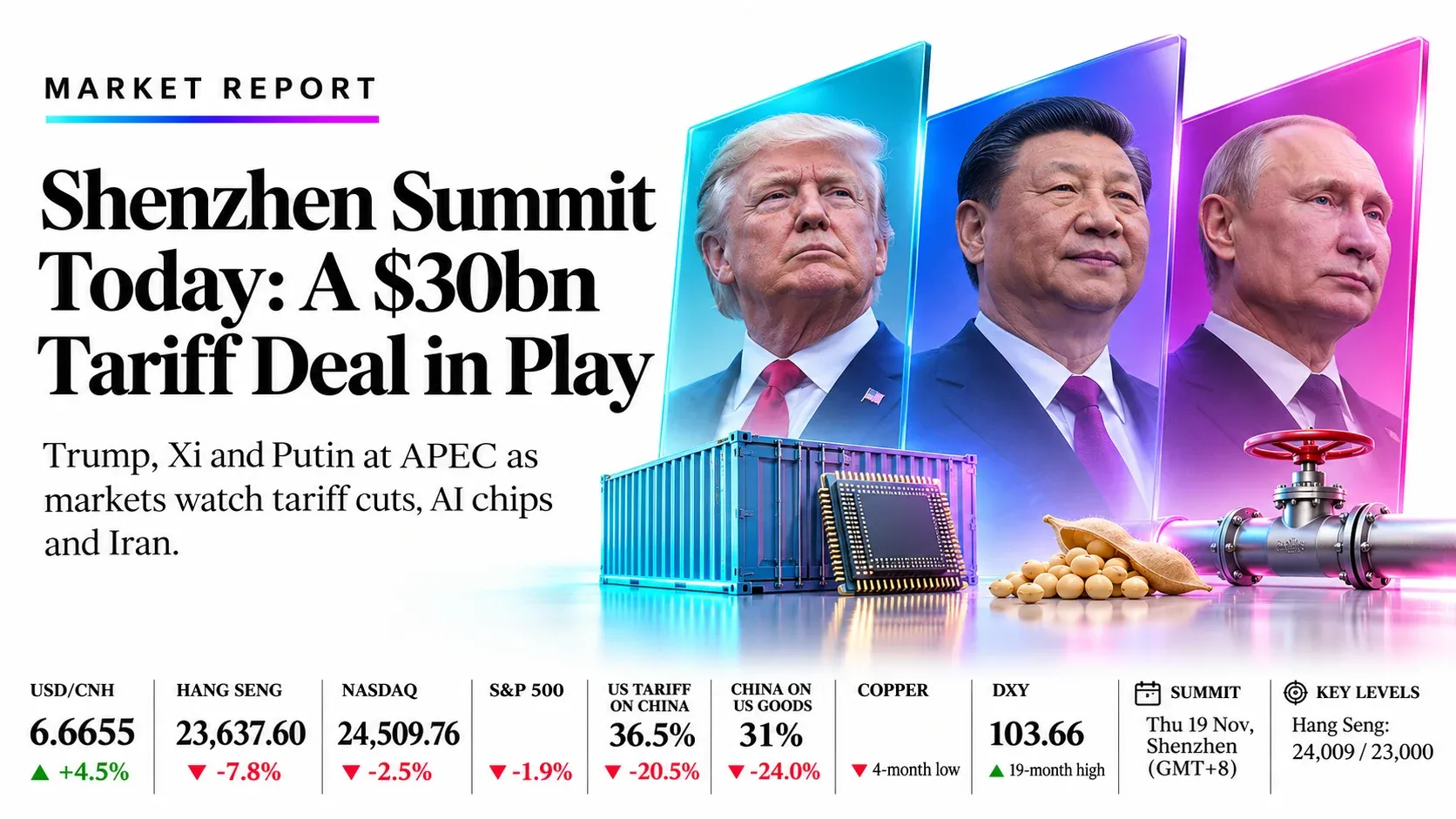
The APEC leaders’ meeting opens in Shenzhen today, and on Thursday 19 November President Trump meets President Xi Jinping before the first three-way meeting with President Vladimir Putin. No exact time has been announced. For markets the bilateral talks matter most: a start date for the deal to cut tariffs on about $30bn of goods each way, Chinese farm purchases, and new US limits on Chinese access to advanced AI chips. Iran and nuclear arms are also on the table. The setup is fragile: the Nasdaq fell 2.5% on Monday, the Hang Seng is 7.8% lower this year, copper is at a four-month low and the dollar index is at a 19-month high of 103.66. The last Trump-Xi meeting, in May, disappointed and the Hang Seng fell 1.6%.
Key highlights
- Event: Thursday 19 Nov, Shenzhen (GMT+8)
- At stake: $30bn tariff cuts, chips, Iran
- Volatility: yuan, Hang Seng, AUD/USD, copper, Brent
What Happened Last Time Trump Met Xi
The pattern is consistent: markets rally into US-China meetings and then trade lower when the results fall short of the hopes. In both summits since October 2025, Chinese shares turned lower on the day the outcome was announced, while chip and farm headlines moved single sectors far more than the broad indices.
| What happened | Date | Impact | Market reaction |
|---|---|---|---|
| Busan meeting: average US tariff cut from 57% to 47%, rare earth curbs paused for a year, soybean purchases resume | Busan | High | The Shanghai Composite touched its highest since 2015, then turned 0.8% lower as the deal was judged already priced. |
| Beijing state visit: 200 Boeing jets (about 500 hoped for), Nvidia H200 sales cleared for 10 Chinese firms, both sides say Hormuz must stay open | Beijing | High | Hang Seng -1.6%, CSI 300 and Shanghai down more than 1%, yuan back above 6.80 a day after a three-year high; Chinese chip stocks +4%. |
| First US-China Board of Trade meeting by video; chip-curb worries return | Trade council | Medium | Hang Seng -1.5% to 23,637.60, its third straight fall; CBOT soybeans closed at 1,231.50 cents. |
| Washington moves to limit Chinese access to advanced AI chips through data centres in Southeast Asia | Chip curbs | High | Nasdaq -2.5% to 24,509.76, S&P 500 -1.9%; on Tuesday the Kospi fell about 2% and the CSI 300 hit its lowest since July 2025. |
US-China Data Dashboard: A Truce Under Strain
| Indicator | Latest | What it means |
|---|---|---|
| Average US tariff on Chinese goods | About 36.5% | Down from 57% before Busan; China’s average on US goods is about 31%. |
| $30bn-for-$30bn tariff package | Agreed in principle | Covers toys and appliances one way, farm goods, medical equipment and coal the other; no start date yet. |
| China’s extra 24% tariff on US goods | Suspended to about 10 Jan | Extended by two months on 9 November, matching the truce expiry. |
| Chinese purchases of US soybeans, 2026 | About 21.8m tonnes | About 87% of the 25m tonne yearly pledge; US beans still pay 13% duty against 3% for Brazil. |
| China exports, October | +35.2% y/y | $412.33bn in the month; the January to October surplus is about $1.04 trillion. |
| Yuan | 6.6655 per dollar | About 4.5% stronger in 2026; the central bank set its strongest fixing since February 2023 at 6.7132. |
| Hang Seng | 23,637.60 (13 Nov) | Down 7.8% this year; 24,009 and 23,000 are the levels to watch. |
| Nuclear arms limits | None binding | New START expired on 5 February; China has about 500 warheads, the US and Russia more than 5,000 each. |
Trade: a start date is the prize
The Board of Trade, set up at the May summit, met for the first time on 13 November and covered tariffs, the $30bn package and farm trade. China calls the tariff cuts a condition for buying more US farm goods, so a start date would lift soybeans, the yuan and Chinese consumer shares together.
Watch: a start date and soybean volumes.
AI chips: the biggest risk
The new US licence rule targets data centres in Southeast Asia used by Chinese firms, and Nvidia’s chief executive resigned last week amid scrutiny of chip shipments linked to a Singapore partner. Nvidia’s results after Tuesday’s US close set the tone for chip shares going into Thursday.
Watch: any pause or tightening of chip curbs.
Iran and nuclear arms
Iran fired six drones at a base in Bahrain on Sunday, and Iranian state television says six vessels have caught fire near Hormuz since then. In May, Xi agreed the strait must stay open. Trump wants China in a future nuclear framework; Beijing says equal limits are unfair today.
Watch: a joint line on Hormuz.
Shenzhen Summit Scenarios: What to Expect
Stall: tougher chip curbs, no trade date
Talks end without a start date for the $30bn package and the US keeps tightening chip access. USD/CNH rises toward 6.7000, the Hang Seng tests 23,000, AUD/USD slips to 0.6685 and copper falls toward $5.92 per lb, while gold edges up toward $3,915.
Warm words, no new deals (desk base case)
A friendly three-way photo and a promise to keep talking, as US officials have signalled. Markets repeat the May pattern of mild selling in Chinese shares, the yuan holds 6.65–6.68 and the dollar’s path stays set by Wednesday’s Fed minutes at 19:00 GMT.
Progress: start date plus farm or chip relief
A firm start date for the tariff cuts, larger farm orders or a pause in new chip limits. USD/CNH falls toward 6.6350, the Hang Seng retakes 24,009 on the way to 24,200, AUD/USD rises to 0.6765, copper recovers to $6.10 and soybeans reach 1,250 cents.
Shenzhen Summit Reaction Map: Why Each Market Moves and by How Much
Trade progress lifts China’s growth outlook, which supports the yuan, Chinese shares and the currencies and metals tied to Chinese demand. Chip headlines run through Nvidia and the Nasdaq, and any shared line on Hormuz runs through oil. Expected moves are desk estimates scaled from the reactions on 30 October 2025, 15 May and 13 and 16 November.
| Market | Now | Why it moves | Last comparable move | If progress | If talks stall |
|---|---|---|---|---|---|
| USD/CNH | 6.6655 | Trade deal supports China’s growth and exports | Yuan weaker past 6.80, 15 May | -0.3% to -0.5%, toward 6.6350 | +0.3% to +0.6%, toward 6.7000 |
| Hang Seng | 23,637.60 (13 Nov) | Chinese tech is most exposed to tariffs and chips | -1.6%, 15 May | +1.5% to +2.5%, toward 24,200 | -1.5% to -2.5%, toward 23,000 |
| AUD/USD | 0.6725 | Australia’s exports depend on Chinese demand | -0.5%, 16 Nov | +0.4% to +0.6%, toward 0.6765 | -0.4% to -0.6%, toward 0.6685 |
| Copper | About $6.00/lb | China buys about half the world’s copper | Four-month low, 17 Nov | +1.0% to +2.0%, toward $6.10 | -1.0% to -1.5%, toward $5.92 |
| Soybeans | 1,231.50¢ (13 Nov) | Purchases hinge on China’s tariff cuts | Busan deal restarted buying, Oct 2025 | +1.0% to +2.0%, toward 1,250¢ | -1.0% to -2.0%, toward 1,210¢ |
| Nasdaq Composite | 24,509.76 | Chip curbs hit Nvidia’s China sales | -2.5%, 16 Nov | +0.8% to +1.2%, toward 24,780 | -0.8% to -1.2%, toward 24,240 |
| Brent crude | $91.70 | A joint line on Iran lowers the Gulf risk premium | -0.8%, 17 Nov | -1.0% to -2.0%, toward $90.00 | +1.0% to +2.0%, toward $93.50 |
| Gold | $3,880 | Safe-haven demand rises when talks fail | +0.6%, 17 Nov | -0.4% to -0.8%, toward $3,850 | +0.5% to +1.0%, toward $3,915 |
- Why the Hang Seng moves most: Chinese internet and chip shares carry both the tariff and the chip risk, and the index has already fallen 1.6% and 1.5% on the last two trade headlines.
- Why the yuan moves least: the central bank has been setting stronger fixings, the latest at 6.7132, and the currency can move only 2% either side of that fixing each day.
- Why the downside is slightly larger: markets rallied into Busan and fell after Beijing, and US officials have played down agreements from the three-way meeting, so a surprise is more likely to disappoint than to impress.
Key Triggers: What Each Shenzhen Signal Means for Prices
If a start date for the $30bn cuts is announced
Then USD/CNH toward 6.6350, Hang Seng toward 24,200
If China announces large US farm orders
Then soybeans toward 1,250¢, AUD/USD toward 0.6765
If Washington tightens chip limits further
Then Nasdaq toward 24,240, Hang Seng toward 23,000
If leaders agree Hormuz must stay open
Then Brent toward $90.00, gold toward $3,850
Conclusion: The Shenzhen Summit Desk Verdict
Summit desk verdict Talks over deals, 23,000 the Hang Seng test
The first meeting of Trump, Xi and Putin is historic, but the market event is the Trump-Xi talks on Thursday. With US officials playing down agreements and chip curbs tightening, the desk’s base case is warm words and mild selling in Chinese shares, as in May. A start date for the $30bn tariff cuts would lift USD/CNH toward 6.6350 and the Hang Seng toward 24,200; new chip limits or a stall would push the Hang Seng toward 23,000 and AUD/USD toward 0.6685. The Fed minutes at 19:00 GMT today steer the dollar before then.
Trade USD/CNH, AUD/USD, the Hang Seng, copper and oil with Capital Street FX.
Frequently Asked Questions
When is the Trump, Xi and Putin summit?
Thursday 19 November in Shenzhen, on the sidelines of the APEC leaders’ meeting on 18 and 19 November. Trump and Xi meet first, then Putin joins. No exact time has been announced; Shenzhen is eight hours ahead of GMT.
Will the US and China sign a trade deal in Shenzhen?
US officials do not expect agreements from the three-way meeting. The bilateral talks could set a start date for the deal to cut tariffs on about $30bn of goods each way, agreed in principle in September.
How could the summit move the Chinese yuan?
The desk sees USD/CNH falling 0.3–0.5% toward 6.6350 on clear trade progress and rising 0.3–0.6% toward 6.7000 if talks stall. The yuan trades at 6.6655, about 4.5% stronger this year.
Why are Chinese stocks falling before the summit?
New US limits on Chinese access to advanced AI chips, Nvidia’s leadership change and a strong dollar. The Hang Seng fell 1.5% to 23,637.60 on 13 November and is 7.8% lower this year.
What happened after the last Trump-Xi summit?
The Beijing visit in May brought 200 Boeing orders, below the roughly 500 hoped for, and H200 chip approvals. The Hang Seng fell 1.6% and the yuan weakened past 6.80 on 15 May.
Could the summit affect oil prices?
Yes. Trump is expected to raise the Iran war. A shared line that Hormuz must stay open could pull Brent 1–2% lower toward $90.00, while no progress after the Bahrain drone attack could lift it toward $93.50.