
February Jobs Report: The One Number That Will Move Every Market Today | The Capital Dispatch — Capital Street FX
February Jobs Report: One Number,
Every Market, Eight-Thirty Sharp

In approximately the time it takes a day trader to finish their first espresso, the Bureau of Labor Statistics will release February’s nonfarm payrolls. The consensus: 50,000–60,000 jobs — a striking retreat from January’s headline-grabbing 130,000 surge. The Federal Reserve is meeting in 12 days. The dollar has been quietly humiliated to multi-year lows. Everything you need to know is below. You have time. Barely.
Wall St. Range: 10K–104K
Beat vs 70K Forecast
Risk of Rise to 4.4%
Forecast — Wage Watch
March 18 Rate Call
Full Year Jobs Erased
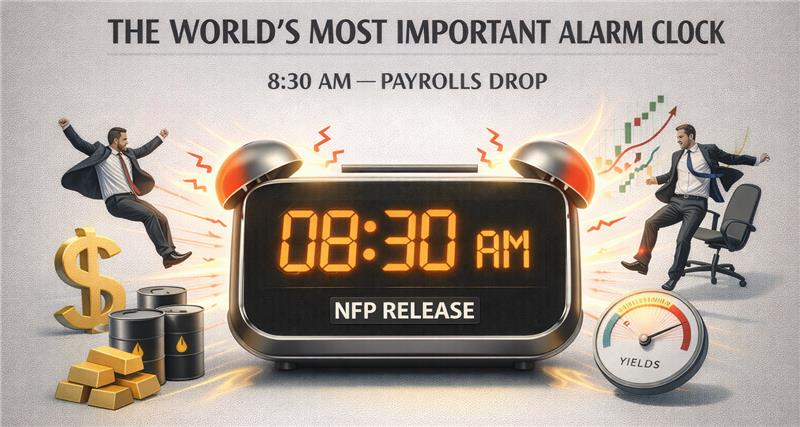
Once a month, at precisely 8:30am Eastern Time, the US government releases a number so powerful that traders across six continents simultaneously hold their breath, tighten their stop-losses, and — if we’re being honest — spill their coffee. Today is that morning. The February nonfarm payrolls report is the single most market-moving data print the US government will produce this week. With the Federal Reserve meeting in exactly 12 days, it may well be the most important jobs report of the entire year.
The context is, to put it mildly, a lot. January delivered a jaw-dropping 130,000 jobs — more than double the 70,000 consensus — in a report that was already delayed by a government shutdown and quietly stuffed with benchmark revisions that erased 911,000 jobs from the entire 2025 tally. That’s right: one report, three surprises. Economists spent the following three weeks arguing over whether January was a genuine labour market renaissance, a statistical magician’s trick, or just seasonal adjustment noise wearing a tuxedo. February is the moment of truth.
Wall Street’s consensus — informed by ADP’s private payrolls print of +63,000 in February, the Kaiser Permanente nurses’ strike that landed squarely in the BLS survey week, and an accelerating federal headcount purge — currently sits at roughly 50,000–60,000 jobs. The range across individual bank forecasts, however, is quite something: Bank of America Securities pencils in 35,000; Deutsche Bank, apparently feeling philosophical, has gone with 25,000; others are closer to 65,000. That span is not disagreement — it is a confession. Nobody knows. The directional tilt is clearly downward, and the stakes are unusually high for a piece of data that is, at its core, a survey of 119,000 employers about a week in February.
January Actual: +130,000 (vs 70K forecast) · February Consensus: 50K–60K · February ADP: +63,000 (private sector only, beats 48K est) · Kaiser Strike Impact: Significant negative drag on February survey week · Federal Cuts: –34K in January alone, likely –30K+ more in February · Unemployment Forecast: 4.3%, risk of 4.4% · Wages YoY: 3.7% · Fed Meeting: March 18, 2026 — rates at 3.50–3.75%
■ 01 — THE BACKDROP Why January’s 130,000 Was the Statistical Equivalent of a Magician’s Trick
When January’s 130,000 print landed on February 11th, it triggered a wave of genuine excitement about labour market resilience. Champagne may not have flowed, but at least a few economists updated their presentations to look slightly less bleak. The number was nearly double the consensus forecast of 70,000. The problem? A careful read of the internals told a considerably less heroic story — and understanding why matters enormously for what February is about to show us.
Almost all of January’s apparent gains were concentrated in just two sectors: healthcare and social assistance (+82,000) and construction (+33,000). The healthcare surge was driven largely by something called the “birth-death model” — a statistical methodology the BLS uses to estimate new business formation and closure that sounds like a concept from a philosophy seminar but is, in practice, capable of moving markets by tens of thousands of jobs in either direction. In January, this model injected a suspiciously large positive adjustment into healthcare. Wells Fargo’s team noted diplomatically that it “overstated underlying momentum in the labor market,” while Deutsche Bank’s Marc Giannoni — apparently unwilling to be diplomatic — estimated February would print just 25,000 jobs partly due to a “partial unwinding of January’s surprising upswing in the birth-death adjustment.” In other words: what the model giveth, it tends to take back.
Meanwhile, January’s report also incorporated the annual benchmark revisions — the once-a-year statistical reckoning where the BLS goes back and compares its monthly surveys against actual payroll tax records. The verdict on 2025 was, to put it generously, a retrospective humbling. The full year, which official monthly reports had shown as +584,000 jobs (roughly 49,000 per month), was revised down to just +181,000 (about 15,000 per month). That is not a rounding error. The US labour market spent all of 2025 being considerably weaker than anyone officially acknowledged. Which means every Fed meeting, every rate decision, and every market consensus built on that data was working from a mirage. Welcome to the real 2025. Now we enter 2026 from a baseline that is softer, cooler, and more honestly described than anyone understood at the time.
■ 02 — THE FEBRUARY DRAG Three Reasons February Is Going to Be Ugly (And None of Them Are Your Fault)
Force 1 — The Kaiser Permanente Strike (Or: How 40,000 Nurses Can Move a Market)
Bank of America’s Shruti Mishra specifically called out the Kaiser Permanente nurses’ strike as a meaningful headwind for February’s survey week. Here’s how the mechanics work: the BLS snapshots employer payrolls during the week containing the 12th of each month. If a major employer’s workers are on strike during that precise window, they disappear from the count — temporarily, but definitively, for that month’s report. Kaiser Permanente is one of the largest private healthcare employers in the United States. The estimated impact: roughly 20,000–30,000 jobs subtracted from the headline versus what would otherwise have printed. It’s not an economic shift. It’s a calendar accident. It still hits the number.
Force 2 — Federal Job Cuts (The Spreadsheet Reduction in Progress)
January saw federal government payrolls fall by 34,000 — the direct consequence of the administration’s deferred resignation programme, under which tens of thousands of federal workers who accepted buyout offers in late 2025 quietly vanished from official headcount. The process was not finished in January. February is expected to deliver further federal job losses of a similar, possibly larger, magnitude as the next wave of departing workers registers in the official count. This is not a one-month story. It is a structural drag that will show up in government payroll data for multiple months running. The federal workforce is shrinking. The data will confirm it, month by month.
Force 3 — The Birth-Death Model Taketh Away (What It Gave Last Month)
As Deutsche Bank flagged, the statistical model that inflated January’s healthcare numbers is expected to at least partially reverse in February. To be absolutely clear: this is not a real-economy event. No actual businesses are closing. No actual workers are losing jobs. It is purely a mathematical consequence of how the BLS estimates the contribution of newly formed and recently closed businesses — a model that, by design, tends to mean-revert after unusually large readings. Healthcare contributed approximately 82,000 jobs in January via this model. Economists are now modelling a meaningful reversal of that contribution in February. The jobs that the birth-death model conjured will, at least in part, be statistically un-conjured. Markets will price this as if it were real. It is not. But that’s markets.
■ 03 — THE FED DIMENSION How This Number Decides Whether Powell Blinks on March 18
The Federal Reserve is sitting at 3.50%–3.75%, hands in pockets, watching the data. The FOMC convenes on March 18th — twelve days from now. Markets are currently pricing approximately 12% odds of a rate cut at that meeting. To put that in perspective: Vegas wouldn’t take that bet seriously. The February NFP will either fan that small probability into a flame or extinguish it entirely — and in doing so, will also significantly reprice the odds for May (currently ~38%) and June.
The threshold analysis is fairly clear, even if executing the trades is not. For a March cut to become a genuine base case, you need one of two things: a payroll print decisively below 35,000–50,000 accompanied by an unemployment rate ticking up to 4.4% or higher, or a combination of soft data that collectively forces the FOMC to conclude January’s 130,000 surprise was, as suspected, a statistical event that has now fully unwound. A print that simply meets the 50,000–60,000 consensus almost certainly changes nothing for March — it validates “cooling but not breaking,” which is precisely the narrative that allows the Fed to stay on hold, speak carefully, and keep its optionality intact through May and June.
Per OANDA/MarketPulse analysis: a March rate cut only becomes the “base case” scenario if the report shows a significant miss below 50K — or a sharp jump in the unemployment rate to 4.6%+. With consensus pinned at 50K–60K, the bar for a March cut is set inconveniently high. The most probable outcome is that February confirms the “cooling but not breaking” narrative — which is Fed-speak for: we’re not cutting today, but we’re absolutely thinking about it. May and June remain very much alive.
One more spanner in the works: the annual population control adjustments. Each February, the BLS quietly incorporates updated Census Bureau data that reweights the household survey by demographic characteristics — and this year’s revision is more significant than usual. With immigration falling sharply during 2025, the revised population data is expected to reduce estimates of the overall labour force, the employment level, and the number of unemployed. The unemployment rate itself is less sensitive to these level adjustments, but depending on the size and composition of the revision, it can still shift by 0.1–0.2 percentage points. In a report where every decimal point will be interpreted as a Fed signal, even a rounding-error-sized revision can move markets.
■ 04 — THE SCENARIOS The Full Playbook: What Every Possible Print Means for Every Market
| Scenario | NFP Print | Unemployment | Equities | Dollar (DXY) | Gold | Fed Implication |
|---|---|---|---|---|---|---|
| 🟢 Goldilocks | +70K–90K | 4.3% | Rally · Risk-on | Modest bid | Slight softening | Hold March · May still live · Soft landing intact |
| 🔵 In-Line | +50K–60K | 4.3% | Flat to modest + | Range-bound | Stable | Hold March confirmed · Modest May cut pricing |
| 🟡 Soft Miss | +25K–45K | 4.4% | Initial rally (rate cut hope) then fade | Sells off | Rallies | March cut back on table · May cut nearly certain |
| 🔴 Hard Miss | Below 20K or negative | 4.4–4.5%+ | Sell-off · Recession fear | Sharp decline | Surges | Emergency cut scenario · Hard landing narrative |
| ⚡ Hawkish Shock | +130K–200K+ | 4.2% | Selloff · Higher-for-longer | Strong rally | Sells off | All 2026 rate cuts repriced away · Hawkish surprise |
■ 05 — THE WAGES STORY Average Hourly Earnings — The Quiet Number That Could Upstage the Loud One
Everyone will stare at the payroll headline. But the wages data — a number that will scroll past most screens in second billing — could ultimately matter more for the Fed’s medium-term thinking. Average hourly earnings in February are forecast at 3.7% year-on-year, exactly matching January’s reading. Month-on-month: 0.3%, also unchanged. These are, by themselves, not alarming numbers. At 3.7% YoY, wage growth has cooled substantially from the 5%-plus peaks of 2022–23. The current trajectory is roughly consistent with 2% inflation — as long as productivity holds, which is its own caveat.
The risk? Wages surprise in either direction. A strike environment can quietly inflate average hourly earnings — because striking workers aren’t counted, which pushes the average wage of the remaining workforce upward in a way that has nothing to do with actual raises. On the other hand, a shift in employment composition toward lower-wage sectors like healthcare and food services could suppress the headline. In short: the wages figure is genuinely uncertain in both directions today, which is the statistical equivalent of being told to dress for any weather. The market will react to whatever it gets.
Here’s the Fed’s nightmare: even a genuinely weak jobs number today doesn’t hand them a clean ticket to cutting rates. Brent crude above $80/bbl — up approximately 11% since Operation Epic Fury on February 28th — is already percolating through gasoline prices, freight costs, and food supply chains. A Fed that pivots into a rising inflation impulse risks recreating the most embarrassing chapter of 2021, when they called inflation “transitory” for nine months too long. The truly uncomfortable scenario: weak jobs + expensive oil = stagflation, where the Fed faces simultaneous pressure to cut (labour market softening) and hold (inflation risk reloading). There is no elegant solution to that equation. This is the scenario that keeps rate strategists awake, and deservedly so.
■ 06 — THE BIGGER PICTURE What the 2025 Benchmark Revision Tells Us (Hint: We Were All Wrong All Year)
The most important long-term signal embedded in this jobs report cycle isn’t the February print itself — it’s what the January benchmark revision quietly revealed about the entire preceding year. The downward revision of 911,000 jobs from the 2025 official tally was the largest such annual revision on record. All year long, monthly reports were telling markets the US economy was generating roughly 49,000 jobs per month. The actual number, once reconciled against the Quarterly Census of Employment and Wages, was approximately 15,000 per month. Your local Starbucks creates more jobs than that. Across an entire country.
In practical terms: the US labour market was considerably weaker throughout 2025 than either the Federal Reserve or financial markets understood in real time. Every rate decision, every policy statement, every strategist consensus built on that data was operating from numbers that were materially wrong. The revision doesn’t change the past — those decisions were made with the information that existed. But it does clarify the baseline from which 2026 begins: a labour market that has been cooling longer than anyone officially acknowledged, now absorbing fresh headwinds from federal downsizing, a reduced immigration-driven labour supply, and an oil-price shock courtesy of a Middle East war that nobody put in their December 2025 forecasts.
Bank of America’s framework for the current US labour market is “low-hire, low-fire” — meaning businesses aren’t aggressively building headcount (low hire), but they’re also not torching it at recession speed (low fire). Think of it as the corporate world collectively choosing to tread water while surveying the geopolitical chaos. The interesting twist: the sharp decline in immigration is actually suppressing the unemployment rate more than you’d expect given the weak hiring environment, because there are simply fewer new workers entering the labour force to be counted as unemployed. The result is a labour market that is genuinely softer than it appears — but where 50,000 jobs per month is arguably close to full employment in today’s lower-immigration context. The breakeven rate — the number of jobs needed monthly just to keep unemployment stable — has likely fallen to around 20,000. By that standard, even a mediocre February is fine.
Frequently Asked Questions
Conclusion: The Ludicrous, Necessary Power of One Government Survey
In a week that has already included a war-disrupted oil market, Broadcom’s AI revenues doubling, Bitcoin’s geopolitical surge, and a full retail earnings calendar, the single most market-defining event is a jobs report. Released at 8:30am ET on a Friday morning. By a government survey of 119,000 employers. About a week in February. And yet: the February NFP is the last major data input before the Federal Reserve’s March 18th rate decision, which makes it exactly as consequential as the hype suggests. It will either confirm a managed labour market slowdown consistent with eventual easing, or it will surprise in a direction that forces rapid repricing across equities, rates, currencies, and everything in between.
The base case: 50,000–60,000 jobs. Deutsche Bank, apparently in a mood, is at 25,000. ADP’s private payroll data suggests 63,000 is possible. The unemployment rate at 4.3% is the dividing line between Fed-on-hold and Fed-pivoting. Average hourly earnings at 3.7% YoY is the boundary between “controlled disinflation” and “this is going to take longer than we thought.” All of these numbers — with their entire weight of monetary policy implication — will be public simultaneously at 8:30am. Then the arguing starts.
What makes this particular NFP unusual — beyond the usual Friday morning theatre — is the confluence of circumstances around it: an active Middle East conflict injecting oil-price inflationary risk, a revised 2025 baseline that confirmed the labour market was softer than anyone admitted in real time, a January print that almost certainly overstated the recovery, and a Federal Reserve that is exactly 12 days from its most closely watched rate decision of 2026. In that context, one number — imperfect, survey-based, subject to revision — genuinely has the power to reset monetary policy expectations, redirect the dollar, and reframe the equity narrative for months ahead. That is the absurd beauty of NFP Friday. And this one, specifically, has something extra riding on it.
Published March 6, 2026 by The Capital Dispatch at Capital Street FX (capitalstreetfx.com). For informational and educational purposes only. Not financial advice. Sources: BLS, ADP, Kiplinger, FinancialJuice, Bank of America Securities, Deutsche Bank, Wells Fargo, Raymond James, OANDA/MarketPulse, Trading Economics.