Trade FX, CFD, Stocks, BTC, Indices, Gold & Oil – 1:1000 Leverage & Bonus – CSFX

Mobile Header & Menu

Global Index Market Analysis – March 10, 2026 | Nasdaq 100 · S&P 500 · DAX 40

March 10, 2026
CSFXadmin
Global Index Market Analysis – March 10, 2026 | Nasdaq 100 · S&P 500 · DAX 40
CapitalStreet Intelligence
Global Index Market Intelligence · Daily Trading Edition
Daily Report
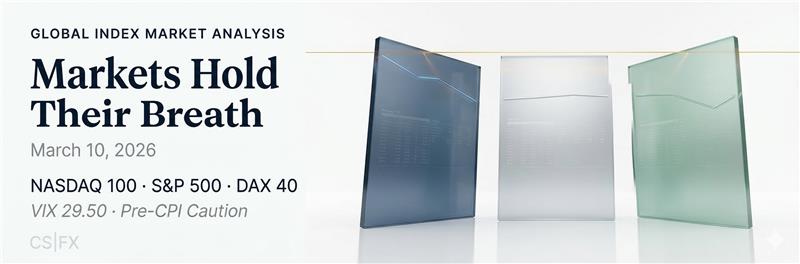
Global Index Market Analysis — Nasdaq 100 · S&P 500 · DAX 40 — Markets Hold Their Breath — March 10, 2026
Global Index Market Analysis · Nasdaq 100 · S&P 500 · DAX 40 · VIX 29.50 · March 10, 2026 · CSFX Research
Global Index Market Analysis

Markets Hold Their Breath: CPI Eve, Oil Retreat and the Battle for Key Technical Levels

U.S. equities entered Tuesday under pressure as Wall Street’s Monday relief rally fades into pre-CPI caution. With February inflation data dropping Wednesday at 8:30 AM ET, oil prices stabilising near $90, and geopolitical uncertainty over Iran lingering, every major index sits at a pivotal technical crossroads. Here is your full actionable breakdown.

📊 Nasdaq 100 📊 S&P 500 📊 DAX 40 🌍 Economic Calendar 📅 March 10, 2026

Live Market Snapshot

Key index and macro readings as of Tuesday March 10, 2026 – US pre-market / European session open.

Index
Price & Change
Session Range
Nasdaq 100 (NDX)
21,648
▼ −1.15%  (−251 pts)
Low: 21,380  |  High: 21,920  |  52W: 17,800–26,054
S&P 500 (SPX)
6,692
▼ −0.71%  (−48 pts)
Low: 6,636  |  High: 6,810  |  52W: 4,835–7,002
DAX 40 (GDAXI)
23,409
▼ −0.77%  (−182 pts)
Low: 22,928  |  High: 23,471  |  52W: 18,490–25,508
VIX (Fear Index)
29.50
◆ Elevated (prev. 25.50)
VIX above 25 signals high volatility regime  |  Normal: below 20
WTI Crude Oil
~$90
◆ Off $120 highs · stabilising
Peaked near $120 Sun night · Iran war ceasefire hopes · key macro driver
10-Year UST Yield
4.156%
▲ +2.3 bps (rising)
Rising yields = additional headwind for growth equities  |  CPI-sensitive

What’s Driving Markets Right Now

Four interconnected forces are shaping price action across all three indices today. Understanding their interplay is essential before placing any directional trade.

Iran War & Oil Shock

The US-Israeli military campaign against Iran triggered a historic oil spike last week — WTI surged over 35% to nearly $120 per barrel, its biggest single-week move since futures trading began in 1983. The Strait of Hormuz closure sent energy markets into panic. President Trump’s comments on Sunday that the war is “very complete, pretty much” sparked Monday’s relief rally, but oil remains near $90 — still elevated. Any reversal in ceasefire hopes will instantly re-price risk assets lower.

February CPI — Tomorrow’s Flash Point

The single most important scheduled event for the next 24 hours is Wednesday’s February CPI release (8:30 AM ET, March 11). January CPI came in at +2.4% YoY. Markets fear that rising oil prices may have already bled into February’s data. A surprise print above 2.6% would likely crush any recovery rally. A softer reading could be the catalyst bulls need. All three indices are essentially “frozen” ahead of this release.

AI & Tech Earnings Cycle

Oracle reports earnings Tuesday after the close — a key bellwether for enterprise AI spending. Monday’s tech-led recovery (+1.38% Nasdaq) was driven by semiconductors: AMD, Broadcom, and Nvidia all rallied 2–5%. The AI investment thesis remains intact structurally, but near-term earnings expectations must clear the bar. Adobe follows on Thursday, providing another read on software demand.

Fed Policy Uncertainty

Geopolitical stagflation risk has complicated Fed communications. Markets had been pricing rate cuts in mid-2026 before the Iran conflict raised oil-driven inflation fears. The surprise February payroll decline of −92,000 (reported Friday, March 6) pointed toward a weakening labour market, while oil threatens higher inflation — a difficult combination. The FOMC’s next meeting on March 18–19 (post-ECB quiet period) is now highly uncertain.

⚠️ Trader Alert: Tuesday’s session is a “pre-positioning” day. Smart money is unlikely to take large directional bets ahead of tomorrow’s CPI. Expect range-bound, choppy price action with potential volatility spikes around any Iran-related headlines or Fed speaker comments. Reduce position size and widen stops accordingly.

Economic Events: Next 24–72 Hours

Filtered for high-impact releases from the USA, UK, Europe, Japan, Australia, and China only. These events have direct market-moving potential for the three indices covered in this report.

Date & Time (ET) Country Event Impact Forecast Previous Index Relevance
Mon Mar 10
Already out
🇨🇳 China CPI (February)
Consumer inflation – Lunar New Year effects
HIGH +0.4–0.5% YoY +0.2% YoY DAX, global risk
Mon Mar 10
Released
🇨🇳 China PPI (February)
Factory gate deflation — 40th consecutive negative month expected
MEDIUM −1.3% YoY −1.4% YoY DAX, industrials
Tue Mar 10
07:30 ET
🇩🇪 Germany Trade Balance & Industrial Production (Jan)
PMI data indicated best reviving pace in ~4 years
HIGH DAX 40 direct
Tue Mar 10
Post-close
🇺🇸 USA Oracle Earnings (Q3 FY2026)
Enterprise AI software bellwether
HIGH EPS est. ~$1.72 Nasdaq 100, S&P 500
Wed Mar 11
08:30 ET ⚡
🇺🇸 USA CPI – February 2026
Most critical scheduled release of the week
EXTREME ~2.5% YoY 2.4% YoY ALL THREE INDICES
Wed Mar 11
08:30 ET
🇺🇸 USA Core CPI (ex-food & energy)
Fed’s preferred inflation gauge for rate decisions
HIGH ~3.1% YoY 3.0% YoY ALL THREE INDICES
Wed Mar 11
15:00 ET
🇺🇸 USA Monthly Budget Statement (February) MEDIUM Bonds, risk sentiment
Tue Mar 10
19:50 ET
🇯🇵 Japan GDP Q4 2025 (Final Revision)
Expected: modest growth; BOJ rate path implications
HIGH +0.4% QoQ −0.2% QoQ Global risk, Nikkei
Tue Mar 10
🇦🇺 Australia Westpac Consumer Confidence (March)
Key read on domestic demand + RBA outlook
MEDIUM Risk sentiment
Fri Mar 13
02:00 ET
🇬🇧 UK GDP (January 2026)
PMI surveys signalled a pickup; BOE rate cut implications
HIGH +0.1% MoM +0.1% MoM FTSE, DAX, EUR/GBP
Fri Mar 13
08:30 ET
🇺🇸 USA PCE Price Index (January) + GDP 2nd Est. Q4
Fed’s core inflation metric + growth revision
HIGH PCE ~2.5% YoY 2.4% YoY ALL THREE INDICES

Nasdaq 100 (NDX) — Full Technical Analysis

Nasdaq 100 Index
NDX / NQ100  ·  As of March 10, 2026 (US pre-market)
Nasdaq 100 (NDX) Daily · Fib 0.382 @ 24,866 · Price 24,909 · Mar 10, 2026
Nasdaq 100 (NDX) Daily · Fib 0.382 @ 24,866 · Price 24,909 · Mar 10, 2026 · CSFX Research · TradingView
21,648
▼ −1.15% today
📉 Trend Analysis
Short-term (1–5 days)Bearish
Medium-term (1–4 weeks)Bearish
Long-term (1–6 months)Neutral-Cautious
PatternDescending Triangle
Structure since Jan 2026Lower highs, lower lows

The Nasdaq 100 was already printing a descending triangle breakdown from its January 2026 all-time high of ~26,054 when the Iran war accelerated the sell-off. The 200-day moving average (~24,100) has been decisively breached. Monday’s tech recovery was encouraging but structurally insufficient to flip the trend. The index has now broken below the floor of its medium-term rising channel, signalling a deceleration of the bull case at minimum.

📐 Key Technical Levels
Current Price21,648
200-Day MA (resistance)~24,100
50-Day MA (resistance)~23,800
Pivot Resistance R122,200
Pivot Resistance R222,800
Key Support S121,400
Critical Support S221,000
Major Floor / ATL Target20,000–20,500
All-Time High (Jan 2026)26,054
📊 Oscillators & Indicators
RSI (14-day)~38 — Nearing Oversold
RSI TrendFalling — early warning of downtrend
MACDBearish crossover; below signal line
Stochastic %K/%DApproaching oversold zone (<25)
ADX (Trend Strength)32 — Moderate-Strong trend
ATR (Daily Volatility)~580 pts — Extremely elevated
Bollinger BandsPrice near lower band — watch for contraction
Invest.com Signal (Daily)Sell
🧠 Fundamental Drivers
Sector Weight~60% Technology / AI
Key Movers (Mon)AMD +4.6%, Broadcom +4.6%, Nvidia +2.7%
Key DragsCisco −3%, Boeing (crossover)
Upcoming EarningsOracle (Tue), Adobe (Thu)
CPI SensitivityVery High (high-duration index)
Elliott WaveWave ii) low potentially in place
YTD Performance−17% from Jan ATH
2026 Bank Target (BofA)~4% full-year gain (base case)
Session Bias
⬇ Bearish / Cautious
Pre-CPI drift lower; fade bounces
Short Entry Zone
22,100–22,300
On bounce into resistance cluster
Stop Loss
22,700
Close above 200-MA resistance
Target / S1–S2
21,000–20,500
R:R approx. 1:2.5+

S&P 500 (SPX) — Full Technical Analysis

S&P 500 Index
SPX / ES  ·  As of March 10, 2026 (mid-session)
FTSE 100 Daily · Fib 0.382 @ 10,352 · Price 10,383 · Mar 10, 2026
FTSE 100 Daily · Fib 0.382 @ 10,352 · Price 10,383 · Mar 10, 2026 · CSFX Research · TradingView
6,692
▼ −0.71% today  |  Mon close: 6,795
📉 Trend Analysis
Short-term (1–5 days)Bearish — Lower high sequence
Medium-term (1–4 weeks)Bearish — Jan ATH to present
Long-term (6–12 months)Bullish — multi-year uptrend intact
200-DMA StatusTesting — Index at/below 200-DMA
Key PatternBearish correction from ATH

The S&P 500 hit its all-time high above 7,002 in late 2025 before pulling back through Q1 2026. The 200-day moving average sits near 6,582 — a level not broken since May 2025. A confirmed daily close below this level would be a major technical breakdown signal, opening the door to the 6,400–6,450 zone. Monday’s recovery to 6,795 was impressive but Tuesday’s reversal shows the bears remain in control heading into CPI.

📐 Key Technical Levels
Current Price6,692
200-Day MA (critical)~6,582
Nov 2025 Support Low~6,550
Fibonacci 38.2% Retracement~6,520
Resistance R16,750 (intraday)
Resistance R2 (50-DMA)~6,950
Resistance R3 (Mon high)6,810
Major Support S26,450–6,400
All-Time High7,002
📊 Oscillators & Indicators
RSI (14-day)~40 — Moderately Oversold
RSI StatusDeclining trend — warning signal
MACDNegative; histogram widening
Stochastic~28 — Nearing oversold
Volume (Mon)3.7B shares — below avg. 5.4B
VIX Reading29.50 — Elevated fear
% Above 200-DMA~42% of S&P stocks
Invest.com Signal (Daily)Sell
🧠 Fundamental Drivers
Top 10 Weight~38% (Nvidia, Alphabet, Apple…)
Sector Leading (Mon)Technology, Semiconductors
Sector LaggingIndustrials, Financials, Cruise lines
Last Week Performance−2.02% — worst week since April ’25
Feb Jobs Report−92,000 (surprise contraction)
CPI SensitivityHigh — Fed rate expectations pivot
Institutional 2026 Consensus7,000+ (17% from current)
Schwab Key Watch Level6,550 November low
Session Bias
⬇ Bearish — CPI hedge
200-DMA at 6,582 is make-or-break
Short Entry Zone
6,720–6,760
Bounce into intraday resistance
Stop Loss
6,820
Above Monday’s high
Target S1 → S2
6,550 → 6,450
200-DMA then Nov low test

DAX 40 (GDAXI) — Full Technical Analysis

DAX 40 Index
GDAXI / GER40  ·  As of March 10, 2026 (Frankfurt session)
DAX 40 Daily · Fib 0.236 @ 23,478 · Price 23,847 · Mar 10, 2026
DAX 40 Daily · Fib 0.236 @ 23,478 · Price 23,847 · Mar 10, 2026 · CSFX Research · TradingView
23,409
▼ −0.77% today  |  Open: 22,999
📉 Trend Analysis
Short-term (1–5 days)Bearish — damaged structure
Medium-term (1–4 weeks)Bearish — lateral with downside risk
Long-term (6–12 months)Bullish — Sondervermögen supported
PatternLateral range + bearish correction
MA StructurePrice below 50 & 100-day MAs

The DAX suffered its sharpest Iran-war correction of any major global index — falling from its January 13 all-time high of 25,507 to a low of 22,928, a drawdown of over 10%. The 50-day MA (~24,900) and 100-day MA (~24,732) are now firmly overhead resistance. The 200-day MA and the critical 23,488 level are the final supports before potential acceleration to 22,934. Critically, the long-term bull case driven by Germany’s €500 billion Sondervermögen investment programme and ECB easing capacity remains structurally intact.

📐 Key Technical Levels
Current Price23,409
50-Day MA (resistance)~24,900
100-Day MA (resistance)~24,732
Near Resistance R123,488 (prev support)
Resistance R224,200–24,414
Major Resistance25,537 (post-ATH ceiling)
Critical Support S123,000 (psychological)
Major Support S222,934 (long-range floor)
All-Time High (Jan 13, 2026)25,507
📊 Oscillators & Indicators
RSI (14-day)~31.8 — Deep Oversold territory
RSI StatusWatch for divergence / bounce
MACDBearish — downward trend
Parabolic SARBullish on very short frame (intraday)
ADXStrong trend strength confirmed
ATR (intraday vol.)9.54 — Very elevated
52-Week Range18,490 – 25,507
Invest.com Signal (Daily)Strong Sell
🧠 Fundamental Drivers
Iran War ImpactEnergy, industrial, travel sectors hit
Structural Positive
€500bn Sondervermögen programme
ECB PolicyRoom to ease; March 18–19 meeting
DZ Bank End-2026 Target27,500 (+17% from current)
Key Stock DragBeiersdorf −20% (recent session)
Key Positive SectorGerman defence, construction
Germany Industrial Prod.Released today — watch closely
Risk FactorUS tariffs on European goods
Session Bias
↕ Neutral — Accumulate Dips
Best long-term R:R of the 3 indices
Long Entry Zone
23,000–23,200
Accumulation near S1 support
Stop Loss
22,700
Confirmed close below 22,934
Target T1 → T2
24,200 → 25,000
R:R approx. 1:3+ on full recovery

Candlestick Patterns — March 9–10, 2026

Candlestick patterns layer contextual intelligence on top of structural indicators. Here are the most significant formations observed across the three indices over the last two sessions.

Nasdaq 100 Daily
Caution
Bullish Engulfing (Mon) → Bearish Gap (Tue)
Monday’s strong reversal candle engulfed Friday’s bearish body — a classic bullish engulfing signal. However, Tuesday’s session opened with a gap down, negating the one-day recovery and indicating continuation of downward pressure. The engulfing candle requires follow-through volume to be trusted, which has not materialised. Pattern reliability is low without confirmation.
S&P 500 Daily
Watch
Long Lower Wick Hammer (Mon) + Doji Potential (Tue)
Monday printed a textbook hammer — extreme intraday lows with a long lower wick and recovery close, showing strong buying at the 6,636 low. This is a potential reversal signal at support. Tuesday is shaping up as a doji or small-bodied indecision candle. Together, the hammer + doji combo ahead of CPI signals market indecision — a classic pre-event consolidation formation.
DAX 40 Daily
Bearish
Bearish Continuation + Inside Bar Near Support
The DAX has formed a series of lower closes since the January ATH. Tuesday’s price action is printing an inside bar — a range contraction pattern — near the 23,000 psychological support. Inside bars at oversold levels (RSI 31.8) can precede sharp directional moves. Given deep oversold conditions, the pattern has a slight bullish lean for a bounce, but the structural downtrend demands bearish confirmation is ruled out before entering longs.
Index Pattern (Mon–Tue) Signal Reliability Confirmation Required
Nasdaq 100 Bullish Engulfing (Mon) + Gap Down (Tue) Neutral Low — failed to confirm Close above 22,300 on volume >avg
S&P 500 Hammer (Mon) + Indecision Doji (Tue) Neutral Medium — awaits CPI catalyst Bullish close above 6,760 post-CPI
DAX 40 Inside Bar at oversold support (Tue) Bearish lean Medium-High — deep RSI oversold Hold above 23,000; break below = sell

Consolidated Trade Setups — March 10, 2026

Index Bias Setup Type Entry Zone Stop Loss Target 1 Target 2 R:R Ratio Pre-CPI Risk
Nasdaq 100 Bearish Fade rally into resistance 22,100–22,300 22,700 21,400 21,000 ~1:2.5 Very High
S&P 500 Bearish Short on 200-DMA rejection 6,720–6,760 6,820 6,550 6,450 ~1:2 Very High
DAX 40 Bullish (LT) Accumulate dip at key support 23,000–23,200 22,700 24,200 25,000 ~1:3 Medium
⚠️ Critical Risk Warning for All Three Setups: Wednesday’s February CPI (March 11, 8:30 AM ET) is the binary event that could invalidate ALL technical setups within minutes. A hot print (>2.6% YoY) likely triggers a sharp sell-off across all three indices. A cool print (<2.3%) could spark a powerful short squeeze. We strongly recommend reducing position sizes by 50–70% and widening stops until the CPI number is absorbed.

Expert Q&A for Active Index Traders

Q1. Is this index sell-off structural or a temporary correction driven by the Iran war?
The honest answer is: it depends on the index. For the Nasdaq 100, this correction has structural elements — the descending triangle pattern from January’s all-time high preceded the Iran conflict, and the breach of the 200-day moving average is technically significant. For the S&P 500, the long-term bull cycle remains intact and the correction looks more like a cyclical pullback within a multi-year uptrend. For the DAX 40, the Iran war exacerbated a correction from an ATH, but Germany’s €500bn Sondervermögen fiscal programme and ECB easing capacity provide powerful structural support for a medium-term recovery. The key test for all three is whether Wednesday’s CPI print adds a new inflation problem to the geopolitical shock.
Q2. How should I trade around tomorrow’s CPI release?
Pre-CPI is typically characterised by low conviction, wide spreads, and false moves — especially in indices that have already been volatile. The professional approach is to significantly reduce position size going into 8:30 AM ET Wednesday, set wider stops, and wait for the initial 5–15 minute volatility “wash” to complete before entering directional trades. A hot CPI print (above 2.6%) should be treated as a bearish catalyst for all three indices, particularly Nasdaq 100 which is most sensitive to rate expectations. A cool print (below 2.3%) may trigger a significant short squeeze, especially in the deeply oversold DAX 40.
Q3. What does the VIX at 29.50 mean for my trading strategy?
A VIX above 25 indicates a high volatility regime — this is not normal market conditions. When VIX is elevated, options become very expensive (premium buyers get punished), average daily ranges expand significantly (the S&P 500 is currently moving 100–200 points per session), and technical levels break more easily and frequently. For active traders, this means: reduce leverage, widen stops proportionally to ATR, avoid tight scalping strategies, and consider strategies that benefit from volatility itself (straddles, strangles) rather than pure directional bets. VIX above 30 historically signals peak fear episodes — these often precede sharp recoveries, so contrarian long setups on deeply oversold indices (like the DAX at RSI 31.8) can offer excellent risk-reward.
Q4. Why is the DAX 40 considered the best risk-reward trade among the three indices right now?
The DAX 40 has experienced the deepest percentage correction from its all-time high of any major global index since the Iran war began — over 10% in less than two weeks. Combined with an RSI at 31.8 (deep oversold), strong structural long-term support from Germany’s €500bn fiscal stimulus programme, ECB capacity to ease rates further (next decision March 18–19), and a DZ Bank price target of 27,500 by end-2026, the risk-reward profile for a medium-term bullish DAX trade is compelling. The stop is clearly defined at 22,700 (below major supports), while the target range of 24,200–25,000 offers a 3:1+ reward ratio. That said, the short-term technical picture remains damaged and entry timing is critical — accumulating near 23,000–23,200 rather than chasing recoveries is the disciplined approach.
Q5. What are the key levels I must NOT let price break without re-evaluating my position?
Three levels define the bear case for each index. For the Nasdaq 100, a confirmed daily close below 21,000 opens the 20,000–20,500 zone and signals institutional capitulation. For the S&P 500, a confirmed close below the 200-day MA at 6,582 — which the index has not breached since May 2025 — would be the most significant technical breakdown in over a year, targeting 6,400–6,450. For the DAX 40, the 23,000 psychological level must hold on a closing basis; a break below 22,934 would likely trigger stop-loss cascades toward 22,000–22,500. Monitor these levels vigilantly and do not try to “catch a falling knife” without those levels confirming as new support.
Q6. How does the Iran war resolution scenario change the technical picture?
A confirmed end to the Iran conflict — with the Strait of Hormuz fully reopened and oil returning toward $75–80 per barrel — would be powerfully bullish for all three indices. It would reduce the stagflation risk premium that markets have built in, potentially restore the Fed’s rate-cut path, and provide a strong fundamental catalyst for technical bounces off current oversold levels. In that scenario, the S&P 500 could quickly retest 6,950–7,000, the Nasdaq 100 could regain the 200-day MA at 24,100, and the DAX could lead a European rally toward 24,500–25,000. This is the “best case” scenario that traders should have in their playbook alongside the downside case.

The Bottom Line for March 10–11, 2026

Patience Over Precision: Let the CPI Print Do the Work

Tuesday is, without question, a pre-event positioning day. Every serious index trader should recognise that the most important price discovery of the entire week will occur tomorrow morning at 8:30 AM ET when the Bureau of Labor Statistics releases February’s CPI data. With oil having surged 35% last week, a jobs report that printed a surprise −92,000, and geopolitical uncertainty still alive despite President Trump’s optimistic Iran comments, the macro backdrop is unusually complex.

Technically, all three indices are under pressure. The Nasdaq 100 remains structurally the most damaged — a broken 200-day MA, descending triangle, and the highest sensitivity to rate expectations make it the most vulnerable to a hot CPI print. The S&P 500 is testing its 200-day moving average at 6,582 — a level that must hold to preserve the long-term bull narrative — while Monday’s hammer candle offers a faint technical lifeline. The DAX 40 presents the paradox of the session: the most technically damaged in the short term, yet the best risk-reward opportunity for the medium term, thanks to deeply oversold RSI readings, robust structural support from Germany’s fiscal bazooka, and ECB flexibility.

The professional trade today is restraint. Reduce leverage, respect your stops, and let the CPI data print set the stage for your next directional trade. Those who manage risk through Wednesday’s data release will be in the strongest position to capitalise on whichever direction the market ultimately decides to move.