
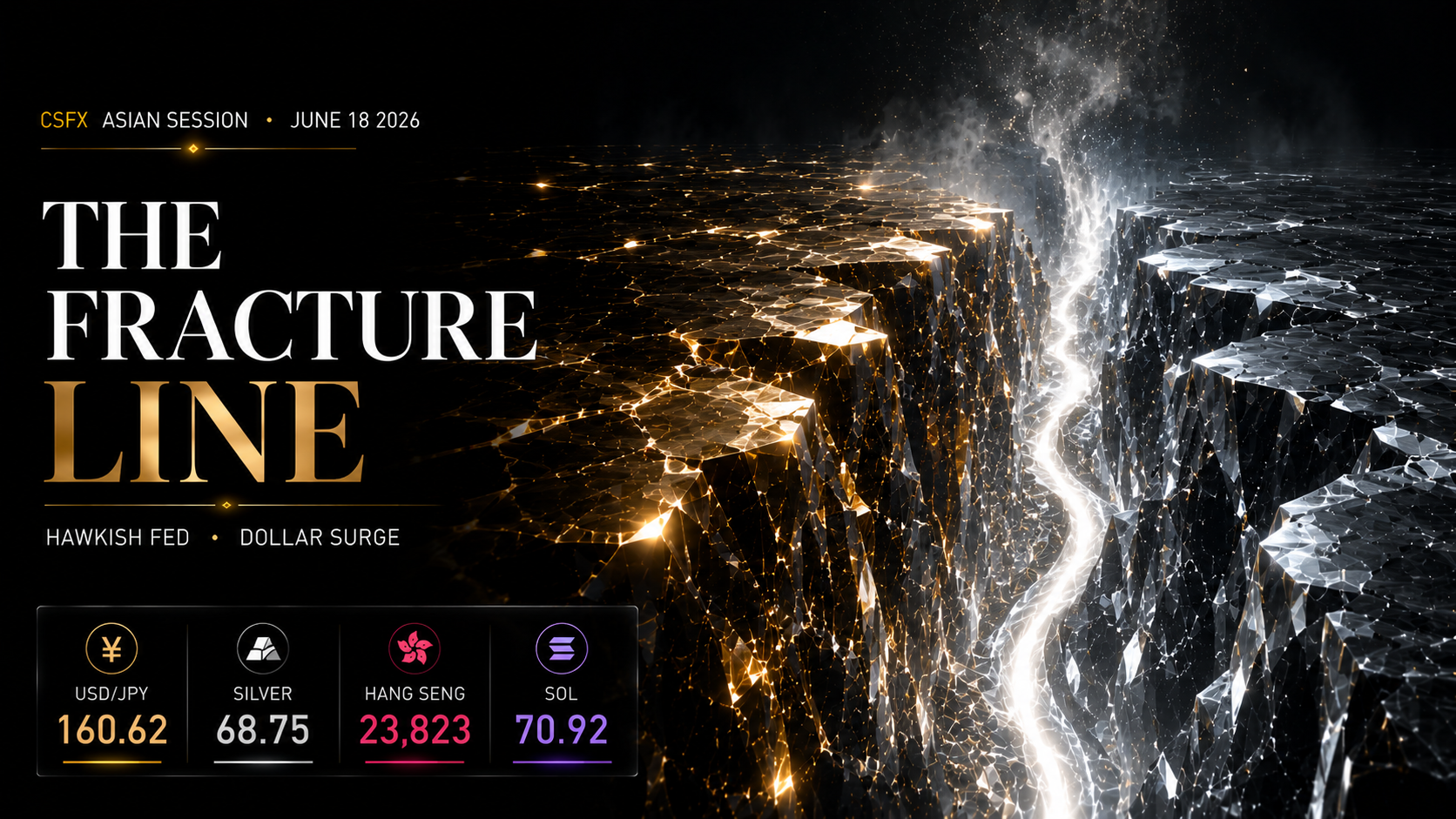
Hawkish Fed Holds at 3.75% – Dollar Surges, Silver $68.75, Hang Seng Tests 23,823, Yen Near 160.62 & Crypto Slips | Technical Analysis – Asian Session Brief | 18 June 2026
Warsh’s Fed Holds But Turns Hawkish
Dollar Surges, Silver Rebounds & Yen Pinned Near 160
Thursday’s Asian session trades in the wake of a decisive macro pivot: the Federal Reserve held its benchmark at 3.50–3.75% on Wednesday but delivered a distinctly hawkish message under new Chair Kevin Warsh — nine of eighteen policymakers now project a rate hike before year-end, and the median 2026 dot rose to 3.8% from 3.4% in March. The dollar surged roughly 1% for its best session in nearly a year, two-year Treasury yields jumped 16bp to 4.21%, and gold fell more than 2%.
The repricing inverts the dovish setup many had positioned for. USD/JPY is pinned near 160.62, with higher-for-longer US rates keeping the dollar bid and the carry trade alive despite Tuesday’s BoJ hike to 1.00% — though the Ministry of Finance’s intervention zone above 160 caps the upside. Silver, having tumbled about 3% on the hawkish surprise Wednesday, is steadying around $68.75 (+1.2% off the open) in Asian trade as the Iran peace deal and structural industrial demand offer a floor. Natural gas stays under pressure near $3.12/MMBtu on a persistent storage surplus, with today’s EIA storage report the next data point.
The crypto complex is sliding after the hawkish Fed dampened risk appetite. Solana has slipped to $70.92, breaking below its $72 shelf as the FIFA World Cup meme-coin wave cools, while Dogecoin trades around $0.083, pressing its $0.081 accumulation floor even with the SEC/CFTC digital-commodity tailwind. Hong Kong’s Hang Seng, at 23,823 after extending its slide to test the 23,800 support, faces a fresh headwind: the HKD peg transmits the Fed’s hawkish hold directly into local rates. The week’s decisive event is now ahead — the formal US–Iran peace signing in Switzerland on Friday and the toll-free reopening of the Strait of Hormuz.
Asian Session Headlines — 18 June 2026
Live market-moving events as markets digest a hawkish Fed and position for Friday’s Iran peace signing
Central Bank Week Done — Hawkish Fed Behind, Iran Signing Tomorrow
The two binary central-bank events are settled; Friday’s geopolitical signing is the week’s last major catalyst (times in GMT)
| Time (GMT) | Region | Event | Forecast | Previous | Impact |
|---|---|---|---|---|---|
| Wed 17 Jun · CONFIRMED | 🇺🇸US | FOMC Rate Decision — Held 3.50–3.75%, Hawkish Dot Plot ▲ | 3.50–3.75% (Hold) | 3.50–3.75% | CONFIRMED HOLD |
| Tue 16 Jun · CONFIRMED | 🇯🇵Japan | BoJ Rate Decision — Hiked 25bp to 1.00% (31-yr high) ▲ | 1.00% | 0.75% | CONFIRMED HIKE |
| Thu 18 Jun · CONFIRMED | 🇯🇵Japan | Japan Trade Balance / Exports (May) — Exports +17% YoY | — | — | MEDIUM |
| Thu 18 Jun 14:30 | 🇺🇸US | EIA Weekly Natural Gas Storage (wk ending Jun 12) | — | +108 bcf | MEDIUM |
| Thu 18 Jun 12:30 | 🇺🇸US | Initial Jobless Claims — Labour-Market Health Check | — | — | LOW |
| Fri 19 Jun | 🌟 Global | US–Iran Peace Signing — Bürgenstock, Switzerland; Hormuz Reopening | — | — | CRITICAL |
| Tue 24 Jun | 🇦🇺Australia | Australia CPI (May) — Key for RBA August Decision | — | — | MEDIUM |
Asian Session Setups — 18 June 2026
Seven instruments across FX, commodities, equities & crypto in a post-Fed, pre-Iran-signing session

Fundamental Backdrop
AUD/JPY sits near 112.95, caught between two offsetting forces. Supporting the cross: the wide yield differential. Even after Tuesday’s BoJ hike to 1.00%, the gap to the RBA’s 4.35% remains roughly 335bp, keeping the yen the natural funding leg of a carry trade. Working against it: Wednesday’s hawkish Fed soured global risk appetite, and AUD/JPY is one of the most risk-sensitive crosses in the G10 — it tends to fall when equities wobble. The net result is a pair drifting toward the lower end of its range, with the carry yield providing a floor and risk-off capping rallies well short of the 114.72 cycle high.
Technical Outlook
AUD/JPY is testing the 112.80–113.00 support band that has framed the recent base, with the 52-week high near 114.72 a distant ceiling. A sustained break below 112.80 opens 112.00 (the entry zone) and then 110.80 (the structural stop region). Resistance is the 113.50 intraday level, the 114.00 round number, and the 114.72 high. Until a clean break either way, this remains a fade-the-extremes range: buy dips toward 112.00 on yield support, take profit into 114.70, and respect that a sharp equity sell-off on any Iran-deal hiccup is the primary downside risk to longs.
Session Catalysts
Watch for: (1) global equity tone — AUD/JPY tracks risk sentiment, so a hawkish-Fed hangover that pressures stocks drags the cross lower; (2) any MOF intervention chatter — a sharp yen rally on intervention would hit AUD/JPY through the JPY leg; (3) Friday’s Iran signing — a clean ceremony supports risk-on and the carry trade, while a setback is risk-off; (4) Australia’s May CPI on June 24 — a hot print revives RBA hike-risk and lifts the AUD leg. Treat this as a range session pending Friday’s geopolitical catalyst.

Fundamental Backdrop
USD/JPY’s setup has flipped from the dovish-Fed thesis that dominated earlier in the week. Wednesday’s hawkish hold — with the dot plot now implying a 2026 hike and the dollar index posting its best day in nearly a year — keeps the greenback firmly bid and the carry trade intact, since the 275bp differential between the Fed’s 3.75% and the BoJ’s 1.00% still dwarfs the cost of funding in yen. Japan’s May exports surged 17% year-on-year, the fastest since late 2022, but even strong trade data has not lifted the yen against this rate gap. The counterweight is the Ministry of Finance: Tokyo’s intervention zone sits at and above 160, and silence from officials near 160.50 is itself a warning that action could follow a fast move higher.
Technical Outlook
The pair is grinding just under the 160.74–160.78 cycle high, which doubles as the intervention ceiling. A clean break and hold above 161.00 would signal the MOF has stepped back; absent that, spikes toward 160.70 are sell-the-rally opportunities into the intervention zone, targeting 158.50 and then 157.00 on any risk-off or verbal intervention. Support sits at 159.50 and 158.25. The asymmetry favours fading strength: upside is capped by policy risk while downside can be sharp if Tokyo acts. Stop above 161.40 clears the intervention shelf.
Session Catalysts
Watch for: (1) MOF / BoJ verbal intervention — any reference to “excessive moves” near 160.50 is an immediate yen-positive trigger; (2) US yields — the two-year at 4.21% is the dollar’s engine, so further yield gains extend the dollar bid; (3) Friday’s Iran signing — lower oil structurally improves Japan’s trade balance and supports the yen over time; (4) any follow-through hawkish Fed commentary. The structural BoJ-normalisation story still argues for a lower pair over the medium term, but the hawkish Fed has, for now, pinned it near the intervention line.

Fundamental Backdrop
Silver’s ~89% year-on-year gain remains the standout in precious metals, but the near-term picture has two-way tension. The bearish input is fresh: Wednesday’s hawkish Fed lifted real yields and the dollar, knocking silver about 3% lower — the classic non-yielding-asset headwind. The bullish offsets are structural and durable: roughly half of silver demand is industrial, anchored by solar photovoltaics, EV connectors, and a powerful new driver — the grid and power build-out for AI datacenters, which are raising the demand outlook for industrial silver. The Iran peace deal removes the war premium but also the rate-hike inflation fear that periodically whipsawed the metal. Thursday’s ~1.2% steadying to $68.75 shows dip-buyers re-engaging.
Technical Outlook
Silver opened at $67.91 and has firmed toward $68.75, holding the broad $66–$72 range that has framed the past month. The 52-week range is extraordinarily wide ($35–$122), a reminder of the volatility profile. Near-term, $68 is the pivot the metal is trying to consolidate above; reclaiming it cleanly keeps $72 in view, with $74–$75 the extension on any dollar pullback. A daily close below $66 opens $63–$64. The favourable structure is to accumulate dips toward $66, stop $63, targeting $74 — an ~8% upside against ~4.5% risk in a market where the structural industrial bid limits how far rate-driven selloffs extend.
Session Catalysts
Watch for: (1) US real yields and the dollar — further dollar strength on the hawkish-Fed afterglow is the main downside risk; (2) Friday’s Iran signing — a clean ceremony and Hormuz reopening calms inflation fears, a mild positive for the rate backdrop silver trades against; (3) AI-datacenter and solar capex headlines — the structural industrial demand narrative; (4) gold’s lead — silver typically amplifies gold’s moves, so watch bullion for direction. The $66 dip-buy thesis holds as long as the industrial-demand story stays intact and the dollar doesn’t break sharply higher.

Fundamental Backdrop
Natural gas faces a supply-driven headwind that the summer heat story has not yet overcome. Inventories stand at 2,686 bcf — roughly 151 bcf, or 6%, above the five-year seasonal average — after the most recent EIA report showed a 108 bcf injection. The EIA’s June Short-Term Energy Outlook raised production expectations, with US marketed output growing about 3.3% in 2026 driven largely by associated gas from the Permian, keeping storage elevated and capping Henry Hub near $3.34/MMBtu through the second half of the year. This is a domestic supply story, largely independent of the Iran geopolitics moving oil. Today’s EIA storage report for the week ending June 12 is the immediate test.
Technical Outlook
Henry Hub near $3.12 sits just above the pivotal $3.00 psychological support. A daily close below $3.00 confirms the next leg toward $2.85–$2.90. On the upside, heat-driven short-covering rallies toward $3.30 are sell opportunities while the surplus persists; a stop above $3.55 captures a scenario where intensifying heat forecasts materially shift the summer demand outlook. The risk/reward on a short from $3.30 to $2.85 is roughly 14% downside against 8% upside to the stop — a balanced setup that favours fading strength into the supply glut.
Session Catalysts
Watch for: (1) today’s EIA storage print — a build above consensus reinforces the bearish surplus, a sharp miss sparks a short-covering bounce; (2) updated temperature forecasts — above-normal heat boosting power-burn cooling demand is the only meaningful bullish catalyst; (3) LNG feedgas flows — export demand is the swing factor that can tighten balances; (4) production data — any sustained Permian slowdown would matter. The dominant force remains the storage surplus; sell bounces with disciplined stops.

Fundamental Backdrop
The Hang Seng has extended its decline to 23,823, slipping about 2% from Wednesday’s 24,312 close and pressing the 23,800 support that marks its lowest level since March. The structural headwind is the Hong Kong dollar peg: because the HKMA automatically tracks US monetary policy to defend the band, Wednesday’s hawkish Fed feeds directly into local interest rates, lifting the discount rate applied to Hong Kong’s growth-heavy technology constituents and the cost of leverage that underpins property and financials. Cushioning the tape is the China AI theme — Knowledge Atlas (Zhipu AI) and Lenovo have drawn buyers on open-source model momentum — but it has not been enough to offset broad profit-taking in Tencent, SMIC, and the heavyweights.
Technical Outlook
The index is now testing the 23,800 support that anchored the March-recovery base, with the 52-week range running from 23,185 to 28,056 — current prices sit deep in the lower third. A clean hold of 23,800 is the setup for a tactical bounce; a daily close below it exposes 23,185 (the 52-week low) and then the psychological 23,000. Resistance on any recovery is 24,300 (Wednesday’s close) and 24,900. With the Fed now a hawkish headwind rather than the hoped-for dovish tailwind, the bias stays neutral-to-bearish: the disciplined play is a tactical long off the 23,800 support, stop 23,150 below the 52-week low, targeting 24,900 — not a blind buy-every-dip stance until the peg pressure clears.
Session Catalysts
Watch for: (1) US-yield direction — higher-for-longer transmits through the peg, the dominant macro driver for HK valuations; (2) China policy signals — any fresh Beijing stimulus or Lujiazui Forum guidance is the key domestic offset; (3) Friday’s Iran signing — lower oil and reduced geopolitical risk support risk-on across Asia; (4) China AI headlines — individual names like Zhipu AI can dominate the index on low-volume days. The peg-driven rate headwind is the defining feature; respect it before chasing rebounds.

Fundamental Backdrop
Solana has slipped to $70.92, breaking back below the $72 shelf, with roughly $2 billion in 24-hour volume and a ~$41 billion market cap. The FIFA 2026 World Cup meme-coin wave that powered its earlier-week surge has cooled as the hawkish Fed trimmed speculative risk appetite across crypto. What endures is the network-utilisation story: Solana’s low fees and high throughput keep it the natural home for high-velocity retail trading, and tokenisation narratives (including real-world-asset experiments on the chain) add a more durable institutional angle. The token still sits about 42% below its year-ago level and well under its 200-day moving average near $99.60, framing this as a recovery range rather than a fresh bull leg.
Technical Outlook
SOL has lost the $72–$74 shelf and is now probing toward the $68 support, with a 14-day RSI easing toward the mid-40s consistent with a softening tape. Support is $68 (the breakout/entry zone) and then $62 (the structural stop region near the longer moving averages). Resistance is the reclaimed $72 shelf, then $76 and $82 (the prior consolidation zone). A clean hold above $68 on any risk-off flush confirms the constructive structure; a weekly close back above $72 with volume is the first sign the dip is being bought. The disciplined plan is to accumulate dips toward $68, stop $62, targeting $82 — favourable skew if the network-activity narrative reasserts once macro risk-off fades.
Session Catalysts
Watch for: (1) broad risk sentiment — the hawkish-Fed dollar bid is the main near-term cap on crypto; a calmer tape lets SOL’s network story breathe; (2) Bitcoin’s lead — SOL’s beta to BTC means a BTC reclaim above $66,000–$67,000 pulls SOL higher; (3) Solana network throughput and World Cup activity data — the real-time confirmation of the utilisation thesis; (4) Friday’s Iran signing — a risk-on resolution supports the entire complex. Size conservatively given crypto’s volatility and the macro headwind.

Fundamental Backdrop
Dogecoin trades near $0.083, pressing the $0.081 accumulation floor, with a market cap near $12.5 billion. Three structural tailwinds distinguish it: the March 20, 2026 SEC/CFTC classification of DOGE as a digital commodity — the same standing as Bitcoin and Ethereum, which removes a long-standing legal overhang; the prospect of DOGE integration into X Money as a native payment layer for one of the largest digital audiences ever; and ongoing speculation about DOGE inclusion in crypto ETF products. On-chain data shows whale accumulation near $0.081, which has emerged as firm support and is exactly where price is now testing. The persistent structural negative remains DOGE’s uncapped supply and continuous issuance, a long-term inflation headwind the market knows well.
Technical Outlook
DOGE is testing the $0.081 floor in tight, thin-volume trade consistent with a market waiting on macro direction. A clean hold of $0.081 is the dip-buy setup; a daily close below it exposes $0.076 and then the $0.072 hard stop (weekly structural support). Resistance on any bounce is the $0.090 shelf, then $0.095–$0.100 and $0.105 (the medium-term target on ETF or X Money confirmation). With the hawkish Fed capping retail risk appetite, the disciplined approach is to buy the $0.081 test rather than chase a bounce, stop $0.072, target $0.105.
Session Catalysts
Watch for: (1) overall crypto risk tone — DOGE is among the most retail-sentiment-driven majors, so it amplifies risk-on/risk-off swings; (2) any X Money / ETF headline — the single most powerful DOGE-specific catalyst; (3) Bitcoin price action — a BTC reclaim above $66,000 lifts DOGE through correlation; (4) Elon Musk’s social-media activity — historically the most volatile short-term DOGE driver. Size positions conservatively; a 5–10% intraday move is within DOGE’s normal range.
Key Questions for the Asian Session
Detailed answers to the session’s most important analytical questions
Asian Session Summary — 18 June 2026
Thursday’s Asian session is defined by the aftermath of Wednesday’s hawkish Fed hold. Kevin Warsh’s debut left rates at 3.50–3.75% but the dot plot now implies a 2026 hike, the dollar index posted its best day in nearly a year, and gold fell over 2%. The repricing inverts the dovish setup markets had positioned for and reshapes every cross-asset relationship into the week’s final catalyst — the US–Iran peace signing in Switzerland on Friday and the toll-free reopening of the Strait of Hormuz. USD/JPY is pinned near 160.62 by the carry trade and dollar strength, capped only by the MOF’s intervention ceiling. Silver, after a 3% hawkish-Fed drop, is steadying near $68.75 on structural industrial demand. Natural gas stays heavy near $3.12 on a storage surplus, with today’s EIA print due. The Hang Seng has fallen to 23,823, testing the 23,800 support as the peg transmits Fed tightening into Hong Kong. Crypto is sliding — Solana below $72 at $70.92, Dogecoin pressing $0.083, Bitcoin soft near $63,985.
The actionable framework is clean. Highest-conviction trade: Natural gas short from $3.30 toward $2.85 — the storage surplus and rising Permian production are the dominant drivers, independent of the Iran geopolitics moving oil. USD/JPY is a fade-the-spike setup near the 160.70 intervention ceiling targeting 158.50, with asymmetric downside if Tokyo acts.
In precious metals, Silver dips toward $66.00 are the accumulation entry targeting $74.00 — the ~89% YoY trend and the AI/solar industrial-demand floor outweigh the near-term rate headwind. In FX crosses, AUD/JPY at 112.95 is a range trade testing the floor — fade the 112.00–114.70 extremes, with the carry yield as a floor and risk-off as the cap. In equities, the Hang Seng is neutral-to-bearish while the peg transmits the hawkish Fed; with the index now testing 23,800, a tactical long off that support targets 24,900, stop 23,150. In crypto, Solana dips to $68 target $82 on the network-utilisation story, and Dogecoin dips to $0.081 target $0.105 on the commodity-status and X Money narrative — both contingent on macro risk-off fading. The week’s decisive moment is now Friday’s signing: a clean ceremony and Hormuz reopening is the risk-on impulse that could let metals, equities, and crypto recover from the hawkish-Fed shock; any setback is the opposite.
Access Live Asian Markets →