Sterling Steadies as Burnham Awaited · ECB Sintra Lagarde Opens · Tech Drives STOXX Recovery · Brent ~$72 · EUR/USD ~1.1400 · GBP/USD ~1.3250 | Technical Analysis – European Session | 29 June 2026
European Tech Rebound Steadies STOXX 600 as Lagarde Opens Sintra —
Sterling Recovers From 2026 Lows While Brent Climbs Above $72 on Hormuz Ceasefire
The European session finds its footing on Monday as a technology-led rebound steadies the STOXX 600 at 636.43 — even as investors remain cautious over a fragile US-Iran ceasefire in the Strait of Hormuz, and all eyes turn to the ECB Forum in Sintra where Christine Lagarde has opened with dovish-leaning remarks and Federal Reserve Chair Kevin Warsh is scheduled to speak on Wednesday. Sterling makes a tentative recovery from Friday’s 2026 low, with GBP/USD rebounding toward ~1.3250 as dollar momentum falters ahead of Tuesday’s Doha peace talks and Burnham’s economic speech.
The session’s most visible market mover is a technology sector rebound across European bourses. The pan-European STOXX 600 steadied at 636.43 by 0800 GMT, flat on the day but with the tech subsector up 1.4% — reversing last week’s rout, which marked tech’s biggest weekly fall since mid-March. The standout move is Nagarro, which soared 91% after India’s Persistent Systems offered €81 per share to acquire the AI-led digital engineering firm in one of the session’s most striking M&A deals. Chip names also recovered sharply: Soitec jumped 7.2%, STMicroelectronics added 3.6%. J.P. Morgan was among the latest brokerages to lift its year-end target for European equities, citing a bullish outlook underpinned by the Hormuz ceasefire and tech fundamentals. The French CAC 40 traded marginally below Friday’s close, while the DAX held steady.
Sterling makes a cautious recovery from Friday’s 2026 low. GBP/USD rebounded toward ~1.3250 in the European session as the dollar’s relentless uptrend showed signs of faltering — traders are taking profits ahead of Tuesday’s pivotal US-Iran Doha talks and Wednesday’s Warsh speech at Sintra, both of which could materially reprice rate expectations in either direction. The pound’s resilience is notable: markets appear to have absorbed the Burnham transition relatively well, with ING noting that GBP has held gains even as Energy Secretary Ed Miliband emerged as a frontrunner for the Chancellor role — suggesting markets either expected the smooth Burnham ‘coronation’ or see limited fiscal slippage risk under Miliband. The key remaining question is the detail of Burnham’s own economic speech, expected to set out his fiscal agenda and choice of Chancellor.
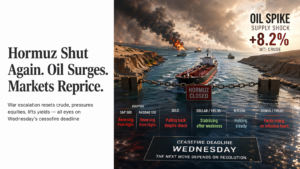
Brent crude climbed above $72 per barrel on Monday, recovering from four-month lows after the US-Iran weekend exchange of strikes. Both sides agreed to halt further hostilities ahead of peace talks in Doha on Tuesday, where officials are scheduled to address the Strait of Hormuz conflict. Hormuz shipping activity has picked up since the interim ceasefire, though shipowners remain cautious. WTI rose toward $70 from Friday’s $68.86 low. The structural supply story remains bearish — Goldman Sachs projects Persian Gulf exports back to pre-war levels by end-July — but the binary of Tuesday’s Doha talks keeps the near-term risk premium live in both directions. Reuters reported oil rising after “days of tit-for-tat attacks between the US and Iran,” with a “tenuous interim ceasefire prevailing.”
At the ECB Forum in Sintra, Lagarde’s opening remarks carried dovish undertones — she reiterated there is no evidence the recent inflationary shock warrants “more forceful” tightening, which has softened immediate EUR/USD headwinds. EUR/USD attempted a tepid bounce above 1.1400 from Friday’s 2026 lows near 1.1393. However, analysts at ING cautioned that EUR/USD upside remains limited absent a material softening in Warsh’s tone on Wednesday, and maintain their view that any downside is “limited to 1.130” with a gradual recovery to 1.150 expected in July. The week’s decisive data duo remains Eurozone flash CPI on Wednesday and US NFP on Thursday.
European Session Headlines — 29 June 2026
Live market-moving events as London, Frankfurt and Paris trade on Hormuz ceasefire optimism, ECB Sintra’s Lagarde opening, and a technology-driven STOXX recovery
The Dollar’s Paradox: A Strong Greenback Overriding Both ECB Hikes and BoE Caution — Europe’s FX Dilemma in a Hawkish-Fed World
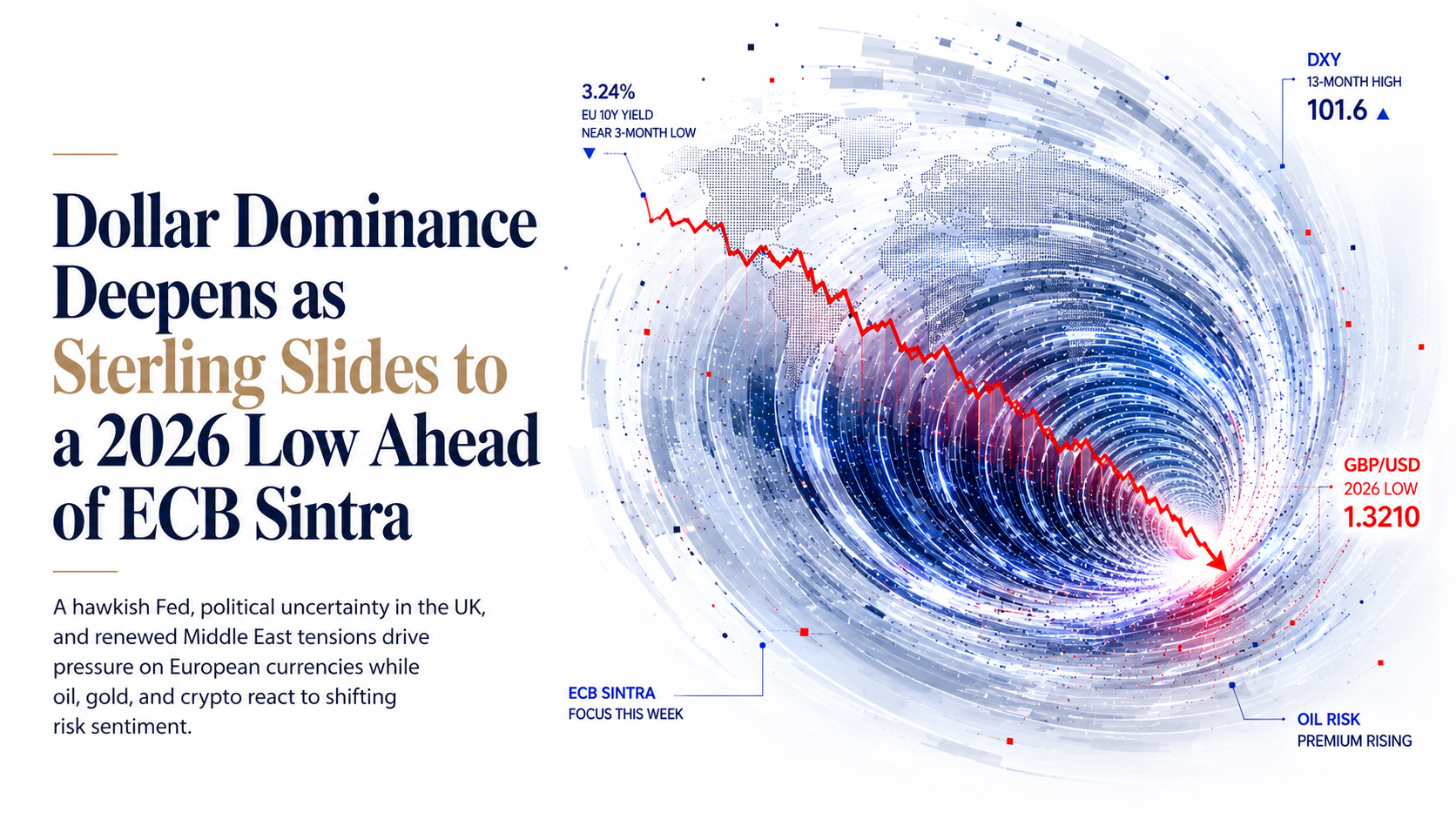
The defining tension of Monday’s European session is the divergence between domestic monetary policy signals and currency outcomes across the euro and sterling. In theory, the ECB’s June hike to 2.25% — its first since 2023, responding to eurozone inflation at 3.0% — should be supporting EUR/USD. The Bank of England’s 7–2 hawkish hold at 3.75%, with two members voting to hike into 2.8% CPI and 3.7% services inflation, should be supporting GBP/USD. Yet both currencies sit at or near their 2026 lows against the dollar.
The reason, as in the Asian session’s yen paradox, is the colossal interest-rate differential. The Fed holds at 3.50–3.75% — 125–150 basis points above the ECB and the BoE — with a dot plot signalling a possible further hike by October, and US Core PCE cemented the higher-for-longer narrative at 3.4% last week. The DXY index is near a 13-month high, and the dollar’s yield advantage overwhelms the ECB’s and BoE’s relatively more modest hawkish pivots. For EUR/USD, the structural bull case (ECB tightening, Fed eventually cutting) remains intact but is materially delayed. For GBP/USD, the added complication is a UK economy in PMI contraction and a political leadership transition with unclear fiscal implications — a combination that makes sterling the weakest of the three despite the BoE’s relatively high rate. The Sintra Forum is the week’s potential inflection point: if Lagarde signals further ECB tightening while Warsh softens even slightly, the differential could compress enough to give EUR/USD a relief bid. The reverse — a hawkish Warsh paired with a cautious Lagarde — would extend the dollar’s dominance into the NFP week.
European Session Economic Calendar — 29 June 2026
Key releases and events shaping price action through London, Frankfurt and into the US open
| Time (BST/local) | Event | Actual / Expected | Impact | Market Read |
|---|---|---|---|---|
| 🇬🇧Ongoing | UK Political Transition — Burnham as PM-in-Waiting; Fiscal Agenda Watch | Burnham reaffirmed fiscal rules; Chancellor appointment pending | 🔴 CRITICAL | No clear fiscal detail = gilt yield tail risk; any spending announcements move GBP |
| 🇪🇺All Day (Mon–Wed) | ECB Forum on Central Banking — Sintra, Portugal; Lagarde, Warsh key speakers | Lagarde signals no need for more forceful action; Warsh tone awaited | 🔴 CRITICAL | Hawkish Lagarde + softer Warsh = EUR/USD relief bid; reverse = dollar extension, yields up |
| 🇮🇷Ongoing | US-Iran Hormuz Talks — Doha, Qatar (Tuesday); Ceasefire Holds? | Weekend strikes; ceasefire Sunday; talks Tue | 🔴 CRITICAL | Successful talks = oil lower, risk-on; breakdown = Brent spike, inflation re-acceleration risk |
| 🇬🇧Released prior week | UK Flash Composite PMI (June) | 49.4 — 14-month low (below 50 = contraction) | 🔴 HIGH | Second consecutive contraction; bearish GBP, complicates BoE; stagflationary backdrop |
| 🇪🇺Released prior week | Eurozone Flash Composite PMI (June) | Below 50 for third consecutive month | 🔴 HIGH | Eurozone GDP contracted in Q1 2026; weak PMI caps ECB hawkishness and weighs on EUR |
| 🇺🇸Released Thu 25 Jun | US Core PCE Price Index (May) — THE WEEK’S PRIOR PIVOTAL NUMBER | Actual 3.4% YoY (up from 3.3%) — HOT | 🔴 CRITICAL | Validates higher-for-longer; DXY near 13-mo high, GBP/USD and EUR/USD to 2026 lows |
| 🇪🇺Wednesday 01 Jul | Eurozone Flash CPI June — Prior: 3.2% (May); ECB’s critical data point this week | Consensus ~3.0–3.2% expected | 🔴 HIGH | Hot = EUR/USD up, ECB hike bets rise; soft = EUR/USD lower, July hike deferred |
| 🇺🇸Thursday 02 Jul | US Non-Farm Payrolls (June) — Early release ahead of July 4 holiday | Consensus ~130K; May printed 172K (beat) | 🔴 CRITICAL | Repeat beat = dollar up, EUR/USD + GBP/USD extend lower; miss = dovish Fed repricing, relief rally |
| 🇨🇳Released prior | China PMI Data — Manufacturing and Services | Manufacturing PMI soft; services mixed | 🟢 MED | Weak China data pressures commodity currencies and risk-sensitive assets including energy |
| 🇬🇧Ongoing / next month | BoE Decision and UK Data Watch — Next meeting 30 July | BoE at 3.75%; services CPI 3.7% key constraint | 🟢 MED | Stagflation corner: can’t cut (services CPI); can’t hike (GDP contracting); GBP caught in middle |
European Session Trade Ideas — 29 June 2026
Eight structured setups — EUR/USD, GBP/USD, Silver, Crude Oil, FTSE 100, EU 10Y, Ethereum, Cardano — with live prices, levels, and full fundamental and technical analysis

Fundamental Backdrop
EUR/USD trades near 1.1393, close to its weakest level of 2026, despite the ECB delivering its first rate hike since 2023 — a 25bp lift to 2.25% deposit rate on 11 June — in direct response to eurozone headline inflation running at 3.0% in 2026 against the ECB’s 2% target. The paradox mirrors the yen’s: a central bank tightening, yet the currency falling, because the other side of the pair is tightening harder. The Fed holds at 3.50–3.75% with a dot plot projecting a possible further hike by October, and US Core PCE cemented the higher-for-longer narrative at 3.4% last week. The 125–150bp rate differential overwhelms the ECB’s move. Eurozone GDP contracted in Q1 2026, and the ECB has now set its full-year growth projection at just 0.8%, creating the same stagflation corner that limits how aggressively the ECB can tighten — a constraint Lagarde herself acknowledged when she said there was no evidence requiring more forceful action. The structural bull case (Goldman Sachs, Deutsche Bank, JPMorgan all targeted 1.22–1.25 for year-end) is still alive mathematically, but requires either US inflation to cool rapidly or the ECB to deliver a second hike in July or September while the Fed pauses.
Technical Outlook
The technical posture is bearish. EUR/USD has reversed from the January high of 1.2022 to the June 24 low of 1.1329, a decline of nearly 7 full figures. Price oscillates near 1.1393, within the lower end of its 2026 range, and technical indicators across most timeframes are flagging sell signals. Key support: 1.1329 (recent 2026 low) and 1.1300 (psychological). Key resistance: 1.1450 (preferred sell-rally), then the 1.14 area (critical Fibonacci support that has turned resistance), and 1.1580 (stop, the prior consolidation zone). The Sintra Forum is the nearest intraday catalyst that could force a rapid 100–150pip move in either direction; position sizing and stops are doing the risk management ahead of a potentially volatile speaker schedule.
Session Catalysts
Watch for: (1) ECB Sintra — Lagarde’s exact language on future rate paths; (2) Fed Chair Warsh speaking at Sintra — any softening of hawkish tone would deflate the dollar; (3) Wednesday’s eurozone flash CPI for June — the data point that decides if another ECB hike is warranted; (4) Thursday’s US NFP — a beat extends dollar strength; (5) Hormuz / Doha talks — energy-driven inflation re-acceleration risk that would test both central banks.

Fundamental Backdrop
GBP/USD is at a 2026 low near $1.3210, caught in a double-squeeze from a hawkish US dollar and a UK economy in an increasingly stagflationary bind. The macro picture is stark: UK composite PMI fell to 49.4 in June, a 14-month low and the second consecutive contraction, while services inflation rose to 3.7%, keeping the Bank of England — which held at 3.75% in a 7–2 vote on 18 June — unable to cut or hike cleanly. The BoE lowered its full-year inflation forecast to 3.2% from 3.6%, reducing the case for hikes, while the contracting economy reduces the room for further support. Politically, Keir Starmer’s resignation sets up Andy Burnham as the new Prime Minister, and while he has reaffirmed the existing fiscal rules, the lack of concrete spending plans keeps a gilt issuance tail risk alive. A Burnham Chancellor appointment that signals higher borrowing would be an independent sterling negative. The Fed–BoE gap (3.50–3.75% vs 3.75%) is now very tight, but the dollar’s structural bid — driven by a hawkish dot plot and higher US inflation — continues to dominate.
Technical Outlook
GBP/USD has broken decisively below a symmetrical triangle pattern and is sitting on the $1.3210 support that analysts identify as a key 2026 low. A sustained break below $1.3210 exposes the $1.3000 late-2025 low (target). Any recovery requires a reclaim of $1.3250 (the preferred sell-rally level), then the horizontal resistance near $1.3330, before the 200-day SMA around $1.3410 and rising trendline resistance come into view — a recovery above $1.3410 would be the first credible sign that the bearish move has exhausted. The 30-day trend: sterling lost 1.89% over the past month and is down 3.87% over twelve months. The monthly chart setup is firmly bearish-to-neutral, and the late-July triple central bank cluster (ECB 23 Jul, Fed 29 Jul, BoE 30 Jul) is the event that resolves whether this is a temporary multi-week low or the start of a deeper cable slide.
Session Catalysts
Watch for: (1) Andy Burnham’s Chancellor appointment or any fiscal policy statement — the near-term wildcard; (2) ECB Sintra — Lagarde and Warsh speeches move the dollar, which moves cable; (3) Thursday’s US NFP — a beat extends the dollar bid; (4) any BoE commentary suggesting a November cut, which would widen the Fed–BoE gap and pressure GBP further; (5) the $1.3210 level — a sustained loss opens $1.3000, a firm hold invites short-covering.

Fundamental Backdrop
Silver is trading near $58.09 during the European session, almost 1% lower on the day, caught in the intersection of three macro headwinds. First, the strong dollar (DXY near a 13-month high) applies the classic inverse-correlation pressure on dollar-denominated metals. Second, renewed US-Iran Hormuz attacks have revived fears of energy supply disruption — a scenario that boosts oil but can crimp silver’s industrial demand if higher energy costs slow global manufacturing and solar panel production, both key silver offtakes. Third, the same higher-for-longer interest rate environment that has weighed on gold since the hot Core PCE print is driving up the opportunity cost of holding yieldless precious metals. Silver hit an all-time high of $121.67 per troy ounce on 29 January 2026 and has since declined more than 50% — a collapse that HSBC characterised as the metal being “fundamentally overvalued” at its wartime peak. The partial upside: industrial demand from solar (silver is critical for photovoltaic cells) and EV battery manufacturing provides a structural floor that gold does not share, and an oversold RSI suggests the pace of decline may be nearing near-term exhaustion.
Technical Outlook
The technical structure is unambiguously bearish. Silver trades well below its 20-day EMA at $65.37, which now acts as overhead resistance rather than support — the distance to this average confirms that any recovery is likely to be corrective within a broader downtrend rather than a trend reversal. The RSI at approximately 31.85 is approaching but has not yet entered oversold territory (below 30), suggesting downside momentum is still dominant but could be nearing exhaustion. Resistance: the March 23 low turned resistance at $61.01 is the first meaningful level, followed by the 20-day EMA at $65.37 (stop). Support: the June 24 low at $55.63 is the next key downside level; a break below exposes the $50 psychological round number (target). The preferred expression is to fade recoveries toward the $61 resistance zone with a stop above the 20-day EMA at $65.50, targeting $50 — while respecting that a sub-30 RSI and an oversold market can produce fast short-covering bounces.
Session Catalysts
Watch for: (1) the dollar — the primary driver; any ECB Sintra dovish surprise from Warsh that weakens the USD is the most powerful near-term bullish catalyst for silver; (2) Hormuz talks — a successful Doha ceasefire reduces energy disruption fears and can provide a silver relief bid; (3) Thursday’s US NFP — a miss would soften the dollar and reduce higher-for-longer expectations; (4) global manufacturing and solar PMI data — industrial demand signal; (5) the $55.63 June low — a decisive break exposes $50, while a hold suggests an oversold bounce toward $61.

Fundamental Backdrop
WTI crude is trading near $69.30 as European markets open, recovering from Friday’s four-month low of $68.86 after a weekend of US-Iran tit-for-tat strikes reignited the Hormuz risk premium. The exchange began Thursday with Iran striking a container ship, escalated through Friday with US retaliatory strikes, and intensified Saturday after Washington launched further attacks following Iran’s targeting of a Qatari-flagged vessel. Both sides agreed Sunday to halt strikes ahead of Doha talks on Tuesday. Brent rose above $73.18 from near $69, and while some of that move has retraced, the market is pricing in genuine uncertainty about whether the partial diplomatic thaw holds. The underlying structural picture remains firmly bearish: WTI lost 22.2% over four weeks, Goldman Sachs has cut its Q4 Brent target to $80 from $90, Persian Gulf exports have resumed to roughly 75% of pre-war levels (Saudi Arabia’s Ras Tanura terminal restarting), and Iraq is pushing OPEC for a higher quota to recoup lost war-era revenue. The near-term binary is stark: successful Doha talks and Hormuz normalisation = oil resumes its downtrend toward $65–$66; a collapse of talks or fresh escalation = a spike well above $75, potentially testing $80.
Technical Outlook
The chart is bearish but has produced a sharp counter-trend bounce from Friday’s low. WTI closed Friday near $68.86, the lowest since 27 February, before gapping higher on weekend Hormuz news. Resistance: the $73.75 area (200-day SMA, a break of which would signal a more sustained recovery); $75 (preferred sell-rally, the Fibonacci 78.6% retracement of the $55–$120 wartime rally); and $79–$80 (stop). Support: $70 (psychological), $68.86 (recent low), $66 (target, a previous consolidation level), and $65 (extended target). The base case is to fade rallies above $75 with a stop above $80, targeting $65 — but this trade carries Hormuz binary risk that can move price $5–$8 in minutes on a headline, so position sizing is the primary risk control.
Session Catalysts
Watch for: (1) Doha talks Tuesday — the near-term binary; a credible ceasefire framework = oil resumes downtrend; (2) Hormuz vessel-tracking data — real-time shipping signals; (3) Goldman Sachs and IEA commentary on the supply surplus timeline; (4) Saudi Aramco restart news — Ras Tanura loading confirmation is the most bullish supply-restoration signal; (5) the dollar — a softer DXY on Warsh dovishness at Sintra would provide a partial floor for oil.

Fundamental Backdrop
The FTSE 100 opened marginally lower at 10,492.5 and trades near 10,492.5 in early European trade, balancing two opposing forces. On the bullish side, the Hormuz bounce in Brent crude above $73.18 provides direct support to the index’s large energy constituents — Shell and BP are among the FTSE’s heavyweight components — while sterling weakness (GBP/USD at 2026 lows near $1.3210) provides a translation boost for the index’s majority of revenues in non-sterling currencies: the FTSE 100 typically benefits from a weaker pound since roughly 70% of its earnings come from overseas. On the bearish side, the UK composite PMI’s fall to 49.4, a 14-month low and second consecutive contraction, signals that domestic-facing sectors are deteriorating. The Bank of England’s stagflation dilemma — can’t cut because services inflation is 3.7%, can’t hike because the economy is contracting — creates a fundamentally uncertain backdrop. Political transition risk under Burnham, with gilt yields “slightly up” in Monday’s early trade, adds a modest headwind for UK financials and rate-sensitive sectors.
Technical Outlook
The FTSE 100 has traded in a tight early range of 10,480–10,510, near the middle of its 52-week 8,531–10,935 range. Daily technical indicators are rated Neutral (Investing.com), consistent with the index sitting in a no-man’s land between an energy-driven bid and macroeconomic headwinds. Key resistance: the 10,510 intraday high and then 10,550 (the preferred sell-rally level). Key support: 10,480 (today’s low so far), 10,200 (near-term pivotal support), and 10,100 (target on a breakdown). The FTSE 100 is less technically weak than European peers because its commodity and financial weighting offsets the UK-specific PMI deterioration, but the balance of risks into the NFP week tilts modestly bearish given the dollar strength environment and global risk-off tone.
Session Catalysts
Watch for: (1) oil price direction — the Hormuz/Doha binary is the single biggest intraday mover for energy majors; (2) sterling — further GBP weakness past 1.3210 is a mechanical tailwind for the index through translation; (3) ECB Sintra — any move in rates expectations ripples through UK gilt yields and domestic financials; (4) Burnham fiscal announcements — higher gilt yields on spending concerns hit rate-sensitive sectors; (5) Thursday’s US NFP — a beat extends the risk-off, higher-for-longer backdrop that weighs on global equities.

Fundamental Backdrop
The EU 10-year yield eased to approximately 3.24% as of 25 June, near a three-month low, as two forces have converged to restrain the yield from rising further after the ECB’s 25bp hike to 2.25% on 11 June. First, ECB President Lagarde’s remarks at the week before Sintra — noting no evidence of a more forceful policy response being needed — caused markets to scale back expectations for a second 2026 hike, taking the wind out of bond market selling pressure. Second, weak eurozone PMI data (private sector in contraction for a third consecutive month) reinforced that the region’s 0.8% growth projection for 2026 faces downside risk, which historically supports bond prices (lower yields). Germany’s 10-year Bund yield fell to approximately 2.92–2.97%, moving toward its lowest levels since March. The ECB’s revised inflation forecasts (3.0% for 2026, 2.3% for 2027) acknowledge the energy-driven shock, but Lagarde’s data-dependent, meeting-by-meeting framing means Wednesday’s June flash CPI and Thursday’s US NFP will determine whether the July 23 ECB meeting delivers a second hike or a pause.
Technical Outlook
EU 10Y yields are in a descending channel from the post-hike highs, with yields falling as bond prices rise on the growth/inflation balance shift. The 3.24% current level sits near the middle of the 2026 range. If Lagarde’s Sintra comments confirm a cautious tilt and Wednesday’s CPI comes in softer, yields could test 3.10% and potentially the 2.85% area (target, near the pre-hike levels). Conversely, if Lagarde signals July is live for another hike and/or CPI comes in hot, yields could spike back toward 3.40–3.45% (stop). The trade idea from a bond perspective is to buy (long bond prices, lower yield) on dips toward the 3.10% yield level, targeting 2.85%, with a stop if yields break above 3.45%. From an investor standpoint, yields here represent moderate compensation for eurozone risk, anchored below the ECB deposit rate at 2.25%.
Session Catalysts
Watch for: (1) ECB Sintra — Lagarde’s tone on future rate hikes is the single biggest driver; hawkish = yields up, dovish = yields down; (2) Wednesday’s eurozone flash CPI for June — above 3.2% would revive July hike bets and push yields higher; (3) Hormuz/Doha — a successful ceasefire reduces inflation risk premium and supports bonds; (4) German PMI — Germany’s PMI contracted at its fastest pace since 2024, a bond-supportive signal; (5) US Treasury yields — the global benchmark that European yields shadow in rate-differential terms.

Fundamental Backdrop
Ethereum trades near $1,571.87, down approximately 1.4% on the day and off roughly 44% year-to-date in what has been the worst year-to-date performance in the top-five cryptocurrencies. The macro drivers are identical to those crushing silver and the other risk assets in this report: a DXY near a 13-month high, a hawkish Fed with an October hike possibility now priced, and a broad risk-off environment that pushes institutional capital away from high-beta assets. The project-specific headwind is material: the Ethereum Foundation reduced its workforce by approximately 20% (54 positions) and cut its budget by roughly 40%, triggering leadership departures throughout H1 2026. While some commentators argue this signals the ecosystem has matured beyond reliance on the Foundation, the timing — into a bear macro environment — has amplified the confidence overhang. The structural positives remain intact: the Glamsterdam upgrade (raising the gas limit from 60 million to 200 million, entering final devnet testing) targets scalability improvements; spot ETH ETFs remain active; and the $1,500–$1,512 support zone has held so far as a technical floor. But without a macro catalyst — a softer dollar, a dovish Fed signal — the structure is bearish-to-neutral.
Technical Outlook
The technical chart is unambiguously bearish. ETH sits below its 20-day EMA ($1,708), 50-day EMA ($1,865), 100-day EMA ($2,037) and 200-day EMA ($2,317) — all four major averages declining, all acting as overhead resistance. The RSI at approximately 29.30 is just below the 30 oversold threshold, the point at which relief bounces can be violent even in a downtrend. The $1,500–$1,512 support zone is the bull/bear line: a hold keeps a recovery toward $1,600 (sell-rally target) and $1,708 (20-day EMA) alive, while a break below $1,500 risks an extension toward $1,450 and potentially lower. Resistance: $1,586–$1,600 (preferred sell-rally) and $1,708 (20-day EMA; stop at $1,720). Support: $1,512 (pivot), $1,500 (psychological), and $1,450 (target). Size for an oversold snap-back risk if $1,500 holds.
Session Catalysts
Watch for: (1) Bitcoin’s direction — ETH is highly correlated to BTC near $60,000; BTC stability provides a floor; (2) the dollar and ECB Sintra — any softening of Warsh’s tone would deflate the USD and provide crypto relief; (3) Ethereum Foundation news — any positive governance or funding announcement could reverse the confidence overhang; (4) Glamsterdam upgrade milestones — major devnet developments act as positive catalysts; (5) the $1,500–$1,512 zone — the bull/bear line that determines whether this is a bottom or a continuation lower.

Fundamental Backdrop
Cardano stabilises near $0.144 — a five-year low that places ADA back at its pre-2021 bull market level — after a 21% decline over two weeks that has been driven by a combination of broad macro headwinds and a project-specific confidence shock. The macro factors are the same as across all eight instruments in this brief: a strong dollar, a hawkish Federal Reserve, the crypto Fear & Greed Index at 13 (Extreme Fear), and approximately $1.26 billion in crypto liquidations over the past week. The project-specific catalyst is the SecondFi wallet exploit, in which approximately 16 million ADA ($2.4 million) was stolen from 374 user wallets through a vulnerability in the wallet-generation software. Emergency rescue measures secured a further 129 million ADA at risk, and a patch was deployed, but the breach has damaged retail confidence at a moment when ADA was already at multi-year lows. The positive structural backdrop includes: Cardano’s Leios Musashi Dojo testnet launched 23 June targeting 30–65x throughput improvement (mainnet target November 2026); the SEC’s proposed “safe harbor” under Chair Atkins in March 2026 removing the securities classification overhang; and pending spot ADA ETF filings from Grayscale, VanEck, 21Shares, and Canary Capital — approval would represent the single largest price catalyst in ADA’s history. The 1.4 billion dollar on-chain community treasury, with 16 of 18 funded milestones delivered in Q1 2026, signals developmental accountability that longer-term holders cite as a structural positive.
Technical Outlook
The technical structure is deeply bearish. ADA trades well below both its 50-day EMA (~$0.200) and 200-day EMA (~$0.306), both of which are declining, acting as overhead resistance. The bearish impulse move has been running for more than two weeks following the SecondFi exploit and testing of the inverse Fair Value Gap between $0.1798 and $0.2001. Funding rates are negative at -0.0155%, Open Interest is up 5% to $369 million (bearish buildup), but volume is down 16% — indicating remaining buyers are holding short positions at a premium. Resistance: the descending trendline break at approximately $0.1850 (preferred sell-rally), the inverse FVG between $0.1798 and $0.2001 (dense cap), and $0.2100 (stop, above the lower FVG bound). Support: $0.144 (current), with no strong support until approximately $0.10 on the longer-term chart (target). ADA needs to reclaim $0.1850 and then $0.2001 to ease selling pressure; a clean break below $0.140 would accelerate the slide.
Session Catalysts
Watch for: (1) SecondFi exploit resolution updates — full user compensation confirmation would reduce the confidence overhang; (2) Bitcoin and broad crypto risk appetite — ADA amplifies BTC moves; (3) the dollar and macro — ETH and ADA rise and fall with the same Fed/dollar variable that dominates all instruments today; (4) Leios testnet progress updates — any significant throughput milestone can provide a narrative catalyst; (5) spot ADA ETF news from the SEC — an approval timeline or filing acknowledgement would be the single most powerful catalyst available to ADA.
Key Questions for the European Session
Detailed answers to Monday’s most important analytical questions
European Session Summary — Monday, 29 June 2026
Monday’s European session is defined by three simultaneous pressures converging on risk assets. The geopolitical: weekend US-Iran tit-for-tat Hormuz strikes have revived the energy risk premium — Brent bouncing above $73.18 from four-month lows — but a Sunday ceasefire and Doha talks on Tuesday mean the market faces a binary that can resolve either with renewed downside for oil (successful talks, supply surplus dominates) or a fresh spike (talks collapse). The macroeconomic: the dollar at a 13-month high, driven by last week’s hot US Core PCE at 3.4%, overwhelms every domestic monetary policy story in this report — ECB’s June hike cannot lift EUR/USD, BoE’s hawkish hold cannot support GBP/USD, and the same rate differential gravity weighs on every risk asset from silver to Cardano. The political: sterling at a 2026 low as Andy Burnham’s fiscal agenda uncertainty adds a local weight to the global dollar headwind, with the UK composite PMI contracting to a 14-month low of 49.4 confirming a stagflation bind for the Bank of England.
The actionable framework across today’s eight instruments is clear. Highest-conviction macro bearish: GBP/USD sell rallies toward 1.3250, stop 1.3420, target 1.3000 — PMI contraction, fiscal uncertainty and 2026 structural low are the cleanest dollar-strength expression with a UK-specific amplifier — but the Burnham Chancellor announcement is the unpredictable wildcard.
For the individual instruments: EUR/USD sell rallies toward 1.1450, stop 1.1580, target 1.1250 — rate differential and dollar headwind; mind the Sintra ECB/Fed speaker risk. Silver sell rallies toward $61, stop $65.50, target $50 — dollar and industrial demand headwind; RSI near oversold means size for a short-covering bounce. WTI neutral; sell rallies above $75 if Doha talks succeed, stop $80, target $65 — this is a two-sided Hormuz trade and the binary is still live. FTSE 100 neutral-sell rallies toward 10,500, stop 10,700, target 10,100 — energy offset vs PMI contraction; range-bound near-term. EU 10Y buy dips in bonds (yield toward 3.10%), stop if yield breaks 3.45%, target 2.85% yield — Lagarde caution and growth weakness are bond-supportive. Ethereum sell rallies toward $1,600, stop $1,720, target $1,450 — below all EMAs, RSI ~29; $1,500 is the bull/bear line and an oversold bounce risk. Cardano sell rallies toward $0.1850, stop $0.2100, target $0.10 — five-year low compounded by SecondFi exploit; Leios/ETF filings are the structural reversal catalysts. The week’s two decisive events are ECB Sintra (Lagarde and Warsh, today through Wednesday) and US NFP on Thursday — together they will settle whether the dollar’s 13-month high is a ceiling or a launching pad into H2 2026. Size positions accordingly.
Access Live European Markets →