EUR/USD ~1.1348 at Yearly Lows as UK Political Void Deepens, CAC 40 Rallies +3.19% — Silver ~$61.23/oz at 6-Month Lows, EU TTF Gas ~€42.5/MWh, Ethereum ~$1,668 | Technical Analysis – European Session | 24 June 2026
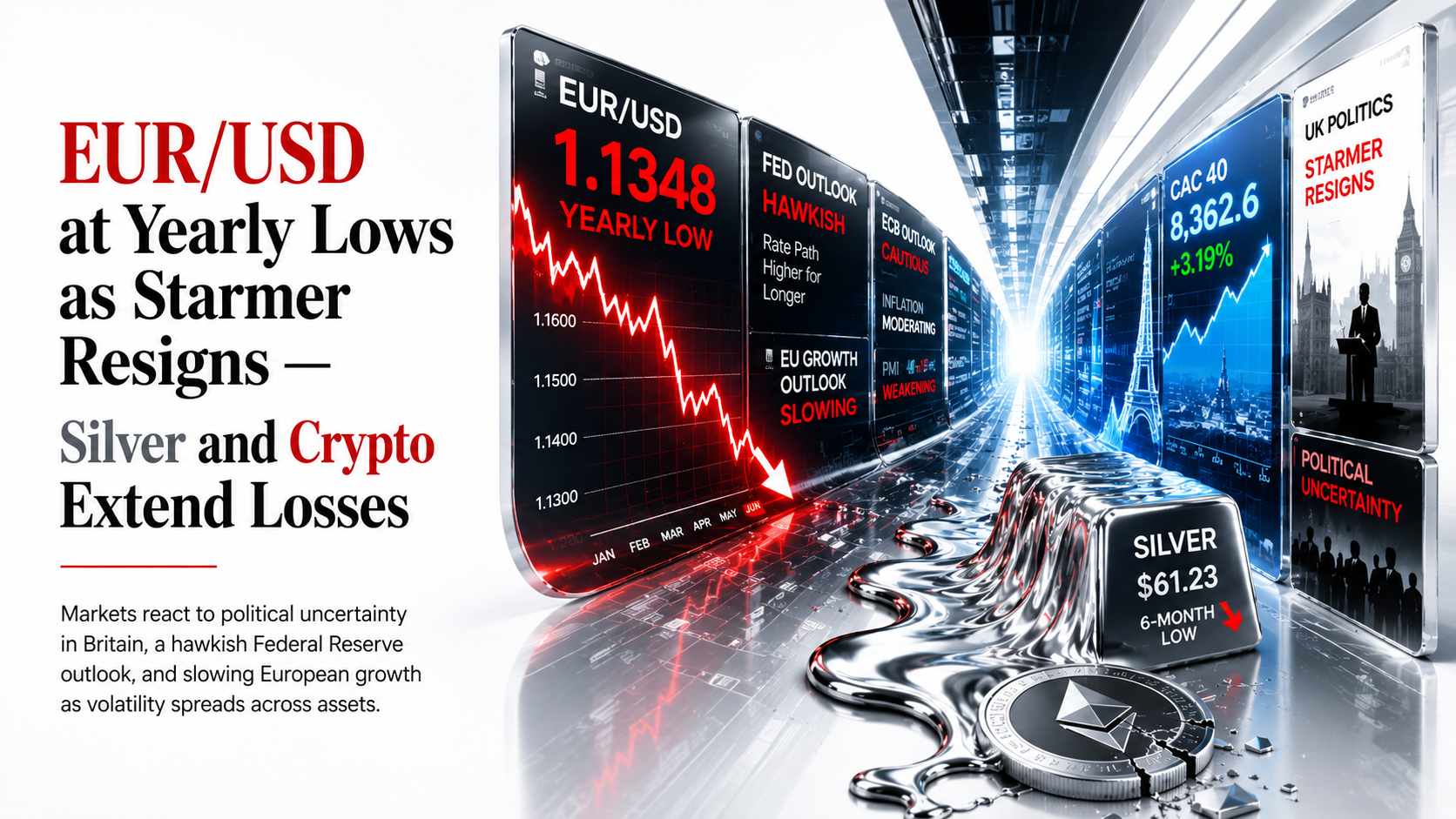
EUR/USD Slides to ~1.1348 Yearly Lows as Starmer Falls — CAC 40 Rallies While Silver and Ethereum Sink
Wednesday’s European session opens to a continent navigating simultaneous political and macro turbulence: the United Kingdom’s seventh prime minister in a decade is now effectively a lame duck after Keir Starmer’s formal resignation, the euro is printing yearly lows against the dollar near 1.1348, and silver — the session’s most stressed commodity — is consolidating near six-month lows of $61.23/oz as hawkish Federal Reserve repricing meets a spillover from Tuesday’s savage tech rout on Wall Street, which saw the Nasdaq 100 fall 3.3% and the S&P 500 slide 1.4%.
The defining macro driver is the widening policy divergence between the Fed and the ECB. While the European Central Bank raised rates by 25 basis points on 11 June — its first hike since 2023, lifting the deposit facility rate to 2.25% — ECB President Christine Lagarde has since struck a notably cautious tone, flagging that the inflation impact from the Middle East energy shock is “large, but not yet large enough” to alter long-term expectations, and that the ECB does not need to “respond more aggressively.” Markets have consequently pared back ECB tightening bets, creating the inverse dynamic from the Fed side, where Bank of America now pencils in three additional 25bp hikes (September, October, December) following a hawkish Fed dot plot. That divergence — more Fed tightening priced, less ECB tightening priced — is the primary mechanical driver pushing EUR/USD to its lowest level since June 2025.
In the UK, Starmer’s resignation after Andy Burnham’s decisive Makerfield by-election victory creates a political vacuum that is so far being navigated with surprising calm by sterling markets, partly because Burnham has been on an aggressive charm offensive with bond investors and partly because the handover timetable — new leader by September — is seen as orderly. EUR/GBP sits near 0.8605, with GBP held back by a weaker-than-expected Flash PMI (composite 49.4, a 14-month low) and uncertainty about whether Burnham’s fiscal views will ultimately tighten or loosen UK gilt conditions. The gas market reflects conflicting pressures: EU TTF hovers near €42.5/MWh as progress in US-Iran talks battles a structurally deficient storage picture — at 45.56% fill vs. a five-year average above 50% — and heatwave-driven cooling demand across France and Germany.
European Session Headlines — 24 June 2026
Live market-moving events as Europe navigates UK political upheaval, EUR/USD yearly lows, a silver rout, and the week’s critical PCE data approaching
CAC 40 Outperforms as Europe Splits — French Index Rises While UK Political Vacuum and German PMI Slump Weigh on Peers
The most striking intra-European market divergence on Wednesday is the CAC 40’s relative outperformance: France’s blue-chip index trades up +3.19% near 8,362.6, materially outpacing a cautious Stoxx 600 (roughly flat) and recovering from Tuesday’s Wall Street-led rout. The CAC’s resilience reflects its composition advantage in today’s specific macro context: the index is heavily weighted toward luxury goods (LVMH, Hermès, Kering) and aerospace and defence names (Airbus, Safran, Thales) — sectors that are relatively insulated from either UK political uncertainty or the ECB-versus-Fed rate divergence that is battering the euro. Luxury goods companies derive the bulk of their revenues in USD and Asian currencies, meaning EUR weakness is actually a margin tailwind. Defence names benefit from a structural European rearmament budget that is decoupled from short-term rate moves.
The contrast with Germany’s macro picture is instructive even as the DAX also rises (+1.43% today, recovering from prior losses): German flash PMI showed the fastest contraction since 2024, driven by industrial weakness and the lingering energy cost drag from gas prices that, at €42.5/MWh, remain well above pre-Iran-conflict levels. The CAC’s resilience vs. Germany’s fundamental challenge mirrors the France-Germany electricity price differential noted by IEEFA — French nuclear power insulates France from TTF gas spikes in a way that energy-intensive German industry cannot replicate. For European traders, the message is clear: within a broadly cautious European market, France is the current relative-value outperformer, and the CAC 40 is the cleanest way to express that view.
European Session Economic Calendar — 24 June 2026
Key data releases and events shaping price action across London, Frankfurt, Paris and Brussels today through Thursday’s PCE
| Time (BST / CET) | Event | Actual / Expected | Impact | Market Read |
|---|---|---|---|---|
| 🇬🇧All Session | UK Political Transition — Starmer Caretaker, Burnham Frontrunner | Nominations open 9 Jul; new leader by Sep | 🔴 HIGH | GBP contained ~1.3200; EUR/GBP ~0.8605; gilts benefiting from orderly handover narrative |
| 🇬🇧Today AM | UK Flash PMI Composite — June (S&P Global) | 49.4 (vs 49.7 prior); 14-month low | 🔴 HIGH | Second consecutive sub-50 reading; GBP/USD caps upside; EUR/GBP floor holds near 0.8550 |
| 🇪🇺Today AM | Eurozone Flash PMI — June (S&P Global) | Manufacturing below 50; Services contracting | 🔴 HIGH | Germany contracting fastest since 2024; EUR/USD bears reinforced; ECB patience validated |
| 🇪🇺Today | ECB President Lagarde — Ongoing Communications | Not need to “respond more aggressively” | 🔴 HIGH | Pares ECB hike bets; EUR bearish; 10Y EU yield easing modestly; EUR/USD cap at 1.1580 |
| 🇬🇧Today 9:30 BST | North Sea Oil & Gas Westminster Hall Debate | Bradley Thomas MP leads; 9:30–11:00 BST | 🔌 LOW | Energy policy focus; National Grid regulatory watch; limited direct FX impact expected |
| 🇺🇸Thu IST eve | US PCE Price Index (Core) — May | Key Fed inflation gauge; 3 hikes now priced | 🔴 CRITICAL | Hot → EUR/USD toward 1.1200, Silver below $58, ETH sub-$1,500; Cool → sharp short squeeze |
| 🇺🇸Ongoing | US-Iran Technical Talks — Switzerland/Geneva | 60-day roadmap agreed; fragile progress | 🔴 HIGH | TTF gas sensitive to any Hormuz re-closure signal; Brent ~$75 if deal solidifies |
| 🇪🇺This week | EU Gas Storage Weekly Update (GIE) | ~45.56% full; 14% below 5yr average | 🟢 MED | Structural bullish floor for TTF; any injection shortfall widens premium vs. seasonal norm |
European Session Trade Ideas — 24 June 2026
Nine structured setups — EUR/USD, EUR/GBP, Silver, Natural Gas, CAC 40, National Grid, EU 10Y, Ethereum, Litecoin — with live prices, levels, and full fundamental and technical analysis

Fundamental Backdrop
EUR/USD sits at its lowest level since June 2025, near 1.1348, caught between two clearly diverging monetary policy trajectories. On the US side, Bank of America has issued a hawkish pivot — forecasting three additional 25bp Fed hikes in September, October, and December 2026 — while the Fed’s June dot plot showed 9 of 19 members projecting at least one further hike. DXY is near 13-month highs around 101.20. On the European side, ECB President Lagarde has signalled that the central bank does not need to respond “more aggressively” to Middle East energy-driven inflation, a notably dovish framing given that the ECB’s June 11 hike to 2.25% was its first since 2023. The ECB revised its 2026 inflation forecast to 3.0% but simultaneously lowered GDP growth forecasts to 0.8%, creating a stagflationary trap that limits the scope for aggressive tightening. The eurozone Flash PMI confirmed Germany contracting at its fastest pace since 2024. Until either the Fed signals a pause or the ECB shifts to a more hawkish footing, the rate differential is structurally EUR-bearish.
Technical Outlook
The pair trades well below the 200-period SMA on the 4-hour chart, with MACD in negative territory and RSI hovering near 38 — classic conditions for continuation with occasional relief rallies. The key resistance zone is 1.1475–1.1500, which was prior support that became resistance on the breakdown; that is the sell zone. The 1.1575–1.1580 horizontal breakpoint is the next layer of supply. Stop above 1.1600 captures the risk of a sharp PCE-driven reversal. The 1.1100 target corresponds to the late-2024 range lows and aligns with a measured move from the recent breakdown. Thursday’s PCE is the critical binary event: a hot print accelerates the downside; a cool print triggers the counter-squeeze.
Session Catalysts
Watch: (1) Thursday’s US PCE — the week’s defining number for EUR/USD direction; (2) any ECB speaker comments that push back against Lagarde’s cautious framing; (3) DXY trajectory around 101.50 — a sustained break higher adds momentum to EUR/USD downside; (4) Eurozone PMI final readings; (5) US-Iran deal fragility — any Hormuz re-closure signal would spike energy prices and potentially re-price ECB hike odds higher, providing a temporary EUR floor. Do not chase the pair below 1.1300 without fresh Fed catalyst.

Fundamental Backdrop
EUR/GBP is a cross defined by two different sets of headwinds on each leg, making this a tactical rather than strategic position. The euro faces the Fed-ECB divergence described above — a structurally bearish driver. Sterling is being capped by the UK political transition (Starmer resignation, Burnham frontrunner), a weak Flash PMI composite of 49.4 (14-month low), and the IMF’s warning that the UK faces the biggest growth hit from the Iran war of any major economy. However, UK gilts are rallying and Burnham’s fiscal pragmatism signals are reassuring bond markets — that gilt bid is relatively GBP-positive, preventing a sharp sterling slide. The net result: EUR is more structurally pressured than GBP, creating a mild tactical case for selling EUR/GBP rallies. Conviction is lower here than EUR/USD, given both legs are under independent pressure.
Technical Outlook
EUR/GBP has oscillated between roughly 0.8540 and 0.8720 over the past month. Current levels near 0.8605 sit in the middle of that range, having peaked when Starmer’s resignation was most uncertain and now drifting as orderly transition removes the worst-case GBP tail. A rally to 0.8680 — the mid-range resistance — is the sell zone, with a stop above 0.8750, which captures the extreme GBP-bearish scenario of a contested Labour leadership battle that unnerves gilt markets. Target of 0.8480 corresponds to early-June support before UK political uncertainty first escalated. The risk is that Burnham surprises the market with a significantly looser fiscal stance, triggering a gilt sell-off that spills into GBP weakness and a EUR/GBP spike back above 0.8750.
Session Catalysts
Watch: (1) Any Burnham fiscal policy comments — the most important EUR/GBP swing variable this week; (2) UK CPI data later this month — BoE rate expectations are a key GBP anchor; (3) BoE speaker comments on the rate path; (4) Eurozone PMI final data vs. UK PMI comparison — the growth differential between the two economies is the structural driver; (5) US PCE (Thursday) — a hot print lifts DXY and disproportionately weakens EUR vs. GBP since EUR/USD is the primary USD vehicle. Size conservatively; this cross is a lower-conviction tactical trade vs. the directional EUR/USD short.

Fundamental Backdrop
Silver’s slide toward $61.23/oz from January’s extraordinary ~$121/oz all-time high represents a more-than-50% correction driven by two structurally adverse developments. First, hawkish Federal Reserve pricing — with 9 of 19 FOMC members now projecting at least one additional hike and Bank of America calling for three more — pushes real yields higher, directly raising the opportunity cost of holding non-yielding silver. Second, the Iran 60-day oil licence has reduced the inflation-fear premium that drove silver’s January run, as easing energy prices compress the commodity inflation narrative. Tuesday’s tech-driven Nasdaq rout (–3.3%) added a third, tactical channel: portfolio managers liquidating silver and gold to offset technology equity losses. Silver’s dual nature as both monetary asset and industrial commodity makes it acutely sensitive to the current mix: monetary headwinds from rate expectations weigh on its financial leg, while the European industrial slump (Germany PMI contracting fastest since 2024) dims its industrial leg.
Technical Outlook
Silver has broken through multiple support levels since January’s peak, with the move from $66.42 Monday to $61.23 Wednesday representing a sharp 8% decline in 48 hours. Current levels sit near the December 2025 / pre-conflict range, meaning any close below $60 would technically complete a full conflict-premium unwind. Resistance is at $63.50 (immediate), then $66.42 (Monday high) and the key $66–68 supply zone above. Support is $60 (psychologically important), then the $56–57 area which corresponds to mid-2025 lows. Thursday’s PCE is the critical swing catalyst: a hot reading accelerates the selloff toward $58–56; a cool reading could produce a violent short squeeze given how stretched short positioning has likely become.
Session Catalysts
Watch: (1) Thursday US PCE — the most direct catalyst for a silver directional break; (2) EU TTF gas trajectory — any Hormuz re-closure signal restores inflation premium, benefiting silver; (3) US Treasury 10-year yield — a move above 4.60% would extend the real-yield headwind on silver; (4) Nasdaq recovery or extension — if tech stabilises Wednesday, some portfolio rebalancing back into silver is possible and could produce a relief bounce; (5) DXY — dollar strength above 102 adds mechanical commodity-price pressure. The base case is continued weakness with tactical bounces to sell.

Fundamental Backdrop
US Henry Hub gas is trading near $3.20/MMBtu, holding a range-bound posture as two structural forces offset each other. On the demand side, new Gulf Coast LNG export capacity continues to ramp toward full nameplate volumes, steadily pulling more domestic gas into the export pipeline and tightening the balance versus prior years. Hotter-than-normal summer temperatures across large swaths of the US are also lifting power-burn demand for air conditioning load. On the supply side, US production remains robust, with Marcellus, Haynesville, and Permian-associated gas output near record levels, and storage is tracking close to the five-year average — a far less stretched picture than other regional gas benchmarks. That balance keeps Henry Hub anchored in a comparatively narrow band, but the export-driven structural demand growth argues for a higher floor over time.
Technical Outlook
Henry Hub has traded in a choppy range through the spring, with rallies capped by ample production and dips supported by LNG-export-driven baseline demand. The current ~$3.20 level sits comfortably inside that range. The $2.85 buy level corresponds to a recent support zone tested multiple times this quarter. Stop at $2.65 captures the scenario where production growth outpaces export and cooling demand, pushing storage back above the seasonal average. Target at $3.75 is consistent with a renewed move toward the upper end of the 2026 trading band if LNG export ramp-up and a hot summer combine to draw down storage faster than expected. This is a tactical, range-trade setup with clear catalysts on both sides.
Session Catalysts
Watch: (1) Weekly EIA natural gas storage report — a larger-than-expected draw supports the bull case; (2) US LNG export terminal ramp-up updates — faster commissioning tightens domestic supply; (3) National Weather Service cooling-degree-day forecasts — an extended heat pattern lifts power-burn demand; (4) Weekly Baker Hughes rig count — a pickup in gas-directed drilling is the primary bearish supply risk; (5) Pipeline maintenance or freeze-off events — unplanned outages can produce sharp short-term spikes.

Fundamental Backdrop
The CAC 40’s +3.19% outperformance in the European session reflects a compositional advantage unique to France’s blue-chip index. LVMH, Hermès, Kering, and L’Oréal — which together represent a substantial weight in the CAC — derive the majority of their revenues in USD and Asian currencies, meaning a weaker euro is a direct margin tailwind rather than a headwind. Airbus, Safran, and Thales — the aerospace and defence contingent — are riding structural demand from European rearmament budgets that are essentially insulated from short-term rate moves, and Airbus in particular benefits from a backlog measured in years. This contrasts sharply with the German DAX’s more cyclical and energy-intensive composition, where manufacturing PMI contraction at the fastest pace since 2024 directly maps to earnings risk. The CAC also benefits from France’s nuclear-dominated electricity mix, which shields French industrial costs from the TTF gas spike that is eating German and Italian corporate margins.
Technical Outlook
The CAC 40 is trading around 8,362.6 within a 52-week range of 6,763–8,642. The index has rallied sharply off Tuesday’s Wall Street-led pullback, leaving 8,150 as the tactical buy-dip level that corresponds to a key support cluster and previous resistance-turned-support. Stop at 7,950 is below the recent range’s lower boundary; a close below 7,950 would signal a deeper corrective structure that would invalidate the bullish bias. Target at 8,500 is approximately midway between current levels and the 52-week high, and represents a continued reversion toward the pre-Iran-conflict highs in a scenario where peace talks progress allows a global risk appetite recovery. The most important near-term technical event is the response to Thursday’s US PCE: if the print is cool and global equities recover, the CAC could make fresh weekly highs.
Session Catalysts
Watch: (1) Thursday US PCE — a cool print and Nasdaq recovery directly supports CAC risk appetite; (2) Luxury goods sector tone from any management commentary or quarterly updates; (3) EUR/USD trajectory — paradoxically, further EUR weakness is mildly positive for the CAC’s luxury revenue translation; (4) EU energy policy developments — the North Sea debate in Westminster today and French nuclear output data; (5) Iran deal durability — a confirmed final framework meaningfully de-risks the energy cost burden on CAC industrials. Do not chase into strength above 8,450 without confirmation from US markets overnight.

Fundamental Backdrop
National Grid PLC trades near 1,226p, having retreated from its 52-week high of 1,428p. The stock faces a confluence of near-term headwinds: Deutsche Bank downgraded to “Hold” with a lowered target earlier in June, citing Q4 earnings that missed profit expectations due to US storm damage costs in New England and New York. In early June the company sought Ofgem approval for £4.5 billion of UK transmission investments — a structurally positive move for long-term regulated asset base growth, but one that highlights the heavy capital requirement the company is committed to. On 3 June, National Grid issued $750 million in 5.405% notes due 2036, suggesting the company is locking in funding ahead of a potentially higher-rate environment. The structural bull case remains powerful: National Grid is the backbone of the UK’s electrification ambitions, and the AGM set for 14 July is a potential catalyst for updated guidance. The incoming Burnham government’s energy policy focus could be either a tailwind (increased transmission investment) or headwind (fiscal pressure limiting allowed returns) depending on regulatory stance.
Technical Outlook
At 1,226p, National Grid sits in the lower third of its 52-week range (1,000–1,428p), having ticked higher on bargain-hunting after the Deutsche Bank downgrade. The 1,205p level is the tactical entry on a pullback — it corresponds to a prior support cluster and is near the stock’s 200-day moving average. A close below 1,115p would represent a material breakdown and invalidate the bullish thesis; at that level the stock would be pricing in a regulatory settlement significantly below current Ofgem expectations or a major escalation in US storm-related losses. The 1,400p target is a return to the 52-week high area and the consensus analyst target range, supported by 8 Buy ratings against 2 Sells. The stock’s dividend yield provides a buffer — National Grid has maintained a scrip dividend reference price, and the 2025/26 final dividend is being processed, which provides income support at current levels.
Session Catalysts
Watch: (1) Today’s Westminster Hall debate on North Sea oil and gas (9:30–11:00 BST) — energy policy signals from MPs could colour the regulatory backdrop for National Grid; (2) Burnham government fiscal stance — any relaxation of capital spending limits would be structurally positive for NG’s regulated asset base growth; (3) Ofgem approval decision on the £4.5bn transmission investment request (expected this summer); (4) AGM on 14 July — watch for CEO commentary on Warsh-era interest rate outlook and its impact on the company’s US financing costs; (5) UK gilt yields — National Grid’s regulated return is benchmarked against gilt yields; a sustained rise in gilts above 5% would pressure allowed returns and the stock’s valuation model.

Fundamental Backdrop
The GDP-weighted EU 10-year sovereign bond yield sits near 3.36%, having eased approximately 0.15 percentage points over the past month even as the ECB raised rates in June — a counterintuitive move explained by two factors: first, Lagarde’s cautious rhetoric signals the ECB is in no hurry to hike again, reducing the “term premium” that markets might otherwise demand; second, the Eurozone’s weak PMI data (Germany contracting fastest since 2024, Eurozone composite below 50) increases the probability that the next ECB move could eventually be a cut rather than another hike. The ECB’s June staff projections forecast headline inflation at 3.0% in 2026 but 2.3% in 2027 and 2.0% in 2028, suggesting the central bank believes inflation is transitory-enough to warrant restraint. EU bonds additionally benefit from safe-haven demand as a hedge against equity volatility — Tuesday’s Nasdaq selloff sent capital into both US Treasuries and EU Bunds, compressing yields.
Technical Outlook
The EU 10Y yield’s recent trajectory — peaking during the peak of Middle East conflict uncertainty near 3.55–3.60%, then easing back — suggests a market increasingly pricing the scenario where ECB hikes are one-and-done. The 3.48% level is a tactical entry for bond buyers (yield sellers): it represents the midpoint of the recent range and is where the yield has consistently met supply from bond bears. Stop at 3.58% — a break through that level would imply the market has fundamentally repriced ECB tightening expectations higher, likely on a hotter PCE print that spills into global yield repricing. Target at 3.15% aligns with pre-conflict Eurozone yield levels and would represent a return to normalcy as the Iran deal solidifies and energy inflation fades through H2 2026.
Session Catalysts
Watch: (1) Thursday PCE — a cool reading is the clearest trigger for an EU yield rally (price rise, yield fall) as it reduces global rate-hike expectations; (2) ECB speaker comments post-Lagarde — any push back against her dovish framing would be yield-bearish for bonds; (3) Eurozone CPI flash estimates — any downside surprise would reinforce the “ECB done” thesis and compress yields; (4) German Bund auction results — a weak auction signals demand concerns; (5) US Treasury yield trajectory — EU yields closely track US yields, so any UST rally post-PCE pulls EU yields lower in tandem. The core thesis is that the ECB is more likely to pause than hike again, creating a bond-friendly environment even at elevated energy prices.

Fundamental Backdrop
Ethereum trades near $1,668, having bounced modestly from approximately $1,650 as Tuesday’s Nasdaq -3.3% tech rout established a clear risk-off pattern in digital assets that has only partially eased. The ETH/USD correlation with Nasdaq100 has been notably tight during this cycle: when the AI-driven equity rally was lifting Nasdaq to record highs, ETH was also benefiting from an indirect risk-appetite tailwind. The reversal of that dynamic — doubts about AI valuations combined with hawkish Fed repricing raising the discount rate on long-duration risk assets — hits ETH through both channels simultaneously. Institutional demand context is revealing: Bitmine Immersion Technologies disclosed holding 5.67 million ETH tokens as of 21 June, confirming large institutional positions exist, but these are long-term strategic holdings rather than near-term price catalysts. ETHConf 2026 in New York this week — co-hosted with Stratosphere, Pudgy Penguins, and Streamex — has generated developer buzz but minimal price-positive impetus in the current risk environment.
Technical Outlook
ETH has been in a sustained downtrend since the hawkish Fed repricing began in earnest after the 17 June meeting, with today’s bounce to $1,668 still well within that broader structure. The $1,800 level represents the most recent failed rally attempt and sits near the 50-period moving average on the 4-hour chart — an ideal sell zone for trend continuation. Stop at $1,970 captures the scenario where a cool PCE print Thursday triggers a sharp risk-on squeeze back toward the $2,000 psychological level. The $1,420 target corresponds to the pre-conflict range and represents the completion of the correction from February’s more elevated levels. Trading volumes near $6.4B daily suggest adequate liquidity but not the frenzied momentum that would accelerate either direction dramatically. The key observation for technicals: ETH has closed below its June 17 open on every session since the Fed meeting bar today’s modest bounce — a persistent distribution pattern.
Session Catalysts
Watch: (1) Thursday PCE — the single most important catalyst; a cool reading could trigger a 10–15% ETH squeeze within 24 hours; (2) Nasdaq Wednesday recovery — if US tech stabilises, some rebalancing back into ETH is possible, limiting downside; (3) Bitcoin price action — BTC has slightly outperformed ETH recently, and BTC breaking $80,000 resistance would create a crypto-wide risk appetite bid; (4) Any stablecoin regulatory developments from the Bank of England’s draft Code of Practice (published 22 June) — longer-term neutral to mildly constructive for ETH ecosystem; (5) Global equity sentiment — ETH is a high-beta risk proxy in the current regime. Size positions to accommodate PCE volatility.

Fundamental Backdrop
Litecoin is in its seventh consecutive week of decline, trading near $42.09 after a sharp 23.5% drop this session and having lost considerably more against ETH over the past 30 days — a performance gap that reveals LTC’s structural disadvantage in the current cycle. Litecoin lacks the institutional narrative that Bitcoin commands (ETF flows, corporate treasury holdings) and the technological ecosystem story that sustains Ethereum (DeFi, NFTs, Layer-2 scaling). It occupies an increasingly awkward middle ground: a decade-old proof-of-work blockchain with halving mechanics that have historically driven price cycles, but whose next halving is not sufficiently close to be a near-term catalyst. The data is unambiguous on institutional demand: DOGE futures open interest fell 10% in 24 hours, and broader mid-cap crypto segments have seen essentially zero institutional inflows this week, per ETHConf 2026 data. “Litecoin Whales Are Buying the Dip” headlines from 13 June have not translated to price support, and today’s fresh leg lower confirms whale accumulation at prior levels lacked the firepower to overcome macro headwinds.
Technical Outlook
LTC has been in a clear downtrend since early May, and today’s break decisively below the prior $50–55 support zone confirms trend continuation rather than the bull-trap recoveries seen earlier in the cycle. The $46 sell level corresponds to the underside of that broken support, now acting as resistance — the kiss-and-sell zone for trend continuation. Stop at $50 sits back inside the old range and is the level any genuine bullish reversal would need to reclaim to change the structure. The $34 target is the next visible support shelf below current levels and represents the completion of the current corrective sequence if the breakdown follows through. Note that LTC’s 24h trading volume of ~$210M is substantially lower than ETH’s $6.4B — thinner liquidity means larger percentage moves on smaller catalysts but also easier manipulation. LTC continues to lose the relative performance race against the broader crypto complex.
Session Catalysts
Watch: (1) Thursday PCE — a cool print produces a crypto-wide relief rally that would be the primary risk to any LTC short, requiring careful management around that event; (2) Bitcoin $80,000 — a clean BTC break higher creates the altcoin lift that temporarily reverses LTC’s underperformance; (3) Broader Nasdaq direction — LTC is a high-beta risk asset and will follow equity sentiment in the near term; (4) Any LTC-specific protocol development or exchange listing — the absence of such catalysts is itself a bearish fundamental signal; (5) DOGE or other competing mid-cap crypto momentum — if retail appetite shifts to competing assets, LTC loses even its speculative bid. The conviction level on the LTC short is high but PCE represents the must-watch binary risk event for position management.
Analyst Q&A — European Session
Technical and fundamental answers to the biggest questions driving price action in Wednesday’s European session
European Session Summary — 24 June 2026
Wednesday’s European session is defined by a classic risk-off-on-one-leg, uncertainty-on-the-other pattern. The macro setup is stark: EUR/USD sits at yearly lows near 1.1348 as the Fed-ECB policy gap widens — Bank of America calling for three additional Fed hikes vs. Lagarde signalling ECB caution. The UK has its seventh prime minister transition in a decade underway, yet markets are holding their nerve with gilts bid and GBP contained, reflecting both the orderly Burnham transition and the reality that structural UK challenges are well-known. Silver at $61.23 is the session’s most stressed asset, caught between Federal Reserve real-yield headwinds and the technical bleed from Tuesday’s tech selloff. CAC 40 at +3.19% is the surprising outperformer, its luxury-goods and defence composition insulating it from both the EUR/USD headwind and the energy-cost squeeze facing German industrials.
The actionable framework is clear. Highest-conviction trade: EUR/USD sell-rallies toward 1.1475, stop 1.1600, target 1.1100 — the Fed/ECB divergence is the dominant force in global FX and has not yet resolved. This is the session’s best risk-reward short.
In cross-rates, EUR/GBP sell-rallies toward 0.8680, stop 0.8750, target 0.8480 — EUR’s structural weakness outpaces GBP’s political noise, but size conservatively given both legs are under independent pressure. In commodities, Silver sell-rallies toward $63.50, stop $66.50, target $56.00 — the Fed real-yield channel is dominant and portfolio liquidation is accelerating the move lower. In energy, US Natural Gas (Henry Hub) buy-dips toward $2.85/MMBtu, stop $2.65, target $3.75 — rising LNG export demand and a hot summer cooling load provide a firming floor even as robust shale production caps the upside. In European equities, CAC 40 buy-dips toward 8,150, stop 7,950, target 8,500 — the index’s luxury and defence composition is the cleanest way to be long European equities in a weak-growth, high-energy environment. In UK equities, National Grid PLC (NG.L) tactical buy near 1,205p, stop 1,115p, target 1,400p — the UK electrification structural story is intact; the Deutsche Bank downgrade and near-term headwinds are creating a dip-buying opportunity ahead of the 14 July AGM. In fixed income, Buy EU bonds on yield spikes toward 3.48%, stop 3.58% yield, target 3.15% yield — ECB pause signals and weak Eurozone growth argue for yield compression. In digital assets, Ethereum sell-rallies toward $1,800, stop $1,970, target $1,420 — hawkish Fed discount rate and Nasdaq correlation make ETH a high-beta short in the current regime; and Litecoin sell-rallies toward $46, stop $50, target $34 — the seven-week losing streak, absent institutional bid, and structural mid-cap crypto weakness make LTC the highest-conviction crypto short in the session. The week’s pivotal event remains Thursday’s US PCE: it is the binary that determines whether EUR/USD accelerates below 1.12 or squeezes back to 1.15, whether silver breaks $58 or rallies to $66, and whether Ethereum finds $1,400 or $2,000 first.
Access Live European Markets →