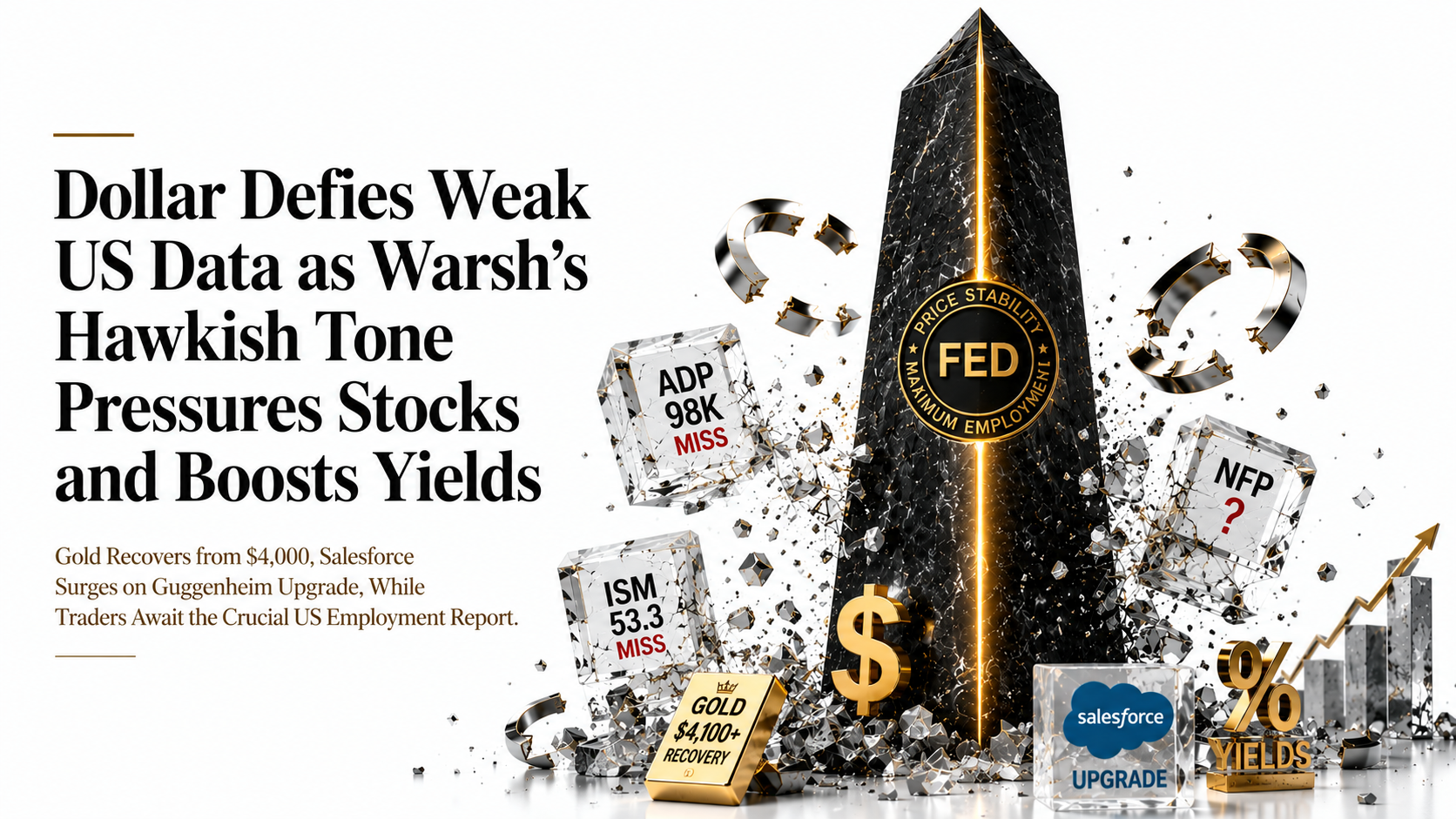
Warsh Declines to Give Forward Guidance at Sintra as S&P 500 Ekes Out a Fresh Record · Meta Surges on Cloud-Compute Pivot, Slamming Chipmakers & AI-Infra Miners · Salesforce Jumps on Guggenheim Upgrade · Gold Rebounds Toward $4,100 — S&P 500 ~7,508.51, US 10Y ~4.50%, WTI ~$68.32 | Technical Analysis US | 1 July 2026
Dollar and Yields Hold Firm as Warsh Reaffirms “Prices Are Too High” at Sintra —
Wall Street Slips Off Record Highs Despite Soft ADP & ISM Misses; Salesforce Jumps on Guggenheim Upgrade as Gold Rebounds Off $4,000
Wall Street opens the third quarter digesting a genuinely mixed data picture — soft ADP and ISM prints that would normally ease hawkish Fed bets, delivered on the same morning new Fed Chair Kevin Warsh told Sintra that inflation remains “too high,” leaving the dollar, yields and risk assets to decide which signal actually matters into Thursday’s early jobs report.
US equities are pulling back modestly from Tuesday’s record closes, with the S&P 500 easing roughly 0.2% to trade near 7,484.30 after finishing Tuesday at an all-time closing high of 7,499.36 — a close that capped the index’s best quarterly performance (+14.9%) since the second quarter of 2020, alongside a roughly 20% quarterly surge for the Nasdaq and a 12% gain for the Dow. The pullback comes despite two notable data misses: ADP reported June private payrolls rose just 98,000 versus a 118,000 consensus, the weakest reading in months, while the ISM Manufacturing PMI printed 53.3 against a 54.0 estimate, both consistent with a cooling — not overheating — economy. Yet new Fed Chair Kevin Warsh, making his first international public appearance since chairing his debut FOMC meeting in June, told Wednesday’s Sintra panel that policymakers have “looked around” and concluded “prices are too high,” reaffirming the Fed’s commitment to 2% inflation as “strong, unanimous and unambiguous” while continuing to withhold explicit forward guidance on the next rate move. That hawkish framing is keeping the US 10-year Treasury yield elevated near 4.47%, little changed from Tuesday’s sharp climb, with markets pricing a roughly one-in-three chance of a July hike and continuing to build in September tightening risk ahead of Thursday’s early nonfarm payrolls release, moved a day forward for Friday’s Independence Day market closure.
The dollar’s resilience in the face of soft data is showing up clearly across FX: USD/CAD is holding near 1.4204, consolidating just below Wednesday’s one-year high near 1.4230, as the Canadian dollar remains the weakest G10 currency amid a deteriorating Canada-US growth and yield-spread picture and falling gold prices, a newly important driver for the loonie. USD/CHF is holding firm near 0.8085 as the broad dollar bid outweighs the franc’s traditional safe-haven bid. In commodities, gold has rebounded off the psychological $4,000 level to trade near $4,100.78, though it remains on track for its worst quarterly performance since 2013, as elevated yields and a firm dollar continue to cap the non-yielding metal’s bounce even as OCBC and other desks maintain a constructive long-term structural view. WTI crude has slipped to near $68.76 after its steepest quarterly decline since 2020, with indirect, technical-level talks between US and Iranian officials continuing in Doha through Qatari and Pakistani mediators — Witkoff and Kushner are not directly participating in Wednesday’s session, and Iran has not received the $6 billion in frozen funds it is seeking, keeping a two-way risk premium alive in the barrel. In single-stock news, Salesforce is the session’s standout gainer, up roughly 5% near $164.90 after Guggenheim upgraded the stock to Buy with a $228 price target, lifting ServiceNow in sympathy and offering the first real relief rally after a brutal year that had seen CRM shares fall as much as 55% from their all-time high. In crypto, Bitcoin is trading near $59,592, bouncing off oversold levels toward the $60,600 reclaim level after testing the $58,000 support shelf, while Cardano’s ADA has staged a sharp reversal off a fresh multi-year low near $0.132 to close near $0.1443, up roughly 7.8% on the day.
US Session Headlines
The stories driving price action across FX, rates, metals, energy, US equities and crypto this session
Warsh’s Sintra Debut Was Meant to Say Little — but Markets Are Reading Between Every Line
The defining story of Wednesday’s session is not the ADP miss, the ISM miss, or even Salesforce’s rally — it’s the tug-of-war between soft incoming data and a Fed chair who has made clear he intends to keep talking tough regardless. Kevin Warsh has explicitly told markets “we’ve dropped forward guidance,” meaning every word he chooses at events like Sintra now carries outsized weight precisely because there’s so little else to go on. His comment that policymakers have “looked around” and concluded “prices are too high” landed on the same morning that two separate data points — ADP payrolls and the ISM Manufacturing PMI — both missed to the downside, a combination that would ordinarily argue for a more dovish read.
That the dollar and Treasury yields shrugged off the misses and held firm is itself the signal: markets are choosing to weight Warsh’s rhetoric and Tuesday’s strong JOLTS report over Wednesday’s softer prints, at least for now. With Thursday’s early nonfarm payrolls report standing as the week’s most consequential release — moved forward a day for Friday’s Independence Day closure — today’s price action across the dollar, yields, gold and equities looks less like a settled verdict and more like a market waiting for one more data point before committing to a direction into the second half of 2026.
US Session Economic Calendar — 1 July 2026
Key releases and events shaping price action across today’s US session and into Thursday
| Time (ET) | Event | Actual / Expected | Impact | Market Read |
|---|---|---|---|---|
| 🇺🇸8:15am | ADP National Employment Report (June) | +98K actual vs. +118K expected, prior +109K | 🔴 CRITICAL | A clear miss that should argue for a softer Fed, but dollar and yields held firm |
| 🇪🇺🇺🇸🇬🇧🇨🇦9:00am | Sintra Panel: Warsh, Lagarde, Bailey & Macklem | Warsh: “prices are too high”; declines to hint at July decision | 🔴 CRITICAL | Hawkish tone reinforces dollar and yield strength into Thursday’s NFP |
| 🇺🇸10:00am | ISM Manufacturing PMI (June) | 53.3 actual vs. 54.0 expected, prior 54.0 | 🔴 CRITICAL | Second consecutive soft print; still in expansion but momentum cooling |
| 🇺🇸10:30am | EIA Weekly Crude Oil Inventories | Markets watching for confirmation of the supply-normalisation trend | 🟢 MED | A large build would reinforce the oversupply narrative pressuring WTI |
| 🇺🇸Ongoing | US-Iran Technical Talks in Doha | Indirect talks via Qatari/Pakistani mediators; Witkoff, Kushner not participating today | 🔴 CRITICAL | No breakthrough yet on frozen funds or Hormuz management; two-way oil risk stays live |
| 🇺🇸Thu, 2 July | US June Nonfarm Payrolls & Unemployment Rate | Cons. +110K jobs, unemployment steady at 4.3%; moved a day earlier for July 4 | 🔴 CRITICAL | The week’s decisive catalyst for the dollar, yields and Fed pricing |
| 🇺🇸Fri, 3 July | US Markets Closed — Independence Day | Thin holiday liquidity expected into the weekend | ⚪ LOW | Positioning into Thursday’s payrolls likely to be squared ahead of the closure |
US Session Trade Ideas — 1 July 2026
Nine structured setups — USD/CAD, USD/CHF, Gold, Crude Oil, S&P 500, Salesforce, US 10Y Treasury Yield, Bitcoin, Cardano — with live prices, levels, and full fundamental and technical analysis
USD/CAD

Fundamental Backdrop
USD/CAD is holding near 1.4204, just below Wednesday’s one-year high near 1.4230, as the Canadian dollar remains the weakest G10 reserve currency, weighed down by a deteriorating Canada-US growth and yield-spread picture and a newly dominant negative correlation with falling gold prices, which have overtaken oil as the more relevant marginal driver of loonie weakness. The Bank of Canada held its policy rate at 2.25% at its last meeting and flagged risks on both sides of its mandate, while the Fed’s Kevin Warsh reaffirmed a hawkish inflation-fighting stance at Sintra Wednesday, widening the policy-divergence narrative that has pushed the pair to its highest level in about a year.
Technical Outlook
USD/CAD is trending higher within a well-defined channel off May’s lows, with today’s mixed ADP/ISM misses doing little to dent the broader uptrend given the dollar’s resilience elsewhere. Resistance: 1.4230 (Wednesday’s one-year high) and 1.4390 (target, next round-number extension). Support: 1.4150 (preferred buy-dip level, near recent consolidation) and 1.4080 (stop, below the rising trendline). A National Bank of Canada research note flags a sustained loonie recovery would likely require Ottawa to secure a trade accord with Washington, a catalyst not yet on the near-term horizon, keeping the structural bias tilted toward further USD/CAD strength on dips.
Session Catalysts
Watch for: (1) Thursday’s early US jobs report and its read-through for Fed policy divergence; (2) further gold-price weakness, given the metal’s strengthening correlation with the loonie; (3) any Bank of Canada commentary on trade or tariff risk; (4) US 10-year yield direction; (5) broad dollar index (DXY) momentum.
USD/CHF

Fundamental Backdrop
USD/CHF is holding firm above 0.8080 as the same dollar strength lifting USD/CAD and pressuring EUR/USD and gold plays out here too, with Warsh’s hawkish Sintra tone and elevated Treasury yields outweighing the Swiss franc’s usual safe-haven characteristics for now. The Swiss National Bank’s mandate to keep CPI inflation below 2% has left it with comparatively little room to react to franc strength, and with US-Iran talks remaining indirect and technical rather than escalating, the geopolitical trigger that would typically drive a flight to the franc has been largely absent from Wednesday’s price action.
Technical Outlook
The pair is grinding higher within a shallow uptrend that began in June, mirroring the broader dollar bid rather than any franc-specific weakness. Resistance: 0.8120 (near-term) and 0.8180 (target, the next meaningful supply zone). Support: 0.8040 (preferred buy-dip level) and 0.7985 (stop, below the base of the recent range). The setup favours buying dips while the dollar holds the upper hand, but traders should stay alert to headline risk from either the Doha talks or a surprise dovish pivot from Warsh, either of which could quickly flip the pair back toward franc strength.
Session Catalysts
Watch for: (1) Thursday’s early US jobs report; (2) any escalation or breakdown in the Doha technical talks, which would likely favour the franc; (3) further commentary from Warsh or other Fed officials; (4) broad dollar index momentum; (5) Swiss economic data releases later in the week.
Gold (XAU/USD)

Fundamental Backdrop
Gold is trading near $4,100.78 an ounce, rebounding off an earlier slide toward $4,000 but still down sharply from its January all-time high above $5,600 and on pace for its worst quarterly loss since 2013, as a combination of hawkish Fed rhetoric from new Chair Kevin Warsh and elevated Treasury yields near 4.47% continues to cap the bounce in the non-yielding metal. Tuesday’s JOLTS report showing a two-year high in job openings had already reinforced the resilient-economy narrative before Wednesday’s ADP and ISM misses complicated the picture; CME data show markets assigning roughly a two-thirds probability the Fed holds rates steady in July, with a September hike increasingly priced. OCBC Bank expects gold to resume its decline through year-end on rising yields and dollar strength, even while maintaining a constructive long-term structural thesis tied to de-globalization and central-bank buying.
Technical Outlook
Gold remains below its descending trendline from January’s record high, with technical indicators on Investing.com currently rating the metal a “Strong Sell” on a daily basis even as today’s bounce off $4,000 looks technically significant on a short-term basis. Resistance: $4,150 (preferred sell-rally level, near recent consolidation) and $4,205 (stop, above the base of last week’s failed bounce). Support: $4,000 (key psychological level, and the base of today’s bounce) and $3,900 (target, near the lower boundary of the metal’s recent multi-week range). The setup favours fading rallies given the dominant macro backdrop, though traders should size conservatively given gold’s history of sharp reversals around major US data surprises.
Session Catalysts
Watch for: (1) Thursday’s early nonfarm payrolls report; (2) any further Warsh or FOMC commentary; (3) US 10-year yield direction; (4) the dollar index, given gold’s inverse dollar sensitivity; (5) any escalation in the Doha talks that could revive safe-haven demand.
Crude Oil (WTI)

Fundamental Backdrop
WTI crude is holding a tight $68.50–69.70 range as indirect, technical-level talks between US and Iranian officials continue in Doha through Qatari and Pakistani mediators, following Tuesday’s meeting between envoys Steve Witkoff and Jared Kushner and Qatar’s prime minister. Neither envoy is participating in Wednesday’s session, and Qatar’s foreign ministry has confirmed $6 billion in frozen Iranian funds has not been released, keeping key issues — including future management of the Strait of Hormuz — unresolved. A senior US official described the talks as showing “progress,” while Iran’s chief negotiator noted the country has already exported more than 40 million barrels since the naval blockade lifted, underscoring the supply-normalisation backdrop that drove both WTI and Brent to their steepest quarterly declines in years.
Technical Outlook
Crude remains rangebound between $68 and $70, well off its conflict-era highs above $120, as the market weighs a still-bearish supply picture against the binary, headline-driven risk of the Doha talks. Resistance: $73.00 (preferred sell-rally level, near recent consolidation) and $75.50 (stop, above last month’s bounce high). Support: $68.50–$68.99 (Fibonacci confluence zone) and $67.00 (target, near the measured-move swing low). The setup still favours fading rallies given the underlying supply-glut backdrop, but traders should size conservatively given how quickly a breakdown in talks could spike prices.
Session Catalysts
Watch for: (1) any concrete progress or breakdown in the Doha technical talks; (2) today’s 10:30am ET EIA crude inventory data; (3) further Gulf tanker-loading and Strait of Hormuz traffic data; (4) the dollar index, given crude’s inverse dollar sensitivity; (5) any fresh Trump administration commentary on Iran policy.
S&P 500

Fundamental Backdrop
The S&P 500 is easing roughly 0.2% to near 7,484.30 after closing Tuesday at an all-time high of 7,499.36, a session that capped the index’s strongest quarterly performance (+14.9%) since the second quarter of 2020, alongside a roughly 20% quarterly surge for the Nasdaq and a 12% gain for the Dow. Wednesday’s pullback comes despite — not because of — softer ADP and ISM data, with investors instead focused on new Fed Chair Kevin Warsh’s hawkish Sintra remarks and elevated Treasury yields. Chipmakers and AI names, which powered much of Tuesday’s advance, are giving back a portion of those gains, while Salesforce and ServiceNow stand out as gainers on the Guggenheim upgrade. Goldman Sachs’ John Flood has argued the broader trend remains higher and dips still present buying opportunities, with retail investors the most consistent buyers of 2026.
Technical Outlook
The index remains in a well-established uptrend following its historic second-quarter rally, with Wednesday’s pullback so far looking like routine quarter-end profit-taking rather than a trend change. Resistance: 7,499–7,510 (Tuesday’s record-high zone) and 7,600 (target, next round-number extension). Support: 7,420 (preferred buy-dip level, near the base of this week’s range) and 7,370 (stop, below the rising 50-day trendline). The setup favours buying dips while the structural uptrend remains intact, though a hot Thursday jobs report combined with continued hawkish Fed rhetoric could extend near-term weakness.
Session Catalysts
Watch for: (1) Thursday’s early nonfarm payrolls report; (2) further commentary from Warsh or other Fed officials; (3) continued follow-through (or fade) in AI and chipmaker names; (4) the 10-year Treasury yield; (5) any single-stock catalysts, including further analyst upgrades or downgrades.
Salesforce, Inc. (CRM)

Fundamental Backdrop
Salesforce shares are up roughly 5% near $164.90 after Guggenheim upgraded the stock to Buy from Neutral with a $228 price target, with ServiceNow rallying more than 5% on the same note in sympathy. The move offers a rare bright spot after a punishing stretch that had seen CRM fall as much as 55% from its all-time high on investor skepticism about the pace and payoff of its Agentforce AI strategy, punctuated by a string of acquisitions including the recently announced $3.6 billion purchase of AI customer-service platform Fin. GuruFocus data show the stock trading at roughly 18x trailing earnings versus a five-year median multiple above 75x, with a GF Value estimate implying more than 50% undervaluation at Tuesday’s close, even as rival analysts including Phillip Securities remain more cautious on legacy SaaS growth.
Technical Outlook
CRM is breaking out of a multi-month basing pattern near $155–158 on the upgrade-driven gap, though the stock remains well below its 200-day moving average and near the bottom of its 52-week range ($146.32–$276.80), reflecting the scale of its 2026 decline. Resistance: $170 (near-term) and $185 (target, next meaningful supply zone from April’s failed bounce). Support: $158 (preferred buy-dip level, near today’s gap-up base) and $150 (stop, below the 52-week low zone). The setup favours buying dips on continued upgrade momentum, but the deeply damaged longer-term trend argues for disciplined position sizing.
Session Catalysts
Watch for: (1) any follow-through analyst commentary after the Guggenheim upgrade; (2) broader AI-software sentiment, given the read-through to ServiceNow and peers; (3) further news on the Fin and Informatica integrations; (4) the S&P 500’s own trend, given CRM’s index weight; (5) any updates on the reported Anthropic Claude/Slackbot competitive dynamic flagged by employees.
US 10Y Treasury Yield

Fundamental Backdrop
The 10-year Treasury yield is holding near 4.47%, little changed after Tuesday’s near-10-basis-point climb, which itself followed a rebound from last week’s seven-week low near 4.37%. Wednesday’s ADP and ISM misses have not dislodged the hawkish narrative set by new Fed Chair Kevin Warsh’s Sintra remarks, in which he reaffirmed that “prices are too high” and that the Fed’s 2% commitment is “strong, unanimous, and unambiguous.” Warsh has also launched a task force reviewing the Fed’s balance sheet, which he has previously campaigned to shrink further — a policy lean that structurally favours higher term premia and yields. CME data show markets pricing roughly one-in-three odds of a July hike, building toward a more confident September call.
Technical Outlook
Yields are recovering within a rising channel off last week’s seven-week low, with today’s price action so far ignoring the softer data prints in favour of the Fed’s rhetorical hawkishness. Resistance: 4.50% (near-term ceiling) and 4.65% (target, the next meaningful level from earlier this year). Support: 4.40% (preferred buy-dip level) and 4.30% (stop, below the recent base). The setup favours buying yield dips (i.e., fading bond-price strength) while the hawkish narrative holds, but a soft Thursday payrolls print would likely reverse the move quickly given how stretched positioning has become around a single data release.
Session Catalysts
Watch for: (1) Thursday’s early nonfarm payrolls and unemployment rate; (2) any further Warsh, Bailey or Lagarde commentary out of Sintra; (3) the ISM Services PMI later this week; (4) any Fed balance-sheet task-force headlines; (5) equity-market risk appetite, given the inverse relationship between yields and rate-sensitive growth stocks.
Bitcoin (BTC/USD)

Fundamental Backdrop
Bitcoin is trading near $59,592, up roughly 2% on the session as it bounces off recent support near $58,000, even as a strong dollar and hawkish Fed policy — reinforced by Warsh’s Sintra remarks and a Supreme Court ruling preserving the Fed’s institutional independence late last week — continue to cap the broader relief in zero-yield assets. A wave of long liquidations totaling nearly $96 million over the past 24 hours had compounded selling pressure from over-leveraged positioning before today’s bounce. The immediate trigger for direction remains the July monthly close relative to the $60,000 level, with Thursday’s early jobs report standing as the next major macro catalyst for risk appetite broadly.
Technical Outlook
Bitcoin remains technically oversold on a medium-term basis even after today’s bounce off the $58,000 support area. Resistance: $60,600 (near-term reclaim level) and $61,500 (preferred sell-rally level, near the base of the prior range). Support: $58,000 (key shelf) and $57,000 (next zone if that breaks), with $55,000 the extended downside target. If $58,000 continues to hold, a period of consolidation between $58,000 and $60,600 is the more likely near-term outcome; a decisive reclaim of $60,600 would be the first real sign of a trend shift. The setup favours fading rallies into resistance given the still-bearish trend structure below key moving averages, though the extended oversold condition argues against aggressively chasing further weakness.
Session Catalysts
Watch for: (1) Thursday’s early US jobs report and its impact on dollar strength; (2) spot Bitcoin ETF flow data; (3) any slowdown in liquidation volume, which could signal selling exhaustion; (4) the dollar index and Treasury yields; (5) broader risk sentiment across equities.
Cardano (ADA/USD)

Fundamental Backdrop
Cardano’s ADA plunged to a fresh multi-year low near $0.132 intraday before staging a sharp reversal to close near $0.1443, up roughly 7.8% on the session — a classic capitulation-and-snapback pattern following last month’s wave of security incidents affecting Cardano-ecosystem projects and the cancellation of the flagship Cardano Summit. Santiment data showing active addresses at a four-month high and social dominance near a 2026 peak is consistent with the kind of oversold positioning that tends to precede sharp short-covering bounces. The broader crypto complex is finding some relief alongside Bitcoin’s own bounce, though the same firm-dollar, hawkish-Fed backdrop keeps a lid on how far the recovery can extend ahead of Thursday’s early jobs report.
Technical Outlook
ADA remains firmly below its 50-day and 200-day moving averages, both of which continue to slope down, meaning today’s sharp reversal candle is a short-term technical event within a still-bearish medium-term structure. Resistance: $0.150 (near-term, the former support-turned-resistance shelf) and $0.165 (target, the next meaningful supply zone). Support: $0.138 (preferred buy-dip level, above today’s low) and $0.128 (stop, below today’s $0.132 low). The setup favours a tactical bounce trade on dips while today’s reversal holds, but the deeply damaged longer-term trend argues against treating this as a confirmed bottom without further follow-through.
Session Catalysts
Watch for: (1) Thursday’s early US jobs report and its impact on broader risk appetite; (2) any further Cardano-ecosystem security developments; (3) progress on the Musashi Dojo/Leios testnet rollout; (4) Bitcoin’s own price action, given ADA’s high beta to broader crypto sentiment; (5) the dollar index and Treasury yields.
US Session FAQ — 1 July 2026
Answers to the questions traders are asking most about today’s US session
US Session Summary — Wednesday, 1 July 2026
Wednesday’s US session opens the third quarter with a genuine tug-of-war between softer incoming data and a Fed chair determined to keep talking tough: June ADP payrolls missed badly at 98,000 versus 118,000 expected, and the ISM Manufacturing PMI printed 53.3 against a 54.0 estimate, yet the dollar and Treasury yields held firm after new Fed Chair Kevin Warsh told Wednesday’s Sintra panel that “prices are too high.” Highest-conviction macro: buy US 10Y yield dips toward 4.40%, stop 4.30%, target 4.65% — Warsh’s hawkish tone is dominating over softer data for now, though Thursday’s early jobs report is the real decision point.
For the individual instruments: USD/CAD buy dips toward 1.4150, stop 1.4080, target 1.4390 — a firm dollar and falling gold, now a dominant loonie driver, both argue for continued USD/CAD strength. USD/CHF buy dips toward 0.8040, stop 0.7985, target 0.8180 — broad dollar strength outweighs the franc’s safe-haven pull while the Doha talks stay technical rather than escalatory. Gold sell rallies toward $4,150, stop $4,205, target $3,900 — today’s bounce off $4,000 is meeting hawkish-Fed, firm-dollar resistance even as the longer-term structural case remains intact. Crude oil sell rallies toward $73.00, stop $75.50, target $67.00 — the supply-normalisation narrative still dominates medium-term, but Doha remains a binary catalyst that could spike prices quickly. S&P 500 buy dips toward 7,420, stop 7,370, target 7,600 — the structural uptrend from the historic second-quarter rally remains intact despite today’s quarter-end pullback. Salesforce buy dips toward $158, stop $150, target $185 — Guggenheim’s upgrade and a genuinely depressed valuation argue for further upside, though the longer-term trend remains damaged. Bitcoin sell rallies toward $61,500, stop $63,200, target $55,000 — today’s bounce off oversold support is meeting a firm-dollar, hawkish-Fed backdrop, with a reclaim of $60,600 the key level to watch. Cardano buy dips toward $0.138, stop $0.128, target $0.165 — today’s sharp reversal off a fresh multi-year low near $0.132 favours a tactical bounce trade, though the broader downtrend argues against calling a bottom. The decisive variable into Thursday’s early June jobs report remains whether today’s mixed data-versus-rhetoric standoff resolves toward the softer prints or the hawkish tone that’s currently winning out. Size positions accordingly, and note that Friday’s Independence Day closure means Thursday’s liquidity may thin out quickly once payrolls cross the wires.
Access Live US Markets →