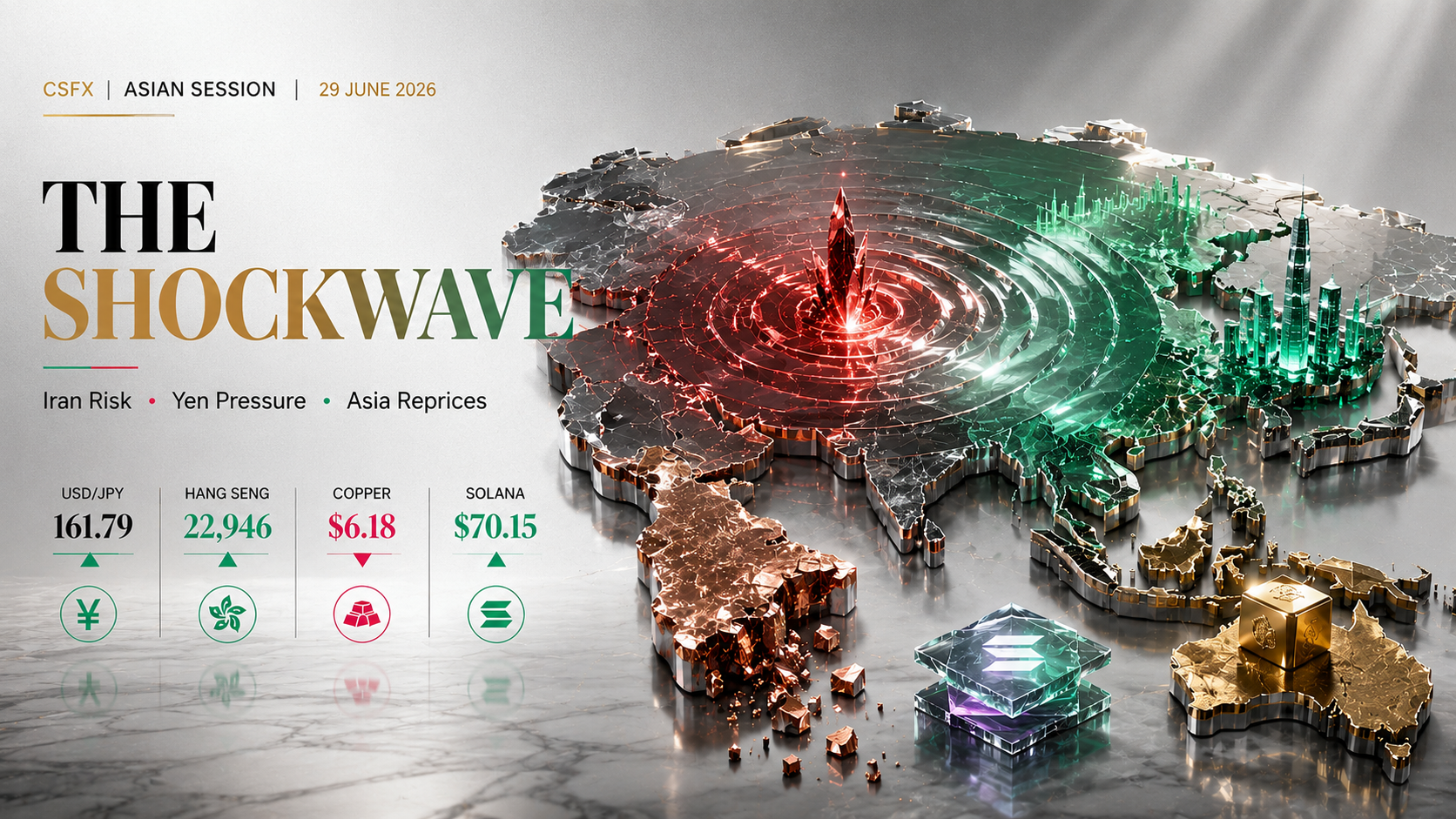
Yen Still Near 40-Year Low · US Strikes Iran Over Weekend · Kosdaq Surges 7% as Kospi Sinks · Baidu’s Kunlunxin Jumps on $50B IPO Report — USD/JPY ~161.79, ASX 200 ~8,793, Solana ~$70.15 | Technical Analysis – Asian Session | 29 June 2026
Yen Still Pinned Near a 40-Year Low as Fresh US Strikes on Iran Reignite the Hormuz Premium —
Kosdaq Rockets 7% Even as Kospi Sinks on Chip Profit-Taking
Monday’s Asian session opens with geopolitics back in the driver’s seat: the United States struck Iranian military targets over the weekend in retaliation for Tehran’s attacks on shipping in the Strait of Hormuz, a tit-for-tat escalation that has put Tuesday’s scheduled Doha talks — aimed at reopening the waterway through which roughly a fifth of the world’s oil and gas flows — squarely back in focus. Crude has settled near $69.41 after touching four-month lows last week, while the yen remains trapped just under the 162.00 handle against the dollar, within a whisker of its weakest level since 1986, as the colossal Fed–BoJ rate gap continues to overwhelm Tokyo’s hot inflation print from Friday.
Equity markets are telling two very different stories beneath the index headlines. South Korea’s Kospi is down roughly 2.3% as index heavyweights Samsung Electronics and SK Hynix give back a slice of last week’s blistering AI-chip rally on renewed profit-taking and a stronger dollar weighing on the won — yet the small-cap Kosdaq is rocketing close to 7% as capital rotates into mid-cap growth and biotech names, a split that underscores how concentrated, and how fragile, the AI-driven leadership in large-cap tech has become. In Hong Kong, the Hang Seng is up around 2.1% on a tech rebound, with Baidu’s Hong Kong-listed shares surging after a report that its AI-chip subsidiary Kunlunxin is targeting an initial public offering that could value the unit near $50 billion — today’s single most volatile large-cap mover in the region. Japan’s Nikkei 225 is consolidating modestly lower, still digesting last week’s sharp tech-led drawdown, while Australia’s ASX 200 is firmer near 8,793.20 as technology and gold miners lead and defensives hold up.
Commodities are diverging along familiar lines: copper sits near a seven-week low around $6.18 a pound as a firm dollar and soft Chinese demand data weigh, even as renewable-energy and electronics demand provide a partial floor, while natural gas is firming toward $3.28–3.30 per MMBtu inside an ascending wedge as forecasters flag a building US heat dome that should lift cooling-driven power demand into the Independence Day holiday. In crypto, the broad-based deleveraging that hit risk assets last week has left Dogecoin hovering just above its 52-week low near $0.71 — down roughly 54% over twelve months — while Solana, near $70.15, is stabilising after Friday’s flush below $65, helped by continued spot-ETF inflows and growing institutional adoption. The session’s defining variable into the Doha talks and this week’s RBA minutes and China PMI releases remains the same one that has governed markets all month: the durability of the Hormuz ceasefire against a backdrop of a still-hawkish Fed.
Asian Session Headlines — 29 June 2026
Live market-moving events as Tokyo, Seoul, Hong Kong and Sydney trade a renewed Hormuz risk premium, a fractured tech tape, and a still-weak yen
Baidu’s Kunlunxin: A $50 Billion IPO Report Turns a Chip Unit Into the Session’s Biggest Single-Stock Swing
Of all the moves across Asian equities Monday, none was sharper relative to its starting point than Baidu’s Hong Kong-listed shares, which surged more than 7% on a report that Kunlunxin — Baidu’s in-house AI-chip design unit — is targeting a Hong Kong initial public offering that could value the affiliate at roughly $50 billion. That is an extraordinary number for a chip business that, until recently, was viewed primarily as a defensive hedge against US export restrictions on advanced semiconductors rather than a freestanding growth story in its own right. The market’s reaction tells you how the narrative has shifted: rather than reading restricted access to Nvidia and AMD’s top-tier chips as a permanent ceiling on China’s AI ambitions, investors are increasingly pricing the domestic chip ecosystem — Kunlunxin, alongside peers like Cambricon and Huawei’s Ascend line — as a genuine, separately monetisable growth vector.
The move had clear regional spillover: the Hang Seng’s roughly 2.1% gain Monday was driven disproportionately by tech, with Tencent, Alibaba and Xiaomi all firmer in sympathy, even as South Korea’s large-cap chip names (Samsung, SK Hynix) were sinking on profit-taking and Japan’s Nikkei consolidated lower. That divergence is itself instructive: where Korea and Japan’s AI trade is concentrated in memory and equipment names exposed to the cost-of-AI-infrastructure debate dominating Wall Street, China’s domestic-chip narrative is running on a largely separate track — sovereign-substitution demand, not global capex sentiment. For traders, the volatility in Baidu/Kunlunxin is a reminder that single-name catalysts (an IPO report, a customer order, a regulatory headline) can still move an index more violently than the macro backdrop on any given day, and that “most volatile Asian stock” and “most informative Asian stock” are very often the same name.
Asian Session Economic Calendar — 29 June 2026
Key releases and events shaping price action across today’s Asia–Pacific session and into the week ahead
| Time (JST/local) | Event | Actual / Expected | Impact | Market Read |
|---|---|---|---|---|
| 🇺🇸Over the weekend | US Strikes Iranian Military Targets — Retaliation for Hormuz Shipping Attacks | Strikes halted pending Doha talks Tuesday | 🔴 CRITICAL | Fresh risk premium lifts crude toward $70; escalation risk remains the dominant swing factor this week |
| 🇺🇸🇮🇷Tuesday (Doha) | US–Iran Talks on Reopening the Strait of Hormuz | Focus shifts from nuclear file to Strait access | 🔴 CRITICAL | Constructive outcome = oil lower, risk-on; breakdown = fresh spike in crude and safe-haven demand |
| 🇰🇷Today (KRX) | Kospi vs. Kosdaq Divergence — Large-Cap Chip Profit-Taking vs. Mid-Cap Rotation | Kospi ~-2.3%, Kosdaq ~+7.3% | 🟢 MED | Watch for sidecar/circuit-breaker triggers if either index’s intraday swing extends further |
| 🇨🇳Today (HKEX) | Baidu / Kunlunxin Hong Kong IPO Report | Reported target valuation ~$50B | 🟢 MED | Confirms domestic AI-chip ecosystem is attracting fresh capital; Hang Seng tech-led bid |
| 🇹🇩This week | RBA June Meeting Minutes | Hawkish hold after three hikes since January | 🟢 MED | Reinforced hawkishness underpins AUD structurally; risk sentiment still dominates intraday |
| 🇨🇳This week | China Manufacturing & Non-Manufacturing PMI | Markets watching for stabilisation signs | 🟢 MED | Soft prints extend the copper/demand-side overhang; a beat would help base metals and AUD |
| 🇺🇸This week | US Heat-Dome Forecasts & EIA Natural Gas Storage Data | Hotter-than-normal outlook through 10 July | 🟢 MED | Rising cooling demand supports natural gas; storage builds remain the key offsetting variable |
| 🇺🇸Fed speakers, ongoing | Fed Commentary Against This Month’s Hawkish Repricing | Tone closely watched after hot Core PCE | 🟢 MED | Any dovish pushback would pressure the dollar broadly, lifting AUD/JPY, copper and crypto |
Asian Session Trade Ideas — 29 June 2026
Eight structured setups — USD/JPY, AUD/JPY, Nikkei 225, Copper, Natural Gas, ASX 200, Dogecoin, Solana — with live prices, levels, and full fundamental and technical analysis

Fundamental Backdrop
USD/JPY remains glued just below 162.00, near the weakest yen since 1986, and Monday’s price action confirms that Friday’s hotter Tokyo CPI print has done little to change the structural picture. The Bank of Japan’s policy rate sits at 1.00% with the next decision not due until 31 July, leaving the pair without a fresh domestic catalyst this week, while the Fed’s 3.50–3.75% band under Chair Kevin Warsh keeps a 250–275bp gap firmly intact. With renewed US–Iran tensions adding a safe-haven dollar bid on top of the carry trade, the path of least resistance remains higher, capped only by the live threat of Ministry of Finance intervention after April’s record-sized operation.
Technical Outlook
The trend remains unambiguously up, with the pair consolidating in a tight 161.50–162.05 band just beneath the 52-week high of 161.95. Resistance: 162.00 (psychological / intervention trigger) and 163.00–163.50. Support: 160.50 (preferred buy-dip), 160.13 and 158.80 (stop). The cleanest expression remains buying pullbacks toward 160.50 rather than chasing strength above 162, where intervention risk poisons the risk/reward.
Session Catalysts
Watch for: (1) any MoF/BoJ verbal or actual intervention — the dominant binary risk; (2) Tuesday’s Doha talks — a breakdown would add safe-haven dollar demand on top of the carry trade; (3) Fed speakers pushing back on hike pricing; (4) US long-end yields; (5) risk sentiment from the Kospi/Kosdaq and Hang Seng divergence, which can cut either way for haven-dollar demand.

Fundamental Backdrop
AUD/JPY is sitting almost exactly on its pivot near 111.51, caught between two offsetting forces. On the Australian side, the RBA remains in hawkish-hold mode after three rate hikes since January, with this week’s June meeting minutes likely to reiterate that core inflation has not yet been tamed — structurally supportive for the Aussie. On the yen side, the BoJ’s 1.00% rate is unchanged and the next decision is a month away. The swing factor is regional risk sentiment, which is genuinely mixed today: the ASX 200 and Hang Seng are both firmer, but the Kospi’s sharp decline and the renewed Hormuz risk premium are reminders that a single escalation headline from the Doha talks could flip the cross sharply lower.
Technical Outlook
The chart shows AUD/JPY consolidating around the 111.51–111.60 pivot, having extended a bearish run below 111.51 in recent sessions before stabilising. Resistance: 112.17 (1st resistance) and 113.00 (stop). Support: 110.88 (1st support) and 109.80 (target, near the 200-day SMA zone). With price sitting almost exactly at the pivot, the highest-probability expression is to fade strength into 112.10 with a tight stop, rather than chase the pair in either direction from current levels.
Session Catalysts
Watch for: (1) the outcome of Tuesday’s Doha talks — a breakdown is unambiguously AUD/JPY-negative via risk-off and yen demand; (2) this week’s RBA minutes and any hawkish language; (3) China PMI data, given Australia’s trade exposure; (4) the Kospi/Kosdaq divergence as a barometer of regional risk appetite; (5) any verbal MoF intervention on the yen, which would hit AUD/JPY alongside USD/JPY.

Fundamental Backdrop
The Nikkei 225 is consolidating modestly lower near 69,032, still digesting last week’s sharp tech-led drawdown that briefly took the index below 69,000 amid concerns over the rising cost of AI infrastructure and a SoftBank-led decline tied to reports OpenAI may delay its IPO. Today’s renewed US–Iran tensions are an additional headwind via the safe-haven dollar and the risk of a fresh oil-price shock, even as Tuesday’s Doha talks offer a path to de-escalation. Meanwhile, a hot Tokyo CPI print and an unchanged BoJ rate this week leave domestic monetary policy a secondary driver; the index remains primarily a derivative of US tech sentiment and Middle East headlines.
Technical Outlook
The index sits well below its recent highs near 72,831 but is also off last week’s lows, consolidating in a 68,000–70,400 range. The 4.5%+ single-day declines seen last week underline how violently sentiment can swing when AI-infrastructure-cost concerns resurface; a clean break above 70,400 would suggest the rout is over, while a break below 68,000 risks accelerating toward the 39,288.90–72,831.73 52-week range’s lower-middle zone. With tech leadership this fragile, fading strength into resistance carries better risk/reward than chasing a recovery.
Session Catalysts
Watch for: (1) Tuesday’s Doha talks outcome; (2) further AI-infrastructure-cost headlines from US mega-cap earnings and capex commentary; (3) SoftBank-specific news flow given its outsized index weight; (4) USD/JPY direction, since yen weakness has historically supported Nikkei exporters even amid tech weakness; (5) any signs the Kospi/Kosdaq-style mid-cap rotation spreads into Japanese small- and mid-caps.

Fundamental Backdrop
Copper futures are hovering near $6.18 per pound, close to their lowest levels in seven weeks, primarily on the back of a firm US dollar (DXY near 101.6) that makes the dollar-priced metal more expensive for buyers using other currencies. Persistent weakness in China’s traditional copper-consuming construction and manufacturing sectors continues to weigh, though this is only partially offset by resilient demand from renewable energy, energy storage and electronics industries — a structural source of demand that has kept the 52-week range elevated relative to history. Despite the recent softness, copper is still up roughly 21% over the past twelve months, underlining that the medium-term uptrend remains intact even as the near-term tape is dollar-driven and soft.
Technical Outlook
Copper is trading inside a $5.99–$6.24 range, having tumbled more than 3% in a single session last week before stabilising. The 52-week range spans $4.3325 to $6.7160, leaving copper roughly in the upper-middle of its annual band despite the recent pullback. Resistance: $6.21 (recent high) and $6.30 (preferred sell-rally level), then $6.55 (stop). Support: $5.99 (today’s low) and $5.80 (target). Daily technical signals lean sell, consistent with a dollar-driven grind lower rather than a structural breakdown.
Session Catalysts
Watch for: (1) the dollar index and any dovish Fed pushback that could spark a relief rally; (2) China PMI data this week — a beat would support both copper and the broader base-metals complex; (3) further Chinese stimulus or property-sector headlines; (4) renewable-energy and EV demand data as a structural offset; (5) any supply-side disruption news from major producing regions (Chile, DRC, Peru).

Fundamental Backdrop
Natural gas is firming toward $3.28–3.30 per MMBtu as weather forecasters flag a building heat dome over the most populous US regions through 10 July, lifting electricity demand for air conditioning in a country where gas-fired plants generate roughly 40% of power supply. Average daily flows to major export terminals have risen to around 17.3 billion cubic feet in June, boosted by record feedgas activity at the Golden Pass facility, while Lower-48 production has held steady near 109.7 billion cubic feet per day. The Energy Information Administration’s most recent storage report showed a near-normal injection that keeps inventories roughly 5.7% above seasonal norms — a supply cushion that caps, without eliminating, the upside from the demand-side heat story.
Technical Outlook
Prices have been climbing inside an ascending wedge on the short-term chart, recently tagging a swing high near $3.326 before pulling back to around $3.267–3.28. Fibonacci retracement levels from the recent swing low to swing high put the 38.2% retracement at $3.248 and the 50% level at $3.223, with a deeper correction potentially reaching the 61.8% level near $3.199 — which also aligns with the lower boundary of the wedge. The 100-day SMA sitting above the 200-day SMA supports a path of least resistance still to the upside, making dips toward $3.20 attractive for buyers so long as the wedge structure holds.
Session Catalysts
Watch for: (1) updated weather forecasts and any extension or moderation of the heat-dome outlook; (2) Thursday’s EIA weekly storage report; (3) LNG export-flow data, particularly at Golden Pass; (4) any further escalation in US-Iran tensions, which could spill into broader energy-complex sentiment; (5) the $3.326 wedge-top and $3.199 wedge-bottom as the key technical boundaries.

Fundamental Backdrop
The ASX 200 is up around 0.2% near 8,793.20, off session highs of roughly 0.66%, with technology stocks posting strong gains even though the sector remains down about 16% year-to-date, and gold producers such as Newmont and Northern Star supported by Friday night’s roughly 1.2% rise in gold to near $4,096 on a weaker US dollar. The broader macro backdrop is a tug-of-war: a hawkish RBA after three rate hikes since January remains structurally supportive of Australian equities and the currency, while the weekend’s US strikes on Iran and the prospect of a renewed Hormuz risk premium are a fresh source of caution heading into Tuesday’s Doha talks. Energy names such as Santos and Woodside are a key swing factor given their direct sensitivity to the oil price.
Technical Outlook
The index is trading inside its 52-week range of 8,262.40 to 9,202.90, recovering from a recent low near 8,490.90 and consolidating just under its one-month high near 8,822.00. Resistance: 8,822 (recent high) and 8,900 (target). Support: 8,700 (preferred buy-dip level) and 8,550 (stop, near the recent low zone). With healthcare and staples showing a notable change of character after running hard in prior weeks, sector rotation within the index bears watching alongside the headline level.
Session Catalysts
Watch for: (1) Tuesday’s Doha talks and any Hormuz-related oil-price swings, given Woodside and Santos’s index weight; (2) this week’s RBA minutes; (3) China PMI data given Australia’s trade exposure; (4) gold-price direction for the miners; (5) the broader regional risk tone set by the Kospi/Kosdaq/Hang Seng divergence.

Fundamental Backdrop
Dogecoin is trading around $0.71, within touching distance of its 52-week low near $0.70 and down roughly 54% over the past twelve months, making it one of the hardest-hit major tokens in last week’s broad crypto deleveraging. As a high-beta memecoin with no yield, staking mechanism or core utility narrative beyond payments and tipping, DOGE amplifies broad risk-off moves more violently than utility-focused tokens; this week’s renewed Hormuz tensions and a still-firm dollar provide little fundamental relief. On the structural side, DOGE’s March 2026 classification as a digital commodity under a joint SEC/CFTC framework is a longer-term positive for institutional access, but it has done little to offset near-term selling pressure, with both the 50-day and 200-day moving averages falling.
Technical Outlook
The technical picture is unambiguously bearish on trend but stretched on momentum: DOGE sits below its 50-day and 200-day moving averages on every timeframe, with the 4-hour RSI near 20 — deep oversold territory that has historically preceded sharp, if often short-lived, relief bounces. Resistance: $0.78 (preferred sell-rally level) and $0.85 (stop, near the prior consolidation zone). Support: $0.70 (key support) and $0.60 (target, a measured-move extension below the low). The setup favours fading any relief rally rather than chasing the current weakness, given how extended the oversold reading already is.
Session Catalysts
Watch for: (1) Bitcoin’s direction near the $58,000–$60,000 zone flagged as a historical buyer-interest area; (2) the dollar index and any dovish Fed pushback; (3) broader memecoin-sector sentiment and social-media engagement metrics; (4) any Elon Musk or DOGE-policy-related headlines, historically a volatility catalyst for the token; (5) whether the $0.0729 52-week low holds or gives way to a fresh leg lower.

Fundamental Backdrop
Solana is trading near $70.15, recovering from an intraday low around $64.58 hit Friday during the broad crypto deleveraging — one of the token’s worst single-day ranges in months. The rebound is being helped by continued institutional adoption: spot Solana ETF assets from issuers including Bitwise (BSOL) and Fidelity (FSOL) have surpassed $1 billion, Forward Industries continues to operate as a Solana-focused corporate treasury holding over 6.9 million SOL, and the network’s real-world-asset ecosystem has crossed roughly $3 billion in tokenised value. On-chain usage and tokenised-equity initiatives (including reported SpaceX share tokenisation on Solana) continue to expand even as price action lags, reinforcing the view that this remains a macro-driven, not fundamentals-driven, pullback.
Technical Outlook
SOL is attempting to stabilise in the $69–$72 range after Friday’s flush, with the 50-day and 200-day moving averages both still falling, consistent with a longer-term downtrend that the current bounce has not yet reversed. Resistance: $74 (recent local high) and $80 (target, near where the falling 50-day average likely sits). Support: $69 (preferred buy-dip level near the recent consolidation floor) and $64 (stop, just below Friday’s low). The 200-day moving average, estimated near the $80s, remains the key longer-term bull/bear pivot; a sustained reclaim of that zone would meaningfully improve the technical picture.
Session Catalysts
Watch for: (1) Bitcoin’s stabilisation near $58,000–$60,000 and broader crypto risk appetite; (2) continued spot Solana ETF flow data; (3) further institutional adoption headlines (validators, tokenised equities, payments); (4) the dollar index, given crypto’s recent high sensitivity to DXY strength; (5) whether Friday’s $64.58 low holds as a durable floor or proves to be a temporary pause in a deeper move.
Key Questions for the Asian Session
Detailed answers to Monday’s most important analytical questions
Asian Session Summary — Monday, 29 June 2026
Monday’s Asian session is shaped by a familiar geopolitical flashpoint and a sharp internal rotation within equities. The US struck Iranian military targets over the weekend in retaliation for attacks on Hormuz shipping, pulling crude near $69.41 and keeping Tuesday’s Doha talks — aimed at reopening the Strait — as the week’s single most important catalyst; a constructive outcome would likely extend the supply-glut-driven slide in oil, while a breakdown risks a much sharper repricing than today’s modest bounce. Beneath the surface, equities are telling a story of concentrated-rally exhaustion rather than broad risk-off: South Korea’s Kospi is down roughly 2.3% as Samsung and SK Hynix give back gains, even as the Kosdaq rockets near 7% on a rotation into mid-caps, while Hong Kong’s Hang Seng is up about 2.1% on a Baidu/Kunlunxin-led tech rebound — today’s clearest single-stock volatility story, built on a reported $50 billion IPO valuation for an AI-chip unit once viewed mainly as a sanctions hedge.
The actionable framework across today’s eight instruments is clear. Highest-conviction macro: USD/JPY buy dips toward 160.50, stop 158.80, target 163.50 — the Fed–BoJ rate gap remains the cleanest structural setup of the session, with intervention risk above 162 the only real brake.
For the individual instruments: AUD/JPY sell rallies toward 112.10, stop 113.00, target 109.80 — sitting almost exactly on its pivot, with the Doha-talks outcome the key swing factor. Nikkei 225 sell rallies toward 70,200, stop 71,200, target 67,800 — tech leadership remains fragile after last week’s rout. Copper sell rallies toward $6.30, stop $6.55, target $5.80 — dollar strength and soft China demand dominate near a 7-week low. Natural Gas buy dips toward $3.20, stop $3.05, target $3.50 — an ascending wedge meets building heat-dome demand. ASX 200 buy dips toward 8,700, stop 8,550, target 8,900 — tech and gold miners lead, but Hormuz headline risk caps gains. Dogecoin sell rallies toward $0.78, stop $0.85, target $0.60 — sitting on a 52-week low with an RSI deeply oversold. Solana buy dips toward $69, stop $64, target $80 — stabilising off Friday’s flush on continued ETF and institutional-adoption inflows. The decisive variable into Tuesday’s Doha talks and this week’s RBA minutes and China PMI remains the durability of the Hormuz ceasefire against a still-hawkish Fed. Size positions accordingly.
Access Live Asian Markets →