
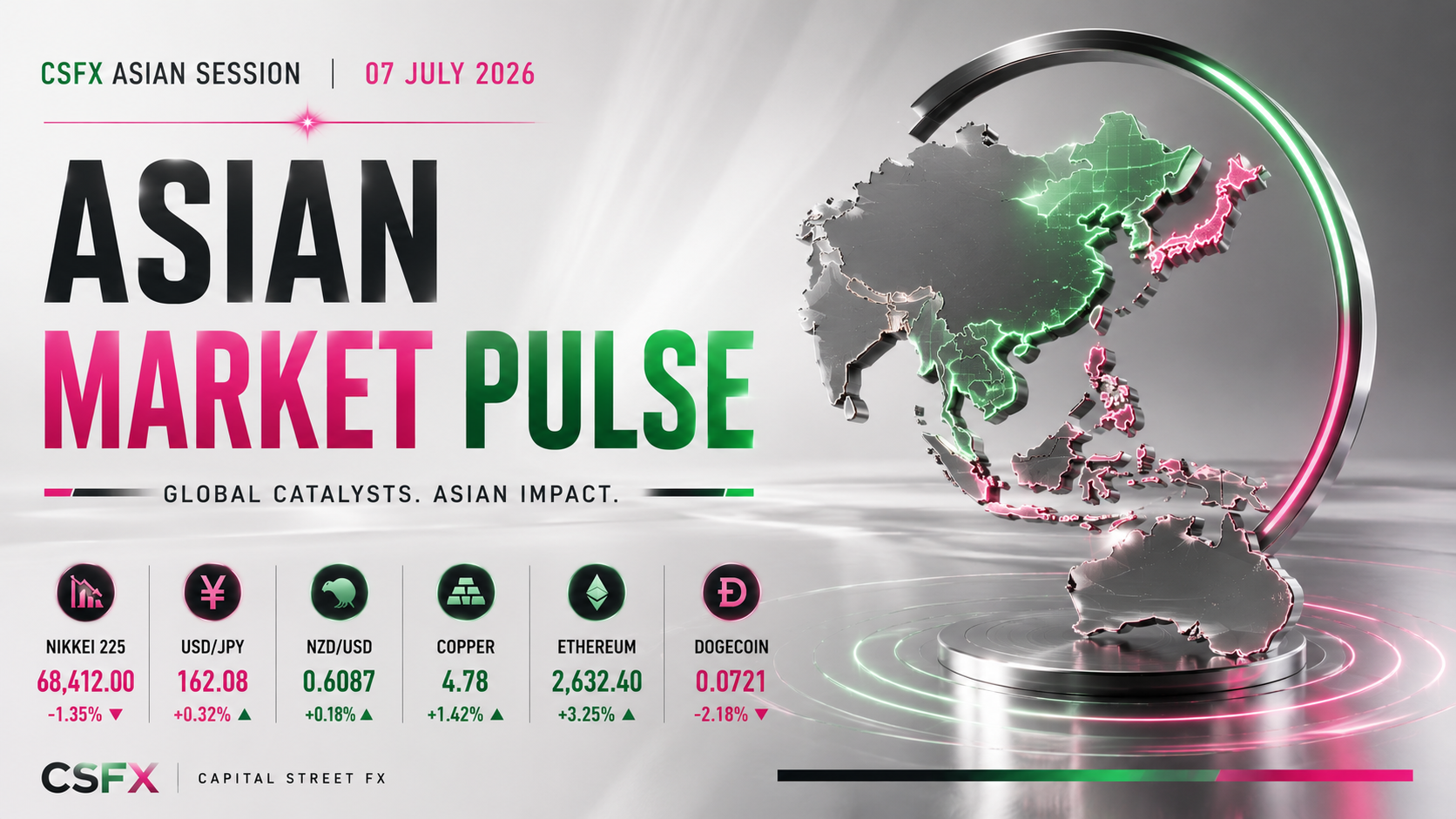
Nikkei Breaks 68,700 Support, Yen Tops 162, Ethereum Climbs | Asian Session – Technical Analysis | 7 July 2026
Nikkei Breaks Below 68,700 Support as the NATO Summit Opens and the RBNZ Decision Looms, the Yen Slips Past 162 on Intervention Watch
Asian markets trade in a cautious, mixed range as the Nikkei breaks below 68,700 support through a second day of chip-stock rotation, the yen slips back past 162 with Tokyo still quiet on intervention, the kiwi holds firm into a closely-split RBNZ decision, Copper and Natural Gas each digest their own supply-side catalysts, and crypto markets diverge as Ethereum extends its CLARITY Act-driven rally while Dogecoin tests critical support — all with the NATO summit opening in Ankara and the FOMC minutes still to come this week.
Monday’s Wall Street reopening rally, led by a chipmaker rebound and SK Hynix’s roughly $28 billion Nasdaq listing, has carried through into a cautiously firmer tone across most of Asia, though Japan’s own chip-equipment and memory names remain under selling pressure for a second straight session as investors continue rotating into industrials, consumer names and financials. The Nikkei 225 closed Monday essentially flat at 69,737, down just 0.01%, while the broader Topix added 0.92% to 4,102, with Mitsubishi Heavy Industries, Shin-Etsu Chemical and Fast Retailing among Monday’s strongest performers even as Kioxia Holdings, Taiyo Yuden and SoftBank Group extended their declines. Tuesday’s session has already tested that resolve, however, with the index sliding to 68,636 in early Asian trade, a decisive break below the 68,700–68,782 area, the early-June swing high that had been defended roughly ten times over the past month. The index is now roughly 5.7% below its June 22 record high of 72,831.73. Japan’s data calendar is busy this week, with the Cabinet Office’s Leading Economic Index, household spending and machine-tool orders all due, ahead of Fast Retailing and Seven & i Holdings kicking off quarterly earnings season on Thursday.
In FX, USD/JPY has slipped back above 161.50, giving back roughly half of the intervention-driven bounce seen in the back half of last week, as Finance Minister Satsuki Katayama’s repeated warnings that Japan and the US remain in close contact on currency policy have so far not translated into actual market intervention. With the pair still within striking distance of the 40-year lows that first triggered intervention chatter in late June, and the Bank of Japan’s next policy meeting not until 30 July, traders are treating every uptick with caution given the asymmetric risk of a sudden, sharp yen reversal. Across the Tasman, NZD/USD has slipped to $0.5684, giving back part of its recent advance, heading into Wednesday’s 2pm (NZT) Reserve Bank of New Zealand Official Cash Rate decision. The May meeting produced a rare 3-3 split vote that required Governor Anna Breman’s deciding vote to hold at 2.25%, and this week’s call looks similarly contested: easing oil prices following the US-Iran de-escalation have prompted banks like ASB to revise their call to a hold, while UBS and others still expect a 25-basis-point hike given how strongly the case was signalled in May.
In commodities, Copper is extending its advance to $6.22 a pound on COMEX, clearing last week’s $6.20 high, after the US Commerce Department finalized its long-awaited Section 232 tariff review on refined copper imports on 30 June, removing a key source of uncertainty just as Goldman Sachs raised its year-end 2026 LME copper forecast to $13,735 a tonne on continued AI-datacentre-linked demand. Natural Gas is holding near $3.22 per MMBtu, capped by near-record Lower 48 production of roughly 110 billion cubic feet per day even as forecasters flag above-normal heat persisting through mid-July, a combination that has kept the market range-bound for close to two weeks. In crypto, Ethereum is easing back to trade near $1,769.25, still up around 9% over the past seven days, on continued optimism around the CLARITY Act’s prospects for unlocking institutional capital and news that Bitmine’s ether treasury has grown past 5.7 million ETH, more than 5% of total supply. Dogecoin, by contrast, is testing its widely-watched $0.072 support shelf near $0.074 as the broader crypto Fear & Greed Index sits in Extreme Fear, even as on-chain analysts flag a sharp pickup in wallet activity that some are reading as an early accumulation signal.
Asian Session Headlines
The stories driving price action across FX, equities, metals, energy and crypto this session
Asian Session Economic Calendar — 7 July 2026
Key releases and events shaping price action across today’s Asian session
| Time (SGT) | Event | Actual / Detail | Impact | Market Read |
|---|---|---|---|---|
| 🇹🇷Ongoing | NATO Summit Opens in Ankara, Turkey (Day 1 of 2) | Allied defence-spending commitments and Ukraine support in focus | 🔴 CRITICAL | Watch for defence-sector equity flows and any broader Dollar safe-haven bid |
| 🇺🇵Ongoing | Nikkei 225 Breaks Below 68,700 Support as Chip-Stock Rotation Continues | Continued memory-stock weakness outweighs gains in industrials and consumer names | 🔴 CRITICAL | Pushes the index to 68,636, a decisive break below Monday’s 69,737 close and the well-defended support shelf |
| 🇺🇵Carryover | USD/JPY Slips Past 162 as Tokyo Stays Quiet on Intervention | Pair gives back roughly half of last week’s intervention-driven bounce | 🔴 CRITICAL | Keeps traders on alert for a sudden, sharp reversal |
| 🇺🇵9:30 AM JST | Japan Leading Economic Index (May, Final) | Cabinet Office data awaited alongside household spending and machine-tool orders | 🟢 MED | A soft print would reinforce the case for continued BoJ caution |
| 🇳🇿Ongoing | RBNZ OCR Decision Preview (Wed 8 July, 2pm NZT) | Bank economists split between a hold at 2.25% and a 25bp hike | 🔴 CRITICAL | The most closely contested RBNZ call in years; kiwi volatility likely to build into Wednesday |
| 🇺🇸Carryover | US ISM Services PMI (June) Confirmed at 54.0 | In line with May’s 54.5 reading; 24th straight month of expansion | 🟢 MED | Confirms a resilient services sector, keeps September hike odds anchored near 45–50% |
| 🇺🇸Ongoing | US Copper Tariff Decision Finalized (Section 232) | Commerce Department’s refined-copper review concluded 30 June | 🟢 MED | Removes a key overhang; Goldman lifts its year-end LME copper forecast |
| 🇺🇸8 Jul, 2:00 PM ET | FOMC Meeting Minutes | Markets parsing for the balance of hike-vs-hold sentiment among officials | 🟢 MED | Could reprice September hike odds in either direction |
Asian Session Trade Ideas — 7 July 2026
Seven structured setups — USD/JPY, NZD/USD, Copper, Natural Gas, Nikkei 225, ETH/USD, DOGE/USD — with updated prices, levels, and full fundamental and technical analysis
USD/JPY

Fundamental Backdrop
USD/JPY has slipped back above 161.50 on Tuesday, giving back roughly half of the intervention-driven bounce seen in the back half of last week, as Finance Minister Satsuki Katayama’s repeated warnings that Japan and the US remain in close contact on foreign-exchange policy have so far not translated into actual market intervention. The pair remains within striking distance of the 40-year lows that first triggered intervention chatter in late June, and reports that Japan may stop signalling its intervention plans in advance, catching speculators off guard, continue to keep short-yen positioning on edge even as the underlying rate differential still favours the Dollar. The Bank of Japan’s next policy decision is not until 30 July, leaving the pair driven in the interim primarily by intervention speculation and the residual hawkish tilt from the Fed’s June meeting, even after Friday’s soft US payrolls print pulled September hike odds down to roughly 45–50%.
Technical Outlook
USD/JPY remains in a broader uptrend on the daily chart despite last week’s sharp, intervention-fear-driven pullback from just above 162, with Tuesday’s move back above 161.50 testing the lower half of the range that has held for the past two weeks. Resistance: 162.80 (last week’s high before the pullback) and 163.50 (this trade’s target, near the 2024 cycle high). Support: 161.20 (a near-term pivot and this trade’s buy-dip level) and 160.30 (this trade’s stop, below the base of last week’s intervention-fear low). A confirmed close below 160.30 would open a deeper move toward 158.50, while a clean break above 163.50 would risk drawing fresh, and potentially more forceful, official attention.
Session Catalysts
Watch for: (1) any actual intervention action from the Ministry of Finance or verbal escalation from Finance Minister Katayama; (2) Japan’s Leading Economic Index, household spending and machine-tool orders this week; (3) Wednesday’s FOMC minutes and their read-through to the rate differential; (4) the NATO summit’s potential impact on broader risk sentiment and safe-haven flows; (5) thin midsummer liquidity potentially amplifying intraday swings.
NZD/USD

Fundamental Backdrop
NZD/USD has eased to $0.5684 on Tuesday, giving back part of last week’s advance, as markets brace for Wednesday’s 2pm (NZT) Reserve Bank of New Zealand Official Cash Rate decision, widely regarded as one of the most closely contested in years. May’s meeting produced a rare 3-3 split vote that required Governor Anna Breman’s deciding vote to hold the OCR at 2.25%, with external committee members voting to hike and internal members voting to hold. Since then, the easing of oil prices following the US-Iran de-escalation, from near $100 a barrel assumed in the RBNZ’s May projections to below $70 currently, has removed one of the main arguments for a July hike, prompting ASB to revise its call to a hold; UBS and other banks, however, still expect a 25-basis-point increase given how strongly the case was signalled just six weeks ago. The kiwi has also found broader support from a softer US Dollar after Friday’s weak payrolls report reduced near-term Fed hike expectations.
Technical Outlook
NZD/USD has rebounded from a seven-month low to test the upper end of its recent range, with Tuesday’s move holding just below the psychologically important $0.5750 level. Resistance: $0.5750 (this range’s recent high) and $0.5850 (this trade’s target, near the next resistance band from May). Support: $0.5650 (a near-term pivot from last week’s consolidation) and $0.5580 (this trade’s stop, below the recent breakout base). A confirmed close above $0.5750 would open a path toward $0.5900, while a break back below $0.5580, particularly on a hawkish RBNZ surprise in the other direction, would risk a retest of the recent seven-month low.
Session Catalysts
Watch for: (1) Wednesday’s RBNZ Monetary Policy Review and OCR decision at 2pm NZT, with the press conference an hour later likely to be the bigger market mover than the decision itself; (2) the 21 July release of June-quarter CPI, which the RBNZ itself has flagged could print near 4.2%; (3) any fresh developments in the Middle East that could reverse the recent oil-price decline; (4) broader US Dollar direction into Wednesday’s FOMC minutes; (5) New Zealand business and consumer confidence data for further signals on the domestic growth outlook.
Copper

Fundamental Backdrop
Copper has broken above $6.20 a pound on COMEX, trading near $6.22, after the US Commerce Department finalized its Section 232 tariff investigation into refined copper imports on 30 June, removing a key source of uncertainty that had weighed on the market since a graduated tariff scheme was first floated in mid-2025. Goldman Sachs responded by lifting its year-end 2026 LME copper price forecast from $12,465 to $13,735 a tonne, citing structural demand from AI data-centre buildouts alongside record COMEX inventories of roughly 650,000 tons built up ahead of the tariff decision. Reduced September Fed hike odds, down to roughly 45–50% after Friday’s soft payrolls print, are providing an additional tailwind for industrial metals broadly, while Chinese funds have reportedly been rotating into copper stocks and futures ahead of expected solid first-half earnings from domestic producers.
Technical Outlook
Copper has broken out of its recent range, clearing $6.20, last week’s high, on Tuesday, with the tariff decision and Goldman’s upgraded forecast now providing a fresh floor under the market. Resistance: $6.30 (the new near-term ceiling) and $6.45 (this trade’s target, near the pre-tariff-decision high from January). Support: $6.05 (a near-term pivot and this trade’s buy-dip level) and $5.90 (this trade’s stop, below the late-June low). A confirmed close above $6.45 would open a path back toward $6.80–$7.00, while a break back below $5.90 would suggest the tariff-clarity tailwind is losing its grip on sentiment.
Session Catalysts
Watch for: (1) preliminary first-half earnings from major Chinese copper producers in the coming weeks; (2) any follow-through commentary on the phased implementation timeline for the finalized tariff scheme; (3) COMEX inventory drawdowns from the current record levels; (4) broader AI-capex confirmation from this week’s US corporate news flow; (5) the NATO summit’s potential impact on broader industrial-metals sentiment via the defence-spending channel.
Natural Gas

Fundamental Backdrop
Natural Gas is holding near $3.22 per MMBtu, retreating from the roughly three-week high of $3.30 hit in late June, as the market balances above-normal heat forecast through mid-July against a supply picture that remains historically ample. The EIA’s most recent storage report showed an 87 billion cubic feet injection for the week ended 26 June, topping both consensus expectations and the five-year average build, lifting the surplus versus the five-year average to roughly 175 Bcf even as inventories sit modestly below year-ago levels. Lower 48 production is running near a record 110 billion cubic feet per day, up from 109.7 Bcf/d in May, while average flows to LNG export terminals have climbed to roughly 17.3–17.4 Bcf/d, providing a structural demand offset that has so far kept the market from breaking meaningfully higher despite the ongoing heat wave.
Technical Outlook
Natural Gas has traded in a well-defined range between roughly $3.05 and $3.35 for close to two weeks, with Tuesday’s level testing the middle of that band after easing back from late June’s three-week high. Resistance: $3.35 (the range’s recent high) and $3.45 (this trade’s target, near the next resistance band from mid-June). Support: $3.05 (the range floor and this trade’s buy-dip level) and $2.90 (this trade’s stop, below the late-June low). A confirmed close below $2.90 would open a deeper move toward $2.70, while a clean break above $3.45 would need a genuine surprise, either a much hotter revision to the NOAA outlook or a materially larger-than-expected storage draw, to sustain.
Session Catalysts
Watch for: (1) Thursday’s EIA weekly storage report and its comparison to the roughly 80–82 Bcf build markets currently expect; (2) the NOAA 8-to-14-day outlook for confirmation of persisting or easing mid-July heat; (3) LNG export terminal flow data, given the structural demand growth story; (4) any hurricane-season developments in the Gulf that could disrupt production or LNG loading; (5) power-sector gas demand data as the current heat wave works through the grid.
Nikkei 225

Fundamental Backdrop
The Nikkei 225 closed Monday essentially flat at 69,737, down just 0.01%, as gains in industrials and consumer names, led by Mitsubishi Heavy Industries, Shin-Etsu Chemical and Fast Retailing, offset continued weakness in memory and AI-linked names such as Kioxia Holdings, Taiyo Yuden and SoftBank Group. The broader Topix outperformed, adding 0.92% to 4,102, underscoring a rotation away from the technology and AI-capex trade that has now persisted for several sessions amid mounting concerns about excess capacity and intensifying competition among AI providers, particularly from China. Tuesday’s session has turned decisively lower, however, with the index sliding to 68,636 in early Asian trade as the chip and memory-stock rotation intensifies; the index is now roughly 5.7% below its 22 June record high of 72,831.73, and the drop unfolds against the backdrop of the NATO summit opening in Ankara and a busy week of domestic data, including the Leading Economic Index, household spending and machine-tool orders, ahead of Fast Retailing and Seven & i Holdings kicking off quarterly earnings on Thursday.
Technical Outlook
The Nikkei’s broader uptrend is under its first genuine test in a month, with Tuesday’s slide to 68,636 decisively breaking the 68,700–68,782 area, the early-June swing high that had been defended on roughly ten separate tests over the past month. A level that well-defended rarely gives way cleanly, so the break itself is a meaningful shift in the near-term picture even though the longer trend and strong trailing-twelve-month earnings backdrop remain intact. Resistance: 69,000 (the broken support shelf, now acting as a near-term ceiling and this trade’s sell-rally level) and 69,700 (Monday’s close, this trade’s stop, above which the breakdown would be invalidated). Support: 68,000 (the recent consolidation base) and 66,500 (this trade’s target, the next chart support below). A confirmed close back above 69,700 would suggest the break was a false one and reopen the path toward the 22 June record of 72,831.73, while a clean move through 66,500 would open a deeper unwind.
Session Catalysts
Watch for: (1) whether the 68,700–68,782 support shelf is reclaimed on a closing basis, which would materially soften the bearish case; (2) the NATO summit in Ankara (7–8 July) and any impact on defence-sector names or broader risk appetite; (3) Japan’s Leading Economic Index, household spending and machine-tool orders this week; (4) Thursday’s start of earnings season with Fast Retailing and Seven & i Holdings; (5) USD/JPY direction, given the index’s sensitivity to yen weakness for exporters versus intervention risk, and an estimated ¥1.7 trillion of index-linked ETF rebalancing flows as funds distribute cash following Japan’s earnings season.
ETH/USD

Fundamental Backdrop
Ethereum is easing back to trade near $1,769.25, still up around 9% over the past seven days, as optimism builds around the CLARITY Act’s prospects for unlocking additional institutional Ethereum capital by providing clearer commodity-style regulatory treatment for the asset. Adding to the momentum, digital-asset treasury company Bitmine added a further 42,197 ETH, worth an estimated $74 million, last week, lifting its total holdings to more than 5.7 million ETH, or over 5% of Ethereum’s entire circulating supply, with the firm’s Tom Lee explicitly tying the pace of accumulation to CLARITY Act odds. Separately, Ethereum co-founder Vitalik Buterin laid out an updated “Lean Ethereum” roadmap, a three-to-four-year protocol overhaul following a researcher meeting in Berlin, which some in the community have described as the network’s biggest structural rethink since the 2022 Merge, adding a longer-term narrative tailwind on top of the near-term institutional flow story.
Technical Outlook
Ethereum has rebounded sharply from below $1,750, cooling from Monday’s push toward $1,798 to trade near $1,769.25, with the seven-day advance still marking one of the stronger short-term moves in recent weeks against a backdrop of a still-cautious broader crypto market. Resistance: $1,820 (the recent 24-hour high) and $2,050 (this trade’s target, near the upper end of the current bullish channel). Support: $1,720 (a near-term pivot from last week’s consolidation and this trade’s buy-dip level) and $1,620 (this trade’s stop, below the base of the recent rally). A confirmed close above $2,050 would open a path back toward $2,400–$2,500, while a break back below $1,620 would suggest the CLARITY Act-driven bounce is losing momentum against the broader 2026 downtrend.
Session Catalysts
Watch for: (1) any formal progress on the CLARITY Act’s Senate timeline, now expected to slip to late July or early August; (2) further Bitmine or other digital-asset treasury accumulation disclosures; (3) spot Ethereum ETF flow data for confirmation of the recent outflow streak reversing; (4) community and market reaction to the pace of the “Lean Ethereum” roadmap’s rollout; (5) broader Bitcoin direction, given Ethereum’s continued high correlation to the majors.
DOGE/USD

Fundamental Backdrop
Dogecoin is testing its widely-watched $0.072 support shelf, trading near $0.074, as the broader crypto Fear & Greed Index remains in Extreme Fear and DOGE continues to underperform both the wider cryptocurrency market and comparable smart-contract platforms over the past week. The coin’s regulatory backdrop has genuinely improved since a joint SEC and CFTC framework classified Dogecoin as a digital commodity in March 2026, and institutional access has widened with the REX-Osprey DOJE ETF, live since September 2025, and the 21Shares TDOG product, the first with Dogecoin Foundation backing and SEC-cleared spot exposure, launched in January 2026. Even so, near-term sentiment remains fragile: social-media chatter around Elon Musk and Michael Saylor’s Independence Day posts has fuelled speculation that a broader “DOGE ends, Bitcoin begins” reform narrative could be forming, while on-chain analysts have separately flagged a sharp spike in wallet activity that some are reading as early whale accumulation.
Technical Outlook
Dogecoin has spent much of 2026 under pressure, with the current setup notable mainly for how tightly it has coiled just above the $0.072 floor rather than for any clear bullish reversal signal. Resistance: $0.0855 (the widely-cited near-term ceiling) and $0.0950 (this trade’s target, near the next resistance band from May). Support: $0.0720 (the critical floor traders are watching and just below this trade’s buy-dip level) and $0.0670 (this trade’s stop, opening the door to the $0.060–$0.065 range on a confirmed break). A decisive close below $0.0720 would risk accelerating the downtrend, while a reclaim of $0.0855 would meaningfully strengthen the case that a base is forming.
Session Catalysts
Watch for: (1) whether the recent pickup in on-chain wallet activity translates into confirmed net accumulation rather than churn; (2) broader Bitcoin direction, since Dogecoin has historically delivered outsized moves, in either direction, when Bitcoin trends strongly; (3) any further Musk- or Saylor-linked commentary that continues to drive social-media speculation; (4) spot ETF flow data for DOJE and TDOG; (5) the $0.072 support test itself, which many traders are treating as the key decision point for the rest of July.
Asian Session FAQ
Asian Session Summary — Tuesday, 7 July 2026
Tuesday’s Asian session trades in a cautious, mixed range as markets digest Monday’s US reopening rally while looking ahead to two key catalysts this week: the NATO summit opening in Ankara and Wednesday’s closely-split Reserve Bank of New Zealand rate decision. The Nikkei 225 has dropped to 68,636, decisively breaking below Monday’s close of 69,737 and the well-defended 68,700–68,782 support shelf, even as the broader Topix outperforms and rotation out of chip and AI-linked names into industrials and consumer names continues for a second straight session, leaving the index roughly 5.7% below its 22 June record high of 72,831.73. USD/JPY has slipped back above 161.50, giving back roughly half of last week’s intervention-driven bounce, as Tokyo has so far stayed on the sidelines despite Finance Minister Satsuki Katayama’s repeated warnings, keeping traders alert to the asymmetric risk of a sudden reversal. Across the Tasman, NZD/USD has eased to $0.5684 heading into Wednesday’s 2pm (NZT) RBNZ decision, one of the most closely contested in years, with bank economists genuinely split between a consensus hold at 2.25% and a 25-basis-point hike. In commodities, Copper is extending its advance to $6.22 a pound, clearing last week’s $6.20 high, after the US finalized its Section 232 tariff review on 30 June, while Goldman Sachs lifted its year-end 2026 LME forecast to $13,735 a tonne on AI-linked demand; Natural Gas is holding near $3.22 per MMBtu as above-normal mid-July heat offsets near-record Lower 48 production of roughly 110 Bcf/d. In crypto, Ethereum is easing back to trade near $1,769.25, still up around 9% over the past seven days, on CLARITY Act optimism and continued Bitmine treasury buying, while Dogecoin is testing its critical $0.072 support shelf near $0.074 amid Extreme Fear, even as on-chain analysts flag a pickup in wallet activity. Highest-conviction macro: sell the Nikkei 225 on rallies toward 69,000, stop 69,700, target 66,500 — the index’s decisive break of the 68,700–68,782 area after roughly ten prior defences over the past month is a genuinely significant technical development that flips the near-term bias bearish, though a sizable stop is still warranted given two-sided event risk from the NATO summit, Thursday’s start of earnings season, and the still-intact 75% trailing-twelve-month uptrend.
For the individual instruments: USD/JPY buy dips toward 161.20, stop 160.30, target 163.50 — the residual Fed-BoJ rate differential remains the dominant driver, though elevated intervention risk argues for a disciplined, tighter-than-usual stop. NZD/USD buy dips toward 0.5650, stop 0.5580, target 0.5850 — a genuinely two-way RBNZ decision on Wednesday is the dominant near-term risk, and position sizing should reflect that this is a real binary event rather than a one-sided trade. Copper buy dips toward $6.05, stop $5.90, target $6.45 — finalized tariff clarity is a genuine standalone catalyst on top of AI-linked demand, though record COMEX inventories are a real offsetting consideration. Natural Gas buy dips toward $3.05, stop $2.90, target $3.45 — heat-driven demand provides a near-term tailwind, though near-record production and a growing storage surplus argue for a measured position size. Nikkei 225 sell rallies toward 69,000, stop 69,700, target 66,500 — the breakdown below the repeatedly-defended swing-high level is a genuine bearish technical signal, though the NATO summit and Thursday’s earnings season both carry real two-way event risk. ETH/USD buy dips toward $1,720, stop $1,620, target $2,050 — concrete institutional accumulation and regulatory optimism are genuine catalysts, though the position should still respect the broader crypto market’s cautious backdrop. DOGE/USD buy dips toward $0.0715, stop $0.0670, target $0.0950 — a reclaim of $0.0855 would meaningfully strengthen the basing case, though the Extreme Fear backdrop argues for disciplined sizing until a confirmed reversal signal emerges. The decisive variables for the remainder of the session are whether the NATO summit produces any market-moving defence-spending or geopolitical headlines, and whether Wednesday’s RBNZ decision and FOMC minutes together reshape the broader Dollar narrative heading into the back half of the week. Size positions accordingly, and note that Thursday’s start of Japanese earnings season and the ongoing chip-stock rotation both carry genuine event risk that could reshape sentiment through the coming days.
Access Live Asian Markets →