
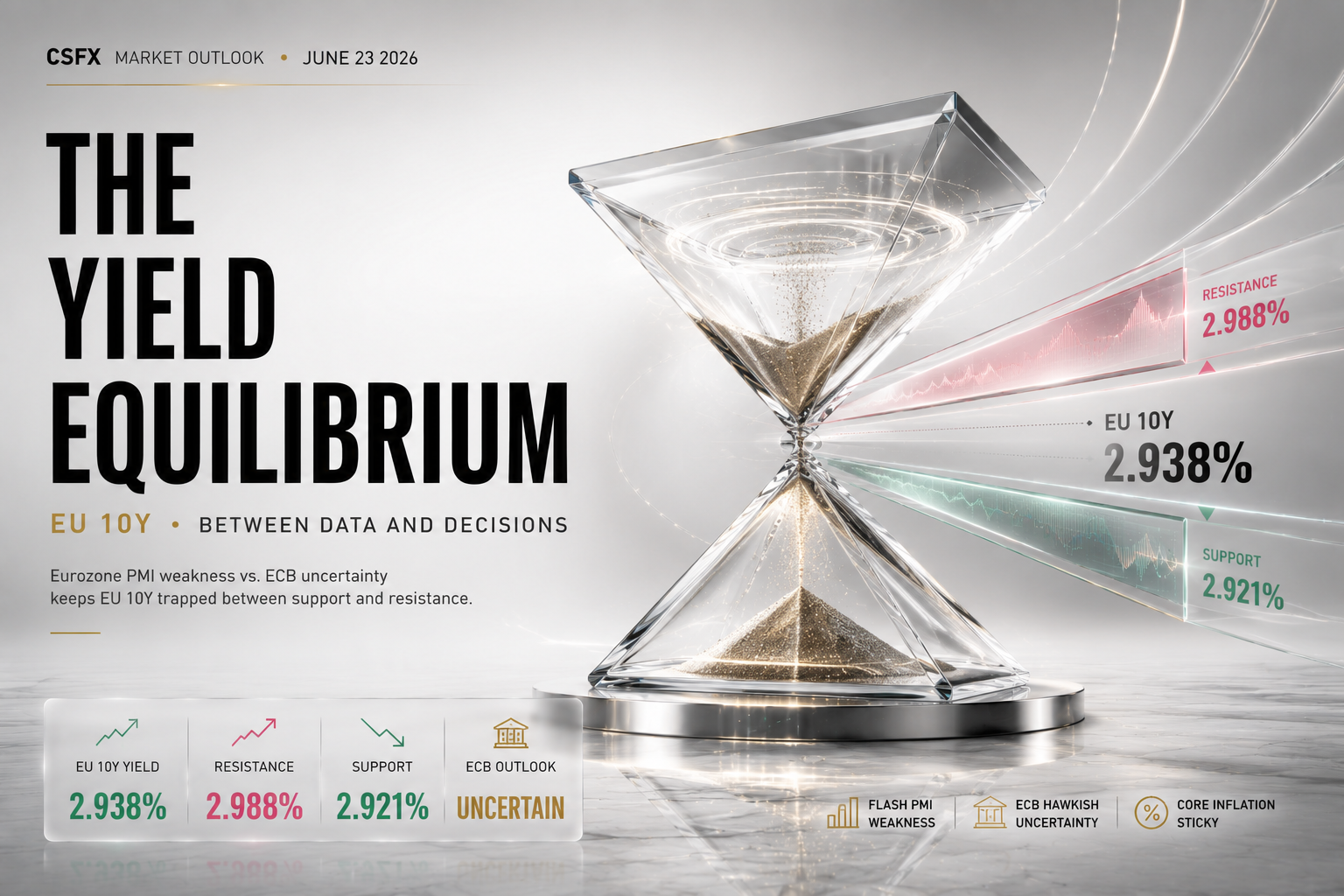
Market Outlook on EU 10Y: Euro 10-Year Bond Yield Forecast & Trade Setup
CapitalStreetFX · Rates Desk · Next 24 Hours
Market Outlook on EU 10Y
A focused 24-hour market outlook on the EU 10Y — the euro 10-year government bond yield — covering today’s technical summary, the fundamental news set to move it most, a mapped support-and-resistance grid, and a clear entry, stop-loss and take-profit trade setup. Published by CapitalStreetFX — see all live market analysis.
Yield (close)
2.938%
Daily change
−0.53%
24h bias
Neutral–soft
Pivot level
2.988%
EU 10Y technical summary for today
The EU 10Y technical analysis shows the euro 10-year government bond yield rallying from the 2.634% March low to a 3.207% high in May, then retracing into the 0.382–0.5 Fibonacci pocket. The yield now trades at 2.938%, slipping below the 2.95–3.03% moving-average cluster that previously supported the advance. That cluster has flipped into near-term resistance, and the −0.53% daily drop confirms soft short-term momentum heading into the next 24 hours.
For the next 24 hours the EU 10Y yield sits between two decisive lines: the 2.921% support (0.5 Fibonacci retracement, reinforced by the rising trendline from the March low) and the 2.988% resistance (0.382 Fibonacci plus the moving-average band). While the euro 10-year bond yield holds below 2.988%, the path of least resistance is a drift lower toward 2.921% and then 2.853%. A daily close back above 2.988% would neutralise the soft tone and reopen 3.027% and 3.072%.
EU 10Y support and resistance levels (next 24h)
| Level | Yield | Role in next 24h |
|---|---|---|
| 0.236 Fib | 3.072% | Upper resistance / breakout extension |
| MA cluster top | 3.027% | Resistance — declining moving average |
| 0.382 Fib · pivot | 2.988% | Key resistance — bias flips bullish on a close above |
| Spot | 2.938% | Current EU 10Y yield |
| 0.5 Fib + trendline | 2.921% | First support / Target 1 |
| 0.618 Fib | 2.853% | Second support / Target 2 |
| 0.786 Fib | 2.757% | Deeper downside if support breaks |

Fundamental news that will impact EU 10Y most
The fundamental backdrop for the euro 10-year bond yield outlook is dominated by three threads over the next 24 hours:
1. Eurozone & German flash PMIs (today). The S&P Global / HCOB flash PMIs are the single biggest scheduled catalyst for the EU 10Y yield. With Q1 eurozone GDP barely positive, the services and composite prints are growth-sensitive: stronger data argues for higher euro bond yields and renewed ECB-tightening pricing, while soft data pulls yields back toward support.
2. ECB tightening context. On 11 June 2026 the ECB raised rates 25bp to a 2.25% deposit rate — its first hike since 2023 — and lifted its 2026 inflation forecast to 3.0%. President Lagarde framed the move as “robust across scenarios” with no preset path. Markets still price at least one more hike this year, which anchors EU 10Y yields near multi-year highs and limits how far they can fall.
3. Oil & the Strait of Hormuz. The US–Iran memorandum of understanding and the prospective reopening of the Strait of Hormuz have driven Brent crude back from a wartime peak near $120 toward roughly $78. A sustained oil slide is disinflationary at the margin and caps the EU 10Y yield; a breakdown of the deal would re-spike energy prices and push yields higher. This is the dominant swing risk around the scheduled data.
Next-24-hour event calendar (chart markings)
These are the calendar events marked on the EU 10Y chart above and weighted for the next 24 hours. Track live releases on the CapitalStreetFX economic calendar.
| Time (UTC) | Event | Why it matters for EU 10Y |
|---|---|---|
| ~07:15–08:00 | Germany & Eurozone flash PMIs (Jun) | Primary driver — growth/inflation read for euro bond yields |
| ~08:30 | UK flash PMIs (Jun) | Spillover to the European rates complex |
| ~13:45 | US flash PMIs (Jun) | Global duration tone — cross-market read for EU 10Y |
| Ongoing | US–Iran / Strait of Hormuz headlines | Oil-led inflation premium — signing expected Friday |
| Thu (T+1) | US PCE price index | Sets the duration tone just beyond the 24h window |
EU 10Y trade setup (entry, stop-loss, take-profit)
The setup below is framed on the EU 10Y yield exactly as charted. Because yields and bond prices move inversely, the primary “short yield” stance is equivalent to a long position in the underlying euro 10-year bund.
Entry zone
2.955–2.940%
Stop / invalidation
2.995%
Target 1
2.921%
Target 2
2.853%
Engage while the euro 10-year bond yield holds below the 2.988% pivot. A daily close above 2.995% (clearing the 0.382 Fib and the moving-average cluster) invalidates the idea. Target 1 is the 2.921% support shelf; Target 2 is the 0.618 Fib at 2.853%, giving an approximate 2.5:1 reward-to-risk on the full move. Manage the position into the flash PMIs rather than holding blind through the release.
Alternate scenario — yields break higher
A daily close above 2.988%, most likely on hot eurozone PMIs or a stall in the Hormuz deal, flips the 24-hour bias bullish for the EU 10Y yield. Upside targets are 3.027% then 3.072%, with invalidation back below 2.95% (and the equivalent bund position reversed).
Key takeaways
- EU 10Y yield at 2.938%, soft on the day, pinned between 2.921% support and 2.988% resistance.
- Today’s eurozone and German flash PMIs are the primary scheduled catalyst for the next 24 hours.
- Falling oil on the Hormuz de-escalation caps the euro 10-year bond yield; a deal collapse is the upside risk.
- Primary plan fades the yield toward 2.921% then 2.853% while below 2.988%; a close above 2.988% flips the bias up.
Conclusion
The 24-hour market outlook on the EU 10Y is a finely balanced one: a euro 10-year government bond yield that has cooled from multi-year highs but remains supported by a hawkish-leaning ECB and sticky eurozone inflation. The 2.988% pivot is the line that decides the session — below it, softening momentum and falling oil favour a grind toward 2.921% and 2.853%; above it, strong PMIs or renewed energy stress reopen the 3.05–3.07% zone. Traders watching the EU 10Y over the next 24 hours should let today’s flash PMIs and the Hormuz headlines confirm direction before committing, and size positions to the invalidation rather than the target. For the risk-asset read alongside this rates view, see the Ethereum trade setup.
EU 10Y outlook FAQ
What is the EU 10Y yield doing today?
The euro 10-year government bond yield is trading near 2.938%, down about 0.53% on the day. Price has pulled back from the 3.207% May high into the 0.382–0.5 Fibonacci pocket, holding above the 2.921% support and capped by the 2.95–3.03% moving-average cluster. The next-24-hour bias for the EU 10Y yield is neutral-to-soft while it stays below 2.988%.
What moves the EU 10Y bond yield in the next 24 hours?
The eurozone and German flash PMIs released today are the primary scheduled catalyst for the EU 10Y yield. Stronger services and composite readings argue for higher euro bond yields, while soft prints revive growth fears and pull yields lower. The other live driver is the US–Iran de-escalation and the slide in oil, which trims the inflation premium baked into euro 10-year government bond yields.
What are the key EU 10Y support and resistance levels?
Immediate EU 10Y resistance sits at 2.988% (0.382 Fib) and the 2.95–3.03% moving-average band, then 3.027% and 3.072%. Immediate support sits at 2.921% (0.5 Fib, aligned with the rising trendline), then 2.853% and 2.757%.
Does a falling EU 10Y yield mean bond prices are rising?
Yes. Bond yields and bond prices move inversely. A falling EU 10Y yield means euro 10-year government bond prices (and Bund futures) are rising, and a rising yield means those bond prices are falling. The trade setup below is framed on the yield as charted, so a ‘short yield’ stance is equivalent to a long position in the underlying bund.
Did the ECB raise interest rates in June 2026?
Yes. On 11 June 2026 the European Central Bank raised its three key rates by 25 basis points, lifting the deposit facility rate to 2.25% — its first hike since 2023 — citing energy-driven inflation from the Middle East conflict. It revised 2026 headline inflation up to 3.0% and markets price at least one further hike, which keeps EU 10Y yields elevated near multi-year highs.