Oil Prices Hit $110: Iran War Ends Market’s Grace Period | CapitalStreetFx
Oil Smashes $110 & The
“Grace Period” Is Officially Dead
The market spent a week pretending the Iran war was a short-term inconvenience. Today it stopped pretending. Dow futures crashed 1,000 points, Iraq lost 70% of its oil output, and Trump called it “a very small price to pay.” Your gas bill disagrees.

For eight days, global markets maintained a polite fiction. The fiction went something like this: the US-Israel war on Iran was a contained, surgical operation that would wrap up in a fortnight, the Strait of Hormuz would reopen, oil would settle back down, and everyone could get on with their 2026 portfolio allocations. It was a lovely story. Markets really wanted to believe it. On Monday morning, reality issued a margin call.
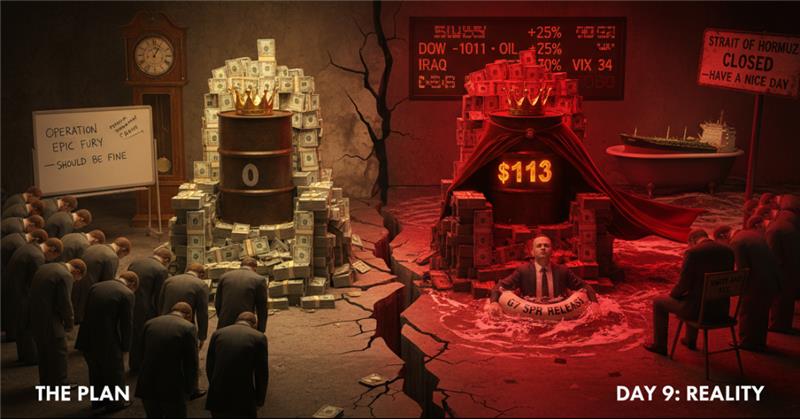
Brent crude surged 23% to $114 a barrel. WTI briefly kissed $119 before settling around $113. Dow futures cratered 1,011 points. The VIX — Wall Street’s official “oh no” meter — jumped nearly 18% to 34.78. Iraq, OPEC’s second-largest producer, effectively lost 70% of its oil output overnight. And somewhere in a Washington situation room, an analyst was trying to explain to someone important what the phrase “force majeure on oil shipments” meant.
The “grace period” — that beautiful, delusional window where markets assumed the worst wouldn’t happen — officially expired sometime between Iran naming a new hardline Supreme Leader, Israel hitting Iranian oil storage facilities, and the UAE intercepting 16 ballistic missiles and 113 drones in a single night. At that point, the market’s optimism didn’t walk out. It was shown the door.
US-Israel launch Operation Epic Fury. Markets spike initially, then shrug. Analysts call it “priced in.” Brent crude: ~$72.
Iran closes the Strait of Hormuz. 20% of global oil supply suspended. ~200 tankers stranded in the Gulf. Brent crosses $83. Gulf airspace partially closes; Emirates flights grounded. Markets still “monitoring.”
February jobs report: -92,000. Third job loss in five months. Iraq, UAE, Kuwait start cutting output — nowhere to store oil when you can’t export. Oil crosses $100. Market has a small panic, then tells itself it’s “transitory.”
Iran names Mojtaba Khamenei as new Supreme Leader (Trump’s response: “unacceptable”). Israel hits Tehran oil facilities. Iran retaliates against Bahrain’s desalination plants. Bahrain declares force majeure. Nikkei drops 7%. KOSPI -8%. US orders diplomats out of Saudi Arabia.
WTI peaks $119.50 intraday before settling ~$113. Dow futures -1,011 pts. G7 emergency call convened. Trump: “small price to pay.” G7: “let’s release reserves.” Oil: “lol okay.”
Here’s the part that sounds made up but isn’t: the Middle East is simultaneously having an oil shortage and an oil surplus at the same time. Iraq, Kuwait, and the UAE — three of OPEC’s biggest producers — are cutting output not because demand is low, but because their storage tanks are full. They’re producing oil they literally cannot ship anywhere because Iran has turned the Strait of Hormuz into a “no tankers allowed” zone, and the oil has nowhere to go.
Iraq’s three main southern oilfields, which normally pump 4.3 million barrels per day, have collapsed to just 1.3 million — a 70% drop. Meanwhile, oil prices are at their highest since 2022. It’s the economic equivalent of a bakery running out of bread while its warehouse is packed with loaves it can’t deliver. Except the loaves are crude oil, the warehouse is a Persian Gulf terminal, and the delivery truck is being threatened by ballistic missiles.
Federal Reserve officials have been describing their approach as “wait and see.” Which is a very professional way of saying they have no idea what to do. And honestly? Fair enough. The Fed is staring at an economy that shed 92,000 jobs last month — the third job loss in five months — while simultaneously facing a potential oil-driven inflation shock that could add 0.4 percentage points to headline CPI for every $20 rise in crude.
Cut rates to support the weakening labour market? Risk reigniting inflation just as oil adds fuel to the fire. Hold rates? Watch a soft labour market potentially tip into something worse. As Morgan Stanley noted this week, the conflict could “box in the Fed” — creating pressure to pause rate moves entirely while officials watch inflation and growth pull in opposite directions.
The Atlanta Fed’s GDPNow model — which tracks real-time economic growth — tumbled to a 2.1% Q1 annualised rate on Friday, down from 3.0% just days earlier. A $20 sustained oil shock could take another 0.1% off GDP. Not catastrophic on its own, but stack it on a weak jobs market, sticky core inflation at 3.0%, and a war with no visible exit strategy, and the phrase “soft landing” starts to feel optimistic.
G7 finance ministers were convened on an emergency call Monday morning to discuss a coordinated release of strategic petroleum reserves — the global economy’s version of breaking glass in case of fire. The last time this happened at scale was after Russia invaded Ukraine in 2022. The IEA is expected to coordinate any action.
Markets reacted with a brief sigh of relief: Brent pulled back from its intraday peak of $119.50 to around $108–114 on the news. Which tells you everything you need to know. A coordinated emergency reserve release — the kind of thing that would normally be headline-calming news — barely knocked 5% off an intraday peak. The market is pricing in a prolonged conflict, and a reserve release is a Band-Aid, not surgery.
☑ Agree oil prices are “concerning”
☑ Discuss coordinated SPR release
☑ Issue strongly-worded joint statement
☐ Figure out how to reopen the Strait of Hormuz
☐ Convince Iran to stop launching missiles
☐ Locate exit strategy (still missing)
Let’s cut through the noise. This is not a two-day oil spike. The structural conditions for elevated energy prices — a closed strait, destroyed storage infrastructure, spooked tanker operators, and a new Iranian supreme leader with hardliner credentials and IRGC backing — do not resolve in a week. As Kpler’s lead crude analyst noted, oil could hit $150/barrel by end-March if Hormuz remains choked. That’s not a base case. But it’s no longer a tail risk.
Energy sector: The obvious beneficiary. US-listed energy companies, particularly those with domestic production, are insulated from the Hormuz closure. Majors with diversified supply chains look attractive in a $110+ environment.
Defence: Palantir jumped 15% last week as the Iran war boosted its government contract prospects. The broader defence complex — Lockheed, Raytheon, Northrop — was already positioned for multi-year tailwinds. This conflict added more runway. Trump confirmed defence CEOs have agreed to quadruple “Exquisite Class” weapon production.
Bonds: The 10-year Treasury yield moved up 6.6 basis points to 4.13% on inflation fears. If oil stays elevated, the inflation-rate cut trade that had many bond investors optimistic for 2026 gets complicated fast. Watch the 10-year closely.
Gold: Already up 7.7% since the war began, gold has quietly become the trade of the conflict. The geopolitical uncertainty premium is real, and with the Fed on hold and dollar strength somewhat offset by global risk-off flows, gold’s case as a hedge remains intact.
Equities broadly: The S&P’s “flat” performance last week was impressive given the circumstances — but that was when the market still had its grace period. Monday’s futures suggest the rethink has begun. The VIX at 34.78 is officially in “elevated anxiety” territory. Expect volatility to be the menu for the foreseeable future.
The President’s confidence is noted. The bond market, the VIX, and 1,011 Dow futures points respectfully disagree. But then again — markets have been wrong before. If the conflict de-escalates rapidly, if the Strait reopens, if the G7 reserve release calms the energy complex, the “transitory” camp gets vindicated and 2026 looks a lot more like the constructive outlook JPMorgan and others laid out in January.
The problem is that none of those “ifs” currently have a visible timeline. And markets, as any trader will tell you, hate uncertainty more than they hate bad news. Right now, they’re getting both.
Wednesday: G7 statement on reserve release — market will price the quantum
Thursday: Iran new Supreme Leader’s first policy signals — IRGC and hardliners have already pledged to fight on
Friday: University of Michigan Consumer Sentiment — brace for ugly
All week: Strait of Hormuz tanker traffic data — the single most important number in global markets right now
The grace period is over. The question now isn’t whether this war disrupts global markets — it already has. The question is whether the disruption lasts weeks, months, or something longer. Position accordingly. And maybe take public transport this week.
Everything You’re Googling Right Now — Answered
From “why is gas so expensive” to “what does this mean for my investments” — we’ve got you. Click any question to expand. No jargon, no condescension, mild amounts of sarcasm.
The short answer: the US-Israel war on Iran has effectively closed the Strait of Hormuz — the narrow waterway through which 20% of the world’s daily oil supply flows. When Iran threatened to attack tankers transiting the strait, shipping operators did what any rational person does when told there are ballistic missiles nearby: they left.
With tankers gone, Gulf producers like Iraq, Kuwait and the UAE couldn’t export their oil. With nowhere to ship it and storage tanks filling up, they started cutting production. Iraq’s three main southern oilfields — which normally pump 4.3 million barrels per day — fell 70% to just 1.3 million bpd. Simultaneously, Israel struck Iranian oil storage facilities over the weekend, and Iran retaliated against Bahrain’s desalination plants. The market, which had politely been pretending this wouldn’t get worse, decided it probably would get worse. Hence: $113 oil and a 1,000-point Dow futures crash before 9 AM on a Monday.
The Strait of Hormuz is a narrow channel — at its narrowest, just 21 miles wide — sitting between Iran and Oman. Every day, roughly 20 million barrels of crude oil pass through it, along with massive volumes of liquefied natural gas. It connects the Persian Gulf (where Saudi Arabia, Iraq, Kuwait, UAE and Iran all export from) to the wider ocean and the rest of the world.
Think of it as the world’s most important energy highway. Now imagine someone put spike strips across it and is threatening to blow up any vehicle that uses it. That’s the Strait of Hormuz in March 2026. The roughly 200 tankers currently stranded in the Gulf represent tens of millions of barrels of oil that should be en route to refineries in Asia, Europe and the US — and aren’t. Every day they stay stuck, the global supply picture gets worse.
Kpler’s lead crude analyst and Qatar’s Energy Minister have both floated $150/barrel as a possibility if the Strait remains closed through end-March. That’s not a certainty — but it’s no longer the kind of number that makes analysts laugh nervously and change the subject.
Here’s what $150 oil would look like in practice:
🚗 US gas prices: National average would likely climb toward $4.80–5.20/gallon (it was $3.45 on Sunday, already up 16% in a week).
✈️ Flights: Jet fuel costs would surge; expect airfare increases within weeks.
🛒 Groceries: Transport and logistics costs would filter through to food prices within 4–8 weeks.
📈 Inflation: Every $20 rise in crude adds ~0.4pp to US CPI. A $40 sustained rise above current levels could push headline inflation back above 3%.
🏦 Interest rates: The Fed, already frozen between a weak job market and sticky inflation, would have even less room to cut rates.
The G7 coordinated strategic reserve release is designed to prevent this scenario. Whether it’s enough depends entirely on how long the Strait stays closed.
This is the Fed’s nightmare scenario, and it’s genuinely not their fault. The Federal Reserve has two jobs: keep inflation around 2%, and keep unemployment low. Right now, those two jobs are pulling in opposite directions at full force, and an oil shock is making both worse simultaneously.
The US economy just shed 92,000 jobs in February — the third monthly job loss in five months. That’s the kind of number that normally screams “cut rates immediately.” But cutting rates when oil prices are surging risks pouring petrol on an already-hot inflation fire (pun very much intended). Core PCE is already at 3.0%, a full percentage point above target. An oil-driven CPI surge on top of that could push headline inflation meaningfully higher.
So the Fed’s options are: cut rates and risk inflation, hold rates and watch the economy slow, or raise rates and cause a recession. Morgan Stanley describes this as the Fed being “boxed in.” We’d describe it as being stuck in a revolving door that’s on fire. Their current approach: “wait and see.” Which is a very professional way of saying they’re watching the same news as everyone else and hoping something changes.
Strategic Petroleum Reserves (SPR) are emergency oil stockpiles held by governments for exactly this kind of crisis. The US alone holds around 400 million barrels in underground salt caverns in Louisiana and Texas. The G7 — US, UK, Germany, France, Italy, Japan, Canada — collectively control significant reserves, and the IEA (International Energy Agency) coordinates member countries’ reserves on top of that.
The last major coordinated SPR release was after Russia invaded Ukraine in 2022, when the IEA released 60 million barrels. It provided temporary price relief. The key word is temporary.
Today’s news of a G7 emergency call pushed oil back from its $119.50 intraday peak to around $108–114 — a meaningful pullback, but it underscores the problem: the market barely blinked. An SPR release puts more oil into the system, but it does nothing to fix the underlying issue, which is that 20% of global oil supply is physically stuck in the Persian Gulf behind a wall of Iranian missile threats. Until tankers can safely transit the Strait of Hormuz again, reserve releases buy time rather than solve the problem.
Please read this alongside advice from a qualified financial advisor. This is analysis, not a recommendation.
📈 Energy stocks (domestic US producers): Companies with US-based production are insulated from Hormuz disruptions. Higher crude prices directly boost their revenues and margins. In a $110+ environment, this is the most straightforward beneficiary.
🛡️ Defence sector: Palantir jumped 15% last week. Lockheed Martin, Raytheon, Northrop Grumman are already in a multi-year government spending supercycle. Trump confirmed defence CEOs have agreed to quadruple “Exquisite Class” weapon production. Wars are expensive; defence companies’ order books grow accordingly.
🥇 Gold: Up 7.7% since the war began on Feb 28. With the Fed on hold, geopolitical uncertainty high, and real yields uncertain, gold’s role as a crisis hedge is doing exactly what it says on the tin.
⚠️ Caution — Broad equities: VIX at 34.78 signals elevated fear. The S&P’s relative calm last week was the grace period. Monday’s futures suggest the reassessment has begun. Volatility is now the baseline, not the exception.
⚠️ Caution — Long-duration bonds: Rising inflation expectations push yields higher, hurting bond prices. The 10-year Treasury yield climbed 6.6bps to 4.13% Monday. If oil stays elevated, the rate-cut narrative that was supporting bonds in early 2026 gets significantly complicated.
On March 8, Trump posted on Truth Social: “Short term oil prices, which will drop rapidly when the destruction of the Iran nuclear threat is over, is a very small price to pay for U.S.A., and World, Safety and Peace. ONLY FOOLS WOULD THINK DIFFERENTLY!”
The geopolitical argument has merit: if the war achieves its stated objectives and the Strait reopens within weeks, the oil spike would prove temporary and the economic damage manageable. History supports the idea that commodity shocks tied to short conflicts resolve relatively quickly.
The problem is the “short” part. The administration’s own timeline has slipped from “a few days” to “4-5 weeks” to Defence Secretary Hegseth’s memorable “3, 6, 8 weeks — whatever.” Iran has now named a hardline new Supreme Leader with IRGC backing who has pledged to fight on. The Strait remains closed. The US just ordered diplomats out of Saudi Arabia.
The bond market (yields up), the VIX (up 18%), the Dow futures (-1,011 points), and the 92,000 Americans who lost their jobs in February would respectfully suggest the price — small or otherwise — is being felt right now, regardless of how it looks in hindsight.
The Grace Period Is Over.
The Reckoning Has Just Started.
For eight days, markets held their breath and priced in optimism. The war would be short. The Strait would reopen. The oil spike would be transitory. The Fed would find a way. The G7 would ride in with reserve releases. Everyone would be fine by Easter.
Monday, March 9, 2026 is the day that story officially died. Oil topped $113. Dow futures crashed 1,011 points. Iraq lost 70% of its oil output. Iran named a new hardline Supreme Leader. The IRGC launched fresh missiles. And the G7 — the most powerful economic alliance on the planet — had to schedule an emergency call before 9 AM just to discuss what to do about gasoline prices.
None of this means catastrophe is inevitable. Wars end. Straits reopen. Reserve releases buy time. New supreme leaders sometimes surprise. The oil market has a well-documented history of overshooting on fear and correcting sharply when the narrative shifts. The “transitory” camp could still be right.
But the burden of proof has shifted. The optimists now need to explain what specifically changes — and when. The Strait doesn’t reopen on its own. A new supreme leader backed by the IRGC doesn’t signal moderation. An economy bleeding 92,000 jobs a month doesn’t absorb a 25% oil spike painlessly. And a Fed frozen between inflation and recession doesn’t have a good answer to any of it.
The market spent a week pretending this was a “short-term disruption.” It wasn’t. The question now isn’t whether the war affects markets — it already has, measurably and materially. The question is duration. Weeks or months changes everything. Position for the scenario where this isn’t over by Easter. Hope to be pleasantly wrong.
And in the meantime — if you drive to work, you already know what $113 oil feels like. Your wallet got the memo before the futures market did.
“The grace period gave markets a week to pretend. The reckoning is giving them no choice but to price. Watch the Strait. Watch the VIX. Watch the 10-year. And for the love of markets, watch the CPI on Tuesday — it’s the last clean number before the oil shock hits the data. After that, all bets are off.”