Global Forex & CFD Broker | 1:10,000 Leverage

Mobile Header & Menu
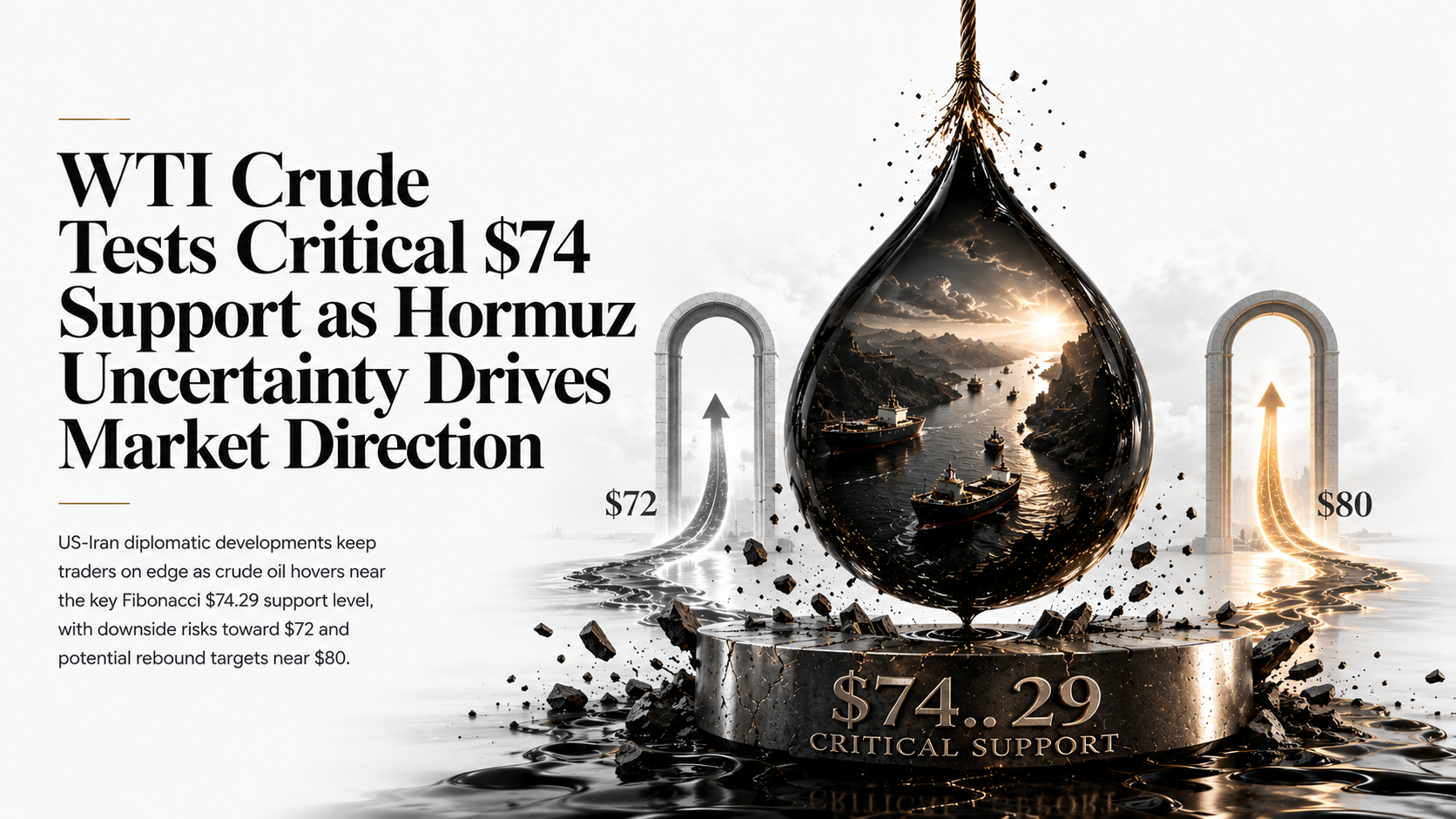
Crude Oil tests

Trade Setup: WTI Crude Oil (USOIL) – June 22, 2026 | Technical & Fundamental Analysis

June 22, 2026
Research Desk
Trade Setup: WTI Crude Oil (USOIL) – June 22, 2026 | Technical & Fundamental Analysis
CSFX Research · Trade Setup · June 22, 2026

Trade Setup for
WTI Crude Oil (USOIL)

$75.31
▼ −$0.20 (−0.26%)
NYMEX: WTI Crude Oil CFD · TVC:USOIL 24-Hour Outlook 🌐 Geopolitical: Strait of Hormuz

Executive Snapshot

Current Price
$75.31
As of 13:49 UTC+5:30 (June 22)
Session Range
$74.90–$78.14
Today’s Open: $78.00
Fib 0.786 Level
$74.29
Critical support – currently testing
Weekly Decline
~10%
Largest weekly loss in June 2026
Daily Bias
Bearish
Strong Sell on daily/5H timeframes
Expected Range (Jun 22)
$71.84–$76.02
LiteFinance Projection
🛢️
PRIMARY DRIVER: Strait of Hormuz & US-Iran MOU
The dominant force behind WTI price action in June 2026 is the status of the Strait of Hormuz — the world’s most critical oil chokepoint. A US-Iran Memorandum of Understanding (MOU) was signed, raising ceasefire hopes and triggering a sharp ≈10% weekly decline in crude as war-risk premium fades. However, talks in Switzerland were delayed/canceled, Iran halted strait traffic again, and President Trump renewed threats. The next 24 hours are defined by whether diplomatic progress holds — any breakdown = spike; any progress = continued decline.

Technical Analysis – WTI Crude Oil Chart

WTI Crude Oil USOIL daily chart with Fibonacci retracement levels and moving averages – June 22 2026
USOIL (WTI Crude Oil) – Daily Chart · Fibonacci Retracement (120.39 → 61.74) · Moving Averages · June 22, 2026 · Source: TradingView (CSFX-RESEARCH)

Chart Interpretation

WTI Crude Oil has been unwinding its “war premium” since the April 2026 peak near $120.39 (Fibonacci 0.0 extension / swing high), declining steeply within a descending channel. Price is now trading at $75.31, hovering immediately above the critical Fibonacci 0.786 retracement level at $74.29 — the most significant support zone on the chart. This level corresponds with the dotted red horizontal line on the chart and represents the last major defense before a potential move toward the swing base at $61.74 (Fibonacci 1.0).

All three moving averages (orange fan) are now in a bearish configuration — short-term MA has crossed below mid-term, and the descending channel continues to compress price. The 100-day and 200-day SMAs (grey diagonal trendlines on chart) are sloping sharply lower and trading well above current price, confirming that the path of least resistance remains downward. A corrective bounce toward the 38.2% Fib at $79.95 is possible if diplomatic progress emerges, but sellers are likely to reload at those levels.

BullishBearish Bias: 72%Bearish

Fibonacci Retracement Levels – WTI Crude Oil

Fib drawn from swing high $120.39 (peak war premium) to swing low $61.74

Fib LevelPriceRoleStatus
0.0 (High)$120.39Swing High / OriginFar Resistance
0.236$106.55First resistance on bounceResistance
0.382$97.9938.2% Fib — seller reload zoneKey Resistance
0.5$91.07Mid-point / pivot on bouncesResistance
0.618$84.1561.8% “Golden ratio” supportBroken (was support)
0.786$74.29⚡ CRITICAL SUPPORT — currently testingTesting Now
1.0 (Low)$61.74Swing Low — downside target if $74.29 breaksMajor Support

Technical Indicators Summary

IndicatorReadingTimeframeSignal
Short-term Moving Average~$87.38 (above price)DailyBearish
Mid-term Moving Average~$93.59 (above price)DailyBearish
Long-term Moving Average~$87.30 (above price)DailyBearish
RSIRising from near-oversoldDailyCorrective Bounce
Stochastic OscillatorTurning higher from lowsDailyBounce Possible
100 SMA / 200 SMABoth sloping sharply lower, above priceDailyBearish
Investing.com Daily SummaryStrong SellDaily / 5HStrong Sell
Key Support$69.92 (daily range projection)DailySupport
Key Resistance$80.53 (daily range projection)DailyResistance
Descending ChannelPrice inside channel, sloping lowerDailyBearish

Fundamental News – Key Drivers Today

Geopolitics · US-Iran · Most Critical
Strait of Hormuz: Reopening vs. Closure – The Binary Risk
The Strait of Hormuz remains the most potent price driver for WTI crude in 2026. The EIA has confirmed that Middle East producers reduced crude output by over 11 million barrels per day in May versus pre-conflict levels due to the effective closure of the strait. An interim US-Iran MOU was signed, but subsequent talks in Switzerland were delayed and Iran halted strait traffic again. Iranian state media reported that Iran demanded an end to the war in Lebanon as a precondition, while President Trump threatened renewed strikes and economic tolls. Saudi Arabia’s first tankers in months have attempted to move, but shipping activity remains severely disrupted. Any credible ceasefire headline = sharp downside for WTI; any escalation = immediate spike.
OPEC Supply · Structural
OPEC Output at Multi-Year Lows; Saudi Price Cuts Signal Demand Concern
In March 2026, OPEC oil output fell to its lowest level since June 2020. Simultaneously, Saudi Arabia is reportedly prepared to lower July official selling prices (OSP) for most crude grades shipped to Asia — a sign that demand from key importers, particularly China, is weakening. Chinese imports of Saudi crude are expected to decline sharply by end of June to 333,000 b/d from 1.4 million b/d at year-end 2025. These demand signals create headwinds for crude even as supply constraints remain.
EIA Outlook · June 2026
EIA Assumes Hormuz Closed in Near Term; Forecasts Q3 Ramp-Up
The US Energy Information Administration (EIA), in its latest Short-Term Energy Outlook, assumes the Strait of Hormuz will remain “effectively closed” in the near term, with shipments resuming in Q3 2026. Full pre-conflict traffic levels are not expected until early 2027. This creates a medium-term bullish floor, but the near-term price action reflects the market pricing in a faster resolution than the EIA baseline. Global oil demand is forecast to decrease by 1.1 million b/d over 2026, a reversal from prior expansion forecasts.
US Economic Data · Week Ahead
PMI Data, GDP Revision & PCE Inflation Data Due This Week
This week’s US economic calendar includes June Manufacturing and Services PMI (flash) on June 23, first-quarter GDP estimates, and the PCE Price Index (May) on June 25. A soft manufacturing PMI or demand-destruction signals in GDP could add further downside pressure on crude oil. The University of Michigan June inflation expectations survey (also due this week) may influence USD strength, which inversely affects oil prices.

Event Calendar – Next 24 Hours (Impact on Oil)

  • Jun 22
    All Day
    🌐 US-Iran Diplomatic Developments (Ongoing)
    Any headline on Strait of Hormuz status, Swiss talks resumption/cancellation, or Iranian traffic controls will cause immediate volatility. Monitor in real time. A formal ceasefire announcement could trigger -3% to -5% in WTI within minutes.
  • Jun 23
    Prelim
    🇺🇸 US Manufacturing PMI (June Flash)
    Weak reading below 50 = bearish for oil demand outlook and could send WTI toward $74 support. Strong reading above 52 = modest bullish lift. Impact window: 30–60 minutes post-release.
  • Jun 23
    Prelim
    🇺🇸 US Services PMI (June Flash)
    Services sector health affects overall energy demand sentiment. A miss here could amplify selling pressure on crude already under technical pressure near $74.29 Fibonacci support.
  • Jun 23
    Post-mkt
    📦 API Weekly Crude Oil Stock Report
    A large inventory build (bearish) could push WTI below $74 Fibonacci support. A large draw (bullish) could trigger a corrective bounce toward $77–$78. Consensus expects a moderate build as US production remains at record highs (~13.6 mb/d).
  • Jun 23
    Ongoing
    🛳 Tanker Traffic Monitoring – Strait of Hormuz
    Satellite and shipping data on tanker movements through the Strait is being actively tracked. A reported surge in Saudi tanker movements = bullish supply-recovery signal for stocks but bearish for oil prices (more supply). A halt in traffic = bullish spike for WTI.

Trade Setup – Entry, Stop Loss & Take Profit

📌 Setup Context: WTI is in a confirmed downtrend, testing critical Fibonacci 0.786 support at $74.29. Two setups are presented: a short continuation (primary, aligned with trend) and a bounce long (counter-trend / short-term only). Both are for the next 24-hour window only.

Primary Setup: Short Continuation (Trend-Following)

📈 Entry (Short)
$76.50–$78.00
Enter short on a bounce/dead-cat retest of the $76–$78 zone (former intraday support now resistance). Look for bearish candle confirmation.
🛑 Stop Loss
$79.00
Above the intraday high session ceiling and the $78.50 horizontal resistance. A daily close above $79 negates the short-term bearish structure.
🎯 Take Profit
$74.29 → $72.00
TP1: $74.29 (Fib 0.786 — partial close). TP2: $72.00 (psychological/channel floor). TP3: $69.92 (projected daily support).

Alternative Setup: Bounce Long (Counter-Trend, Short-Term Only)

📈 Entry (Long)
$74.29–$75.00
Enter long only on a clean bullish rejection candle at the 0.786 Fib support ($74.29). RSI and Stochastic both showing oversold bounce signals.
🛑 Stop Loss
$72.80
Below the $74.29 Fib level with a buffer. A daily close below $74 would signal the support is broken and the next target is $61.74.
🎯 Take Profit
$78.00–$80.00
TP1: $78.00 (recent open / intraday pivot). TP2: $79.95 (38.2% Fib retracement on bounce). Exit before $80.53 resistance wall.

Full Setup Parameters

ParameterShort Setup (Primary)Long Setup (Alt)
BiasBearish / Trend-FollowingCounter-Trend Bounce
Entry$76.50–$78.00 (retest/rejection)$74.29–$75.00 (Fib support)
Stop Loss$79.00$72.80
Take Profit 1$74.29 (Fib 0.786)$78.00 (pivot)
Take Profit 2$72.00$79.95 (38.2% Fib)
Take Profit 3$69.92
Risk/Reward~1:2.2 (short at $77, SL $79, TP $74)~1:2.0 (long at $74.5, SL $72.8, TP $78)
Timeframe24-hour / intradayIntraday only
TriggerBearish rejection candle on bounceBullish rejection candle at $74.29
Key RiskGeopolitical escalation spikeFib support break below $74

Frequently Asked Questions – WTI Crude Oil

Why is WTI crude oil falling sharply in June 2026?
WTI crude oil has fallen approximately 10% in the week ending June 22, 2026, primarily due to a de-escalation in the US-Iran conflict. An interim Memorandum of Understanding (MOU) raised hopes that the Strait of Hormuz — effectively closed since March 2026 — could reopen. As the war-risk premium that drove prices to $120.39 fades, crude oil is retracing toward pre-conflict Fibonacci support levels. Additional headwinds include record US crude production (~13.6 million b/d), declining Chinese demand for Saudi oil, and Saudi Arabia’s decision to lower official selling prices for July.
What is the key support level for crude oil right now?
The most critical support level for WTI crude oil on June 22, 2026, is the Fibonacci 0.786 retracement at $74.29 — drawn from the peak at $120.39 to the swing low at $61.74. This level is also marked by the red dotted horizontal line on the CSFX Research TradingView chart. A sustained daily close below $74.29 would open the path toward $72.00, $69.92, and potentially the $61.74 swing low.
How does the Strait of Hormuz closure affect crude oil prices?
The Strait of Hormuz is the world’s most important oil chokepoint, through which approximately 20–21% of global petroleum flows daily. The effective closure of the strait from March 2026 caused Middle East producers to cut output by more than 11 million barrels per day versus pre-conflict levels, driving Brent crude to $120+ per barrel. Any resumption of traffic through the strait signals increased supply, which is bearish for oil prices. Conversely, any new Iranian military action to block the strait is immediately bullish for crude.
What is the crude oil price forecast for the next 24 hours?
Based on LiteFinance projections and technical analysis, WTI crude oil is expected to trade within the $71.84–$76.02 range on June 22, 2026, with key support at $69.92 and resistance at $80.53. The path of least resistance remains bearish given that both the 100-day and 200-day moving averages slope lower and price remains below all major SMAs. A geopolitical headline could override technical levels in either direction within minutes.
What economic events could move crude oil prices this week?
The most impactful scheduled events for crude oil in the next 48–72 hours are: (1) US Manufacturing & Services PMI flash data (June 23), (2) API Weekly Crude Oil Stock Report (June 23 post-market), (3) EIA Weekly Petroleum Status Report (typically June 25), and (4) US Q1 GDP revision and PCE Inflation data (June 25). Additionally, any unscheduled geopolitical developments around the Strait of Hormuz, US-Iran talks in Switzerland, or OPEC+ announcements would be immediately market-moving.
Is there a bullish case for crude oil in the near term?
Yes. A counter-trend bounce is possible from the $74.29 Fibonacci 0.786 support, as both the RSI and Stochastic oscillator are rising from near-oversold levels. If peace talks break down decisively and Iran re-closes the Strait of Hormuz, WTI could spike sharply toward $80–$85. OPEC output remaining near multi-year lows and the EIA’s view that full Hormuz traffic won’t resume until early 2027 provide structural medium-term support. However, the primary trend remains bearish for the 24-hour window absent a geopolitical shock.

Conclusion

WTI Crude Oil enters the June 22–23 session at a defining technical juncture. Price is testing the Fibonacci 0.786 support level at $74.29 — the last major defense before a potential move toward the swing base at $61.74. All technical indicators across daily and 5-hour timeframes align as “Strong Sell,” confirming that the downtrend initiated from the $120.39 war-premium peak remains firmly intact.

The primary trade setup is a short entry on any bounce toward $76.50–$78.00, targeting the Fibonacci support zone and below. However, traders must maintain strict geopolitical risk awareness: the Strait of Hormuz situation can reverse oil prices by $3–$8 per barrel in minutes on a single headline. Risk management through tight stops at $79.00 is non-negotiable. A valid counter-trend long exists only on a confirmed bullish rejection at $74.29 with an intraday stop at $72.80. The medium-term structural bear case remains intact unless Hormuz talks fail completely and supply restrictions return at full force.

Risk Disclosure: This report is produced by CSFX Research for informational and educational purposes only and does not constitute financial advice, investment advice, or a recommendation to buy or sell any security or commodity. Trading crude oil CFDs, futures, or related instruments involves significant risk of loss including the possible loss of your entire investment. Geopolitical events can cause sudden and extreme price movements. Always conduct your own analysis and consult a qualified financial adviser before making trading decisions.
CSFX Research · Trade Setup: WTI Crude Oil (USOIL) · June 22, 2026 · Report generated at 13:49 UTC+5:30 · For informational purposes only.