West Asia Conflict Hits Home: India Prioritizes Kitchens Over Curry Houses in LNG Shortage | The World Gas Gazette
West Asia Conflict Hits Home:
India Prioritizes Kitchens Over
Curry Houses in LNG Shortage

🌊 The Hole in the World’s Gas Pipe
The World’s Most Inconvenient Shipping Lane
Let us begin with geography, because geography started this. The Strait of Hormuz is, generously speaking, 33 kilometres wide. It sits between Iran on one side and Oman on the other, and it is the reason that roughly 20 percent of the world’s traded natural gas and 21 percent of its oil pass through a gap roughly the width of a major European city — every single day, forever, until something goes wrong.
Reader, it happened. Not a full closure — technically the strait remains open — but a functional one. Since the West Asia conflict escalated in late 2025, insurance premiums for LNG tankers daring to transit the strait have risen by 420 percent. Several vessels have been damaged by drones. Others have simply turned around, concluding that the bonus was not worth the risk.
“The Strait of Hormuz is 33 kilometres wide. The economic catastrophe it has just produced is considerably wider.”
The International Energy Agency, not a body known for drama, used the phrase ‘most severe LNG supply disruption since 2021-22’ in its emergency bulletin of March 3rd. Global LNG spot prices have more than doubled since January. Qatar, the world’s second-largest LNG exporter, is honouring its long-term contracts — which cover perhaps 70 percent of its output — and spot markets are left to fight over the remainder with the intensity of a Boxing Day sale at an appliance store.
The World Reacts (Badly, Expensively, and in Several Languages)
If there is one country on earth that did not need a sequel to the 2022 gas crisis, it is Germany. The Germans spent three years and 10 billion euros building four new LNG terminals, diversifying away from Russian pipelines, and reassuring themselves that they had learned their lesson. They had. The lesson just had a follow-up exam nobody had pencilled into the calendar.
Germany’s Federal Network Agency has quietly activated Stage 2 of the national Gas Emergency Plan, placing industrial users on notice for mandatory cuts of up to 25 percent. BASF — the world’s largest chemical company, which consumes more gas than the entire nation of Portugal — has begun reducing output at its Ludwigshafen complex for the third time in four years, which is now so routine they have a slide in their investor presentation for it.
The timing, to use the technical policy term, is catastrophic. Germany holds federal elections in September. No governing coalition in history has won re-election while telling voters that their heating and their factory jobs are being rationed simultaneously. The phrase ‘Energiekrise II’ is trending on German social media, which is exactly as grim as it sounds.
Italy’s contribution to world civilisation includes art, philosophy, cuisine, and — less romantically — the world’s most advanced glass and ceramics industry. Glass furnaces require temperatures above 1,500 degrees Celsius. They run on gas. They cannot be easily turned off without destroying the furnace itself. Italy’s glassmakers are caught between a rock and an energy bill, and they have chosen, sensibly, to start cutting production.
The upshot: pharmaceutical vials, wine bottles, and flat glass for construction are getting scarcer. The irony of an Italian gas crisis manifesting first as a wine bottle shortage is so perfect that journalists across the country have collectively agreed not to make the obvious joke. (We are not Italian journalists.)
Spain, meanwhile, is suffering the unique indignity of having done mostly the right things — built Atlantic LNG terminals, diversified suppliers — and still watching household energy bills rise 31 percent year-on-year, because global markets care neither for competence nor for effort. Spanish consumers have coined the phrase ‘la paradoja energética,’ which translates roughly as ‘we tried and it still cost this much.’
Japan imports approximately 75 million tonnes of LNG every year — more than any other country — and uses it to generate a third of its electricity. This is the kind of structural dependency that makes energy ministers age visibly in real time. Prime Minister Takaichi’s government has convened an emergency cabinet sub-committee, issued formal requests to industry for voluntary 10 percent reductions, and sent envoys to Australia, Malaysia, and the UAE simultaneously. Japan, as a country, is doing everything correctly and experiencing the problem anyway.
South Korea’s situation is arguably more alarming for the global consumer economy. POSCO — the world’s sixth-largest steelmaker — has cut output by 15 percent at its Pohang facility. Samsung SDI, which makes batteries for Teslas and BMWs, has flagged energy cost increases that will feed into battery pack prices. The clean energy transition, it turns out, runs on gas at the manufacturing stage.
“Japan has 11 days of LNG reserves. Taiwan has 11 days of LNG reserves. Germany has 58 percent of storage capacity. Everyone is smiling tightly and updating their emergency plans.”
Taiwan imports 98 percent of its gas as LNG. It has approximately 11 days of strategic reserves. The island is simultaneously managing energy shortages, watching Chinese military exercises in the Taiwan Strait, and trying to keep TSMC’s chip fabs — which supply semiconductors for every smartphone, laptop, car, and data centre on earth — powered and operational. If you have ever used a computer, a phone, or a modern car, you have a personal interest in Taiwan’s gas supply situation that your energy bill does not yet reflect.
🇮🇳 India’s Triage — Kitchens vs Curry Houses
The World’s First Officially Rationed Dinner
Which brings us, with appropriate drama, to the subcontinent. India has the distinction of being the first major economy to implement formal domestic gas rationing in response to the 2026 crisis — and the rationing priority list, if you read it as social commentary rather than energy policy, tells you everything about how governments think about their citizens.
Priority One: households. Because the alternative is telling 1.4 billion people they cannot cook their own food, which is not a policy any government survives. Priority Two: CNG for transport. Because the auto-rickshaw driver who loses his fuel is also a voter who loses his livelihood, and India has a democratic election cycle that focuses the mind wonderfully. Priority Three: fertilizer plants, because the alternative is a food price crisis on top of an energy crisis. Priority Four: industrial users. Priority Five: commercial establishments — meaning restaurants, hotels, sweet shops, and dhabas — who have received cuts of 30 to 50 percent with a notice period that could generously be described as ‘brisk.’
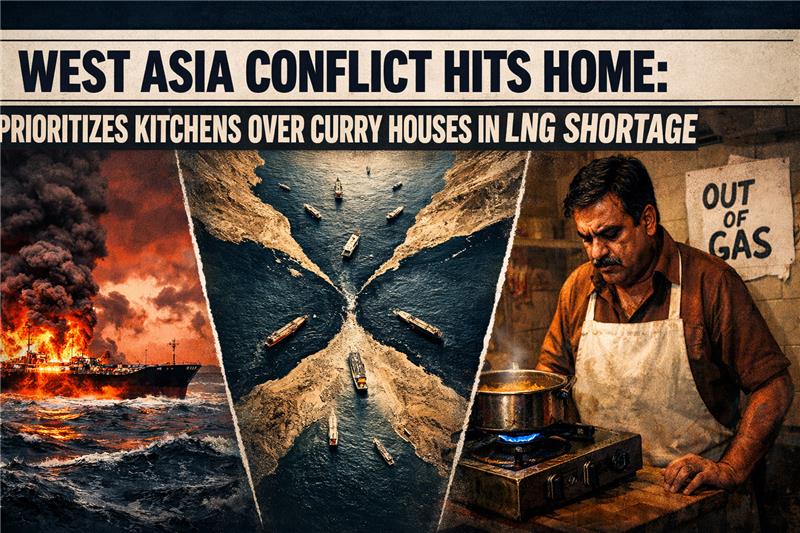
Rajan Kapoor, who runs a dhaba in South Delhi’s Lajpat Nagar, received a government notice alongside a 40 percent supply reduction on Monday morning. He has sourced one electric induction burner to compensate, has removed two items from his menu, and has shortened his operating hours. ‘I understand the government has to manage,’ he says, tending to a dal makhani that has been cooking since 5am. ‘But I also have to manage. And right now managing means the same dal, smaller pot, same price, more complaints.’
The National Restaurant Association of India, representing the sector’s 7.3 million direct workers, has written to the Ministry. The letter is polite, urgent, and almost certainly filed under ‘will review when geopolitical situation stabilises’ — which is to say: not immediately.
The fiscal fallout is the part the government would prefer you not to dwell on. India has tabled emergency supplementary demands of Rs 4,230 crore for the urea subsidy and Rs 15,000 crore for the broader fertilizer bill — a combined overrun that suggests the original budget was written in more optimistic geopolitical times, which it was, because everyone’s budget is written in more optimistic geopolitical times than the times we are currently living through.
The Rest of the World Is Also Having a Terrible Time
While Germany debates its election implications and Japan activates emergency cabinets, the countries absorbing the worst human cost of this crisis are not making the front pages of the Financial Times. Bangladesh — which funds gas imports partly through IMF credit lines — has been priced out of the spot market almost entirely. Load-shedding runs 6 to 8 hours per day in Dhaka. Garment factories — which clothe much of the developed world — are running on diesel generators, and the cost is quietly flowing into next season’s fast-fashion prices.
Pakistan, which was already rationing domestic gas for 4 to 6 hours per day before the crisis, has essentially exited the LNG spot market altogether. Karachi and Lahore are managing with what little the domestic grid can provide. Industrial production in energy-intensive sectors has collapsed. This is the part of the crisis that will, in a decade, produce the academic papers about structural inequality in global energy markets. Right now, it is just people managing without.
The United States presents the most gloriously ironic picture of the entire crisis. America is now the world’s largest LNG exporter — a fact that would have seemed implausible a decade ago — and the chaos in the Gulf is the greatest windfall the Texas gas industry has enjoyed since the shale boom. Cheniere Energy is up 34 percent. The state of Louisiana is building new export terminals with the urgency of a country that has found an ATM that prints money. Houston is having a very different week to Tokyo.
Meanwhile, in Boston, utilities are warning of potential supply stress and hospitals have activated backup heating protocols. It turns out that a country which exports gas at record volumes while simultaneously consuming record volumes is not, in fact, fully insulated from global price movements. America is making money on the crisis and catching a mild cold from it simultaneously, which is very on-brand.
Qatar — a country with a population smaller than Singapore and an outsized role in the global energy market — is currently experiencing what strategists politely call ‘enhanced leverage.’ As the world’s second-largest LNG exporter and the supplier most critically positioned relative to the conflict, Qatar is simultaneously hosting diplomatic back-channels for a ceasefire, managing its long-term supply commitments, and extracting spot market premiums that are making its sovereign wealth fund very, very comfortable. The Doha skyline, never exactly modest, is glittering with the particular confidence of a country that has become accidentally indispensable.
Everything Else the Gas Shortage Is Quietly Wrecking
Here is the thing about natural gas that most people, reasonably, do not spend their evenings thinking about: it does not merely heat homes and cook food. It is the silent feedstock of the industrial economy, hiding inside almost every product in your house, your medicine cabinet, your wardrobe, and your recycling bin. A partial list of things quietly affected by the current disruption:
- Your groceries — Natural gas makes ammonia, ammonia makes fertilizer, fertilizer makes food cheap. Global urea prices are up 28 percent since January. Your wheat, rice, and vegetables have received the memo and will be adjusting their prices accordingly. The UN Food and Agriculture Organization has issued a food security alert for 23 countries.
- Your packaging — Polyethylene and polypropylene, which wrap, bottle, and contain virtually every consumer product you buy, are made from natural gas liquids. Production costs are up 15 to 22 percent. Everything that comes in a bag, bottle, or clamshell is about to cost more. This is everything.
- Your medicine — India supplies 20 percent of the world’s generic drugs. The factories that make the active ingredients run on industrial-scale energy. Higher gas costs mean higher API costs, which mean higher medicine costs in every pharmacy in Africa, Southeast Asia, and Latin America that depends on Indian generics.
- Your clothes — Polyester, nylon, and acrylic are petrochemical derivatives. Textile dyeing and finishing plants run on gas. Bangladesh and Pakistan — which clothe a significant fraction of the developed world — are running garment factories on diesel generators. H&M, Inditex (Zara), and Primark buyers have been on calls with their supply chain managers since February. The cost will eventually be yours.
- Your beer and whisky — Breweries and distilleries are large gas consumers. Scottish whisky distilleries — which exported £6.2 billion worth of product in 2025 — are facing gas cost increases of 40 to 60 percent per litre of spirit produced. Several smaller Highland distilleries have announced temporary production suspensions. The drams are rationed. Take a moment.
- Your wine bottle — Italy’s glass industry, which makes much of the world’s bottle supply, is cutting production by 20 to 35 percent. Pharmaceutical vials and flat glass for construction are following. This is a crisis that will become visible as a queue at your local wine merchant wondering why that particular Barolo is unavailable.
- Your electric car — EV batteries are made in South Korean and Japanese factories that run on gas-fired electricity. POSCO’s steel output is down 15 percent. Samsung SDI has flagged cost increases feeding into battery pack prices. The clean energy future is being assembled using equipment that is, temporarily, more expensive because of fossil fuels. The irony has not been lost on anyone.
- Your Amazon delivery box — Paper and cardboard mills are enormous gas consumers. Nordic and Central European mills are reducing output. Cardboard prices are rising. Every e-commerce package you receive is about to come with a small, invisible surcharge from the Persian Gulf. Jeff Bezos is, reportedly, aware.
🔮 The Long, Expensive Lesson Nobody Wanted to Learn
The war in West Asia will, presumably, end. The Strait of Hormuz will eventually return to business-as-usual. Tankers will sail freely, spot prices will fall, and energy ministers will retire to write memoirs titled something like ‘The Night We Rationed Everything.’ But the world that emerges from this crisis will be, structurally, different from the one that entered it. The lessons are familiar: diversify, decarbonise, decouple.
The countries least affected by the 2026 crisis, it turns out, are the ones that invested most aggressively in solar and wind — Spain’s Atlantic coast, Australia’s renewables buildout, the UAE’s paradoxically enormous solar programme. This is not a coincidence and energy ministries everywhere have noted it with the expression of people who were told something repeatedly and chose not to act, and are now nodding slowly.
Back in Lajpat Nagar, Rajan Kapoor is still cooking. The dal makhani is still on. The flame is smaller. The price is slightly higher. He shrugs with the philosophical equanimity of a man who understands, without needing an economics degree, that everything in the world is connected to everything else, and that the connection usually expresses itself in his gas bill.
‘Gas gone, price up, customers complain,’ he summarises, stirring slowly. ‘Same as always. Just the reason changes.’
He is, in the space of one sentence, a more accurate macroeconomist than most of the people currently on television.