
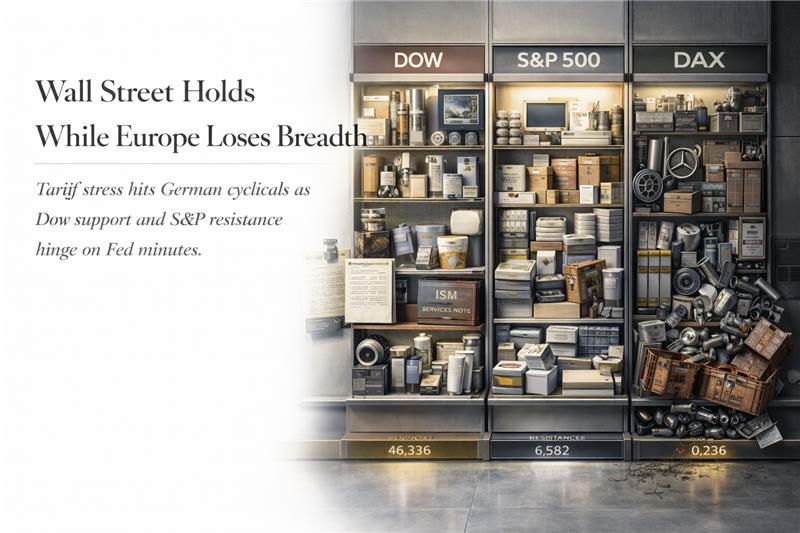
Global Indices Market Report — Dow Jones, S&P 500, DAX 40 | Capital Street FX Research Desk · April 2, 2026
Liberation Day Anniversary Splits Global Indices — US Bounces While DAX Craters 526 Points
Full daily analysis of Dow Jones Industrial Average, S&P 500 Index and DAX 40 — Fibonacci levels, candlestick patterns, key support zones and trade setups · April 2, 2026
What You Need to Know Before You Trade Today
Exactly one year after the original Liberation Day tariff shock, global indices markets are telling a starkly divergent story. US indices — the Dow Jones and S&P 500 — are posting modest gains (+0.48% and +0.72% respectively) as markets apply the hard-won lesson of 2025: that tariff shocks are volatile but ultimately navigable, and that US economic resilience has consistently supported buy-the-dip behaviour at structural Fibonacci levels. European markets, however, are not applying the same playbook — the DAX 40 is collapsing 2.26% (−526 points) as Germany’s export-dependent economy faces the most acute tariff exposure among the major indices in this report.
The broader narrative for the indices market is one of regime divergence: US indices are engaged in a “valuation test” following a 10% drawdown from January highs, while European indices are in active breakdown territory. The FOMC minutes today at 18:00 GMT and Non-Farm Payrolls on Friday are the dominant near-term catalysts that will determine whether today’s US bounce is a dead cat or the start of a genuine recovery leg.
April 2, 2026 — What Drove Each Index Today
The Dow Jones opened the day at 46,396 and has staged a modest 0.48% recovery — the second consecutive positive session. The DJIA is outperforming both the Nasdaq and even the S&P 500 on a relative basis, which aligns with the analyst thesis that the Dow — being a value-heavy, industrials-dominated index — is better positioned to act as a “haven within equities” during periods of tech sector and growth stock rotation.
Today’s Dow gains have been led by Boeing (+2.1%), Caterpillar (+1.8%), and several financial sector components that benefit from a steeper yield curve environment. The DJIA has successfully defended the critical 0.236 Fibonacci retracement at 46,336 — a level that has been tested and held for the third time in the past ten sessions, building a meaningful support base.
The session high of 46,803 provided an important data point: the Dow tested the zone just above the 0.236 Fib and was met with selling, suggesting that the market is still in distribution mode at higher levels. A sustained daily close above 47,137 (0.382 Fib) would be the first genuine signal that a more meaningful recovery is underway for the Dow Jones index.
Key risk for the DJIA today remains the FOMC minutes at 18:00 GMT. Hawkish language emphasising tariff-driven inflation could reverse today’s gains, pulling the index back below 46,336. Conversely, any dovish undertone suggesting the Fed is monitoring growth risks could extend the DJIA bounce toward the 47,000–47,137 resistance cluster.
The S&P 500 is posting its best single-day gain in over two weeks at +0.72%, but the technical context places this squarely in the category of a corrective bounce within a broader downtrend rather than a trend reversal. Current price of 6,575 is testing the Fibonacci 0.382 retracement at 6,582 — the single most critical technical level in the SPX structure today. The outcome at this level will define the weekly directional bias.
The S&P 500’s bounce is being driven by a handful of tech mega-caps — Western Digital and SanDisk paced today’s gainers — alongside financials and healthcare defensives. This narrow breadth is a warning sign: historically, index recoveries driven by a small number of large-cap names without broad participation tend to fail at the first meaningful resistance level. The 0.382 Fib at 6,582 is that resistance.
The broader narrative for the S&P 500 in Q2 2026 is one of a “valuation test” — markets learned in April 2025 that Liberation Day tariff shocks are ultimately recoverable, which is why today’s bounce is more orderly than last year’s panic. However, the inflationary impulse from 2026 tariffs is compounded by the Iran war and elevated oil, which makes the Federal Reserve’s path more constrained than in 2025.
The S&P 500 is currently down approximately 5.10% year-to-date. Corporate earnings for Q4 2025 were strong — revenues up 9.2% and earnings up 13.4% — which provides a fundamental floor for the index. However, any Q1 2026 earnings warnings citing tariff margin compression (expected to begin in April earnings season) could undermine this foundation and push the SPX back toward the 6,319 Fibonacci base.
The DAX 40 is today’s standout loser among major global indices, declining 2.26% — a loss of 526.79 points — to 22,772.10. This is the DAX’s worst single-session performance in three weeks and represents a decisive breakdown below the Fibonacci 0.236 retracement at 22,695. Germany’s export-heavy economy faces the greatest direct exposure to US tariffs among the three indices covered today, explaining the sharp divergence from US market performance.
The DAX decline is being driven by multiple concurrent forces: retaliatory tariff fears (the EU is reportedly preparing counter-measures to US tariffs), the closure of the Strait of Hormuz driving energy costs higher for Germany’s manufacturing sector, and a strengthening Euro that erodes the competitiveness of German exporters. BASF, Volkswagen, Siemens, and BMW — all significant DAX components — are among the worst performers today, each heavily exposed to both input cost inflation and export pricing pressures.
The session opened at 22,935, rallied briefly to 22,997, then reversed sharply to close near the lows at 22,765 — a textbook bearish intraday reversal pattern. The intraday rejection of 23,000 is particularly significant because it coincides with the declining EMA 20, which is now capping every bounce attempt and serving as dynamic resistance. The descending channel on the daily chart is intact and accelerating.
Looking ahead, the next meaningful Fibonacci support for the DAX sits at the 0.0 base of 21,845. Between current price (22,772) and 21,845 there is relatively limited structure-based support — the primary intermediate level is 22,400 (psychological) and 22,200 (prior March structure). The Liberation Day anniversary represents a potential catalyst for further sentiment deterioration if EU retaliatory measures are announced today or tomorrow.
The Forces Behind Today’s Global Indices Market Divergence
Primary Driver — Liberation Day Anniversary and Tariff Regime Reset: April 2, 2026 marks exactly one year since the original Liberation Day executive order that triggered a near-20% S&P 500 decline in seven weeks during 2025. The anniversary itself is a psychological and analytical marker for global indices markets. Institutions are explicitly referencing the 2025 playbook — buy at Fibonacci support levels, expect volatility, but do not panic-sell — and this institutional memory is providing a floor under US indices that European markets, with their more direct tariff exposure, are unable to access. The key distinction in 2026 is that the tariff landscape is now a known risk variable rather than a shock, fundamentally changing how the indices market prices in trade escalation headlines.
Federal Reserve Posture — Higher for Longer Constrains Upside: The Federal Reserve’s trajectory is the dominant macro variable for all three indices in this report. FOMC meeting minutes due at 18:00 GMT today are expected to confirm that policymakers remain hawkish in their assessment, with tariff-driven inflation pressures keeping rate cuts off the table through at least Q3 2026. For the US indices market — particularly the S&P 500 — a higher-for-longer Fed removes the most powerful secular tailwind: the anticipated rate-cut cycle that had been priced into early 2026 valuations. The 10-year Treasury yield remains above 4.5%, creating continuous competition for equities via the risk-free rate.
Geopolitical Escalation — Iran War and Strait of Hormuz: The ongoing Iran-US military conflict and the closure of the Strait of Hormuz is the most consequential geopolitical factor for the indices market in Q2 2026. Oil prices above $100 per barrel act as a de facto tax on corporate margins and consumer spending, with an estimated 0.4–0.6 percentage point drag on US GDP growth for every $10 rise in oil. For the DAX specifically, Germany’s heavy reliance on imported energy — particularly industrial energy for its manufacturing base — makes the Strait of Hormuz closure acutely damaging. The DAX indices market is pricing this in today with a 2.26% decline, while US indices benefit from domestic energy production insulating the US economy from the full impact.
Risk Sentiment and Volatility Environment: The VIX (CBOE Volatility Index) remains elevated, reflecting the binary risk environment facing the global indices market ahead of FOMC minutes today and Non-Farm Payrolls on Friday. Historically, when the VIX trades above 20 for an extended period — as it has since late February — index rally attempts are characterised by low conviction, narrow breadth, and frequent reversals at resistance. Today’s S&P 500 bounce to the 0.382 Fib at 6,582 fits this pattern precisely. The US S&P 500’s RSI of 45.69 and the Dow Jones RSI of 46.03 are both in neutral-bearish territory, not generating the oversold readings (below 30) that typically precede sustainable indices market recoveries.
Cross-Market Correlation — Dollar, Bonds, and Equity Rotation: The US Dollar Index’s relative strength in 2026 — it recovered much of 2025’s 10% decline — is creating a headwind for European equities denominated in weaker currencies. The EUR/USD exchange rate is weighing on DAX exporters at the margin. Meanwhile, a steepening US Treasury yield curve (10Y-2Y) is explicitly supportive of the Dow Jones’s value-heavy composition over the tech-dominant Nasdaq and S&P 500. This yield curve dynamic is driving the subtle DJIA outperformance visible today. Bond markets are pricing a higher terminal Fed rate, which compresses tech multiples more severely than value multiples — creating the intra-index divergence between the Dow’s +0.48% and the broader SPX dynamic.
Forward-Looking Catalyst — Non-Farm Payrolls, Friday April 4: The most important event for the global indices market in the next 48 hours is Friday’s Non-Farm Payrolls report. Market consensus expects +215K jobs; a print above +250K would strongly entrench the Fed’s hawkish stance and likely cause all three indices to reverse today’s modest gains aggressively. A print below +180K could spark a short-lived relief rally in US indices but would simultaneously raise recession concerns that cap upside. The binary nature of Friday’s data — in a market already at elevated volatility — means that all three indices are in decision zones: the Dow at 0.236 Fib, the S&P 500 at 0.382 Fib, and the DAX near a potential structural breakdown. Do not carry large directional exposure into the Friday close.
The Dow Jones Industrial Average is benefiting from an explicit institutional narrative in Q2 2026: the DJIA as a “value haven” within US equities. The index’s composition — dominated by industrials, financials, healthcare, and consumer staples rather than high-multiple tech — makes it a natural rotation destination when the Fed remains hawkish and tech valuations face multiple compression. Boeing’s recovery from its 2025 production struggles, combined with Caterpillar’s domestic infrastructure exposure, is providing leadership to today’s DJIA indices market recovery.
From a macro perspective, the Dow Jones is also benefiting from the specific dynamics of a steepening yield curve. When the 10-year minus 2-year Treasury spread widens — as it has in recent months — financial sector earnings expectations improve (banks earn more on net interest margins), and the discount rate applied to near-term earnings (which the Dow has in greater proportion than the Nasdaq) falls relative to long-duration growth stocks. This creates a structural tailwind for DJIA outperformance versus tech-heavy benchmarks.
The fundamental risk for the DJIA indices market is corporate earnings sensitivity to input cost inflation from tariffs and oil. Boeing, for instance, sources components globally and is directly affected by import tariffs. If Q1 2026 earnings guidance — due to begin in mid-April — shows margin compression from tariff pass-through costs, the DJIA’s current “value haven” narrative could be challenged. The index needs to close above 47,137 (0.382 Fib) on a weekly basis to confirm that the fundamental floor is holding and the indices market has absorbed the tariff shock.
The Dow Jones daily chart shows a classic Fibonacci correction structure from the all-time high at 50,529 (Fibonacci 1.0) to the March 2026 cycle low at 45,041 (Fibonacci 0.0) — a 10.9% drawdown. Price is currently at 46,565, which sits just above the 0.236 retracement at 46,336 — the first meaningful Fibonacci support level. The chart clearly shows three EMA lines (20, 50, and 200-period) all curling downward and sitting above current price, confirming the macro bearish structure despite today’s mild bounce. However, the DJIA is the only instrument in this report where the EMAs are showing signs of convergence rather than divergence — a subtle early positive signal.
On the weekly chart, the Dow Jones has been in a defined ascending channel from the 2022 lows through the 50,529 ATH in January 2026. The current correction is testing the lower boundary of this long-term channel, approximately near the 45,000–45,500 zone. The RSI sub-panel on the chart shows dual readings of 46.03 and 33.55 — the primary RSI (14) at 46.03 is neutral-bearish territory while the smoothed average (33.55) shows the depth of the recent correction. Neither reading is yet at the deeply oversold levels (sub-20) that historically signal major DJIA bottoms.
The 4-hour DJIA chart shows a short-term bullish flag forming at the 46,300–46,600 range — a potential continuation pattern after the bounce from 45,041 lows. However, the flag’s resolution must be confirmed by a break above 46,803 (today’s high) with volume. A failure at 46,800 that returns price below 46,336 would eliminate the bullish flag thesis and likely trigger the next leg lower toward 45,500 and then the 45,041 Fibonacci base. Key decision point: the 47,137 Fibonacci 0.382 level is the critical medium-term pivot that separates the recovery scenario from the continued correction scenario.

The most significant recent candlestick formation on the Dow Jones daily chart was the Bullish Hammer that formed at the 45,041 Fibonacci 0.0 base in mid-March 2026. This hammer — characterised by a long lower wick, small body near the session high, and formed at a major Fibonacci level — is a classic reversal signal that initiated the current bounce. The hammer’s long wick to approximately 44,800 represented a failed attempt by sellers to push the DJIA below the critical $45,000 psychological support, after which buyers aggressively stepped in. This is the same “Liberation Day playbook” that investors used in April 2025 when the S&P 500 bounced from its 2025 tariff lows.
Today’s Dow Jones daily candle is constructive — a bullish body closing near the session high at 46,565 after opening at 46,396, forming a small Bullish Marubozu variant. The absence of a significant upper wick suggests that selling pressure at today’s highs is moderate, and the session closed with buyers in control. This candle type at the 0.236 Fibonacci support level adds credence to the short-term bullish flag thesis visible on the 4-hour chart.
The critical confirmation required for the DJIA bullish flag thesis: a daily close above 46,803 (today’s high) with volume above the 30-day average would confirm the breakout and project the pattern toward 47,137–47,785. Conversely, a daily close below 46,336 (0.236 Fib) with increased volume would negate the recovery pattern and signal a resumption of the broader downtrend. Given the FOMC risk this evening, traders should not assume the flag resolves upward without this confirmation.
| Level Type | Price | Basis | Significance |
|---|---|---|---|
| All-Time High | 50,529 | Fibonacci 1.0 Peak | January 2026 ATH; full Fibonacci range top |
| Strong Resistance | 47,785 | Fibonacci 0.5 Retracement | Mid-Fibonacci resistance; descending EMA 50 zone |
| Key Resistance | 47,137 | Fibonacci 0.382 Retracement | Critical weekly pivot; break above = recovery confirmed |
| Immediate Resistance | 46,803 | Today’s Session High | Flag breakout trigger level; failing here = reversal risk |
| Current Price | 46,565 | Live Close | Holding above 0.236 Fib; below all EMAs |
| Immediate Support | 46,336 | Fibonacci 0.236 Retracement | Three-time tested support; break below = downtrend resumes |
| Psychological Support | 45,500 | Round Number / Structure | Intermediate support between Fib levels |
| Major Support | 45,041 | Fibonacci 0.0 Base | March 2026 cycle low; full Fibonacci base |
The Dow Jones bullish hammer at 45,041 and the short-term bullish flag forming at 46,300–46,800 create a conditional BUY setup — but the entry requires confirmation via a daily close above 46,803 (today’s session high). Do NOT enter before this confirmation given the FOMC minutes risk at 18:00 GMT. If the FOMC tone is neutral-to-dovish and the Dow closes above 46,803 with volume, the flag target measures toward 47,137 (TP1) and 47,785 (TP2). Stop below 46,300 — a break here resets the bias to neutral/bearish. R/R approximately 1:1.6 to TP1, 1:2.2 to TP2.
The S&P 500’s 0.72% bounce today is the largest single-day gain for the index in two weeks, but the fundamental context is fragile. The SPX reached its all-time high of 7,007 in early January 2026 before the Liberation Day anniversary context began weighing on valuations. Year-to-date, the S&P 500 is down approximately 5.10% — a correction that is being characterised by institutional analysts as a “valuation test” rather than a fundamental breakdown. S&P 500 corporate earnings for Q4 2025 were strong (revenues +9.2%, earnings +13.4% YoY), which provides a fundamental floor that prevents a 2025-style 20% drawdown scenario.
The S&P 500’s tech-heavy composition — the Magnificent Seven command a disproportionate index weighting — creates vulnerability to the current higher-for-longer Fed environment. When real interest rates are elevated, the discounted future cash flows of long-duration growth stocks compress, which drives the SPX lower relative to the value-heavy DJIA. This explains the relative underperformance: S&P 500 down 5.10% YTD versus the Dow’s more modest decline. Any normalization in Fed expectations — either through a soft NFP on Friday or a neutral FOMC tone today — could spark a more sustained SPX recovery, but it would first need to clear the 0.382 Fibonacci resistance at 6,582.
SpaceX’s confidential IPO filing (reported today) represents a significant potential catalyst for the broader indices market, particularly the S&P 500. If SpaceX pursues a full public listing, the addition of a company with estimated $350–400 billion valuation to the S&P 500 index would trigger enormous passive inflows and could provide a structural positive shock to indices market sentiment that transcends the current tariff-driven headwinds. This is a forward-looking, not an immediate catalyst, but it is worth monitoring.
The S&P 500 daily chart is at its most critical technical juncture of 2026. Price has bounced from the 6,319 Fibonacci 0.0 base (March 2026 low) and is now testing the 0.382 retracement at 6,582 — a level that should act as significant resistance. The entire Fibonacci structure from 6,319 (0.0) to 7,007 (1.0) is well-defined on the chart, and the current bounce pattern — from 0.0 base to 0.382 resistance — is the textbook first phase of a Fibonacci retracement bounce within a corrective trend. A rejection here would establish the next leg lower toward 6,400 and then 6,319.
The three EMA lines visible on the chart (20, 50, and 200-period, shown as orange curves) are all above current price and curling downward — a triple EMA bearish alignment that is one of the strongest trend confirmation signals in technical analysis. The EMA 20 sits near 6,809, EMA 50 near 6,789 — these are 3.5–3.6% above current price and represent significant overhead resistance that any sustained S&P 500 recovery would need to navigate. The gap between current price and the EMA cluster is the “recovery gap” — it needs to be closed for the broader indices market bias to shift from bearish to neutral.
The RSI dual-panel shows 45.69 (primary) and 36.14 (smoothed average) — neither reading is at the oversold extreme (sub-30) that generates high-conviction buying signals for the indices market. This contrasts with the March 2025 Liberation Day lows where RSI touched 20–22 on the S&P 500, providing a much more powerful oversold condition for the recovery. The current RSI profile suggests the S&P 500 is in a “dead zone” — not oversold enough to be a high-conviction buy, and not overbought enough to be a clean sell — making the 0.382 Fib resistance at 6,582 the deciding level.

The S&P 500’s most significant recent chart pattern is a potential Double Bottom formation at the 6,319 Fibonacci 0.0 level — price tested this base twice in March 2026, with each test creating a similar candlestick pattern: an intraday decline below 6,400 followed by a strong close near session highs. If confirmed, the Double Bottom would project a measured move toward 6,700–6,744 (0.618 Fib). However, the Double Bottom is NOT yet confirmed — confirmation requires a daily close above the neckline at approximately 6,620 (the interim high between the two bottom touches). Today’s high of 6,609 fell just short of this neckline, making tomorrow’s session critical.
The broader descending channel from the 7,007 January high is the dominant pattern. The channel’s upper boundary sits near 6,700–6,720 at current pace, and the lower boundary projects to approximately 6,100–6,200 by end of April — consistent with the 6,145 support level identified by institutional analysis as a key post-Liberation Day 2025 floor. Today’s candle is constructive within the channel but remains well within the established range rather than breaking it.
Confirmation candles for the S&P 500 bullish case: a daily close above 6,582 (0.382 Fib) today would be the first signal; a close above 6,620 (Double Bottom neckline) would be the stronger confirmation. Without these specific closes, the dominant pattern remains bearish and today’s move is classified as a corrective bounce within the descending channel. The FOMC minutes at 18:00 GMT today will be the primary catalyst determining which scenario materialises.
| Level Type | Price | Basis | Significance |
|---|---|---|---|
| All-Time High | 7,007 | Fibonacci 1.0 Peak | January 2026 ATH; full psychological target |
| Strong Resistance | 6,744 | Fibonacci 0.618 Retracement | Golden ratio; EMA 20 convergence zone |
| Key Resistance | 6,663 | Fibonacci 0.5 Retracement | Mid-Fibonacci; Double Bottom neckline zone |
| Immediate Resistance | 6,582 | Fibonacci 0.382 Retracement | TODAY’S CRITICAL LEVEL — bounce stalling here |
| Current Price | 6,575 | Live Close | Below 0.382 Fib; below all three EMAs |
| Immediate Support | 6,482 | Fibonacci 0.236 Retracement | First Fibonacci support below current price |
| Key Support | 6,400 | Psychological Round Level | Round number floor; prior March structure |
| Major Support | 6,319 | Fibonacci 0.0 Base | March 2026 cycle low; Double Bottom base |
The S&P 500 indices market is testing the critical 0.382 Fibonacci resistance at 6,582 with today’s bounce — a level where price has previously reversed twice. The triple EMA bearish alignment, neutral RSI at 45.69, and absence of a Double Bottom neckline confirmation all support a sell-at-resistance strategy. Enter short at 6,575–6,590 with a stop above the 0.5 Fibonacci at 6,665. Take 50% profit at 6,400 (psychological round number), then target the 6,319 Fibonacci base with the remainder. Wait for the FOMC minutes response at 18:00 GMT before committing — hawkish minutes create the ideal trigger for this setup. R/R approximately 1:2.5.
The DAX 40’s 2.26% single-session collapse to 22,772 is the sharpest decline among global major indices today and reflects Germany’s unique vulnerability in the current tariff environment. Germany’s economy is built on exports — particularly automotive (Volkswagen, BMW, Mercedes-Benz), chemicals (BASF), and industrial equipment (Siemens, Thyssen). These sectors face a direct hit from US import tariffs, EU retaliatory measures that could restrict access to key markets, and elevated energy costs from the Strait of Hormuz situation. The combination is uniquely damaging for an export-dependent economy in a way that is not replicated for the domestically-driven US economy.
The European Central Bank’s posture adds another layer of complexity. Unlike the Fed — which has domestic inflation pressures from tariff pass-through — the ECB faces the dilemma of slowing growth in the Eurozone’s largest economy (Germany) while simultaneously managing inflationary impulses from oil prices. A more dovish ECB would support DAX valuations by lowering borrowing costs, but it would also confirm that the growth outlook has deteriorated sufficiently to warrant stimulus — a negative signal for corporate earnings. This paradox is keeping DAX investors in a state of uncertainty that manifests as selling pressure on any news catalyst.
From a Liberation Day anniversary perspective, the DAX is not benefiting from the same “buy the dip” institutional conditioning that US markets have developed. European institutional investors do not have the same 2025 recovery trade memory for the DAX — the German index’s 2025 performance was mixed, and the structural headwinds (energy costs, export exposure, demographic challenges) are more persistent than the tariff-timing headwinds that US markets managed to absorb. The DAX indices market at 22,772 is 10.7% below its January 2026 high of 25,445 and the trajectory is clearly downward.
The DAX 40 daily chart is the most bearish technical structure among the three indices covered today. From the January 2026 high at 25,445 (Fibonacci 1.0), the DAX has declined through every major Fibonacci level without establishing a meaningful hold: the 0.786 at approximately 24,600, the 0.618 at 24,070, the 0.5 at 23,645, the 0.382 at 23,220, and now the 0.236 at 22,695. Today’s break below the 0.236 Fib is the critical violation — it means the DAX has retraced more than 76.4% of its full range from 21,845 to 25,445, effectively bringing the instrument near the base of the full Fibonacci structure.
The three EMA lines on the DAX chart (20, 50, and 200-period) are sharply diverging downward — the EMA 20 sits near 23,107, the EMA 50 near 24,122, and the EMA 200 near 24,179. This “fan formation” where EMAs are spread out and all declining is the technical fingerprint of a powerful trending move, not a consolidation. The RSI dual-panel shows 42.45 (primary RSI) and 37.02 (smoothed average) — both in bearish territory and neither at oversold levels, suggesting the downtrend has room to run before exhaustion.
The descending channel on the DAX is clear and accelerating. The channel upper boundary sits near 23,400–23,600 (declining) and the lower boundary near 22,200–22,400 (today’s lows are testing this boundary). A close below 22,765 (today’s low) on tomorrow’s session would confirm the channel breakdown and project toward the 21,845 Fibonacci 0.0 base. The DAX is the only instrument in today’s report where the technical, fundamental, and macro evidence all point uniformly in the same direction: lower.

Today’s DAX daily candle is a textbook Bearish Engulfing — the session opened at 22,935, briefly reached 22,997 (flirting with the 23,000 psychological resistance that coincides with the declining EMA 20 at 23,107), then reversed violently to close at 22,772. This candle’s body completely engulfs the previous session’s candlestick range, signalling that sellers overwhelmed any buyers who entered during the brief morning rally. The Bearish Engulfing formed precisely as the DAX tested and failed at both the 23,000 psychological level and the declining EMA 20 — a confluence of three resistance signals (EMA 20, round number, and prior day’s range) that creates a very high-probability reversal signal.
The broader descending channel pattern has been intact for the DAX since the 25,445 peak in January 2026. Over this period, the channel has contained every rally attempt — each bounce to the channel’s upper boundary (defined by the declining EMA 20 and 50) has been sold aggressively. Today’s session is consistent with this pattern: the intraday high of 22,997 represents a test of the upper channel boundary, which was rejected with a 225-point intraday reversal. This channel continuation pattern, with each leg lower taking the DAX below the next Fibonacci level, is now approaching the 0.0 base at 21,845.
The confirmation candle for continued DAX downside is a daily close below 22,765 (today’s intraday low) — this would confirm that the channel breakdown is not a false move and accelerate toward 22,400 and then 21,845. Bulls would need to see a daily close above 23,220 (0.382 Fib) with high volume to even begin questioning the bearish thesis. Given the fundamental backdrop of EU retaliatory tariff risks and the ECB’s ambiguous policy stance, the probability of such a close in the near term is very low.
| Level Type | Price | Basis | Significance |
|---|---|---|---|
| All-Time High | 25,445 | Fibonacci 1.0 Peak | January 2026 ATH; full Fibonacci range top |
| Strong Resistance | 24,070 | Fibonacci 0.618 Retracement | Golden ratio; EMA 50 convergence zone |
| Key Resistance | 23,645 | Fibonacci 0.5 Retracement | Mid-Fibonacci; declining EMA 50 zone |
| Immediate Resistance | 23,220 | Fibonacci 0.382 Retracement | Critical resistance; break above = trend shift begins |
| Dynamic Resistance | 23,107 | EMA 20 (Declining) | Rejected today at 22,997 — confirms EMA as cap |
| Current Price | 22,772 | Live Close | Below all Fibonacci support except 0.0 base |
| Immediate Support | 22,695 | Fibonacci 0.236 · Broken Level | Flipped to resistance; watch as support attempt fails |
| Key Support | 22,400 | Psychological / Structure | Intermediate support; prior March structure congestion |
| Major Support | 21,845 | Fibonacci 0.0 Base | Full Fibonacci base; ultimate downside target |
The DAX 40 Bearish Engulfing candle below the 0.236 Fibonacci at 22,695, combined with the EMA fan formation (all three EMAs declining and above price), ADX at 36.8 confirming strong trend strength, and bearish MACD expansion, creates the highest-conviction short setup among today’s three indices. Sell any bounce to the 22,900–23,000 resistance zone (EMA 20 and psychological round number cluster). Take 60% profit at 22,200 (intermediate structure), then target 21,845 Fib base with the remainder. This is today’s Best Setup — R/R approximately 1:2.1 to TP1, extending to 1:3.5 toward the 21,845 target.
How to Capitalise on Today’s Indices Market with Capital Street FX
Three distinct setups across DJIA, S&P 500 and DAX 40 — from a conditional long to two active shorts — Capital Street FX gives you access to all global indices on the same platform.
Today’s DAX Bearish Engulfing at 22,997 with EMA 20 resistance is the sharpest indices market setup of the day. Capital Street FX’s 0.0 pip spreads ensure you capture the full 500+ point move toward 21,845 without paying wide spreads on Europe’s most volatile index.
→ Short DAX NowThe S&P 500 is stalling at the 0.382 Fibonacci level (6,582) — a sell-at-resistance setup with FOMC minutes as the catalyst tonight. Trade SPX with Capital Street FX’s maximum 1:10,000 leverage and Negative Balance Protection for precision execution at the indices market’s most critical level.
→ Trade SPX SetupFOMC minutes at 18:00 GMT and NFP Friday mean high gap risk across all three indices. Test the DAX short, S&P resistance sell, and Dow flag breakout on a Capital Street FX free demo account — same live indices market prices, zero capital at risk.
→ Open Free DemoToday’s DAX ATR is 480 points — on an index this volatile, tight spreads are the difference between a profitable setup and a marginal one. 0.0 pip spreads keep your entry and exit costs at zero.
FOMC minutes release at 18:00 GMT will cause extreme indices market volatility across all three instruments. Zero slippage guarantees your stop-losses execute at your exact specified level, not through a gap.
Three active setups — DAX short, SPX resistance sell, and conditional DJIA long — require simultaneous margin. Our 900% bonus multiplies your available margin to run all three indices positions concurrently.
ALTX’s multi-index charting lets you monitor all three descending channels and Fibonacci structures simultaneously — essential when today’s DJIA, SPX and DAX are all approaching critical decision levels at the same time.
NFP drops Friday at 12:30 GMT — a market-closed weekend risk. Our 24/7 support ensures you can manage indices positions, adjust stops, and get margin assistance at any hour ahead of the Friday data release.
The DAX dropped 526 points today in one session. FOMC minutes tonight could create a 300–500 point gap on open tomorrow. Negative Balance Protection ensures that regardless of indices market gap risk, your losses are capped at your deposit.
Today’s High & Medium Impact Events — April 2, 2026
| GMT Time | Currency/Market | Event | Forecast | Previous | Actual | Impact |
|---|---|---|---|---|---|---|
| 07:00 | EUR/DE | German Retail Sales (MoM) | +0.3% | −0.4% | Released | MED |
| 08:55 | EUR/DE | German Unemployment Change | +12K | +11K | Released | HIGH |
| 09:00 | EUR | Eurozone PPI (MoM) | +0.2% | +0.6% | Released | MED |
| 12:30 | USD | ADP Non-Farm Employment Change | +140K | +166K | Pending | HIGH |
| 14:00 | USD | ISM Services PMI | 52.8 | 53.5 | Pending | HIGH |
| 14:00 | USD | JOLTS Job Openings | 7.62M | 7.74M | Pending | MED |
| 18:00 | USD | FOMC Meeting Minutes | — | — | Pending | HIGH |
| Fri 12:30 | USD | Non-Farm Payrolls (Apr 4) | +215K | +228K | Apr 4 | HIGH |
| Fri 12:30 | USD | Unemployment Rate (Apr 4) | 4.1% | 4.0% | Apr 4 | HIGH |
Today’s Indices Market — Your Questions Answered
The divergence between the DAX 40’s −2.26% decline and the Dow Jones (+0.48%) and S&P 500 (+0.72%) gains reflects structural differences in tariff exposure and institutional conditioning. US indices are applying the 2025 Liberation Day playbook — buying at Fibonacci support levels based on the lesson that tariff shocks are recoverable. The DAX, however, represents Germany’s export-heavy economy (automotive, chemicals, industrials) which faces direct tariff damage, elevated energy costs from the Strait of Hormuz closure, and potential EU retaliatory measures that create a uniquely negative environment for German equities that US indices market participants simply do not share.
The 6,582 level on the S&P 500 is the Fibonacci 0.382 retracement of the full move from the 6,319 March low to the 7,007 January 2026 all-time high. In Fibonacci analysis, the 0.382 retracement is the minimum pullback that defines a corrective move — a bounce that stalls here confirms the correction is still in progress and that the prior downtrend has not been overcome. If the S&P 500 cannot close above 6,582 on a daily basis, it signals that institutional sellers are using today’s bounce to distribute rather than accumulate, keeping the indices market in its broader downtrend. A daily close above 6,582 would be the first meaningful sign that the correction has deeper recovery potential.
The DAX Bearish Engulfing candlestick that formed today — opening at 22,935, briefly testing 22,997, then reversing sharply to close near 22,772 — signals that sellers are firmly in control of the DAX indices market at both the EMA 20 resistance (~23,107) and the psychologically significant 23,000 level. A Bearish Engulfing at these confluent resistance points carries exceptional weight: it means bulls attempted to push through three resistance barriers simultaneously (EMA 20, round number, prior candle range) and failed decisively. This pattern historically precedes a continuation move of 3–7% in the direction of the engulfing candle — projecting toward 22,200–21,845 for the DAX in the coming sessions.
For existing positions: reduce size by 30–50% before 17:45 GMT and widen stops slightly to prevent being stopped out by the initial volatility spike before the directional move becomes clear. For new positions: wait until 18:15 GMT for the initial 15 minutes of post-FOMC volatility to resolve before entering. If the minutes are hawkish (language about inflation persistence from tariffs, no rate cuts expected) — the S&P 500 and DAX setups become high-conviction shorts immediately. If the minutes are neutral-to-dovish — the DJIA conditional long above 46,803 becomes the preferred indices market setup. The single most important rule: do NOT use maximum leverage into the 18:00 GMT release on any of the three indices positions.
The Liberation Day anniversary matters for the indices market in two ways. First, it creates a specific valuation reference point: institutions are explicitly comparing today’s S&P 500 and Dow Jones levels to where they bottomed in April 2025 and evaluating whether the current Fibonacci support zones offer similar risk/reward opportunities. Second, the anniversary reinforces the “TACO trade” (Trump Always Comes Off) market thesis — the idea that aggressive tariff headlines from the Trump administration ultimately soften, and that buying at Fibonacci support during tariff panics has been a winning strategy. This institutional memory is providing a floor under US indices that the DAX — which does not benefit from the same playbook — cannot access.
Today’s global indices market presents three distinct setups across three different instruments — a conditional DJIA long, a SPX resistance sell, and an active DAX short — all simultaneously in play. Capital Street FX’s 2,000+ market offering means you access all three index CFDs (Dow Jones, S&P 500, and DAX 40) within a single account with unified margin, 0.0 pip spreads, and the 900% tradable bonus amplifying your effective capital across all three positions. The ALTX platform’s multi-chart layout allows you to monitor all three indices simultaneously, essential when tonight’s FOMC minutes will move all three instruments within minutes of each other. This integrated approach — versus using separate brokers for US and European indices — eliminates split-margin inefficiency and ensures you never miss a simultaneous setup trigger.
Daily Bias Summary & Outlook — April 2, 2026
Today’s global indices market has confirmed a clear transatlantic divergence that will define trading for the remainder of this week. The Dow Jones has defended its critical 0.236 Fibonacci support at 46,336, staging a modest +0.48% recovery consistent with the “value haven” rotation thesis that has been building since mid-March. The S&P 500 has recovered +0.72% but is now pressing against the 0.382 Fibonacci resistance at 6,582 — the result of tonight’s FOMC minutes will determine whether this level holds as resistance (continuing the downtrend) or is broken (opening the recovery scenario). The DAX has delivered the day’s sharpest and most unambiguous signal: a Bearish Engulfing candle, rejection at EMA 20 and 23,000, and a confirmed break below the 0.236 Fibonacci. No ambiguity in the DAX — the indices market trend is bearish and the target is 21,845.
The structural macro theme for the week remains the tariff shock versus institutional resilience narrative. Markets have applied the 2025 Liberation Day lesson to US indices, creating a degree of institutional buy-the-dip support at Fibonacci levels that is not available to European indices. However, this US resilience is conditional: it depends on the Federal Reserve’s posture remaining at least neutral-to-accommodating on growth risks. If tonight’s FOMC minutes signal that tariff-driven inflation is genuinely delaying any rate-cut consideration, the US indices’ “valuation test” could turn into a more serious “valuation correction” — erasing today’s gains and pulling all three instruments into aligned bearish territory.
Today’s remaining catalysts at specific GMT times: ADP Employment at 12:30 GMT (already past for European session); ISM Services PMI at 14:00 GMT — a miss below 52 would immediately pressure SPX below 6,582 resistance; FOMC Meeting Minutes at 18:00 GMT — the apex event for all three indices today; and US market close at 21:00 GMT will set the futures overnight bias heading into Thursday. Non-Farm Payrolls on Friday at 12:30 GMT is the binary risk event for next week’s opening positions.
Longer-term bias over the next 3–5 days: DAX remains the clearest short — the break of 0.236 Fib, EMA fan formation, and EU-specific tariff headwinds target 22,200 and then 21,845. S&P 500 remains cautiously bearish — a daily close above 6,582 would shift to neutral, but the base case is a rejection at this Fib level and a retest of 6,400–6,319. Dow Jones is the most nuanced — a close above 46,803 tonight (post-FOMC) would make it the only US index with a constructive short-term setup, targeting 47,137; otherwise, a return below 46,336 re-aligns the DJIA with the broader bearish indices market theme.
Capital Street FX Research Desk · April 2, 2026 · Internal Research · capitalstreetfx.com