
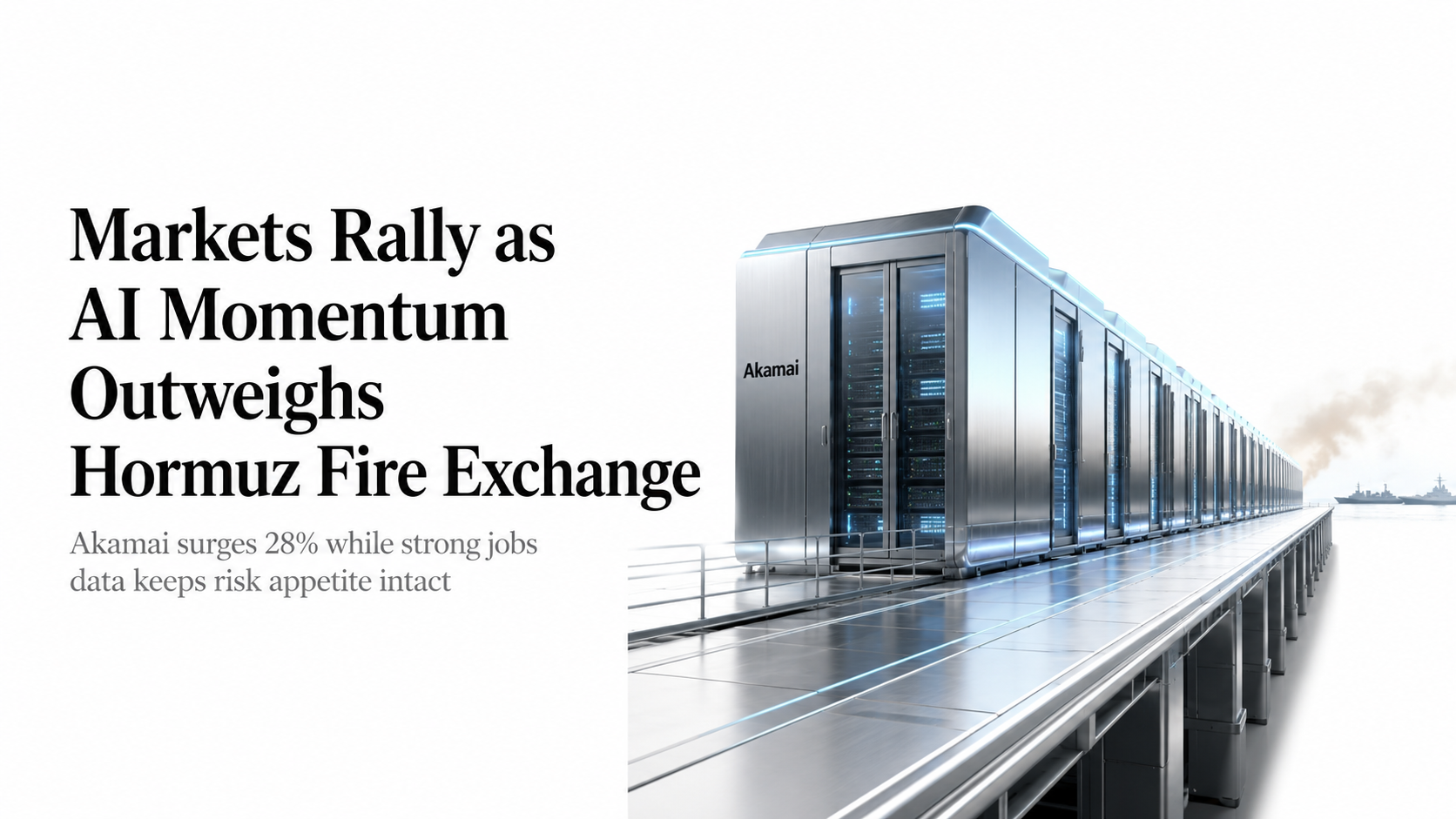
US Markets Rally as AI Momentum Outweighs Hormuz Fire Exchange
US Close — Friday, May 8, 2026
Akamai +28% on $1.8B AI Megadeal; Jobs Blow Past 115K vs 62K Forecast; Markets Shrug Off US-Iran Fire Exchange; S&P +0.41% Near ATH; Warsh Senate Vote Days Away
Friday delivered one of the week’s most revealing sessions: a market that chose optimism over fear in the face of genuine geopolitical escalation. US and Iranian forces exchanged fire in the Strait of Hormuz overnight Thursday — the most significant test of the April 8 ceasefire since it was established — and yet the S&P 500 advanced 0.41%, the Nasdaq gained 0.66%, and the Dow rose 0.37% as the session closed. The session’s primary catalyst was not the geopolitics but the data: April nonfarm payrolls surged to 115,000, nearly double the 62,000 consensus forecast, with the unemployment rate steady at 4.3% and average hourly earnings rising a softer-than-expected 0.2% — the precise combination of resilient growth and contained wage inflation that the market has been praying for. Akamai Technologies surged 28% after announcing a landmark $1.8 billion, seven-year AI cloud infrastructure commitment from a leading frontier AI model provider — the fifth major AI infrastructure earnings catalyst of the week. Expedia fell 6.7% despite a historic quarterly beat after the company declined to raise its full-year revenue guidance above Street consensus. The Russell 2000 was the session’s lone laggard, declining 1.63% as small caps de-rated on the residual Iran risk. Oil held near $95.64 WTI and gold firmed to ~$4,720 as the week’s most consequential unanswered question — Tehran’s formal response to the US 14-point peace proposal — remained unresolved heading into the weekend.
Friday’s session was the week’s clearest demonstration of the market’s dominant hierarchy: AI infrastructure earnings and macro resilience outweigh geopolitical noise, even when that noise is live gunfire. Akamai’s $1.8 billion, seven-year AI cloud commitment from a leading frontier model provider is the fifth AI infrastructure catalyst of the week — following Palantir (software), AMD (chips), Super Micro (servers), and Datadog (observability) — and with Akamai now landing a deal that exceeds Datadog’s entire quarterly revenue in a single customer contract, the AI infrastructure stacking story has extended into the network and security layer. The geopolitical backdrop was objectively alarming: US Navy destroyers and Iranian fast boats exchanged fire in the Strait of Hormuz Thursday night — the first direct military engagement since the April 8 ceasefire — with Trump describing the US response as blowing Iranian vessels “away” but insisting the ceasefire remained “in effect.” Iran said the US had violated ceasefire terms. Yet oil only added 0.88% to $95.64 and VIX fell 1.5% to 17.13 — the market’s verdict that the fire exchange was a tactical incident, not a strategic escalation. The April jobs report was the session’s anchor data point: 115,000 payrolls against 62,000 expected, with wage growth at 0.2% MoM below the 0.3% estimate, producing the most favourable labour market configuration possible for risk assets — growth without inflationary wage pressure. Healthcare led with 37,000 new positions; tech continued to contract with 13,000 losses. Warsh’s full Senate confirmation vote approaches for the week of May 8–15, making the Fed transition a days-away event rather than a weeks-away one. Expedia’s −6.7% on a spectacular quarterly beat confirmed that full-year guidance optionality has become the primary market-mover in 2026 earnings — one metric that disappointed enough to erase a 41% EPS beat.
Markets Snapshot — Close of Business, May 8, 2026
| Index | Close | Change | Session Signal | Context |
|---|---|---|---|---|
| S&P 500 | ~7,384 | ▲ +0.41% | RESILIENT NEAR ATH | Rallied through US-Iran fire exchange and Expedia’s full-year guidance miss. Jobs beat (115K vs 62K) and Akamai’s $1.8B AI megadeal drove conviction. S&P futures up ~0.33% after hours. Now trading above Wednesday’s ATH close of 7,365 — market has digested the Iran conflict premium and re-rated on AI earnings momentum. |
| Nasdaq Composite | ~26,022 | ▲ +0.66% | AI WEEK CONFIRMATION | Nasdaq led large caps Friday, capping the AI earnings week with Akamai’s 28% surge. The index closed above 26,000 for the first time. Rackspace +12.5% (AMD AI cloud MOU) also contributed. AMD itself gained +1.7% adding to its post-earnings premium. Tech breadth notably stronger than Tuesday-Thursday. |
| Dow Jones Industrial | ~49,780 | ▲ +0.37% | PAYROLLS-DRIVEN BROAD GAIN | Dow rose modestly, driven by the jobs beat underpinning consumer and industrial sentiment. Within 220 points of 50,000 psychological level. Microsoft +2.38% and Salesforce +2.37% were the top contributors. Caterpillar −2.29% and Chevron −2.10% dragged on continued oil/geopolitical uncertainty. Nike −1.1% after Wells Fargo downgrade weighed on consumer names. |
| Russell 2000 | ~2,779 | ▼ −1.63% | IRAN RISK OVERHANG | Small caps were the session’s clear underperformer. The Russell 2000 is disproportionately exposed to higher oil prices (energy input costs), higher interest rates (floating-rate debt), and the domestic growth risks from a prolonged Iran conflict. The −1.63% move is the week’s sharpest single-session decline among major indices. Small caps remain the primary Iran deal beneficiary if Tehran confirms — and the primary vulnerability if the deal collapses. |
| VIX | ~17.13 | ▼ −1.5% | FEAR GAUGE EASING | VIX declined despite the US-Iran fire exchange — a remarkable signal of the market’s confidence that the ceasefire base case remains intact. Still elevated versus the sub-15 levels that would prevail if a deal were confirmed and oil dropped $10–$20. The 17 handle is the “deal is possible but not done” equilibrium level that has held since Wednesday’s ceasefire euphoria dissipated. |
Friday’s session gave the market a test it was not expecting at Thursday’s close: live fire between US and Iranian forces in the world’s most critical oil chokepoint. The textbook response to that event — a Thursday-night exchange of missiles, drones, and small-boat fire in the Strait of Hormuz — should have been a gap-down open, a VIX spike to 22+, and WTI testing $102. Instead, the S&P 500 opened higher, the Nasdaq led, and the VIX fell. The reason is context, not complacency: both Trump and Iran described the incident as contained. US Central Command confirmed no US ships were hit. Iran did not fire on commercial vessels. Trump was explicit that the ceasefire remained “in effect.” The market absorbed the escalation because the participants absorbed the escalation — neither side escalated their stated intent. The jobs report arriving simultaneously at 08:30 EDT and printing 115,000 against a 62,000 consensus was the session’s definitive pivot. A strong employment print combined with below-consensus wage growth is the rarest macro configuration in 2026: it proves the economy is growing faster than feared while wage inflation is contained — removing the argument for rate hikes and providing the Warsh Fed a clean macro backdrop to inherit. The week of May 4–8 will be recorded as the week that validated the 2026 AI investment thesis across five earnings cycles, survived a ceasefire fire exchange without a market breakdown, and delivered the strongest employment beat of the Iran-war era. The open question heading into the weekend is singular: Tehran’s formal response to the 14-point US peace proposal. If Iran responds positively, the S&P 500 moves toward 7,500+, oil falls $10–$20, and the Warsh Fed inherits the cleanest macro backdrop since 2019. If Iran delays or rejects, Monday opens with oil retesting $100–$105, the 10-year yield pushing toward 4.50%, and the week’s gains partially at risk.
Oil & Geopolitics — US-Iran Fire Exchange; Ceasefire Survives; Tehran Response Awaited
Thursday night’s US-Iran fire exchange in the Strait of Hormuz was the ceasefire’s most significant test since April 8 — and the market’s verdict Friday was that it passed. US Central Command said American forces “responded with self-defense strikes” after three Navy destroyers came under missile and drone fire, destroying the attacking Iranian vessels without US casualties. Trump’s Truth Social post — “They trifled with us today. We blew them away” — was followed by a press conference confirmation that the ceasefire was “holding.” Iran’s statement that the situation had “stabilized” was the critical signal: neither side wanted a full re-escalation. The market’s contained response — WTI +0.88%, not +8% — is the most important pricing signal of the week. In March 2026, when the initial US-Israel strikes on Iran occurred, Brent surged 10–13% in the first two trading days. Friday’s contained move tells you the market believes the ceasefire framework is durable even under tactical stress — which is the correct read if both parties confirm that the fire exchange was limited and contained. The critical variable heading into the weekend: Tehran’s formal response to the 14-point US proposal. Reports indicate Iran is expected to respond through Pakistani mediators within “the next two days.” If that response arrives as positive over the weekend, the Monday open should price out roughly $10–$20 of the war premium embedded in oil, cutting WTI toward $80–85 and providing the single most powerful inflation tailwind the US economy has seen since the conflict began in late February. That singular binary dominates every other market variable heading into next week’s Warsh confirmation and the first Warsh-era FOMC on June 16–17.
Earnings — Akamai $1.8B AI Deal; Expedia Historic Beat But Guidance Miss; Full Week AI Stack Review
| Company | Result vs Est | Signal | Key Metric / Commentary |
|---|---|---|---|
| Akamai TechnologiesAKAM · +28% | EPS BEAT · $1.8B DEAL | Cloud Infra +40% YoY | EPS $1.61 vs $1.60 est. Revenue $1.07B in-line. Cloud Infrastructure Services +40% YoY. Security +11% YoY to $589.8M. $1.8B, 7-year AI cloud deal with unnamed frontier model provider (likely hyperscaler per Raymond James) — largest deal in Akamai history. FY26 EPS guide midpoint $6.78 vs $6.86 est. Stock +28% on the megadeal, completing the week’s AI infrastructure earnings stack across all five layers. |
| Expedia GroupEXPE · −6.7% | BEAT Q1 · FY GUIDE MISS | EBITDA +83% · FY Guide Low | EPS $1.96 vs $1.39 est (+41% beat). Revenue $3.43B (+15% YoY, beat). Adj. EBITDA +83% to $542M — highest Q1 EBITDA margin in 15 years (+591bp). Gross bookings +13% to $35.5B. B2B GBs +22%, B2C +10%. Booked room nights +6% to 113.9M. New $5B share buyback. But full-year revenue guidance midpoint $15.8B fell below $15.95B Street est → −6.7%. CEO Ariane Gorin: “highest first-quarter profitability in our history.” |
| Rackspace TechnologyRXT · +12.5% | MOU CATALYST | AMD AI Cloud Partnership | Shares +12.5% after Rackspace signed a memorandum of understanding with AMD to develop an enterprise AI cloud platform tailored for regulated industries and sovereign workloads. AMD itself gained +1.7% on the news. The Rackspace-AMD MOU signals that AMD’s chip market-share gains from its Q1 blowout are being translated into downstream partnership announcements — the AI ecosystem building out vertically. |
| Datadog (prior session)DDOG · Th +28% | DOUBLE BEAT · $1B MILESTONE | First $1B Quarter | Thursday: Revenue $1.006B (+32% YoY, beat $959M). EPS $0.60 vs $0.51 (+18% beat). FCF $289M. 4,550 customers with $100K+ ARR (+21% YoY). Q2 guide $1.08B midpoint (+8.3% above Street). FY26 guide raised to $4.32B. AI-powered observability confirmed as the fourth layer of the 2026 AI stack. Held most gains Friday +28%. |
| NikeNKE · −1.1% | DOWNGRADE | Turnaround Extended | Wells Fargo analyst Ike Boruchow downgraded NKE to equalweight from overweight, cutting PT to $45 from $55. NKE at $43.94. Wells Fargo cited that Nike’s global turnaround is taking longer than expected and that international disruption (oil-driven logistics costs, China market softness) is likely to weigh on near-term results. The downgrade reflects the broader consumer discretionary pressure from elevated fuel prices. |
Akamai’s $1.8 billion, seven-year AI cloud infrastructure deal is the week’s single most structurally significant earnings catalyst — more important even than Datadog’s $1B quarterly milestone. Here is why: Datadog’s revenue is recurring SaaS, measured in hundreds of millions of dollars per quarter. Akamai’s $1.8 billion deal is a committed, contracted, multi-year infrastructure obligation from an unnamed frontier AI model provider — almost certainly a hyperscaler, per Raymond James analyst Frank Louthan. That means a company building frontier AI models has committed to spending $257 million per year, every year for seven years, on Akamai’s cloud infrastructure. This is not a pilot program. It is a capital expenditure commitment that exceeds Akamai’s entire Q1 revenue in a single deal, contracted for longer than most corporate planning cycles. The implication for the AI infrastructure investment thesis is direct: the AI model builders are not just buying chips and servers from hyperscalers — they are diversifying their infrastructure sourcing into specialized CDN and security providers like Akamai. Expedia’s −6.7% decline on a 41% EPS beat is the week’s clearest signal about the 2026 guidance premium. The company delivered the highest Q1 EBITDA margin in its 15-year history, beat EPS by 41%, grew gross bookings 13%, and launched a $5 billion share buyback — and the stock fell. The reason is singular: full-year revenue guidance midpoint $15.8B came in $150 million below the Street’s $15.95B consensus. In 2026, the question of whether management’s guidance implies future acceleration or caution has become the dominant earnings market-mover — a consequence of two years of macro uncertainty that has made investors hypersensitive to forward signals over historical results. The week’s AI infrastructure earnings run — five consecutive sector beats across five different layers — is unprecedented in the 2026 cycle. Each layer confirmed not just its own numbers but validated the layer below: Palantir’s software demand requires AMD chips, AMD chips go into Super Micro servers, Super Micro servers require Datadog observability, and all of it runs on Akamai’s CDN and cloud network. That is a vertically integrated AI infrastructure confirmation, and the market is repricing every layer accordingly.
Macro & Fed — April Jobs Goldilocks; Warsh Vote Days Away; Fed Transition Underway
| Driver | Level | Signal | Implication |
|---|---|---|---|
| April NFP — Jobs Report | +115K | MAJOR BEAT vs 62K EST | Strongest payroll beat relative to consensus since the Iran conflict began. Healthcare +37K, transport/warehouse +30K, retail +22K. Fed govt −9K, info −13K, manufacturing −2K. The “low-hire, low-fire” labour market is adding jobs again — two consecutive months for the first time in nearly a year. Removes downside growth risk from incoming Warsh Fed’s mandate calculus. |
| April Average Hourly Earnings | +0.2% MoM | BELOW 0.3% EST | 3.6% YoY vs 3.8% estimate. This is the “goldilocks” wage reading: strong enough to sustain consumer spending, weak enough to not threaten the Fed’s inflation objective. Combined with 115K jobs, this is the dual mandate configuration the market has been waiting for — the Warsh Fed inherits a labour market that is neither too hot nor too cold. |
| Warsh — Full Senate Vote | Week of May 8–15 | IMMINENT — DAYS AWAY | Senate Banking Committee voted 13-11 (party line) to advance Warsh. Full Senate expected to confirm with 53-seat Republican majority + at least Sen. Fetterman (D-PA). DOJ dropped Powell probe, Sen. Tillis reversed hold. If confirmed by May 15, Warsh chairs the June 16–17 FOMC — the first opportunity to signal any policy shift. Powell confirmed he will stay as a Board governor. |
| Fed Funds Rate (Current) | 3.5–3.75% | HOLD — LAST POWELL MEETING | Powell’s April 29 FOMC meeting held rates steady — almost certainly his final decision as Fed chair. Warsh has signalled he believes AI productivity gains are structurally disinflationary, which could support rate cuts later in 2026 if oil recedes (Iran deal) and wages remain contained (as April data showed). The June FOMC is the first “Warsh Fed” meeting — all eyes will be on his communication style and forward guidance changes. |
| Gold / Inflation Hedge | ~$4,720 | WEEKLY GAIN +2% | Gold at highest since April 22 and heading for a weekly gain of over 2%, per Trading Economics. Still down 10%+ since the war began (Feb 28) as oil-driven inflation fears kept rates higher-for-longer. The trajectory going forward depends on the Iran deal: a confirmed Hormuz reopening would likely push oil down $10–20, easing inflation and allowing gold to reclaim its role as a rate-cut play rather than a stagflation hedge. |
April’s jobs report is the most consequential labour market print of the Iran-war era, and it arrived at the most consequential moment possible — the week before the Warsh Fed takes over. The 115,000 payroll print against a 62,000 consensus is a nearly 2x beat. More importantly, the below-consensus wage reading (0.2% MoM vs 0.3% est; 3.6% YoY vs 3.8% est) produced the dual mandate configuration the market has been waiting for: an economy adding jobs without adding wage-driven inflation. The information sector continues to shed jobs (−13,000 in April) — predominantly AI-driven displacement in white-collar tech roles — while healthcare, transport, and retail absorb the displaced workers at lower wage points. The net result is an employment market that is simultaneously tight (4.3% unemployment), growing (+115K), and disinflating (below-consensus wages). The Warsh confirmation vote arriving this week gives the incoming Fed chair the cleanest possible macro inheritance: a labour market that is neither too hot nor too cold, an AI productivity story that is compounding across every earnings layer, and an Iran deal that — if confirmed — removes the single largest inflation shock in decades. Warsh’s theoretical framework — that AI-driven productivity gains are structurally disinflationary, enabling the Fed to ease without sacrificing the inflation mandate — finds direct empirical support in Friday’s data. If April’s wage deceleration continues in May and June, Warsh has a data-driven case for rate cuts as early as September 2026. The risk scenario for the Warsh Fed is not inflation from the labour market — it is inflation from oil. The Iran war, now entering its 10th week, has been the dominant inflation driver since February 28. Every week the Strait of Hormuz remains functionally closed adds approximately 0.1–0.2 percentage points to core CPI. An Iran deal this weekend is the single fastest inflation-fighting tool available to the incoming Fed chair — more powerful than any rate decision he could make at June’s FOMC.
Commodities & Crypto — Gold +2% Weekly; Oil Holds $95; Bitcoin Retreats
| Asset | Price | Move | Signal | Commentary |
|---|---|---|---|---|
| WTI Crude Oil | ~$95.64 | ▲ +0.88% | CEASEFIRE PREMIUM HELD | Contained gain despite fire exchange. Market pricing $8–12 of war premium at $95. ANZ: “rollercoaster rise” as doubts emerged over US-Iran peace deal. Trump paused “Operation Freedom” naval convoy mission — reducing immediate escalation pressure. Citi analysts expect broader financial markets to stabilise. |
| Brent Crude | ~$101.26 | ▲ +1.20% | ABOVE $100 | Brent held above $100 for the week despite Iran deal optimism — a sign that the structural supply disruption from closed Hormuz remains priced. Shipping insurance premiums remain 4–5x pre-war levels. Up to 20,000 seafarers remain stranded on ~2,000 vessels in the strait. The backlog of unloaded cargo means even a deal won’t immediately collapse prices. |
| Gold (Spot) | ~$4,720 | ▲ +0.43% | WEEKLY HIGH SINCE APR 22 | Heading for weekly gain of over 2%. Still down 10%+ since the war began — oil-driven inflation fears raised rate expectations, suppressing gold’s traditional safe-haven bid. Friday’s below-consensus wage data and Iran peace optimism provided the dual catalyst for the weekly recovery. If Iran deal confirmed, gold re-rates as rate-cut play; if Iran deal collapses, gold re-rates as stagflation hedge. Either direction is bullish. |
| Bitcoin (BTC) | ~$79,420 | ▼ −2.32% | RISK-OFF DIVERGENCE | Bitcoin declined while equities rallied — a notable divergence. BTC has been more correlated with geopolitical risk (Hormuz fire exchange) than with equity AI sentiment in May 2026. The −2.32% move reflects crypto’s higher risk premium for a prolonged Iran conflict scenario. Still approximately flat on the week ($79,420 vs ~$79,900 Monday close). |
| US Dollar Index | ~97.69 | ▼ −0.19% | MILD SOFTNESS | Dollar softened modestly on the below-consensus wage reading, which reduces near-term rate hike probability. The 97.69 level is the dollar’s equilibrium between strong jobs growth and Iran-war inflation uncertainty. A confirmed Iran deal would likely weaken the dollar further as oil-inflation premium falls; a deal collapse would support dollar strength as rate expectations rise. |
CSFX Trade Setups — Key Levels Into Next Week
| Instrument | Bias | Entry Zone | Target | Stop | Thesis |
|---|---|---|---|---|---|
| WTI Crude Oil | SHORT BIAS | $96–98 | $82–87 (deal) | $102.50 | Iran deal binary dominant catalyst. Any positive weekend response from Tehran triggers immediate $10–20 drop. Risk: fire exchange escalation sends Brent to $110+. |
| S&P 500 / SPX | LONG BIAS | 7,330–7,380 | 7,550+ (deal) | 7,250 | AI earnings week confirmed 5-layer infrastructure thesis. Jobs goldilocks. Warsh confirmation removes Fed uncertainty. Iran deal removes oil inflation headwind. All three simultaneous = 7,500+ trajectory. |
| Gold (XAU/USD) | LONG BIAS | $4,680–4,720 | $4,850+ | $4,580 | Gold wins in both Iran scenarios: deal closes → rate-cut expectations re-emerge (gold bullish); deal collapses → stagflation hedge bid returns. Below-consensus wages on Friday support both paths. |
| Russell 2000 (RUT) | IRAN DEAL PLAY | 2,760–2,790 | 3,000+ (deal) | 2,700 | Small caps are the highest-beta Iran deal trade. −1.63% Friday already pricing maximum deal uncertainty. A confirmed Hormuz reopening cuts input costs, reduces rate hike odds, and unlocks small-cap growth. Asymmetric risk/reward vs large caps. |
| USD/JPY | SHORT BIAS | 152–154 | 145–147 (deal) | 156.50 | Iran deal → oil falls → US inflation eases → Warsh rate-cut signal → USD weakens vs JPY. Below-consensus wages on Friday support thesis. Warsh confirmation adds policy uncertainty that historically weakens dollar temporarily. |
🤔 Analyst Q&A — Friday May 8, 2026
Closing Summary — Friday, May 8, 2026
The week of May 4–8 will be recorded as the most consequential AI infrastructure earnings week in 2026 — and Friday’s session closed it with the most structurally important deal of the five-day run. Akamai’s $1.8 billion, seven-year AI cloud commitment from a leading frontier model provider is not an earnings beat — it is a capital allocation signal. When a frontier AI model provider commits to spending $257 million per year for seven consecutive years on network and cloud infrastructure outside the hyperscaler ecosystem, it means two things simultaneously: AI infrastructure demand is so large it overflows the hyperscaler capacity envelope, and non-hyperscaler infrastructure providers have a durable role in the AI buildout that the market has been systematically undervaluing. The week’s five-layer confirmation — Palantir (AI software demand), AMD (AI chip supply), Super Micro (AI server build-out), Datadog (AI observability), Akamai (AI network/cloud) — is the most complete sector earnings sweep since the beginning of the AI investment cycle.
The week’s defining geopolitical event arrived Thursday night in the Strait of Hormuz: US Navy destroyers and Iranian fast boats exchanged live fire in the first direct military engagement since the April 8 ceasefire. The market’s 0.41% Friday gain in the face of this exchange is the clearest signal yet that the base case — ceasefire holds, deal comes — remains the dominant market pricing. Both sides confirmed the incident was contained; neither side announced formal ceasefire termination. Trump called it a “love tap.” WTI added only 0.88% to $95.64. The market chose the jobs report (115K vs 62K) over the fire exchange as its primary Friday catalyst — a rational hierarchy when the geopolitical data was ambiguous and the macro data was exceptional. The April jobs print — 115,000 payrolls against a 62,000 consensus, wages below estimates at 0.2% MoM — is the most favourable labour market configuration in months: resilient growth without inflationary wage pressure. This is the “goldilocks” reading that gives the incoming Warsh Fed maximum optionality for the June FOMC and potential rate cuts in H2 2026.
The weekend’s singular binary dominates every other variable. Tehran’s formal response to the 14-point US peace proposal — expected through Pakistani mediators “within two days” — will determine Monday’s open more than any earnings release, any Fed communication, or any other macro variable. If Iran responds positively, the week of May 4–8 becomes the launching pad for the S&P 500’s move toward 7,500+, and the Warsh Fed inherits the cleanest macro environment since 2019. If Iran delays again or rejects, oil retests $100–105, the 10-year yield tests 4.50%, and the AI earnings gains face their first serious macro headwind. But the market’s week-long message — from Monday’s continuation of the AI rally through Friday’s shrug at live Hormuz fire — is that the AI infrastructure thesis is structurally confirmed, the labour market is resilient, and the Iran war is a solvable problem. The five earnings catalysts were real. The jobs beat was real. The Warsh confirmation is days away. The only thing that remains is Tehran’s answer.