
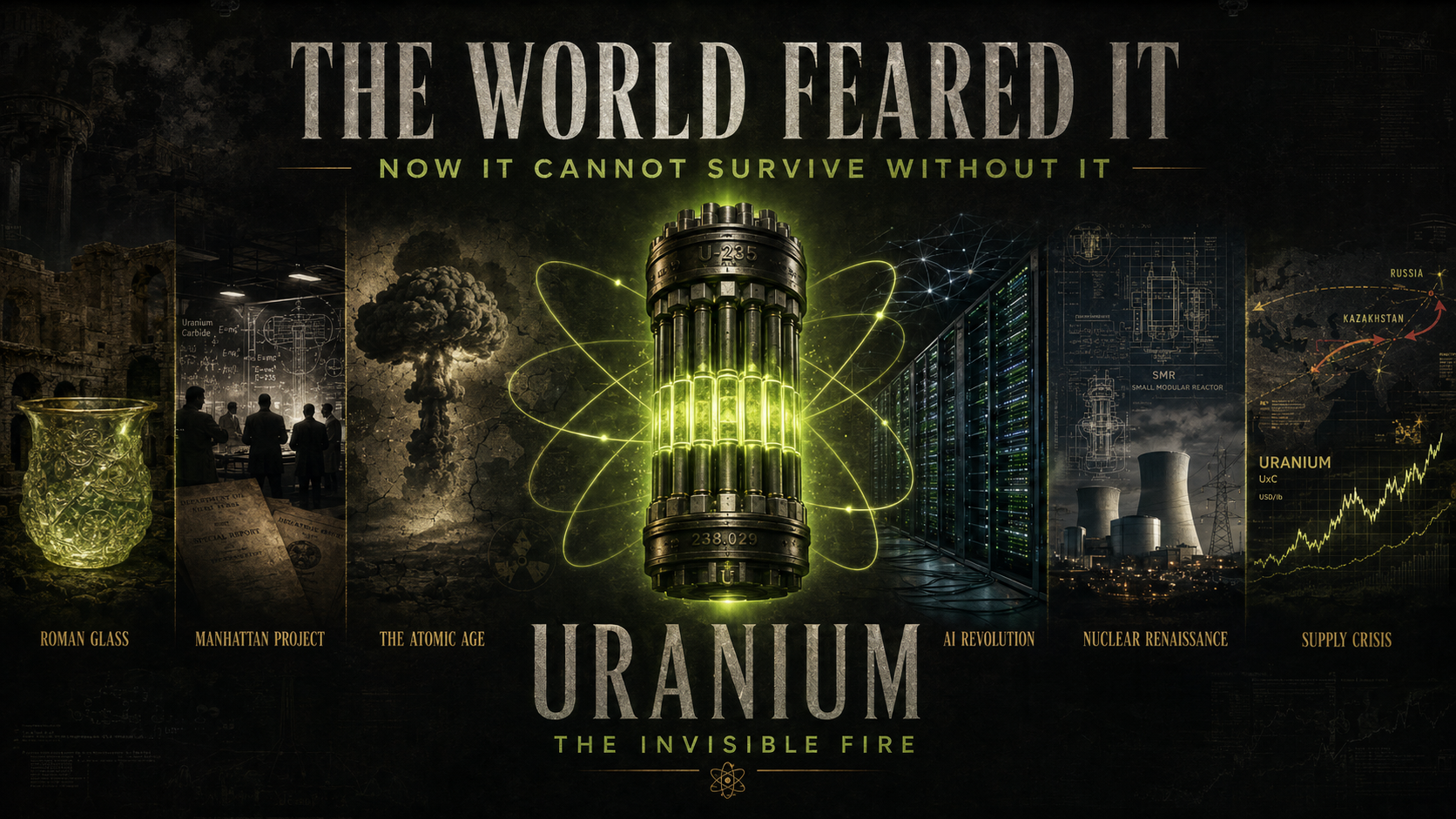
Uranium: The Invisible Fire — 80 Years of Fission, Fear & Power | Capital Street FX
URANIUM
The Invisible Fire
80 Years of Fission, Fear & Power — and Why the AI Age Cannot Survive Without It
From a Roman glassmaker’s yellow pigment to the Manhattan Project to Microsoft restarting Three Mile Island — the complete, definitive story of the most energy-dense substance on earth, the 31-million-pound annual supply deficit, and the geopolitical chokepoints reshaping energy markets in 2026.
The Fuel the World Needs — and Is Running Out Of
There is a substance on this planet so energy-dense that a pellet the size of a fingertip contains more power than 17,000 cubic feet of natural gas, 1,780 pounds of coal, or 149 gallons of oil. For most of human history, no one knew it existed. For the past eighty years, it has powered the lights of a billion homes, launched the world’s most powerful submarines, and twice annihilated entire cities in seconds. And right now, in 2026, it sits at the centre of the world’s most consequential and least-discussed supply crisis — the one that will determine whether artificial intelligence gets the electricity it needs to exist.
Uranium is not coal. It is not oil. It is not lithium or copper. Every commodity on that list can, to some degree, be substituted, conserved, or worked around when prices spike. Uranium cannot. Once a nuclear reactor is built — and 440 of them are operating today, with 63 more under active construction — it must be fuelled. There is no alternative. No switch to solar when uranium prices rise. No battery backup that can replace a 1,000-megawatt baseload reactor. The demand is inelastic in a way no other commodity can claim. And the supply is structurally, mathematically, unavoidably insufficient to meet it.
The world is experiencing a nuclear renaissance. It was not planned. It was forced. Four events collided between 2022 and 2026: Russia’s invasion of Ukraine revealed catastrophic Western energy dependency; the Inflation Reduction Act created $370 billion in clean energy incentives; ChatGPT launched an AI revolution demanding insatiable always-on electricity; and the US ban on Russian uranium imports removed 35% of American enriched uranium supply at a stroke. Together, these did what thirty years of climate advocacy could not: they made nuclear power politically, economically, and strategically indispensable.
- The Physics: Why Uranium Is Unlike Every Other Energy Source
- The History: From Roman Glass to the End of Everything
- Where It Comes From: The Most Concentrated Supply Chain on Earth
- The AI & Power Revolution: Why Big Tech Went Nuclear
- The Demand Revolution: Climate, Policy & the Nuclear Renaissance
- The Supply Crisis: Why the Numbers Don’t Add Up
- The Geopolitics: Uranium as a Strategic Weapon
- The Market: Prices, Cycles, Scenarios & Trade Ideas Across Time Horizons
- Markets Affected by Uranium Demand — What Moves and Why
- How to Track the Uranium Story: Three Core Proxy Instruments
- The Future: SMRs, Thorium & the Long Arc
- FAQ
The 50-Million-to-One Advantage
One kilogram of uranium fuel produces the same energy as 45,000 kilograms of coal. At the atomic level, splitting one U-235 nucleus releases 200 million electron volts. Coal releases 4 eV. The ratio is 50 million to one. This is not engineering — it is physics.
Uranium sits at atomic number 92 — the heaviest naturally occurring element on earth. When struck by a neutron, the nucleus of uranium-235 splits in two, releasing approximately 200 million electron volts of energy and 2–3 additional neutrons, each capable of splitting another nucleus. Controlled by neutron-absorbing rods, this chain reaction produces sustained heat that drives steam turbines. Uncontrolled, it produces an explosion. The entire technology of nuclear energy is the art of keeping that reaction precisely at the boundary between these two outcomes.
Only 0.7% of natural uranium is the fissile U-235 isotope. The remaining 99.3% is U-238, which does not sustain a chain reaction. To produce reactor fuel, natural uranium must be enriched — the concentration of U-235 increased from 0.7% to approximately 4–5%. This requires enormous industrial centrifuge facilities. Enrichment is the critical bottleneck in the nuclear fuel cycle — and it is the bottleneck that Russia currently controls with 40% of global capacity.
Uranium’s energy advantage over fossil fuels is not marginal — it is civilisational. One uranium fuel pellet (fingertip-sized) = 1,780 lbs of coal = 149 gallons of oil = 17,000 cu ft of natural gas.
Uranium is not rare. It is as common in the earth’s crust as tin or molybdenum — present in most rocks, in soil, in seawater. But economically mineable concentrations are rare and geographically concentrated. The world’s highest-grade deposits are in Saskatchewan, Canada, where ore grades reach 9% uranium oxide. The global average is 0.1%. That hundred-fold difference in grade is the difference between a viable mine and a geological curiosity.
80 Years That Remade Civilisation
Every great commodity has a history that tracks the arc of human ambition. Gold’s history is one of desire. Silver’s is one of commerce. Copper’s is one of connection. Uranium’s history is something darker and more complex: a story of accidental discovery, scientific triumph, moral catastrophe, public fear, political abandonment — and now, reluctant return.
The First Use: Roman Glassmakers’ Yellow Pigment
When archaeologists excavated Pompeii, they found vivid yellow-green glass whose colour came from uranium oxide. Roman glassmakers had been mixing uranium into their furnaces for centuries, entirely unaware of what they were handling. The Victorian Uranium Glass movement carried this tradition forward — producing objects that glow green under ultraviolet light — blissfully ignorant of the atom within.
Becquerel and Curie: The Discovery of Radioactivity
Henri Becquerel accidentally discovers radioactivity when uranium ore left on a photographic plate in a dark drawer develops the plate without light. Marie Curie maps the phenomenon she names “radioactivity” — and dies in 1934 from aplastic anaemia caused by decades of radiation exposure. Her laboratory notebooks remain so radioactive they require lead-lined storage and protective clothing to handle today.
Fission, Chain Reaction, and the Bomb
Otto Hahn splits the uranium atom in Berlin. Enrico Fermi achieves the first self-sustaining chain reaction beneath a squash court at the University of Chicago in 1942 — with no cooling system and no regulatory approval. July 1945: Trinity test, New Mexico. August 6, 1945: “Little Boy” — a uranium gun-type bomb — detonates above Hiroshima. 80,000 dead instantly. The uranium age announces itself with the worst single act of destruction in human history.
The Peaceful Atom: Nuclear Goes Commercial
Queen Elizabeth II switches on Calder Hall — the world’s first commercial nuclear power station — in 1956. France, recognising its complete dependence on imported fossil fuels, makes the most consequential energy decision of the 20th century: go 75% nuclear. By 1990, France has the cheapest electricity in Europe. The blueprint for nuclear power’s civilisational role is written in French.
Three Mile Island, Chernobyl, Fukushima: The Three Nuclear Winters
Three accidents in 32 years define nuclear’s public perception for a generation. Three Mile Island (1979): partial meltdown, no deaths, but 40 years of frozen American nuclear development. Chernobyl (1986): 31 immediate deaths, European nuclear stalls. Fukushima (2011): zero radiation deaths, yet Germany shuts all 17 reactors and uranium price collapses from $73 to under $18 by 2016. A decade of fatal underinvestment begins.
The Nuclear Renaissance: Forced by Crisis, Not Choice
Russia invades Ukraine — energy security panic. Inflation Reduction Act — $370B clean energy. ChatGPT launches — AI power crisis begins. US bans Russian uranium imports — 35% of enriched supply vanishes. Microsoft restarts Three Mile Island. Google signs SMR contracts. Meta targets 7.8GW of nuclear. The nuclear winter is over — not because the politics changed, but because the energy mathematics left no other choice.
Uranium’s price cycle is driven almost entirely by policy events and supply shocks — not conventional economic cycles. Each collapse corresponds to a nuclear accident; each recovery to a supply or policy inflection point.
Three Countries. One Chokepoint. Zero Alternatives.
Three countries supply more than 70% of the world’s uranium. One country controls 40% of the world’s enrichment capacity. And that country is Russia. This is not a supply chain — it is a geopolitical chokepoint dressed as a commodity market.
The Big Three: Kazakhstan, Canada, and Namibia
Kazakhstan (43% of world supply) — Kazatomprom, the state-owned national uranium company, is the Saudi Arabia of uranium. It mines through in-situ recovery: dissolving uranium underground and pumping it to surface — cheaper and faster than conventional mining, but entirely dependent on Russian pipeline infrastructure for export. In 2026, Kazatomprom has signalled a ~10% production cut, exercising pricing discipline. The world’s largest, lowest-cost producer is intentionally restricting output.
Canada (15%) — The World’s Best Ore, Not Flowing Freely — Saskatchewan’s Athabasca Basin contains deposits with ore grades up to 9% U₃O₈, compared to the global average of 0.1%. Cameco’s McArthur River is the world’s richest uranium mine. Yet Cameco’s production ran 18% below prior year in 2025 due to equipment reliability issues and remote-site logistics.
Namibia (11%) — Two Mines, One Problem — Namibia hosts the Rössing mine (now owned by China National Uranium Corporation, acquired from Rio Tinto in 2019) and Husab (owned by China General Nuclear Power). Both of Namibia’s significant uranium mines are Chinese-controlled.
The Step That Everybody Forgets: Enrichment
Mining produces yellowcake (U₃O₈). That is only step one. Before yellowcake can power a reactor, it must be converted to uranium hexafluoride (UF₆), then enriched from 0.7% to 4–5% U-235, then fabricated into ceramic fuel pellets. Russia’s Rosatom/TENEX controls 40% of global enrichment — the step where natural uranium becomes reactor-grade fuel. The 2024 US ban on Russian enriched uranium created an immediate, painful gap that the $2.7 billion DOE emergency investment in Centrus Energy is working to fill. Building enrichment capacity to replace Russia’s 40% share is a 5–10 year project minimum.
The AI Power Crisis — and Why Nuclear Is the Only Answer
The AI revolution has a power problem. Every large language model training run, every inference server, every GPU cluster needs electricity — clean, reliable, always-on electricity that solar and wind cannot guarantee. Nuclear is the only answer that works at scale. And nuclear means uranium.
A single large-scale AI model training run (GPT-4 scale) consumes approximately 50 gigawatt-hours of electricity — enough to power 5,000 homes for a year. There are now hundreds of such training runs occurring simultaneously. But training is only the beginning. The inference phase — serving answers to every user query, every second of every day — consumes even more electricity in aggregate because it runs continuously. Data centres consumed approximately 460 TWh globally in 2022. The IEA projects that figure will exceed 1,000 TWh by 2030 — equivalent to adding Japan’s entire electricity consumption to global demand in eight years.
Why Nuclear — The Capacity Factor Problem
Nuclear delivers a 92% capacity factor — it generates electricity 92% of every hour of every year. Solar averages 25%. Wind averages 35%. AI data centres cannot tolerate intermittency. A server farm that goes dark when the sun sets does not work. Battery storage at the scale required — hundreds of gigawatt-hours per large data campus — is economically unviable. Nuclear is the only clean energy source that delivers guaranteed 24/7 power at the scale AI infrastructure requires.
AI data centre electricity demand is projected to more than double by 2030. The ChatGPT inflection point (Nov 2022) marks the moment the trajectory changed permanently. Nuclear is the only clean energy source that can meet this demand reliably at scale.
Big Tech’s Nuclear Commitments — The Signed Deals
These are not aspirational statements. They are signed contracts with specific delivery timelines and financial commitments:
28 Countries. Triple Capacity by 2050.
The AI power story is the most dramatic new source of uranium demand — but it is not the only one. National nuclear programmes across five continents are simultaneously accelerating, driven by net-zero climate commitments and the energy security awakening triggered by Russia’s invasion of Ukraine.
The National Programmes Reshaping Demand
China is building 28 reactors simultaneously — the most aggressive civilian nuclear programme in history — targeting 150 reactors by 2035. China is simultaneously the world’s largest electricity consumer, the most aggressive nuclear builder, and the most active buyer of uranium assets globally. When China contracts for uranium, it contracts for decades of reactor operations.
France reversed its nuclear phase-out under Macron. Six new EPR2 reactors approved; eight more under consideration. Existing reactor fleet being life-extended beyond 50 years. France is repositioning nuclear as the cornerstone of its net-zero strategy and its industrial competitiveness.
Japan — 14 reactor restarts approved since Fukushima reversal. The government’s new Industry Minister has called nuclear “essential” to Japan’s energy security. The country that prompted the 2011 uranium price collapse is now helping lead the recovery.
India — 21 reactors planned or under construction; government mandate to quintuple nuclear capacity by 2047 as part of its net-zero commitment.
At COP28 in Dubai, 22 countries pledged to triple nuclear capacity by 2050. Six more joined at COP29 in Baku. These are binding policy commitments attached to national net-zero targets — representing reactor construction programmes that will collectively require hundreds of millions of additional pounds of uranium annually by 2035–2040.
“Nuclear is no longer the political liability it was. It is the only answer to the AI power crisis that works at scale. The demographic most concerned about climate change has concluded that opposing nuclear power is itself a form of climate denial.”Capital Street FX Research Desk · May 2026
Supply: 173M lbs. Demand: 204M lbs. Gap: −31M lbs.
This is not a forecast. It is accounting. Global uranium mine production in 2025: 173 million pounds. Global reactor requirements: 204 million pounds. The deficit is 31 million pounds — and it is widening every year. The uranium supply crisis has a peculiar quality that makes it more dangerous than most commodity imbalances: it cannot be resolved quickly, regardless of price.
A uranium mine takes 10–15 years from initial discovery to first production. That timeline cannot be compressed even with unlimited capital. The investment decisions that would have been needed to eliminate the 2026 deficit had to be made in 2011–2016 — during Fukushima’s nuclear winter, when uranium was trading at $18–30/lb and no rational investor was deploying capital into new mines. Those decisions were not made. The consequences are arithmetically fixed for the next decade.
The World Nuclear Association projects demand rising 28% by 2030 and doubling by 2040, while existing mine output is projected to halve in the decade after 2030. The gap between the lines is the investment case.
“The forward demand that has yet to come to the market has never been bigger. Utilities have covered only 60% of their forward requirements. When they return to the market to cover the remainder, they buy regardless of price — because the alternative is shutting down a reactor.”Grant Isaac, President & COO, Cameco Corporation — PDAC 2026
The deficit is compounded by the depletion of secondary supply sources. The “Megatons to Megawatts” programme (Russian HEU downblended to reactor fuel — ended 2013), enrichment underfeeding, and Cold War government stockpiles are all exhausted. The market has reverted to pure primary supply — mines — at exactly the moment when mine output is constrained by a decade of underinvestment.
The Inelastic Demand Argument: Uranium is the only major commodity where price has essentially zero effect on demand. A utility operating a nuclear reactor spends approximately 5% of its total electricity generation cost on uranium fuel. If uranium doubles from $85 to $170/lb — a front-page event — the cost of electricity from that reactor rises by approximately 5–7%. Utilities do not shut down billion-dollar reactors over a 7% fuel cost increase. They buy the uranium. This inelasticity is the structural foundation of the bull case.
The Fuel That Powers Cities and Destroys Them
Uranium is the only commodity on earth that can simultaneously power a city and destroy one. That duality makes it subject to political forces no other commodity faces — and makes its supply chain uniquely vulnerable to geopolitical disruption.
Russia’s Nuclear Trap
Rosatom — Russia’s state nuclear corporation — builds and operates reactors in more than 30 countries. Hungary, Finland, Turkey, India, Egypt, Bangladesh, China, Iran — these countries have Russian-built reactors, Russian-supplied fuel, and Russian-trained engineers. Sanctioning Russian uranium means not just denying Russia export revenue; it means creating fuel shortages in allied nations’ own reactors. Russia has constructed a dependency relationship with nuclear power that is harder to sever than oil or gas, because 10-year fuel cycle commitments make switching suppliers costly, slow, and technically complex.
China’s Systematic Resource Lock-Up
China’s state-owned nuclear companies have been systematically acquiring uranium assets globally for two decades. CNUC now owns Rössing in Namibia (acquired from Rio Tinto for $6.5M in 2019 — arguably one of the most consequential resource acquisitions of the decade). CGN owns Husab in Namibia. China has negotiated access agreements in Kazakhstan, Niger, and Canada. China is pre-buying the uranium supply that Western utilities will desperately need in 2035.
The Niger Coup — How Fragile Supply Really Is
In July 2023, a military junta overthrew Niger’s government and expelled France’s Orano from the SOMAÏR uranium mine — approximately 4% of global supply gone overnight. Zero production in 2025. France, which derives 70% of its electricity from nuclear, found a material share of its uranium supply suddenly unavailable. The episode is the clearest possible demonstration that uranium supply is not just an economic variable — it is a political one, entirely at the mercy of whatever government controls the territory above the deposit.
The Weapons Dimension: Uranium is the only commodity whose civilian supply chain intersects with weapons of mass destruction. Iran is enriching uranium to 60% — a technically trivial step from weapons-grade 90%. Saudi Arabia has stated publicly it will pursue nuclear weapons if Iran crosses the threshold. The Non-Proliferation Treaty framework is under its most sustained pressure since the Cold War. This dimension makes uranium subject to geopolitical shocks that cannot be modelled with conventional commodity frameworks.
$85 Today. Three Paths. One Structural Truth.
Uranium has one of the most unusual price mechanisms of any commodity on earth. 75% of it trades in long-term bilateral contracts — not on open exchanges. Its demand is inelastic. Its supply takes 10–15 years to expand. These characteristics combine to produce explosive bull markets. Below: three scenarios with specific trade ideas across 1 month, 1 year, 5 years, and 25 years.
Analyst Price Targets — Institutional Consensus
| Institution | 2026 Target | 2027–28 Target | Key Thesis |
|---|---|---|---|
| Bank of America | $100/lb | $110–120/lb | Utility under-contracting creates procurement scramble |
| Canaccord Genuity | $95/lb | $120/lb (bull) | Supply constraints persist through decade |
| Sprott Asset Mgmt | $90–110 | $130+/lb | Structural deficit requires price to incentivise new mines |
| Conservative consensus | $88–100/lb | $100–120/lb | Gradual utility re-engagement |
| Bear case | $70–80/lb | $80–90/lb | Recession reduces power demand |
Three Scenarios — Probability, Narrative & Trade Ideas by Time Horizon
Utility Procurement Scramble. US utilities recognise critically low forward coverage and simultaneously re-enter the long-term uranium market. Kazatomprom maintains production discipline. A major mine (McArthur River or Husab) suffers an unplanned outage. Big Tech SMR contracts accelerate new reactor permitting. Price breaks $120/lb by end-2027. BHP announces accelerated Olympic Dam uranium expansion ahead of the 2028 smelter decision.
Gradual Re-engagement. Utilities slowly add long-term contracts through 2026–2027. Kazatomprom holds discipline. Spot price consolidates $85–100/lb. Long-term contract price rises toward $95/lb, incentivising feasibility studies but not final investment decisions. BHP Olympic Dam uranium expansion decision pushed to 2029. AUD and CAD benefit gradually alongside BHP. The structural deficit is recognised but not yet urgently bid.
Demand Setback. Global recession delays AI infrastructure build-out and reduces near-term electricity consumption growth. Kazakhstan reverses production discipline to capture market share at lower prices. Japan reverses reactor restart programme following political pressure. Spot uranium tests $65–70/lb, approaching the economic pain threshold for Western producers. High-grade Canadian mines (McArthur River) remain viable; marginal US/Namibia producers halt output.
| Horizon | Instrument | Direction | Rationale & Catalyst | Target / Level | Risk |
|---|---|---|---|---|---|
| 1 Month May–Jun 2026 |
BHP (LSE: BHP) | ▲ LONG | Utility contracting news from PDAC follow-up; any Kazatomprom production update or McArthur River news triggers immediate BHP re-rating on Olympic Dam uranium exposure. Near-term catalyst: BHP Q3 production report expected June 2026. | +5–8% from £21.84 | BHP copper/iron ore dragging down if China growth data disappoints simultaneously |
| 1 Month | USD/CAD | ▲ CAD LONG (sell USD/CAD) |
Cameco (Canada) Q2 guidance update expected May 28. Any upgrade to McArthur River output or long-term contract signing strengthens CAD directly. Sell USD/CAD on uranium-specific catalysts. | 1.3700–1.3750 target | BoC rate surprise; US tariff escalation on Canadian goods reverses CAD |
| 1 Year To May 2027 |
BHP (LSE: BHP) | ▲ LONG — Core Position | Olympic Dam uranium expansion decision expected 2028; BHP will price in the decision throughout 2027. Uranium price at $120/lb adds material uplift to Olympic Dam revenue and re-rates BHP’s critical minerals division. Copper-uranium dual tailwind from energy transition demand. | +18–25% upside £25–27 target range |
Iron ore price collapse driven by China slowdown; BHP weighted toward iron ore in revenue mix |
| 1 Year | AUD/USD | ▲ LONG AUD | Australia uranium reserve re-rating as Western governments push for expanded output from the world’s largest reserve nation. Simultaneously, China reactor build-out supports iron ore demand. AUD benefits from dual commodity tailwind in bull scenario. | 0.6600–0.6800 range | RBA rate cuts ahead of Fed; iron ore price reversal; China growth shock |
| 5 Years To 2031 |
BHP (LSE: BHP) | ▲ LONG — Strategic | Olympic Dam expansion complete or in construction; uranium at $120–150/lb as utility procurement scramble peaks. BHP positioned as the world’s only large-cap Western miner with top-5 uranium, copper, and gold exposure simultaneously. Critical minerals supercycle plays directly through BHP’s asset base. | +50–80% cumulative £32–40 range |
BHP strategic restructuring; Pilbara iron ore disruption; Australian resource tax changes |
| 5 Years | USD/CAD | ▲ CAD LONG | Canada cements position as the West’s primary Western-aligned uranium supplier. Athabasca Basin mines at capacity. Saskatchewan becomes the geopolitical equivalent of Saudi Arabia’s Ghawar field for nuclear fuel. Structural CAD appreciation against USD driven by resource re-rating. | 1.25–1.30 range | US-Canada trade war re-escalation; Canadian political risk; BoC policy divergence |
| 25 Years To 2051 |
BHP (LSE: BHP) | ▲ LONG — Generational | In a bull scenario over 25 years, nuclear powers 30%+ of global electricity. BHP’s Olympic Dam — with 1M+ tonnes of uranium resources — is producing at maximum capacity supplying hundreds of reactors globally. The copper-uranium-gold combination makes BHP the definitive energy-transition mining stock of the 21st century. At $150–200/lb uranium, Olympic Dam’s uranium alone could be worth more than BHP’s current market cap. | Multi-bagger potential Dividend + capital growth |
Fusion energy commercialised by 2040s, eliminating uranium demand; BHP corporate risk over 25yr horizon |
| 25 Years | AUD/USD | ▲ Structurally Long AUD | Australia becomes the world’s largest uranium exporter in the 2030s as Olympic Dam expansion comes online. Combined with copper, gold, and lithium exports, Australia is the definitive critical-minerals nation of the energy transition. AUD re-rates structurally as global reserve managers recognise Australia’s unique resource position — possibly reaching parity with USD or beyond by 2040–2050. | 0.75–1.00 long-term Structural trend |
Climate change impacts on Australian agriculture and tourism; political risk; commodity cycle reversals |
| Horizon | Instrument | Direction | Rationale & Catalyst | Target / Level | Risk |
|---|---|---|---|---|---|
| 1 Month | BHP (LSE: BHP) | ▲ MILD LONG | Base scenario: uranium consolidates $85–95/lb. BHP holds value on Olympic Dam exposure without significant catalyst. Range-trade BHP around £21–23. Wait for uranium contracting news before adding aggressively. | £21–23 range +3–5% |
Copper price weakness drags BHP despite uranium stability |
| 1 Month | USD/CAD | → NEUTRAL / Tactical | In base scenario, CAD trades on BoC and US-Canada trade dynamics more than uranium. Monitor for uranium-specific news (Cameco guidance, Kazatomprom update) before directional positioning. Range: 1.37–1.40. | 1.37–1.40 range | US tariff noise creates CAD volatility unrelated to uranium |
| 1 Year | BHP (LSE: BHP) | ▲ LONG — Patient | Uranium drifts to $95–100/lb through gradual utility contracting. BHP’s Olympic Dam uranium revenue grows 12–18%. Combined with copper tailwind from EV/grid demand, BHP appreciates steadily. Core position with patience — the catalyst will come when utilities are forced back to market. | £23–25 target +8–14% |
No major uranium catalyst in 12 months if utility procurement continues to delay |
| 1 Year | AUD/USD | ▲ MILD LONG | Gradual uranium demand recognition, stable China growth, and RBA on hold supports AUD. Not a dramatic move but a steady drift toward 0.66 as commodity basket strengthens. Uranium story becomes incrementally more visible to AUD bulls. | 0.6500–0.6650 | China slowdown; RBA rate cuts before Fed |
| 5 Years | BHP (LSE: BHP) | ▲ LONG — Core Hold | Five-year base case: uranium reaches $100–120/lb as utility under-contracting becomes undeniable. BHP’s Olympic Dam expansion proceeds. The stock compounds at 10–15% annually, driven by uranium re-rating plus copper and gold tailwinds from the broader energy transition. BHP becomes the market’s go-to critical minerals expression. | £28–34 range +28–55% |
Iron ore structural decline; BHP dividend cuts if capex escalates at Olympic Dam |
| 5 Years | USD/CAD | ▲ CAD gradually appreciates | Canada cements uranium supply role over five years. USD weakens structurally as US fiscal trajectory degrades. CAD-uranium correlation becomes clearer to market participants as Athabasca Basin output grows. Gradual move toward 1.28–1.32 on five-year horizon. | 1.28–1.32 | Oil price collapse removes energy sector CAD support |
| 25 Years | BHP (LSE: BHP) | ▲ LONG — Dividend Compounder | Base 25-year case: nuclear provides 20–25% of global electricity by 2050. Olympic Dam producing uranium, copper, and gold at record levels. BHP remains the world’s largest diversified miner with an unparalleled critical minerals asset base. Dividend reinvestment compounds returns substantially over the full 25-year horizon. | +150–250% total return with dividends reinvested |
Technological disruption; nationalisation risk in Australia; climate policy reversal |
| 25 Years | AUD/USD | ▲ Gradual structural appreciation | Australia’s critical minerals dominance — uranium, copper, lithium, nickel — makes AUD the definitive energy-transition currency over a 25-year horizon. As global reserve managers diversify away from USD toward commodity-backed currencies, AUD benefits alongside gold. Structural appreciation toward 0.80+ on a 25-year base case. | 0.78–0.88 range 25-yr target |
Climate change physical risk to Australia; demographic decline; China dependency |
| Horizon | Instrument | Direction | Rationale & Catalyst | Target / Level | Risk |
|---|---|---|---|---|---|
| 1 Month | BHP (LSE: BHP) | ▼ SHORT or AVOID | Bear trigger: Kazakhstan announces production increase or a major reactor restart programme is cancelled. BHP’s uranium exposure ($85/lb → $65/lb) cuts Olympic Dam uranium revenue ~25%. Combined with copper weakness in a recession, BHP faces dual commodity headwind. Short on confirmed bear catalyst, not pre-emptively. | £18–20 downside −8–12% |
BHP’s copper/iron ore may hold independently; uranium-only bears may not be sufficient to move BHP significantly short-term |
| 1 Month | AUD/USD | ▼ SHORT AUD | Bear scenario: recession reduces China steel demand (iron ore) simultaneously with uranium sentiment. AUD is the most sensitive G10 currency to simultaneous commodity weakness. Short AUD/USD on confirmed recession signals and commodity downturn. | 0.6100–0.6200 | RBA holds rates longer than expected; commodity prices hold despite growth fears |
| 1 Year | BHP (LSE: BHP) | ▼ REDUCE / HEDGE | Uranium at $65–70/lb for 12 months damages Olympic Dam economics; BHP evaluates production cut or suspension of expansion capex. Stock underperforms broader market. Reduce exposure; hedge with put options if available. Re-enter when uranium price tests key support levels ($60–65/lb) and supply discipline reasserts. | £18–21 range −5–15% from entry |
Bear scenario is 20% probability; being short BHP in a resource bull market is costly if bear doesn’t materialise |
| 1 Year | USD/CAD | ▼ USD LONG (buy USD/CAD) |
Canada’s uranium and energy exports weaken; CAD loses its resource premium. USD strengthens as recession triggers safe-haven flows back to dollar. Buy USD/CAD on confirmed recession signal — target 1.42–1.45 as CAD underperforms in a risk-off environment where both commodities and risk appetite deteriorate. | 1.42–1.45 target | BoC rate cuts accelerate — could weaken CAD even without uranium selling off |
| 5 Years | BHP (LSE: BHP) | → UNDERWEIGHT / WAIT | Bear scenario over 5 years: uranium stays in the $65–85/lb range; Olympic Dam expansion is deferred; BHP pivots capital to copper and iron ore. The uranium bull case is delayed not destroyed — the supply deficit is structural and will eventually reassert. Use the five-year bear scenario as an accumulation window, not a permanent short. | £18–24 wide range Accumulate on weakness |
Overstaying the bear is costly — uranium’s inelastic demand means the cycle will turn; the question is when, not if |
| 5 Years | AUD/USD | ▼ STRUCTURAL HEADWIND | Five-year bear: China’s property crisis deepens, reducing iron ore imports and AUD’s resource premium. Uranium demand delay extends. AUD trades with a structural discount to fair value throughout the bear scenario. Avoid long AUD as a primary position; use USD/CAD or DXY alternatives for non-AUD exposure. | 0.5800–0.6200 range | China policy stimulus could reverse iron ore and AUD sharply; RBA rate cuts creating carry trade inflows |
| 25 Years | BHP (LSE: BHP) | → LONG-TERM ACCUMULATE | Even in the 25-year bear scenario, the structural case for uranium demand is not destroyed — it is delayed. Fusion energy remains decades away. Nuclear remains the only proven clean baseload technology. BHP’s Olympic Dam resources are not going anywhere. On a 25-year horizon, the bear scenario creates a lower entry price, not a fundamental negation of the bull thesis. Dollar-cost average into BHP over the bear period. | Better entry points created by bear |
The only true 25-year bear case for uranium is fusion energy reaching commercial scale — currently modelled as earliest 2045–2050 |
| 25 Years | USD/CAD | → MIXED LONG-TERM | On a 25-year horizon, even the bear scenario for uranium eventually reverses. The structural deficit returns. CAD gradually strengthens relative to USD as Canada’s critical minerals role becomes undeniable. Use the 25-year bear’s lower CAD entry point to build long CAD positioning for the eventual structural re-rating. | 1.35–1.45 through bear period then 1.20–1.30 recovery |
US fiscal repair; USD structural strengthening if America reduces deficit; Canadian political instability |
Important: All trade ideas represent analytical thinking on how uranium fundamentals may transmit through available instruments, and do not constitute investment advice. All trading involves significant risk of loss. Scenario probabilities reflect Capital Street FX Research estimates as of May 2026 and are subject to change. Please read our full risk disclosure before trading. Open a Capital Street FX account to access BHP (LSE equity CFD), USD/CAD, and AUD/USD with live spreads.
Every Market the Nuclear Renaissance Touches
Uranium demand does not move in isolation. A structural increase in nuclear power capacity ripples across equity markets, commodity markets, forex markets, and indices — each through a distinct and traceable causal chain. Understanding these second-order effects is as important as trading the primary uranium thesis.
Equity Markets — Stocks Directly Powered by Nuclear Growth
Forex Markets — Currencies Moved by Nuclear Demand
(sell USD/JPY)
(buy USD/RUB)
Commodity Markets — The Second-Order Effects
as nuclear displaces gas
Index & Sector Exposure — Broad Market Effects
Uranium Cannot Be Traded Directly. Here’s What Can.
An Important Clarification: Uranium (U₃O₈) does not trade on public commodity exchanges. 75% of all uranium transactions occur through long-term bilateral contracts between utilities and producers — private negotiations, not exchange-listed instruments. Academic peer-reviewed research (ScienceDirect, 2024) confirms that uranium has low correlation with gold and oil, both of which are tangential or inverted in stress events. The three instruments below have direct, logical, causal connections to uranium fundamentals — not thematic associations.
Olympic Dam in South Australia is the world’s single largest uranium deposit — over 1 million tonnes of uranium resources. Uranium accounts for approximately 25% of Olympic Dam’s total revenue. When uranium sentiment strengthens, BHP benefits directly and materially.
BHP is investing $840M+ in Olympic Dam expansion with a major smelter decision in 2028. Management has framed Olympic Dam as a “critical minerals and energy transition” asset — tying it directly to the nuclear renaissance narrative.
Caveat: BHP is primarily a copper and iron ore miner. Uranium is meaningful (25% of Olympic Dam) but not dominant in group revenue. Use when uranium is the dominant macro story and monitor Olympic Dam-specific news.
Canada is the world’s second-largest uranium producer (15% of global supply) and home to the highest-grade deposits on earth. The Athabasca Basin in Saskatchewan, where ore grades reach 9% U₃O₈ vs the world average 0.1%, is the geological foundation of the uranium bull case.
When uranium investment accelerates — reactor announcements, Kazatomprom cuts, utility contracting news — the Canadian dollar benefits as a resource currency tied to a sector experiencing structural re-rating. Canada’s positioning as the West’s preferred alternative to Russian/Kazakh supply reinforces this.
Caveat: CAD is also driven by US-Canada trade relations, Bank of Canada rate policy, and oil prices. Use as a directional indicator when uranium-specific catalysts are the dominant driver.
Australia holds 28% of the world’s proven uranium reserves — the largest single national reserve concentration on earth — yet mines only approximately 10% of annual global supply. This gap represents enormous latent supply that Western governments are now actively pushing Australia to develop.
BHP’s Olympic Dam alone sits in Australian soil. When uranium demand rises, pressure on Australia to expand production increases, investment flows to Australian uranium assets, and AUD benefits as the world’s largest uranium-reserve nation currency.
Caveat: AUD is the world’s copper and iron ore currency first, uranium proxy second. It tracks China growth and RBA policy more prominently. Use when uranium is the leading macro narrative.
Using All Three Together: The strongest uranium signal occurs when all three proxies move in the same direction. When BHP rises on Olympic Dam news, USD/CAD strengthens on Cameco production data, and AUD/USD rallies on Australian nuclear policy announcements simultaneously — that is the full uranium thesis expressing itself across markets. Confluence across all three provides the strongest directional confirmation. Access all three through Capital Street FX’s full instrument range.
Beyond the Boom: What Comes After 2030
Small Modular Reactors: The Game Changer
More than 50 SMR designs are in active global development. Instead of building a single massive reactor over 15 years at a cost of $8–15 billion, SMRs are designed to be manufactured in standardised modules in factories, shipped to site, and assembled in two to three years. Target outputs range from 50 MW (industrial heat, remote communities) to 300 MW (city power, large data campuses). The economics at scale could reduce the cost of nuclear electricity by 30–40%.
NuScale Power (US, first NRC-approved). Rolls-Royce SMR (UK, 470MW, targeting 2030). X-energy (US, Amazon-backed, high-temperature gas-cooled). Kairos Power (US, Google contract, 2030 deployment). TerraPower (US, Bill Gates-backed, sodium-cooled, Wyoming). All of these require uranium fuel — specifically, many require HALEU (High-Assay Low-Enriched Uranium) at 19.75% U-235 rather than standard 4–5%, creating an additional demand stream for enrichment capacity that barely exists outside Russia today.
The Perception Shift That Changes Everything
For the first time since Three Mile Island, polls show majority support for nuclear power in the United States (52%), United Kingdom (58%), and France (71%). Young people — the demographic most concerned about climate change — have concluded that opposing nuclear power is itself a form of climate denial. Environmental organisations that spent decades opposing nuclear, including Greenpeace chapters, have reversed their positions. The political risk that killed nuclear in the 1980s and 1990s has structurally diminished — and this is the most durable change in the entire nuclear landscape, because it determines the regulatory environment that decides how quickly new reactors can be built.
The Invisible Fire That the World Cannot Afford to Ignore
There is a substance on this planet that Roman glassmakers used to colour goblets yellow in the first century AD, entirely unaware of what they were handling. That Marie Curie carried in her coat pockets until it killed her. That Enrico Fermi split beneath a squash court in Chicago in 1942 and changed the trajectory of human history forever. That was dropped on two Japanese cities in August 1945, ending a war and beginning a new era of geopolitical terror. That has powered the lights of a billion homes for seventy years, largely invisibly, without smoke or CO₂. And that right now, in 2026, sits at the centre of the most consequential supply deficit in the global energy system — the one that will determine whether the AI revolution gets the electricity it needs to continue.
The mathematics are not complex. The world has 440 operating reactors that must be fuelled. It has 63 more under construction that will need fuel within three to five years. It has policy commitments from 28 countries to triple nuclear capacity by 2050. And it has a mine supply currently producing 31 million pounds less than reactor demand, with no credible scenario for closing that gap before the mid-2030s. New mines take a decade to build. The decision to invest in those mines was not made during the nuclear winter of 2012–2021. The consequences are fixed in time. They cannot be resolved by a policy announcement or a technology breakthrough. They can only be resolved through price — higher prices that attract the capital needed to find and develop the next generation of uranium supply.
Gold held its value across six thousand years of human history. Silver built civilisations and was forgotten — until the modern world needed it for solar panels and semiconductors. Copper connected the ancient world and is now connecting the AI world. Uranium is different from all of them. It is the only element that can simultaneously power a hospital and destroy a city. The only clean energy source that can give the AI revolution the always-on electricity it cannot live without. The invisible fire has been burning for eighty years. The world is finally paying attention.
All market data current as of May 12, 2026. Forecasts are analytical estimates and do not constitute investment advice. BHP, USD/CAD, and AUD/USD are discussed as proxy instruments for uranium market exposure — not direct uranium investments — and carry their own independent risk factors. Trading involves significant risk of loss.
Start Trading These Markets →