April CPI Shock Hits 3.8% as Oil Surges and Nasdaq Slides | US Closing Session | May 12 2026
US Close — Tuesday, May 12, 2026
CPI 3.8% Shocks Markets; Nasdaq Tumbles 1.5% on Chip Rout; Warsh Confirmed as Fed Governor — Chair Vote Wednesday; Iran Ceasefire on “Life Support”; WTI Breaks $101; Rate Hike Odds Surge
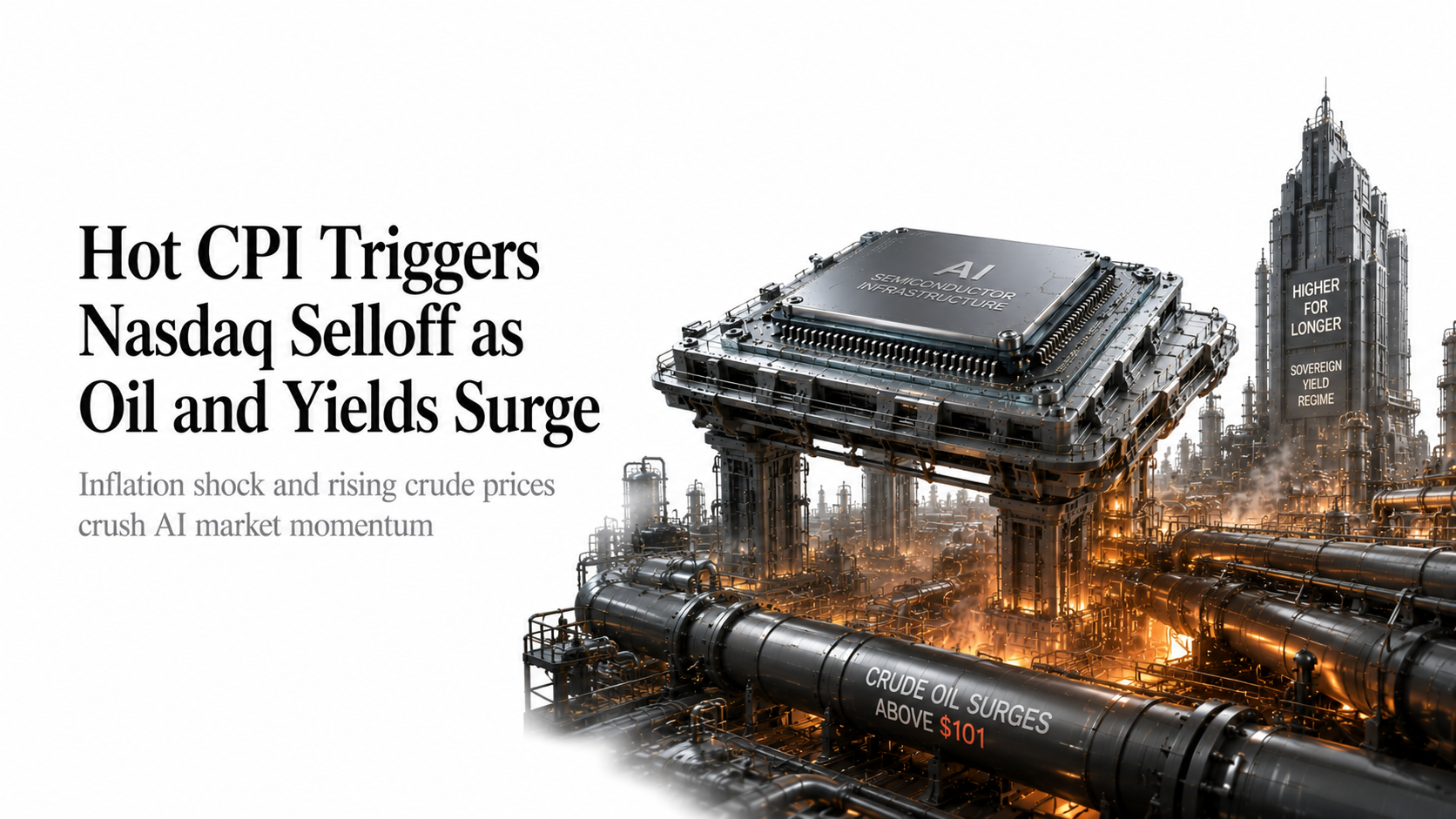
Tuesday delivered the session the market had been dreading since oil crossed $95: a hot CPI print that forced traders to confront the full stagflationary arithmetic of the Iran war. April headline inflation came in at 3.8% year-over-year — a 50 basis-point acceleration from March’s 3.3%, the highest reading since May 2023, and one-tenth above the 3.7% consensus. Core CPI, stripped of food and energy, rose 0.4% month-on-month against a 0.3% estimate, confirming that the energy shock from the closed Strait of Hormuz is now bleeding into broader prices beyond the gas pump. The Nasdaq bore the brunt of the repricing, falling 1.52% as chipmakers and AI infrastructure names led the rout — Intel tumbled 4.7%, CoreWeave slumped 8%, and Micron dropped 4%. The S&P 500 shed 0.65% while the Dow, insulated by its lower-tech composition, declined a fractional 0.03%. The 10-year Treasury yield surged toward 4.46%, pricing out any remaining 2026 rate-cut probability and lifting the odds of a rate hike by end-2026 to approximately 30%. Against this macro shock, the Warsh confirmation process continued its choreographed advance: the Senate confirmed Warsh as a Fed Board Governor by a 51-45 vote on Tuesday, clearing the procedural path for Wednesday’s decisive chair vote, hours before Jerome Powell’s term expires on Friday May 15. And on the geopolitical front, the weekend that was supposed to bring Tehran’s peace response instead brought Trump’s declaration that the US-Iran ceasefire is now on “massive life support” — a formulation the market has struggled to map onto conventional risk frameworks, and the primary reason WTI crude broke above $101 for the first time since the April 8 ceasefire.
Tuesday’s session was defined by the collision of two forces that the market had hoped to avoid simultaneously: an inflation shock that resets the Fed policy calculus, and a geopolitical deterioration that removes the nearest catalyst for oil price relief. The April CPI report, released at 08:30 ET, landed like a torpedo. Headline inflation at 3.8% was not just above the 3.7% forecast — it marked the fastest annual price acceleration since May 2023, and it arrived with a core reading (0.4% MoM, 2.8% YoY) that exceeded estimates on both metrics, confirming that energy-driven inflation is spreading into shelter, airfares, and apparel. Energy accounted for over 40% of the monthly headline gain, with gasoline up 28.4% annually. For the first time since April 2023, real average hourly wages turned negative year-over-year — paychecks growing 3.6% while prices rose 3.8%. The Warsh confirmation machinery continued on schedule despite the macro shock: the Senate confirmed Warsh to the Fed Board of Governors by 51-45 — with only Senator Fetterman crossing party lines — clearing the path for Wednesday’s separate chair vote, which would install Warsh as the first new Fed chair since Jerome Powell in 2018. Wednesday’s chair vote is expected, though not guaranteed, to confirm. Powell will then remain on the board as a governor while the DOJ renovation probe remains pending. The geopolitical picture darkened materially. Trump declared the ceasefire “on massive life support” after rejecting Iran’s latest counterproposal as “TOTALLY UNACCEPTABLE.” Reports emerged that the president met with his national security team to discuss restarting military operations and revisiting plans to escort commercial ships through the Strait by force. WTI crude broke through $101 for the first time since the ceasefire; Brent approached $107. The prospect of a deal — which as recently as Friday appeared days away — has visibly deteriorated into a standoff with no clear resolution timeline.
Markets Snapshot — Close of Business, May 12, 2026
| Index | Close | Change | Session Signal | Context |
|---|---|---|---|---|
| S&P 500 | ~7,364 | ▼ −0.65% | CPI SELLOFF | Pulled back from Monday’s record close of 7,412 as the CPI shock repriced the entire rate path. The index remains just 48 points below the all-time high — a testament to the structural resilience of the AI earnings thesis, even as the macro backdrop deteriorates. Energy stocks were the sole bright spot, adding as oil broke $101. Tech and growth names led the declines as the 10-year yield surged to 4.46%. |
| Nasdaq Composite | ~25,874 | ▼ −1.52% | CHIP ROUT — AI DERATING | The Nasdaq led losses for the session as semiconductor and AI infrastructure names de-rated sharply on the higher-for-longer rate reset. Intel fell 4.7%, trimming its remarkable 2026 YTD gain of 80%+. CoreWeave dropped 8%, extending post-earnings losses. Micron −4%. The session tested whether the AI earnings narrative can withstand a macro tightening signal of this magnitude — the answer on Tuesday was: not fully. |
| Dow Jones Industrial | ~49,690 | ▼ −0.03% | NEAR FLAT — OIL OFFSET | The Dow’s near-flat close reflects its relative insulation from rate-sensitive tech names. Energy components (Chevron, ExxonMobil) benefitted from the oil surge. The index is within striking distance of 50,000 — a psychological level that has proven durable support in the 2026 rally. The Dow’s composition makes it the most informative index for gauging the non-tech economy’s resilience to the current dual shock of inflation and geopolitical uncertainty. |
| Russell 2000 | ~2,825 | ▼ −1.59% | OIL + RATES DOUBLE SQUEEZE | Small caps continue to absorb the heaviest macro headwinds. The Russell 2000 is now down materially from its recent highs, pressured by both higher energy input costs (oil above $101) and higher floating-rate borrowing costs (10Y at 4.46%). The index has now declined in two of the last three sessions — the most sustained small-cap weakness since March. A Hormuz reopening remains the single most powerful potential catalyst for small-cap recovery. |
| VIX | ~18.34 | ▲ elevated | FEAR RISING — NOT PANIC | VIX climbed from Friday’s 17.13 close to 18.34 — a meaningful but contained fear reading. The market has not yet entered panic territory (VIX above 25 would signal that), but the directional move is clearly toward higher risk premiums. The “Warsh confirmation = institutional anchor” thesis has not been enough to offset the CPI shock and Iran deterioration. A VIX move above 20 would be the threshold signalling genuine market stress. |
Stocks & Sectors — Chips Lead Selloff; Energy Lone Gainer; CoreWeave Extends Losses
| Company / Asset | Signal | Catalyst | Analysis |
|---|---|---|---|
| Intel CorporationINTC · −4.7% | RATE DERATING | CPI-Driven Margin Compression | Intel fell 4.7%, trimming its extraordinary 2026 YTD gain (the stock had more than tripled by Tuesday’s open). The selloff is a direct consequence of the CPI-driven rate reset: Intel’s Q1 2026 earnings delivered revenue of $13.58B (+7.2% YoY, beating $12.42B est) and non-GAAP EPS of $0.29. The business is recovering — Q2 guide of $13.8–14.8B is constructive. But at 3x YTD appreciation, the stock’s valuation premium is acutely sensitive to discount rate changes, and a 10-year yield at 4.46% compresses semiconductor multiples materially. CFO David Zinsner’s comment about “billions per customer” in advanced packaging revenue remains the long-term thesis — it just needs a rate-friendly environment to be fully priced in. |
| CoreWeaveCRWV · −8% | GUIDANCE OVERHANG | Q2 Guide Miss + Rate Reset | CoreWeave extended post-earnings losses, falling 8% on Tuesday as the CPI shock amplified existing concerns from last Thursday’s results. Q1 revenue of $2.08B (+112% YoY) beat estimates, but Q2 guidance of $2.45–2.60B (midpoint $2.53B) trailed the $2.69B Street consensus. The company raised capex guidance to $31–35B (from $30–35B) and holds nearly $25B in debt — a leverage profile that becomes significantly more expensive when the 10-year yield surges 13bps in a single session. The $99.4B revenue backlog remains the bull case; the debt load is the bear case; and Tuesday’s CPI print moved the debate decisively toward the latter. The stock is still up ~80% YTD but has now given back a material portion of its post-IPO gains. |
| Micron TechnologyMU · −4% | SECTOR CONTAGION | AI Chip Risk-Off | Micron dropped 4% as the CPI-driven selloff swept through the semiconductor complex. No company-specific catalyst — the move is pure rate-multiple compression applied to a high-growth AI memory supplier. Micron has been one of 2026’s strongest performers on the thesis that AI training and inference workloads are driving HBM memory demand to structural new highs. That thesis remains intact, but at current multiples the stock requires a benign rate environment, and Tuesday’s CPI print definitively removed that support in the near term. |
| Energy Sector (XLE)XLE · +2.1% | OIL SURGE BENEFIT | WTI $101 · Iran Escalation | Energy was the session’s only major sector winner as WTI crude broke above $101 and Brent approached $107 on the Iran ceasefire deterioration. Chevron and ExxonMobil led gains within the Dow’s energy components. The energy sector now represents the clearest expression of the market’s Iran war risk premium — every dollar of WTI above the “deal” price (~$75–80) is a direct subsidy from the global economy to energy producers. The XLE’s outperformance on Tuesday was the largest single-session sector spread (energy vs Nasdaq: approximately 3.6 percentage points) since mid-March when the war began. |
| Copper FuturesHG · record close | RECORD CLOSE MON | $6.46/lb — AI & Infrastructure Demand | Copper hit a record closing price of $6.4605 per pound on Monday (May 11) — a 13%+ gain in 2026 — before pulling back Tuesday amid the broader commodities reset. The copper rally reflects the AI infrastructure buildout’s raw materials demand: data centers, power grid expansion, and EV manufacturing are all copper-intensive. Monday’s record close was a signal of how broad the AI spending wave has become — it is now bidding up not just semiconductors and cloud software, but the base metals that carry electricity to the data centers. Citigroup strategist Scott Chronert noted the Nasdaq 100 remains a preferred AI play even at elevated valuations given its direct exposure. |
Tuesday’s chip selloff is the most instructive data point of the session for AI infrastructure investors, and the key question it raises is whether the CPI shock represents a temporary rate repricing or a sustained multiple compression cycle for AI names. The argument that it is temporary: the CPI reading’s primary driver — energy — is entirely a function of the closed Strait of Hormuz. Goldman Sachs analyst Mark Zandi projects inflation falls back to approximately 3.3% by year-end if the conflict ends in coming weeks. A Hormuz reopening cuts $15–25 from WTI, removes 40%+ of the monthly CPI energy contribution, eases airline fares, reduces logistics costs — and the entire inflationary transmission mechanism that drove Tuesday’s 3.8% print begins to reverse within one to two months. That is the scenario in which Intel’s 4.7% decline and CoreWeave’s 8% drop are buying opportunities. The argument that Tuesday’s repricing is structural: core CPI at 0.4% MoM (highest since January 2025) includes shelter inflation catch-up from October’s government shutdown data gap, tariff-related pressure on apparel and household furnishings, and sticky non-housing services inflation that is not directly linked to oil. Even if oil falls, these components do not immediately reverse. Pantheon Macroeconomics senior economist Oliver Allen acknowledged both sides, noting there are “good reasons to believe that it’s not spiraling out of control” while conceding it will be “uncomfortable for households for the next few months.” The market’s challenge heading into Wednesday is to simultaneously process the Warsh chair confirmation vote — which is structurally bullish (institutional continuity, known policy framework) — and the Iran ceasefire deterioration — which is structurally bearish (oil stays elevated, inflation stays hot). The Warsh confirmation will happen. Tehran’s peace response remains the only event that changes the inflation calculus — and as of Tuesday’s close, that response is further away than it was on Friday.
Macro & Fed — CPI Inflation Shock; Warsh Chair Vote Tomorrow; Rate Hike Odds Reset Higher
| Driver | Level | Signal | Implication |
|---|---|---|---|
| April CPI — Headline | +3.8% YoY | ABOVE 3.7% EST | Highest annual inflation since May 2023. Accelerated from 3.3% in March — a 50bps jump in a single month. Prior to the late-February US-Iran conflict, inflation had eased to 2.4%. The entire acceleration is Iran-war driven: energy accounted for 40%+ of the monthly gain. Removes all rate-cut optionality for the incoming Warsh Fed in the near term. |
| April CPI — Core ex-food/energy | +0.4% MoM · +2.8% YoY | ABOVE 0.3% / 2.7% EST | Core beat on both the monthly and annual print — the most concerning signal of the day. Monthly 0.4% is the highest since January 2025. Shelter +0.6% (statistical catch-up from October shutdown). Airline fares +2.8% MoM. Apparel +0.6%. Household furnishings +0.7%. These components are tariff- and logistics-driven, not purely Iran-energy. Suggests inflation is broader than just the gas pump. |
| Real Average Hourly Wages | −0.3% YoY | FIRST NEGATIVE SINCE APR 2023 | Nominal wage growth +3.6% YoY — but CPI +3.8% YoY means real purchasing power has turned negative. This is the most direct measure of the Iran war’s consumer impact: the energy price shock has overtaken wage gains, eroding household real income. Lower-income households are most exposed — NY Fed data showed they cut gas consumption 7% in March; higher-income households increased spending 19%. Consumer spending bifurcation is widening. |
| Warsh — Fed Governor Confirmed | 51-45 Senate Vote | CHAIR VOTE WEDNESDAY | The governor confirmation Tuesday was the procedural prerequisite for Wednesday’s chair vote — the actual moment of transition. If confirmed Wednesday, Warsh takes over before Powell’s term expires Friday May 15. Warsh inherits a CPI reading that is the direct opposite of the “AI-driven disinflation” thesis he has publicly championed. His first FOMC communication (June 16-17) will need to address whether Tuesday’s 3.8% print changes his rate-cut sequencing. |
| CME FedWatch — Rate Hike Odds | ~30% by end-2026 | HIKE PRICING RE-EMERGING | Prior to Tuesday’s CPI, markets had fully removed 2026 rate-cut expectations but had not priced hikes. The 3.8% print pushed hike probability to ~30% by end-2026 per CME FedWatch. Bank of America pushed its first-cut forecast to H2 2027. If Warsh signals hawkish continuity at his first FOMC, cut expectations may be pushed even further. The Atlanta Fed’s GDPNow shows 3.7% Q2 GDP growth — still strong, but downside revision risk is elevated after today’s data. |
| Trump — Iran & Gas Tax Suspension | 18.4¢/gal for “a period of time” | LIMITED RELIEF SIGNAL | Trump told CBS News on Monday his administration would suspend the federal gas tax — 18.4 cents/gallon for regular, 24.4 cents/gallon for diesel — “for a period of time.” Analysts described the relief as limited: with gas prices up 28.4% YoY, a 18-cent cut provides roughly 3-4% relief at current price levels. The administration also rejected a bailout for airlines dealing with higher jet fuel costs. The gas tax suspension is a political signal, not an economic solution to the energy inflation problem. |
Tuesday’s CPI print fundamentally changes the inheritance Kevin Warsh receives when he takes the chair on Friday. The scenario that Warsh publicly described — AI productivity driving structural disinflation, enabling the Fed to ease without sacrificing the inflation mandate — has been directly contradicted by a CPI reading that is running at 3.8% and accelerating. Warsh’s “regime change” at the Fed now inherits a regime where the primary inflation driver (Iran war oil prices) is entirely outside the Fed’s toolkit. No rate decision the Warsh Fed makes at the June 16-17 FOMC changes the price of oil. The only variable that changes the inflation outlook is the Iran deal — and that deal is, as of Tuesday’s close, further away than it was on Friday. The Warsh Fed’s communication challenge at June’s FOMC is therefore unprecedented in modern Fed history: how to signal institutional credibility on inflation without committing to a rate hike path that would be unnecessary if the Iran deal materialises within weeks. The right communication framework is conditionality — “our policy path is conditional on the energy price trajectory, which is itself conditional on the geopolitical resolution.” But conditionality is a difficult message to deliver from the bully pulpit of a Fed chair’s first press conference. The market will be watching for any signal of Warsh’s willingness to hike — and even a cautious framing may be interpreted as hawkish in the current environment. For ordinary Americans, Tuesday’s data represents the starkest summary of the Iran war’s economic cost: real wages fell below inflation for the first time in three years, household energy bills are $75 per month higher than before the war, and the Federal Reserve that was supposed to begin easing in 2026 may instead be forced to tighten into a slowdown. The stagflation word — which was premature in March — is now a legitimate characterisation of the risk scenario if the ceasefire collapses entirely.
Commodities & Crypto — WTI Breaks $101; Gold Under Pressure; Bitcoin Retreats
| Asset | Price | Move | Signal | Commentary |
|---|---|---|---|---|
| WTI Crude Oil | ~$101.34 | ▲ +3.33% | CEASEFIRE BREAKDOWN PREMIUM | WTI broke above $100 for the first time since the April 8 ceasefire as Trump’s rejection of Iran’s counterproposal removed the nearest resolution catalyst. The 52-week range is $54.98–$117.63 — the full arc of the Iran war premium. ANZ Research: “rollercoaster” volatility will persist until a credible negotiation path re-emerges. The $101 level carries symbolic weight as the market’s “deal is failing” price point. |
| Brent Crude | ~$107 | ▲ +2.86% | HORMUZ PREMIUM WIDENING | Brent approaching $107 reflects the global oil market’s recalibration of Hormuz disruption duration. Nearly 20% of global petroleum trade transits the Strait — every week of effective closure adds pressure to refining margins globally. Asian importers are most exposed. Energy analysts warn extended supply disruptions could significantly impact transport costs, manufacturing prices, and downstream inflation worldwide — adding to the CPI spiral that Tuesday’s data confirmed. |
| Gold (XAU/USD) | ~$4,678 | ▼ −0.85% | REAL YIELD HEADWIND | Gold fell despite the geopolitical deterioration — a counterintuitive move explained by the CPI-driven dollar rally and surging real yields. When 10Y yields spike 13bps in a single session, the opportunity cost of holding non-yielding gold rises sharply, triggering liquidation. Down from ~$4,720 on May 8. Still 43.79% above year-ago levels. The gold bull case remains intact: an Iran deal reopens the rate-cut path, dollar weakens, real yields fall, gold rallies. But Tuesday’s data pushed that scenario further into the future. |
| Bitcoin (BTC/USD) | ~$80,445 | ▼ −1.81% | RISK-OFF CORRELATION | Bitcoin pulled back from recent highs as the CPI shock triggered a broad risk-off move. The crypto asset has increasingly traded as a risk-sentiment proxy in 2026, amplifying macro moves in both directions. Still above the $75,000 level that represented last week’s resistance. The higher-for-longer rate environment removes a key crypto tailwind: the “Fed cuts reduce opportunity cost” argument that had supported BTC above $80K. Watch for support at $78,000–79,000. |
| Copper Futures | ~$6.46/lb | ● record level | AI INFRA DEMAND | Copper set a record close of $6.4605 per pound on Monday May 11 — up 13% in 2026 — before consolidating Tuesday. The copper rally is structural rather than cyclical: AI data center construction, power grid expansion, and EV manufacturing are all copper-intensive. The metal’s record run is the most direct commodity signal of the AI infrastructure buildout reaching into raw materials — a confirmation that the AI capex cycle is broad enough to move physical commodity markets. |
Trade Setups — Key Levels & Positioning for Wednesday’s Open
| Instrument | Direction | Entry Zone | Target | Stop | Rationale |
|---|---|---|---|---|---|
| WTI Crude Oil | WATCH BOTH SIDES | $99–102 | $110+ (no deal) | $95 (deal signal) | WTI is a pure binary on the Iran deal. Ceasefire collapse → $110–117 range. Credible deal progress → rapid return to $80–90. Wednesday’s Warsh confirmation and any diplomatic developments are the key catalysts. Position sizing must account for the possibility of a 10-15% gap move in either direction within 24-48 hours. |
| S&P 500 (SPX) | DIPS BID — CONDITIONAL | 7,320–7,370 | 7,500+ (deal+Warsh) | 7,200 | AI earnings fundamentals remain structurally intact — five consecutive sector beats, $99B CoreWeave backlog, Akamai $1.8B deal all confirmed last week. Tuesday’s macro shock is real but energy-driven and potentially reversible. Long bias on dips to 7,320–7,370 zone with a stop below 7,200 (Iran escalation scenario). Warsh confirmation Wednesday is a potential positive catalyst. |
| Nasdaq 100 (NDX) | RATE SENSITIVE — CAUTION | 25,700–26,000 | 27,000 (rate reversal) | 25,200 | Nasdaq is the most rate-sensitive major index. The 10-year at 4.46% is already compressing AI multiples — further yield moves to 4.6–4.7% would extend the selloff. Citigroup Chronert still sees NDX as the preferred AI play vs S&P 500. Wait for yield stabilisation before initiating large long positions. |
| Gold (XAU/USD) | LONG BIAS — DUAL SCENARIO | $4,620–4,680 | $4,850+ (deal / rate cuts) | $4,500 | Gold wins in both Iran resolution scenarios: deal closes → oil falls → inflation eases → rate-cut expectations re-emerge (gold bullish); deal collapses → stagflation hedge premium returns even with higher real yields (gold still bid). Tuesday’s dip to $4,678 is a potential entry for the longer-term thesis. Goldman Sachs year-end target: $4,900/oz. |
| USD/JPY | SHORT BIAS — RATE PEAK PLAY | 153–156 | 145–148 (Iran deal) | 158 | CPI shock temporarily strengthened USD. But if an Iran deal materialises and oil falls sharply, US inflation collapses, rate hike pricing reverses aggressively, and USD weakens vs JPY. The short USD/JPY trade is the highest-conviction Iran deal expression in FX markets. The entry window on dollar strength is attractive for a medium-term position ahead of the deal resolution. |
| Energy Sector (XLE) | HEDGE — IRAN ESCALATION PLAY | Current levels | +15% (no deal, oil $110) | −20% (deal, oil $75) | XLE is the natural portfolio hedge against Iran escalation risk. As the session’s only major sector gainer (+2.1%), it demonstrated its role in an oil-above-$100 environment. Consider a small XLE long as insurance against the ceasefire collapse scenario — it performs inversely to the rest of the portfolio in that outcome. |
🤔 Analyst Q&A — Tuesday May 12, 2026
Closing Summary — Tuesday, May 12, 2026
Tuesday, May 12, 2026 is the session in which the market was forced to confront the full arithmetic of the Iran war for the first time. The April CPI reading — 3.8% headline, 0.4% core, gasoline up 28.4%, airlines up 20.7%, real wages negative for the first time in three years — was not a surprise to anyone who has been tracking the Strait of Hormuz closure since late February. But the confirmation in official BLS data, at 08:30 ET, triggered the repricing that the market had been partially anticipating and partially avoiding. The Nasdaq’s 1.52% decline was not a panic; it was a rational recalibration of growth stock multiples in a rate environment that moved from “cuts possible in 2026” to “hike odds 30%” in a single morning.
The Warsh confirmation process continues its scheduled advance — Tuesday’s 51-45 governor vote sets up Wednesday’s decisive chair vote, and if the procedural choreography holds, Kevin Warsh will be the 17th Federal Reserve Chair before Jerome Powell’s term expires on Friday May 15. The market’s challenge is that Warsh’s first public test as chair-designate arrives at the worst possible macro moment: an inflation reading at three-year highs, a geopolitical situation described by the sitting president as “on massive life support,” and a 10-year yield that just added 13 basis points in a single session. The institutional signal of a confirmed, credible Fed chair is positive for markets in the long run — it removes the governance uncertainty that has hung over the Fed since Trump first mooted Powell’s replacement. But in the near term, Warsh’s first FOMC communication must thread the needle between acknowledging the inflation reality and maintaining the optionality that an Iran deal resolution would unlock.
The Iran deal binary dominates every other variable heading into Wednesday. Trump’s rejection of Tehran’s counterproposal — “TOTALLY UNACCEPTABLE” — and the NSC meeting to discuss military restart options represent the most significant ceasefire deterioration since the May 7-8 Hormuz fire exchange. WTI above $101 is the market’s real-time verdict on the current deal probability. The path forward is narrow: either Iran submits a revised proposal that addresses the nuclear moratorium and sanctions sequencing that Washington requires, or the ceasefire deteriorates further toward the military restart scenario that would push WTI to $110+ and the S&P 500 to 7,000-7,100. The week’s remaining catalyst sequence — Warsh chair vote Wednesday, Powell exit Friday — is entirely eclipsed by Tehran’s next diplomatic move. The AI infrastructure thesis is confirmed, the labor market is resilient, and the Warsh Fed is about to take over. The only thing that changes Tuesday’s story is the answer that Iran has not yet given.