Daily Market Analysis – Evening Session |EU BOUNCES +0.7% | May 13, 2026 | Capital Street FX
EU Bounces +0.7% · Starmer Defies Resignation, Gilt Yields Fall Back · Siemens €6B Buyback After Q2 Beat · Brent Holds $107 · EUR/USD Recovers 1.174 · Trump-Xi Meeting Today — The Iran Wildcard
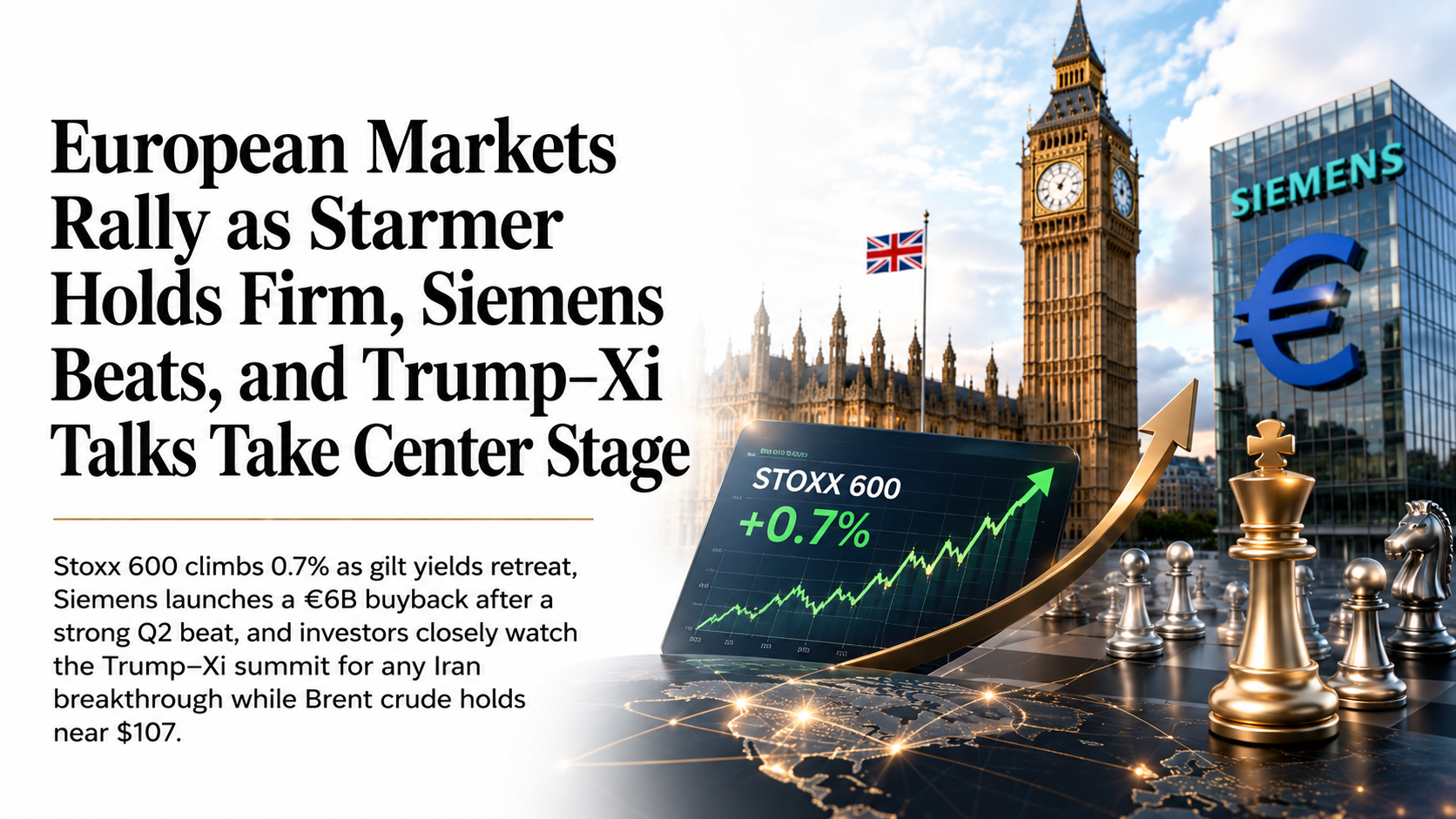
Wednesday, May 13, 2026 — European markets are staging a relief rally, with the Stoxx 600 up 0.7% as Starmer’s refusal to resign at Tuesday’s cabinet meeting allows gilt nerves to partially calm. UK 10-year gilt yields retreated from Tuesday’s decade-high of 5.116% back toward 5.01%, lifting GBP and releasing pressure on European risk assets. Siemens AG delivered a forecast-beating Q2 result and launched a new €6B five-year share buyback program, while Allianz SE releases its first quarterly report since 2016. Brent crude holds near $107/bbl as the Hormuz closure enters its twelfth week with no breakthrough in sight. Global markets are now laser-focused on the Trump-Xi summit — the final diplomatic channel for an Iran deal this week before Warsh takes over as Fed Chair on Thursday.
EU Session Macro Scorecard — Wednesday, May 13, 2026
European Session Market Snapshot — May 13, 2026
| Asset | Price | Change | Context | Bias |
|---|---|---|---|---|
| DAX 40 (DE40) | ~24,040 | ▲+0.7% | Germany’s flagship index bouncing after Tuesday’s Iran-inflation double shock. Siemens’ Q2 beat and new €6B buyback provides a structural German industrial anchor to the rally. Digital Industries strength confirms AI-driven industrial capex is flowing even amid the geopolitical backdrop. DAX energy sector (Siemens Energy) supported by sustained Brent $107. Automotive sector cautiously positive — rate-hold fears from hot US CPI linger, but relief that UK political chaos isn’t systemic. Industrial conglomerates leading the index higher. | INDUSTRIAL BID |
| FTSE 100 (UK100) | ~8,490 | ▲+0.8% | FTSE outperforming all continental peers this morning — the index’s ~15% energy sector weighting (BP, Shell) benefits directly from Brent holding $107. Political risk premium from Starmer crisis is easing: gilt yields fall 2–6bps, GBP recovers from $1.351 to $1.357. Internationally exposed FTSE 100 multinationals benefit from GBP softness boosting dollar-denominated revenues. NatWest and Lloyds rebounding from Tuesday’s -3% panic lows. FTSE 250 (domestic-focused) recovering more slowly as political uncertainty lingers. | OIL LIFT · GILT EASE |
| CAC 40 (FR40) | ~7,956 | ▲+0.2% | France underperforming peers as the CAC lacks the earnings catalyst firepower of Germany’s reporting day. Luxury names (LVMH, Hermès) cautiously positive on USD strength supporting dollar-denominated revenue. TotalEnergies gains from sustained Brent $107. French banks modestly higher — the Starmer-driven gilt contagion to sovereign spreads has been contained; French OATs are stable. Airbus benefits from energy sector supply chain normalisation hopes tied to Trump-Xi summit. CAC stagflationary macro risk (growth slowing, inflation sticky) remains the structural headwind. | CAUTIOUS · LAGGING |
| Stoxx 600 | +0.7% | ▲ BROAD RALLY | Pan-European benchmark staging a broad relief bounce, all sectors positive on the open. Banks +1.1% (led by UK names recovering from Starmer panic); industrials +0.9% (Siemens halo); technology +0.7% (AI-investment narrative from Siemens results); energy +0.6% (Brent $107 sustained). Healthcare and utilities lagging but positive. The bounce is a technical relief after Tuesday’s 1.2% sell-off — not yet a fundamental reassessment. Volume is cautious ahead of Trump-Xi meeting clarity on Iran. | RELIEF BOUNCE |
|
— Commodities —
|
||||
| Brent Crude (Jul ’26) | ~$107.00 | ▲ HOLDS HIGH | Brent is holding near $107/barrel — its third consecutive session of gains — as the Strait of Hormuz remains effectively closed with no diplomatic breakthrough. The Trump-Xi meeting provides a theoretical path to Iran deal pressure via China, but Trump has signalled trade issues dominate the agenda. Market is in a “ceasefire limbo” premium: not fully pricing in combat resumption (which would gap Brent to $115–$120) but not pricing in a deal either (which would push Brent toward $88–$94). The $100–$108 range is the geopolitical gridlock band. Saudi Aramco warned normalisation won’t occur until 2027 if the strait stays closed. | GEOPOLITICAL BID |
| Gold (XAU/USD) | ~$4,685 | ▲+0.10% | Gold holding near unchanged — the same dual-force gridlock from Tuesday persists: hawkish macro (hot CPI, no 2026 Fed cuts, Warsh hawkish-hold) versus geopolitical fear (Iran ceasefire on life support). The EU session bounce in equities has slightly dampened the safe-haven bid for gold today, keeping it range-bound just above $4,680. WGC Q1 2026 demand record ($193B institutional) provides the structural floor. The Trump-Xi meeting is the key catalyst: a China-mediated Iran signal would push gold toward $4,640, while combat resumption would spike gold toward $4,850–$4,950. | CONTESTED RANGE |
|
— FX & Rates —
|
||||
| EUR/USD | ~1.1740 | ▲ RECOVERING | Euro recovering modestly from Tuesday’s post-CPI lows near 1.172. The EU session bounce in equities and calming of UK gilt panic is providing marginal EUR support. However, the structural EUR negative case remains intact: eurozone energy import costs remain ~40% above pre-war baseline, ECB is pricing in potential rate hikes of ~40bps by year-end (vs prior cut expectations), and stagflationary data — growth slowing while inflation stays sticky — undermines EUR appreciation. Support at 1.170; resistance at 1.178. Short EUR/USD remains the medium-term structural trade but tactical intraday recovery to 1.176 is possible if Trump-Xi produces Iran constructivism. | FRAGILE RECOVER |
| GBP/USD | ~1.357 | ▲ RECOVERING | Cable recovering from Tuesday’s intraday low of $1.351 as gilt yields retreat 2–6bps after Starmer’s defiance steadied political risk sentiment. However, Citi strategists maintain a downside bias: a Labour leadership contest or left-wing policy shift would trigger “higher gilt yields and weaker GBP.” The pound is also supported by UK energy sector strength (FTSE 100’s oil weighting). Key technical: GBP/USD needs to hold above $1.350 to avoid signalling a more sustained downtrend. 10-year gilt at 5.01% (down from 5.116% peak) is still historically elevated — political uncertainty is a persistent overhead pressure. EUR/GBP fell as EUR recovers less quickly than GBP. | POLITICAL RISK |
| UK 10-Year Gilt | ~5.01% | ▼ FROM 5.116% | UK government bonds are recovering from Tuesday’s multi-decade highs after Starmer ruled out resignation. Yield fell 2–6bps across the curve on the open. However, the fundamental drivers of UK gilt pressure are structural: energy-driven inflation running above peers, fragile fiscal position, and political uncertainty around fiscal policy direction. 30-year gilt retreated from its 1998-high of 5.81% but remains elevated. Oxford Economics warns yields will stay “higher for longer” regardless of Starmer’s fate — increased spending is seen as likely under any scenario. | RISK PREMIUM PERSISTS |
| EUR/GBP | ~0.866 | ▼ GBP OUTPERFORMING | EUR/GBP falling as sterling outperforms the euro in Wednesday’s session — gilt yields retreating faster than ECB hawkishness is building. UK energy sector (FTSE) benefit + Starmer political resolution marginal positive = GBP relative strength. Jefferies recommends shorting GBP tactically (“any change in government would likely be left-leaning”), but intraday the pair is driven by gilt-ECB spread dynamics. EUR/GBP short positioning cautious ahead of Trump-Xi meeting outcome. | GBP NEAR-TERM FIRM |
EU Session News Feed — Wednesday, May 13, 2026
EU Session Fundamentals Analysis — May 13, 2026
🇬🇧 UK Gilt & Political Crisis — What Wednesday’s Calm Tells Us
The 2–6bps decline in gilt yields on Wednesday morning reflects relief, not resolution. Starmer’s refusal to resign removes the immediate catalyst for a leadership contest — which requires 81 Labour MPs to formally back a challenger. As of Tuesday’s count, 83 MPs had publicly called for resignation, but without a declared challenger the formal process stalls. Angela Rayner, Wes Streeting, and Andy Burnham are the three names circulating, but none has yet declared.
The bond market’s concern is forward-looking: even if Starmer survives, Citi warns that his attempts to “regain popularity” will involve increased government spending — which the UK’s fiscal position cannot easily accommodate. UK 10-year yields at ~5.01% remain near multi-decade highs, reflecting the structural reality that the UK is more exposed to Iran-driven energy inflation than almost any comparable European economy. Andrew Goodwin (Oxford Economics) expects yields to stay “higher for longer” regardless of who is Prime Minister.
The GBP implication: Sterling at $1.357 is a fragile equilibrium. A leadership contest → leftward policy shift would push GBP toward $1.330–$1.340. Starmer surviving and delivering fiscal consolidation signals would allow GBP recovery toward $1.370–$1.380. The asymmetry is bearish: more ways for GBP to fall than rally from here. Jefferies maintains a short-GBP recommendation.
⚙️ Siemens Beat — What It Tells Us About European Industrial Demand
Siemens Q2 FY2026 results are significant beyond the headline beat. Orders rising 18% on a comparable basis, with double-digit growth across most industries, signals that European industrial capex is accelerating despite geopolitical headwinds. The specific driver CEO Busch highlighted — AI-driven data centre demand — mirrors what US tech companies have been reporting for months. The “Eigen Engineering Agent” AI product confirms Siemens is embedding AI into its core industrial automation offering.
The bullish read: European industrial giants with global customer bases are insulated from domestic energy cost headwinds by the structural AI-investment cycle. Orders backlogs (Siemens Energy’s €146B is a record) provide multi-year revenue visibility. The €6B buyback signals Siemens AG’s management is confident in forward cash generation despite the macro environment.
The risk caveat: Siemens Energy’s wind division (Siemens Gamesa) narrowed its quarterly deficit to €46M (from €1.36B a year ago) but is not yet profitable. The geopolitical environment remains “very demanding” by the CEO’s own admission. Any Hormuz escalation → energy cost spike → industrial customer capex pause → order risk. The fundamental thesis is intact but the geopolitical tail risk remains binary.
🛢️ Brent $107 — Why Hormuz Persistence Changes the Macro Narrative
Brent crude at $107/barrel — sustained for a third consecutive session — is no longer a “spike.” It is the new baseline. The Strait of Hormuz has been effectively closed for over 12 weeks, and every day that passes increases the probability that the “temporary disruption” repricing becomes a permanent structural re-rating of energy costs. Saudi Aramco CEO Amin Nasser’s warning that the oil market will not normalise until 2027 if the strait stays closed is the clearest projection from the most informed supply-side actor.
The European implication: Unlike the US (which has the Strategic Petroleum Reserve and growing domestic production), Europe has no natural energy buffer. German industry (the DAX’s backbone) still runs on gas — much of which originated from Middle Eastern sources. ECB projections already flag that energy-driven inflation will peak at 3.1% in Q2 2026. A prolonged Hormuz closure pushes that timeline deeper into H2 2026 and locks in ECB hawkishness through the end of the year.
The Trump-Xi wildcard: China is the single most powerful lever on Iranian behaviour. Chinese refineries — particularly Shandong teapot refineries — process significant volumes of sanctioned Iranian crude. China’s willingness to use that dependency as a pressure mechanism would be transformative. But Trump’s aides have signalled trade takes priority. A China-mediated Iran signal at the Trump-Xi summit today would be the most bullish macro catalyst for European equity markets since the ceasefire was first announced.
📊 ECB Fundamentals — Stagflation Trap Tightening
The European Central Bank faces its most difficult policy environment since the 2011–2012 sovereign debt crisis. The combination of energy-driven inflation, slowing growth, and a politically fragile UK (the eurozone’s largest trade partner outside the US) creates a genuine stagflationary trap. ECB March 2026 staff projections forecast eurozone inflation averaging 2.6% for 2026 and 2.0% for 2027 — but these projections assume some Hormuz normalisation in H2 2026. If the strait remains closed, the 2026 average could exceed 3.0%.
The rate dilemma: OIS markets now price ~40bps of ECB hikes by year-end — a dramatic reversal from pre-war expectations of cuts. But hiking into a slowing economy risks exacerbating the downturn. Eurozone GDP growth is losing momentum; German GfK consumer confidence is weakening; business surveys across the region are deteriorating. The ECB cannot cut (inflation too high) and struggles to hike (growth too fragile). The result is paralysis — with June’s meeting a key decision point.
EUR/USD structural view: The currency pair’s recent stability near 1.172–1.178 masks extreme fundamental uncertainty. EUR/USD bears have three simultaneous tailwinds: Iran risk-off (USD safe haven), US hawkish macro (hot CPI, zero cuts, Warsh hawkish-hold), and EU stagflationary trap. EUR/USD short below 1.175 targeting 1.158 remains the highest-conviction structural FX trade for Q2 2026.
EU Session Trade Scenario Matrix — May 13, 2026
Trigger: Trump-Xi summit produces a China-mediated Hormuz partial-reopening signal. Iran accepts phased approach. Ceasefire formally extended.
Oil: Brent collapses to $88–$94. WTI sub-$90. Energy sector gives back 5–7%.
DAX: Surges 2.5–3.5% on energy-cost relief. Industrial names rally hard. Auto sector outperforms.
FTSE: Paradox — oil heavyweights (BP, Shell) fall 4–6% as energy rally collapses, but domestics and consumers rally on lower inflation expectations. Net FTSE: modest +0.5% to +1%.
EUR/USD: Rallies toward 1.185–1.192 on USD safe-haven unwind and EU inflation relief.
GBP/USD: Recovers to $1.380–$1.390 on reduced gilt premium + lower inflation narrative.
Gold: Softens to $4,620–$4,650. Safe-haven + inflation premium unwinds.
Probability: ~20% (requires Trump-Xi miracle on Iran specifically)
Trigger: Starmer holds. Trump-Xi meeting inconclusive on Iran. Ceasefire technically survives. Hormuz remains at below-normal capacity. No formal deal, no new escalation.
Oil: Brent holds $102–$108 range. WTI $97–$103.
DAX: Consolidates 23,900–24,200. Siemens earnings glow fades by afternoon. Volume drops ahead of Warsh Thursday.
FTSE: Holds 8,420–8,520. Oil heavyweights support; domestic stocks rangebound on lingering Starmer risk.
EUR/USD: Range 1.170–1.178. No directional break without Iran catalyst.
GBP/USD: Range $1.348–$1.362. Political uncertainty caps upside; energy support caps downside.
Gold: Range $4,660–$4,720. Contested between hawkish macro and geopolitical fear.
Probability: ~50% (most likely; Hormuz status quo = market limbo)
Trigger: Trump formally signals resumption of combat operations. Ceasefire collapses. Simultaneously, a Labour challenger formally declares. Double shock for UK/EU markets.
Oil: Brent gaps to $115–$122. WTI $108–$114.
DAX: Drops 2.5–4.0% intraday. Industrial selloff, auto stocks hit by energy cost fears, chemical sector crushes.
FTSE: Oil boost partially offsets. BP/Shell surge. But domestic UK stocks hit by gilt spike and political chaos. FTSE 100 flat to -0.5%; FTSE 250 -2.5–3.5%.
EUR/USD: Falls toward 1.155–1.162. Double USD safe-haven + EU energy shock.
GBP/USD: Falls toward $1.325–$1.335. Gilt spike = GBP collapse. UK political premium maximises.
Gold: Surges to $4,850–$4,960. Dual geopolitical fear + inflation shock = maximum gold bid.
Probability: ~30% (elevated but requires two simultaneous negative events)
Analyst FAQ — Top EU Session Questions Today
This apparent paradox is explained by the FTSE 100’s unique composition. Unlike most European indices which are dominated by industrials, financials, and domestic businesses, the FTSE 100 derives roughly 80% of its revenues from outside the UK and carries approximately 15% weighting in energy majors (BP, Shell, and associated businesses). When Brent holds at $107/barrel — as it does today — this energy sector weighting provides a direct, mechanical uplift to the FTSE that other European indices don’t enjoy.
Additionally, the pound’s weakness (GBP still below its pre-Starmer-crisis levels at $1.357) boosts dollar-denominated revenues for FTSE multinationals when translated back to sterling. This is the FTSE’s “natural hedge” — the same mechanism that made the FTSE outperform during Brexit uncertainty and the 2022–2023 energy crisis. International earnings are worth more in GBP terms when the pound falls.
The important nuance: This is FTSE 100 outperformance, not FTSE 250. The FTSE 250 — which is far more exposed to UK domestic business conditions — is recovering much more slowly from Tuesday’s Starmer shock. Investors watching “the UK” should distinguish between the globally-exposed FTSE 100 (benefiting today) and the domestically-exposed FTSE 250 (still under pressure). CFD trading involves significant risk. This is educational market analysis and does not constitute personal financial advice.
Siemens AG launching a €6 billion, five-year share buyback program — its largest since 2017 — sends three simultaneous messages to markets that carry broad European significance.
Signal 1 — Cash generation confidence: A buyback of this scale requires management to be confident in multi-year free cash flow generation. Given the “very demanding” geopolitical environment Busch himself acknowledged, this is a notable assertion of industrial resilience. It implies Siemens believes energy cost headwinds will not structurally impair its business model.
Signal 2 — AI capex tailwind validation: The orders growth (+18% comparable) and Digital Industries outperformance confirm that the AI-driven industrial automation cycle is real and accelerating. This is bullish for the entire German industrial complex: BASF, Infineon, and other companies with AI-adjacent businesses may see sympathy upgrades as analysts extrapolate the Siemens data.
Signal 3 — Return of European corporate capital discipline: The combined €6B Siemens AG buyback + €3B Siemens Energy acceleration + Allianz’s ongoing €2.5B program signals a broader European corporate shift toward shareholder returns. This is the most structurally bullish development for European equities in months — if the energy and political crises allow it to flow through. CFD trading involves significant risk. This is educational market analysis and does not constitute personal financial advice.
The gilt crisis is paused, not over. The difference matters. Tuesday’s spike — 10-year yields to 5.116%, 30-year to 5.81% (highest since 1998) — was triggered by a specific political event (Starmer facing formal resignation calls at a cabinet meeting). Starmer’s defiance temporarily removes that immediate catalyst, allowing gilt yields to fall 2–6bps on Wednesday. But the structural pressures that drove yields to these levels remain intact.
The three structural UK gilt negatives that haven’t resolved: (1) UK energy inflation is running above European peers due to heavier gas import exposure — this keeps real yields required by investors elevated. (2) Political uncertainty: even if Starmer survives, Labour will likely increase spending to rebuild popularity after the local election rout, worsening the fiscal deficit. (3) UK mortgage market stress: higher long gilt yields feed into swap rates, which underpin commercial lending and mortgage pricing — this squeezes consumer demand and SME investment, a stagflationary loop.
On GBP specifically: Buying GBP at $1.357 offers a limited risk-reward. The upside scenario (Starmer fiscal discipline + Iran deal + energy cost normalisaton) is 3-4 months away at best and requires multiple simultaneous positive events. The downside scenario (leadership contest + leftward policy shift + Brent escalation) could materialise within days. Jefferies maintains a short-GBP recommendation. Société Générale’s Kit Juckes flagged that higher taxes on wealth and housing are “a given” under any Labour configuration. A tactical short-GBP/USD below $1.360 targeting $1.330–$1.335 captures the asymmetric downside risk. CFD trading involves significant risk. This is educational market analysis and does not constitute personal financial advice.
For European traders, the Trump-Xi meeting has three potential market-moving outputs — only one of which is directly bullish for EU markets.
Output 1 — Iran breakthrough signal (20% probability): China agrees to pressure Iran via crude purchase leverage. Hormuz partial reopening agreed. Brent collapses $12–$18. ECB inflation projections crater. DAX and Stoxx 600 surge 2–3%. EUR/USD recovers to 1.185. This is the single most bullish outcome for European equity investors and the ECB.
Output 2 — Trade deal clarity only (50–55% probability): Trump-Xi agree tariff framework on Chinese goods. Iran barely discussed. Brent stays at $107. European markets muted — any US-China trade clarity marginally positive for German exporters and semiconductor supply chains, but no energy relief. EUR/USD stays range-bound. ECB still faces June hike decision under stagflation.
Output 3 — No deal + escalation language (25–30% probability): Trump confirms combat resumption is imminent. Xi declines to apply Iran pressure (domestic politics). Brent spikes toward $115. Stoxx 600 drops 2–3%. EUR/USD falls to 1.155. FTSE 250 collapses. This is the tail risk that is suppressing European investor risk appetite today despite the morning rally.
The single sentence to watch from any Trump-Xi press statement: any mention of “Strait of Hormuz,” “Iran,” or “energy corridors” is a market-moving signal. Silence on Iran = Output 2. Positive Iran language = Output 1. Combative Iran language = Output 3. CFD trading involves significant risk. This is educational market analysis and does not constitute personal financial advice.
Normally, higher ECB rate expectations would be bullish for EUR/USD — a hawkish ECB raises the eurozone’s return on capital, attracting flows into EUR-denominated assets. But the current ECB repricing is different in character: it is driven by energy-induced inflation, not by economic strength. Markets are pricing hikes not because the eurozone is booming, but because energy inflation has forced the ECB’s hand — and the economy is simultaneously weakening.
This is the textbook stagflation paradox: the central bank is forced to tighten into a slowing economy. Unlike the US — where Warsh’s AI-disinflationary thesis at least offers a growth-inflation escape valve — the eurozone has no such narrative. Germany’s consumer confidence is falling. Business surveys are deteriorating. A June ECB hike into these conditions would be seen as a policy mistake by many analysts.
The EUR/USD implication: The ECB hiking 40bps while growth slows = a “bad hike” that depresses growth further without resolving the supply-side energy inflation. This is negative for EUR, not positive. The 2011–2012 ECB (Trichet’s rate hike into a sovereign debt crisis) is the cautionary analogue. USD simultaneously benefits from Fed hawkish-hold (Warsh inheriting hot CPI), Iran risk-off safe-haven demand, and zero cut pricing. EUR/USD short below 1.175 targeting 1.158 — with a stop at 1.182 — is the highest-conviction structural FX trade for Q2 2026. CFD trading involves significant risk. This is educational market analysis and does not constitute personal financial advice.
EU Session Report Summary — European Session Only · Wednesday, May 13, 2026
Wednesday’s European session opened with a coordinated relief bounce across all major bourses — Stoxx 600 +0.7%, FTSE 100 +0.8%, DAX +0.7%, CAC 40 +0.2% — driven by three simultaneous positive impulses: Starmer’s defiance of resignation calls pausing the UK gilt crisis, Siemens AG’s Q2 beat and €6B buyback launch, and the temporary absence of fresh Iran escalation overnight. The session demonstrates the resilience of European equity markets to absorb serial macro shocks — but also their fragility: today’s gains could evaporate within hours if the Trump-Xi summit produces a negative Iran signal.
The UK political situation is the most acute single-country risk in European markets today. Gilt yields at ~5.01% (10Y) and ~5.65% (30Y) remain at levels last seen in the late 1990s — not because of an acute crisis, but because the fundamental pressures (energy inflation, fiscal expansion risk, political uncertainty) are structural. Whether Starmer holds for another month or collapses this week, the UK bond market is signalling that borrowing costs will stay elevated. This flows into mortgage affordability, SME lending, consumer confidence, and ultimately FTSE 250 earnings — a slow-moving negative that equity markets will reprice over the next two quarters.
Wednesday’s EU session action plan: (1) DAX / Siemens: Do not chase the Siemens rally above its pre-results level without Iran clarity — the earnings catalyst is real but the geopolitical backdrop is binary. Monitor Siemens Energy results for Gamesa recovery confirmation. (2) FTSE 100: Respect the natural hedge structure — oil above $107 = FTSE defensive floor. Short FTSE 250 on any fresh Starmer deterioration or UK yield spike; long FTSE 100 energy names (BP, Shell) on any Iran escalation. (3) EUR/USD: Short bias maintained below 1.175 — do not add to EUR longs ahead of Trump-Xi meeting. A China-Iran signal could spike EUR to 1.185 briefly but the structural bearish case remains. Tactical short entry on any spike to 1.178+. (4) GBP/USD: Cautious — the $1.357 level is a fragile equilibrium. Short below $1.360 targeting $1.330–$1.340 on any Starmer deterioration; stop at $1.368. Do not buy GBP expecting a quick recovery — the gilt premium is structural, not event-driven. (5) Brent: Do not initiate new longs above $107 — this is the upper bound of the ceasefire-limbo band. The Trump-Xi downside risk to $94 on an Iran deal signal is larger than the upside to $115 from here (combat resumption already partially priced). Asymmetric risk favours standing aside at $107. (6) Gold: Hold $4,680–$4,720 range — the dual-force gridlock makes directional conviction impossible before Trump-Xi clarity. Add on dips below $4,670 with stop at $4,640. CFD trading involves significant risk. This EU session report is educational market analysis and does not constitute personal financial advice.