Trump–Xi Summit Fallout, Yen Under Siege & The Kospi Crash | Capital Street FX Asian Weekly · 16 May 2026
Trump–Xi Summit Fallout,
Yen Under Siege & The Kospi Crash
Nikkei 63,272 · Hang Seng 23,840 · Kospi 7,493 · ASX 200 8,630
Full Trade Ideas · Technical Charts · Weekly Economic Calendar · Asia FAQ
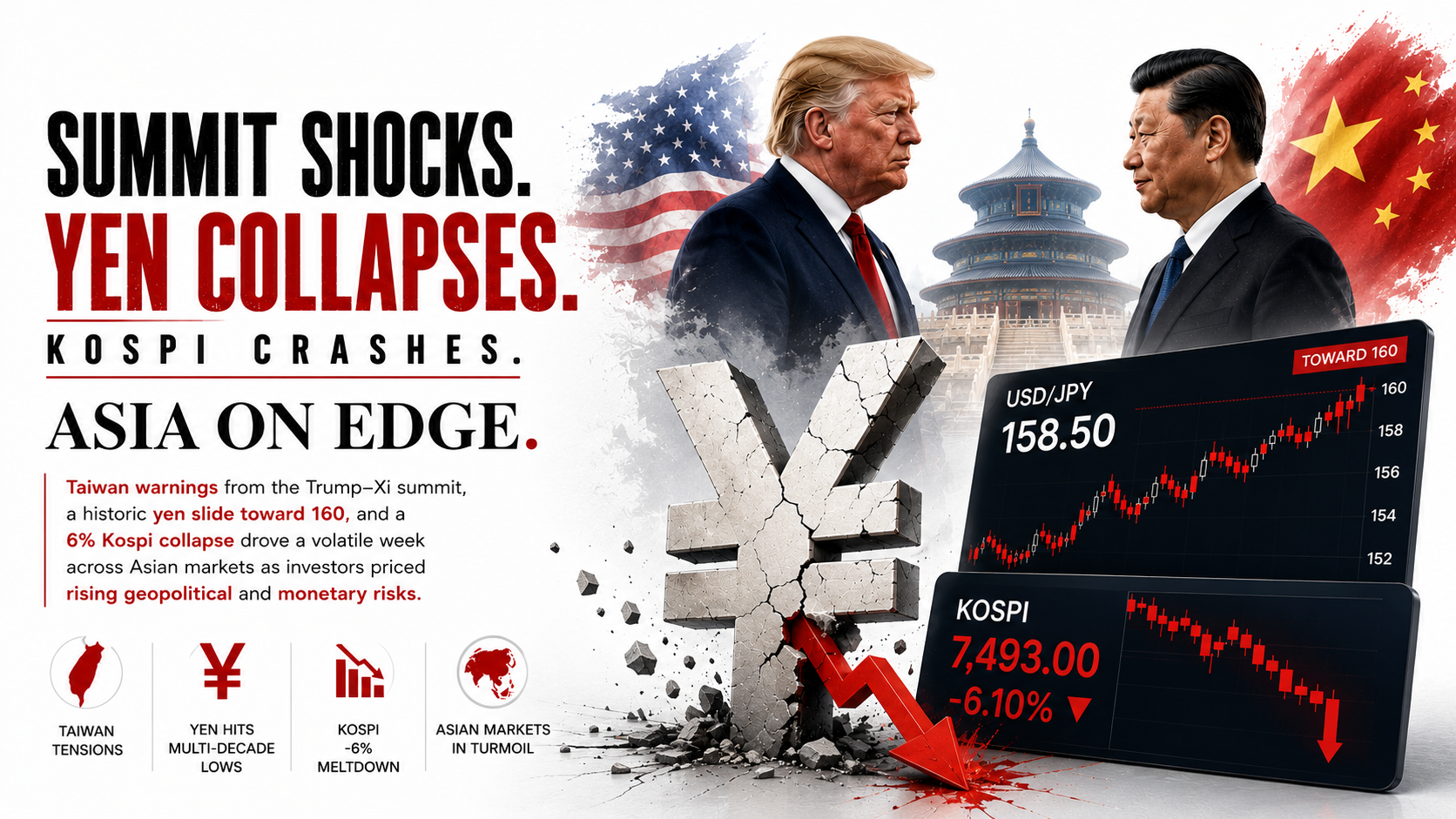
Asia’s week was dominated by three seismic events: a historic Trump–Xi summit in Beijing that opened with a Taiwan warning, a Kospi flash-crash from record highs, and a Japanese yen sliding to multi-decade lows as JGB yields hit their highest since 1997.
The Trump–Xi meeting at the Temple of Heaven produced more tension than relief. Xi’s stark warning that Taiwan could push the two superpowers into “conflict or even clashes” sent markets into risk-off mode across the region on Friday — with the Hang Seng falling 1.6%, mainland CSI 300 dropping 1.12%, and South Korea’s Kospi retreating sharply from record highs above 8,000 to close at 7,493.
Japan’s yen was the week’s biggest forex story. USD/JPY weakened toward 158.5 — on course for a weekly loss of over 1% — as persistent US inflation pressures linked to the Iran war reinforced expectations for a Federal Reserve rate hike later in 2026. The yen has now surrendered roughly half of the gains made from earlier rounds of government intervention, with JGB 10-year yields touching a 27-year high of 2.545%. BOJ board member Kazuyuki Masu publicly called for rate hikes “as soon as possible,” creating intervention vs. rate-hike crossfire for policymakers.
Australia’s ASX 200 was a relative outperformer, trading near 8,630 with resilience from commodity exposure and RBA rate stability. China’s CPI and PPI surprised to the upside in April — driven by Iran war energy costs — complicating the PBOC’s easing calculus heading into the week.
Five Stories Driving Asian Markets
The week of 11–16 May 2026 — a geopolitical, monetary, and technical reckoning for Asia
USD/JPY · AUD/USD · USD/CNH — Weekly Trade Ideas
Three defining Asian FX pairs with distinct drivers for the week ahead
Technical Analysis
USD/JPY has posted four consecutive sessions of JPY weakness, driven by the hot US inflation narrative from the Iran war. The pair has now surrendered roughly half of the gains won from Tokyo’s earlier intervention rounds. Price is consolidating near 158.50 — above the key 157.00 level which previously attracted MOF action. The 160.00 round-number level acts as the next critical resistance and likely intervention trigger zone. RSI is at 62 — elevated but not yet overbought. The 50-day SMA at 156.40 is the key downside anchor if risk-off accelerates.
Fundamental Context
Japan faces a textbook policy bind: the BOJ’s 0.75% rate sits roughly 300 basis points below the Fed, fuelling carry-trade outflows. BOJ board member Masu calling for hikes “as soon as possible” citing Iran war inflation risks is a hawkish signal — but markets are testing whether the institution will follow through. JGB 10Y yields at 2.545% are the highest since 1997, raising fiscal sustainability concerns for Japan’s 260% debt-to-GDP economy. US Treasury Secretary Bessent’s support for yen stabilisation measures keeps intervention alive as a tail risk — traders must price a potential MOF bazooka above 160. The OECD projects the BOJ rate could reach 2% by end-2027, which is the structural yen-positive case.

Technical & Fundamental
AUD/USD is the market’s cleanest proxy for China risk sentiment — and the Trump–Xi summit outcome will determine the pair’s direction for the coming weeks. The 0.6440 level is near-term resistance; a failure here on summit disappointment opens a move toward 0.6370 (April monthly low). Technically, the pair is below its 20-day EMA and testing the descending trend channel from the 0.6720 high. Iron ore at $104.20/t provides mild support, but any trade deal rollback — particularly on rare earths or agriculture — would accelerate AUD selling. The RBA is on hold at 4.10%; the next catalyst is Australia Employment data (May 21) and China’s retail sales print. A genuine trade détente would be AUD/USD bullish toward 0.6520.

Technical & Fundamental
USD/CNH is less susceptible to summit volatility than AUD or KRW because the PBOC actively manages the daily fix within a ±2% band. At 7.2150, the offshore yuan is at a slight discount to the onshore rate, reflecting modest capital outflow pressure. The PBOC has been setting its daily fix at a stronger-than-expected level to signal stability during the summit week — a classic “don’t panic” posture. The structural case for CNH weakness: China’s CPI and PPI surprise in April is actually bearish for the yuan, as higher commodity costs widen the current account headwind. Meanwhile, the PBOC has limited room to cut rates aggressively while inflation is running hot from energy import costs. A genuine US–China trade deal outcome — particularly tariff reductions — would see USD/CNH testing 7.10 support. A breakdown in summit talks pushes toward 7.30.

Nikkei · Hang Seng · Kospi · ASX 200 — Trade Ideas
Four benchmark indices with radically divergent weekly stories
Technical Analysis
The Nikkei 225 remains in a medium-term bullish trend, supported by a rising channel since early May. The index closed Friday at 63,272 with the Topix at 3,919, both in positive territory despite regional risk-off. The key technical level to watch is 62,000 — the 50-day SMA confluence and prior resistance-turned-support. A weekly close below 62,000 would signal the bullish structure is breaking down. RSI at 58 leaves room for extension. The 65,000 psychological level is the next key resistance zone.
Fundamental Context
Japan’s yen weakness at 158.50 is a double-edged sword for the Nikkei. Export-oriented names (Toyota, Sony, Fanuc) benefit directly from yen depreciation — a weaker currency inflates overseas earnings when repatriated. However, rising JGB yields at 27-year highs are increasing the cost of capital for leveraged domestic companies and raising debt-service concerns for the Japanese government. BOJ board discussions about “hiking as soon as possible” create a structural risk: any surprise rate move would cause immediate yen appreciation and a sharp Nikkei sell-off (echoing the August 2024 carry-trade unwind that caused a 26% crash). Earnings growth consensus is +9% for the next 12 months — supportive at current valuations. Iran ceasefire hope mid-week drove the Nikkei rally alongside the Topix.

Technical Analysis
The Hang Seng is at a critical technical juncture. The Friday decline of 1.6% has broken the index below the 5-day EMA and threatens the 24,000 psychological level. Key support at 23,200 (April structure low) is now the downside target on further summit deterioration. The index was in a rising trend from early May, but the Investtech analysis noted the index approaching support at 25,200 before this week’s move, suggesting a technical test was already underway. A recovery above 24,500 on positive summit resolution would set up a move toward the analyst target of 28,300 by end-2026.
Fundamental Context
The Hang Seng’s composition makes it directly sensitive to two forces: Mainland China policy signals and US–China geopolitical risk. Xi’s Taiwan warning at the summit introduces a “tail risk premium” that the market had not been pricing. The index rose 29% in 2025 — its best year since 2017 — but the forward P/E of 11.8x (one standard deviation above the 10-year average) leaves less valuation cushion than earlier in the year. Chinese technology and consumer stocks, which dominate the index, benefit from Beijing’s AI and domestic consumption push but face headwinds if summit talks produce escalatory tariff language. Corporate earnings growth is expected to accelerate from 4% in 2025 to 8% in 2026 — the structural bull case — but it requires Sino-US stability to play out.

Technical Analysis
The Kospi’s intraday breach of 8,000 followed by a 6% crash to 7,493 is a textbook “blow-off top” reversal signal. The candlestick pattern — a large upper shadow with a bearish close — is one of the most reliable reversal patterns in technical analysis. Volume on the sell-off was extreme. The key support levels now are 7,200 (the prior breakout level) and 7,000 (psychological). The Kosdaq fell over 5% simultaneously, confirming this was a systematic de-risk from AI and semiconductor exposure, not isolated to a single stock. A short setup targeting 7,100 carries strong risk/reward from current levels.
Fundamental Context
South Korea’s Kospi has been driven to record highs by extreme concentration in AI semiconductor names — Samsung Electronics and SK Hynix together represent a disproportionate share of the index. Analysts at multiple banks have raised “concentration risk” warnings throughout Q2 2026, and Friday’s move validated those concerns. The Trump–Xi summit added a Korea-specific risk: any escalation of US–China tech export restrictions would directly impact Korean HBM (High-Bandwidth Memory) chipmakers who supply both US hyperscalers and Chinese AI companies. The Kosdaq’s simultaneous 5% decline confirms the tech-led nature of the unwind. South Korea’s exposure to both US and Chinese trade policy makes it uniquely vulnerable to summit uncertainty in either direction.

Gold · Iron Ore · LNG — Asia’s Commodity Picture
Asia-Specific Gold Drivers
Gold sold off sharply on Friday — falling 1.43% to $4,583 — as precious metals broadly declined with spot silver losing over 5% to $79.07. The Asian angle on gold is distinct from the Western narrative: Asian central banks (China, India, South Korea, and ASEAN nations) are collectively running the largest gold accumulation programme since the post-Bretton Woods era — over 860 tonnes per year — as a dollar-reserve diversification strategy. This structural buying creates an asymmetric floor under price. India raising gold import duties is a bearish short-term demand headwind for the world’s largest physical gold consumer. A Trump–Xi trade deal would reduce safe-haven demand, but structural Asian CB buying makes sub-$4,500 levels attractive on a medium-term basis.

Asian Market Weekly Performance — 12–16 May 2026
| Market / Asset | Friday Close | WoW Change | Key Driver | Outlook |
|---|---|---|---|---|
| Nikkei 225 | 63,272 | ▲ +1.2% | Iran ceasefire hopes · export boost from weak yen | Cautious bullish — BOJ rate risk |
| Hang Seng | 23,840 | ▼ −2.4% | Trump–Xi Taiwan warning · risk-off Friday | Bearish short-term; 23,200 target |
| CSI 300 | 4,860 | ▼ −0.8% | Choppy: CPI beat (bullish) vs summit risk (bearish) | Range-bound 4,800–4,950 |
| Kospi | 7,493 | ▼ −5.8% | Record 8,000 breach then 6% flash crash — AI unwind | Bearish — 7,100 downside target |
| ASX 200 | 8,630 | → −0.2% | Defensive; RBA on hold; commodity cushion | Neutral — 8,500 key support |
| USD/JPY | 158.50 | ▼ JPY −1.0% | US inflation + Iran war · 4 sessions of yen weakness | JPY bearish; MOF intervention risk at 160 |
| AUD/USD | 0.6420 | ▼ −0.5% | China summit risk · iron ore soft | Neutral–bearish; 0.6370 target |
| Gold XAU/USD | $4,583 | ▼ −1.4% | Summit sell-off · silver −5% · India duty headwind | Buy $4,520 dip — CB floor intact |
| JGB 10Y Yield | 2.545% | ▼ (Yield ▲) 27yr high | BOJ hike debate · Iran inflation · BOJ member Masu | Bearish JGBs — yield curve steepening |
Asia Economic Events — Week of 19–23 May 2026
High-impact Asian data and central bank events for the coming week — all times in Asia Standard Time (UTC+8)
| Day / Time (AST) | Country | Event | Impact | Forecast / Prior |
|---|---|---|---|---|
| Mon 19 May · 09:30 | 🇯🇵 Japan | BOJ Summary of Opinions (April) — Full text release of April policy debate | High | Hawkish tone expected · Rate hike debate likely detailed |
| Mon 19 May · 10:00 | 🇨🇳 China | Loan Prime Rate (1Y & 5Y) — PBOC benchmark lending rate decision | High | Hold expected: 1Y 3.10% / 5Y 3.60% |
| Tue 20 May · 11:30 | 🇦🇺 Australia | RBA Meeting Minutes — Details of May rate hold decision and forward guidance | Medium | AUD/USD sensitive to tone on inflation path |
| Wed 21 May · 11:30 | 🇦🇺 Australia | Employment Change & Unemployment Rate — April labour market data | High | Exp: +25K jobs · Unemployment 4.1% |
| Wed 21 May · 10:00 | 🇨🇳 China | Retail Sales (April YoY) — Consumer demand health post-CPI beat | High | Exp: +4.8% YoY · Prior: +4.2% |
| Thu 22 May · 08:30 | 🇯🇵 Japan | National CPI (April) — Key inflation gauge for BOJ rate hike timing | High | Exp: +3.2% YoY · Prior: +2.9% |
| Thu 22 May · 09:00 | 🇸🇬 Singapore | MAS Core Inflation (April) — Leading indicator for ASEAN inflation regime | Medium | Watch for Iran-war energy pass-through |
| Fri 23 May · 08:00 | 🇯🇵 Japan | PMI Manufacturing & Services Flash (May) — Earliest read on Q2 2026 activity | Medium | Manufacturing ~49.5 · Services ~51.2 exp |
| Fri 23 May · TBD | 🌏 Asia-Wide | Trump–Xi Summit Communiqué / Joint Statement | High | Binary risk event for all Asian assets |
“The BOJ is the only major central bank hiking rates in 2026 — but hiking into a yen carry unwind, a JGB yield spike, and geopolitical risk from the Taiwan strait is not a textbook scenario.” CSFX Research · Asian Weekly · 16 May 2026
Asian Markets — Trader Questions Answered
Common questions from CSFX clients this week
The Asian Week Ahead
Asia enters the week of 19 May with three dominant themes: the Trump–Xi summit communiqué (the single most important binary risk event for regional assets), the BOJ’s May 29 rate decision (and whether Masu’s hawkish call accelerates the timeline), and China’s April retail sales on Wednesday — a critical read on whether the CPI beat represents genuine domestic demand recovery or simply imported inflation.
The Kospi’s blow-off top is the week’s clearest technical signal — a 6% crash from record highs in a single session, driven by AI concentration risks that have been building for months. Korean semiconductor stocks are the market’s canary: if Samsung and SK Hynix continue to underperform, watch for contagion into the Nikkei’s tech complex.
For FX traders, USD/JPY at 158.50 with the MOF’s 160 trigger zone approaching is the week’s highest-conviction setup. Japanese CPI on Thursday May 22 is the critical catalyst — a beat above 3.2% would accelerate BOJ hike expectations and create a violent JPY reversal. Australia’s employment data on Wednesday provides the AUD catalyst while the world watches China for summit resolution.
Trade Asian Markets at CSFX →