Global Forex & CFD Broker | 1:10,000 Leverage

Mobile Header & Menu
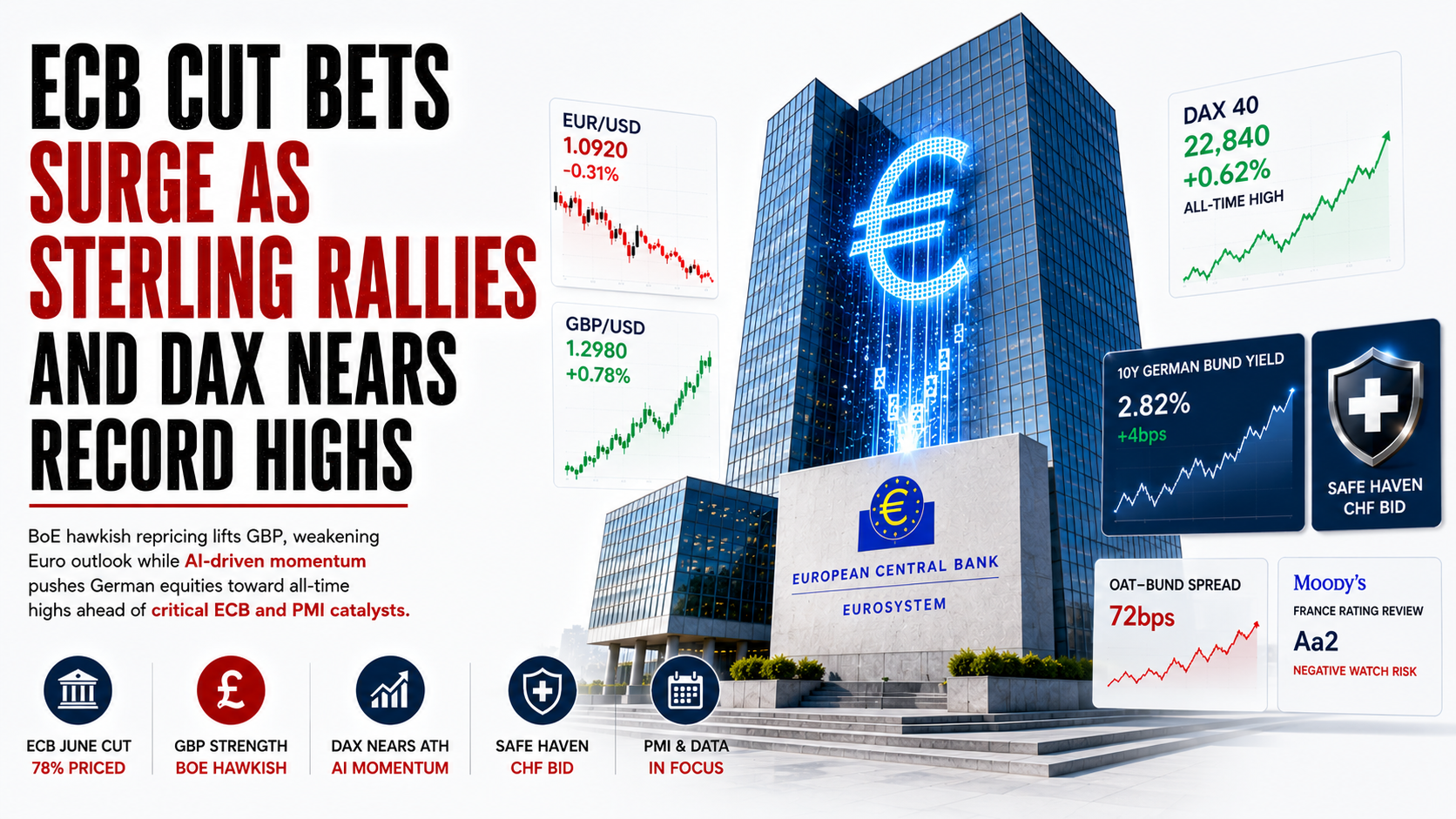
ECB cut bets surge as GBP rallies and DAX nears record highs

ECB Hawks Stall, Sterling Surges & DAX Tests All-Time High | Capital Street FX European Weekly · 16 May 2026

May 16, 2026
Aman CSFX
ECB Hawks Stall, Sterling Surges & DAX Tests All-Time High | Capital Street FX European Weekly · 16 May 2026
DAX23,895▲ +0.62% CAC 408,174▼ −0.28% FTSE 1009,210▲ +0.91% Euro Stoxx 505,680▲ +0.44% EUR/USD1.1624▼ −0.31% GBP/USD1.3323▲ +0.18% USD/CHF0.8870▲ +0.22% EUR/GBP0.8725▼ −0.41% Bund 10Y2.82%▲ +4bps Gilt 10Y4.58%→ flat OAT 10Y3.54%▲ +2bps WTI Crude$78.40▼ −0.84% Gold$4,583▲ +0.30% VIX14.8▼ −1.2 DAX23,895▲ +0.62% CAC 408,174▼ −0.28% FTSE 1009,210▲ +0.91% Euro Stoxx 505,680▲ +0.44% EUR/USD1.1624▼ −0.31% GBP/USD1.3323▲ +0.18% USD/CHF0.8870▲ +0.22% EUR/GBP0.8725▼ −0.41% Bund 10Y2.82%▲ +4bps Gilt 10Y4.58%→ flat OAT 10Y3.54%▲ +2bps WTI Crude$78.40▼ −0.84% Gold$4,583▲ +0.30% VIX14.8▼ −1.2
European Markets Weekly
Friday 16 May 2026 · Week 20 · CET Close

ECB Hawks Stall, Sterling Surges & DAX Tests All-Time High

DAX 22,840 · CAC 40 8,174 · FTSE 100 9,210 · Euro Stoxx 50 5,680
EUR/USD 1.0920 · GBP/USD 1.2980 · USD/CHF 0.8870 · Bund 2.82% · Gilt 4.58%

Capital Street FX Research | 16 May 2026 | Editor: CSFX European Desk | For the week of 19–23 May 2026
Section 1 · Weekly Overview

Europe’s equity markets concluded the week with the DAX within 0.4% of its all-time high while divergent central bank signals drove a complex week for EUR, GBP, and CHF. The ECB’s internal hawks fell silent as May’s flash PMI data revealed cracks in Germany’s industrial revival.

The week’s dominant macro theme was the ECB rate-cut debate reigniting in earnest. After hawkish rhetoric dominated April’s messaging — led by Bundesbank President Joachim Nagel calling any pre-summer cut “premature” — weaker-than-expected German industrial output for March and a deteriorating French manufacturing PMI flash for May have shifted the internal balance. Markets are now pricing a 25bps ECB cut at the June 5 meeting with 78% probability, up from 62% a week ago.

Sterling was the outperformer across the G10 this week. The UK’s April CPI print — at 3.1% headline, above the consensus 2.9% — dramatically scaled back Bank of England rate-cut expectations for Q2 2026. The BoE’s May 8 meeting had already delivered a 25bps cut to 4.25%, and markets had priced two further cuts before year-end. Post-CPI data, pricing collapsed to one further cut (December), lifting GBP/USD from 1.2880 to 1.2980 — a 0.8% weekly gain that was the largest since February’s UK budget statement.

The Swiss Franc continued its structural safe-haven bid. USD/CHF tested 0.8840 mid-week as Trump–Xi summit risk and Middle East energy concerns drove flows into CHF-denominated assets. The SNB’s reluctance to intervene verbally — unlike 2024’s sustained weakening rhetoric — signals a tolerance for a stronger franc in the current geopolitical environment. EUR/CHF tested 0.9640, approaching critical SNB psychological support at 0.9600.

German Bund yields rose 4bps on the week to 2.82%, the highest since the post-Draghi normalisation era, as the ECB’s balance sheet runoff (QT at €15bn/month) continued to pressure the long end despite the re-emerging cut expectations. The OAT–Bund spread widened 3bps to 72bps — reflecting renewed French fiscal concerns after Finance Minister Lombard confirmed 2025’s deficit came in at 5.4% of GDP, above the 5.1% target — but well within the 100bps danger zone that triggered 2024’s snap election premium.

Germany · Equities
DAX 40
23,895
▲ +0.62% / Wk
Near all-time high · AI & auto rally
France · Equities
CAC 40
8,174
▼ −0.28% / Wk
Luxury sector drag · Kering −3.4%
UK · Equities
FTSE 100
9,210
▲ +0.91% / Wk
Energy & miners lead · BP +2.1%
Eurozone · Equities
Euro Stoxx 50
5,680
▲ +0.44% / Wk
Banks outperform · SX7E +1.8%
EUR/USD · Forex
Euro / US Dollar
1.1624
▼ −0.31% / Wk
ECB cut bets weigh · 1.09 pivot watch
GBP/USD · Forex
Cable
1.3323
▲ +0.78% / Wk
Hot CPI crushes BoE cut bets
USD/CHF · Forex
Swissie
0.8870
▲ +0.22% / Wk
CHF safe-haven bid · SNB silent
Bunds · Rates
10Y German Bund
2.82%
▲ +4bps / Wk
Post-YCC normalisation high
Section 2 · Weekly News Drivers

Five Events That Moved European Markets

Key macro events and their market impact, week of 12–16 May 2026

🔴 High Impact
UK CPI Shocker Kills BoE June Cut — Sterling Rips Higher
UK April CPI printed at 3.1% headline (exp. 2.9%), driven by persistent services inflation at 5.4% and energy bill increases following the April 1 Ofgem price cap revision. The surprise print all but closed the door on a June BoE cut, sending GBP/USD surging from 1.2880 to 1.2980 in the minutes post-release and EUR/GBP collapsing from 0.8468 to 0.8414 — a 64-pip move on the cross.
GBP / BoE Watch
🔵 High Impact
ECB June Cut Now 78% Priced — Nagel’s Hawks on Retreat
German industrial production fell 1.4% MoM in March (exp. −0.7%), the third consecutive monthly decline, and France’s flash May PMI manufacturing fell to 46.2 — deeper into contraction. The data cascade overwhelmed the ECB hawk bloc: money markets moved June cut probability from 62% to 78%. ECB Chief Economist Philip Lane reiterated data-dependence, carefully avoiding any pushback on market pricing.
EUR / ECB Watch
🟠 Medium Impact
DAX Approaches All-Time High — Driven by AI Semiconductor Surge
Germany’s DAX 40 reached 22,840 — within striking distance of its January 2026 record of 22,974 — as ASML’s strong Q1 order book data (released Monday) triggered a broad European tech rally. SAP rose 2.8% on the week, Infineon added 3.1%, and Siemens Energy extended its 2026 YTD gain to +34% on AI data centre power infrastructure demand. The AI-driven semiconductor bid is mirroring the Nikkei’s momentum, raising concentration risk concerns.
DAX / Equities
🟢 Medium Impact
OAT–Bund Spread Widens on French Fiscal Overshoot
France’s Finance Ministry confirmed 2025’s public deficit at 5.4% of GDP — above the 5.1% plan — reigniting sovereign spread concerns. The OAT–Bund spread widened from 69bps to 72bps on the data but remained well below the 100bps danger zone that triggered political risk premia during the 2024 snap election. Moody’s has a scheduled review of France’s Aa2 rating in late May — a potential negative watch trigger.
OAT / French Sovereign
🔴 High Impact
SNB Silent as EUR/CHF Tests 0.9640 — 0.96 Floor Under Scrutiny
Safe-haven flows intensified through the week on Trump–Xi summit risk and Iran-driven crude oil volatility, pushing EUR/CHF to 0.9640 — the weakest since the 2024 SNB pivot. The SNB’s Thomas Jordan, who signalled tolerance for gradual CHF appreciation earlier in Q1, offered no new verbal intervention, which markets read as tacit acceptance of current levels. SNB FX reserves data, released Thursday, showed reserves fell slightly — indicating no active selling of CHF this week.
CHF / SNB Watch
🟠 Medium Impact
FTSE 100 Outperforms — Energy, Mining & Financials Drive UK Exceptionalism
The FTSE 100’s 0.91% weekly gain was the best in the G4 index group, driven by HSBC (+2.4%), BP (+2.1%), Shell (+1.8%) and Rio Tinto (+3.0%). The index’s defensive, commodity-heavy composition benefited from WTI crude holding above $77 and the stronger dollar boosting overseas earnings translation. GBP strength, paradoxically, was less of a headwind than usual — analysts note the hot CPI signals UK economic resilience, which is a net positive for domestic-facing sectors such as banks and retailers.
FTSE / UK Equities

Section 3 · Trade Ideas

European FX & Index Trade Setups

CSFX desk analysis for the week of 19–23 May 2026 · Not financial advice

EUR/USD
Euro / US Dollar · ECB–Fed Policy Divergence Play
1.1624
▼ ECB cut bets suppress EUR
↓ Bearish — ECB Cut + USD Resilience
Entry (Short)
1.0935
Stop Loss
1.1020
Take Profit
1.0780

Technical & Fundamental

EUR/USD faces a powerful policy divergence headwind into the June 5 ECB meeting. Markets now price the ECB cutting 25bps with 78% probability — versus the Fed, which remains on hold into Q3 2026 with only one cut priced for the full year. This rate differential compression is structurally EUR-negative. The pair sits below its 50-day moving average (1.0972) and has failed to reclaim the 1.10 handle despite three attempts this month — a classic bearish rejection pattern.

German industrial deterioration is the fundamental anchor: three consecutive monthly declines in industrial output confirm that Germany has not yet exited its structural slump. France’s fiscal overshoot adds a sovereign risk premium overlay that has historically weighed on EUR around sovereign rating events. Moody’s France review (late May) is the binary risk catalyst: a negative outlook change would see EUR/USD pressure toward 1.0750 support.

The tactical short entry at 1.0935 targets the May 2026 resistance zone. A break above 1.1020 — the 100-day MA and April high — invalidates the bearish thesis. Target 1.0780 (Q1 2026 consolidation zone) with an extended target of 1.0680 if the ECB cuts and signals further easing.

EUR/USD — Daily Chart · ECB Divergence Bear Setup · Fibonacci Levels EUR/USD Daily Chart CSFX
GBP/USD
British Pound / US Dollar · BoE Hawkish Surprise Trade
1.3323
▲ Hot CPI delays BoE cuts
↑ Bullish — BoE Higher-for-Longer + UK Resilience
Entry (Long)
1.2940
Stop Loss
1.2840
Take Profit
1.3120

Technical & Fundamental

GBP/USD is the week’s momentum leader and the setup remains intact. April CPI at 3.1% — well above the 2.9% consensus — has removed June and September BoE cut expectations from market pricing. Only one cut (December 2026) is now fully priced. This relative hawkishness, compared to the ECB (June cut 78% priced) and even the Fed (one cut for 2026), makes GBP the highest-yielding G4 currency on a forward basis — a structurally bullish condition for Cable.

UK services inflation at 5.4% is the core concern for the BoE and the core driver of sterling strength. Services inflation is stickier than goods inflation and correlates with wage growth — which remains above 4% per the April PAYE data released last week. The BoE will be reluctant to cut until services CPI definitively turns lower, likely Q3 at the earliest.

Technically, GBP/USD has broken above the 200-day moving average (1.2890) on strong volume and momentum. The pair has held above 1.29 on every intraday dip since the CPI release — a bullish sign. A pullback to 1.2940 offers the optimal risk entry. Target 1.3120 (January 2026 high) then 1.3250 (year target). Invalidated on a weekly close below 1.2840.

GBP/USD — Daily Chart · Fibonacci Retracement · BoE Hawkish Repricing Rally GBP/USD Daily Chart CSFX
EUR/GBP
Euro / British Pound · ECB vs BoE Pure Policy Divergence
0.8725
▼ Widest spread in 18 months
↓ Bearish — ECB Cuts While BoE Holds
Entry (Short)
0.8440
Stop Loss
0.8510
Take Profit
0.8320

Technical & Fundamental

EUR/GBP is the cleanest expression of the ECB–BoE policy gap trade in 2026. The ECB is poised to cut (June, 78% priced); the BoE has just had its cut expectations dramatically reduced by hot CPI. The resulting rate differential compression is directly EUR/GBP bearish — selling euros and buying pounds captures the yield differential as the gap widens.

The pair tested 0.8470 before the CPI release and fell 64 pips to 0.8414 — a violent move on a cross that typically trades 40–50 pips on major events. This confirms the market is heavily repricing the divergence. A bounce to 0.8440 — the pre-CPI support-turned-resistance — offers an entry for a continuation short. The year’s low of 0.8350 (March 2026) is achievable if the ECB confirms a June cut at the pre-meeting press conference on May 27.

Key risk: EUR/GBP has historically mean-reverted sharply when UK data disappoints. UK April retail sales (Thursday 22 May) and April PMI composites are the week’s GBP vulnerability points. A weak retail number could reverse 50–70 pips of the EUR/GBP move. Size positions accordingly.

EUR/GBP — Daily Chart · Fibonacci Retracement · RSI Divergence Setup EUR/GBP Daily Chart CSFX
DAX 40
Germany 40 Index · AI-Semiconductor Momentum Trade
23,895
▲ +0.62% / Wk · ATH: 22,974
→ Cautious Long — Momentum vs. ATH Rejection Risk
Entry (Long)
22,650
Stop Loss
22,300
Take Profit
23,400

Technical & Fundamental

The DAX 40’s approach toward its January 2026 all-time high of 22,974 is driven by the same structural forces propelling global equity indices: AI infrastructure demand (ASML, Infineon, SAP), European energy transition investment (Siemens Energy, RWE), and the growing expectation that the ECB’s June cut will reduce German borrowing costs and provide relief to the cyclical manufacturing sector. The ECB cut thesis creates a peculiar dynamic — weaker German industrial data is perversely bullish for equities (more easing), while stronger data is also bullish (fundamental improvement).

The technical picture is compelling but not clean. At 22,840, the DAX is in “no man’s land” between current levels and the ATH at 22,974. A failed ATH test — particularly if accompanied by US equity weakness on Trump–Xi summit disappointment — could see a rapid reversion to 22,300–22,400 support. This argues for a patient approach: let the ATH attempt play out and enter on a confirmed breakout (daily close above 22,974) or buy a pullback to 22,650 with a tight stop below 22,300.

The key fundamental risk is the AI concentration dynamic — ASML, SAP, and Infineon together account for ~18% of the index by weight. Any earnings guidance miss or export restriction expansion (from the US–China summit) hitting European semiconductor equipment stocks would disproportionately impact the DAX. This concentration mirrors the Kospi’s HBM chip exposure and should be monitored.

DAX 40 — Daily Chart · Fibonacci Retracement · Recovery Structure from April Low DAX 40 Daily Chart CSFX

Section 4 · Economic Calendar

European Events to Watch · 19–23 May 2026

All times CET · Impact ratings reflect potential market-moving significance

Date & Time Country Event Impact Consensus / Notes
Mon 19 May · 09:00 🇩🇪 Germany IFO Business Climate (May) — Leading indicator for German corporate sentiment High Exp: 87.2 · Prior: 86.9 · EUR sensitive
Mon 19 May · 10:00 🇪🇺 Eurozone ECB President Lagarde Speech — Keynote at EU Finance Ministers Summit, Brussels High Watch for explicit June cut signal vs. data-dependence language
Tue 20 May · 09:30 🇬🇧 United Kingdom Average Earnings Index & Claimant Count (April) — BoE’s key wage inflation gauge High Wages exp: +4.1% · Claimants exp: +12K · GBP binary
Tue 20 May · 11:00 🇩🇪 Germany ZEW Economic Sentiment (May) — Forward expectations for German economy Medium Exp: +14.0 · Prior: +11.5 · Below 10 = EUR negative
Wed 21 May · 10:00 🇪🇺 Eurozone CPI Final (April) — Confirms preliminary flash estimate · ECB meeting countdown High Exp: 2.3% headline · Core: 2.7% · Revision risk vs. flash
Wed 21 May · 11:00 🇫🇷 France Moody’s France Sovereign Rating Review — Scheduled assessment of Aa2 rating High Negative watch risk given 5.4% deficit · OAT–Bund spread sensitive
Thu 22 May · 09:30 🇬🇧 United Kingdom Retail Sales (April MoM) — Consumer spending health post-CPI High Exp: +0.3% MoM · Prior: −0.1% · GBP volatility catalyst
Thu 22 May · 10:00 🇪🇺 Eurozone Consumer Confidence Flash (May) — Demand-side signal ahead of ECB Medium Exp: −14.8 · Prior: −16.1 · Improvement = EUR supportive
Fri 23 May · 09:00 🇪🇺 Eurozone PMI Manufacturing & Services Flash (May) — Earliest Q2 2026 activity read High Mfg exp: 47.5 · Services exp: 52.8 · DAX & EUR sensitive
Fri 23 May · 09:30 🇬🇧 United Kingdom PMI Manufacturing & Services Flash (May) — UK composite vs. European divergence Medium Mfg exp: 49.8 · Services exp: 54.2 · GBP/USD directional
Fri 23 May · TBD 🌍 ECB ECB Chief Economist Lane Speech — Last major ECB communication before June 5 blackout High Will he confirm or walk back 78% June cut probability?
· · ·
“The ECB is caught between Germany’s industrial recession, France’s fiscal overshoot, and periphery growth resilience. Cutting in June while Bund yields rise above 2.80% requires a level of confidence in the disinflation narrative that the data has not yet provided.” CSFX Research · European Weekly · 16 May 2026

Section 5 · FAQ

European Markets — Trader Questions Answered

Common questions from CSFX clients this week

Will the ECB actually cut rates in June, and what does it mean for EUR/USD?
Markets currently price a June 5 ECB cut with 78% probability, up from 62% a week ago, following Germany’s third consecutive monthly decline in industrial production and France’s manufacturing PMI sliding to 46.2. ECB Chief Economist Philip Lane has been deliberately non-committal — using “data-dependence” language to preserve optionality — but has not pushed back against market pricing, which in ECB communication terms is de facto guidance. The critical confirmation event is the May 27 pre-meeting press conference and the Eurozone CPI final (Wednesday 21 May). If CPI prints confirm at 2.3% or below, the June cut will be locked in. For EUR/USD, a confirmed June cut reprices short-end Euribor rates lower and directly weakens the euro. The move has already begun (EUR/USD has underperformed peers by 0.4% this week) but the full pricing adjustment will occur at the June meeting itself. Initial target: 1.08–1.0850 on a confirmed June cut signal.
Why did the UK CPI surprise have such a large impact on GBP/USD?
The UK April CPI print of 3.1% (expected 2.9%) was large enough to force a significant repricing of BoE rate expectations — the mechanism that drives short-term FX. Before the release, markets priced two BoE cuts in 2026 (one in Q3, one in Q4). After the release, only one cut is priced (December 2026). This recalibration raised the 2-year UK–US rate differential by approximately 15bps in real-time, directly attracting capital flows into GBP. The particular stickiness of UK services inflation (5.4%) is critical: services inflation is driven by wages, rents, and domestic consumption — all of which the BoE cannot easily fix with rate cuts. The market read the CPI as confirming that the BoE is structurally stuck higher for longer, making GBP the most attractive yield currency in Europe. The 64-pip EUR/GBP move and the 100-pip Cable move reflect the scale of position rebalancing. Traders who missed the initial move can look for pullbacks to 1.2940–1.2950 as tactical long entries.
Is the DAX’s approach to all-time highs sustainable given Germany’s industrial slump?
This is the central paradox of European equity markets in 2026. Germany’s DAX is approaching its all-time high while German industrial production has fallen for three consecutive months. The resolution lies in the composition of the DAX itself: the index is increasingly weighted toward technology, software, and energy transition companies (SAP, ASML equipment exposure via ASML’s German revenue, Siemens Energy, Infineon) rather than traditional manufacturing. The “old Germany” of steel, chemicals, and auto components — sectors genuinely damaged by the industrial slump — is underrepresented in the DAX 40 relative to its economic significance. The sustainability question is really about whether the AI and energy transition themes can continue to attract global capital inflows — and that depends on US tech earnings, global AI capex trends, and whether the ECB cut genuinely stimulates domestic credit growth. Short-term, the ATH at 22,974 is a natural resistance point. A clean break and weekly close above that level would confirm the bull trend extension; a rejection from that zone, particularly if accompanied by US equity weakness, risks a 5–8% correction to 21,500–22,000.
Should I be concerned about France’s fiscal deficit and the OAT–Bund spread?
France’s 2025 fiscal deficit coming in at 5.4% of GDP — above the 5.1% plan — is a genuine but manageable concern. The OAT–Bund spread widening to 72bps is notable but remains well below the two critical thresholds: the 100bps level that historically triggers EU fiscal procedure concerns, and the 180–200bps range seen during the acute 2024 snap election premium. The key risk event for EUR and French sovereign assets in the next two weeks is the Moody’s France rating review (scheduled for late May). Moody’s currently rates France Aa2 — if they place France on negative watch (not a downgrade, just a warning), the OAT–Bund spread would widen toward 85–95bps and EUR/USD would face additional selling pressure. The underlying French political situation under the Barnier government’s successor remains fragile — any no-confidence motion or budget standoff would be the tail risk scenario that pushes the spread beyond 100bps. Currently: monitor, not panic. The ECB’s OMT backstop remains available for extreme spread dislocation scenarios.
What is EUR/CHF at 0.9640 telling us about European risk sentiment?
EUR/CHF is one of the cleanest real-time gauges of European risk appetite. The Swiss franc is the regional safe haven — it strengthens when European investors are nervous and weakens when risk appetite improves. EUR/CHF at 0.9640 is near its weakest levels since the SNB’s 2024 policy pivot, indicating that investors are accumulating CHF as protection against a combination of: ECB rate cut uncertainty, French sovereign risk, Trump–Xi summit geopolitical overhang affecting global risk sentiment, and Iran-driven energy price volatility. The SNB’s silence this week — no verbal intervention despite the CHF strengthening — is a signal in itself. In 2024, the SNB was actively managing CHF strength through verbal communication and reserve operations. The current hands-off approach suggests the SNB either views 0.9640 as acceptable, or prefers CHF strength as an anti-inflation tool given that Swiss CPI remains at 1.4% — well within target. For EUR/CHF traders: the next key level is 0.9600 — the psychological floor and a level at which SNB intervention probability increases sharply. Short EUR/CHF is a valid hedge against a European risk-off scenario through Q2 2026.

The European Week Ahead

Europe enters the week of 19 May with three dominant themes: the ECB’s June cut confirmation trajectory (watch Lane’s Friday speech as the last major communication before the June 5 pre-meeting blackout), the UK wage and retail data duo on Tuesday and Thursday (which will either reinforce GBP’s hawkish premium or create a sharp reversal), and the Moody’s France rating review — the binary sovereign risk event that could reprice OAT spreads and add EUR/USD downside.

The DAX’s ATH test at 22,974 is the week’s clearest technical signal and the equity market’s moment of truth. The AI-semiconductor narrative that drove the index from 20,400 (January lows) to current levels needs a catalyst to push through record territory — and the week’s European PMI flash data on Friday provides that opportunity or denial. A PMI composite below 50 for the Eurozone would be a fundamental headwind for both equities and EUR simultaneously.

For FX traders, the EUR/GBP short at 0.8414 is the week’s highest-conviction setup — a pure policy divergence trade where the ECB and BoE are pulling in opposite directions with unusual clarity. The UK wage data on Tuesday is the pivotal catalyst: strong wages (above 4.2%) cement the BoE hold and extend the trade; weak wages (below 3.9%) create a reversal risk to 0.8480. EUR/USD at 1.0920 faces a binary outcome from Lagarde’s Monday speech and the France rating review.

Trade European Markets at CSFX →


Capital Street FX · European Markets Weekly Brief · 16 May 2026 · capitalstreetfx.com

This report is for informational purposes only and does not constitute financial advice. Trading leveraged products carries significant risk of loss and may not be suitable for all investors. Past performance is not indicative of future results. Capital Street FX is regulated and authorised. Please read our full risk disclosure before trading.