Fed Hike Risk Returns, Oil Above $104 & AI Stocks Defy the Selloff | Weekly Analysis – US Markets | 19–23 May 2026
Fed Hike Risk Returns, Oil Above $104 & AI Stocks Defy the Selloff
S&P 500 7,408 · Nasdaq 26,225 · Dow 49,526 · Russell 2000 2,184
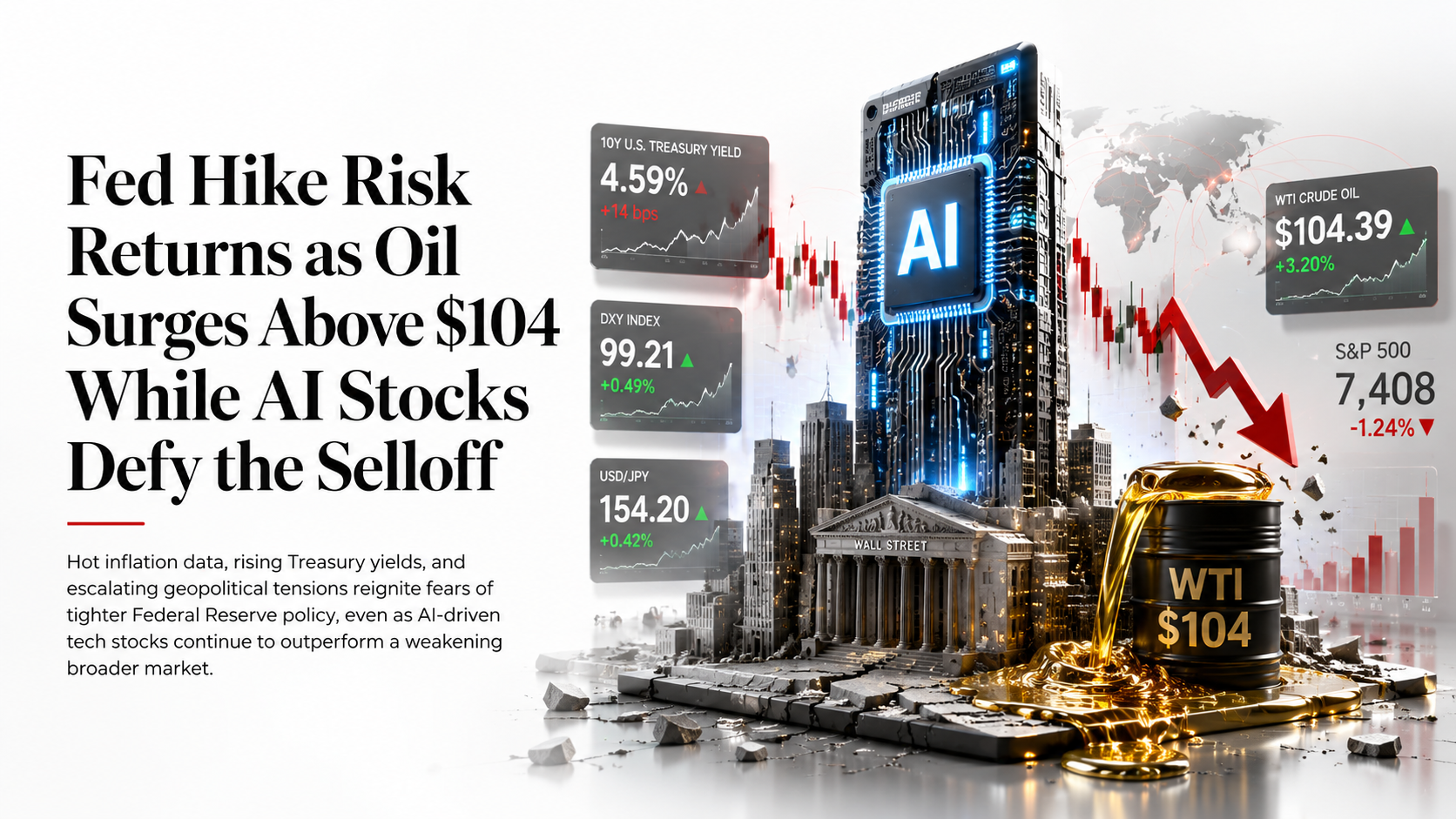
EUR/USD 1.1624 · USD/JPY 154.20 · DXY 99.21 · 10Y Yield 4.59% · WTI $104.39
U.S. equities closed the week in the red as a toxic combination of surging oil prices, hotter-than-expected inflation data, and a Trump–Xi summit that yielded no breakthrough on the Strait of Hormuz sent the S&P 500 to its worst daily performance in three weeks. The AI trade remains the last bastion of bullish conviction in an increasingly hostile macro backdrop.
The week’s dominant macro theme was the resurgence of Federal Reserve rate-hike risk. After April CPI printed at 3.8% YoY — the highest reading since May 2023 — and PPI surged 6.0% YoY, its largest gain since 2022, markets fully priced out any remaining rate-cut probability for 2026. More dramatically, futures markets began pricing a 50% chance of a Fed rate hike before year-end, with a 25bps move to 4.00–4.25% now fully priced for December. The 10-year Treasury yield broke above 4.59% — a 12-month high — while the 30-year bond yield pierced 5.12%, the highest since May 2025.
The week’s equity story was one of violent sector bifurcation. AI-linked semiconductors and infrastructure continued to attract inflows — Cerebras Systems launched its Nasdaq IPO on Thursday, surging 68% intraday to approach a $100 billion valuation, while the Philadelphia Semiconductor Index (SOX) extended its 12-month gain to 143%, trading 32% above its own 50-day moving average. Meanwhile, the broader market sold off sharply: the Russell 2000 fell 2.1% on Friday alone, putting it on track for its worst single session since November 2025, as rising yields and energy prices crushed rate-sensitive small caps, consumer discretionary, and industrials.
The Trump–Xi Beijing summit ended without meaningful progress on the Iran conflict or Strait of Hormuz re-opening. WTI crude closed at $104.39 — up $3.22 on the day — after Trump confirmed no breakthrough on Iran policy, and markets priced the prospect of sustained $100+ crude for longer. This has direct implications for U.S. inflation: the national average gasoline price has risen above $4.50 per gallon. New Fed Chair Kevin Warsh, confirmed by the Senate on Wednesday, now inherits an inflation profile that leaves him almost no room to ease. The incoming Chair’s reputation as a hawk — forged in the post-GFC tightening debate — means the market is already pricing his first statement as potentially more restrictive than his predecessor.
Dollar strength was a notable cross-asset theme. The DXY index rose 0.49% to 99.21 as rate differential widening versus the ECB and BoJ attracted flows into USD assets. USD/JPY tested 154.20 as the BoJ’s ultra-gradual normalisation policy was overwhelmed by U.S. yield dynamics. Gold sold off 2.7% as rising real yields eroded bullion’s appeal — a counterintuitive but technically classic response when 2-year nominal yields breach 4%, the level above which gold historically faces sustained selling pressure from institutional re-allocation.
Five Events That Moved U.S. Markets
Key macro events and their market impact, week of 12–16 May 2026
U.S. FX & Index Trade Setups
CSFX desk analysis for the week of 19–23 May 2026 · Not financial advice
Technical & Fundamental
USD/JPY is the cleanest expression of the current U.S. macro narrative: surging Treasury yields and rising Fed hike probability are directly widening the 2-year U.S.–Japan rate differential, which has now pushed above 380 basis points — a level that historically produces sustained USD/JPY appreciation. The Bank of Japan’s deliberate gradualism — raising rates just once in Q1 2026 to 0.75% and signalling no urgency to move further — creates an asymmetric policy divergence backdrop that is structurally USD/JPY bullish.
The pair broke through 154.00 resistance cleanly this week, which was the 100-day moving average and the key level tested three times in April without a sustained close above. A confirmed weekly close above 154 opens the path to 157.50 — the April 2025 intervention zone. The risk to the long thesis is a surprise BoJ emergency communication or a rapid U.S. inflation reversal (neither is likely on a 2-week horizon). The tactical long entry at 153.80 targets a pullback to the breakout level before continuation. Stop at 151.50 (below the 50-day MA and prior consolidation).
Import price data released Thursday showed a 1.9% monthly rise and 4.2% annual gain — the largest since October 2022 — reinforcing the U.S. inflation story and the USD/JPY bullish driver. The week’s key catalysts are Fed Chair Warsh’s first public speech (Tuesday, expected to set the tone for the June FOMC) and BoJ’s April meeting minutes (Wednesday).

Technical & Fundamental
The S&P 500 presents a tactical short opportunity on the combination of historically narrow leadership (the equal-weight S&P has underperformed the cap-weight index by 9% YTD — a concentration signal), rising 10-year yields (which increase the discount rate for all equities and are particularly damaging to the 40%+ weighting in mega-cap growth), and an oil shock that is directly pressuring corporate margins across industrials, transport, and consumer discretionary.
The index hit an all-time high of 7,517 earlier this month — driven almost entirely by AI semiconductor stocks — and the Friday close at 7,408 represents a 1.4% pullback from that peak. The market is in the early stages of a potential sentiment shift: the VIX rose 6.78% on Friday to 18.43 — not elevated in absolute terms, but the velocity of the move signals that institutional hedging activity is increasing. Ten of eleven S&P 500 sectors were in the red on Friday, with materials, utilities, and industrials leading losses.
The tactical short targets a return to the 7,150 zone — the S&P’s May support level and the 50-day moving average — driven by Warsh’s hawkish debut, continued oil strength, and upcoming retail earnings from Walmart, Target, and Home Depot which will reveal consumer margin pressure in real-time. A break above 7,530 (the all-time high on a closing basis) would invalidate the short thesis and signal the AI rally has durably overcome the macro headwinds.

Technical & Fundamental
EUR/USD is caught in a double compression: the ECB is approaching a June cut with 78% market probability, while the Fed is now pricing a hike — the opposite policy trajectory that drove EUR/USD from 1.05 to its recent highs. This dual policy divergence is the most structurally bearish setup for EUR/USD seen since 2022’s parity trade. The 2-year U.S.–Germany rate differential has widened by 45bps over the past month, the fastest expansion since the post-COVID recovery, and this differential has historically been the primary driver of EUR/USD direction on a 4–8 week horizon.
The pair has failed to sustain gains above 1.17 on three separate occasions this month — a classic triple-top rejection that confirms the level as a structural resistance zone. The 50-day moving average at 1.1540 and the 100-day at 1.1420 are the next meaningful support levels. A clean break below 1.15 would confirm the trend reversal from the April 2026 highs and open the 1.13–1.14 zone as the medium-term target.
The week’s key EUR/USD catalyst is Warsh’s first Fed speech (Tuesday) and the Eurozone CPI final confirmation (Wednesday). A Warsh hawkish signal combined with on-target Eurozone CPI confirming the June cut case would be the highest-conviction trigger for the bearish move. The extended target of 1.1200 becomes relevant if the June ECB cut is delivered alongside a July Fed hike signal.

U.S. Market Events — Week of 19–23 May 2026
Key scheduled releases and Fed communications · All times Eastern Time (ET)
| Date & Time (ET) | Country / Source | Event | Impact | Consensus / Notes |
|---|---|---|---|---|
| Mon 19 May · 08:30 | 🇺🇸 U.S. | April Housing Starts & Building Permits — Leading indicator for construction and rate-sensitive housing sector | Medium | Starts exp: 1.38M · Permits exp: 1.42M · USD & homebuilder sensitive |
| Tue 20 May · 09:00 | 🇺🇸 Federal Reserve | Fed Chair Warsh — First Public Speech — Inaugural remarks as 17th Fed Chair; markets watching for inflation framework and rate path signals | High | Will he signal tolerance for hike? Hawkish lean = USD bull, equity bear |
| Tue 20 May · 06:00 | 🇺🇸 U.S. Retail | Home Depot Q1 2026 Earnings — Key consumer sentiment and housing capex bellwether | High | EPS exp: $3.72 · Revenue exp: $39.2B · Housing slowdown risk |
| Wed 21 May · 08:30 | 🇺🇸 U.S. | FOMC Meeting Minutes (May 7 Meeting) — Reveals internal debate: how close is the committee to hike discussion? | High | Watch for dissent language and inflation concern intensity · USD binary |
| Wed 21 May · All Day | 🇺🇸 U.S. Retail | Target & TJX Companies Q1 Earnings — Consumer discretionary margin stress test vs. energy price-driven inflation | Medium | Consumer guidance for H2 2026 key · Discretionary sector directional |
| Thu 22 May · 08:30 | 🇺🇸 U.S. | Initial Jobless Claims (week ending 17 May) — Labour market resilience gauge; Fed-sensitive in current inflation context | High | Exp: 228K · Prior: 221K · Above 250K = risk-on relief; below 215K = hike fears amplify |
| Thu 22 May · 06:00 | 🇺🇸 U.S. Retail | Walmart Q1 2026 Earnings — Most important consumer bellwether; guidance on inflation pass-through and shopper behaviour | High | EPS exp: $0.64 · Revenue exp: $162.5B · Consumer health binary |
| Fri 23 May · 09:45 | 🇺🇸 U.S. | S&P Global PMI Flash — Manufacturing & Services (May) — Earliest May activity read; confirms or challenges Empire State surge | High | Mfg exp: 50.8 · Services exp: 53.4 · Below 50 on Mfg = stagflation concern deepens |
| Fri 23 May · 10:00 | 🇺🇸 U. of Michigan | University of Michigan Consumer Sentiment (May Final) — Inflation expectations component critical for Fed reaction function | High | Exp: 57.8 · 5-yr inflation exp watched closely · Above 4% = hike probability spikes |
“The Federal Reserve is being handed a stagflation test on its very first week under new leadership. Kevin Warsh must choose between fighting the oil-driven inflation shock with rate hikes — and risking a hard landing — or tolerating above-target inflation in the hope the energy supply disruption proves temporary. Neither option comes without severe financial market consequences.” CSFX Research · U.S. Weekly · 16 May 2026
U.S. Markets — Trader Questions Answered
Common questions from CSFX clients this week
The U.S. Market Week Ahead
The U.S. enters the week of 19 May with three dominant themes: Fed Chair Warsh’s policy debut on Tuesday (the single most market-moving event of the week — every word will be parsed for the Fed’s reaction function under new leadership), the retail earnings gauntlet (Walmart, Home Depot, and Target collectively reveal how the oil-inflation shock is landing on the American consumer), and the Treasury yield ceiling test — whether the 10-year can hold below 4.60% or breaks toward 4.80%, which would represent the most significant tightening of financial conditions since the 2022 hiking cycle.
The AI semiconductor bifurcation is the equity market’s central paradox: the SOX trading 32% above its 50-day moving average while the Russell 2000 posts its worst week in months. This divergence cannot persist indefinitely. The resolution will be either AI stocks correcting to catch down to the broader market, or the broader market being dragged higher by AI momentum. Given the macro backdrop — oil above $100, yields above 4.5%, hike risk rising — we assess the former as the more likely outcome over a 4–6 week horizon.
For FX traders, USD/JPY long at 153.80 is the week’s highest-conviction setup — a pure policy divergence trade where the Fed and BoJ are on the most extreme opposite trajectories in the G10. The key binary catalyst is Warsh’s Tuesday speech: a hawkish signal cements the move toward 157.50, while any softening of the Fed’s stance would create a sharp reversal risk to 151.50. EUR/USD at 1.1624 faces compounding headwinds from both the U.S. and European sides — a dual-catalyst short that should respond to both Warsh’s speech and the Eurozone CPI final on Wednesday.
Trade U.S. Markets at CSFX →