Yen Eyes 160, Nikkei Slides & Iran Deadlock Deepens | Technical Analysis – Asia Session | 19 May 2026
Yen Eyes 160,
Nikkei Slides & Iran Deadlock Deepens
Nikkei –1.45% · ASX 200 –1.10% · Hang Seng –1.62% · Kospi –1.35%
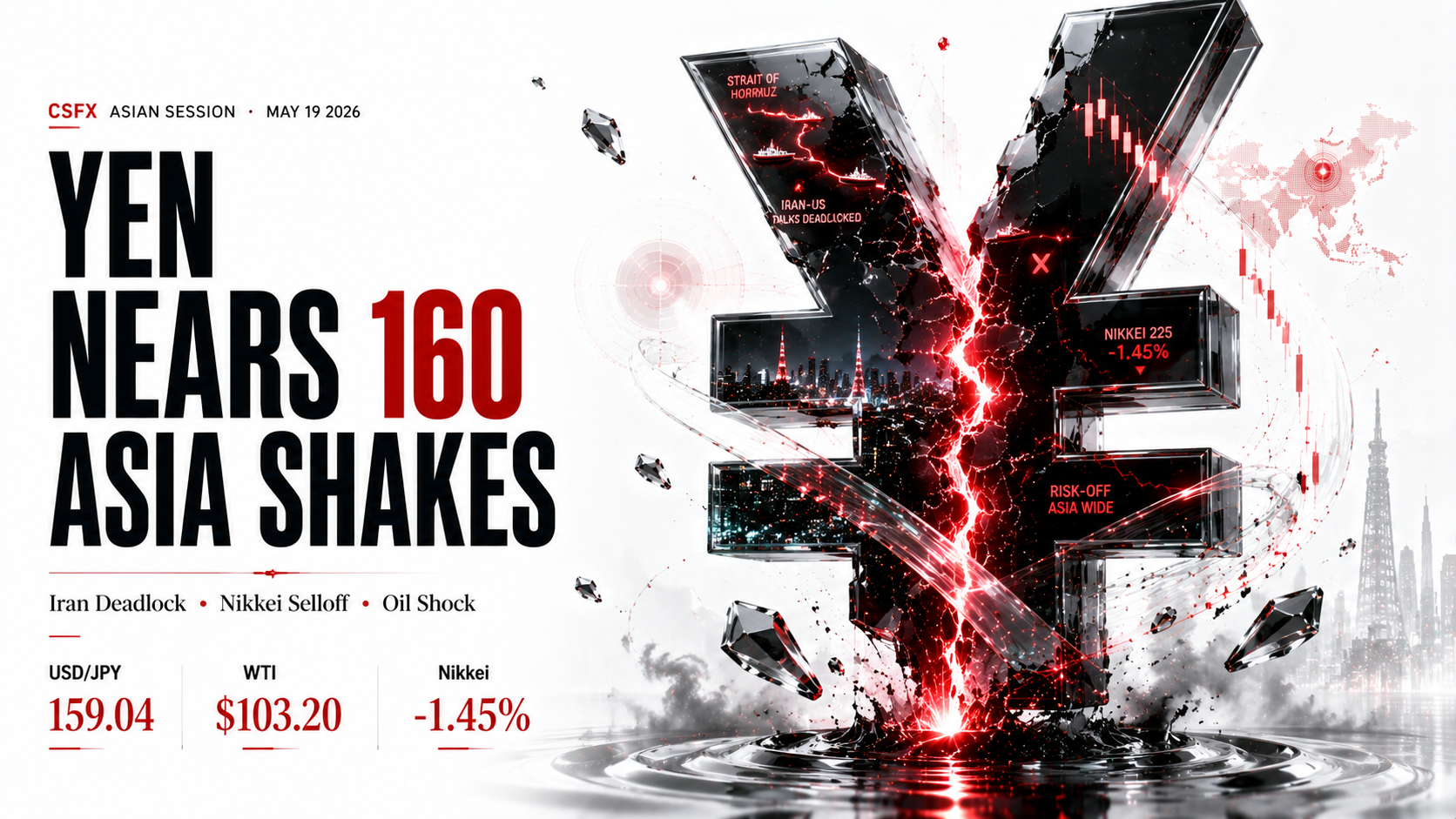
The Japanese yen continues its relentless slide, with USD/JPY printing a fresh six-session high at 159.04, edging ever closer to the critical 160.00 intervention threshold that has previously triggered Ministry of Finance action. Bank of Japan board member Masu reiterated earlier this week that rates should be raised “as soon as possible,” but the market is increasingly skeptical the BOJ can tighten into this energy-driven inflation environment without triggering a broader economic slowdown. The Nikkei 225 opened sharply lower, dropping 1.45%, as equity traders re-priced energy import costs for Toyota, Sony, and the broader manufacturing sector.
The Australian dollar is under double pressure — weaker risk appetite and a sell-off in the ASX 200 (–1.10%) — ahead of today’s Wage Price Index release for Q1, due at 01:30 GMT. The market expects 3.2% year-on-year, down from 3.4%, which could soften any hawkish RBA narrative that might otherwise support the Aussie. The New Zealand dollar has suffered more sharply, falling below 0.5840 against a broadly stronger US dollar, as investors price in continued Fed hawkishness following last week’s hotter CPI print.
Gold remains under pressure from rising US Treasury yields and the strong dollar, trading near $4,508 despite the persistent geopolitical bid. WTI crude is trading near $107.20, with Brent near $105.60, following weekend reports that energy infrastructure in the Persian Gulf was targeted once more. CNN is now reporting that Israel is preparing to strike Iranian nuclear facilities — an escalation that markets are beginning to treat as a genuine tail risk. This week’s macro calendar remains packed: Australian Wage Price Index today (01:30 GMT), FOMC Minutes Wednesday, Japan National CPI Wednesday night, and Australian Employment data Thursday.
What’s Driving Asian Markets Today
High-impact events and narratives shaping price action in the Tokyo/Sydney session
Equity Market Snapshot
Live session performance across major Asia-Pacific exchanges
Asian Session Pair Charts
Price action with entry, stop-loss, and take-profit reference levels for active setups
Active Setups for 19 May 2026
Levels are indicative. Always apply your own risk management. R:R calculated from listed entry.


Week of 19–23 May 2026
High and medium-impact events relevant to Asian session FX pairs
| GMT | Date | Ccy | Impact | Event | Forecast | Prior |
|---|---|---|---|---|---|---|
| 01:30 | Tue 19 May | AUD | High | Wage Price Index (Q1 y/y) | +3.2% | +3.4% |
| 18:00 | Wed 20 May | USD | High | FOMC Meeting Minutes | — | — |
| 23:30 | Wed 20 May | JPY | High | National CPI (Apr y/y) | +3.1% | +3.6% |
| 01:30 | Thu 21 May | AUD | High | Employment Change (Apr) | +28.0K | +32.1K |
| 01:30 | Thu 21 May | AUD | High | Unemployment Rate (Apr) | 4.2% | 4.1% |
| 08:30 | Thu 21 May | GBP | High | Flash PMI (May) | 52.8 | 52.5 |
| 13:30 | Thu 21 May | USD | High | Initial Jobless Claims | 220K | 215K |
| 14:00 | Thu 21 May | USD | High | Flash Manufacturing PMI (May) | 52.0 | 52.3 |
| 01:00 | Fri 23 May | NZD | Med | Retail Sales (Q1 q/q) | +0.4% | +0.9% |
| 14:00 | Fri 23 May | USD | High | UoM Consumer Sentiment (May) | 67.0 | 68.6 |
What to Watch: Key Themes for Today
Our research team’s highest-conviction narratives heading into the London open
1. Iran-Israel escalation risk is the new tail event. CNN’s reporting on Israeli preparations to strike Iranian nuclear facilities represents a qualitative shift in the crisis. Until yesterday, the market was pricing a protracted diplomatic stalemate; today it must now price genuine military escalation probability. This is bullish oil, bullish USD, and bearish risk assets. Any official Israeli denial or US diplomatic pressure on Israel to stand down would cause a sharp reversal.
2. USD/JPY is at critical intervention territory. At 159.04, the yen is approaching the exact level that prompted the MOF’s April 30 intervention. Markets are front-running both outcomes — the long USD/JPY trade is still valid given macro drivers, but the intervention tail risk is severe and non-linear. We recommend very tight stops on any USD/JPY longs entered above 159. A MOF statement could spark a 200–300 pip snap reversal in minutes.
3. AUD Wage Price Index (01:30 GMT) is today’s key Asia session event. A reading of 3.2% as expected — or weaker — would confirm the Australian labour market is losing steam under the energy cost burden. This removes one of the last hawkish pillars for AUD. The RBA would become more likely to hold or cut, widening the rate differential versus the USD and pushing AUD/USD toward 0.7050.
4. FOMC minutes tomorrow (Wednesday) will define the week. The market has already priced out all rate cuts for 2026. If the minutes reveal active debate about rate hikes — particularly hawkish dissents — the USD would extend its rally across all G10 pairs and emerging markets. This is the macro anchor for the rest of the week.
5. Bitcoin at $76K is a critical technical juncture. The $76,000 support level is being tested in real time this session. Institutional ETF flows have provided a floor, and the CLARITY Act regulatory tailwind is genuine. But risk-off pressure from equities and the geopolitical backdrop creates near-term selling pressure. A clean close above $78,500 would signal the correction is over; a close below $75,500 opens the $72,000 range for the next leg down.
Frequently Asked Questions — 19 May 2026
Answers to the questions our desk receives most during the Asian session
Yes — but only with disciplined position sizing. The macro backdrop remains firmly USD-bullish: the Fed has priced out all 2026 rate cuts, US CPI remains sticky, and energy-driven inflation is widening the rate differential vs Japan. At 159.04, however, you are 96 pips from the 160.00 level that previously triggered Ministry of Finance intervention on April 30. The trade is valid; the risk management is critical. We recommend reducing standard lot size by 30–50% on any new entry above 159.00, keeping stops at 158.00, and not holding the position through the Tokyo fix or any unscheduled BOJ/MOF press conference.
A beat — wages printing above the 3.4% prior figure — would be an immediate short-cover trigger and could push AUD/USD back toward 0.7150–0.7175, invalidating the short entry at 0.7125. A hawkish surprise would revive RBA rate-hike speculation and attract fresh AUD longs. In that scenario, our short thesis is suspended until the pair returns to offer a better risk/reward entry, potentially after the FOMC Minutes on Wednesday provide a USD anchor. A miss or in-line print (3.2%) leaves the short intact.
This is the primary stop-out risk for the WTI long. A credible ceasefire announcement, a US-brokered freeze on Iranian nuclear activity, or a public statement from Israeli leadership walking back strike preparations could trigger a $5–8 per barrel sell-off within hours. Technically, the first support on a reversal would be the $105.80 stop level, then $102–103 (prior breakout zone). Our stop at $105.80 is designed to absorb moderate noise but would not protect against a full geopolitical repricing. Traders with outsized exposure should consider buying short-dated put options as a tail hedge.
Gold is experiencing a classic rate-vs-haven tug of war. The Iran-Israel escalation is providing a geopolitical bid, but rising US Treasury yields — driven by a market that now expects the Fed to hold or potentially hike — are increasing the opportunity cost of holding a non-yielding asset. The 10-year US yield sitting above 4.80% is the dominant force right now. Gold also had an extended run from $4,400 to $4,713 over the past three weeks, and profit-taking on long positions is adding technical selling pressure. The support zone of $4,480 is key — a hold there keeps the medium-term bull case intact.
Bitcoin’s 24/7 market structure means liquidity is thinner in Asian hours, which amplifies both upside and downside moves. The $76,000 support level is technically significant and has attracted institutional accumulation from ETF players in previous tests. However, with risk-off sentiment dominating equities across Tokyo, Sydney, and Hong Kong, a sentiment-driven break below $75,500 is possible during the session — and in thin liquidity, it could overshoot toward $74,000 before recovering. We recommend waiting for the New York open for clearer directional conviction unless you are specifically trading the Asian session range.
The FOMC Meeting Minutes on Wednesday at 18:00 GMT. Markets have already priced out rate cuts — but they have not yet priced in rate hikes. If the minutes reveal meaningful hawkish dissent, discussion of resuming tightening, or language around higher-for-longer extending into 2027, the USD would rally sharply across all G10 pairs and EM currencies, equities would sell off further, and gold would face additional downside. Conversely, a neutral or divided set of minutes could provide a relief bounce in risk assets. Everything else this week — AUD wages, Japan CPI, US PMIs — is secondary to this.
Conclusion: Navigating a Volatile Open
CSFX Research Desk final word for the Asian session — 19 May 2026
The dominant theme is USD strength underpinned by energy-driven stagflation risk. The Fed cannot cut into inflation above 3%, yet rate-sensitive sectors in the US are already softening. Meanwhile, the BOJ faces the inverse problem — it wants to raise rates, but surging oil import costs risk tipping Japan into a consumption recession before any tightening cycle can gain traction. This divergence continues to favour USD/JPY longs, albeit with the non-linear intervention risk that demands smaller position sizes than the macro conviction might otherwise justify.
The Iran-Israel situation is the market’s primary tail event right now. CNN’s reporting on Israeli strike preparations represents a genuine escalation from the diplomatic stalemate that markets had been comfortable pricing. Traders should not be complacent: a military strike on Iranian nuclear or energy infrastructure would send Brent crude through $120 within hours, trigger emergency safe-haven flows into USD and CHF, and create severe volatility in Asian equity futures during a session window with limited liquidity buffers. This is not a base case — but it is no longer a fringe scenario.
For the Australian dollar, today’s Wage Price Index at 01:30 GMT is a make-or-break moment for the session’s price action. Weaker wages confirm the short thesis; a beat suspends it. Either way, the medium-term bias remains bearish AUD on widening rate differentials and commodity demand concerns driven by slowing Chinese growth.
The week ahead is macro-dense and geopolitically charged. Maintain disciplined position sizing, honour your stops — particularly on USD/JPY given MOF tail risk — and do not let high-conviction narratives override your risk management rules. The best trades are the ones you can stay in; outsized leverage in this environment is the primary threat to capital.