
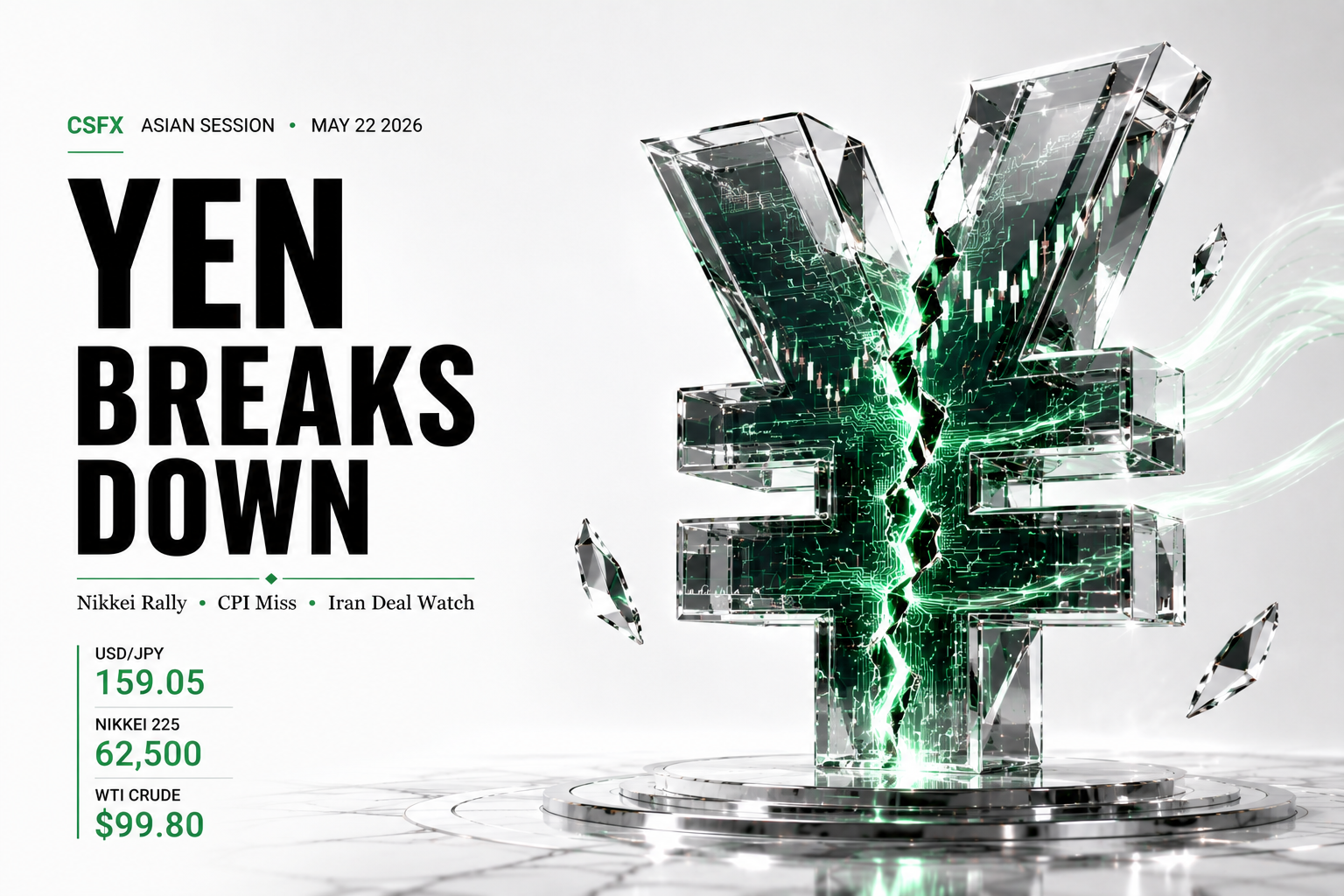
Nikkei Rallies & JPY Dumps on CPI Miss | Technical Analysis – Asian Session | Capital Street FX Daily Brief · 22 May 2026
Nikkei Rallies & JPY Dumps on CPI Miss
Silver $76.10 · Gold $4,530 · WTI $99.80 · DXY 99.18
Full Trade Ideas · Live Charts · Economic Calendar · BOJ CPI Analysis · Asian Session FAQ
The Asian session on Friday 22 May is shaped by three dominant forces: a dovish shock from Japan’s CPI miss hammering the yen toward 159, a surging Nikkei led by AI-tech and semiconductor heavyweights, and the most concrete progress yet toward a US-Iran ceasefire — with an official announcement now described as potentially imminent.
Japan’s Ministry of Internal Affairs released April CPI data at 08:30 JST that came in sharply below all economist estimates. Core CPI (ex-fresh food) printed at +1.4% YoY versus the 1.7% consensus — the weakest reading since March 2022 and a four-year low. The core-core gauge (ex-food and energy), closely watched by the BOJ as a demand-driven inflation signal, fell harder to 1.9% from 2.4%. Government subsidies on electricity and gas are the primary culprit, shielding consumers from the Iran war energy shock while suppressing the official CPI reading. The market immediately repriced BOJ June rate-hike odds, with the meeting now seen as a close call rather than the near-certainty it appeared last week. Capital Economics’ APAC economist noted inflationary pressures will likely pick back up, and still expects the BOJ to tighten sooner rather than later.
The Nikkei 225 extended Thursday’s 3.14% surge, now trading near 62,500 in morning trade. Today’s session continues the AI-semiconductor momentum story triggered by Nvidia’s blowout earnings: Tokyo Electron (+3.2%), Advantest (+2.8%), Kioxia (+4.1%) and Renesas (+5.5%) are leading. Japan’s April trade data confirmed exports surged 14.8% YoY — the fastest growth in three months — driven by semiconductor shipments. The weaker yen acts as an additional export earnings tailwind.
On geopolitics, US-Iran talks have reached their most advanced stage to date. Iran’s ISNA agency confirms Pakistani officials are engaged in “intense mediation activity.” Al Arabiya reports possession of a near-final draft covering: full ceasefire, Strait of Hormuz safe navigation guarantee, phased sanctions relief, and nuclear talks to begin within 7 days. The unresolved sticking point: Tehran refuses to ship its highly enriched uranium stockpile abroad, a central US demand. Trump says he is prepared to wait “a few days” for right answers. Oil has reversed some of Wednesday’s losses on residual deal uncertainty, with WTI back near $100 and Brent above $106.
Live Market Levels — Tokyo Open
Key instruments as of the Asian session · All prices indicative
Key Catalysts Moving Markets Now
The six stories every trader must track in this session
USD/JPY · AUD/USD · NZD/USD — Trade Ideas
Three core Asian session pairs with full technical and fundamental analysis
Technical Analysis
USD/JPY is trading in a compressed range just below the critical 160.00 level, which Japanese authorities have used repeatedly as an intervention trigger. The pair has been unable to decisively break above 159.50 despite today’s dovish CPI shock, reflecting extreme market caution about official intervention. The daily chart shows a rising wedge formation from the 154.80 April low — a pattern that typically resolves bearishly. RSI on the 4H is at 65, elevated but not overbought. The 200-day SMA sits near 155.20, a key downside target if the pair breaks lower. The 159.00–160.00 zone is an extremely dangerous area for long positions: any MoF statement referencing “one-sided moves” or “excessive volatility” could trigger a 200–300 pip instantaneous drop.
Fundamental Context
Today’s CPI miss (1.4% vs 1.7% expected) gives the BOJ cover to delay the June rate hike to 1%. The BOJ currently holds at 0.75% — the highest rate since September 1995. Three dissenting members at the April meeting pushed for an immediate hike to 1%. Capital Economics and DBS both still expect the BOJ to tighten “sooner rather than later,” noting Japan’s Q1 GDP grew at a 2.1% annualised pace, beating expectations. Japan’s April exports also surged 14.8% YoY — a sign of economic resilience that supports eventual tightening. The BOJ’s dilemma is stark: government subsidies suppress official CPI while the Iran war energy shock creates underlying inflationary pressure. The pair hovers near the 160 level that triggered intervention in late April and early May. Multiple officials have warned that intervention can come “as often as necessary.” Asymmetric risk: upside is capped at 160 by intervention while downside is open to 157–155 on any BOJ hawkish signal or Iran deal announcement.

Technical Analysis
AUD/USD rallied from the Iran war lows (approximately 0.6480 in early March) to a recovery high near 0.7240 on Iran deal optimism in early May, then pulled back to the current 0.7100–0.7150 consolidation zone. The 50-day SMA is near 0.7060 and the 200-day SMA sits around 0.6850. A break below the 0.7100 psychological support opens a move toward 0.7040 and then 0.6980. The daily RSI at 44 is neutral with moderate downside momentum. UBS has raised its year-end AUD/USD target to 0.74 on Iran deal expectations — but the jobs data fundamentally weakens that near-term case. The pair is caught between the Iran deal risk-on bid (bullish AUD as a risk currency) and domestic weakness (bearish). Resistance at 0.7145 and 0.7185 are the key levels to breach for any meaningful recovery.
Fundamental Context
Australia’s May employment report was a significant miss: −2,500 jobs versus the +25,000 consensus. The unemployment rate held at 4.1% only because labour force participation also fell. Flash Australian PMI data released Thursday also disappointed. This combination has pushed RBA cut expectations to approximately 75% probability for June 3 — a material shift from last week. An RBA cut would narrow the interest rate differential with the USD (where the Fed is signalling higher-for-longer), applying structural downside pressure. Today’s RBA Governor Bullock speech is critical: any explicit guidance on June cuts, or acknowledgement of the jobs deterioration, would push AUD/USD through 0.7100. The Aussie’s key support comes from China’s trade outlook — any positive Iran deal development typically boosts Chinese manufacturing expectations and therefore commodity demand, providing a floor for AUD/USD.

Technical Analysis
NZD/USD is testing the critical 0.6000 psychological level — described by analysts as the “pre-war level” — after a 1.5% mid-week rally driven by Iran deal headlines. The pair broke above its three-week consolidation range top and is now testing 0.6000–0.6020 (April highs). A confirmed close above 0.6020 would be technically significant, targeting 0.6100 and then 0.6180. Support at 0.5940 (former resistance, now support) is the key level to hold on any pullback. The daily MACD is crossing higher from positive territory — momentum is constructive. However, the pair’s entire rally is conditional on the Iran deal materialising. Without it, NZD/USD would likely retrace to 0.5850–0.5900. Volatility will be extreme around any deal headline.
Fundamental Context
The Kiwi is a high-beta risk currency that amplifies global risk sentiment moves. The Iran peace deal scenario is directly bullish for NZD: lower oil reduces the global inflation shock, reducing pressure on central banks to hike, which supports risk appetite and commodity-linked currencies. New Zealand’s Q1 unemployment rate declined unexpectedly in May, providing domestic support. The RBNZ is in an active cutting cycle with the OCR at 3.25% and markets pricing further cuts — this caps NZD’s upside from interest rate dynamics. The pair is essentially a binary trade on the Iran deal outcome. A confirmed ceasefire announcement could push NZD/USD toward 0.6100–0.6150 rapidly. A breakdown in talks could drag it back to 0.5880. Risk management is paramount: use tight stops, as geopolitical announcements can gap through levels without the opportunity to exit.

Nikkei 225 — AI Momentum & Weak Yen Tailwind
Japan’s benchmark at year highs as the AI trade and CPI-driven JPY weakness converge
Technical Analysis
The Nikkei 225 has surged 68% over 12 months, reaching a 2026 record high of 63,799 on May 14. A brief pullback to 59,804 on May 20 — driven by elevated US Treasury yields and Iran war anxiety — was sharply reversed on Thursday with a 3.14% session gain. The index now trades near 62,500 in the Asian session Friday. Structure remains decisively bullish above the 61,000 consolidation support. Key resistance is the 63,800 record high; a break above opens fresh targets at 65,000–67,000 on the monthly chart. RSI on the daily has pulled back from overbought readings to approximately 62 — room to extend higher without triggering an immediate correction signal. Approximately 70% of Nikkei earnings come from export revenues in foreign currencies — today’s JPY weakness at 159 is a direct fundamental tailwind for index earnings.
Fundamental Context
Three intersecting forces drive the Nikkei’s outperformance. First, the AI semiconductor supercycle: Nvidia’s blowout Q1 results triggered upgrades across Japan’s semiconductor ecosystem — SoftBank (nearly 20% gain Thursday), Tokyo Electron, Advantest, Kioxia and Renesas are all re-rating higher on the AI demand story. Second, Japan’s April trade data confirmed exports grew 14.8% YoY — the fastest pace in three months — driven by semiconductor and auto shipments, demonstrating economic resilience. Third, today’s CPI miss (1.4% vs 1.7%) means the BOJ is unlikely to deliver a hawkish surprise at the June meeting, keeping the yen weak and export earnings elevated in yen terms. The primary bear risk is a rapid JPY reversal via BOJ intervention or surprise hawkish pivot, which would mechanically compress export earnings and trigger index de-rating. Monitor USD/JPY 160.00 as the intervention trigger. If oil falls sharply on an Iran deal, that would also reduce Japan’s import cost burden — an additional Nikkei positive that the market is not yet fully pricing.

Silver XAG/USD — Hawkish Fed vs Industrial Demand Floor
The white metal trades near $76 after a violent 5% selloff as Fed hike speculation intensifies
Technical Analysis
Silver reached a historic all-time high of $121.64 in late January 2026, then corrected sharply — more than 37% from peak — as the war risk premium was partially priced out and Fed hawkishness mounted. The current $76.10 level represents consolidation near the VC PMI mean price of $75.52, which has acted as a near-term floor with the metal bouncing twice off $74.50–$75.00 this month. Resistance sits at $78.50 (former support, prior breakdown level) and $81.00. A breakdown below $75.00 opens a move toward $72.00 and $69.50. The gold-silver ratio at approximately 59.5x is elevated versus the historical average of approximately 50x, suggesting silver is underperforming gold — either a catch-up opportunity or a signal that industrial demand expectations are being downgraded. XAG/USD is rated “Sell” by technical indicators on investing.com with the daily bias negative.
Fundamental Context
Silver is caught in a three-way tug-of-war. Bearish: the Fed is signalling “higher for longer” with markets pricing a 40% chance of a December 2026 hike and cuts pushed to 2027. Elevated real interest rates structurally weigh on non-yielding precious metals. The strong DXY near 99.18 adds additional headwind. Bullish: Iran war geopolitical uncertainty maintains some safe-haven floor alongside gold. Structural industrial demand from solar panel installations (silver is a critical input for photovoltaic cells) and EV battery production remains robust, with the Silver Institute forecasting a supply deficit through 2027. Iran deal wildcard: a confirmed ceasefire would reduce the safe-haven premium but increase industrial and risk-on demand, creating a potentially net-neutral effect on silver in the immediate term — but a medium-term bullish driver as global manufacturing activity recovers. The near-term bear catalyst is any Fed official explicitly confirming the December hike scenario, which would spike real yields and push silver through the $74.50 support toward $72.00. The upside catalyst is an Iran deal announcement boosting industrial demand expectations.

Asian Session Events — 22 May 2026
All times in IST (UTC+5:30). Released events marked with actuals vs forecast.
| Time (IST) | Country | Event | Impact | Forecast | Actual | Market Impact |
|---|---|---|---|---|---|---|
| 05:00 | 🇯🇵Japan | National Core CPI (April, YoY) | HIGH | +1.7% | +1.4% ✖ | USD/JPY spiked · BOJ hike doubts surge |
| 05:00 | 🇯🇵Japan | National CPI Headline (April, YoY) | MED | +1.5% | +1.4% ✖ | 4-year low · confirms dovish read |
| 05:00 | 🇯🇵Japan | Core-Core CPI (ex-Food & Energy) | HIGH | +2.2% | +1.9% ✖ | BOJ’s preferred gauge below 2% target |
| All Session | 🌎 Geopolitics | US-Iran Peace Deal Announcement Window | HIGH | Ongoing | Awaited | All markets · Binary headline risk |
| 07:30 | 🇯🇵Japan | Nikkei Manufacturing PMI (May Flash) | MED | 52.1 | Pending | Nikkei / JPY / Export outlook |
| 08:00 | 🇦🇺Australia | RBA Governor Bullock Speech | HIGH | — | Pending | AUD/USD · June cut guidance is key |
| Upcoming | 🇳🇿New Zealand | RBNZ Rate Decision (next week, −25bp expected) | HIGH | 3.00% (−25bp) | Next week | NZD/USD positioning ahead of cut |
Geopolitical Calendar Override: The US-Iran peace deal announcement is the dominant event risk for ALL markets today and overrides scheduled data releases. A confirmed ceasefire could move USD/JPY by 200–300 pips, crash oil $5–8 per barrel, push NZD/USD through 0.6000, and temporarily spike Silver back above $78. Position sizing and stop placement must account for the possibility of gapping around any headline. Standard trailing stops may not protect against announcement-driven slippage.
Asian Session Questions Answered
Key questions traders are asking this Friday morning
Asian Session Verdict — 22 May 2026
This Friday Asian session is defined by a singular tension: the BOJ’s worst-possible optics (CPI missing badly, delaying hikes) colliding with the Nikkei’s best-possible setup (AI momentum, weak yen, export surge). Traders positioning for JPY intervention near 160 face a coin-flip, while Nikkei bulls have the cleaner trade for now — assuming USD/JPY holds below 160 and the BOJ delivers no hawkish surprise.
The Iran peace deal is the wildcard that could reshape every trade in this report within minutes. A confirmed ceasefire announcement would: (1) crash WTI oil $5–8 per barrel, (2) push NZD/USD through 0.6000, (3) lift AUD/USD toward 0.7200, (4) stabilise Silver above $78, and (5) reduce gold’s safe-haven premium. Without a deal, the default risk-off drift continues, the USD stays firm, and Silver tests the $74.50 support. The partial-deal scenario — ceasefire + Hormuz without nuclear resolution — is currently the highest-probability path and would produce a moderate risk-on move without the full magnitude of a comprehensive peace agreement.
The structural Asian session trade remains: long Nikkei 225 on pullbacks toward 62,000 with a stop at 61,200. The AI-semiconductor narrative, weak yen, and strong Japan export data create a multi-session fundamental tailwind that does not fully depend on the Iran binary. For FX, USD/JPY near 160 is an asymmetric short — limited upside vs substantial downside on any intervention or BOJ pivot. Trade the dominant regional theme, not just the geopolitical noise.
Access Asian Markets with Capital Street FX →