ECB Hike Threshold Breached, Iran Oil Premium & Euro Inflation Shock | Capital Street FX Europe Weekly · 23 May 2026
ECB Hike Threshold Breached, Iran Oil Premium & European Inflation Shock
EUR/USD 1.1602 · GBP/USD 1.3485 · FTSE 100 10,490 · DAX 40 24,791 · CAC 40 8,128
Brent Crude $104.24 · Bund 10Y 3.12% · Gilt 10Y 4.38% · ECB Rate 2.15% · BoE 3.75%
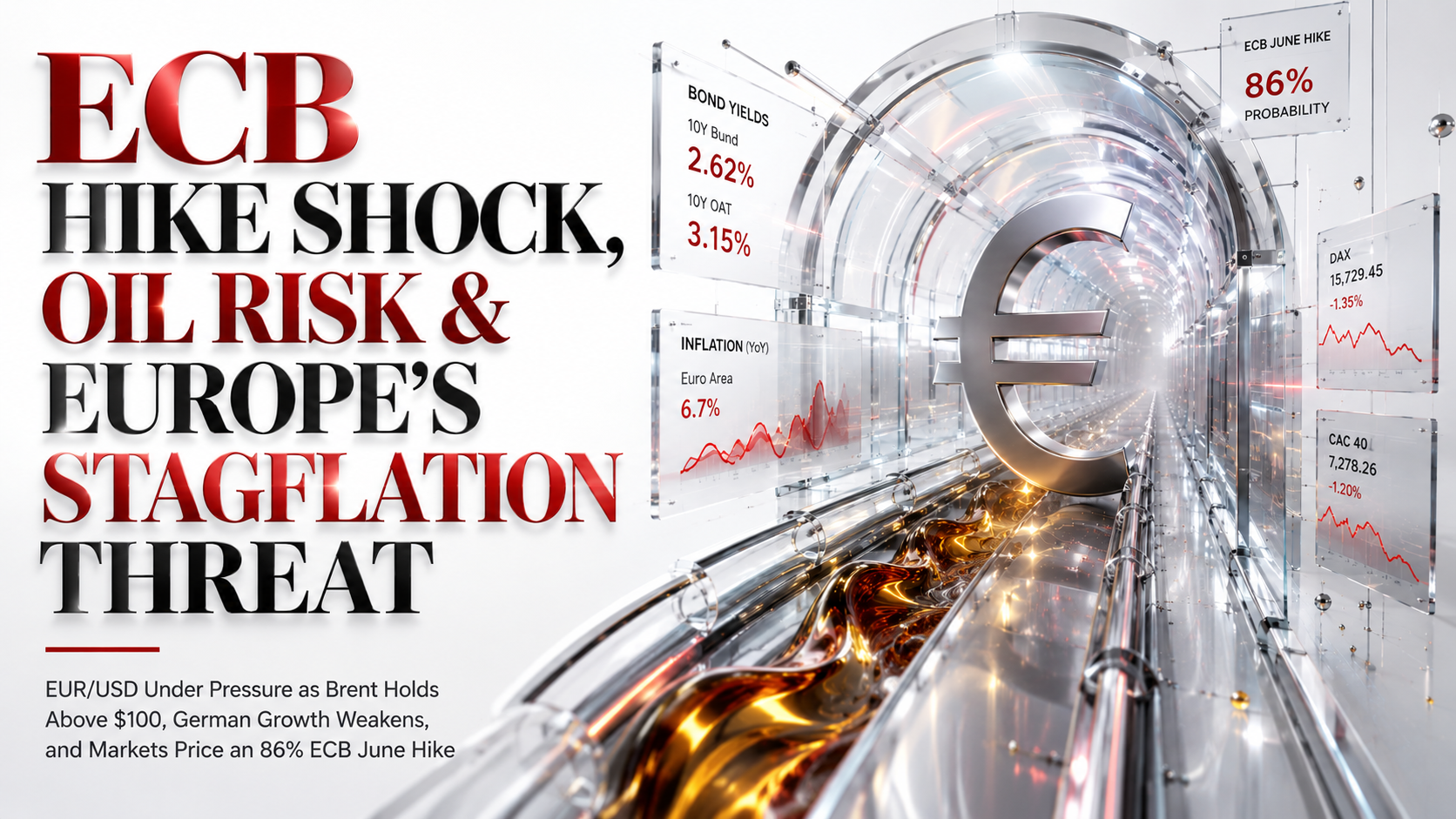
European equities posted their worst weekly performance in six weeks as Brent crude held above $104 and eurozone headline inflation breached 3.0% for the first time since mid-2024, forcing markets to recalibrate the ECB rate path — with the probability of a June 11 hike now priced at 86%, having been near zero just 45 days ago.
The week of 19–23 May was a turning point for European financial markets. The DAX 40 fell 1.59%, the CAC 40 dropped 1.97%, and even the more defensive FTSE 100 slipped 0.37%, as surging energy prices and a surprise inflation shock simultaneously squeezed corporate margins and compressed equity multiples. European benchmark bond yields rose sharply — the German 10-year Bund reached 3.12% and the UK 10-year Gilt pushed to 4.38% — as investors rapidly repriced the probability that both the ECB and Bank of England face a more difficult policy dilemma than previously assumed.
The energy backdrop for Europe is acutely different from the US. Europe is a net importer of both oil and natural gas, meaning that Brent crude’s persistence above $100 does not provide a revenue offset (as it does for US energy stocks) but instead functions as a pure tax on the economy. European natural gas prices, linked to global LNG markets disrupted by Middle Eastern geopolitics, have risen 28% since the Strait of Hormuz crisis began. German industrial production — already contracting through Q1 2026 — faces a direct cost headwind that the IMF has flagged in its 1.1% eurozone growth forecast for 2026.
For currency traders, the week crystallised the central tension defining EUR/USD: does Lagarde’s ECB hike on June 11 (euro bullish) or does eurozone growth deterioration keep the ECB on hold (euro bearish)? With 86% of market pricing now favouring a June hike, the risk is asymmetric to the downside if the ECB disappoints. Meanwhile, GBP/USD is caught between the Bank of England’s hold at 3.75% and a UK economy that showed unexpected Q1 resilience — but is now facing rising energy import costs that threaten to re-ignite CPI. CSFX enters the week of 26–30 May with a bearish EUR/USD bias, cautiously bullish GBP/USD, and a selective bearish stance on energy-sensitive European indices.
Looking ahead to the data-dense week of 26–30 May, European traders face a calendar dominated by German IFO Business Climate (Monday), French and German Q1 GDP second estimates (Tuesday–Wednesday), ECB speakers on the pre-meeting blackout boundary, UK mortgage approval data, and critically — the US PCE data on Friday which directly impacts ECB rate expectations via EUR/USD. European and US monetary policy are now more intertwined than at any point in the post-COVID cycle.
What Moved European Markets This Week
The five key stories that defined the 19–23 May trading week across European markets
Eurozone headline HICP inflation surged to 3.0% in April from 2.6% in March, driven almost entirely by energy as Brent crude held above $100 since mid-April. Core inflation remained contained at 2.2%, but the energy-driven headline print reignited debate inside the ECB’s Governing Council. Markets have now priced an 86% probability of a 25bp rate hike at the June 11 meeting, a seismic shift from near-zero odds just six weeks ago. ECB President Lagarde and board member Schnabel signalled the bank will move cautiously, but the door is now unmistakably ajar.
Monetary Policy · ECBGermany’s DAX 40 fell 1.59% on the week as the May ZEW economic sentiment indicator came in at −10.2, an improvement of just seven points from April’s −17.3 but remaining firmly in contraction territory. German industrial production has contracted for three consecutive months as energy costs and elevated interest rates simultaneously compress manufacturer margins. The DAX’s underperformance relative to the FTSE 100 reflects Germany’s unique exposure: as a manufacturing-heavy economy, Germany bears a disproportionate share of Europe’s energy import costs with few offsetting energy-sector revenues.
Germany · EquitiesUK CPI remained at 3.4% in April, stubbornly above the Bank of England’s 2% target and well above Governor Bailey’s recent public commentary suggesting “encouraging progress.” Services inflation — running at 4.8% — remained the primary driver, reflecting ongoing wage pressures in a labour market that continues to see nominal pay growth above 5%. The Bank of England’s hold at 3.75% now looks increasingly difficult to sustain if energy pass-through feeds through to services pricing. GBP/USD fell 0.31% on the week as traders weighed the BoE’s limited room to manoeuvre against a broadly firmer US dollar.
UK · Monetary PolicyBrent crude retreated from $111 to $104.24 on the week as reports of Oman-mediated Iran–US back-channel talks produced cautious optimism. However, US Secretary of State Rubio described only “slight progress,” and Tehran’s Supreme Leader hardened his position on uranium enrichment. For European markets, even at $104 Brent represents a sustained energy shock: European natural gas, Dutch TTF, remains 28% above pre-Strait-of-Hormuz-crisis levels. Any Iran ceasefire resolution would be unambiguously positive for European indices and the euro — delivering a deflationary shock that reduces ECB hike necessity and boosts growth expectations simultaneously.
Commodities · GeopoliticsThe German 10-year Bund yield pushed to 3.12% this week — its highest since late 2023 — as markets priced the ECB June hike scenario. More concerningly, peripheral sovereign spreads widened: Italian BTP yields moved to 4.41% (a 129bp spread over Bunds), while French OAT yields reached 3.99% (87bp over Bunds). The spread widening signals that markets are beginning to differentiate between eurozone economies based on debt sustainability under a higher-rate environment. Spain and Portugal held relatively tighter, but Italy’s debt-to-GDP trajectory at 140%+ remains the eurozone’s principal fiscal fragility at higher rates.
Fixed Income · SovereignsThe IMF reduced its 2026 eurozone GDP growth forecast to 1.1% from 1.4% in its April World Economic Outlook, citing “persistent energy price pressures, tightening financial conditions, and weakening external demand.” Germany was the primary drag: German growth was revised to near-zero for the full year. The ECB’s own internal projections have been revised upwards on inflation and downwards on growth — the definition of a stagflationary squeeze. This creates a policy trap: if the ECB hikes to fight inflation, it risks tipping Germany and Italy into recession; if it holds, it risks losing credibility as inflation approaches 3.5% on some energy-shock scenarios.
Macro · ECB Policy TrapUpcoming Week Key Highlights
26–30 May 2026 · European Markets · Pre-ECB Positioning Week · Highest-Stakes Calendar of Q2 2026
The ECB Governing Council enters its pre-meeting communication blackout on Saturday 31 May, ahead of the June 11 rate decision. This means the week of 26–30 May is the final window for any ECB officials to provide forward guidance before the most pivotal meeting of 2026. Any scheduled speeches — particularly from hawks like Schnabel or Knot — carry the potential to move EUR/USD by 50–80 pips on a single sentence. Traders should monitor ECB speaker schedules daily. The absence of new hawkish guidance would itself be read as a softening signal.
📅 Blackout Starts Sat 31 May · ECB Decision Jun 11Friday’s US PCE inflation print is a critical input not just for the Fed, but for the ECB. A hot PCE print above 3.4% would push USD higher across all pairs — forcing EUR/USD lower regardless of ECB positioning — while simultaneously raising the bar for any potential ECB rate-cut pivot. A benign PCE below 3.0% would weaken the dollar, relieve EUR/USD downward pressure, and allow the ECB’s June hike to become a EUR/USD positive catalyst. The ECB–Fed policy interaction is the dominant EUR/USD driver through Q2.
📅 Friday 30 May · 8:30 AM ET · Transatlantic binaryMonday’s German IFO Business Climate survey is the first major European data release of the week and will set the tone for DAX positioning. After May ZEW came in at −10.2, an IFO print below the 87 consensus threshold would confirm that German business sentiment has deteriorated further under the dual pressure of high energy costs and elevated borrowing costs. A surprise recovery above 89 could trigger a short-covering bounce in the DAX and a modest EUR/USD bid. This is the single most important sentiment indicator for the eurozone’s largest economy before the ECB’s blackout.
📅 Monday 26 May · 10:00 CET · DAX sentiment driverThe second estimates of Q1 2026 GDP for Germany (Tuesday) and France (Wednesday) will confirm or revise early readings that showed German growth near flat (+0.1% QoQ) and French growth marginally positive (+0.3%). A downward revision for Germany toward negative territory would officially constitute a technical recession for the eurozone’s largest economy — a significant negative for the DAX and EUR/USD, and a complication for ECB hawks arguing for a June rate hike. French data will reveal whether Paris-based luxury and industrial sectors provided a meaningful growth offset.
📅 Germany Tue 27 May · France Wed 28 May · 08:00 CETThursday’s Bank of England data on mortgage approvals for April and M4 money supply growth will provide the clearest picture yet of UK credit conditions under 3.75% base rates and 7.2% average mortgage rates. Approvals are expected near 55,000 — historically below-average — but any print below 50,000 would signal that the UK housing market is entering a more severe correction phase. For GBP/USD, weaker credit data would support the “BoE cuts before ECB” narrative that is negative for sterling. Watch the Nationwide House Price Index (Monday) as an early signal.
📅 Thursday 29 May · 09:30 BST · GBP/USD driverThe Memorial Day weekend in the US creates an extended window for Iran ceasefire headline risk. For European traders, the Brent crude reaction on the Monday FTSE open (UK markets open while US is closed) will be the first price discovery of any weekend diplomatic development. A ceasefire framework would send Brent below $88 within 48 hours, delivering a massive positive shock to European equities (particularly airline, chemical, and consumer-facing sectors) and removing the primary inflation driver pressuring the ECB. Conversely, a breakdown in talks would see Brent retesting $110 and European equities opening sharply lower Monday.
📅 Weekend Risk · FTSE opens Monday 26 May (US Closed)Tuesday’s eurozone unemployment rate for April is expected to remain near its record low of 6.1%. The ECB’s hawks (Schnabel, Knot) have cited labour market tightness — and the resulting wage growth at 3.3% — as a key justification for a June hike even amid growth concerns. A surprise uptick in unemployment above 6.3% would undercut the hawkish case and reduce EUR/USD upside on ECB hike hopes. Watch German unemployment specifically (also Tuesday) as the canary in the eurozone coal mine given Germany’s industrial slowdown.
📅 Tuesday 27 May · 11:00 CET · ECB data inputThe ECB releases its monthly Consumer Expectations Survey on Thursday — a dataset that ECB President Lagarde has cited directly in recent press conferences as a key input to Governing Council deliberations. If three-year-ahead inflation expectations have risen above 3.0% in this survey, it would constitute the most hawkish signal possible heading into the June 11 blackout period and could trigger a significant EUR/USD rally. The survey’s publication typically causes 20–30 pip EUR/USD moves within minutes — monitor it closely on Thursday morning European time.
📅 Thursday 29 May · 10:00 CET · EUR/USD catalystWednesday brings the final French and German composite PMI readings for May, which will confirm or diverge from the flash estimates released earlier in the month (France 49.8, Germany 49.1 — both below the 50-expansion threshold). Any downward revision into the mid-to-low 48s would represent a notable deterioration and would compound bearish CAC 40 and DAX positioning. Germany’s GfK consumer confidence reading for June (Thursday) is forecast at −18.5 — still deeply negative but the second monthly improvement in a row, suggesting energy cost fatigue is slowly giving way to cautious adaptation.
📅 Wed 28 May (PMI Final) · Thu 29 May (GfK) · CET morningsEuropean Session — Highest Conviction Setups
For the week of 26–30 May 2026 · All ideas carry elevated event risk around ECB pre-blackout guidance and US PCE Friday
Thesis — ECB Hike Fully Priced, Warsh Fed Creates Asymmetric USD Strength
EUR/USD short is CSFX’s highest-conviction European setup for the week of 26–30 May. The central thesis rests on an asymmetry that has developed since Kevin Warsh’s appointment as Fed Chair: the market has fully priced an ECB 25bp hike on June 11 (86% probability), meaning this positive EUR catalyst is already reflected in the 1.1602 level. Any disappointment — an ECB hold, a Lagarde press conference that leans dovish, or growth data suggesting the ECB cannot risk hiking — would deliver a sharp EUR/USD sell-off from a position where longs are overextended.
On the other side of the pair, Warsh’s Fed is structurally USD-positive in a way the market has not fully discounted. A hot PCE print on Friday — which CSFX views as the base case — would validate the narrative that Warsh will be forced toward a rate hike later in 2026, widening the Fed-ECB rate differential from the current 185bp to potentially 210bp. The technical setup reinforces this: EUR/USD rejected the 1.1760 resistance level twice this month and has formed a lower-high pattern. A break of 1.1540 opens the path to 1.1360 and ultimately toward the 1.12 zone by Q3. Entry on a rally toward 1.1620 provides favourable risk-reward with a tight stop above the May high at 1.1760.

Thesis — BoE Hold Premium Undervalued vs ECB Hike Risk; UK Q1 GDP Resilience
GBP/USD long at 1.3420 on a dip represents CSFX’s second-highest conviction European setup. The UK’s monetary policy position is materially different from the eurozone: the Bank of England holds at 3.75% with UK Q1 2026 GDP having surprised to the upside at +0.6% QoQ, powered by services sector resilience. Unlike Germany, the UK does not have a structurally manufacturing-dependent export model that magnifies energy import cost damage — the UK’s services-driven economy absorbs energy shocks differently, and the City of London’s financial services revenues have actually benefited from elevated rate volatility.
The GBP/USD technical setup shows a well-defined support zone at 1.3380–1.3420, where the pair has held during three tests since mid-April. A ceasefire development over the Memorial Day weekend would send Brent below $88 at Monday’s London open — a specific positive catalyst for sterling given the UK’s net energy import position. On the risk side: Thursday’s UK mortgage approval data carries asymmetric downside risk — a weak reading would signal that BoE policy is beginning to crack the housing market, potentially accelerating BoE rate cut expectations and removing sterling’s rate differential support against EUR/GBP. Size this position at 60% of full risk allocation to allow for additions on dips.

Thesis — Defensive Composition Limits FTSE Downside; Iran Ceasefire is an Asymmetric Positive
The FTSE 100’s composition is structurally different from the CAC 40 and DAX — and that difference is the core of this conditional long thesis. The index is heavily weighted toward energy (BP, Shell, 14% of index), commodities (Rio Tinto, Glencore, Anglo American, 12%), and global financial services (HSBC, Barclays, Standard Chartered, 18%), meaning a significant portion of the index is either positively correlated to oil prices or operates predominantly outside the UK domestic economy. This limits the FTSE’s downside in an energy-driven inflation scenario relative to more domestically-exposed European peers.
The conditional element: this is a buy-on-weakness trade, not a buy-at-market trade. The FTSE needs to pull back toward 10,340 — the 200-day moving average support zone — before the risk-reward is sufficiently attractive. The catalyst scenario is the Iran ceasefire: a weekend resolution would gap the FTSE higher at Monday’s open (while US markets remain closed), as energy stocks rally on stabilising supply, airlines and consumer stocks recover, and sterling strengthens. An Iran deal is the single biggest positive catalyst for the FTSE 100 available on the current events calendar, potentially worth 300–400 index points from current levels.

Thesis — Germany’s Stagflationary Squeeze: Three Headwinds Converging
The DAX 40 faces a convergence of three simultaneous headwinds that CSFX views as structural, not cyclical, for the next 4–6 weeks: energy costs, rising borrowing costs, and deteriorating export demand. German industrial production has contracted for three consecutive months, the ZEW economic sentiment index remains in deeply negative territory at −10.2, and the IMF’s revision of Germany’s 2026 growth forecast toward zero reflects genuine structural damage from the combination of high energy input costs for manufacturers, rising Bund yields squeezing capital expenditure decisions, and subdued demand from China (Germany’s second-largest export market) and the US (increasingly pivoting to domestic production under trade policy pressures).
An ECB rate hike on June 11 — increasingly likely at 86% probability — would further compress DAX valuations by raising the risk-free rate that discounts German corporate earnings. Unlike the US S&P 500’s resilience driven by tech earnings momentum, the DAX is dominated by industrials (Siemens, BASF), autos (Volkswagen, BMW, Mercedes), and chemicals (Bayer, BASF) — all sectors that are acutely exposed to the energy-cost-meets-rising-yield combination. Short DAX on a relief bounce toward 24,960 with a target of 24,040 and a stop above the May high.

Thesis — Luxury Sector Rotation Out Accelerates; OAT Spread Widening Adds Premium
The CAC 40’s 1.97% weekly decline — making it the worst-performing major European index — reflects two structural pressures specific to France that go beyond the pan-European energy and rates story. First, the luxury sector rotation: LVMH, Kering, and Hermès collectively represent approximately 18% of the CAC 40’s market cap weighting, and the luxury spending cycle is showing clear signs of fatigue. Chinese luxury spending — the primary growth driver for European luxury since 2021 — has softened alongside weaker Chinese economic momentum, and US consumer confidence data increasingly suggests that even the high-income cohort that buys luxury goods is moderating spending under energy and mortgage cost pressure.
The second CAC-specific pressure is the French sovereign spread widening: OAT yields reached 3.99% this week versus Bunds at 3.12% — an 87bp spread that represents investor concern about France’s fiscal trajectory under President Macron’s industrial policy programme. This sovereign risk premium compresses valuations for French large-cap equities and makes CAC 40 a less attractive vehicle than its peers for international capital. Short CAC 40 on a relief bounce toward 8,200 with a target of 7,820, treating the Iran ceasefire scenario as the primary stop-loss trigger: a ceasefire would rescue the luxury sector outlook and French consumer confidence simultaneously.

Thesis — Binary Event Risk: Iran Ceasefire vs Strait of Hormuz Escalation Range Play
Brent crude is the most fundamentally binary trade in global markets for the week of 26–30 May, and CSFX’s view is to play the range rather than establish directional conviction ahead of potential weekend developments. The supply picture without Iran resolution is unambiguously bullish: OPEC+ production constraints remain in place, US strategic petroleum reserve releases have now drawn down to the lowest level since 1983, and Libya’s ongoing production disruptions add a secondary 400,000 barrels per day supply deficit on top of the Hormuz-related disruption. This underpins Brent’s floor at $100–$102 regardless of ceasefire noise.
However, the ceasefire risk cannot be dismissed — Secretary Rubio’s “slight progress” commentary, combined with Iran reviewing a new US proposal via Pakistan, creates a genuine probability distribution with a fat tail at the downside for oil. A credible ceasefire framework would send Brent to $86–$88 within 48 hours, with a full Hormuz reopening timeline potentially pulling it toward $82. The optimal strategy is therefore to buy the $100.50 range support in anticipation of the persistent supply deficit, while maintaining a tight stop at $96.00 (a ceasefire deal stop) and targeting a sell at $108.50 on any military escalation re-pricing. Do not hold directional positions over the long Memorial Day weekend.

European Markets — Week of 26–30 May 2026
All times CET (Central European Time) unless stated · BST = CET −1hr · ECB pre-blackout begins Saturday 31 May
| Time (CET) | Event | Impact | Prior | Consensus | CSFX View |
|---|---|---|---|---|---|
| 08:00 | Nationwide UK House Price Index (May) | MEDIUM | −0.6% MoM | −0.4% MoM | GBP/USD early signal — housing under 7.2% mortgage rates |
| 10:00 | German IFO Business Climate (May) | HIGH | 86.9 | 87.3 | Below 87 = DAX sell; above 89 = short-covering bounce |
| 10:30 | ECB’s De Guindos Speech (final pre-blackout?) | MEDIUM | — | — | Any hike language = 40–60 pip EUR/USD spike |
| 15:30 | Eurozone Consumer Confidence Flash (May) | LOW | −14.0 | −13.2 | Energy cost fatigue — watch direction vs expectations |
| Time (CET) | Event | Impact | Prior | Consensus | CSFX View |
|---|---|---|---|---|---|
| 08:00 | Germany Q1 2026 GDP — Second Estimate (QoQ) | HIGH | +0.1% (flash) | +0.1% | Negative revision = EUR/USD sell · Technical recession risk |
| 09:55 | Germany Unemployment Change (April) | MEDIUM | +11K | +12K | Rising = ECB hike argument weakens; labour market softening |
| 11:00 | Eurozone Unemployment Rate (April) | MEDIUM | 6.1% | 6.1% | Hawkish ECB case rests on tight labour market; watch carefully |
| 11:00 | Eurozone Economic Sentiment Index (May) | MEDIUM | 94.8 | 95.1 | Below 94 = risk-off for European equities across the board |
| 14:30 | S&P Case-Shiller Home Price Index (US, Mar) | LOW | +4.8% YoY | +4.6% YoY | USD reaction may affect EUR/USD afternoon session |
| Time (CET) | Event | Impact | Prior | Consensus | CSFX View |
|---|---|---|---|---|---|
| 07:45 | France Q1 2026 GDP — Final Estimate (QoQ) | HIGH | +0.3% (flash) | +0.3% | Downward revision = CAC 40 sell pressure, EUR/USD negative |
| 09:00 | Spain CPI Flash Estimate (May) | MEDIUM | 3.2% | 3.0% | Leading indicator for overall Eurozone HICP flash on Friday |
| 09:55 | Germany Composite PMI Final (May) | MEDIUM | 48.6 (flash) | 48.7 | Below 48 = deepening contraction; bearish DAX 40 |
| 10:00 | France Composite PMI Final (May) | MEDIUM | 49.8 (flash) | 49.8 | Below 49 = CAC 40 negative; luxury sector watches services PMI |
| 10:00 | Eurozone Composite PMI Final (May) | MEDIUM | 49.4 (flash) | 49.4 | Sub-50 = recession territory; ECB hike case increasingly difficult |
| 20:00 | US FOMC May Meeting Minutes | HIGH | — | — | Hawkish minutes = USD strength, EUR/USD sell in NY session |
| Time (CET) | Event | Impact | Prior | Consensus | CSFX View |
|---|---|---|---|---|---|
| 08:00 | Germany GfK Consumer Confidence (Jun) | MEDIUM | −19.4 | −18.5 | Second monthly improvement = sentiment cautiously stabilising |
| 10:00 | ECB Consumer Inflation Expectations Survey | HIGH | 2.9% (3yr fwd) | 3.0% | Above 3% = June hike near-certain; EUR/USD spike 40–60 pips |
| 10:30 BST | UK Mortgage Approvals (Apr) — BoE Data | HIGH | 53,800 | 55,000 | Below 50K = BoE cut narrative builds; GBP/USD negative signal |
| 10:30 BST | UK M4 Money Supply (Apr) | MEDIUM | +1.6% YoY | +1.4% YoY | Credit tightening signal — watch for sharp deceleration |
| 14:30 | US Durable Goods Orders (Apr) | MEDIUM | +0.7% | −0.5% | USD reaction feeds into EUR/USD pre-PCE positioning |
| Time (CET) | Event | Impact | Prior | Consensus | CSFX View |
|---|---|---|---|---|---|
| 08:00 | Germany Import Prices (Apr) | LOW | +2.8% YoY | +3.1% YoY | Pipeline inflation signal — energy import pass-through |
| 09:00 | Italy CPI Flash Estimate (May) | MEDIUM | 2.8% | 2.9% | BTP spread implications — Italian inflation above Bund yield? |
| 11:00 | Eurozone HICP Flash Estimate (May) | HIGH | 3.0% (Apr) | 2.9% | Above 3% = ECB June hike probability rises to 95%+ |
| 11:00 | Eurozone Core HICP Flash (May) | MARKET DEFINING | 2.2% (Apr) | 2.3% | Sticky core = ECB forced hike · Falling core = ECB holds |
| 14:30 | US PCE Price Index (Apr) — Fed Preferred Gauge | HIGH | 3.0% YoY | 3.2% YoY | Hot PCE = USD strength, EUR/USD lower despite ECB hike hopes |
| 14:30 | US Q1 GDP Second Estimate (Annualised) | HIGH | 1.8% (1st est.) | 1.9% | Stagflation risk: weak GDP + hot PCE = worst combination for EUR |
| 16:00 | University of Michigan Consumer Sentiment Final (May) | LOW | 67.4 (prelim) | 67.8 | Inflation expectations sub-component; feeds USD late-session |
European Markets — Trader Questions Answered
Key questions from CSFX clients ahead of the ECB pre-blackout week
CSFX View: Europe Enters the Most Critical Pre-ECB Week of 2026
The week of 26–30 May 2026 represents the final opportunity for European market participants to position for the June 11 ECB rate decision before the Governing Council enters its communication blackout on Saturday 31 May. The convergence of pre-blackout ECB speaker risk, critical German and French GDP revisions, the ECB Consumer Expectations Survey, UK credit data, and Friday’s transatlantic double-barrel of Eurozone HICP Flash and US PCE creates a week of unusually dense and inter-connected event risk for EUR/USD, GBP/USD, and the three major European equity indices.
European markets are caught in a structural bind that has no clean resolution in the short term. Brent crude above $100 creates a persistent inflation tax on an economy that produces no oil — every day the Strait of Hormuz remains impacted, the ECB’s policy choice grows more painful. A June hike risks triggering a German recession; a June hold risks surrendering inflation credibility. The 86% market pricing of a hike is itself a constraint: if the ECB disappoints, EUR/USD falls sharply from an overextended long positioning base.
For our European clients, CSFX’s core positioning for the week is EUR/USD short, DAX short, and CAC short — with conditional FTSE long on dips and range-play on Brent. GBP/USD long at support represents the one European trade where the risk-reward favours the upside, contingent on UK credit data holding and Brent not re-escalating. The single most important wildcard remains the Iran ceasefire — a weekend resolution would force an immediate repositioning of every European trade on this list, and CSFX will issue an intra-week alert if the geopolitical picture changes materially.
Trade European Markets at CSFX →