
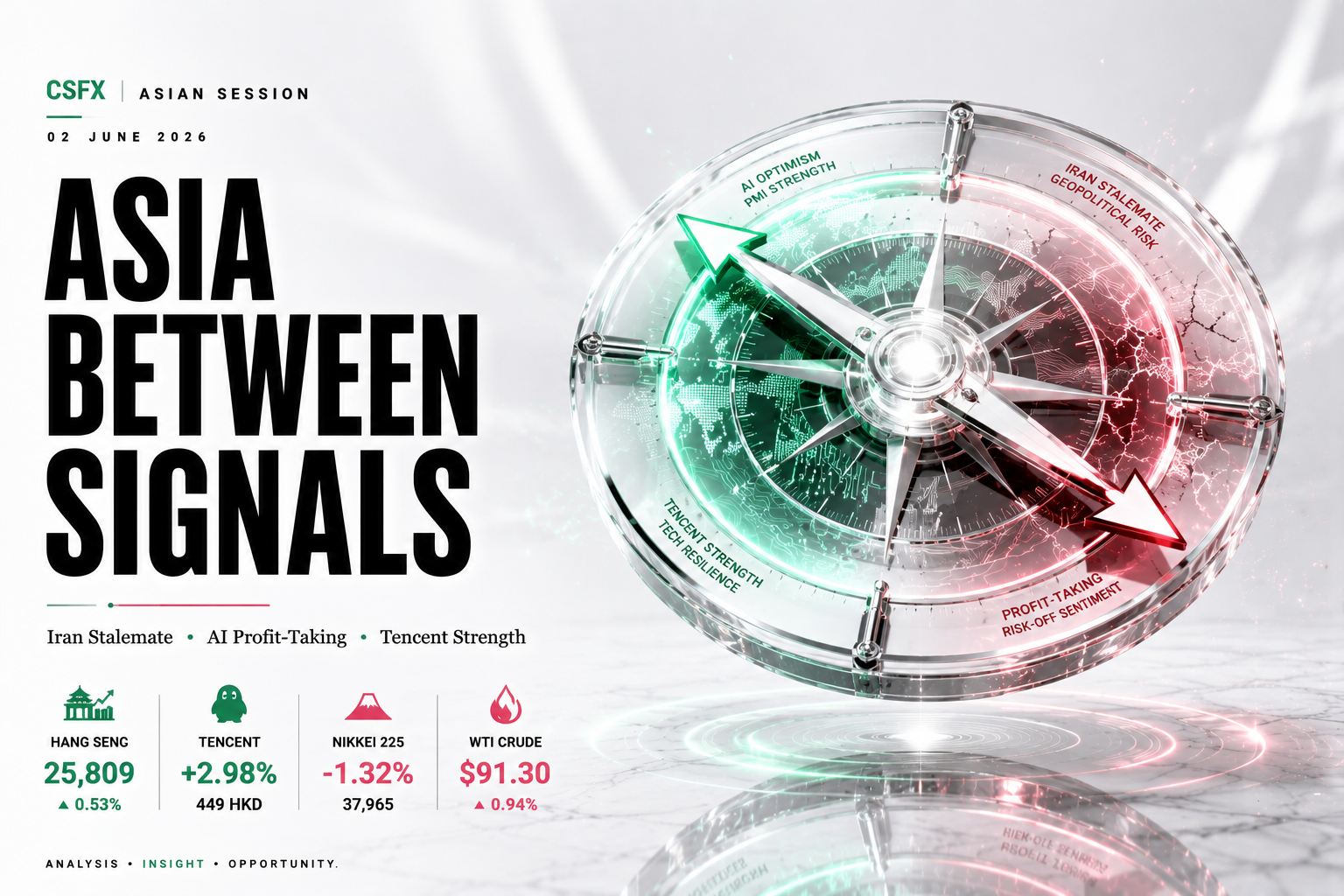
Iran Stalemate, AI Profit-Taking & Kospi Surge | Technical Analysis | Capital Street FX Asian Session Brief · 2 June 2026
Iran Stalemate, AI Profit-Taking
& Tencent’s Resilient Surge
Silver $75.83 · Wheat 603¢/bu · Cardano $0.2275 · Litecoin $49.50
Full Trade Ideas · Technical Charts · Economic Calendar · Asian Equity Spotlight · FAQ
Asian equities are broadly lower this Tuesday. The Nikkei 225 fell 1.32% (66,405), Kospi dropped 1.92%, and the ASX 200 lost 0.71% — all weighed by fresh uncertainty over whether the fragile U.S.–Iran ceasefire, struck in April, will survive. President Trump shrugged off the breakdown risk on Monday, telling CNBC “I don’t care if they’re over, honestly,” sending a chill through risk sentiment. Brent crude slipped to $94.45/bbl as Lebanon announced a partial Hezbollah–Israel ceasefire, but traders remain on edge given Tehran’s reported walkout from negotiations.
The notable outlier is the Hang Seng, clinging to fractional gains (+0.13%), supported by China’s ongoing AI optimism and a bounce in Tencent Holdings (+2.98% to 449 HKD), which is today’s most volatile Asian stock after Friday’s weak close and fresh Morgan Stanley upgrades. Overnight on Wall Street, the S&P 500 rose 0.26% to 7,599.96 and the Nasdaq gained 0.42%, bolstered by ISM Manufacturing PMI hitting a four-year high of 54.0 in May — a positive fundamental backdrop for the session even as geopolitical anxiety dominates Asian hours.
For traders, the key themes are: AUD/CAD as a commodity-bloc proxy with diverging central bank narratives; NZD/JPY as a direct risk-sentiment barometer; Silver balancing inflation hedging against Iran ceasefire de-escalation; and Wheat caught between improving US precipitation forecasts and ongoing supply destruction linked to Middle East shipping disruption. Crypto altcoins ADA and LTC remain in a bear trend.
Live News Driving Markets This Hour
Geopolitical, macro, and corporate catalysts shaping the Asian session · 2 June 2026
Live Rates — 2 June 2026 Asian Session
Key instruments across forex, indices, commodities, and crypto as of Asian morning
Tencent Holdings — Today’s Most Volatile Asian Stock
HK:0700 · The China tech giant roars back as PayPal integration, Morgan Stanley upgrade and AI positioning converge
Why Tencent is moving today: Three catalysts have converged. First, PayPal officially announced its integration with WeChat Pay, opening Tencent’s platform to millions of US travellers spending in China — a meaningful new revenue vector for Tencent’s fintech division. Second, Morgan Stanley and Goldman Sachs both reiterated bullish Chinese tech views, specifically citing Tencent’s AI monetisation cycle as early-stage but accelerating — total revenue grew 9% in Q1 with operating margins at a decade-high of 38.5%. Third, short-covering is amplifying the move: the stock sat 34% below its 52-week high at Friday’s close, making it technically attractive for funds rebalancing China tech exposure.
Fundamentals: Q1 EPS of $1.085 beat the $1.059 consensus. Next earnings due 19 August 2026. Gaming revenue benefited from AI-driven personalisation. The company’s stake in PDD, Kuaishou, and Xiaohongshu provides a portfolio of the fastest-growing Chinese consumer tech plays. Regulatory risk from Beijing remains the key structural overhang — China’s regulators have become more assertive in 2026, though the government has signalled it wants a stable capital market ahead of the 20th Party Congress anniversary.
Risk factors to watch: Any renewed escalation in U.S.–China semiconductor export controls (a Trump administration lever) could rapidly unwind Chinese tech gains. U.S. Treasury’s designation of additional Chinese tech entities would be a binary downside event. Trump–Xi relations remain the critical macro overlay for all Hong Kong-listed China tech names.
Asian Session Data — 2 June 2026
Key events scheduled during today’s Asian trading hours and their market implications
| Time (SGT/HKT) | Country | Event | Impact | Forecast | Actual / Status |
|---|---|---|---|---|---|
| 08:30 | 🇯🇵Japan | Jibun Bank Manufacturing PMI (Final, May) | Medium | 51.2 | 51.7 ✔ Beat |
| 09:45 | 🇨🇳China | Caixin Manufacturing PMI (May) | High | 51.0 | 51.4 ✔ Beat |
| 11:00 | 🇸🇬Singapore | Retail Sales (Apr, YoY) | Low | +3.2% | Pending |
| 11:30 | 🇦🇺Australia | RBA Rate Decision (June) | High | Hold at 4.10% | Decision Due |
| 13:00 | 🇳🇿New Zealand | Building Consents (Apr, MoM) | Low | −1.5% | Pending |
| 14:00 | 🇯🇵Japan | BoJ Deputy Governor Himino — Rate Timing Remarks | High | Cautious on hike timing | Watch Live |
| 16:30 | 🇭🇰HK / China | Hong Kong Exports (Apr, YoY) | Medium | +4.8% | Pending |
Key Catalyst to Watch: The RBA rate decision at 11:30 SGT is the single biggest event for the AUD complex today. Markets price a hold at 4.10%, but RBA Governor Bullock’s tone on future easing will directly move AUD/CAD and AUD/USD. Any hint of dovishness adds selling pressure on AUD; a hawkish surprise could briefly rescue the pair. BoJ Deputy Governor Himino’s remarks on rate hike timing are the JPY wildcard — any signal of an early normalisation would compress NZD/JPY sharply.
AUD/CAD & NZD/JPY — Asian Session Trade Ideas
Two commodity-bloc pairs with diverging central bank stories and risk-sentiment dynamics
Technical Analysis
AUD/CAD has been consolidating below parity (1.0000) since late May, forming a descending triangle on the daily chart. The pair made a series of lower highs from 1.0210 in April to the current 0.9910 resistance. A break below the 0.9860 horizontal support opens the path to 0.9750 — the next significant cluster of daily structure. The 50-day SMA at 0.9935 is acting as overhead resistance. RSI at 42 is trending lower with room to reach oversold. The weekly close below 0.9920 on Friday initiated the bearish structure. A confirmed break below 0.9860 on a 4H close would be the trigger.
Fundamental Context
The AUD/CAD pair encapsulates the divergence between two resource-currency central banks. The RBA is widely expected to hold at 4.10% today, but Governor Bullock has signalled that the next move could be a cut if inflation continues to decline toward the 2–3% target — Australian CPI has fallen to 3.4%. Meanwhile, the Bank of Canada is more neutral to hawkish, with oil at $92/bbl supporting Canadian petrodollar receipts and nominal growth. Canada’s trade surplus from energy exports acts as a persistent structural AUD/CAD headwind. The pair is also sensitive to Chinese demand — weak Hang Seng performance and risk-off from Iran stalemate reduce AUD appeal. Use leverage carefully ahead of the RBA decision.

Technical Analysis
NZD/JPY is one of the cleanest risk-barometers in the Asian session — it rallies with global equities and falls sharply when geopolitical anxiety spikes. The pair has been in a descending channel since its April peak near 96.20, making lower highs and lower lows. The current level of 94.77 sits at the mid-channel. Below 94.20 (the lower channel line) the path to 87.80 opens. The 200-day SMA resides near 91.40 — well above current levels, confirming the structural deterioration. RSI at 38 is approaching oversold but not yet there; momentum traders can still press shorts from intraday bounces toward 95.20.
Fundamental Context
NZD/JPY is a tale of two divergent monetary policy trajectories. The RBNZ is in an active cutting cycle — the OCR sits at 3.75% with markets pricing further cuts into year-end as New Zealand’s economy faces a consumer slowdown and weaker dairy commodity prices. The BoJ, by contrast, is normalising: Deputy Governor Himino’s comments today are crucial — if he signals that conditions for a rate hike are being evaluated, JPY could strengthen sharply across the board, compressing this cross by 100+ pips immediately. Separately, the Iran ceasefire stalemate is a classic NZD/JPY negative catalyst: risk-off flows drive JPY demand (safe haven) and NZD selling (high-beta commodity). New Zealand’s current account deficit and China trade exposure add structural vulnerability. Manage leverage tightly around the Himino speech.

Hang Seng — Trade Idea & Chart
HK equities stand out as the session’s resilient outlier amid broader Asian selling
Technical Analysis
The Hang Seng Index has recovered over 47% from its 2026 low of 17,200, driven by China tech re-rating. The current level of 25,809 sits in a consolidation zone between 25,300 support (20-day EMA) and 26,480 resistance (2026 high). The daily structure is broadly constructive: higher highs since March, a rising 50-day SMA at 23,800, and RSI at 55 — neutral with bullish momentum. A sustained close above 25,500 would target 26,480. The key downside risk is a confirmed daily close below 24,800, which would invite a deeper pullback toward 23,800.
Fundamental Context
The Hang Seng is the single largest beneficiary of the China AI investment thesis. Tencent (17% index weight), Alibaba (11%), and Meituan (7%) are all re-rating as domestic AI monetisation accelerates. China’s Caixin Manufacturing PMI came in at 51.4, beating expectations — a direct positive for Hong Kong-listed industrial and tech names. The lingering risk is geopolitical: any deterioration in U.S.–China relations (semiconductor export controls are a live threat), or a Trump Twitter/Truth Social post targeting Beijing, could create a 3–5% intraday drawdown. Traders should use CFD access to the Hang Seng with tight stops given the binary news risk today.

Technical Analysis
Tencent Holdings has been building a base structure between 420 HKD and 460 HKD since April, with today’s move pressing the top of that range. A confirmed break above 450 on volume opens the path to 480 HKD — a significant resistance cluster that aligns with the April rejection high. The RSI at 58 has room to extend before overbought. MACD on the daily is crossing positive from the zero line — a bullish signal. Key downside support is at 428 HKD (the base of the recent consolidation) and 420 HKD (the 52-week low zone).
Fundamental Context
Tencent’s Q1 results showed gaming revenue boosted by AI personalisation, cloud services growing at 21% YoY, and fintech payments volumes rising 14% despite regulatory headwinds. The PayPal integration announcement this week opens a new revenue category — international commerce through WeChat Pay — that analysts had not fully priced into consensus. Operating margin is at a decade-high of 38.5%. At 449 HKD, the stock is valued at a 37% discount to the 12-month consensus target, which is unusual for a company with Tencent’s cash flow generation and platform moat. The primary risk is Beijing regulatory action — any move by Chinese authorities to mandate data-sharing, restrict monetisation, or impose content controls would be a sharp negative catalyst.

Silver & Wheat — Inflation Hedge vs Supply Squeeze
Technical Analysis
Silver surged 117% year-to-date — from $32/oz in early 2026 to a peak of $115 in late January before correcting sharply to the current $75 consolidation zone. The current price of $75.83 represents the 65% Fibonacci retracement from the January high, which has acted as dynamic support. The daily structure shows a base forming between $72 and $79.25 — a $7 range that has held for five weeks. RSI at 50 is neutral. A break above $79.25 (the recent cycle high) would be a strong bullish signal targeting the $85–$88 range. The bear case requires a daily close below $70.80.
Fundamental Context
Two powerful forces drive silver’s 2026 surge: geopolitical safe-haven demand (Iran war, Strait of Hormuz disruption) and stubbornly elevated US inflation (at a three-year high) keeping real yields low. Silver also carries industrial demand from solar panel manufacturing — China’s solar build-out continues regardless of geopolitical tensions. The headwinds are a ceasefire-progress narrative that would deflate the war premium, and a strong USD (DXY up 0.42% today) which pressures dollar-denominated metals. Investors are awaiting Friday’s US Non-Farm Payrolls for the next major Fed direction signal — a strong print would strengthen the case for “higher for longer” and could add tailwinds for silver via the inflation-hedge channel.

Technical Analysis
CBOT Wheat rallied 39.8% from 492¢ in October 2025 to 688¢ on May 14, 2026, before entering a correction phase. The current 603¢ level represents a 12.4% pullback from the high and is testing the ascending trendline from the October 2025 low. The weekly structure remains bullish: higher highs and higher lows since last autumn. RSI on the weekly has corrected from overbought (75) to neutral (52), creating room for a resumption. The 600¢ psychological level and the 50-week SMA at 590¢ are the key support zones. A close below 578¢ would negate the bullish structure.
Fundamental Context
Wheat faces a classic push-pull today. Bullish: the USDA projects US wheat production at 1.561 billion bushels, the lowest since 1972, driven by drought in Nebraska, Oklahoma, and Kansas (only 35% of Kansas crop rated good-to-excellent, the lowest since 2023). Also bullish: ongoing Middle East shipping disruption raises Black Sea wheat export risk premiums. Bearish: a partial Lebanon ceasefire and Iran stalemate talk of potential progress reduce the geopolitical premium; and China’s agriculture ministry did not confirm the $17 billion bilateral agricultural deal, creating uncertainty around the demand outlook. New crop export sales of 1.058 MMT were a marketing year high last week — a demand positive. The USDA WASDE report (due mid-June) is the next major catalyst.

Cardano & Litecoin — Altcoin Bear Trend Persists
Both altcoins trade below key moving averages as the broader crypto market faces headwinds from a strong USD
Technical Analysis
Cardano (ADA) is in a well-defined bearish structure. Both the 50-day and 200-day moving averages are declining and sit above the current price of $0.2275 — a confirmed bearish alignment. The 50-day MA has been falling since 29 May 2026; the 200-day MA has been declining since 3 May 2026. RSI at approximately 35 is approaching oversold but has not yet generated a reversal signal. ADA has failed multiple times to sustain a move above the $0.28–$0.31 resistance band since February. The $0.22 level is the critical support — a break below that targets $0.19 (the post-CME futures launch low).
Fundamental Context
Cardano’s fundamentals remain challenged despite a strong theoretical roadmap. The network generated only $352,000 in fees in 2026 despite an $8.48B market cap — an acute revenue productivity gap that institutional capital finds difficult to justify. The Cardano Summit 2026 was cancelled after a failed onchain governance vote to fund the event, signalling community coordination challenges. Positive catalysts would be: a Cardano spot ETF approval (speculative), breakthrough dApp adoption, or a Bitcoin rally lifting all altcoins. The VOLTAIRE governance upgrade is the project’s best near-term catalyst, but implementation timelines remain uncertain. Macro headwinds — strong USD, elevated real yields — will continue to weigh on low-utility altcoins into Q3.

Technical Analysis
Litecoin has been trapped in a narrow consolidation range of $49.77–$59.09 since mid-February 2026. The 50-day MA is declining and positioned above the price — acting as resistance. The 200-day MA has been falling since 25 May 2026, confirming the longer-term bearish trend. RSI at 41 is neutral-to-bearish, with the MFI declining — indicating capital is flowing out of the asset. Bullish reversal patterns (Morning Star, Hammer, Dragonfly Doji) have formed near the $49.77 support, suggesting some buying interest, but these patterns have not yet produced a sustained breakout. The VWAP sits above current price — a bearish indicator suggesting sellers are in control of the aggregate distribution.
Fundamental Context
Litecoin is the quintessential “digital silver” narrative — a fast, cheap, established peer-to-peer payments chain. At $49.50, LTC is trading near its weakest levels since January 2026. The crypto fear and greed index at “Extreme Fear” (score 22) suggests the market is broadly risk-off. LTC’s primary use case as a payments layer faces competition from faster and cheaper chains (Solana, Avalanche). There is no major LTC-specific catalyst expected in the near term — no ETF filing, no major protocol upgrade, no institutional adoption announcement. LTC will trade as a beta play on Bitcoin: a Bitcoin recovery above $90,000 would provide the strongest bullish catalyst for LTC. Until then, the path of least resistance is lower. The $49.77 support is the critical level to watch for a breakdown signal.

Traders’ Questions Answered
Common questions on today’s Asian session market conditions and trade ideas
“The market has grown accustomed to the back-and-forth — ceasefire negotiations between the U.S. and Iran have seen repeated false starts since April, and today’s lack of progress is no exception.” — Fabien Yip, Market Analyst, IG Sydney · 2 June 2026
Asian Session Verdict — 2 June 2026
The Asian session opened in a cautious risk-off mode with the Iran ceasefire narrative providing the dominant macro overlay. Markets have learned to live with the “on again, off again” diplomatic rhythm between Washington and Tehran — but the absence of progress is a persistent drag on risk assets, particularly the high-beta Antipodean currencies (AUD, NZD) and commodity-linked altcoins.
The standout trade for the session is short NZD/JPY — a direct expression of risk-off sentiment, a cutting RBNZ versus a normalising BoJ, and Iran stalemate as the geopolitical catalyst. The setup is technically clean (descending channel, RSI declining) and fundamentally supported (monetary policy divergence, current account dynamics). Tencent Holdings is the equity story of the day — the PayPal integration and analyst momentum suggest the stock is attempting to build a sustainable base after a deep discount from 2025 highs.
Silver remains structurally constructive as the inflation-hedge and geopolitical premium play — the $73–$79 range is a compelling long entry zone for medium-term traders. Wheat’s correction is offering a retest of the ascending trendline from October 2025. ADA and LTC remain tactical shorts or “avoid” unless Bitcoin reclaims $90,000.
Trade smart, manage risk, and let price structure guide your decisions.
Trade the Asian Session →