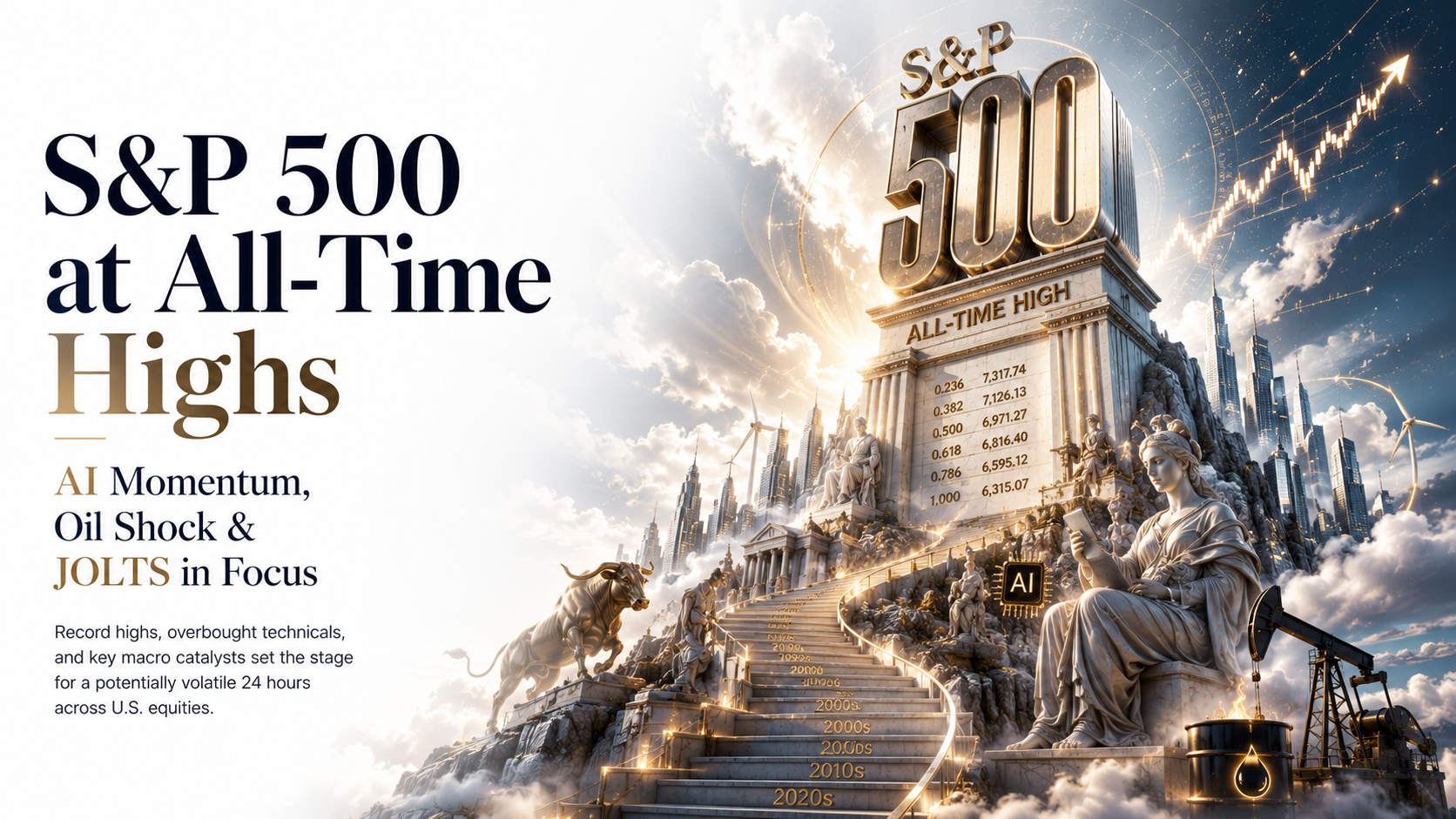
The S&P 500 closed at a record high of 7,599.95 on June 1, 2026 — its ninth consecutive weekly gain. Technology and energy sectors led the advance, fueled by Nvidia’s AI chip launch and a sharp spike in oil prices driven by rising Middle East geopolitical tensions.
Close Price7,599.95All-Time High Close
Day Change+0.26%+19.90 points
Intraday High7,617.66New ATH intraday
Intraday Low7,562.6154.05 pt range
RSI (Daily)74.51Overbought territory
Weekly Streak9 WeeksConsecutive gains
02Price Chart with Indicators
SPX Daily Chart — Fibonacci & Moving Averages
The annotated chart below reflects the current S&P 500 technical picture as of June 2, 2026, with Fibonacci retracement levels from the April 7 low (6,315.07) to the all-time high (7,627.47), along with 50-day and 200-day EMA overlays.
S&P 500 Index (SPX) — Daily Chart | Fibonacci Retracement + EMAs + RSI
1H4H1D1W
Chart: S&P 500 Daily (Oct 2025–Jun 2, 2026). Fibonacci retracement from April 7 low (6,315.07) to ATH (7,627.47). 50 EMA (yellow), 200 EMA (orange). RSI at 74.51 — overbought. Red dashed line marks JOLTS event on Jun 2.
03Technical Summary — Next 24 Hours
Technical Analysis: S&P 500 (SPX)
The S&P 500 is trading in a well-defined ascending channel with all major moving averages pointing higher. However, the RSI at 74.51 flags an overbought condition on the daily timeframe, suggesting the risk of short-term consolidation or a minor pullback before any further breakout above the Fibonacci 0% zone at 7,627.47.
Multiple macro and micro events are shaping S&P 500 price action in the next 24 hours. The dominant themes are the ongoing AI/tech rally anchored by Nvidia’s Computex announcements, sharp oil price moves driven by Iran-Strait of Hormuz tensions, and today’s key labor data event: JOLTS Job Openings for April.
🤖
Nvidia AI Chip Launch — Computex 2026 Catalyst
Nvidia CEO Jensen Huang unveiled the RTX Spark Superchip at the Computex Taipei summit on June 1, claiming it represents a reinvention of the PC comparable to the smartphone era. NVDA surged over 6%, dragging the entire S&P 500 technology sector up by 2%+. Dell Technologies rose 1.7% and HP Inc gained 4% on the announcement, while Intel fell more than 6%.
📈 Bullish for Tech/SPX
🛢️
Iran — Strait of Hormuz Blockage Threat & Oil Spike
Iranian state media reported Tehran may halt communications with the U.S. through intermediaries and move toward fully blocking the Strait of Hormuz. WTI crude surged 5.93% and Brent crude gained 4.24%, reviving inflation fears and raising energy cost concerns. The 10-year Treasury yield climbed to 4.48%, adding pressure on rate-sensitive sectors and potentially constraining further SPX upside if oil stays elevated.
🔴 High Risk — Geopolitical
📊
JOLTS Job Openings — April Data (10:00 AM ET, June 2)
The JOLTS Job Openings report for April is the primary scheduled macro event for June 2, 2026. A higher-than-expected print signals a tight labor market, supporting a “higher for longer” Fed narrative that could pressure equity multiples. A miss, however, could reignite rate-cut hopes, providing fresh fuel for the S&P 500 rally. The consensus estimate is approximately 7.8–8.0 million job openings.
🔴 High Impact — Market Moving
📋
Key Earnings: Palo Alto Networks, Ulta Beauty, Dollar General (After Close)
Three S&P 500 constituents report after the closing bell on June 2. Palo Alto Networks (PANW) results will reflect AI-driven cybersecurity demand trends. Ulta Beauty and Dollar General will test consumer spending resilience. Any significant earnings surprises — especially from PANW, whose market cap is material to the tech sector — could trigger pre-open S&P 500 futures moves overnight.
🟡 Medium Impact — Earnings Risk
🏦
JPMorgan CEO Jamie Dimon: Markets “Exuberant,” Risks Underpriced
At the Reagan National Economic Forum on May 29, JPMorgan’s Jamie Dimon warned that market risks may be underpriced, cautioning about “exuberant” sentiment. With the S&P 500 now up more than 20% from its April lows in under 50 days and an RSI in overbought territory, Dimon’s warning adds a valuation and sentiment counterweight that sophisticated market participants are monitoring closely.
🟡 Medium Impact — Sentiment Risk
🏭
ISM Manufacturing PMI Beats at 54.0 (June 1)
U.S. factory activity printed at 54.0 in May — above the Dow Jones consensus estimate of 53.2 and up 1.3 points from April — suggesting broad-based economic expansion. New orders rose to 56.8 and imports climbed 2.7 points to 53, signaling genuine demand recovery. The prices sub-index eased 2.5 points, offering a partial inflation comfort signal for rate watchers.
📈 Bullish — Economy Expanding
05Trade Setup — Next 24 Hours
S&P 500 Trade Setup: Entry, Stop Loss & Take Profit
Based on the technical structure (ascending channel, Fibonacci levels, EMA alignment) and fundamental backdrop (AI momentum vs. geopolitical oil risk), two high-probability setups are identified for the next 24-hour trading window.
Setup A — Bullish Breakout Play
Continuation of the 9-week uptrend on confirmation above ATH
▲ LONG
Entry Zone
7,580–7,600
Buy on intraday dip or on break of 7,627 ATH
Stop Loss
7,500
Below channel lower band & 20-day SMA zone
Take Profit
7,680 / 7,750
TP1: Channel upper band | TP2: Fib extension target
Rationale: The S&P 500 is sitting 27 points below the 0% Fibonacci resistance at 7,627.47. A decisive close above this level on strong volume — catalyzed by a JOLTS miss or further AI-sector news — opens the path toward 7,680 (channel upper band) and the 7,750 Fibonacci extension. The 50 EMA at ~7,078 and the broader rising channel provide a strong structural floor. However, the overbought RSI at 74.51 with negative divergence demands disciplined risk management.
Risk/Reward
1 : 1.8 → 1 : 3.0
Risk (SL Distance)
~90–100 pts
TP1 Target Gain
+80 pts (+1.05%)
TP2 Target Gain
+150 pts (+1.97%)
Setup B — Overbought Mean Reversion (Hedge)
Short-term pullback play on RSI divergence and JOLTS beat risk
▼ SHORT / HEDGE
Entry Zone
7,615–7,630
Short on rejection at 0% Fib / ATH zone
Stop Loss
7,660
Above channel upper band — invalidates setup
Take Profit
7,500 / 7,430
TP1: 20-day SMA | TP2: Channel lower band
Rationale: The RSI at 74.51 with a forming negative divergence on the daily chart, combined with price sitting at a proven ATH resistance zone (7,627.47) and the Iran–Strait of Hormuz headline risk, makes a short-term mean-reversion trade viable as a hedge. A JOLTS beat (higher job openings = hawkish Fed) could be the catalyst. The target is a retracement to the 20-day SMA (~7,431 area) or the rising channel’s lower rail. This is a lower-probability setup against a strong trend — size accordingly.
Risk/Reward
1 : 2.2 → 1 : 3.7
Risk (SL Distance)
~30–45 pts
TP1 Target
-115 pts (-1.5%)
Probability
Lower — Counter-trend
06Economic Event Calendar
Events Impacting S&P 500 in Next 24 Hours
The following scheduled and unscheduled events are expected to drive S&P 500 volatility between now and June 3, 2026 (next 24 hours). JOLTS is the single most important macro event today, with earnings adding overnight risk.
24-Hour Event Timeline — June 2–3, 2026All times ET
10:00 AM ET Jun 2
★ JOLTS Job Openings — April 2026
Primary market-moving event today. Consensus: ~7.8–8.0M openings. Beat = hawkish Fed tone → possible SPX pressure. Miss = rate-cut hope → potential rally catalyst. Directly impacts rate expectations and equity valuations.
HIGH IMPACT
After Close Jun 2
Earnings: Palo Alto Networks (PANW)
Cybersecurity giant reporting Q3 FY2026. AI-driven security demand is the key narrative. SPX tech sector will react to guidance on AI security spending. Options market implies ~8% move in PANW overnight.
HIGH IMPACT
After Close Jun 2
Earnings: Ulta Beauty (ULTA) & Dollar General (DG)
Consumer bellwethers. DG results will gauge lower-income consumer resilience; ULTA reflects premium consumer spending. Together they provide a read on U.S. consumer health relevant to SPX breadth.
MED IMPACT
Ongoing Jun 2
Iran — Strait of Hormuz Geopolitical Risk
Real-time headline risk. Any escalation (or de-escalation) around Iranian threats to block the Strait of Hormuz will move oil prices sharply, directly impacting S&P 500 energy sector and overall inflation expectations. Wall Street has developed “headline fatigue” but a material action remains a tail risk.
HIGH RISK
8:15 AM ET Jun 3
ADP Employment Report — May 2026
Private payrolls preview for Friday’s Nonfarm Payrolls. ADP beat = hawkish Fed expectations. Already relevant within the 24-hour window as it prints early on June 3, potentially impacting S&P 500 futures overnight.
MED IMPACT
Fri Jun 5
Nonfarm Payrolls — May 2026 (Forward Look)
The week’s headline macro event. Markets will begin positioning ahead of Friday’s NFP print throughout this week. Strong labor market data could trigger SPX profit-taking; weak data could ignite another leg of the rally on rate-cut optimism.
The S&P 500 enters June 2, 2026 at an all-time high of 7,599.95, supported by one of the strongest technical structures in years — a clean ascending channel, a golden cross between the 50 and 200-day EMAs, and nine consecutive weeks of gains. The AI mega-cycle, anchored by Nvidia’s dominance and Jensen Huang’s Computex keynote, continues to provide the primary fundamental fuel for higher prices.
However, the daily RSI at 74.51 with a forming negative divergence is a clear warning sign that the index may be entering a short-term exhaustion phase. History shows that corrections from overbought RSI extremes tend to be shallow in strong uptrends — typically 2–5% — but they do happen. The JOLTS data at 10:00 AM ET and the Iran headline risk represent the two most immediate catalysts that could determine whether today’s session brings a breakout above 7,627 or a pullback toward the 7,430–7,500 zone.
For the next 24 hours, the path of least resistance remains upward as long as the S&P 500 holds above the 20-day SMA (~7,431) and the channel lower band. A decisive close above 7,627.47 (the 0% Fibonacci level) would be a strong technical signal for further upside toward 7,700+. Traders should watch JOLTS at 10 AM ET, the PANW earnings call tonight, and any Middle East headline as the key near-term swing factors.
08Frequently Asked Questions
S&P 500 FAQ — June 2, 2026
Answers to the most searched questions about today’s S&P 500 price, technical setup, and market events.
The S&P 500 closed at a record high of 7,599.95 on June 1, 2026 (up +0.26%, or +19.90 points). This marks the index’s ninth consecutive week of gains and a new all-time high close. The intraday high reached 7,617.66 before settling at the close.
The immediate resistance for the S&P 500 today is the 0% Fibonacci retracement level at 7,627.47 (the all-time high). Above that, the next target zones are 7,650 (ascending channel upper band) and 7,700–7,750 (Fibonacci extension area). A convincing close above 7,627 would be a significant bullish breakout signal.
Key support levels for the next 24 hours: immediate support at 7,500–7,520 (psychological zone and channel midline), followed by the 20-day SMA at approximately 7,431 (channel lower band). Below that, the 0.236 Fibonacci level at 7,317.74 represents the next major floor. The 50-day EMA at ~7,078 is the key medium-term support that has not been tested since the April recovery began.
Yes — on the daily timeframe, the S&P 500’s RSI(14) reading of 74.51 is firmly in overbought territory (above 70). Additionally, RSI is showing a negative divergence against price (RSI making lower highs while price makes higher highs), which is a classic warning of near-term exhaustion. However, in strong trending markets like the current AI-driven bull run, overbought conditions can persist for weeks. The overbought RSI reduces the probability of a sustained breakout without at least a brief consolidation.
The primary scheduled event today is the JOLTS Job Openings report for April at 10:00 AM ET. After market close, Palo Alto Networks (PANW), Ulta Beauty (ULTA), and Dollar General (DG) all report earnings. Ongoing geopolitical risk from Iran’s potential Strait of Hormuz blockage threats is the main unscheduled wildcard. Tomorrow morning (June 3), the ADP Employment report will also begin to influence S&P 500 futures overnight.
For a bullish setup: Entry at 7,580–7,600 (or on a breakout above 7,627), Stop Loss at 7,500, Take Profit at 7,680 (TP1) and 7,750 (TP2). Risk/reward approximately 1:1.8 to 1:3. For a short/hedge setup: Entry at 7,615–7,630 on ATH rejection, Stop Loss at 7,660, Take Profit at 7,500 (TP1) and 7,430 (TP2). All setups are for educational and informational purposes — not financial advice.
The S&P 500 has gained approximately 20%+ from its April 2026 low in under 50 days, driven by three primary forces: (1) the AI mega-cycle — Nvidia’s back-to-back chip launches and the broader adoption of agentic AI have supercharged technology sector earnings expectations; (2) ISM Manufacturing expansion at 54.0 — signaling broad economic resilience; and (3) inflation moderating — the prices subindex eased, keeping Fed rate-cut hopes alive. The 9-week winning streak reflects strong institutional momentum and retail investor FOMO (fear of missing out).
The Iran conflict affects the S&P 500 through two channels: (1) Direct oil price impact — WTI crude surged 5.93% on June 1 as fears of a Strait of Hormuz blockage mounted; higher oil prices raise input costs for S&P 500 companies, compress margins, and can revive inflation concerns that push the Fed toward a “higher for longer” stance; (2) Risk-off sentiment — escalation headlines trigger flight to safety (Treasuries, gold), temporarily reducing equity allocations. However, Wall Street has developed some “headline fatigue” to recurring Iran reports, meaning only a genuine material escalation would have sustained SPX impact.
Risk Disclaimer: This S&P 500 market outlook is provided for educational and informational purposes only and does not constitute financial, investment, or trading advice. All trade setups (entry, stop loss, take profit) are hypothetical examples based on technical analysis and are not recommendations to buy or sell any security or financial instrument. Trading financial markets involves significant risk, including the potential loss of capital. Past performance is not indicative of future results. Always conduct your own research and consult a qualified financial advisor before making any investment decisions. Market data referenced is as of June 1–2, 2026. CSFX Research assumes no responsibility for trading decisions made based on this report.