
Gold vs Silver: The Broken Ratio — A Deep Analysis (2026) | Capital Street FX
The Broken Ratio: Gold, Silver, and the Anatomy of a Market Fracture
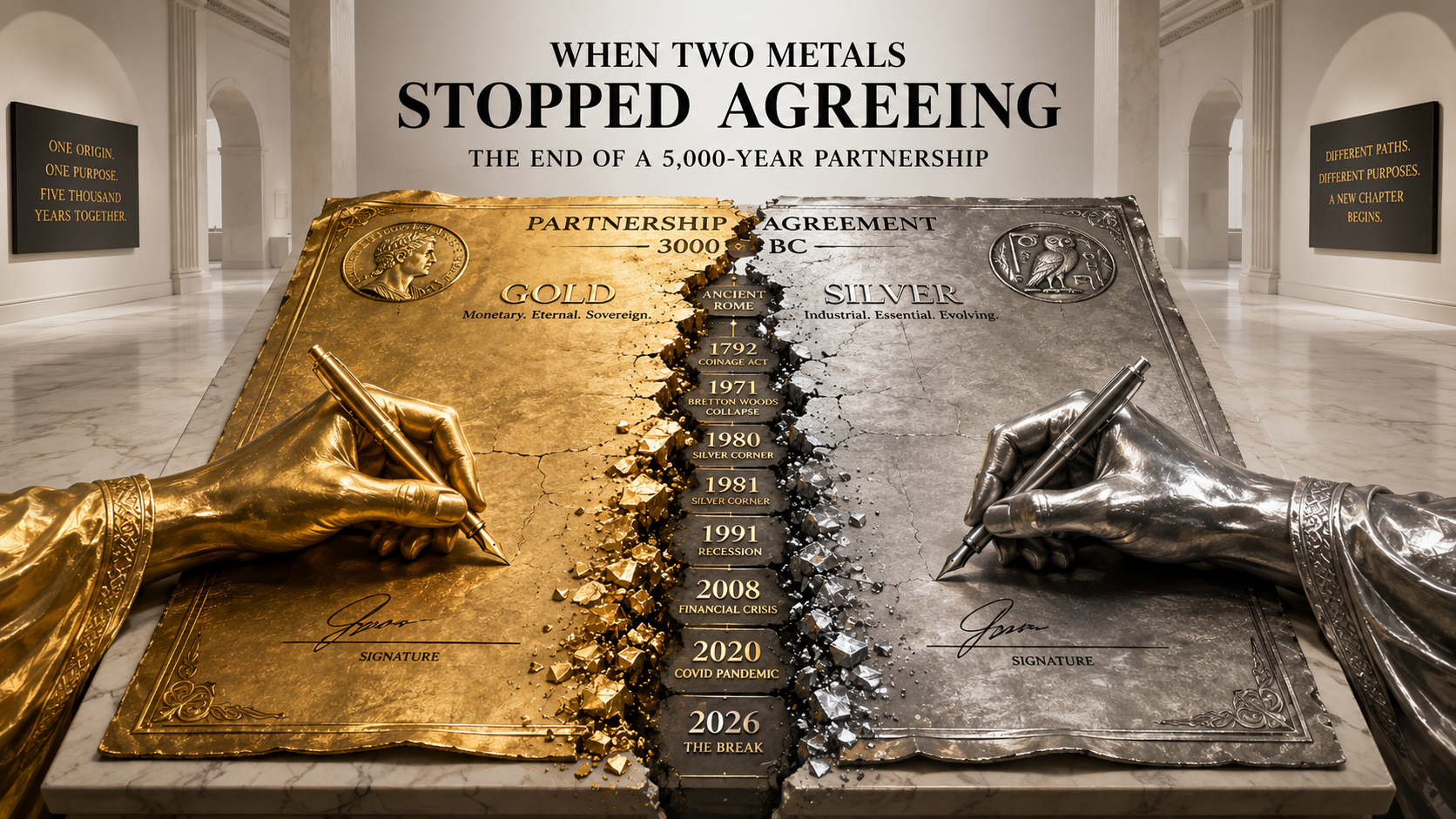
For four thousand years, the price of gold relative to silver followed a law of nature — fixed first by geology, then by monarchs, then by markets. Today that relationship has fractured in ways that illuminate something profound about our moment: the weaponisation of the dollar, the rewiring of global energy, and the question of whether silver is the most structurally mispriced major commodity on earth.
The Number That Governed Empires: A History of the Gold-Silver Ratio
Divide the price of one troy ounce of gold by the price of one troy ounce of silver. The number you get — today, roughly 60 — is one of the oldest continuously tracked ratios in human economic history, predating central banks, stock markets, and the concept of paper money by several millennia. It is a number that has funded wars, stabilised empires, driven colonists to the New World in search of silver mines, and periodically sent commodity trading desks into states of evangelical frenzy. To understand what is happening to gold and silver today — and why it matters enormously for anyone trading commodities, managing portfolios, or simply trying to make sense of the global monetary system — you must first understand what the ratio meant for most of human history, and what shattered that meaning in the nineteenth century.
Silver’s dominance in monetary history runs deeper than most people realise. For most of antiquity and the Middle Ages, silver was not a secondary monetary metal — it was the monetary metal. The Roman denarius, the British pound sterling (literally, a pound of silver), the Spanish peso de ocho (piece of eight), the German Thaler (which gave us the word “dollar”) — all silver. The gold-silver ratio was therefore not an abstract financial metric but a constitutional question: how much monetary value did the state assign to each metal? Rome legislated it near 12:1. The medieval Islamic world generally traded between 8:1 and 12:1. Napoleon’s 1803 Germinal Franc fixed it at 15.5:1. The Latin Monetary Union — the nineteenth-century forerunner of the euro — adopted 15.5:1 as its binding standard.
None of these numbers were arbitrary. They broadly reflected the geological reality that silver occurs in the earth’s crust at roughly 15 to 17 times the concentration of gold, making the ratio in nature’s ledger approximately 15–17:1 — which is why bimetallic authorities kept landing on similar figures. When the ratio drifted significantly away from the “natural” level, arbitrage ensued: merchants would ship whichever metal was undervalued across borders until prices rebalanced. The system was elegant in theory and deeply unstable in practice, as centuries of monetary crisis attested.
The definitive break came in the 1870s, when Germany — newly unified and flush with French war reparations paid in gold — demonetised silver and adopted the gold standard. The United States followed with the Coinage Act of 1873, dubbed the “Crime of ’73” by American agrarians who correctly identified that removing silver from the monetary system would benefit creditors over debtors and East Coast bankers over Western silver-mining states. By 1900, the classical gold standard linked virtually every major economy’s currency to gold alone, and silver was reclassified from monetary metal to industrial commodity with residual investment appeal.
“You shall not crucify mankind upon a cross of gold.” William Jennings Bryan’s 1896 presidential campaign was the last serious political effort to restore silver’s monetary role. He lost three times. The gold standard’s victory over bimetallism was total — and the consequences for the gold-silver ratio were permanent.
— Bryan’s “Cross of Gold” speech, Democratic National Convention, 1896| Era / Event | Ratio | Context & Primary Driver |
|---|---|---|
| Ancient Rome (legislated) | 12 : 1 | Fixed by decree; reflects natural crustal abundance (~15:1 geological) |
| Medieval Islamic world | 8–12 : 1 | Trade-determined; consistent with geological scarcity ratios |
| Napoleon’s Germinal Franc, 1803 | 15.5 : 1 | Bimetallic standard legally enforced across the French empire |
| Latin Monetary Union, 1865 | 15.5 : 1 | France, Belgium, Italy, Switzerland adopt common standard |
| Post-demonetisation, 1900–1940 | 35–50 : 1 | Silver loses monetary role; price set by industrial demand and investment |
| Post-WWII, 1945–1970 | 30–45 : 1 | US silver price controlled; industrial demand grows steadily |
| Hunt Brothers peak, January 1980 | ~17 : 1 | Silver at $50.35/oz; public speculation frenzy; COMEX rule changes end it |
| 1991 US recession | ~100 : 1 | Industrial demand collapses; gold holds on safe-haven flows |
| 2011 commodity super-cycle peak | 31 : 1 | Silver to $49.82; QE era; industrial and investment demand peak together |
| 2016–2019 mean | 75–85 : 1 | New elevated range; silver structurally lags gold’s monetary demand premium |
| March 2020 pandemic panic | 125 : 1 | Most extreme modern reading; gold safe-haven; silver industrial crash |
| April 2025 tariff shock | 107 : 1 | Brief re-widening on global trade war fears; ratio briefly above 100 |
| December 2025 silver bull market | ~49 : 1 | Silver +147% in 2025; physical vault squeeze; ratio compression |
| Today — June 2026 | 58.9 : 1 | Post-ATH consolidation; deficit continues; both structural forces operating |
Silver Thursday 1980: The Greatest Commodity Squeeze in History and Its Lessons for Today
On January 21, 1980, the silver price reached $50.35 per troy ounce — a level not seen again for thirty-one years. In the three years preceding that peak, the price had risen from roughly $4 to $50: an eleven-hundred percent gain. The gold-silver ratio compressed from approximately 35:1 to around 17:1 — the tightest reading of the modern era. And then, in the space of ten weeks, most of it reversed. By March 27, 1980 — a date that became known as Silver Thursday — silver had collapsed to $10.80 per ounce. Two of the richest men in America were technically bankrupt. The lessons of that episode still reverberate every time silver makes a dramatic move.
Nelson Bunker Hunt and William Herbert Hunt were sons of H.L. Hunt, the Texas oil wildcatter who had built one of America’s largest fortunes. By the early 1970s, the brothers had become convinced that inflation — running in double digits by mid-decade — would destroy the purchasing power of paper money. Prohibited by US law from owning gold (Franklin Roosevelt’s 1933 executive order had banned private gold ownership, a restriction only lifted in 1974), they turned to silver. Starting at around $1.50 per ounce in the early 1970s, they began accumulating. By 1979, in partnership with wealthy Saudi investors, their combined position had grown to approximately 200 million ounces — roughly half of the world’s entire deliverable silver supply.
The mechanics of the squeeze were straightforward: by taking physical delivery of silver on COMEX futures contracts rather than rolling them forward as most speculators did, the Hunts were draining the exchange’s vault inventory. When physical supply becomes scarce and futures shorts cannot deliver, they must buy to close — driving prices higher in a feedback loop. Silver rose from $6 in early 1979 to $50 by January 1980. Goldman Sachs estimated the Hunts had turned a $1 billion investment into roughly $5 billion at peak prices.
The unravelling was triggered by regulatory intervention and leverage. COMEX’s board voted on January 7, 1980 to introduce “Silver Rule 7” — limiting new purchases of silver futures to liquidation only. Traders could only sell, not buy. With the bid side of the market effectively removed, the Hunt brothers’ vast long position became impossible to maintain. Simultaneously, Federal Reserve Chairman Paul Volcker quietly instructed banks not to extend further credit for speculative commodity positions. Denied the ability to roll their leveraged positions, the Hunts faced cascading margin calls as prices fell.
On March 27, silver fell $5 in a single day as brokerages liquidated Hunt-associated accounts to meet margin calls. The collapse threatened several major brokerage firms and required a $1.1 billion bailout loan from a consortium of US banks — one of the largest financial rescues of the era. The Hunts were eventually fined $134 million and Nelson Bunker Hunt filed for personal bankruptcy in 1988.
Historical reassessment has complicated the conventional narrative. CPM Group’s Jeff Christian has argued that the Hunts’ actual price impact may have been far smaller than claimed — perhaps 50–75 cents on a $50 move. The broader forces of 1970s inflation, the Iran hostage crisis, the Soviet invasion of Afghanistan, and genuine public appetite for silver as an inflation hedge may have driven most of the price surge. What is beyond dispute is that when regulators changed the rules mid-game, the price collapsed regardless of the underlying fundamentals — a tail risk that remains relevant to every leveraged commodity trade today.
From 125:1 to $121.64: The Most Violent Precious Metals Cycle in Modern History
The modern chapter of this story begins on March 18, 2020. As governments globally locked down their economies in response to COVID-19, industrial demand for silver collapsed almost overnight — manufacturing halted, construction paused, automotive production fell off a cliff. Meanwhile, gold surged on safe-haven demand and monetary stimulus expectations. The gold-silver ratio hit 125.08:1 on that day: the highest reading in 5,000 years of recorded history. It was not a small deviation from the mean. It was an outlier of statistical significance that, had it been a bond yield or a credit spread, would have triggered emergency central bank meetings.
From that extreme, silver began a recovery that — with significant interruptions — culminated in one of the most dramatic commodity bull markets in modern times. By August 2020, silver had already rallied from $12 to $29. The WallStreetBets community attempted a short squeeze in January 2021, pushing prices briefly above $30 before fading; the silver market proved too large and physically complex for a retail internet campaign to corner. But the structural forces underneath were genuine.
De-Dollarisation and the Central Bank Buying Surge That Has Permanently Repriced Gold
While silver was experiencing its delayed but violent bull market, gold was doing something historically remarkable and structurally distinct: it was being purchased at record rates by the world’s central banks, for reasons that had nothing to do with inflation expectations or industrial demand and everything to do with the rewiring of the global monetary order. To understand why the gold-silver ratio has remained elevated even as silver has surged, you must understand what happened on February 26, 2022.
On that day, the United States, the European Union, and their allies announced the immobilisation of approximately $300 billion in Russian central bank foreign exchange reserves — the largest sovereign asset freeze in history, executed as a response to Russia’s invasion of Ukraine. For every central bank watching from the sidelines, the message was unambiguous: dollar-denominated reserves, and any reserves held in the financial systems of countries that might become adversaries, were not safe. Gold, sitting in domestic vaults, could not be frozen, sanctioned, or defaulted upon. It has no issuer. It carries no counterparty risk.
762 Million Ounces and Counting: The Silver Supply Crisis the Market Keeps Ignoring
In April 2026, the Silver Institute and Metals Focus published the World Silver Survey 2026 — the definitive annual accounting of the global silver market. Its headline conclusion was striking: for the fifth consecutive year, global silver demand had exceeded global silver supply in 2025. The resulting deficit of 40.3 million ounces, combined with the deficits of the preceding four years, brought the cumulative drawdown from above-ground stocks to 762 million troy ounces since 2021. That number has no modern precedent. It represents roughly 90% of one full year of global silver mine production — consumed from existing stockpiles simply to bridge the gap between what the mines produce and what the world demands.
Silver and the Solar Revolution: The Demand Story That Thrifting Cannot Yet Eliminate
Silver has a physical property that makes it central to the global energy transition: it is the best electrical conductor of any element at room temperature, superior even to copper by 5–8%. In solar photovoltaic manufacturing, silver paste is applied to silicon wafers to form the conductive contacts that collect electrical current. No other material currently matches silver’s combination of conductivity, workability, and stability at the microscopic scale.
The central debate in silver’s industrial demand thesis concerns the race between technological thrifting — engineering cells to use less silver per watt — and deployment growth. This race is now more competitive than silver bulls have historically acknowledged. PV silver demand fell 6% in 2025 to 186.6 million ounces, and is forecast to fall a further 19% in 2026 to around 151 million ounces, as sustained high prices accelerated paste formula improvements.
However, even at 151 million ounces in 2026, solar remains a far larger silver consumer than a decade ago (~50 million ounces in 2016). Complete silver-free solar cell architectures using copper or carbon-based conductors remain in research rather than commercial production. The deficit persists in 2026 at 46.3 Moz despite ongoing thrifting.
The Paper Mountain: COMEX Dynamics and the Disconnect Between Futures and Physical Silver
To trade silver effectively, a trader must understand the relationship between the COMEX futures market — where the silver price is largely set — and the physical market where metal actually changes hands. COMEX silver futures contracts each represent 5,000 troy ounces. Total open interest typically runs between 100,000 and 160,000 contracts, implying a paper commitment of 500–800 million ounces — more than the entire world’s annual mine production.
The CFTC’s weekly Commitments of Traders report breaks silver futures into three categories: Commercials, Large Speculators, and Small Speculators. As of February 2026, silver’s COT data showed Large Speculators at a moderate net long of +22,955 contracts.
This positioning — moderate speculative longs, manageable commercial shorts — is not at the extreme readings that typically precede sharp corrections. At the 2025 price peak, large speculators were at multi-year record net longs. Current positioning is a structurally healthier setup for a sustainable trend.
Are Gold and Silver Permanently Divorced? Analysing the Structural Break in Their Relationship
The gold-silver ratio at 60:1 in June 2026 sits below the extreme readings of 2020 (125:1) and April 2025 (107:1), but above the long-run post-demonetisation average of roughly 47:1. The question of whether the current level represents a temporary dislocation or a new structural equilibrium is highly consequential.
“Silver is the sprinter and gold is the long-distance runner. Gold sets the pace and establishes the trend. Silver falls behind — and then, when the structural deficit and investor psychology finally align, it runs at speeds that make gold look like it is standing still.”
— Market Observation on Precious Metals CyclesWhere Does 60:1 Go From Here? Three Scenarios, Weighted by Evidence
The Fed completes its rate-cutting cycle, weakening the dollar and compressing real yields. The silver deficit enters a seventh consecutive year. The ratio compresses toward the 45–52:1 range seen at the 2011 bull market peak.
Gold and silver both appreciate at roughly comparable rates. This is the outcome if the Fed’s rate cuts are shallow and gradual, keeping the ratio range-bound between 55:1 and 70:1.
A global recession triggers risk-off positioning. Global manufacturing contracts sharply, industrial silver demand collapses, and the ratio returns toward 80–100:1, replicating the 2020 crash dynamic.
Specific Trade Ideas — 4 June 2026
Actionable Trade Setups: Gold, Silver & the Ratio
Interactive Tool
Gold-Silver Ratio Calculator
Enter any gold and silver price to calculate the ratio and see whether it is historically elevated, compressed, or at the long-run mean.
Frequently Asked Questions
Everything Traders Need to Know About the Gold-Silver Ratio
The Ratio at 60:1: At the Intersection of Ancient History and the Future of Energy
The gold-silver ratio at 60:1 in June 2026 is best understood as the compressed expression of a genuine structural fracture in the precious metals market — a fracture produced by forces that have not operated simultaneously since before the First World War. For traders and investors who can manage the timing risk and the leverage sensibly, the silver-gold relationship is one of the most analytically rich and potentially rewarding relative-value opportunities in commodities markets today.
Access XAU/USD and XAG/USD with 0.0 pip spreads, leverage up to 1:10,000, and full TradingView charting — on web, desktop, iOS, and Android with no app store restrictions.