Euro Holds $1.14 as Dollar Softens with Sintra Under Way on the Last Day of Q2 · DAX Eyes a Strong Quarter on Chip Rebound · Oil Set for Worst Quarter Since 2020 as Doha Talks Resume — EUR/USD ~1.1388, GBP/USD ~1.3235, DAX 40 ~24,824 | Technical Analysis European Session | 30 June 2026
Euro Holds Above $1.14 as the Dollar Softens with the Sintra Forum Under Way on the Last Trading Day of Q2 —
DAX Eyes a Strong Quarter on a Chip Rebound While Oil Heads for Its Worst Quarter Since 2020
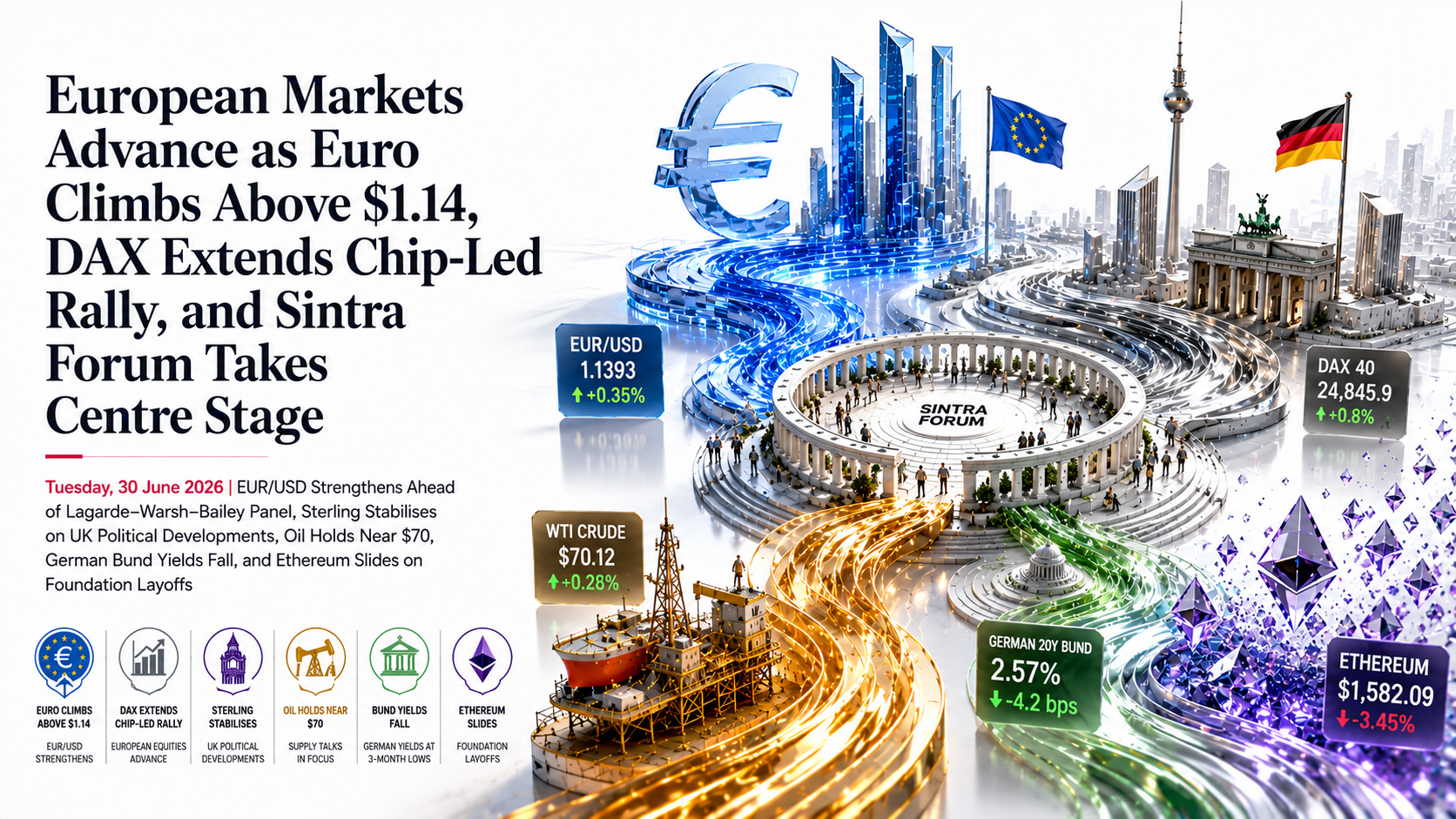
As of mid-morning trade, with the European session live and the final cash session of the second quarter still unfolding, the dollar is on the back foot with the ECB’s Sintra Forum already underway and the quarter-end tape splits cleanly in two: the euro is firm above $1.14 and European equities are tracking toward a strong quarter on a chip rebound, even as crude heads for its worst quarter since 2020.
The euro is holding above $1.14, trading near 1.1388 for a third consecutive session, as broad-based dollar weakness rather than any fresh eurozone catalyst keeps it supported even as it sits toward the lower end of its 2026 range. The ECB’s annual Forum on Central Banking in Sintra, Portugal opened Monday with Lagarde striking a notably conventional tone, telling delegates the central bank no longer needs unconventional instruments or complex forward guidance — commentary markets read as quietly confident rather than overtly dovish. The real test comes Wednesday, when Lagarde shares a panel with Fed Chair Kevin Warsh and Bank of England Governor Andrew Bailey, an unusually concentrated gathering of monetary-policy firepower that traders are positioning around on the last day of the quarter.
European equities are the brighter half of that split, tracking toward a strong quarter and led through the morning by a chip rebound. Germany’s DAX is up about 0.8% near 24,824, building on Monday’s 24,627 close, as semiconductor names lead the move — ASML is up roughly 3.2%, BE Semiconductors around 2% and ASMI about 1.4% — while the pan-European Stoxx 600 adds around 0.6% near 636, with mining stocks up some 2% and industrial goods around 1.4%. The advance is not uniform: luxury heavyweights LVMH, Richemont, Hermes and Burberry are trading 1–2% lower, a reminder that the rebound is concentrated in cyclicals and chips. The bounce claws back ground lost in a difficult prior week of AI-valuation jitters that hit SAP and Infineon, leaving the index well placed into the Sintra panel even as its heavy technology and auto weighting keeps it exposed to renewed swings in chip sentiment.
Crude is the darker half: WTI near $70.50 is on course for its worst quarter since 2020, down roughly 24%, as US-Iran talks resume Tuesday in Doha and Gulf supply normalises back toward pre-war levels. Elsewhere, sterling has stabilised near $1.3235 as political uncertainty eases — Greater Manchester Mayor Andy Burnham has emerged as the clear frontrunner to succeed Keir Starmer, with Wes Streeting’s endorsement reducing the odds of a drawn-out contest — though June’s composite PMI at a 14-month low of 49.4 complicates the picture. German Bund yields sit near three-month lows ahead of Wednesday’s Sintra panel, while crypto stays under pressure, with Ethereum near $1,582.09 after the Ethereum Foundation’s 20% staff cut and a fifth straight day of spot-ETF outflows. On the policy wire, the European Commission said it will cut its duty-free steel import quota by an average of 47% from 1 July, with out-of-quota imports facing a 50% tariff — a fresh support for European steelmakers as the quarter turns.
European Session Headlines
The stories driving price action across FX, metals, energy, European equities, rates and crypto this morning
German Bund Yields Compress to Three-Month Lows as Markets Position for the Sintra Triple-Header
The standout story beneath the surface of Tuesday’s European session is the steady compression in German Bund yields, with the 10-year benchmark trading around 2.85% — near its lowest level since early March — and the newly-issued 20-year Bund yielding close to 3.08%. The move reflects a combination of softer eurozone data, with German and broader euro-area PMIs both signalling contraction, and reduced conviction that the ECB will deliver more than one additional hike this year following Lagarde’s comments that the central bank “does not need to respond more aggressively” to Middle East-driven inflation risks.
The compression in yields matters disproportionately this week given the unusual concentration of central-bank communication on the calendar: Lagarde, Warsh and Bailey all speak from the same Sintra stage on Wednesday, an event traders are treating as the most significant single catalyst for European rates, the euro and sterling this quarter. A genuinely dovish read from any of the three — particularly Lagarde, given her direct influence over the Bund curve — could extend the yield compression further and add fuel to the euro’s recent recovery; a hawkish surprise from Warsh, by contrast, would likely reverse both moves quickly given how much of the current dollar weakness is priced on continued Fed patience.
European Session Economic Calendar — 30 June 2026
Key releases and events shaping price action across today’s European session and into the week ahead
| Time (CET) | Event | Actual / Expected | Impact | Market Read |
|---|---|---|---|---|
| 🇪🇺Mon (ongoing) | ECB Sintra Forum Opens — Lagarde Curtain-Raiser Speech | “Back to basics,” June hike “justified under every scenario” | 🔴 CRITICAL | Conventional-policy framing read as quietly confident; euro firms broadly |
| 🇪🇺🇺🇸🇬🇧Wed (Sintra) | Lagarde, Fed Chair Warsh and BoE Governor Bailey Joint Panel | Most-watched event of the week for EUR, GBP and European rates | 🔴 CRITICAL | Dovish tilt extends Bund yield compression and euro strength; hawkish surprise reverses both quickly |
| 🇶🇦Tuesday | US & Iran Hold Fresh Talks in Doha | Requested by Iran after weekend Hormuz clashes | 🔴 CRITICAL | Constructive outcome extends oil’s slide and supports risk sentiment; breakdown spikes crude and revives haven flows |
| 🇪🇸Today | Spain EU-Harmonised CPI (June, Final) | 3.6% y/y, unchanged from May, highest since June 2024 | 🟢 MED | Sticky inflation keeps ECB hawks engaged ahead of Wednesday’s panel |
| 🇪🇺This week | German & Euro Area Flash June Inflation | Markets watching for confirmation of moderating trend | 🟢 MED | A soft print reinforces ECB pause bets and Bund yield compression |
| 🇬🇧This week | Labour Party Leadership Contest Developments | Andy Burnham frontrunner; Streeting has endorsed | 🟢 MED | Faster resolution reduces sterling’s political risk premium; gilt-issuance concerns remain the key swing factor |
| 🇺🇸This week | US Labour Market Data & Fed Commentary Following Warsh’s Hawkish Tone | Markets watching for any dovish pushback | 🟢 MED | Softer data or dovish Fed-speak would extend broad dollar weakness, supporting EUR, GBP and crude |
| 🇪🇺This week | German 20-Year Bund Auction Follow-Through | First-ever 20Y syndicated issuance earlier this year | ⚪ LOW | Demand patterns offer an early read on long-end European duration appetite into Wednesday’s Sintra panel |
European Session Trade Ideas — 30 June 2026
Eight structured setups — EUR/USD, GBP/USD, Silver, Crude Oil, DAX 40, EU 20Y Bund, Ethereum, Litecoin — with live prices, levels, and full fundamental and technical analysis

Fundamental Backdrop
EUR/USD is trading near 1.1388, holding above $1.14 for a third straight session from last week’s one-year low close to 1.1330, as broad dollar softness rather than a fresh eurozone catalyst drives the move. The ECB’s Sintra Forum opened Monday with Lagarde striking a measured, conventional-policy tone, telling delegates the central bank no longer needs unconventional instruments and defending June’s 25bp hike as fully justified. Spain’s harmonised CPI held at 3.6% year-on-year in June, its highest since mid-2024, keeping at least one further ECB hike priced this year even as German and euro-area PMIs point to contraction. The pair’s next major catalyst is Wednesday’s joint Lagarde-Warsh-Bailey panel, the most concentrated policy-signal event of the quarter.
Technical Outlook
The pair remains in a near-term recovery within a longer corrective structure, having fallen more than 2% over the past month before this week’s bounce. Resistance: 1.1445 (last week’s high) and 1.1480 (target, near the early-June consolidation shelf). Support: 1.1340 (preferred buy-dip level, near the recent breakout base) and 1.1265 (stop, below last week’s low). The setup favours buying pullbacks while the dollar stays on the defensive into Wednesday’s Sintra panel, though a genuinely hawkish read from Fed Chair Warsh on Wednesday would likely cap upside quickly given how much of the current move is a dollar story rather than a euro one.
Session Catalysts
Watch for: (1) Wednesday’s Lagarde-Warsh-Bailey Sintra panel, the dominant binary catalyst of the week; (2) German and euro-area flash June inflation data; (3) US labour-market releases and any follow-through Fed commentary; (4) the Doha talks outcome and its read-through to broader risk sentiment and the dollar; (5) German Bund yield direction as a proxy for ECB rate-path repricing.

Fundamental Backdrop
GBP/USD is trading near 1.3235, steadying after touching its weakest level since November last week, as markets digest a fast-moving Labour leadership contest alongside broad dollar softness. Greater Manchester Mayor Andy Burnham has emerged as the clear frontrunner to replace Keir Starmer, with former health secretary Wes Streeting’s endorsement reducing the risk of a prolonged and destabilising contest. The political clarity is a net positive for sterling, but it is partly offset by weak domestic data: June’s flash composite PMI fell to a 14-month low of 49.4, signalling a second straight month of UK private-sector contraction, while rising input costs continue to complicate the Bank of England’s policy calculus ahead of Bailey’s Wednesday Sintra appearance.
Technical Outlook
The pair remains in a broader downtrend from its January high near 1.38, though the past two sessions show tentative stabilisation. Resistance: 1.3270 (recent consolidation high) and 1.3380 (target, near the early-June shelf). Support: 1.3120 (preferred buy-dip level) and 1.3030 (stop, below the recent seven-month low). The setup favours cautious dip-buying as political risk recedes, but a credible signal of higher gilt issuance to fund a Burnham government’s spending agenda would reintroduce a fiscal risk premium that could quickly cap any sterling recovery.
Session Catalysts
Watch for: (1) further developments in the Labour leadership race and any concrete fiscal-policy signals from Burnham’s camp; (2) Wednesday’s Bailey appearance alongside Lagarde and Warsh at Sintra; (3) UK gilt-market reaction and issuance headlines; (4) the broader dollar index and US data flow; (5) any fresh UK PMI or confidence revisions later in the week.

Fundamental Backdrop
Silver is trading near $58.69, off about 1.7% on the session as a softer gold (down ~1.6% near $4,029) drags the complex lower, extending a sharp correction from its 2026 high close to $79 reached in May, with year-to-date losses now exceeding 18%. The pullback reflects the partial unwinding of the safe-haven premium built up during the Iran conflict, as the fragile Hormuz truce reduces near-term geopolitical tail risk, alongside continued dollar resilience that has kept dollar-denominated metals under pressure. The Gold/Silver ratio remains elevated near 69.6, signalling silver underperforming gold even within the broader metals pullback, consistent with silver’s larger industrial-demand sensitivity to a softer global growth outlook.
Technical Outlook
Silver remains in a near-term downtrend within a much larger multi-year bull structure, still up substantially over the past 12 months despite the recent slide. Resistance: $61.50 (preferred sell-rally level, near the recent breakdown shelf) and $64.00 (stop, near last week’s local high). Support: $57.45 (today’s session low) and $54.50 (target, a measured-move extension). Barchart’s technical model currently rates silver a Strong Sell on a weakening short-term trend, favouring continued fading of rallies while the dollar stays firm into Wednesday’s Sintra panel, though any dovish surprise from the Wednesday central-bank panel could trigger a sharp short-covering bounce.
Session Catalysts
Watch for: (1) the dollar index and any dovish pushback from Wednesday’s Sintra panel; (2) the Doha talks outcome and its effect on the residual geopolitical risk premium; (3) the Gold/Silver ratio for relative-strength signals; (4) industrial-demand data out of China and Europe; (5) broader risk sentiment spillover from European equities.

Fundamental Backdrop
WTI crude is trading near $70.50, paring Monday’s gains and on track for a quarterly loss of about 24% — its worst quarter since 2020 — as US-Iran de-escalation and normalising Gulf supply roll prices back toward pre-war levels. The latest move follows a weekend escalation near the Strait of Hormuz that had seen US forces strike ten Iranian military targets in retaliation for a drone attack on a commercial tanker. Iran has requested fresh talks in Doha for Tuesday, with both sides said to be continuing technical discussions on a broader memorandum of understanding. ING strategists flagged that the market’s apparent complacency about a swift Gulf supply recovery “leaves significant upside risk” should the recovery in shipping and exports prove slower than expected, or should fresh clashes erupt before a durable agreement is reached.
Technical Outlook
Crude remains range-bound between roughly $69 and $73 as the market processes the still-unresolved Hormuz situation, well off its conflict-era highs above $120 and also below the $90-plus levels seen as recently as late May. Resistance: $73.50 (preferred sell-rally level, near recent consolidation) and $76.50 (stop, above last month’s bounce high). Support: $69.00 (psychological level/recent low) and $66.50 (target, a measured-move extension). The setup favours fading rallies on truce-driven relief while supply normalisation continues, but traders should size positions conservatively given the binary, headline-driven nature of the Doha talks.
Session Catalysts
Watch for: (1) Tuesday’s Doha talks, the dominant binary catalyst for the session; (2) any fresh reports of strikes, drone activity or shipping disruption near Hormuz; (3) Gulf producer export and tanker-loading data, including Saudi Arabia’s Ras Tanura ramp-up; (4) the dollar index, given crude’s inverse dollar sensitivity; (5) US inventory data later in the week.

Fundamental Backdrop
The DAX 40 is up around 0.8% near 24,824, building on Monday’s close at 24,627, as European semiconductor names including ASML, BE Semiconductors and ASMI lead a continent-wide chip-sector rebound that is also lifting the broader Stoxx 600 roughly 0.6%. The recovery follows a difficult prior week in which the index fell 1.29%, driven by a global reassessment of AI-related valuations that hit SAP and Infineon alongside a BaFin accounting investigation into Zalando. Monday’s session also saw sharp single-stock moves, with Heidelberg Materials plunging 9.1% on cut revenue forecasts and Deutsche Post falling 5% on accelerated Telekom-T-Mobile merger reports, while defense names Rheinmetall and Hensoldt continued to outperform.
Technical Outlook
The DAX remains in a powerful longer-term uptrend, up roughly 4.5% over the past year despite the recent pullback from January’s all-time high near 25,508. Resistance: 25,000 (psychological round number, also Friday’s relief-rally area) and 25,300 (target, within the 25,000–25,500 zone that capped the index during the earlier Iran-deal relief rally). Support: 24,400 (preferred buy-dip level, near the prior week’s consolidation) and 24,000 (stop, below the recent swing low). The setup favours buying dips while chip-sector sentiment stabilises and Sintra optimism persists, though the index’s heavy technology and auto-sector weighting leaves it more exposed than peers to renewed AI-valuation jitters or USMCA-related trade headlines in July.
Session Catalysts
Watch for: (1) Wednesday’s Lagarde-Warsh-Bailey Sintra panel and its read-through to European rate expectations; (2) follow-through in US and European semiconductor sentiment; (3) further developments in the Zalando BaFin investigation and Heidelberg Materials’ guidance; (4) German Bund yields as a proxy for the domestic rate backdrop; (5) the Doha talks outcome, given Germany’s exposure as a major energy importer.

Fundamental Backdrop
The German 20-year Bund yield is trading near 3.08%, with the more closely watched 10-year benchmark around 2.85%, close to its lowest level since early March, as soft eurozone data and a measured tone from Lagarde reduce conviction that the ECB will deliver more than one additional 25bp hike this year. Germany issued its first-ever 20-year federal bond via syndication earlier in 2026, a new addition to the Bund curve that the Finance Agency expects to grow into a meaningfully traded long-end benchmark. Preliminary PMI data showing German private-sector activity contracting at its fastest pace since 2024, alongside broader euro-area weakness, has reinforced the disinflationary narrative even as Spain’s harmonised CPI held at a two-year high of 3.6%.
Technical Outlook
Long-end European yields remain in a multi-week downtrend (price uptrend) as growth concerns outweigh sticky inflation prints in select member states. Resistance (yield): 3.20% (preferred fade level, near the recent consolidation high) and 3.32% (stop). Support (yield): 3.00% (psychological level) and 2.95% (target, a measured-move extension toward the multi-month low). The setup favours fading yield spikes — i.e., buying Bund price dips — while the disinflationary growth narrative persists into Wednesday’s Sintra panel, though a hawkish surprise from Lagarde on Wednesday or a sharply above-consensus eurozone inflation print would quickly reverse the compression trend.
Session Catalysts
Watch for: (1) Wednesday’s Lagarde-Warsh-Bailey Sintra panel, the dominant catalyst for the long end of the European curve; (2) German and euro-area flash June inflation data; (3) any signal on the pace of future 20-year Bund issuance and investor demand; (4) US Treasury yield direction as a global duration cross-current; (5) broader risk sentiment, given Bunds’ haven-asset behaviour around the Doha talks.
Fundamental Backdrop
Ethereum is trading in the $1,582.09–$1,617 range, down nearly 37% over the past 12 months, after the Ethereum Foundation announced it is cutting 54 employees — around 20% of its workforce — and reducing its operating budget by 40% in a major restructuring disclosed late last week. Spot Ether ETFs have recorded approximately $274 million in net outflows over five consecutive sessions with zero positive-flow days, while the Crypto Fear & Greed Index sits at just 13, deep in “Extreme Fear” territory. On the more constructive side, BitMine added a further 27,084 ETH to its treasury, bringing its holding to roughly 5.7 million ETH, or about 4.7% of total supply, and was added to the Russell 1000 index — a sign that some institutional accumulation continues despite the broader bearish tape.
Technical Outlook
The technical picture remains unambiguously bearish on trend, with both the 50-day and 200-day moving averages sloping down and price trading well below the 20-day EMA near $1,708. The 14-day RSI sits near 29, in oversold territory, a pattern that has historically preceded sharp but short-lived relief bounces even within larger downtrends. Resistance: $1,710 (preferred sell-rally level, at the 20-day EMA) and $1,870 (stop, near the 50-day EMA). Support: $1,500–$1,512 (key near-term support zone) and $1,400 (target, a breakdown extension). The setup favours fading rallies into resistance rather than chasing the current weakness given how stretched the oversold reading already is.
Session Catalysts
Watch for: (1) further detail on the Ethereum Foundation’s restructuring and its effect on developer-ecosystem sentiment; (2) daily spot ETF flow data for signs of stabilisation; (3) Bitcoin’s price action and broader crypto risk appetite, given BTC’s recent 7%+ weekly decline; (4) institutional treasury accumulation trends following BitMine’s latest purchase; (5) the dollar index, given crypto’s recent sensitivity to DXY strength.

Fundamental Backdrop
Litecoin is trading near $41.41, down roughly 51% over the past 12 months and sitting close to its 52-week low of $39.34, as broad altcoin weakness compounds a difficult year for the token. The decline tracks the wider “Extreme Fear” regime gripping crypto markets following Bitcoin’s recent 7%+ weekly drop, alongside the same dollar-strength and risk-off dynamics weighing on Ethereum. On the more constructive side, Litecoin’s ecosystem has continued to see incremental development activity, including ongoing LTCVM testnet progress and continued institutional usage as Coinbase loan collateral, though neither has been sufficient to offset the broader macro-driven selling pressure.
Technical Outlook
The technical picture is unambiguously bearish across daily and weekly timeframes: the 50-day moving average is falling and sits above price, while the 200-day moving average has been falling since late May, confirming a sustained downtrend. The 14-day RSI sits near 22, deep oversold territory that increases the probability of a sharp but likely short-lived relief bounce. Resistance: $48.05 (today’s classical pivot point, also the preferred sell-rally level) and $52.30 (stop, near the next resistance band). Support: $41.11 (strongest near-term support) and $39.50 (target, just above the 52-week low). The setup favours fading relief rallies rather than chasing the current weakness given how extended the oversold condition already is.
Session Catalysts
Watch for: (1) Bitcoin’s stabilisation and broader crypto risk appetite following its recent sharp weekly decline; (2) further updates on LTCVM testnet and broader ecosystem development progress; (3) LTC/BTC relative strength, a key indicator the bearish thesis would need to invalidate; (4) the dollar index, given crypto’s recent sensitivity to DXY strength; (5) any fresh institutional accumulation or custody/collateral-usage headlines.
Key Questions for the European Session
Detailed answers to Tuesday’s most important analytical questions
European Session Summary — Tuesday, 30 June 2026
Tuesday’s European session trades the final day of the second quarter with the dollar on the back foot into the week’s most consequential central-banking event, the ECB’s Sintra Forum, where Lagarde’s measured “back to basics” message has set the tone ahead of Wednesday’s pivotal joint panel with Fed Chair Warsh and BoE Governor Bailey. The quarter-end tape splits cleanly: WTI crude near $70.50 is closing its worst quarter since 2020, down roughly 24%, as Doha talks resume, while European equities wrap a strong quarter with the DAX up about 0.8% near 24,824 on a chip rebound. The euro and German Bund market remain the session’s clearest structural stories, with EUR/USD holding above $1.14 near 1.1388 and 10-year Bund yields compressing toward three-month lows as markets position for Wednesday’s catalyst. Highest-conviction macro: EUR/USD buy dips toward 1.1340, stop 1.1265, target 1.1480 — the dollar-weakness setup remains the cleanest structural trade of the session, with Wednesday’s Sintra panel the key swing factor.
For the individual instruments: GBP/USD buy dips toward 1.3120, stop 1.3030, target 1.3380 — easing political risk from the Burnham leadership bid is offset by weak UK PMI data. Silver sell rallies toward $61.50, stop $64.00, target $54.50 — fading safe-haven demand and dollar resilience dominate the near-term tape. Crude oil sell rallies toward $73.50, stop $76.50, target $66.50 — Tuesday’s Doha talks are the dominant binary catalyst. DAX 40 buy dips toward 24,400, stop 24,000, target 25,300 — chipmakers lead the rebound, but auto-sector and AI-valuation risk linger. EU 20Y Bund fade yield spikes toward 3.20%, stop 3.32%, target 2.95% — soft eurozone data and Lagarde’s tone favour continued yield compression into Wednesday’s Sintra panel. Ethereum sell rallies toward $1,710, stop $1,870, target $1,400 — Foundation restructuring and persistent ETF outflows dominate, with RSI near 29 deeply oversold. Litecoin sell rallies toward $48.05, stop $52.30, target $39.50 — sitting near 52-week lows with RSI near 22, among the most oversold levels of any major token. The decisive variable into Wednesday’s Lagarde-Warsh-Bailey Sintra panel and Tuesday’s Doha talks remains the durability of both the Hormuz truce and the current disinflationary, ECB-pause narrative against a still-fragile geopolitical backdrop. Size positions accordingly.
Access Live European Markets →