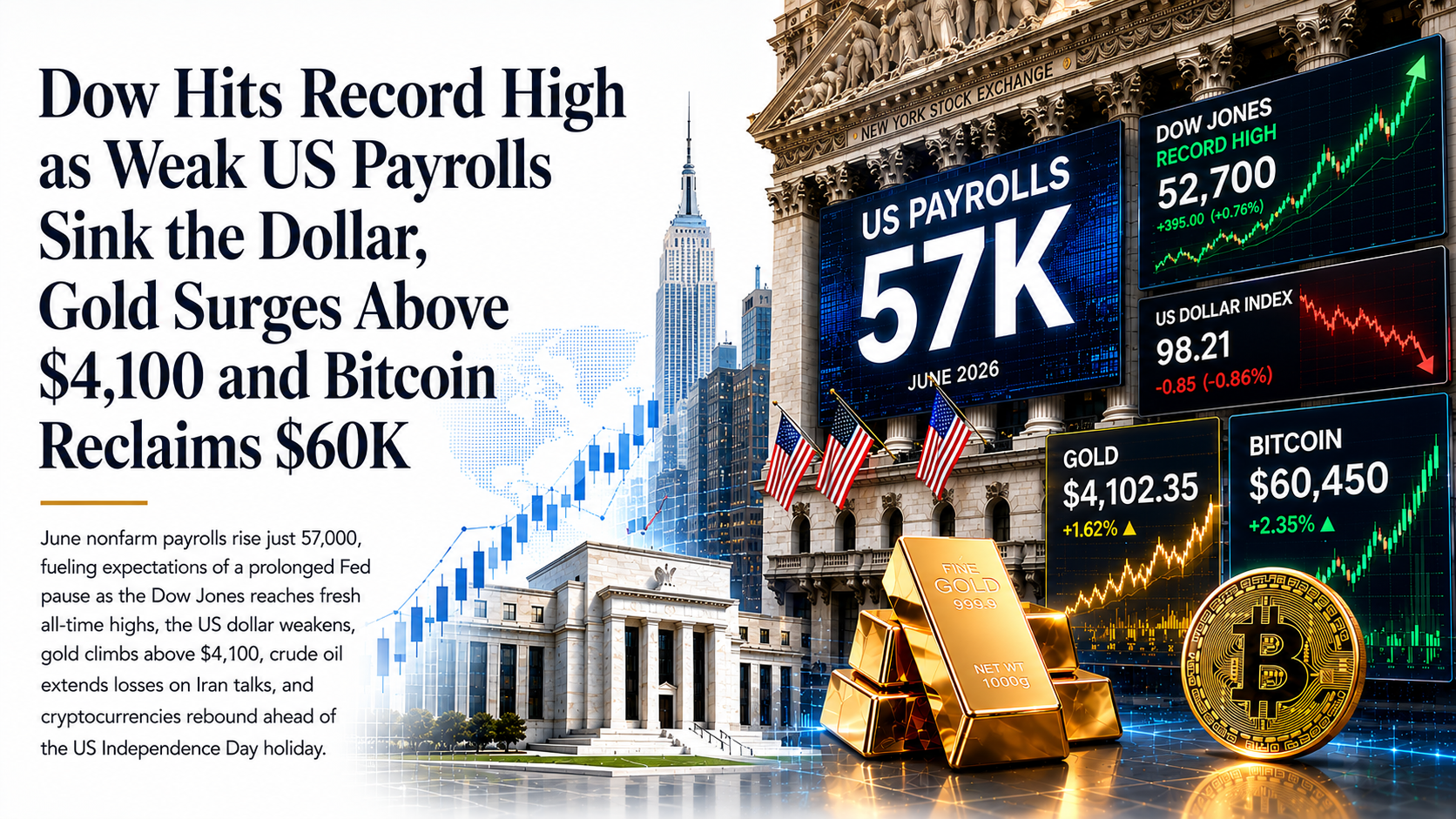
Dow Hits Record High as Weak June Payrolls (+57K) Slam the Dollar, Gold Tops $4,100, Bitcoin Reclaims $60K | Technical Analysis US Session | 2 July 2026
Dow Hits Record High as Weak June Payrolls (+57K) Slam the Dollar, Gold Tops $4,100, Bitcoin Reclaims $60K | Capital Street FX US Session Technical Analysis · 2 July 2026Skip to main content
Thursday, 2 July 2026 · US Session Technical Analysis
▸ DOW HITS RECORD HIGH · PAYROLLS MISS AT 57K · GOLD TOPS $4,100 · BITCOIN RECLAIMS $60K
Dow Jones Rallies to a Record High and the Dollar Slides After June Payrolls Grow Just 57,000, While Gold Surges Past $4,100 and Bitcoin Reclaims $60,000 Ahead of Friday’s Independence Day Closure
USD/CAD ~1.4165 ▼ sliding from the day’s high near 1.4220 as a broadly softer dollar follows a much weaker than expected June jobs report · USD/CHF ~0.8045 ▼ the franc firms as safe-haven and rate-differential flows turn against the dollar · Gold ~$4,094 ▲ up roughly 1.6% and briefly topping $4,100 as soft payrolls slash near-term Fed hike bets · WTI Crude ~$67.60 ▼ extending a third straight losing session as US-Iran talks in Doha progress · Dow Jones ~52,700 ▲ up roughly 395 points and printing a fresh record intraday high as markets cheer the payrolls miss · Walmart (WMT) ~$109.60 ▲ stabilizing modestly after Wednesday’s near-4% tariff-and-recall-driven slide · US 30-Year Yield ~4.94% ▼ easing as the weak jobs data tempers near-term rate-hike expectations · Bitcoin ~$60,400 ▲ reclaiming the $60,000 handle as risk appetite improves on the softer dollar · Solana ~$78.50 ▲ outperforming the broader crypto market, up roughly 5% on the session
Analyst: Capital Street FX Research Desk·Session: New York · Thursday, 2 July 2026 · LIVE·DEVELOPING: The US Bureau of Labor Statistics reported that June nonfarm payrolls rose by a seasonally adjusted 57,000, well short of the 115,000 Dow Jones consensus estimate and down sharply from May’s downwardly revised 129,000 gain, while combined April–May revisions cut a further 74,000 jobs from prior estimates. The unemployment rate, however, unexpectedly eased to 4.2% from 4.3%, and average hourly earnings rose 0.3% on the month. The report — released a day early because Friday, 3 July, is a US market holiday for Independence Day — has been read as a “soft landing, not a slowdown” print: weak enough to take pressure off the Federal Reserve to hike, but not so weak as to trigger recession fears. Treasury yields fell at the short end while the Dow Jones Industrial Average surged to a fresh record intraday high, up roughly 395 points. The US Dollar Index has slid broadly, lifting Gold back above $4,100 and pulling USD/CAD and USD/CHF off their pre-data highs. WTI Crude Oil continues to slide on reports that US envoys Jared Kushner and Steve Witkoff are making progress with Iran in Doha over Strait of Hormuz shipping. Walmart shares are stabilizing after Wednesday’s near-4% drop tied to tariff-cost warnings and a nationwide potato-chip recall, while Bitcoin has reclaimed $60,000 and Solana is outperforming the broader crypto tape, up roughly 5% on the day.
US Session Overview
Wall Street opens Thursday’s early-release jobs day with a genuine surprise: June payrolls grew by just 57,000 against a 115,000 consensus, yet the Dow Jones has stormed to a record high as traders read the miss as exactly the kind of labor-market cooling the Fed needs to stay on hold, even as the dollar slides, gold tops $4,100, and crypto markets extend their rebound — all ahead of Friday’s Independence Day market closure.
June’s Employment Situation report landed well below expectations: total nonfarm payrolls rose by 57,000, roughly half the 115,000 economists had penciled in, while the unemployment rate ticked down to 4.2% from 4.3%, confounding forecasts for it to hold steady. April and May were both revised sharply lower — April cut to +148,000 from +179,000, and May cut to +129,000 from +172,000 — removing a combined 74,000 jobs from the prior two months. Leisure and hospitality shed 61,000 positions, while professional and business services, social assistance, and health care continued to add jobs. Average hourly earnings rose 0.3% on the month and 3.5% over the year, broadly in line with expectations. The combination of a soft headline print, a falling jobless rate, and steady wage growth has been read by markets as evidence the Fed can keep policy unchanged rather than a signal of genuine labor-market distress, and the reaction across asset classes has been swift and broadly consistent with that “soft landing, not a slowdown” read.
In FX, the broadly softer US Dollar has pulled USD/CAD down toward 1.4165 from an earlier session high near 1.4220, even as the Canadian Dollar itself remains near one-year lows against a basket of G10 currencies after the Bank of Canada held its policy rate at 2.25% last week. USD/CHF has eased to around 0.8045 as the safe-haven Franc, still recovering from a one-year low near 0.8135 hit in late June, draws support from the reduced odds of near-term Fed tightening. In commodities, Gold has surged roughly 1.6% to around $4,094, briefly topping $4,100 intraday, as the weak payrolls print sharply cut the market-implied odds of a Fed hike by September from over 60% earlier in the week. WTI Crude Oil has extended its slide to around $67.60 a barrel, its third straight losing session, as negotiators Jared Kushner and Steve Witkoff report constructive progress with Iran in Doha over shipping through the Strait of Hormuz, adding a bearish supply overlay on top of the demand-side reaction to the jobs data. On Wall Street, the Dow Jones Industrial Average has rallied roughly 395 points, or about 0.7%, to a fresh record intraday high near 52,700, while Walmart (WMT) shares are stabilizing near $109.60 after Wednesday’s near-4% slide, which was driven by CEO comments on rising tariff-related costs, a nationwide recall of roughly 700,000 bags of potato chips, and broader concerns about a tariff-and-oil-price squeeze on lower-income consumers. The US 30-Year Treasury yield has eased to around 4.94% as the soft jobs data reduces the odds of further near-term Fed tightening, even as the long end remains anchored by persistent fiscal-deficit concerns. In crypto, Bitcoin has reclaimed the $60,000 handle, rebounding from Wednesday’s low near $57,950 — its lowest level in more than 21 months — on the back of the softer-dollar, lower-rate-odds backdrop, while Solana is outperforming the broader market, up roughly 5% on the session, extending its recent run of relative strength versus Bitcoin and Ethereum. With US markets closed Friday for Independence Day, today’s reaction is likely to carry through an extended weekend before traders get a chance to reassess on Monday.
Top Stories
US Session Headlines
The stories driving price action across FX, equities, metals, energy and crypto this session
🔴 Critical
June Payrolls Rise Just 57,000, Miles Below the 115,000 Consensus
Nonfarm payrolls badly missed forecasts even as the unemployment rate unexpectedly eased to 4.2%; April and May were revised down a combined 74,000, and leisure and hospitality shed 61,000 jobs.
Labor Market
🟢 High
Dow Jones Surges to a Fresh Record High, Up Roughly 395 Points
Equities read the payrolls miss as dovish rather than recessionary, sending the Dow to a new intraday all-time high near 52,700 as the S&P 500 and Nasdaq both advance roughly 0.7%.
Equities
🟢 High
Gold Tops $4,100 as Fed Hike Odds Are Slashed
Bullion has jumped roughly 1.6% on the session as the softer-than-expected jobs report cuts market-implied odds of a September Fed rate hike, with silver also up nearly 2% near $60.20.
Metals
🟢 High
Crude Oil Extends Third Straight Losing Session on Iran Progress
WTI has slipped toward $67.60 a barrel as US envoys report constructive progress with Iran in Doha over Strait of Hormuz shipping, adding a supply-side overlay to today’s demand-side dollar weakness.
Energy
🟢 Medium
Walmart Stabilizes Near $109.60 After Wednesday’s Near-4% Tariff-Driven Slide
Shares are finding a modest bid alongside the broader market rally, but remain pressured after CEO commentary on rising tariff costs and a nationwide potato-chip recall triggered Wednesday’s sharp drop.
Equities
🟢 Medium
Bitcoin Reclaims $60,000 as Solana Outperforms, Up Roughly 5%
Crypto majors are extending their rebound off multi-month lows as the softer dollar and reduced Fed hike odds improve risk appetite, with Solana leading gains among large-cap tokens.
Crypto
Section 1 · Economic Calendar
US Session Economic Calendar — 2 July 2026
Key releases and events shaping price action across today’s US session ahead of Friday’s market holiday
US session economic calendar for Thursday, 2 July 2026, listing scheduled times, events, expectations, impact rating and market read
Time (ET)
Event
Actual / Expected
Impact
Market Read
🇺🇸8:30am
US Nonfarm Payrolls (June) — Early Release
+57,000 vs. +115,000 expected; unemployment 4.2% vs. 4.3% expected
🔴 CRITICAL
Sharp miss on jobs growth, but falling jobless rate reads as soft-landing, not slowdown
🇺🇸8:30am
Average Hourly Earnings (June)
+0.3% m/m, +3.5% y/y, broadly as expected
🟢 MED
Wage growth steady, doesn’t add to inflation concerns
🇺🇸Ongoing
US-Iran Indirect Talks Continue in Doha
Kushner and Witkoff report constructive progress on Strait of Hormuz shipping
🔴 CRITICAL
Weighing on crude oil, easing broader inflation-risk premium
🇺🇸10:00am
ISM Services PMI (June)
Watched for confirmation of labor-market cooling signaled by payrolls
🟢 MED
Secondary catalyst, session focus remains on the payrolls reaction
🇺🇸1:00pm
US Bond Market Early Close (Independence Day Eve)
Bond market closes early at 2:00pm ET; equities trade a full session
🟢 MED
Thinner afternoon liquidity may exaggerate late-session moves
🇺🇸All Day
US Markets Closed Friday for Independence Day
Full market closure 3 July 2026
🔴 CRITICAL
Today’s reaction must carry positioning through an extended weekend
Section 2 · Trade Ideas
US Session Trade Ideas — 2 July 2026
Nine structured setups — USD/CAD, USD/CHF, Gold, Crude Oil, Dow Jones, Walmart (WMT), US 30Y, Bitcoin, Solana — with updated prices, levels, and full fundamental and technical analysis
USD/CAD
FX · ~1.4165 — Sliding Off the Day’s High as a Broadly Softer Dollar Follows the Payrolls Miss
1.4172
▼ down roughly 0.3% on the session (Investing.com live), pulling back from an earlier high near 1.4220
▸ NEUTRAL-TO-BEARISH USD/CAD — Sell Rallies Toward 1.4230 as the Softer Dollar Impulse Dominates, Though a Weak CAD Backdrop Limits the Downside
Sell Rally1.4230
Stop Loss1.4270
Take Profit1.4080
USD/CAD · Daily · MA Ribbon & Fibonacci Retracement
Fundamental Backdrop
USD/CAD has slipped to around 1.4165 after trading as high as 1.4220 earlier in the session, as the broadly softer US Dollar following the weak June payrolls report outweighs a Canadian Dollar backdrop that remains structurally soft. The Loonie touched a one-year low near 1.4250 in late June after the Bank of Canada held its policy rate at 2.25% and flagged risks on both sides of its mandate, while core Canadian inflation has stayed close to the BoC’s 2% target. Today’s US jobs miss reduces near-term Fed hike odds, providing a genuine, if likely temporary, headwind for the pair even as the broader multi-month uptrend in USD/CAD remains intact.
Technical Outlook
USD/CAD remains in a well-defined uptrend on the daily chart, trading above both its 50-day and 200-day moving averages, with today’s pullback fitting the pattern of a dollar-wide correction within that broader trend rather than a reversal. Resistance: 1.4230 (preferred sell-rally level, near today’s high) and 1.4270 (stop, above the late-June one-year high near 1.4250). Support: 1.4120 (near-term floor) and 1.4080 (target, next extension on a confirmed pullback). A decisive break below 1.4080 would open the way toward the 1.4000 handle.
Session Catalysts
Watch for: (1) any further US Dollar Index follow-through after the payrolls miss; (2) US 10-year and 2-year Treasury yield direction; (3) crude oil price action, given Canada’s status as a major oil exporter; (4) thinner afternoon liquidity ahead of tomorrow’s US market holiday; (5) any fresh Bank of Canada commentary.
USD/CHF
FX · ~0.8045 — Franc Firms as the Dollar Retreats Broadly on the Jobs Miss
~0.8045
▼ down roughly 0.5% on the session, pulling back from a pre-data level near 0.8090
▸ BEARISH USD/CHF (SHORT-TERM) — Sell Rallies Toward 0.8090 as the Softer-Dollar, Lower-Rate-Odds Backdrop Favors the Franc
Sell Rally0.8090
Stop Loss0.8125
Take Profit0.7990
USD/CHF · Daily · MA Ribbon & Fibonacci Retracement
Fundamental Backdrop
USD/CHF has eased to around 0.8045 from roughly 0.8090 ahead of today’s jobs data, as the Swiss Franc — still broadly favored as a safe haven — draws support from the reduced odds of near-term Fed tightening following the weak payrolls print. The pair had rallied for two straight sessions into Wednesday on hawkish Fed positioning and elevated geopolitical risk premia tied to the ongoing US-Iran standoff, with the Swiss National Bank having held its policy rate at 0% for a fourth consecutive meeting in June while flagging a willingness to intervene in FX markets if needed. Today’s softer US Dollar impulse is a genuine near-term headwind for the pair, though the SNB’s zero-rate policy continues to cap the Franc’s structural appeal versus higher-yielding currencies.
Technical Outlook
USD/CHF remains in a bullish structure on the daily chart after last week’s breakout above the 0.8030 resistance zone, with today’s pullback testing that former resistance as new support. Resistance: 0.8090 (preferred sell-rally level, near the pre-data high) and 0.8125 (stop, above the late-June one-year low for the Franc). Support: 0.8030 (the broken resistance-turned-support zone) and 0.7990 (target, psychological level on a confirmed breakdown). A reclaim of 0.8125 would reassert the broader uptrend and threaten a retest of the June high near 0.8135.
Session Catalysts
Watch for: (1) continued US Dollar Index reaction to the payrolls miss; (2) any fresh SNB intervention rhetoric; (3) broader risk sentiment, given the Franc’s safe-haven status; (4) US Treasury yield direction; (5) Friday’s reduced liquidity ahead of the US holiday.
Gold (XAU/USD)
Metals · ~$4,094 — Surging Back Above $4,100 as Weak Payrolls Slash Fed Hike Bets
~$4,094
▲ up roughly 1.6% on the session, briefly topping $4,100 intraday
▸ BULLISH GOLD (SHORT-TERM) — Buy Dips Toward $4,050 as Reduced Fed Hike Odds Provide a Genuine Tailwind
Buy Dip$4,050
Stop Loss$4,000
Take Profit$4,180
Gold (XAU/USD) · Daily · MA Ribbon & Fibonacci Retracement
Fundamental Backdrop
Gold has jumped roughly 1.6% to around $4,094, briefly topping $4,100 intraday, after June nonfarm payrolls rose by just 57,000 versus the 115,000 consensus, sharply reducing the market-implied probability of a Federal Reserve rate hike by September from over 60% earlier in the week. The metal had already closed higher at $4,029.89 on Wednesday after Fed Chair Kevin Warsh said at the ECB’s Sintra Forum that inflation expectations and risks have eased in recent weeks, even as he reiterated the central bank’s commitment to its 2% inflation target. Silver has similarly rallied roughly 1.8% to around $60.20, extending its own rebound off this week’s seven-month low.
Technical Outlook
Gold has decisively reclaimed the $4,000 psychological level and is testing the upper end of its recent multi-week consolidation range following today’s payrolls-driven surge. Resistance: $4,110 (near-term ceiling, today’s intraday high) and $4,180 (target, next extension if the rally extends). Support: $4,050 (preferred buy-dip level, near the pre-NFP consolidation zone) and $4,000 (stop, below the psychological round number). A sustained close above $4,180 would open the way toward a retest of the $4,250 area, while a reversal below $4,000 would suggest today’s move was a payrolls-driven spike rather than a genuine trend shift.
Session Catalysts
Watch for: (1) any further US Dollar Index weakness extending today’s move; (2) US Treasury real-yield direction, particularly at the front end; (3) ISM Services PMI later in the session; (4) any fresh Fed commentary on the rate path; (5) thinner holiday-week liquidity into Friday’s closure.
Crude Oil (WTI)
Energy · ~$67.60 — Extending a Third Straight Losing Session on US-Iran Progress
~$67.60
▼ down roughly 1.2% on the session, extending Wednesday’s slide below $69
▸ BEARISH CRUDE OIL — Sell Rallies Toward $69.00 as Iran Talks Progress and a Supply Glut Persists
WTI Crude Oil has extended its slide to around $67.60 a barrel, its lowest level since late February and a third consecutive losing session, as US negotiators Jared Kushner and Steve Witkoff report constructive progress with Iran in indirect talks held in Doha, with technical discussions advancing over reopening the Strait of Hormuz to normal shipping traffic. Iran has reportedly shipped more than 40 million barrels of oil since a US naval blockade was lifted, while record-breaking Russian exports have added to a growing buildup of seaborne inventory. Today’s weak payrolls print adds a secondary, demand-side bearish overlay, as a cooling US labor market raises modest concerns about the pace of future oil demand growth.
Technical Outlook
Crude oil remains in a well-defined downtrend on the daily chart, having broken decisively below the $69 support zone that had held for much of the second quarter. Resistance: $69.00 (preferred sell-rally level, near the broken support-turned-resistance) and $70.20 (stop, above this week’s brief bounce high). Support: $65.50 (target, next round-number extension) and the 52-week low near $54.98 remaining the structural floor. A confirmed Strait of Hormuz shipping resolution would likely accelerate the downside break toward $65.50 and beyond.
Session Catalysts
Watch for: (1) any formal confirmation or breakdown in the Doha talks; (2) Strait of Hormuz tanker-traffic data; (3) weekly EIA inventory figures; (4) broader US Dollar direction, given oil’s inverse dollar correlation; (5) OPEC+ commentary on production policy.
Dow Jones Industrial Average
Index · ~52,700 — Surging to a Fresh Record High as Markets Cheer the Payrolls Miss
~52,700
▲ up roughly 395 points, or 0.7%, printing a new record intraday high
▸ BULLISH DOW JONES — Buy Dips Toward 52,400 as the “Soft Landing” Read on Payrolls Fuels Fresh Record Highs
Buy Dip52,400
Stop Loss51,900
Take Profit53,200
Dow Jones Industrial Average · Daily · MA Ribbon & Fibonacci Retracement
Fundamental Backdrop
The Dow Jones Industrial Average has surged roughly 395 points, or about 0.7%, to a fresh record intraday high near 52,700, as investors read June’s weak payrolls print — just 57,000 jobs added versus 115,000 expected — as reducing pressure on the Fed to hike rates without signaling genuine economic distress, particularly given the unemployment rate’s unexpected decline to 4.2%. The S&P 500 and Nasdaq Composite are both up roughly 0.7% in sympathy. The rally extends a broadly strong first half of 2026, in which the Dow gained 8.9% — its best first-half performance since 2021 — with a “Great Rotation” theme seeing inflows shift from richly valued technology names into the index’s more defensive, blue-chip constituents.
Technical Outlook
The Dow remains in a powerful uptrend on the daily chart, with today’s record breakout confirming continued bullish momentum after Wednesday’s brief pullback from an intraday high near 52,743. Resistance: 52,900 (near-term ceiling, today’s fresh high) and 53,200 (target, next round-number extension). Support: 52,400 (preferred buy-dip level, near Wednesday’s close) and 51,900 (stop, below this week’s pullback low). A close back below 51,900 would suggest today’s record breakout requires more consolidation before the next leg higher.
Session Catalysts
Watch for: (1) any late-session profit-taking ahead of the extended holiday weekend; (2) ISM Services PMI; (3) sector rotation flows between technology and value/defensive names; (4) US Treasury yield direction; (5) any fresh Fed commentary reinforcing or challenging today’s dovish read on payrolls.
Walmart Inc. (WMT)
Equities · ~$109.60 — Stabilizing After Wednesday’s Near-4% Tariff-and-Recall-Driven Slide
~$109.60
▲ up roughly 0.7% on the session, a modest bounce after Wednesday’s 3.9% drop to $108.82
▸ NEUTRAL-TO-BEARISH WMT — Sell Rallies Toward $112.50 as Tariff-Cost and Consumer-Squeeze Headwinds Persist
Sell Rally$112.50
Stop Loss$115.00
Take Profit$105.00
Walmart Inc. (WMT) · Daily · MA Ribbon & Fibonacci Retracement
Fundamental Backdrop
Walmart shares are stabilizing near $109.60, up modestly after Wednesday’s roughly 3.9% slide to $108.82, one of the worst performers in the Dow that session alongside Caterpillar. Wednesday’s drop followed renewed investor focus on rising tariff-related costs — with new, potentially higher tariffs under a different statute reportedly expected as soon as July 24 — layered on top of a nationwide recall of nearly 700,000 bags of potato chips and broader concern that elevated oil prices from the US-Iran conflict, combined with tariff pass-through, could squeeze lower- and middle-income consumers who make up a meaningful share of Walmart’s customer base. Even after the pullback, the stock trades at a rich valuation near 38 times earnings, leaving little margin of safety against further negative headlines.
Technical Outlook
WMT has broken down from its multi-week range, with Wednesday’s sharp decline confirming a shift to a more bearish near-term structure after the stock’s strong run earlier in 2026. Resistance: $112.50 (preferred sell-rally level, near the broken support-turned-resistance) and $115.00 (stop, above the pre-selloff consolidation zone). Support: $107.25 (Wednesday’s intraday low) and $105.00 (target, next extension on a confirmed breakdown). A reclaim of $115.00 would ease the near-term bearish bias and suggest Wednesday’s slide was an overreaction rather than the start of a deeper de-rating.
Session Catalysts
Watch for: (1) any additional tariff policy headlines or clarity on the July 24 timeline; (2) further developments in the potato-chip recall and any broader food-safety fallout; (3) broader consumer-discretionary and retail-sector sentiment; (4) crude oil price direction, given its read-through to consumer spending power; (5) analyst commentary following Wednesday’s slide.
▼ down roughly 3bps on the session, off Wednesday’s close near 4.97%
▸ BEARISH YIELD / BULLISH BONDS — Sell Yield Rallies Toward 5.02% as the Payrolls Miss Reduces Near-Term Hike Odds, Though Fiscal Concerns Cap the Downside
Sell Yield Rally5.02%
Stop Loss5.10%
Take Profit4.85%
US 30-Year Treasury Yield · Daily · Fibonacci Retracement
Fundamental Backdrop
The US 30-Year Treasury yield has eased to around 4.94% from Wednesday’s close near 4.97%, as June’s weak payrolls print reduces the near-term odds of a Federal Reserve rate hike, pulling the front end of the curve lower and dragging long-dated yields down alongside it. The move is more muted at the 30-year point than at shorter maturities, however, as persistent US fiscal-deficit concerns and heavy Treasury issuance continue to anchor long-end yields at elevated levels versus their historical range. The 2-year yield fell more sharply on the data, consistent with markets pricing out near-term hike risk more aggressively than they are pricing in any change to the Fed’s longer-run policy stance.
Technical Outlook
The 30-year yield remains in a broad uptrend that has persisted for much of 2026, with today’s pullback fitting the pattern of a data-driven correction within that larger structure rather than a trend reversal. Resistance (in yield terms): 5.02% (preferred sell-yield-rally level, near this week’s high) and 5.10% (stop, above the recent range high). Support (in yield terms): 4.90% (near-term floor) and 4.85% (target, next extension on a confirmed pullback). A sustained move below 4.85% would suggest a more durable shift in the market’s Fed-policy expectations rather than a one-day payrolls reaction.
Session Catalysts
Watch for: (1) any further Fed commentary following today’s data; (2) the early bond-market close at 2:00pm ET ahead of the holiday; (3) ISM Services PMI; (4) ongoing fiscal-deficit and Treasury-issuance headlines; (5) broader risk sentiment, given the inverse relationship between equity strength and safe-haven bond demand.
Bitcoin (BTC/USD)
Crypto · ~$60,400 — Reclaiming $60,000 as the Softer Dollar Improves Risk Appetite
~$60,400
▲ up roughly 2% on the session, extending its bounce off Wednesday’s 21-month low near $57,950
▸ BULLISH BITCOIN (SHORT-TERM REBOUND) — Buy Dips Toward $58,800, but the Broader Trend Stays Fragile After June’s Worst Monthly Drop Since 2022
Buy Dip$58,800
Stop Loss$57,200
Take Profit$63,500
Bitcoin (BTC/USD) · Daily · MA Ribbon & Fibonacci Retracement
Fundamental Backdrop
Bitcoin has reclaimed the $60,000 handle, trading near $60,400 and extending its rebound off Wednesday’s low near $57,950 — the lowest level in more than 21 months — as today’s weak payrolls print and the resulting softer-dollar, lower-rate-odds backdrop improve broader risk appetite. The bounce follows a brutal June, in which Bitcoin fell more than 20%, its worst monthly performance since June 2022, driven in large part by sustained outflows from US spot Bitcoin ETFs; BlackRock’s iShares Bitcoin Trust led roughly $4.5 billion in net ETF outflows during the month, the largest monthly outflow since the products launched. Bitcoin whales have reportedly accumulated more than 270,000 BTC over the past two weeks even as ETF flows stayed negative, hinting at a divergence between institutional-vehicle selling and larger holder accumulation.
Technical Outlook
Bitcoin remains bearish across the medium-term weekly and monthly timeframes, trading well below its 20-month and 50-month EMAs, even as today’s bounce shows early signs of short-term stabilization above the 200-week moving average zone. Resistance: $61,800 (near-term ceiling) and $63,500 (target, next extension on continued follow-through). Support: $58,800 (preferred buy-dip level, near the psychological $60,000 handle) and $57,200 (stop, below this week’s 21-month low). A sustained close back below $57,900 would risk reopening the path toward the $53,800 realized-price support zone that analysts are watching as the next major downside level.
Session Catalysts
Watch for: (1) US spot Bitcoin ETF daily flow data for signs of a turn from June’s record outflows; (2) broader US Dollar and Treasury yield direction following today’s jobs data; (3) whale wallet accumulation trends; (4) Ethereum and altcoin price action, given high cross-asset correlation; (5) any fresh regulatory or macro headlines into the holiday weekend.
Solana (SOL/USD)
Crypto · ~$78.50 — Outperforming the Broader Crypto Market, Up Roughly 5% on the Session
~$78.50
▲ up roughly 5% on the session, extending its recent run of relative strength versus Bitcoin
▸ BULLISH SOLANA — Buy Dips Toward $74.50 as Ecosystem Strength and Improving Risk Appetite Both Provide Tailwinds
Buy Dip$74.50
Stop Loss$71.00
Take Profit$85.00
Solana (SOL/USD) · Daily · Fibonacci Retracement
Fundamental Backdrop
Solana has surged roughly 5% to around $78.50, outperforming the broader crypto market as it did over the prior week, when it led major tokens with gains of over 15% even as the broader market struggled. The move follows several supportive structural developments: the Solana Foundation has launched onchain governance with stake-weighted voting for validators, MoneyGram has joined the network as a validator and infrastructure partner to support stablecoin-powered remittance flows, and spot Solana ETFs — which launched with staking enabled, passing validator rewards through to shareholders — have continued to see steady inflows from issuers including Bitwise and Fidelity. Today’s broader risk-on tone following the weak payrolls print is providing an additional near-term tailwind.
Technical Outlook
Solana has broken out of the multi-month falling-wedge pattern that had capped price action through most of June, with today’s move extending a recovery that began near the $66–$70 support zone. Resistance: $80.00 (near-term ceiling, the psychological round-number level) and $85.00 (target, next extension on continued follow-through). Support: $74.50 (preferred buy-dip level, near the broken wedge resistance-turned-support) and $71.00 (stop, below this week’s low). A sustained close above $80 would open the way toward the $97–$100 zone flagged by several analysts as the next major resistance band.
Session Catalysts
Watch for: (1) continued Solana spot ETF flow data; (2) broader Bitcoin and crypto-market direction, given high cross-asset correlation even during periods of outperformance; (3) any further validator or governance-related network announcements; (4) DeFi and memecoin trading-volume trends on Solana-based platforms; (5) US Dollar and risk-sentiment direction following today’s jobs data.
Section 3 · FAQ
US Session FAQ — 2 July 2026
Answers to the questions traders are asking about today’s US session price action
The key is that the report combined a soft headline number with a falling unemployment rate and steady wage growth, rather than showing broad-based deterioration. A payrolls miss this size would normally raise recession concerns, but the unemployment rate actually improved to 4.2% from 4.3%, and average hourly earnings grew in line with expectations at 0.3% month-on-month. That combination lets markets interpret the report as evidence of a “low-hire, low-fire” labor market cooling toward the Fed’s comfort zone, rather than a genuine downturn. Because equity markets have spent recent months worried that a resilient labor market would keep the Fed on a hiking path, a report that takes pressure off the Fed without signaling recession is, on balance, good news for stocks — hence the rally to a fresh record high rather than a selloff.
What changed is the market’s confidence in that hike happening on the previously expected timeline. Going into today, markets had priced in more than a 60% probability of a Fed hike by September, based largely on a resilient run of prior data and hawkish rhetoric from Fed Chair Warsh at this week’s Sintra Forum. A payrolls miss of this magnitude — only half the expected job gains — is exactly the kind of data point that can shift those odds quickly, since the Fed has repeatedly said labor-market conditions are a key input to its policy path. Gold, which had already found some support from Warsh’s Wednesday comments that inflation expectations have eased, is reacting to the reduced near-term hike probability rather than to any change in the Fed’s stated long-run inflation target, which is why the move has been sharp but the metal remains well below its earlier-2026 all-time high.
The muted bounce does suggest the market sees Wednesday’s slide as reflecting a genuine, ongoing concern rather than a one-day overreaction. Walmart’s decline wasn’t driven by a single headline but by the combination of rising tariff-cost pressure that management has flagged will continue building into the third and fourth quarters, a nationwide recall affecting a well-known snack product, and a broader worry that elevated oil prices from the US-Iran conflict could squeeze the lower- and middle-income consumers who make up a meaningful share of Walmart’s customer base. None of those three factors resolved overnight, which is consistent with the stock only partially recovering even as the broader index posts a record high. The valuation context matters too: at roughly 38 times earnings, Walmart has less room for negative surprises than a more cheaply priced stock would, which can make even modest negative headlines carry outsized share-price impact.
The more balanced read is that today’s bounce is a genuine, catalyst-driven relief rally rather than a confirmed trend reversal. The catalyst is identifiable and specific: today’s weak payrolls print reduces near-term Fed hike odds, which supports risk assets broadly, including crypto. That’s a real, if narrow, positive shift. But the structural picture that drove June’s roughly 20% decline hasn’t changed — US spot Bitcoin ETFs recorded their worst month of outflows on record in June, at about $4.5 billion, and Bitcoin remains well below both its 20-month and 50-month exponential moving averages on the monthly chart, which points to weak medium-term trend structure. Whether today’s bounce extends will likely depend on whether ETF flows turn positive again in the coming days, rather than on a single data-driven pop.
Solana’s outperformance looks like a case of idiosyncratic, ecosystem-specific catalysts layering on top of the same broad risk-on tailwind lifting Bitcoin. Both tokens are benefiting from today’s softer-dollar, lower-rate-odds backdrop following the weak payrolls print, which explains why both are higher. But Solana has additional, network-specific demand drivers that Bitcoin doesn’t share right now: the recent launch of onchain governance for validators, MoneyGram’s move to become a network validator to support stablecoin remittance flows, and steady inflows into staking-enabled spot Solana ETFs that pass validator rewards through to holders. That combination of a shared macro tailwind plus idiosyncratic, positive network catalysts is a fairly classic setup for one asset to outperform a broader-market rally rather than simply track it.
This comes down to what each part of the curve is primarily pricing. Shorter-dated yields, like the 2-year, are highly sensitive to near-term Fed policy expectations, so a payrolls miss that reduces the odds of a hike in the next few months moves them quickly and by a relatively large amount. The 30-year yield, by contrast, reflects a much longer-run set of expectations — average growth, average inflation, and critically, the market’s assessment of US fiscal sustainability and Treasury issuance supply over decades, not months. A single weak jobs report doesn’t meaningfully change any of those longer-run factors, which is why the 30-year yield has eased only modestly today even as the front end of the curve has moved more sharply. That’s a fairly normal pattern for how yield curves react to single data points, rather than a sign that bond markets doubt the report.
US Session Summary — Thursday, 2 July 2026
Thursday’s US session is defined by a genuine surprise in the day’s most important data release: June nonfarm payrolls rose by just 57,000, roughly half the 115,000 consensus, even as the unemployment rate unexpectedly eased to 4.2% from 4.3% and average hourly earnings grew a steady 0.3% on the month. Markets have read the combination as a soft landing rather than a slowdown, sending the Dow Jones Industrial Average up roughly 395 points to a fresh record intraday high near 52,700, with the S&P 500 and Nasdaq both up in sympathy. The broadly softer US Dollar that followed the miss has pulled USD/CAD down to around 1.4165 from an earlier high near 1.4220, and USD/CHF to around 0.8045 from roughly 0.8090 ahead of the data. Gold has surged roughly 1.6% to around $4,094, briefly topping $4,100, as reduced Fed hike odds provide a genuine tailwind, while WTI Crude Oil has extended a third straight losing session to around $67.60 on progress in US-Iran talks in Doha. Walmart shares are stabilizing near $109.60 after Wednesday’s near-4% tariff-and-recall-driven slide, the US 30-Year Treasury yield has eased modestly to around 4.94%, and in crypto, Bitcoin has reclaimed the $60,000 handle while Solana continues to outperform, up roughly 5% on the session. Highest-conviction macro: buy Dow Jones dips toward 52,400, stop 51,900, target 53,200 — the soft-landing read on today’s payrolls miss should continue to support risk assets into the holiday weekend, though thinner Friday-eve liquidity is a genuine wildcard that could exaggerate any late-session reversal.
For the individual instruments: USD/CAD sell rallies toward 1.4230, stop 1.4270, target 1.4080 — the softer-dollar impulse should continue to weigh on the pair near-term, though the Loonie’s own structural weakness limits how far the pullback can extend. USD/CHF sell rallies toward 0.8090, stop 0.8125, target 0.7990 — reduced Fed hike odds favor the Franc, though the SNB’s zero-rate policy continues to cap the currency’s structural appeal. Gold buy dips toward $4,050, stop $4,000, target $4,180 — today’s payrolls-driven surge reflects a genuine shift in near-term Fed expectations, though a reversal below $4,000 would suggest the move was a one-day spike rather than a trend shift. Crude Oil sell rallies toward $69.00, stop $70.20, target $65.50 — both the Iran-talks progress and today’s demand-side jobs reaction argue for fading strength, though a breakdown in Doha talks remains a binary upside risk. Walmart sell rallies toward $112.50, stop $115.00, target $105.00 — tariff-cost and consumer-squeeze headwinds remain unresolved even as the broader market rallies, leaving the stock vulnerable to a resumption of Wednesday’s slide. US 30Y sell yield rallies toward 5.02%, stop 5.10%, target 4.85% — reduced near-term hike odds should continue to cap yields, though persistent fiscal-deficit concerns limit how far the long end can fall. Bitcoin buy dips toward $58,800, stop $57,200, target $63,500 — today’s bounce reflects a genuine, if fragile, improvement in risk appetite, though June’s record ETF outflows argue for a disciplined stop. Solana buy dips toward $74.50, stop $71.00, target $85.00 — genuine ecosystem catalysts layered on top of today’s broader risk-on tone both support continued outperformance versus Bitcoin. The decisive variable for the remainder of the session is whether today’s dovish read on payrolls holds through the thinner, early-closing bond session, or whether afternoon profit-taking ahead of Friday’s Independence Day closure reverses part of the move. Size positions accordingly, and note that tomorrow’s full US market holiday means today’s reaction may need to carry positioning through an extended weekend with reduced opportunity to adjust.